Featured Post

SIX KEYS TO A LITERARY GENETIC CODE

In essays on the subject of centricity, I've most often used the image of a geometrical circle, which, as I explained here,  owes someth...

Thursday, August 30, 2018

R.I.P. MARIE SEVERIN AND GARY FRIEDRICH

Synchronicity strikes thrice. On August 30 of this year, two comics professionals, best known for  their Silver and Bronze Age works, passed away. Both had endured lingering health problems (a stroke for Marie Severin, Parkinson's for Gary Friedrich).

An additional odd "meaningful coincidence:" Severin and Friedrich had briefly collaborated, principally (if not exclusively) on Marvel's INCREDIBLE HULK feature right around the time that it shifted from the "split-book" TALES TO ASTONISH to its own title, which has continued in one form or another since then.

A third coincidence meaningful only to me: just yesterday, an anonymous commenter on my blog called my attention to an error in this essay, wherein I'd written about a run of SUB-MARINER comics (#9-13, not long after Subby departed the title he'd formerly shared with the Green Goliath). The commenter pointed out that I'd credited John Buscema with the pencil-art on that sequence of stories, when said art was actually produced for two issues by Gene Colan and three by-- Marie Severin.

And finally, though it's in no way a coincidence, my personal acquaintance with the Hulk in his own feature started with that period in which Severin and Friedrich briefly collaborated.

Technically, the last issue of TALES TO ASTONISH, before it was re-titled THE INCREDIBLE HULK, was a collaboration by Severin-- who had already done assorted earlier stories-- and Stan Lee. TALES TO ASTONISH #101 was the first part of a two-part story, and the first part was scribed by Stan Lee, who hurled the bellicose behemoth into the fantasy-otherworld of Thor's Asgard.

So this was my first exposure to the Hulk in his own series, beginning with a killer scene wherein the monster-hero thrashes Heimdall, guardian of Asgard's Rainbow Bridge.


Gary Friedrich picked up scripting-duties for the second part of the mini-epic, which, among other things, involved Bruce Banner being saved from death by two of Marvel's dastardly demigods, the Enchantress and the Executioner.


The Enchantress actually strikes the Hulk dead in this issue, but Odin conveniently brings the monster back to life and sends him home. The sorceress meets the Hulk in numerous stories later on, but she never seems to remember that handy instant-death spell. But I digress.

In HULK #104, Friedrich and Severin collaborated on a kickass battle between Old Jade-Jaws and Spider-Man's foe, the Rhino. The story ends with the villain's apparent death, which I found very impressive at the time. Naturally, the Rhino got better as soon as some writer needed him.


Finally, Severin bid farewell to the feature. at least for several years, in TALES TO ASTONISH #107-108.  This two-part tale pitted Old Greenskin against Iron Man's villain, the Mandarin. Friedrich again wrote, though Severin contributed only layouts for a penciller who would soon become dominantly associated with the Hulk: Herb Trimpe. Here's a panel in which the monster saves Nick Fury from the villain, not so much out of a desire to benefit Fury as to thwart Mandarin.


Today I can't say the Friedrich-Severin HULK stories are any sort of pinnacle in the history of the character. Still, even aside from these issues being my quasi-introduction to the character, I still think they're better-than-average formula entertainment. I'm not even claiming they're the only times the two professionals crossed paths, but these stories were probably the most meaningful to me.

Wednesday, August 29, 2018

THE READING RHEUM: THE ENCHANTED SCREEN (2011)


I'd read one or two works by Jack Zipes before sampling THE ENCHANTED SCREEN, and to say the least his heavily Marxist interpretations of fairy tales were not to my taste. Still, SCREEN was touted as the first extensive survey of cinematic fairy-tale adaptations, so I couldn't resist giving it a try.

Although the book's subtitle is "the unknown history of fairy-tale films," my word "survey" applies better than "history," which implies a tracing, whether synchonic or diachronic, of developments over a timespan. Zipes' first chapter sets forth his theoretical preferences. Then, in the next four chapters, he (1) excoriates all of the fairy-tale works of the Walt Disney company, (2) champions the greatness of George Melies, and (3) provides quasi-histories of short fairy-tale cartoons and of feature-length animated fairy tale films. Live-action fairy-tale films are discussed in later chapters, but they don't get this summary treatment. The rest of the book is somewhat in the diachronic mode, as Zipes devotes whole chapters to cinematic treatments of particular fairy tales, such as "Cinderella" and "Snow White," or to general topics of academic interest, such as the lugubriously titled "Between Slave Language and Utopian Optimism." In a prologue Zipes admits that he simply didn't have room for some subjects, such as adaptations of the Arabian Nights.

What Zipes finds plenty of room for-- over and over and over again-- are his aesthetically hollow validations of only those works that conform to his Marxist dialectic. On the first page of the book proper, Zipes describes his priorities.

Fairy tales hint of happiness. This hint, what the German philosopher of hope, Ernst Bloch, has called the anticipatory illumination, has constituted their utopian appeal that has a strong moral component to it.

Much in the same vein as a similar Marxist work, Rosemary Jackson's FANTASY: THE LITERATURE OF SUBVERSION, Zipes' survey celebrates fantasy for purely utilitarian purposes, in line with the Marxist project of restructuring corrupt society. Thus, a fairy-tale story that has "a strong moral component" gets the Zipes stamp of approval, but if it in any way supports the bad old bourgeoisie, it gets condemned to commodification hell.

Here's Zipes clarifying that what he doesn't like about the bad fairy-tale films, i.e. almost everything done by Disney, because they're not "carnivalesque" in the sense of the word coined by Mikhail Bakhtin:

Fun is cotton-candy, fluffy, sweet, and without nutrients. It is the staple of all banal products of the culture industry up through the present. Fun has nothing to do with carnivalesque laughter... for the carnivalesque fairy tale ridicules fun and provokes reflection and self-reflection-- p. 56.
The idea that one should divorce "fun" from any concept related to carnivals-- which are, by the bye, a great source of cotton candy-- is not redeemed by such Marxist moralizing as "a questioning of the hierarchical arrangements of society" and so forth.

The real-world history of applied Marxism does not exactly suggest that it can deliver on its "utopian" anticipations. At best, Marxism has provided critiques of particular manifestations of social corruption, but so far its perfect society, like More's original utopia, exists in "no place." Thus, for someone who advocates fairy-tale works that are "reflective," Zipes is pretty unreflective about his discriminations. For instance, he validates most of the Fleischer Brothers' fairy-tale works, particularly those starring Betty Boop, since Betty is the picture of a harried working-girl. But for paltry reasons he dismisses three long Popeye cartoons of the late 1930s-- wherein the sailor-man encounters such entities as Sinbad, Aladdin's genie and the Forty Thieves-- largely because Zipes thinks the Fleischers were trying to emulate the works of Disney, that evil emissary of the culture industry. I would say that there's nothing in the Fleisher history more "carnivalesque" than one scene in POPEYE MEETS ALI BABA'S FORTY THIEVES. Popeye, facing off against the nasty Abu Hassan (Bluto in Arabesque gear), somehow steals the villain's longjohns off his fully clothed body, and then remarks:


"Abu Hassan got 'em any more."


Clearly, Zipes only likes moral arguments he agrees with. Of other non-Disney works that he faults is Jacques Demy's 1970 DONKEY SKIN, because "it is unclear at the end of the film whether Demy winks at the serious nature of incest." Demy's film might have some problems, but I find it ironic that Zipes dismisses it, simply for not being overtly serious about the subject of incest, given that many of the actual oral stories in the "Donkey Skin" tradition don't supply a pellucid moral. Thus, in Zipes's world, the foremost requirement of the carnivalesque is-- seriousness.


The most that I can say for THE ENCHANTED SCREEN is that it should introduce readers to many, many fairy-tale adaptations that aren't well known to Americans. But the tired recitation of nearly every Marxist cliche-- from "culture industry" to "commodification" to "appropriation"-- renders most of Zipes' observations less than illuminating.

Tuesday, August 28, 2018

ANGRY SNOWFLAKES

No, not yet finished venting about the matters discussed here.

I was never able to convince the posters on CBR of my credentials as a classic liberal, probably because they were so unaware of political history that they believed their current form of ultraliberalism defined the entire spectrum.

Nevertheless, I had been a good liberal since I was old enough to vote. I believed that most liberals were working to correct the problems of society, and I voted Democratic in every election. Even when I had disagreements with idiots like Eldridge Cleaver, or, much later, with the COMICS JOURNAL's conversion to full-blown Adornite Marxism, I believed that liberals were working for the betterment of all Americans, and that the Right was just devoted to protecting the rich and starting B.S. issues like "the war on Christmas," allegedly started by Bill O'Reilly in 2004. When George W. Bush was in the White House from 2000 to 2009, I refused to listen to Fox News, since its multiple untruths were exposed (or so I thought) by books like Al Franken's LYING LIARS AND THE LIARS WHO TELL THEM. 

But in time, the Left collectively became dissatisfied with taking the high ground. Political correctness had been growing in power since the 1990s, and indeed, my first post here under the "politics" rubric was this 2009 essay, which took issue with Alan Moore's laughable views on the character of the American people. But during the eight years of Barack Obama's tenure, the intransigence of the Republican majority in Congress evidently exacerbated the Left's ability to produce coherent arguments. Even though Franken's book is at least partly a satire, his points are always cogent and not made in the service of some overblown ideology. Such was not the case when I engaged the fuzzy thinking of ultraliberals on Comicon.com, Sequart and the Hooded Utilitarian. None of the people I contended with were able to define their terms, and for me to even ask for a definition for terms was sometimes taken as "hate speech" in the service of the Right.

In my opinion, ultraliberals during Obama's presidency were fit to be tied by the Right's refusal to validate Obama's entire program, and in retaliation, they began to go nuts about defending every quasi-liberal cause, from the issue of the Big NastyTaboo Word no non-black person can speak, to constant criticisms against "straight white men," as exemplified by the best-selling Michael Moore book, 2001's STUPID WHITE MEN.

Political correctness, the attempt to control political discourse with extremely divisive ideological rhetoric, has finally turned me against the Left. I feel no desire to vote for Trump, should he be the candidate in 2020. But it seems to me that a vote for the Democrats would have no less noxious results. So, in 2020, I'll probably leave voting to the ideologically pure.


Monday, August 27, 2018

MYTHCOMICS: "THE GUNS OF SAKAI" WEEKLY MANGA ACTION, 197?


As with my last LONE WOLF AND CUB review, it's taken from the translation provided by First Comics.

I noticed a pattern in a re-read of several LONE WOLF issues. that the series' glorification of the samurai code bushido usually takes one of two positions. Either assassin Itto Ogami comes across people who deviate from the honor of the code, after which Ogami either kills them or shames them with his dispassionate scorn, or he comes across people who fulfill the code, after which Ogami usually duels them to the death.

"The Guns of Sakai" takes a somewhat broader sociological view of Ogami's world, 16th-century Japan, then under control of a Shogunate constantly trying to keep all its subjects in line. Ogami's skills as an assassin are engaged by a group of gunsmiths who provide rifles for the Shogun. The gunsmiths claim that one of their number, Shichirobei "the Silent Gunsmith." has been providing guns to rebel forces. Ogami asserts that the gunsmiths want him to do their dirty work so that they can steal his gun-making secrets, but he accepts the contract anyway.


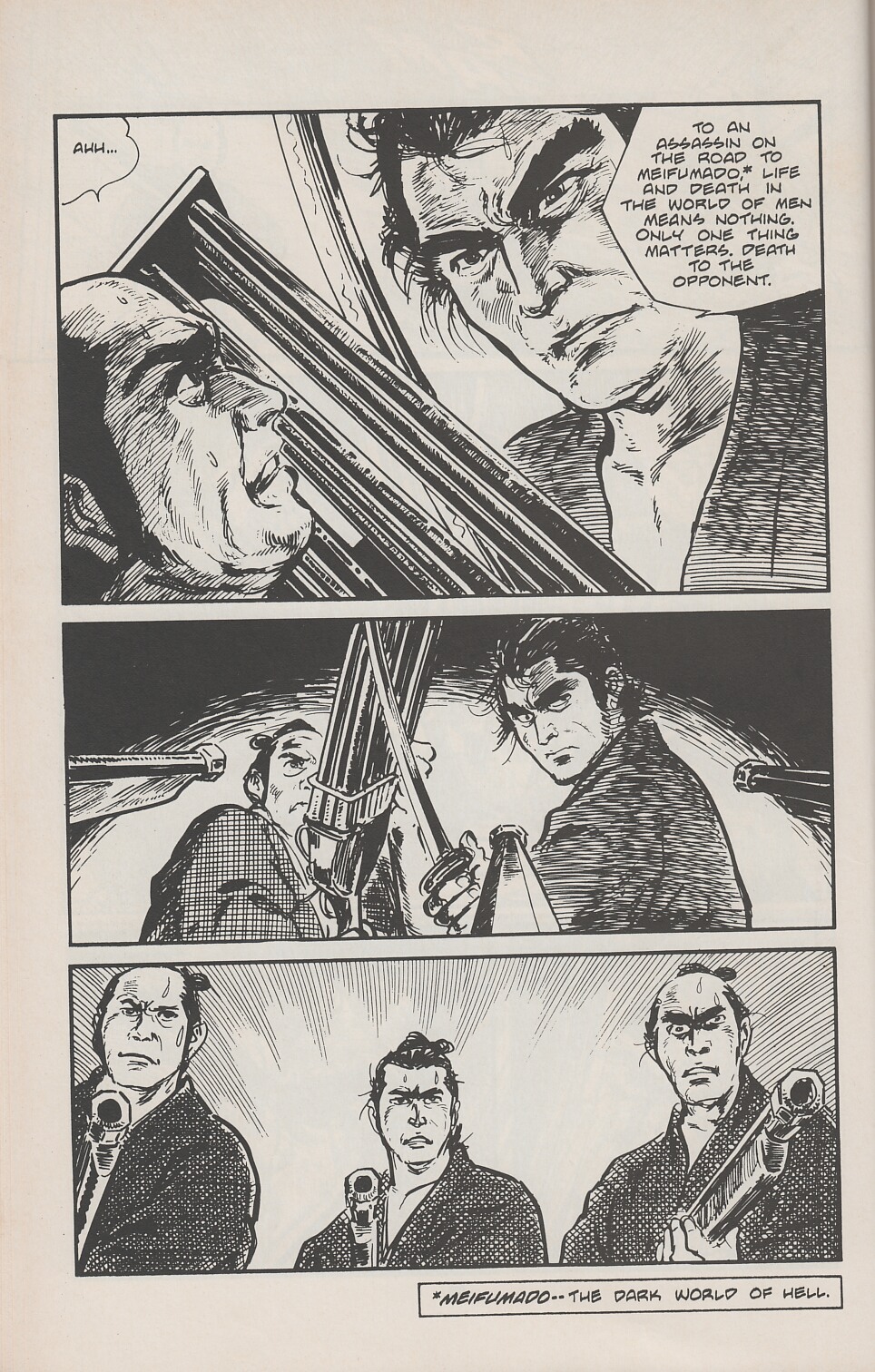
Eventually Ogami comes face to face with Shichirobei, and sword contends with gun as Ogami explains his willingness to die because "only one thing matters [to the assassin on the path of hell]. Death to the opponent."


Shichirobei's rifle-armed students show up, but once Shichirobei realizes that Ogami is willing to die as long as he slays his target, he asks a boon from Ogami: to let him impart to his students his 'secret traditions of the quest of the gun," after which he will submit to assassination. Ogami agrees, and sits in while Shichirobei hectors his students about their inability to understand his doctrines.


He also excoriates his rival gunsmiths for trying to steal his secrets and making a bad job of it. Nothing is said about his supplying guns to rebels, which suggests that this was a lie by his rivals, for the Silent Gunsmith-- apparently so called because he can talk about nothing but guns-- has a scientist's desire for infinite improvement : "striving toward the future, innovating, refining..." Then Shichirobei reveals his real intentions: he knows that all three students sold his secrets to the rivals and hoped to steal yet more. He kills them all with a device not unlike a handheld gatling-gun.


Having slain his betrayers, Shichirobei expresses a quasi-patriotic desire for innovation in weapons-building, in part because of the threat of barbarian outsiders.


He gives Ogami his gun-plans, so that the Lone Wolf can use them in his quest for justice, and then accepts his death by the assassin's sword.

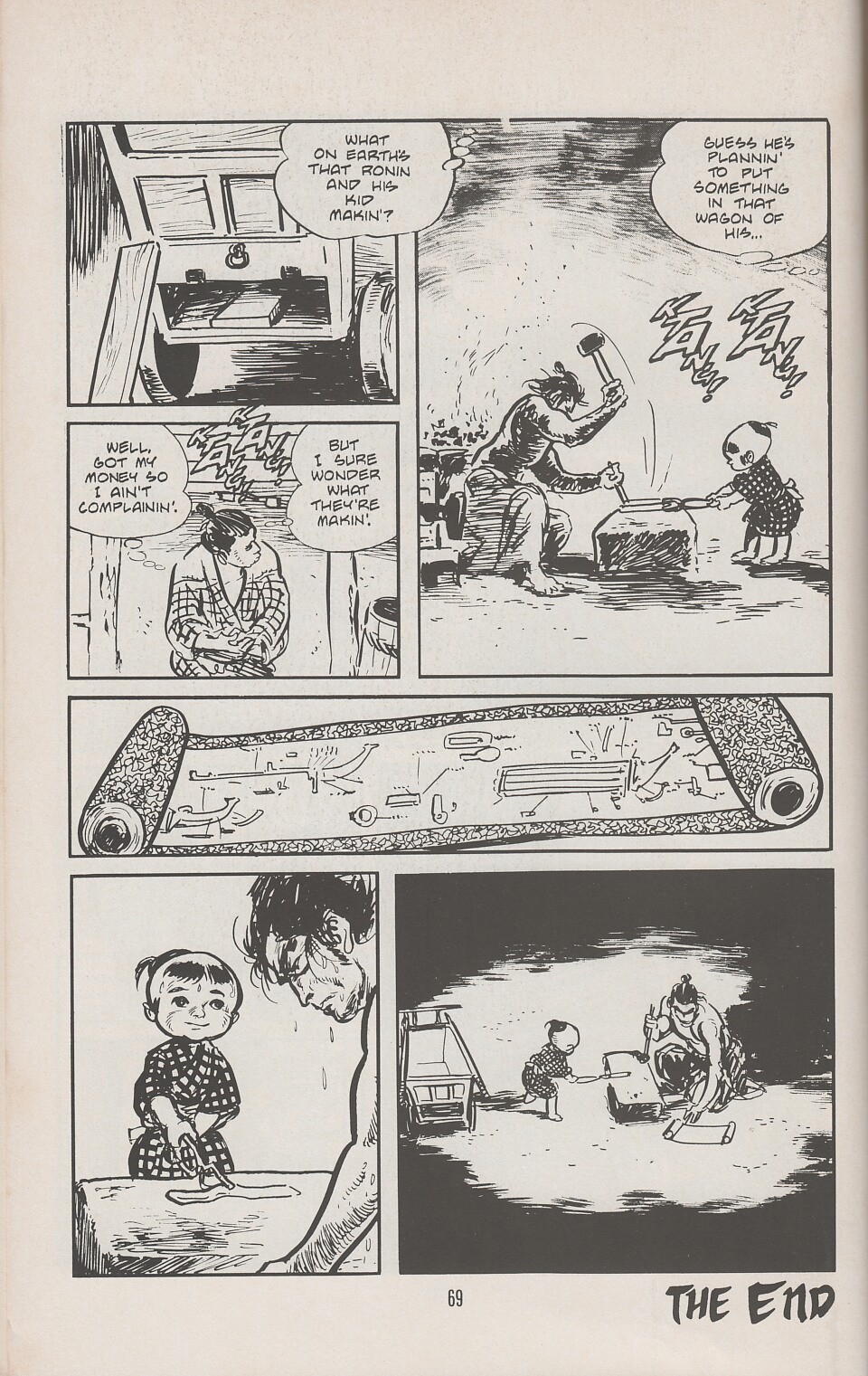
Ogami then leaves with his son Daigoro in the usual baby-cart, but his employers catch up with him, demanding to be given the plans. The Lone Wolf decimates the riflemen with the repeating-rifle,  but spares the gunsmiths because it was Shichirobei's wish that they be spared, so that they could carry on the work of innovation, albeit without his help. The story ends by showing how Ogami uses a forge to incorporate the guns into the baby-cart, which remains one of the signature images of the series.


Thursday, August 23, 2018

AFTER THE TORRENT, THE FLOOD

It's been over a year since I wrote A TINY TORRENT OF CENSORSHIP, in which I mentioned two unrelated incidents in which I'd made posts on two forums-- CBR and SUPERHERO HYPE-- that were censored, in one case, with a post-deletion, in the other case, with a locked thread. (I also mentioned an incident on THE BEAT, but it wasn't my post that was deleted.) This year, the "flood" has struck, in that in the past week I was banned from both CBR and SUPERHERO HYPE.

Such forums, of course, are always dictatorships, distinguished only by whether or not the dictators are permissive or stringent. This in turn depends on the POV of the person making the judgment. Based on my experiences with these two forums, I would say HYPE was pretty stringent while CBR at least displayed some desire to be seen as permissive. This is ironic in that CBR rebooted its forums in 2014, theoretically in response to the Janelle Asselin business, for reasons that remain unclear.

Now, precisely because HYPE locked one of my threads unfairly, I barely posted there in the last year. As for CBR, I changed my mind since writing, in the aforementioned Asselin essay, that I didn't think that I'd join the new CBR community. I did join, but since I didn't get the sense that I shared any of the tastes of the posters re: pop culture, most of the time I hung out on one or two Politics threads. Occasionally I took forum-posts made on CBR and made them into blogposts here. 

Given that the majority of posters on CBR were ultraliberals, the only attraction of posting on CBR was to bait said ultraliberals. Now, unlike most persons of this political persuasion-- and presumably ultraconservatives as well, if I could find any-- I don't consider "baiting" to be the same as "trolling." I'm aware that in some quarters "trolling" is defined as the activity of expressing an opinion that runs contrary to the opinions dominating the forum. Generally, this is not the meaning most posters communicate when they use the term "troll." They mean, rather, that the poster is putting out some opinion that diverges from the dominant one because the individual poster is attempting to sow strife and toxicity. "Baiting," however, has a longer and nobler tradition that predates Al Gore's invention of the Internet. and has more to do with voicing opinions based in differing premises. CBR actually put up with my baiting of toxic ultraliberals for over a year, and since I didn't break any rules for the forum, it seems likely that some snowflake poster made a complaint, the better to make the political threads into an echo chamber wherein everyone agrees.

So what did I get banned for? In both cases the ban was permanent, so I can't access the forums from my normal IP address. I assume that I could see CBR if I used another IP address, but I have not yet done so. I'm sure that there will be no explanation of what rule I supposedly violated, but I'm reasonably sure that I didn't post anything different from what I'd been posting for a year. I recall that one poster had just accused me of being a white supremacist, so it's probable that this was the rationale that the moderators used to get me off their backs.

I did look at HYPE through another IP that I'd never used for that board. All I noticed was that one of my posts had been completely deleted, but it wasn't even particularly inflammatory-- except to ultraliberals. One poster had been going on about how American Neo-Nazis were the lowest form of life, and that they automatically inherited all the sins of the Holocaust. I did not defend Neo-Nazis in any way, but I pointed out that the imputation of transferrable guilt did not make any sense. I stated, as a reducio ad absurdum, that it made about as much sense as saying that modern Muslims were responsible for the deeds of archaic Muslims who made slavery into Big Business. In retrospect I wonder if I would've been banned had I used a different argument, like finding American Communists responsible for the deeds of Stalin. But it's a moot point.

I've now sought out the political board DEBATE POLITICS to see how that one works. I've been a classic liberal for a long time, and still deem myself one. But I depart from most of the positions of current Leftists, particularly their descent into incoherence when anyone challenges their belief-system.

ADDENDUM: I was amused by this 2020 podcast--

https://www.youtube.com/watch?v=QiKQa8YOxpY

--in which one podcaster calls Comic Book Resources a "Tumbler dumpster file" because of yet another ultraliberal essay about how Hollywood oppresses female superheroes. I'm not surprised to hear that the site has gone even farther down the rabbit hole of idiocy than was previously the case.

Wednesday, August 22, 2018

THE FOUR AGES OF DYNAMIS PT. 2

I should first note that my statements about the *dynamis* appropriate to each of the 'four ages of man," as mentioned in Part 1, does not imply anything regarding the amount of actual power any given character within a mythos can display. In GRAVITY'S CROSSBOW PT. 3 I cited examples of protagonists in four features, each of which represented one of the four Fryean mythoi, noting that all of them were roughly comparable in terms of their power, even though each of the four-- Buffy Summers, Harry Potter, Ranma Saotome, and Doctor Manhattan-- was conceived to obey a very different "power-of-action." Later, in BUFFY THE MYTHOS SLAYER, I referenced this foursome again, but decided to change the representative of irony into "Marshal Law," simply because Doctor Manhattan was just one starring character in the graphic novel WATCHMEN.


My discussion of "the four ages" in Part 1, though, makes me realize that in both arguments, I subconsciously chose at least three protagonists who were in the "summer" portions of their lives, even though only one, Buffy Summers, belonged to the mythos appropriate to summer. Harry and Ranma are, like Buffy, both within the same "summer" range, going from late teen years through the twenties. Only the two protagonists I chose for the irony-representative-- first Manhattan and then Marshal Law-- suggest something more of the protagonist who is tending toward the "autumn" of middle age.

So, just as a mental exercise, I decided to look through some of the combative ironies I'd analyzed, to see if any of them even starred characters in their "summer" years. And here's the closest I've found to a "combative irony" hero in his summer-years, pictured in a particularly doleful sketch by creator Wally Wood.


I've discussed Wood's Wizard KIng "duology" in two essays, as well as devoting a separate essay to the reasons I determined the story of Odkin to be an irony-story rather than an adventure-tale. Odkin, though an extremely reluctant hero, proves himself capable of cutting goblin-throats--


Or contending with giant insects.


To be sure, since Odkin's people "the Immi" are said to be capable of living to age 300, it's hard to say what age he is. Further, Wood undercuts the reader's Tolkien-esque expectations by making the Immi, unlike Tolkien's hobbits, to be so sexually active that Odkin's father is also his brother. This detail, which is disclosed early in the first volume of the duology, aptly communicates the tendency of the irony-mythos to depict a world dominated by irrational laws. Since our own world is governed by laws that many persons consider rational-- include proscrptions against incest-- the world that Odkin regards as normative must perforce seem somewhat out of whack.

Having established four summer-age protagonists for the four mythoi, my next inquiry leads me back to the exemplary actions formulated by Theodore Gaster for his four types of religious ritual. In Part One, I boiled these actions down to:

COMEDY-- the presentation of incongruity
ADVENTURE-- the presentation of combat
DRAMA-- the presentation of a scapegoat's explusion
IRONY-- the presentation of communal mortification

Ranma Saotome adheres strongly to the first exemplary action, given that he's a male character who's constantly humiliated after being cursed to transform into a girl when struck with cold water.


Buffy Summers, as discussed in greater detail, is focused primarily on acts of combat, encoded in her nickname of "vampire slayer."


For Harry Potter, his entire status as "the Boy Who Lived" suggests a death averted. His creator pursues this theme to the final book, DEATHLY HALLOWS, with many suggestions that Harry may meet his doom, much in the manner of the scapegoat who perishes to avert evil from the community. Harry seems to accept his doom with lamb-like equanimity, but other forces save him and death takes his enemy instead.


Odkin seems a bit like a scapegoat as well, since early on he's expelled from his community by a drawing of the shortest straw. However, the longer that the Immi-- who is a tricky type by nature-- travels in the greater culture, the more he's besieged by deceptions greater than any he can muster. Granted, the elf-like protagonist is too pragmatic to indulge in the sort of histrionics Gaster finds characteristic of the mortificative mood; actions like fasting and lamentation. Nevertheless, Odkin, unlike Harry Potter, really does die, and he only survives the remainder of his narrative because his wizard friend Alcazar creates a duplicate of him, telling the second Odkin "in a sense you are your own father and mother." Following the defeat of the evil enemy, Odkin's final words in the duology are the ironic pronouncement, "It is living that can kill you." This may be the closest Odkin can come to voicing a lament of the world's fundamental corruption.

Monday, August 20, 2018

MYTHCOMICS: "BOY MEETS GIRL" (URUSEI YATSURA, 1987)

For my 100th mythcomics post, I chose a story that had some major resonance, and the same holds true for #200.

In my analysis of a particular arc of URUSEI YATSURA stories, I observed that despite the great creativity of manga-creator Rumiko Takahashi, she often didn't go much further than create wacky comic situations.

However, in subsequent stories Takahashi doesn't truly examine the Lum-Ataru relationship in mythic depth. It becomes just a comic routine; Ataru refuses to acknowledge his "marriage" to Lum (or for that matter, whatever genuine feelings he eventually has for her), runs around futilely trying to date other women, and gets punished for it by Lum's demonic powers. 
Still, like most manga-makers, at some point Takahashi decided to wrap the series, which obligated her to give her readers a finale. However, though the author had suggested the possibility of the two hyper-aggressives being permanently married, she chose not to have them wed at the feature's conclusion. It may be that she wanted to keep the situation open-ended for the purpose of independent anime productions (though only one such production came out in 1991, following the anime-adaptation of BOY MEETS GIRL).

In any case, BOY starts out typically enough. Lum has a minatory dream of impending darkness, but Ataru won't listen as he goes girl-chasing, resulting in the usual chaos.


However, Lum's dreams anticipate a long-buried family secret: that her great-great-great grandfather promised her hand in marriage to a scion of the "World of Darkness."  This is a sunless world inhabited by dark-skinned humanoids in Arab-looking attire. The Darkworlders are sustained by mushroom, given that fungi don't need sunlight to grow. Lum's intended, Prince Rupa, shows up on Earth, driving a flying chariot pulled by flying pigs (apparently a reference to porkers and their love of truffles), and asserts that he is to be married to Lum. He slips a ring on her finger, but not just as a promise of his intentions.


Rupa's ring is designed to accelerate Lum's aging process just enough that she loses her horns and her powers, making it easy to do a Hades-routine with Lum as Persephone.


Ataru, belying his usual indifference to Lum, organizes a pursuit party made up of Lum's circle of friends, but as soon as they arrive in the Darkworld, their spaceship crashes into another one. The friends are all captured except for Ataru, who encounters a Darkworld native, Lady Carla, who was the pilot of the other spaceship. She finds Araru and wants him to marry her-- or, rather, to fake a marriage so that Carla can prevent Lum from marrying Rupa, who was at one point Carla's intended.


Without going into all of Takahashi's fine points of comic confusion, Lum doesn't marry Rupa-- not least because she gets back her powers-- but both she and Ataru become estranged, having respectively been convinced that the other has cheated with one of the Darkworlders. Takahashi gives the quarrel an epic connotation, however, in that Lum has finally had enough of Ataru's constant attempts to woo other women. Rupa and Carla are perhaps more substantive threats because they are loose mirror-images of Ataru and Lum, though Rupa is not as lustful as Ataru and Carla is more casually violent than Lum. Rupa returns to Earth with Ataru and the other rescuers, while Lum remains in the Darkworld with Rupa.

Through more comic complications, the Earth gets overrun by Carla's giant mushrooms.


This gives Lum an inspiration. Though she's pursued her "darling" for years, it's always been out of an instinct that he loved her, rather than any outright confession on his part. So Lum makes a deal with Rupa. The two of them will send Rupa's mushroom-eating pigs to devour the offending fungi, if Ataru can win a race against Lum, essentially a replay of the contest that brought them together in the first URUSEI episode, A GOOD CATCH. Lum stipulates that he can only win one of two ways, by grabbing her horns against her will, or by capitulating by admitting his true love for her. (This would seem to be Lum's way of forcing Ataru to make a commitment less equivocal than his apparent marriage-proposal in CATCH.)


Araru defies Lum, believing that he can catch her as he did before, though on another level, he doesn't want her to hear a confession that's been coerced.


To up the stakes even more, Lum unleashes an "amnesia device" that will, if Ataru loses the contest, erase the memories of all Earth-people about their alien visitors. Lum's mix of alien and human friends don't want to forget one another, and try, with slapstick results, to stop the device. As for Ataru, he's determined not to forget Lum, even though he has no chance to capture her against her will.

Takahashi does formulate a way to give Lum her victory without forcing Ataru to make a direct commitment, which, as I said before, allows the author to restore the status quo. Yet on the final page, Takahashi gives her final comment on the "war between men and women." Lum pledges to spend the rest of her life trying to make Ataru confess his love, and he answers that "I'll say it on my death-bed." It's a conclusion that allows Ataru to hold onto his stubborn masculine reticence, and yet also gives Lum a confession more implicit than explicit, thus binding them not to a marriage contract, such as the one Lum's relative negotiated, but a social contract appropriate to their equally bull-headed natures.