Featured Post

SIX KEYS TO A LITERARY GENETIC CODE

In essays on the subject of centricity, I've most often used the image of a geometrical circle, which, as I explained here,  owes someth...

Showing posts with label ra's al ghul. Show all posts

Friday, July 22, 2022

MYTHCOMICS: BIRTH OF THE DEMON (1992)

 I posted two essays about Denny O'Neil the week after he passed in 2020. One was a mythcomics appreciation of one of his QUESTION stories. In the other essay, I wrote the following:

When considering my favored subject, that of “myth in literature,” O’Neil certainly doesn’t rank alongside the creators who tally up the greatest quantity of mythcomics, such as Fox, Broome, and Kirby. Of course, even the best myth-makers, in order to stay gainfully employed, had to craft many, many stories that appealed to the reader’s desire for easily comprehensible lateral meaning, whereas the more difficult vertical meaning proved hit and miss. Indeed, a lot of the stories in which I’ve observed a high symbolic discourse seem to have done so without much conscious intention. I would’ve thought that, given his considerable investment in the Caped Crusader, there might’ve been a fair sampling of myth-tales during O’Neil’s various outings with the character. But even the stories with O’Neil’s most celebrated creation, Ra’s Al Ghul, only rate as near-myths.

Happily, I recently learned that this was inaccurate. Though I tried to keep abreast of most major developments of commercial comics in the 1990s, I've missed some things without intending to do so. Just as I never heard anything about the WOLVERINE: ORIGIN series of 2001, I entirely overlooked BIRTH OF THE DEMON, a stand-alone graphic novel in which O'Neil related the origin-story of Ra's Al Ghul, aided by Norm Breyfogle. Breyfogle's selection for this project  was almost certainly predicated on his professional inspiration by Neal Adams, with whom O'Neil co-created Ra's Al Ghul in BATMAN #232 (1971). The selection of an Adams-like artist suggests to me that O'Neil aspired to recapture the elan that he and Adams captured in their attempt to move Batman away from the gimmicky stories that had dominated the character for many years-- not only in the tales of raconteurs like Fox and Robbins, but even from co-creator Bill Finger-- and back to his earliest roots in pulpish thrills.

Though BIRTH is devoted to the story of Ra's Al Ghul, it's framed as a Batman story. The crusader becomes obsessed with the possibility of finally ending the villain's menace by finding and destroying all of the Lazarus Pits scattered around the world. By so doing, Batman can at last prevent his enemy from being able to continually resuscitate himself-- which Ra's has done for many centuries, giving the immortal evildoer resources beyond any of the other criminals in the hero's rogues' gallery. In a non-diegetic sense the famous Bat-villains are of course as immortal as Ra's, as is Batman, but within the diegesis, an ever-recrudescent villain suggests the futility of the hero's war against crime. Additionally, Batman is emotionally entwined with Talia, "the daughter of the demon," whose off-again, on-again loyalty to her father further compromises the crusader's dedication to his crimefighting cause.


The main part of the story is a chronicle of the early life of Ra's Al Ghul, recited by both Talia and Batman as she tries to keep the hero from destroying another Lazarus Pit. The chronicle was compiled by Huwe, one of the future villain's few comrades in medieval Arabia, though in the sequence above Huwe relates a scene at the birth of the man who would be Ra's-- whom I will henceforth call "the doctor," since he's given no proper name and does not take the demonic cognomen in his early years.


O'Neil does not devote any time to the doctor's childhood, and only says that at some point in his studies, the doctor formed a preternatural aversion to the fact of Death. He becomes so skilled that he rises to the position of royal physician to a prestigious ruler, the Salimb. However, the king's son heedlessly injures an infirm townswoman, and though the doctor is not at fault, he offers himself as a sacrifice to the old woman's son. The young fellow, Huwe by name, almost accepts the sacrifice, but later becomes the doctor's companion throughout the majority of his ancient exploits.


The Salimb's unnamed son falls ill, and even though the doctor has only contempt for the prince, he journeys to the place where he the doctor was born. There he goes into a trance, and beholds a bat-like demon whom he associates with Death. He imagines himself being immerses and strengthened by a pit of liquid, though he has yet to actually experience a Lazarus Pit.


Using this visionary experience as a guide, the doctor revives the moribund prince by uncovering a real Lazarus Pit. The doctor pays dearly for this hubris, for upon rising the prince goes berserk, as do all such reborn individuals-- and the mindless royal slays the doctor's wife. The Salimb cares no more for the deceased doctor's wife than his son did for the old woman, and in fact he condemns the doctor for the act of murder. The prince provides the icing on the cake, ghoulishly confining the doctor in a cage with the dead body of his beloved.


Huwe saves the doctor and the two flee into the desert. The doctor guides them to the camp of his uncle, and despite initial resistance, the uncle makes it possible for the doctor to achieve vengeance-- the first time the reader sees evidence of the doctor's uncanny ability to plan the doom of his enemies. This time the physician imagines the bat-demon of his previous dream helping him slay the corrupt prince, though the full scheme-- once more depending on the use of the Lazarus Pits-- also brings doom to the Salimb as well.


Following the overthrow of the city's rulers, the formerly merciful physician leads his uncle's raiders against the city, slaughtering dozens of innocents. The doctor himself is wounded, and for the first time he uses a Pit to save himself from Death's grasp. Now that he feels himself the very incarnation of the power of the Pits, he overthrows the idol of the demon Bisu, whom the locals venerate as the representation of the desert's unforgiving cruelty. There are some intimations that the bat-demon seen in the doctor's visions may be covalent with Bisu rather than with Death, but O'Neil does not commit himself one way or the other.


Though the doctor uses the Pits to keep Huwe and his uncle as immortal as he is, the association goes sour after several centuries, when the doctor catches Huwe recording his chronicle. He ends up slaying Huwe, but the uncle preserves the chronicle so that it can fall into the hands of the Batman. Returning to modern times, the hero and the daughter of the demon discuss the similarity of Ra's obsessions and those of Batman himself. But in the end, Talia has to step back from the confrontation-- for Ra's himself has been listening to the conversation, and he demands access to the Pit being blocked by the Caped Crusader.


There is, inevitably, yet another climactic battle between the adversaries, and it ends with the mysterious maybe-death of Ra's, though of course no reader believes him truly destroyed. Batman survives as well, apparently having been succored by none other than the demon Bisu-- though of course only the readers, not the hero himself, may choose to believe that. 


I'll conclude by noting that not only does O'Neil provide a full-blown mythic origin for the best-known character of his creation, he also revises the origin of the second-best known O'Neil character, the demon's daughter. In the 1987 graphic novel SON OF THE DEMON, Mike Barr and Jerry Bingham purveyed a rather mundane backstory for Talia's mother Melisande. The O'Neil-Breyfogle narrative rewrites that as seen above, asserting that Ra's met Talia's mother at Woodstock. In his massive Bat-saga, part of which I reviewed here, Grant Morrison shows his respect for O'Neil by endorsing O'Neil's version of Talia's genesis, though Morrison does keep Barr's name for the mother, Melisande. I don't know what O'Neil thought of other writers' elaborations of his most famous characters. But I'm happy to see that, just as Morrison gave life to a full-blown myth for Talia Al Ghul, the Demon himself got his finest myth-narrative from the man who conceived him.


Thursday, January 3, 2019

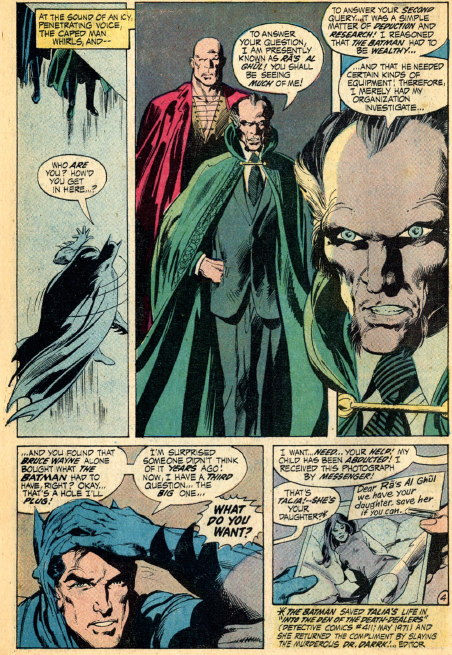
NEAR-MYTHS: "THE DEMON LIVES AGAIN" (1971), SON OF THE DEMON (1987)


In the mythos of Golden Age Batman, as with those of many heroes in that era, criminality is a short-term menace. World-conquerors in this period are relatively few, and the various spies and agents of foreign powers represent a different type of villainy. Batman’s best-known rogues seem content to rip off company payrolls and visiting potentates. Sometimes they even commit crimes with no real end beyond dueling with Gotham’s premiere protector.


In 1971, however, writer Denny O’Neil and artist Neal Adams added two characters to the rogues’ gallery that became as well-known to Bat-fans as any of the classic Golden Age malcontents: Ra’s Al Ghul and his daughter Talia. In various interviews O’Neil averred that his primary inspiration for these characters were that father-and-daughter team created by Sax Rohmer: the world-conquering Fu Manchu and his daughter Fah Lo Suee. Like Fu Manchu, Ra’s Al Ghul—whose name is routinely translated as “the Demon’s Head”-- has used weird science to live far longer than his normal span of years. Further, like Fu, Ra’s commands a covert army of Oriental assassins, with whom Ra’s hopes to change the entire structure of Earth’s sociopolitical system. However, there are also important differences.


In his early adventures Fu Manchu has no daughter. That said, the first story-arc introduces a femme fatale, Karameneh, and when Doctor Petrie asks who she might be, Fu’s perpetual opponent Nayland Smith speculates that she might be the arch-fiend’s own spawn. Rohmer doesn’t introduce Fah Lo Suee until 1930, after which the character remains a permanent feature of the prose-series. Fah Lo Suee is often seen aiding her father’s schemes, though when convenient she lends aid to Nayland Smith and Petrie. When she does help the Englishmen, it’s because of her amour fou toward Nayland Smith, an amour of  which her father definitely does not approve.


O’Neil, however, introduces Talia Al Ghul slightly before her father’s debut, and when Ra’s shows up, he first puts Batman through a series of ordeals. Then the vaguely Arabic-seeming overlord announces to the hero that because Talia has fallen in love with him, Ra’s wants Batman to give up the life of a crime-fighter and inherit Ra’s mantle, the governance of the League of Assassins.  Batman of course opposes the criminal plots of his would-be father-in-law, even though the hero reciprocates Talia’s feelings.


Most of the Ra’s/Talia stories don’t reach a high level of mythicity. However,  in one respect Ra’s improves on his model. Whereas Fu Manchu simply uses an alchemical elixir to cheat death, Ra’s is first seen literally rising from the dead in a two-part 1971 arc, thanks to the help of a supernatural resource: a “Lazarus Pit.” The second part of the story,  “The Demon Lives Again”(BATMAN #244), develops this revelation by positing that when Ra’s first comes back from death, he becomes temporarily insane as well as having “the strength of ten,” equally temporarily. Thus he might seem to be the horror of bridegrooms everywhere: the father-in-law who’s never really out of his little girl’s life.


Yet perhaps the most mythic aspect of Ra’s culminating narrative is his battle with Batman beneath the desert sun of Old Araby. Fu Manchu is never seen fighting his enemies, but Ra’s, despite his great age, is every bit as battle-worthy as his prospective son-in-law. “Demon” concludes with Ra’s and Batman doffing their shirts and fighting with swords beneath the Arabian sun. Briefly, the desert seems to intercede on the behalf of its human representative, for a scorpion stings Batman, presaging his death. But Talia, in her first real betrayal of her father, slips an antidote to the hero. Batman then returns to face his foe again, giving “the Demon’s Head” his first opponent who seems to match Ra’s for deathlessness.


For fans of BATMAN, the comic book rarely exceeded the intensity of this Oriental romanticism. Over the years, this scenario, in scripts both by O’Neil and by other DC writers, the “eternal triangle” between Batman, Talia and her fanatical father proved a fruitful source of high melodrama, particularly as Ra’s becomes increasingly portrayed as an “eco-terrorist,” out to purge the world of humankind’s corrupting influence. But with the possible exception of Grant Morrison’s BATMAN INCORPORATED serial-- which I’ll address separately— no one succeeded in giving the Ra’s-myth deeper connotations.


In the 1987 graphic novel BATMAN:  SON OF THE DEMON, writer Mike W. Barr and artist Jerry Bingham create an “alternate-world” scenario for the threesome, about a year or so after Frank Miller did the same with his vision of THE DARKKNIGHT’S RETURN. Without speaking to the personal involvement of the authors, SON seems to be aimed firmly at the “Talia-shippers” among Batman-fandom, since the story alters the “triangle-scenario” to make the three characters one big happy family, complete with a little one on the way.


To achieve this familial bliss, Barr creates a mutual enemy for Batman and the Al Ghuls: a terrorist named Qayin (the Arabic version of the name given to the Bible’s first murderer). Batman encounters one of Qayin’s terrorist-cells in Gotham, and almost immediately Talia shows up on his doorstep, inviting him to join her and her father in rooting out this world-menace—who just happens to be an indirect part of the Al Ghul family, since Ra’s is Qayin’s godfather. Talia’s reasons for pursuing Qayin are more personal than Batman’s, for Qayin slew her mother Melisande. (Parenthetically, this seems to be the first extensive accounting for the absence of Talia’s female parent.) Batman is invited to join not only in hunting down the terrorists, but to join with Talia in holy matrimony. On rather short notice, Batman not only puts aside his commitment to Gotham City and becomes the de facto son of Ra’s Al Ghul, so that the hero can remold the League of Assassins into a paramilitary force trained in the crusader’s non-lethal techniques. Further, Batman puts a bun in Talia’s oven, hence giving Ra’s his first grandson. Although Talia is now depicted as a kung-fu mistress—for the first time, I believe-- Batman tries to protect her from harm.  However, she loses the child, and after Batman vanquishes Qayin and his nuclear threat, the hero returns to Gotham. The novel then ends on a peculiar note: suggesting that Talia faked losing the child and sent the baby away to be adopted, though Barr supplies no hints as to why she might do so.


The most mythic aspect of SON OF THE DEMON would be the story’s evocation of the trope of “the hero tries to walk away from his destiny.” Barr’s handling of the myths of both Batman and the Al Ghuls is pedestrian at best, while Qayin is a make-work villain. He becomes embittered toward Ra’s because Ra’s sent Qayin’s parents on a mission that resulted in their deaths, which by itself is banal. Further, the circumstances under which he kills Melisande don’t track either. She surprises her godson messing around near one of Ra’s Lazarus Pits, but it’s not clear if he has some idea of using the Pit to bring back his patents, or if he just wants to deprive Ra’s of the resource. To complicate things needlessly, Barr also reveals that at some point Qayin becomes terminally ill, which apparently accounts for his willingness to destroy the whole world—which is also extremely jejune in terms of any discourse, symbolic or otherwise.

However, simplistic as SON OF THE DEMON is, it did contribute some tropes to the Bat-mythos that proved vital to Morrison’s massive “encyclopedia of all things Batman.”