Featured Post

SIX KEYS TO A LITERARY GENETIC CODE

In essays on the subject of centricity, I've most often used the image of a geometrical circle, which, as I explained here,  owes someth...

Showing posts with label discourse. Show all posts

Wednesday, April 28, 2021

RUNNING ON ABOUT DISCOURSE

In the 2016 essay AFFECTIVE FREEDOM,COGNITIVE RESTRAINT and in the two parts of 2019’s AND THE HALFTRUTH SHALL SET YOU FREE, I aligned the didactic and mythopoeic potentialities with, respectively, my categories of “cognitive restraint” and “affective freedom.” I made heavy use of Ernst Cassirer in these essays, but for this one, I’ve decided to take a different path in order to dilate on the salient differences between the ways these potentialities operate.


In literature as in other cultural forms, all potentialities express themselves through processes of discourse. The discourses of “lateral meanings” deal with concrete subject matter—that of what sensations the subject experiences, and of the subject’s emotional reactions to those sensations. In contrast, the discourses of “vertical meanings” concern themselves with abstractions, with the didactic making use of “ideas” while the mythopoeic makes use of “symbols.” For the sake of argument, I will treat both ideas and symbols as if they existed as discrete monads, which is not the way either are experienced. Both ideas and symbols are best expressed in the form of typical story-tropes. Levi-Strauss was pleased to term these tropes “mythemes,” conveniently ignoring how such monadic forms were dispersed throughout all forms of human communication, not just myth.


Didactic discourse and mythopoeic discourse are not as intimately entwined as those of the kinetic and dramatic potentialities. The discourses can appear independently of one another, or they may intertwine within a narrative to support one another, or they may conflict with one another so as to confuse the narrative. An example of the last-named would be Steve Ditko’s story “Am I Roma…,” which I explicated it in this post.


The word “discourse” stems from a Latin root meaning “to run around.” However, all four discourses run in different ways, though I’ll only discuss the two vertically aligned potentialities here.


The didactic discourse runs in the fashion of a single contestant in a one-on-one foot race. The course of the race may be winding or straight, but the contestant runs in as direct a line as possible from start to finish. Didactic discourses may employ idea-tropes as disparate as “Christ died for our sins” or “Capitalism is doomed by its own excesses,” but the discourses are always aimed at teaching some sort of linear lesson to listeners.


In contrast, a mythopoeic discourse is more akin to a team of runners in a relay race, opposed, naturally, by a corresponding team. There’s still a goal that a given team aspires to reach first, but achievement of the goal depends on the successful interaction of all players on the team. Symbols can be used to help convey linear lessons, but their primary potency is poetic and associative. In my first post on the ARCHIVE, I quoted William Butler Yeats, who asserted that “symbols are an endless inter-marrying family.” The interactions of members in a family is of course analogous to the concerted efforts of a relay-team, and symbol-tropes in a mythopoeic discourse only win their “race” when they work so as to reinforce one another.


As noted, the vertical discourses align respectively with the categories I’ve termed “cognitive restraint” and “affective freedom.” Didactic discourse aspires to teach, and while some teachers seek to help students learn how to think for themselves, it’s implicit that each student will still end up choosing to advocate favored ideas over non-favored ones—in essence, “restraining” any potential tendency to advocate the latter idea-group. Even writers who analyze myths, both religious and literary, must use didactic discourse to assign a particular set of values to the myths analyzed. In this essay I showed how Claude Levi-Strauss advocated a “scientific” approach to myth and stated that he believed that mythic activity was on its way out of human culture. By contrast, Ernst Cassirer championed myth as an irreducible element of human culture. But both had to use didactic discourse to explain their respective ideas and philosophies. The didactic discourse thus is at its strongest within the sphere of non-fiction but has a more tendentious hold in fiction.


The mythopoeic flourishes in fiction but only appears sporadically in non-fiction, and then usually only in commentaries on fictional constructs, such as Raymond Durgnat’s FILMS AND FEELINGS. Mythopoeic discourse doesn’t so much send a message as open up all lines of communication. In contrast to the old saw “If it feels good, do it,” the mythopoeic discourse says, “If it seems significant, symbolize it.”


Mythopoeic discourse aligns to the category of “affective freedom,” meaning that symbols can combine in any way a creator may please to arrange them, irrespective of logical amenities. To be sure, mythicity takes on greater value when an author relates the symbols to the epistemological patterns that the audience recognizes from the world of experience. But I’ve argued, as did Cassirer in MYTHICAL THOUGHT, that mythic symbols are not gain their power from simply copying what audiences see around them. Cassirer had a more Platonic emphasis than I do. On page 3, he speaks of how Plato valued myth as signifying “the world of becoming” in contrast to the adherents of the allegorical school, and throughout the book he emphasizes myth’s potential to dissolve the boundaries between inner reality and outer reality (particularly on page 156). I agree, but for me the dissolution comes about when myth and its near relative literature make use of “real” epistemological patterns for “unreal” purposes.


In mythopoeic discourse, “perfect freedom” not only doesn’t mean “perfect service,” said freedom can be free of any utilitarian purpose. Case in point: Robert E. Howard’s 1936 novelette BLACK CANAAN, recently reviewed here. I pointed out that although Howard placed his story of an aborted race-war in a real location-- an Arkansas town named Canaan-- the author showed no real interest in reproducing the realities of life in that time (post-Civil War) and place. I noted that the outcome of the Civil War made no difference to the novel, and that Howard had no interest in what inequities might have contributed to the mutual hatred between the whites of Canaan and the blacks of the neighboring swamplands, called Goshen. Going purely by the content of the existing story—while acknowledging that the author was forced to cut his original draft for publication—it’s apparent that Howard wanted a pure “clash of civilizations.” The only motivation for the strife is rooted in the tropes of fantasy-fiction, in that Howard imagines the blacks of Goshen as having made diabolical alliances with elder voodoo-deities. Yet this is certainly not a didactic argument, since Howard says absolutely nothing about the presumed Christian orientations of the Canaanites.


Indeed, the only references to Judeo-Christianity devolve also to the blacks of Goshen. Howard named his imaginary swampland after the Egyptian domain where the pre-Exodus Jews were kept in bondage, before they escaped the land of the Pharaohs into Canaan. This symbolic trope is reinforced by the history of the way blacks of pre-emancipation America identified with the pre-Exodus Jews, which I tend to believe a Southerner like Howard could not help but know of. Thus, in the story the minions of Saul Stark, by rising up against white Canaanites, duplicate the action of the archaic Jews who conquered archaic Canaan and transformed that land into the kingdoms of Israel and Judah.


But what message was Howard sending in the story? None, I would venture. While he certainly could have infused his story of a fictional uprising with his own political opinions, as did many other authors, here Howard only cares about a conflict of good and evil. And even Howard’s concept of “good” may be problematic, since the righteousness of protagonist Kirby becomes compromised by his unquestionable hunger for the “forbidden fruit” of the quadroon voodoo-priestess, the Bride of Damballah. If Howard had wanted only to denigrate the evil represented by Black People—whom, to be sure, he denotes with the customary Nasty Taboo Word of the period—he could have left out this tantalizing sorceress. From first to last, though, she has Kirby under her thrall, and she’s defeated only by the chance intervention of a minor support-character. The hero enjoys the final triumph over the evil Stark, but Kirby doesn’t win because he’s white, and in many ways Stark and Kirby are mirror-images of each other, each striving to make sure his own race holds the whip hand.


There’s no harm in admitting that such a story has no moral to offer, but it’s far from proven that a story with a moral is necessary superior. On a personal note, in my youth I probably liked a good number of preachy stories, since my own ethos was still being formed. But today I tend to find even the best “idea-tropes” in fiction to have less value than the best “symbol-tropes,” while in non-fiction I often fault authors who load their arguments with clumsy symbolism, as per Frederic Wertham’s tortuous comparison between children and garden-flowers. Both discourses have their strengths, but the races they run come off to best effect on level playing-fields.  


Sunday, April 5, 2020

MYSTERY OF THE MASTER THREAD PART 2


To my knowledge, no written work of fiction provides a mythopepic discourse denser than that of Herman Melville’s MOBY DICK. This sprawling tale is replete with many threads of mythopoeic vertical meaning, ranging from the relationship of white men to colored men (which theme preoccupied Leslie Fiedler) to the nature of fate (Fedallah’s MACBETH-like prophecies). But all of these meaning-threads are subordinate to the master thread, which, if removed, would unravel the whole kit and kaboodle. The master thread for MOBY DICK consists of the myth of the Hunter and the Hunted—with the additional fillip that the Hunted is either God or the agent of God’s inscrutable will, so that the Hunt itself is inevitably doomed.

All of the subordinate vertical threads of MOBY DICK are so well developed that the author could have made stand-alone stories out of any of them. This is not generally the case, however. Of the thousands of other narratives that possess strong mythopoeic meaning, most of them possess no more than a single strong master thread.


Case in point: CRISIS ON INFINITE EARTHS. When I wrote my mythcomicsreview of CRISIS, I was more than a little aware of the serial’s numerous flaws, from the bland scripting of Marv Wolfman to the drably functional manner in which the story tossed together nearly every famous or semi-famous character in DC Comics history. Those subplots that even came close to vertical meaning were frequently botched, as with a maudlin encounter between Kamandi—Jack Kirby’s “Planet of the Apes” swipe—and Solovar, one of DC’s seemingly endless supply of intelligent gorillas. However—there was one master thread I discerned, one in which Wolfman built upon the “devilish” character of Krona, and contrasted this character’s impiety with a “holy trinity” of characters implicated in the death of the old cosmos and the birth of the new.


On the more positive side, some master-threads receive support in unpredictable ways. Jack Kirby’s NEW GODS saga, reviewed here, has one obvious master-thread: the prophecy of an eventual confrontation between the tyrant Darkseid and the hero Orion. I wasn’t entirely pleased with Kirby’s years-later wrap-up of his epic series. But even though the author went down a somewhat unsatisfying path, HUNGER DOGS wasn’t without mythopoeic meaning in itself.


But I’ve recently noticed one particular subordinate thread, one so subtle that one could barely even assign a didactic meaning. In my review I had no space to examine the curious relationship between Darkseid and his mother Heggra.


The reader only three things about the wizened queen: (1) that she rules Apokolips before Darkseid ascends to the throne, (2) that her influence obliges Darkseid, against his will, to wed a noblewoman named Tigra, who ends up being the mother of Orion, and (3) at some time, Darkseid has his mother killed, probably because she blocked his rise to power.


But in recent months, I noticed that the given names of Heggra and Tigra are not dissimilar, suggesting a symbolic identity between them. Visually, they’re opposites, for Tigra is lean and given to overt violence, while Heggra is sedate, like a brooding hen sitting on her “hegg.” But despite these differences they collude to create Orion, whom Darkseid will make the mistake of casting out. The result is that Orion becomes dedicated to his father’s defeat, and though Orion’s primary mission is to keep Darkseid from gaining the Anti-Life Equation, it would not be incorrect to say that the conflict of father and son ends up avenging the maltreatment of two maternal figures. It’s a subordinate vertical thread that in no way diminishes the master thread of the father-son conflict, but because of this mini-discourse, the master thread is made yet denser and richer.

MYSTERY OF THE MASTER THREAD PART 1


In essays such as THE LINE BETWEEN FAIR AND GOOD PART II, I’ve compared the organization of fictional narratives to the ways in which students are taught to structure their compositions around a “theme statement.” I never developed that line of thought, but of late it’s struck me that there’s a parallel between the general idea of a “theme statement” and my concept of the “focal presence,” insofar as both are organizing principles. But there is a salient distinction between the two.

According to my lit-crit system, the focal presence is allied to a narrative’s lateral meaning, the combination of the kinetic and the dramatic, of the things that physically happen to characters and how they feel about it. The focal presence denotes the narrative’s centricity, which in keeping with my observations in STRONG AND WEAK PROPOSITIONS, does not require vertical meaning in order to engage a reader’s conviction.

In contrast, any “theme statement”—a term I will soon replace with one more apt for my purposes—must correlate principally with vertical meaning. This meaning, as I’ve mentioned earlier, can be represented by didactically presented ideas, mythopoeically presented symbols, or (in the words of Janis Joplin) a “combination of the two.” I’ve frequently pictured these vertical meanings as either being “over” or “under” a narrative’s lateral meaning, but for current purposes maybe it might be better to imagine them as many disparate threads running through the (potentially) labyrinthine structure of the narrative. A single narrative can incorporate more than one vertical meaning. However, to be coherent said narrative needs what I’ll henceforth call a “master thread.”

Since standard theme statements emphasize didactic meanings, I won’t spend a lot of time on that topic. I'll confine myself to stating that two given narratives can both possess the requisite master thread, but one can be better developed than the other (for instance, Upton Sinclair’s socialist diatribe in THE JUNGLE is far less compelling than Charles Dickens’ “anti-utilitarian argument” in HARD TIMES—not simply because I personally favor one over the other, but because the latter possessed greater intellectual elaboration than the former.

I have a great deal more to say about the ways mythopoeic master threads disport themselves, coming up in Part 2.

Friday, March 29, 2019

CONCRESCENCE AND THE KINETIC POTENTIALITY

At the end of CONCRESCENCE AND COMPLICATION I wrote:


....since I've gone to great effort to expound upon the ways in which complexity can only be judged through examination of the four potentialities, I won't repeat that argument here, except to say that I've allowed for the possibility that symbolic complexity is not the only form of complexity.

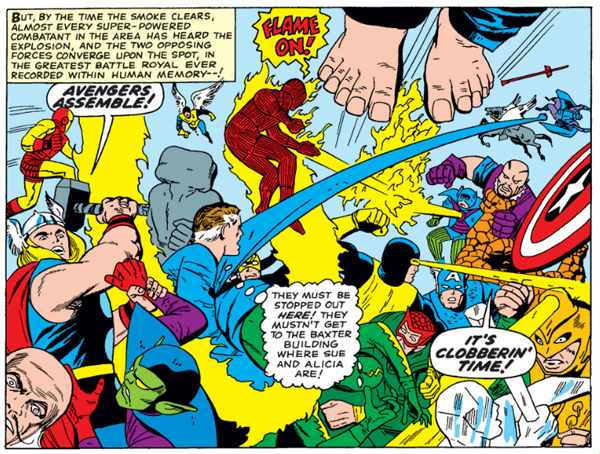
Some time before adopting the term "concrescence," I illustrated the ways in which different comics-artists constructed fight-scenes, arranging all of the "quanta" of kinetic representations in order to satisfy the reader.  I used Jack Kirby FANTASTIC FOUR #3 as an example of a "good kinetic discourse," while Mike Zeck's SECRET WARS was an example of a "bad kinetic discourse."

Here's a more specific example of Kirby art from the same FF Annual:


In the previous panels, the Cobra leaps on Captain America's back. The Cobra's "kinetic quanta" consists of attacking enemies in a "snake-like" fashion, while Captain America is the epitome of speedy athleticism. Not only does the hero stymie the villain's attack by slamming Cobra into a wall, he then uses the Cobra's body as a bludgeon against his next opponent. Since the Executioner is a super-strong demigod, the hero has to then duck and dodge his opponent's blows-- though the ending of this particular contest is not seen, since Kirby moves the action to other heroes and villains, all battling to prevent the wedding of Reed and Sue (or something like that).

In contrast, here's a scene from Zeck's SECRET WARS, in which a bunch of heroes attempt to make a frontal assault on Galactus:


Zeck may well have been constrained to follow the demands of editor/writer Jim Shooter, but whoever was to blame, there's no attention to the logic of the combative activity depicted here. The good guys shoot rays or throw rocks, Galactus shoots rays back at them. There's no attention to the distinctive "energy-quanta" represented by any of the heroes, much less Galactus, who, based on previous depictions, shouldn't even bother to engage in such a fight. The same scene could've been created with different heroes in place of those used.

In the case of the kinetic phenomenality, the operation of concrescence depends on bringing together disparate elements into what appears a seamless whole, just as it does with respect to symbolic discourses.


Tuesday, January 1, 2019

CONVERGING ON CONCRESCENCE PT. 2

In Part 1, I wrote:

Conscresence, more than its roughly equivalent term "coagulation," suggests the process by which seemingly unrelated phenomena "concretize" into a greater whole. Thus images, symbols and story-tropes which can only have a very limited meaning by themselves, take on greater depth when associated with others that have a reinforcing effect.

What causes this "reinforcing effect," though? Upon rereading August's FOUNTS OF KNOWLEDGE PT. 3, it occurred to me that most of the mythcomics essays I've printed here depend on the authors having organized their symbolic constructs around what I called "aspects of discursive symbolism." The full context is as follows:

Thus, it would seem that even when humans are seeking to plumb the depths of presentational symbolism in order to employ tropes that transmit deep emotional states of mind, the same humans cannot help but reproduce aspects of discursive symbolism characteristic of the theoretical mind-- which may later have some repercussions to my evolving theories regarding the interactions of human work and human play (to be discussed at some future time).

In other words, in order for a narrative to manifest the strongest form of symbolic concrescence-- a.k.a. "hyperconcrescence," as I currently like to call it-- the author(s) must first draw upon what they know of the real world, the world which can be represented by discursive symbolism (or "work"). Then, to make this knowledge function in a fictive world, the kernels of information must be transformed into the tropes of presentational (also called "expressive") symbolism (or "play"). Thus the mind's ability to "work hard" proves essential to the process of "playing hard," and therefore, "playing well."

I have to reiterate that it's always possible for an author to "dumb down" the expressive symbolism in a narrative in order to get across some limited didactic message. When an author does so, he has to some extent sacrificed "play" on the altar of pure "work" by making the narrative function as persuasive rhetoric. That said, creators who have deep reservoirs of imagination may still at times produce narratives that have the qualities of mythic play even though the authors are trying to convert an audience to some position.

Case in point: Dave Sim's CEREBUS. Most of the time, particularly in the later issues, Sim is seeking to persuade readers of his philosophical positions, and this is probably no less true in the narratives I've deemed mythcomics (the last part of LAST DAYS here, and the first part of GUYS here) as in a narrative I deemed a "null-myth" (the horror of CHASING YHWH). But irrespective of Sim's conscious intentions, his imagination is "working" full blast at the same time his conscious intellect is formulating the didactic schemes of the prior two works, while in YHWH, his imagination has sort of given up the game. So, although discursive symbolism is at work in all three, in CHASING YHWH there is no such transformation of Sim's rhetorical stance into the playful discourse of art. Thus, even though I personally disagree with Sim's position re: "fanboys" as he expresses them in GUYS, I had to give him some props for "promoting a satiric version of Spider-Man to make his points about creeping emotionalism." Thus there's an expressive underthought to complement the rhetorical overthought.

I will expand on the final paragraph from FOUNTS PT. 3:

I should add that I regard even scientifically incorrect theoretical conclusions, like the concept of the seven spheres of heaven, or early theories on spontaneous generation, to be well within the scope of the discursive.
In similar fashion, I regard Sim's sociological connections between comic book people and "creeping emotionalism" to be incorrect on two counts: one, because there's no way to prove such a connection, and two, because even if there was one, how would it be categorically different from the "creeping emotionalism" present in any other ingroup-- say, Canadian hockey fans?

Hyperconcrescence, then, most often takes place when the discursive mode of work, the overthought, reinforces the expressive underthought. The main exceptions are those narratives that seem to have no strong discursive overthought, like the origin of the Golden Age Hawkman. Yet even here, author Gardner Fox is conjuring with metaphysical tropes that were discursively organized by their pagan proponents. And thus familiar tropes, such as the one regarding the soul's fate after death, still exhibit the modern author's understanding of the original structuring principles, even within the venue of a superhero comic book.

Tuesday, September 5, 2017

DISCOURSES WITH DEAD MEN

At the beginning of last year's THE QUANTUM THEORY OF DYNAMICITY, I said:

From the beginnings of this blog I've maintained that a narrative's "mythicity" inheres in its ability to focus on *symbolic discourse;* which is another name for the author's use of narrative to explore the way his (or her) symbolic representations interact with one another.

It occurred to me that I ought to refine this a little. While the statement by itself is not incorrect, it neglects one of the author's main reasons for "exploring the way his (or her) symbolic representations interact with one another," and that is for the purpose of communicating to persons other than him/herself.

For commercial writers, it goes without saying that the main purpose of writing any sort of narrative is to make money. Robert Heinlein famously boiled down the author's purpose by saying, "Let's not kid ourselves; we're fighting for [our readers'] beer money." This brass-tacks statement isn't all that well exemplified by Heinlein himself, since he established himself from his earlier works as a writer primarily invested in one type of fiction, whose works always followed his personal conception of ethics. Indeed, Heinlein's career seems almost "artsy" next to the practiced cynicism of the genuine formula-writer, who may toil under a number of pseudonyms, writing whatever the market will bear at a given time, be it hard-boiled crime or ladies' Gothics.

At the other end of the spectrum. we find a smattering of works produced by authors who had no expectations of circulating them to a general public. at most showing them to selected acquaintances. Shelley's play PROMETHEUS UNBOUND is a "closet drama" in that it was never meant to be performed on stage, though of course it did see book publication. Franz Kafka published very little of his writing in his lifetime, and ostensibly told friend Max Brod to destroy his works after Kafka passed-- which Brod chose not to do. Shelley and Kafka may have desired acclaim at one time or another, but patently both wrote certain works that were more about pleasing themselves.

So any artistic narrative always has this dual potential: it can be produced for a wide audience, or for the author alone. Psychic mediums notwithstanding, artistic narrative-- which term here subsumes also music and the visual arts-- is almost the only way that artists can keep "talking" with people long after the artists themselves are dead. To some extent non-fictional narrative shares some of the power of the arts, but artistic narrative seems to hold much more power to remain relevant to audiences born long after the narrative was originated.

Though my writings on "discourse" go back at least to 2008, I began writing about the topic more frequently in essays like QUANTUM THEORY because I found that the word had applications beyond what I call "the mythopoeic potentiality." Though I have generally focused on the ways in which "super-functional" elements in a narrative interact, I've also come to the recent conclusion that one cannot escape the use of elements that are more purely functional, if only for purposes of contrast. I alluded to this aspect of narrative most recently in GOOD WILL QUANTUMS PT. 4, stating that characters who are "simple" rather than "complex" can provide an audience with much-needed diversion. Indeed, one may observe similar phenomena in real-time discourse. What speaker, having delivered a monologue on something of Great Import, does not seek to "lighten the mood" with a joke or two?

I'll note in conclusion that some of the most interesting literary discourses to have taken place came about because an audience wanted more of something that a given author never meant to pursue. If (a) an author decides to do a "one-off," after which (b) the audience says, "We want more," and (c) the author complies by giving them more, then--

Who then is in control of the discourse?

Monday, April 24, 2017

GOOD WILL QUANTUMS PT. 3

In GOOD WILL QUANTUMS PT. 2 I said:

But although "density/complexity" is the primary criterion of fictional excellence in any potentiality, there is a role for Raymond Durgnat's "aesthetic of simplicity." Simplicity is the mode or modes through which an author seeks to communicate complexity in a pleasing manner, so that the reader absorbs the complexity without the sense of having it forced down his throat. More on this point later.

I invoked the base idea of simplicity-- though not as an "aesthetic"-- in a February 2008 essay, MOVING FURNITURE, TRADINGS SYMBOLIC SPACES.  

To repeat what I said in “Myths Without Fantasy,” any kind of story may attain to the complexity of myth, and any element of narrative storytelling—a plot-event, a setting, a piece of dialogue, or a turn of characterization—can have the potential to go from a simple variable to a complex one. At the simple level, such elements are manipulated by the author to serve the ends of the story, which (as per this article’s title) I consider to be akin to the simple act of moving one’s furniture from one place to another. However, where one encounters the author bringing in extra levels of associational complexity, often not necessary as such for the story’s smooth functioning, one is dealing with another level of symbolic discourse, where the simple is “traded” for the complex, rather than simply being moved from one spot to another.

 I didn't mention Frye in this essay, but he was credited for the "complex variable" insight in a related essay, DON'T FEAR THE FURNITURE, where I further built upon the simple/complex dichotomy.


Back in this essay I spoke of functions without any great associative complexity as "simple variables," akin to narrative "furniture" that an author had to move about. Somewhat later I used "null-myth" as a term of evaluating such simple variables in terms of their lack of mythicity. "Function" is meant to be more inclusive. Say that I consider Sherlock Holmes mythic while I deem August Derleth's imitation-Holmes "Solar Pons" to be null-mythic. That does not mean that I might not be amused in some way by a Solar Pons tale, depending on how well the author presents his material on the purely kinetic level. But I would not expect the level of associative complexity that makes the Sherlock stories generally more appealing.
Both Holmes and Pons stories share functions that their respective authors did not "invent." The Holmes stories, because of their added associative qualities, may be said to be "super-functional" in that author Doyle forges more felicitous associative connections within the literary elements of his tales than Derleth does. But Doyle doesn't escape the need for narrative functionality.
"Narrative functionality" means that whether a story is symbolically simple or complex, it has to satisfy certain some audience's narrative expectations, even if that audience might be limited to the author's idealized image of "the perfect audience." This is easy to descry with genre-stories: once Conan Doyle establishes (but does not invent) the trope that every detective-story concludes with the detective solving some mystery, then most other stories in that genre will follow the same pattern, in order to be "pleasing" to the reader. And though many literary elitists like to think that artistic fiction is immune to this sort of narrative expectations, I've noted the same distinction between complex and simple forms of art-fiction on assorted occasions, as per my unfavorable comparison of Daniel Clowes to Harvey Kurtzman here.

In the second part of DON'T FEAR THE FURNITURE, I also associated the simply functional elements of literature with the linguistic concept of the *denotative:* 

Even I, a pluralist, would rather read works that strike me as "super-functional" rather than only functional. But that which is purely functional informs every narrative ever conceived, if only insofar as all narratives need the denotative as a buttress for the connotative. So fearing and/or hating the functional is, in the final analysis, not much more profound than the activity of moving around one's old furniture.

Nowadays, I would not associate my idea of the "null-myth" with this base denotative functionality: over time it's come to mean a work that had "super-functional" potential coded into the narrative but which became denatured by authorial confusion or misjudgment. I note that in these older essays I only referenced the potentialities of "the kinetic" and "the mythopoeic." However, I've given other examples in recent essays as to how the other two potentialities are also embraced by the concepts of narrative complexity and simplicity.

To return to the last two examples cited above, the better work of Harvey Kurtzman has a desirable level of complexity, but it is presented in such a way that the author does not "force [the complexity] down the audience's throat." In contrast, though I do not consider Daniel Clowes' to be very complex in terms of any potentiality-- though I suppose it's strongest in the domain of "the didactic"-- it also sins in regard to the aesthetic of simplicity, by conveying his intellectual take on life in a poorly executed emulation of Alfred Hitchcock's storytelling practices.

Thursday, April 6, 2017

GOOD WILL QUANTUMS PT. 2

I gave one definition of the word "potentiality" in Part One, but I was unaware when I gave the term a Jungian-Fryean connotation that it also had jargonistic applications in the world of quantum mechanics.  Not being heavily into quantum mechanics, I hadn't encountered the datum stated in the Wikipedia article: that David Bohm and Basil Hiley defined "quantum potential/ potentiality" as "an information potential which acts upon a quantum particle." I did not have this in mind when I invoked the metaphor of the quantum particle in the essay THE QUANTUM THEORY OF DYNAMICITY, but the Bohm-Hiley statement provides a strong parallel to one of my long-stated statements about the relationship of literary archetypes to the information that they can be made to convey, as referenced in JUNG LOVE, FIRST LOVE. 

When I wrote QUANTUM THEORY, I was simply seeking to provide symmetry. I had established that I regarded mythicity as a discourse within the combinatory mode, and it eventually occurred to me that dynamicity could equally be defined as a discourse, but one within the corresponding mode of the dynamic mode. In THEORY I cited various ways in which I perceived "power" as taking different discursive forms within various works within the same genres: comparing, for instance, the "poor discourse" of the Shooter-Zeck SECRET WARS to the "good discourse" of the Lee-Kirby FANTASTIC FOUR. In essence, I represented the two modes principally with reference to Jung's two "irrational functions" when I stated:

Mythicity= the discourse of symbolic constructions
Dynamicity= the discourse of quantum constructions.

I did not draw any parallels in THEORY between the symbolizing nature of the "intuition function," nor to the sensory nature of the "sensation function." I used the term "quantum constructions" simply because in physics the word "quantum" is defined as "the minimum amount of any physical entity involved in an interaction." Since I was speaking of both mythicity and dynamicity as relationships between literary phenomena, I coined the term "quantum constructions" as short-hand for the ways in which different entities interact with one another on the plane of dynamicity, be it through direct violence, like that of a superhero, or through indirect influence, as per my example of Ibsen's HEDDA GABLER.

However, in the ensuing months I continued meditating on the subject of the four potentialites that I extrapolated from Jung's four functions. Many writers (not least Jung) had opined that the rational function of thinking developed out of the irrational function of intuition, but not as much had been written about a corresponding relationship between the rational function of feeling and the irrational function of sensation. Indeed, my initial statement of the potentialities from FOUR BY FOUR might have suggested too much distinction between the four:


The KINETIC is a potentiality that describes the relationships of sensations.
The DRAMATIC is a potentiality that describes the relationships of discrete personalities.
The DIDACTIC (formerly "thematic") is a potentiality that describes the relationships of abstract ideas.
The MYTHOPOEIC is a potentiality that describes the relationships of symbols.

Slowly the logical symmetry settled in. If "symbolic constructions" are at the root of "ideational constructions," then there must be a parallel between the other two functions. What I initially called "quantum constructions" originally implied simply the perceiving subject's experience of his own body and other bodies as giving the subject either pleasant or unpleasant sensations. "Discrete personalities" was a reference was based in my understanding of Jung's interpretation of feeling as a more rational meditation as to WHY one's own body or other bodies became a source of a variety of sensations, including those situations in which the pleasant and unpleasant might intertwine. At the time I choose not to delve into PSYCHOLOGICAL TYPES to review Jung's position, given that my extrapolation of the potentialities is not strictly Jungian anyway.

My solution to the problem of philosophical symmetry, then, is to propose that all four of the potentialities can be viewed as means by which the perceiving subject-- whether a real person or a literary construct-- sorts out different *QUANTA* of information that the subject encounters in the world. But the solution comes with another problem: how are these quanta at once alike and yet different?

One cornerstone of my theory is the rethinking of Aristotle's "pity and terror" into what I consider a more pleasing terminology: that of "sympathetic affects" and "antipathetic affects," as explored in this 2013 essay.  Another Wikipedia essay states that the term "affect" has in psychology assorted connotations.

Many theorists (e.g., Lazarus, 1982) consider affect to be post-cognitive: elicited only after a certain amount of cognitive processing of information has been accomplished. In this view, such affective reactions as liking, disliking, evaluation, or the experience of pleasure or displeasure each result from a different prior cognitive process that makes a variety of content discriminations and identifies features, examines them to find value, and weighs them according to their contributions (Brewin, 1989). Some scholars (e.g., Lerner and Keltner 2000) argue that affect can be both pre- and post-cognitive: initial emotional responses produce thoughts, which produce affect. In a further iteration, some scholars argue that affect is necessary for enabling more rational modes of cognition (e.g., Damasio 1994).

Plainly the function of sensation as Jung and I conceive it is entirely "pre-cognitive," while that of feeling is "post-cognitive." It doesn't help me at all to use 'affect" in both senses, so from now on I will take the first-stated position: "affects" are *quanta* that belong to the post-cognitive function of feeling. In contrast, the function of sensation, being non-judgmental, is concerned rather with dynamicity in its purest state, as stimuli that either enhance or detract from the subject's life-quality. This brings me back to Kant's concept of dynamicity as "might" or "strength," and thus I reconfigure the earlier statement of the potentialities thusly:


The KINETIC is a potentiality that describes the relationships of strength-quanta.
The DRAMATIC is a potentiality that describes the relationships of affect-quanta.
The DIDACTIC (formerly "thematic") is a potentiality that describes the relationships of idea-quanta.
The MYTHOPOEIC is a potentiality that describes the relationships of symbol-quanta.

Within a fictional context, as stated before, all of these quanta are, unlike real energy-quanta, only real insofar as readers/audiences experience them as incarnations of the author's *WILL,* as stated in SEVEN WAYS FROM SCHOPENHAUER.  This "unified field theory" of the four potentialities will probably not inspire in critics the degree of enthusiasm quantum physicists experience as they cover a similar unification between the "four physical forces," but such a theory does make it somewhat easier to talk about the different forms of "will" which creators choose to emphasize.

As a closing note, I return to this statement from the first GOOD WILL QUANTUMS:

...I perceive a general principle: that density is the means by which the reader subconsciously rates one creator above another: because the reader believes that Creator A can better describe a set of relationships so "densely" that it takes on the quality of "lived experience."

But although "density/complexity" is the primary criterion of fictional excellence in any potentiality, there is a role for Raymond Durgnat's "aesthetic of simplicity." Simplicity is the mode or modes through whcih an author seeks to communicate complexity in a pleasing manner, so that the reader absorbs the complexity without the sense of having it forced down his throat. More on this point later.

Tuesday, October 25, 2016

THE QUANTUM THEORY OF DYNAMICITY

From the beginnings of this blog I've maintained that a narrative's "mythicity" inheres in its ability to focus on *symbolic discourse;* which is another name for the author's use of narrative to explore the way his (or her) symbolic representations interact with one another. This creative propensity on the part of authors I've given the name of *mythopoesis,* one of the four potentialties.

But, given that I've sought to maintain some degree of symmetry between the mode of the dynamic and the mode of the combinatory, and their respective sublime affects, I must then ask: is dynamicity also a discourse, and if so, of what?

In one essay I denied the potential of dynamicity to be a discourse, but I'll retract that now.  When the focal presences of a narrative engage one another-- said presences ranging from sentient characters to inanimate objects-- these encounters will form a "discourse" composed of that interaction relating to the power, or lack of power, that characterizes each such presence.

In the majority of narratives, this encounter takes the form of violent conflict. However, violence is not necessary to portray a conflict of dynamicities. For instance, Ibsen's HEDDA GABLER culminates when the titular character faces the possibility that an unscrupulous character has gained the "power" to expose her to societal scandal. Hedda's only method of overcoming her opponent consists of a pyrrhic victory: she kills herself, leaving the extortionist with nothing.

Thus, regardless as to whether a character's dynamicity-- or, what I've called "might" in some older essays-- is expressed in violence or not, each character possesses a *quantum* of dynamicity. In stand-alone narratives, this quantum tends to be unchanging from the start to the finish of the narrative. With serial characters, however, the quantum may change any number of aspects from story to story.

Therefore, my symmetrical arrangement now reads:

Mythicity= the discourse of symbolic constructions

Dynamicity= the discourse of quantum constructions.

Now, further consideration of the aspects of quantum-dynamicity leads me back to the distinctions I've made between two particular types of violence: "functional" and "spectacular." One of my last observations on this subject appeared in CENTRIC AND DIFFUSE WILL PT. 2.  I stated that though the initial outings for Universal's DRACULA and FRANKENSTEIN were both subcombative, the former displayed only functional violence because most of the violent interactions were merely "intimated," while the latter embodied spectacular violence because of that film's greater attention to the emotional effect of the conflict within the narrative. Now I would add that there is also more of a "quantum discourse" in FRANKENSTEIN simply because the intent behind the violent depictions is more efficacious, a point also made in INTENT VS. EXECUTION.

Within the sphere of works that do use literal violence, subcombative works cannot develop the full potential of the quantum discourse. Seeing the Frankenstein Monster pitted against mere villagers is never much of a challenge to his powers, even if on occasion they may be able to overpower him by sheer numbers, as in BRIDE OF FRANKENSTEIN.


In contrast, the sole combative work in the Universal Frankenstein series does give the Monster a viable opponent in the Wolf Man, short though the battle may be.


The battle between the Monster and the Wolf Man supplies a definite discourse in the sense that the authors must figure out how their respective powers will play off against one another; something that the authors of BRIDE OF FRANKENSTEIN need not do with the merely functional encounter of the Monster and the villagers.

Now, just because an author arranges a combative situation, that doesn't automatically mean he manages to arrange all the quanta in pleasing proportions. Jack Kirby, of course, was the master of all types of fight-scenes, and excelled all of his contemporaries in terms of the "multi-character battle," as seen in this spread from FANTASTIC FOUR ANNUAL #3,


This isn't even Kirby's best multi-character "discourse," but one can see how skillfully the artist composes all the chaotic visual elements with considerable attention to the "quantum* of each one's powers.

As an example of a "bad discourse," we have this scene from the first SECRET WARS mini-series, in which penciller Mike Zeck was reportedly constrained to follow the artistic dictates of his editor and collaborator Jim Shooter.


Though one sees all of the dynamicity-quanta in play-- Spider-Man dodges Storm's lightning-bolt, catches Nightcrawler in webbing, etc.-- there's no sense of creative free play here.  The discourse, although it does belong within the domain of the spectacular and the combative, is so uninventive as to come as close to "functional violence" as one can come within a combative work. 

In any case, the formulation of functional and spectacular violence in terms of their energy-quanta also gives me a parallel to this 2014 statement on my distinction between symbols in their 
incarnations of "stereotype" and "archetype."

A stereotype is defined by bare functionality.
An archetype is defined by some degree of "super-functionality."