Featured Post

SIX KEYS TO A LITERARY GENETIC CODE

In essays on the subject of centricity, I've most often used the image of a geometrical circle, which, as I explained here,  owes someth...

Showing posts with label the brave and the bold. Show all posts

Thursday, July 3, 2025

HOSTS, HEAVENLY AND OTHERWISE PT. 3


I started thinking once more about the topic of "story-hosts" after re-reading Batman's visit to "The House of Mystery" in BRAVE AND BOLD #93, courtesy of Denny O'Neil and Neal Adams. In a previous installment of this essay-series, I had talked about how certain issues of that rotating team-up title, because those stories paired Batman, a superordinate icon, with such subordinate icons as The Joker, the Riddler and Ra's Al Ghul, none of whom have ever progressed beyond the subordinate level (in contrast, say, to a rare character like The Catwoman, who made her superordinate mark in the 1990s and who has kept that stature thereafter). 


But at least all of the villains so featured were actual icons. In the story "Red Water, Crimson Death," the two "headliners" are Batman and Cain from DC's "House of Mystery" title-- but not only do they not interact with one another, the latter character has, as far as this story is concerned, no power to interact with Batman or anyone else. He might best be termed a "null-icon" here, as he is in most if not all of the horror-stories he hosted. Thus, in contrast to what I wrote in COSMIC ALIGNMENT PT. 6, in all such narratives Cain would be neither Prime nor Sub. I'm aware that he becomes a Sub in the SANDMAN comic, which parallels what I also wrote in the above essay about the EC story "Horror Beneath the Streets." In that tale the three EC horror-hosts come into "reality" to berate the comic-book makers-- but only to make the humans assign the hosts to their already established venues. Technically they are Primes and the comic-book authors are Subs-- though the categorization is made more difficult in that story-hosts are essentially identical with their authors. They serve the same purpose as omniscient narrators, but as "null-icons," they convey a sense of personality absent in such narrators.


So in my book, "Crimson" is essentially a Batman story, concerning his adventure when he tries to take a vacation from being Batman. He meets a young Irish boy, Sean, during an ocean voyage , and though Bruce Wayne has no idea that Sean is involved in a criminal case, he ends up accompanying the boy back to his small fishing-isle, and thus, getting some necessary exposition-- and an introduction to a supernatural manifestation.          


I won't recount the whole story here, but suffice to say that there's a human agency behind the so-called "red tides" and the never-specified deaths of Sean's parents. However, there's also a superhuman agency that manipulates the Gotham Guardian into intervening to capture the criminals and save Sean's life. And yet, though as scripted this is a Batman story, with no crossover elements, O'Neil and Adams structured the tale as the sort of thing that could have run in HOUSE OF MYSTERY. And suppose that it had been reworked to be just such a story, with Batman ejected and replaced by just some basic one-shot viewpoint character? Then the centricity would have shifted from that POV type to either King Hugh, the ghost that renders aid to the boy's protector-- or even to Sean, since O'Neil's backstory slightly suggests that the boy, still grieving for his lost parents, may have subconsciously summoned the spirit of his dead relative to enact vengeance.


Monday, March 3, 2025

NULL-MYTHS: "THE ARROW OF ETERNITY" (BRAVE AND BOLD #144, 1978)

 While I don't retract anything I said about the two Bob Haney stories I analyzed in this post, here I want to show that even a story constructed from a tissue of coincidences can be pretty entertaining-- the more so since this one is a "rediscovery," one I didn't remember reading the first time round.                                                                                               


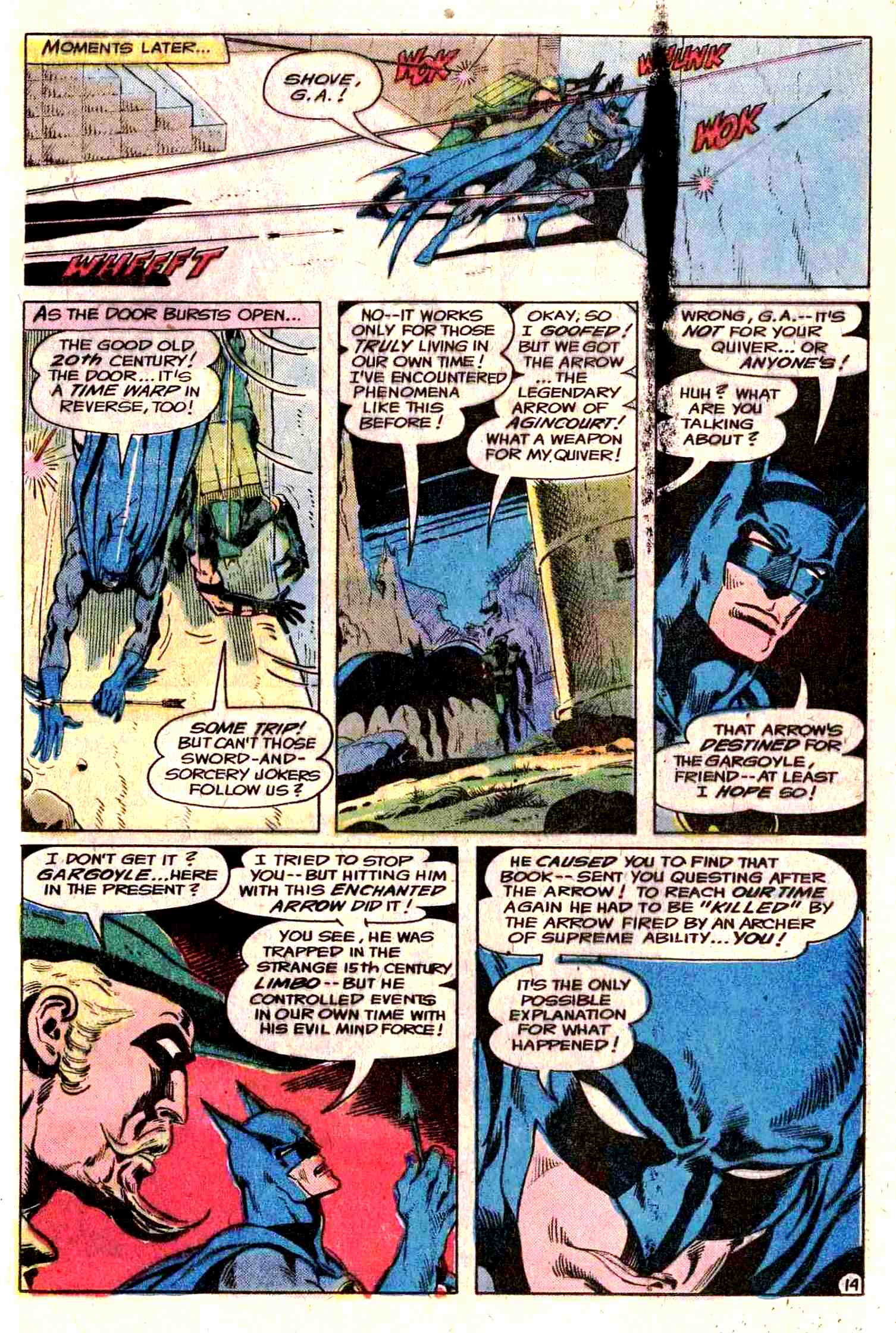
 So the action starts when Green Arrow, that noted bibliophile (sarcasm emoji), approaches Batman in his secret ID as rich guy Bruce Wayne, about a discovery the archer made. Arrow came across an old tome talking about a magic arrow made by Merlin himself. This arrow turned up much later in the 1415 Battle of Agincourt, and though history lies and tells us that the English won the battle thanks to superior archery weapons, the book tells Arrow that the English won because of just ONE arrow, when the magic bolt was used to bring down one particular French champion. Arrow being a bug of all things related to archery, the financially restricted hero asks Bruce for a lift to France. Bruce agrees.                                       

 So Arrow bails out of the Batplane, but after he leaves, Batman discovers that Arrow left his book behind. Batman doesn't plan to do much about this, but Some Mysterious Watcher fears that the crusader might launch an investigation of the tome's provenance. The Watcher spirits away the book, and-- causes the Batman to launch an investigation, tailing Arrow to his French destination.       

   
Batman then gets whipped back to 1415 at Agincourt, to which point in time Green Arrow has also been deposited. The mysterious manipulator is none other than The Gargoyle, one of the better Teen Titans villains created by Haney. He didn't want Batman, only Green Arrow, whom he manipulates into shooting him with the magic arrow of Merlin. Seems Gargoyle got exiled to the dimension of Limbo at the end of both of his previous two adventures, and though for some reason he's entered Earth back in the 13th century, he dopes out that he can return to the 20th if he gets shot by the arrow. Why does he have to be shot only by Green Arrow, and only during the Battle of Agincourt? Because the script says so, of course.                                   

                      
Gargoyle succeeds in getting shot, sending him back to the 20th century of his origins. Batman and GA follow, pour on tons of exposition, and eventually send the evildoer back into limbo by shooting him a second time. Despite all these tortured plot contrivances, this is a fun story based just on how well Haney succeeds in playing up the respective strengths of the bat and the archer. And how often do modern comics-stories even reference important historical events like Agincourt, even if the events are rewritten for the purpose of wild fantasy?                                                       

  Similarly, though artist Jim Aparo is no Hal Foster, I can't even imagine a modern comics artist attempting the sort of knightly grandeur seen in the above illustration. 

Tuesday, February 25, 2025

NULL-MYTHS: IT'S METAMORPHOSING TIME!

Before the Silver Age, if a series-character didn't sell, no publisher tried to bring said character back. But four years after the cancellation of METAMORPHO in 1968, writer-creator Bob Haney paired with editor Murray Boltinoff-- who had edited the Element Man's title-- to interest fans in the character. Their attempt failed, but a couple of the stories now give me examples of two species of "null-myths." In past essays, I've asserted that this category covers two types of story: those that are just flatly stereotypical, bringing no insight or emotion to the symbolism of their content, and those that make inconsummate use of those symbols. I'll now distinguish these as "passive null-myths," in which no real mental activity is in evidence, and "active null-myths," in which the mental activity goes down some weird pathway.                                                                                               

In 1972 Haney had been writing most if not all of the scripts for DC's teamup title THE BRAVE AND THE BOLD for seven years, and although Metamorpho had appeared once before in that title, the pulpishly-titled story "Cold Blood, Hot Gun" re-introduces the hero to readers. The 1968 title, BTW, had ended on an unresolved cliffhanger, but to my knowledge neither Haney nor anyone else ever tried to wrap up that story.                                                                   

  According to Haney's new scenario, Metamorpho has been off the grid for four years because he's been undergoing an experimental treatment to undo his freakish mutation, courtesy of conniving rich guy Simon Stagg, father to Metamorpho's beloved Sapphire Stagg. Much to the Element Man's frustration, Simon prematurely aborts the treatment because Simon has received news that an assassin seeks to kill Sapphire, who needs extra protection.                               
The source of this info is none other than Batman, but the means by which the Dark Knight acquires the intel is extremely dicey. After a businessman is flung to his death from his office on a high floor, Batman investigates. Haney needs the detective to find a list of the other people the assassin plans to knock off, but the author isn't content with simply having the hit man drop a written list in the office. Instead, after offing his target, the killer sits down and types out such a list in the office and takes it with him-- but Batman's able to reconstruct what was typed from analyzing the typewriter ribbon. And you thought the Internet was bad about preserving deleted content. Inevitably Batman and Metamorpho team up to prevent heiress Sapphire from getting killed, though Sapphire doesn't take the threat seriously and makes the heroes' job harder. The only distinction of this routine formula-tale is the typewriter nonsense, but this is a failure of verisimilitude, not mythicity.                               

 Haney managed to sell DC on giving Metamorpho a backup feature in ACTION COMICS, but the Element Man only hung in there for six installments before getting pushed out by the Human Target. However, by that time Bob Haney was writing WORLD'S FINEST, so he used a story in issue #217, entitled "Heroes with Dirty Hands," to re-relaunch Metamorpho. Fans sometimes complain about modern writers expecting the readers to remain clued in on whole histories of characters, but Haney is no different here, clearly expecting that the WORLD'S FINEST reader is going to remember the setup about Metamorpho undergoing the experimental treatment. The splash above barely shows the hero stewing in a nearby laboratory vat, while focusing mostly on a burly fellow wearing a costume that's half Superman and half Batman, who were, as most will know, the co-stars of the title. Is this some freaky return of the team's old villain, The Composite Superman?                                                               

But no, it's Java, Simon Stagg's dull-witted assistant, a Neanderthal man pulled from a bog and restored to something like sentient life. I'll forego citing Java's lame reasons for wearing the half-and-half costume, but the last panel of page 2 is one of those examples of an active null-myth I spoke of-- though I'll elaborate on it later.                     


   Haney then throws in a BS explanation about how the computer programmed the powers and propensities of Batman and Superman into the makeup of the Element Man, so that when he emerges from the vat, he's now wearing the half-and-half costume. He doesn't seem to be able to change back to his regular form, but maybe that's because hes been a D-lister for about seven years now, and he kind of likes biting the style of the World's Finest team. Simon Stagg dubs Metamorpho "Super-Freak," anticipating the Rick James song hit by eight years. Off goes Super-Freak to fight crime, and in jig time he's embarrassed Superman and Batman by doing their thing better than they can. So the heroes do the logical thing and defect to a foreign country, Slavia.                                                                                           

                                                               
I doubt that even the dumbest kids in 1973 didn't anticipate that DC's foremost heroes were just running a scam. In this case, they're hoaxing Rastinyak, Slavia's evil ruler, so that he'll accept their allegiance and reveal to them his special secret weapon. Apparently, this overly complicated "mission impossible" also requires the US President to ask Metamorpho to fetch the renegade heroes back to their country, as if they don't have the right to defect, just because. Metamorpho isn't informed of the deep fake and fights the heroes for real, so they have to throw the fight so that the evildoer will show his hand. The villain is defeated and Super-Freak's career ends with the fading of his bogus powers. This guest-star appearance led to Metamorpho getting a handful of backup strips in WORLD'S FINEST. But there was no real comeback for the Man of a Thousand Elements, and even membership in that lame super-team THE OUTSIDERS didn't get Metamorpho off the D-list.                                                                                                                                                                                                            Unlike "Cold Blood," "Dirty Hands" does have the kernel of a myth at its mostly hollow center. In a literal sense, the costumes of Superman and Batman don't confer any power on the heroes. But on the symbolic level, even imitations of the heroes' actual costumes incarnate the mana of the two crimefighters, and it's that mana that's being transferred to Metamorpho, rather than attributing such a power-boost to Simon Stagg's computer. As an extra added attraction, Haney blows his own fantasy-rules for Metamorpho's powers. Supposedly Metamorpho can only alter his body into new shapes if those shapes are made of elements naturally in the human body. So-- how does he manage to imprison Superman in a globe made of "anti matter?"                                                                                                      

Wednesday, July 13, 2022

PRIME STATURE, DEPENDENT STATUS

In my review of Edgar Rice Burroughs' 1930 novel A FIGHTING MAN OF MARS, I mentioned that I was reluctant to call the book a crossover simply because the book includes one or two scenes in which new hero Tan Hadron interacts with the main hero of the first three Mars books, John Carter. 

There's no question that in this particular book, Hadron is the main, or Prime, character, while Carter, despite his having greater fame, has been demoted to a subordinate, or Sub, role. This was not by any means the first time Burroughs had employed this technique. In my review of the 1915 SON OF TARZAN, I pointed out that SON was the only book in the series not to star Tarzan, though the original ape man does get more scenes than John Carter does in FIGHTING MAN. But by the logic I asserted in A CROSSOVER MISCELLANY PT. 1, Tarzan's role in SON would have to be a crossover just because he does have a little "activity" in the novel. 

The idea of having one character appear just long enough to introduce a newer one has precedent in a film like the 1972 BLACULA. In this movie's opening scenes, the original Dracula is around for ten minutes or so at the outset, talking turkey with Prince Mamuwalde. Then the vampire decides to make the African prince into an undead creature, sticks the newly vampirized unfortunate into a tomb for the next seven decades, and even gives the neo-vamp a sarcastic version of Drac's iconic name. During the main action of the film, when Blacula revives in the early 1970s, the Count does not reappear, nor is he mentioned again. To the extent that any viewer thinks about the matter, said viewer probably assumes that the racist vamp gets knocked off some time before Blacula revives in 1972. But because Dracula is such a major fictional figure, BLACULA (but not SCREAM, BLACULA, SCREAM) is a crossover-- though again, a very low-charisma type, since the iconic vamp makes only a token appearance.

Nevertheless, in crossovers of such low charisma, I find myself compelled to speak of such crossovers as "stature-dependent." In other words, Blacula exists because of the stature of Dracula, and Korak exists because of the stature of Tarzan. And so it's easy to see the relatively obscure hero Tan Hadron as being "stature-dependent" on the greater repute of John Carter. But this dependent status, in contrast to crossover-status, would not necessarily depend on whether or not John Carter had any scenes in the new hero's novel. It's been a year since I re-read THUVIA MAID OF MARS, which I reviewed here, but I recorded that John Carter was entirely absent. Yet because the novel's male hero Carthoris was the son of Carter, obviously any fame he accrued was borrowed from his famous peer.


A different form of Prime Yet Dependent Stature can be viewed in some of the hero-groups I've called "Semi-Inclusive Ensembles" in CROSSOVER MISCELLANY PT. 5. In this and other crossover-essays I mentioned that such ensembles were defined by their blending of both new and previously established characters into a new ensemble-franchise. Arguably the most famous example of this sort of franchise in comics history is the Silver Age AVENGERS. For fifteen issues, this series focused on heroes who either starred in ongoing serials (Thor, Iron Man) or who had been franchise-stars but didn't currently have a berth (The Hulk, Giant-Man and the Wasp, and Captain America). Then in issue #16, editor Stan Lee decided to push out almost all established stars, except for Captain America, who became the mentor to three "superhero trainees," Hawkeye, Quicksilver and the Scarlet Witch.


Though I have not looked at sales figures, I would assume that AVENGERS sold decently after the change, since "Cap's Kooky Quartet" plugged on in this "semi-inclusive" mode for thirteen issues. When the lineup was changed, it was not to bring back relative heavy-hitters like Thor or Iron Man, but to provide a berth for failed franchise-heroes Giant-Man and Wasp (with the former getting a new cognomen, "Goliath.") Without belaboring the obvious, from then on THE AVENGERS continued to follow this model, sometimes cycling in "big name" heroes, sometimes playing up extreme obscurities like Doctor Druid.


This raises yet another wrinkle: since such characters as Hawkeye, Quicksilver and Scarlet Witch had no stature prior to the Avengers, is their stature not also dependent upon being members of the super-group? Over time, the Scarlet Witch had a few more stabs at starring status, either by herself or in combination with the Vision, while neither Hawkeye nor Quicksilver ever enjoyed great fame as solo acts. Over time a number of heroes appeared in such semi-inclusive groups who would never have any stature outside such a group, and so they too would be even more "stature-dependent" than a protagonist who does later get a shot at a solo outing. 


In some cases semi-inclusive ensembles might even be used after the fashion of TV's "back door pilots." For three issues of THE INVADERS, writer Roy Thomas took the two juvenile members of the group, Bucky and Toro, and lined them up with two new similarly aged heroes, Golden Girl and the Human Top. The more famous members of the group-- Captain America, the Human Torch, and the Sub-Mariner-- did appear in selected scenes within the story, but clearly these issues were meant to emphasize the new team. In a much later interview Thomas admitted that he created the Kid Commandos as a means to shuffle Bucky and Toro out of the group, since he didn't like having to cope with the teenaged characters. Yet for the space of three issues, the Kid Commandos do acquire at least a dependent form of stature. Yet because their group never became independent of the Invaders, they are best seen as an adjunct of the Invaders group.


Next to lastly, I used THUVIA MAID OF MARS as an example of a novel within the "John Carter series" even though Carter did not appear in it. Similarly, the DC comic GOTHAM CITY SIRENS teamed up three of Batman's femme-adversaries: Catwoman, Poison Ivy, and Harley Quinn. Yet in the third issue of the series, the three of them barely appear, and writer Scott Lobdell focuses rather upon The Riddler as he tries to solve a serial killer case. A version of Batman-- actually Nightwing disguised as the Caped Crusader for continuity-reasons-- has like the Sirens a subordinate role in the story. If anyone behind this comic had some thoughts of giving the Riddler his own series as a quasi-hero, his "dependent stature" role here could have served as an adequate "pilot."


I might also add that "dependent stature" also attends to a lot of characters without their own serials who appear in discontinuous team-up titles like THE BRAVE AND THE BOLD and MARVEL TEAM-UP. Some of these characters included former villains, also discussed in A CONVOCATION OF CROSSOVERS PT. 3, and some were characters who never stood a chance at getting a series, like the entirely forgettable "Bat-Squad" from BRAVE AND BOLD #92.

Thursday, October 17, 2019

NULL-MYTHS: "THE BRIDE AND THE BOLD" (ALL-NEW BATMAN/BRAVE AND BOLD #4, 2011)


I'm nostalgic enough that I think I enjoyed the 2008-11 cartoon teleseries BATMAN: THE BRAVE AND THE BOLD just as its creators intended: as a salute to the antic wackiness that dominated many Silver Age DC Comics. As I noted in this essay, the creators of the teleseries, rather than seeking to produce another "campy" Batman, rather sought to orient the crusader toward the form of "hip humor."

It's a tough form of humor  to do well, given that hipness rather easily devolves into Borsht-belt schtick-- and that's what I found on display in a TPB that collected several issues of DC's attempt to emulate the cartoon. The comic was launched in the same year that the cartoon wrapped up, and most of the adventures are mediocre but inoffensive visits to the goofier side of the DC Universe. "The Bride and the Bold," though, provides a good exemplar of a null-myth, in that writer Sholly Fisch fails to exploit the symbolic aspects of his narrative.

Oddly, Fisch starts off his story by referencing one of the most mythic comics of DC's Golden Age. Eros, the Greek god of love, seems to have been doing a close reading of William Marston's early WONDER WOMAN issues, for he complains that Wonder Woman isn't spreading "love" as Marston's heroine claims to be doing, that instead the Amazon is just getting into a lot of brawls with super-villains. Indeed, at the time that Eros gets so torqued off, the Amazon happens to be teamed with Batman in stopping the improbable criminal alliance of Giganta and the Mouse-Man. Eros then takes it into his head to force Wonder Woman and Batman to fall in love, apparently with the idea that greater love will be promoted in the world if two superheroes get publicly married.


This leads one of Batman's many amours to assume the role played by Doctor Doom in the wedding of Reed and Sue Richards, as she sends every nearly goofball villain in DC's history to disrupt the wedding.


I have to admit I liked seeing the resurrection of the DC-World's Zaniest Villains, even in a story as paper-thin as this one. One balmy Marston villain even makes the cut, the Blue Snow Man, though most of the Wonder Woman foes are from the nutty Silver Age Kanigher era, like the aforementioned Mouse Man, the Paper Man, Egg Fu and the Crimson Centipede.


Though Fisch's apparent reverence for Distinguished Craziness may equal that of the BRAVE AND BOLD cartoon, he's unable to give Eros, his primary "villain," a compelling reason to do what he does, and as a complete cop-out reveals at the climax that the two heroes weren't really enthralled, but went through the wedding because-- well, they read the script, so they knew that someone would send a lot of villains to fight them. Sorry, Solly; that's not hip, it's just lame and lazy. The BRAVE AND BOLD cartoon knew how to make the simple motivations of both heroes and villains take on mythic import, if not mythic content-- and I suspect that the remainder of the issues in the comic's 16-issue run fail this test as well.


NOTE: Though there are a huge bunch of DC heroes at the wedding who engage the villains in battle, none of the heroes in the story are "centric" to the story except for the primary team-up figures, Bats and WW.

MYTHCOMICS: "REVENGE OF THE ROBOT REJECT" (BRAVE AND BOLD #55, 1964)


DC's title THE BRAVE AND THE BOLD is known primarily as the "Batman and--" team-up feature. However, at various times the title played host to swashbuckling tales, "strange sports stories," and showcases for possible regular features. But for about two years before Batman became the feature's exclusive selling-point, the title also played host to a number of more inventive crossovers. I assume that the men behind the comic approached these crossovers in the same spirit as the Golden Age JUSTICE SOCIETY OF AMERICA: a title in which the company's strong sellers could theoretically boost the weaker properties.


By the time "Revenge of the Robot Reject" appeared on stands in 1964, the Atom had enjoyed his own feature for roughly three years, edited by Julius Schwarz, and the Metal Men for two, edited by Robert Kanigher. This story, edited by George Kashdan, shows writer Bob Haney and artist Ramona Fradon-- best known for their co-creation METAMORPHO-- attempting to mimic the relevant aspects of both franchises. Haney's script delves far more into the Metal Men mythology than that of the Atom, though he finds a satisfactory premise that allows him to play the Tiny Titan off Doc Magnus's six robot heroes-- who are, for any not hip to the feature, are Gold, Iron, Mercury, Tin, Lead, and Platinum (the only female robot, and the only one who gets a nickname, that of Tina).

In the regular METAL MEN feature, Kanigher tended to soft-pedal any intimations of the robots' inventor as being their parent, even in the figurative sense that one sees in Mary Shelleys' FRANKENSTEIN and the Universal adaptations thereof. In contrast, "Reject" starts out with Magnus having his six robots visit an orphanage to entertain the kids. Tina, the only female robot in the group in 1964, was always seen expressing her undying love to her creator, and "Reject" is no exception. However, I don't think Kanigher's METAL MEN ever showed Tina waxing maternal, and in the opening scenes of "Reject," Tina is apparently so charmed by all the munchkins that she suggests that she and Magnus should marry and have kids. When her bemused creator reminds Tina that a robot can neither marry nor conceive, she cheerily responds that Magnus could just build "cute little robot replicas of you and me."


Once Magnus and his six quixotic creations return to their HQ, Tina's burst of erotic enthusiasm is still with her, and as a result she dances about, unintentionally courting thanatos so that she falls to her death into a generator. In the regular title, this isn't a problem, since the Metal Men are always getting reduced to piles of mangled scrap, only to be magically resuscitated by their inventor's peerless skills. But this time, Magnus can't restore Tina, because her atomic structure has been altered somehow. The next seven pages then read like a quickie version of "Ten Little Indians," as each of the other Metal Men also fall victim to peculiar accidents, and again, Magnus cannot revive any of his "children."


Magnus sits alone in his laboratory, emulating Dorothy Gale as he muses that he'll miss his sexy female robot most of all (not exactly in those terms, of course). Then the villains responsible for the Metal Men's decimation appear. One is the first robot Magnus ever created, Uranium, and also the "reject" of the title, since Magnus attempted to destroy him. The other villain is Uranium's own creation, a silver female robot named Agantha, who bears a nodding physical resemblance to Tina and whom Uranium designed to be his version of Magnus's "girl robot creation." (In other words, Uranium may not be Magnus's literal child, but the robot-reject's doing his darnedest to follow the scientist's example.)  Uranium announces that through his command of all elements, he was able to remotely guide the Metal Men to their respective dooms and then to alter their atomic arrangements so that Magnus couldn't bring them back. He did all this because he resents that Magnus tried to destroy him-- even though a flashback shows Uranium being callously destructive, much like the element he's made of-- and because now he wants Magnus to help him devise a world-conquering weapon. Agantha is just as vicious, though she does pay the scientist a backhanded compliment: "If it weren't for [Uranium] here, I could go for you-- now that your platinum girlfriend is gone."


Threatened with immediate death for non-compliance, Magnus helps the project to buy time. He also manages to send out a distress signal. Ray (The Atom) Palmer receives the signal in his own lab, dons his costume, and rushes over to Magnus's HQ to help. Being unobtrusive, the Atom's able to infiltrate the HQ and figure out what's been happening, and being a physics major, he assembles the remains of the Metal Men and figures out how to use his "atomic"  skills to restore their integrity-- at which point the robots reconstitute themselves.


Meanwhile, Uranium's project is finished, but he's still victim to daddy issues, unable to kill Magnus because "he is the man who gave me life." Agantha, who's become Lady Macbeth in a few pages, has no such compunctions and prepares to destroy the robot-maker.

In burst the Metal Men, and Tina, though she didn't witness Agantha flirting with Magnus, immediately calls her a "silver hussy." The two ductile damsels fight it out, with Tina winning due to her greater knowledge of the elemental sciences (is silver really more vulnerable to sound-waves than platinum? I dunno). Uranium proves a tougher nut to crack, for his creativity doesn't stop with making his own robot-doll. He reveals that he can manifest the radiation in his body into three missile-shaped mini-minions, who are named after their types of radiation, Alpha, Beta, and Gamma. (The reader shouldn't need more than one guess as to why these energy-constructs look like missiles.)


Though the radiation-minions can't harm Lead, the other Metal Men get kicked around pretty good. The Atom, who's been confined to the sidelines during this high-powered scuffle, suggests that they take Mercury aside and bond his atoms to those of Lead. That way, when Mercury attacks Uranium again, the radiation-minions can't hurt him. Uranium can't understand what's happening, and keeps bombarding Mercury until the villainous metal exhausts himself and devolves to a hunk of inert radium. Magnus does express some regret for his own hubris: "It was really all my fault from the first! I made you wrong, to start with!"

The psychological myths about robots and their creators are fairly lightweight here, but Haney does a good job-- better than many of Kanigher's stories-- at putting forth the cosmological myths necessary for both of the crossover-features. Maybe all the elemental research in this toss-off tale helped inspire him to co-create the Metamorpho concept with Fradon.
Tuesday, April 23, 2019

HOSTS, HEAVENLY AND OTHERWISE PT. 2

One of the biggest problems for my theory of centricity pertains to the concept of the "rotating team" franchise.

I consider myself fully cognizant of the most important crossover-permutations of crossovers in popular fiction. The earliest examples seem to be short-term, usually dealing only with two established characters or concepts encountering one another, like the 1920 SHE AND ALLEN. John Kendrick Bangs' four "Associated Shades" stories, which I have not read, may be the first time someone invented the idea of a "team" whose members were fairly fluid, though most of Bangs' characters were historical rather than fictional figures.

As far as I can tell, the first true "rotating team" concept appeared in 1963. Since 1955 DC Comics had been trying to score a hit in its anthology series THE BRAVE AND THE BOLD. Though DC was sometimes able to use the title as a showcase for serials that graduated to their own series, such as the Justice League, nothing caught fire within the magazine, until issue #50 teamed up two of the company's lesser lights, Green Arrow and the Martian Manhunter. Batman began enjoying team-ups irregularly in issue #50, but not until issue #74, in 1967, did he become the exclusive co-star in the series, using his TV-amplified clout to help DC try to hype its vast array of non-bat characters.


In many respects, this innovation resembled the core idea for the Golden Age Justice Society, whose principal raison d'etre was to use the more popular DC heroes to spark readers' interest in lesser lights. I tend to doubt that any of the 1960s lesser lights burned any brighter thanks to hobnobbing with Batman, any more than 1940s flops like Starman and Hourman had benefited from their temporary association with the Flash and Green Lantern. But once BRAVE AND BOLD became dominated by the Caped Crusader, the series provided its writers with a dubious challenge: that of finding rationales for teaming up the urban hero with characters rooted in wild concepts of SF and fantasy, like the Metal Men and Green Lantern, or even in different time-frames, like Scalphunter and Sergeant Rock.

Now, had any of these short-term team-ups appeared in one of Batman's own books, then the team-up characters would be mere "guest stars," and the charismatic action would be non-distributive, descending only to the Big Bat. But in theory, even though Batman is a constant presence after 1967, the concept of the franchise should mean that Batman shares charisma with any of his co-stars--

-- with just a few exceptions. Most of the time, the co-stars either had their own franchises, or had enjoyed such regular berths at some point in DC's history. However, on a few occasions the Bat teamed up with one of his famed enemies, and I would consider all of these to be subordinate rather than coordinate figures, because the villains had not previously enjoyed their own franchises.

Here's the crusader being forced to team up (sort of) with the Riddler--


And here he is with Ra's Al Ghul.

And then there was Bats and the Joker:


Admittedly, by the time that the Brave and Bold Bat had to make a temporary alliance with the Joker, the Crown Prince of Crime had enjoyed a short-lived nine-issue solo series. But since he wasn't really known as a starring character despite that series, I would say that he too became as much a subordinate figure as Riddler and Ra's, due to the dominant approach of the BRAVE AND BOLD series.

A similar aesthetic came to pass when Marvel attempted to sell Doctor Doom as a regular co-star in the title SUPER VILLAIN TEAM UP.  Though the Sub-Mariner was also a regular for the first nine issues, issues 10-12 11 focus upon Doom's (non-team) encounter with a genuine Marvel fiend, the Red Skull. Admittedly #10, seen before, still shows the "team" of Doom and Namor above the series-title, the next two spotlight Doom and the Skull.


Namor gets the above-title billing in #13 again, but then it's Doom and Magneto in issue #14.


Following a reprint of an earlier Doom-Skull tale, the series then finishes up with a two-parter with neither Doom nor Namor, but presenting the Red Skull working alongside a far less popular Marvel menace, the Hate-Monger.


Since at the time Red Skull, Magneto and Hate Monger had not enjoyed serials of their own, all of them would be subordinate figures, even as the Joker, Riddler and Ra's are within the context of BRAVE AND BOLD, and so Doctor Doom alone is the sole coordinate in the stories without the Sub-Mariner. HOWEVER-- in the final two issues, it can be fairly judged that both the Red Skull and the Hate-Monger share the centric position. In the absence of a figure who dominates the narrative, the way Batman dominates most texts in which he appears alongside one of his vilains, the two villains here are coordinated as the unchallenged stars of the story.