Featured Post

SIX KEYS TO A LITERARY GENETIC CODE

In essays on the subject of centricity, I've most often used the image of a geometrical circle, which, as I explained here,  owes someth...

Tuesday, November 26, 2024

NEAR-MYTHS: "EUSTACE THE TURKEY" (THE SPIRIT, 1943)


I'm aware of no fully mythic Thanksgiving stories. But Will Eisner managed a cute near-myth with a tale of a turkey who is seemingly spared his grisly holiday fate, but who ends up sacrificing his life to save his fellow birds (sort of). Strangely, Eisner does not make the predictable comparison to the Nazarene, but to-- that gloomy Dane, Hamlet?


Just for good measure, here's a bit from GIGGLE COMICS in which an endangered turkey pleads for the main cat-hero to become his "Lincoln."


CURIOSITES #40: RADIATION REVELS

I've been a little curious lately as to when comic books began making sustained use of the fantasy-trope that radiation can cause either (1) modifications in infants at conception or in the womb, or (2) spontaneous changes in fully grown entities. In prose science fiction, the trope has been traced back to the late twenties and early thirties.

So far the earliest comics-examples I've found appear in 1944. One is in a YOUNG ALLIES story, wherein a Nazi agent is mutated by radium exposure and changes into an atomic powerhouse who's variously referred to as both "The Green Death" and "The Radium Man."


By an interesting coincidence, 1944 also gave us the short-lived jungle girl strip, JUN-GAL, whose star gains super-strength from exposure to natural radium. There's no mention as to why the Black natives in her tribe fail to get similarly empowered.


EVIL, BE THOU OUR GOOD PT. 3

 So in the previous two installments of this essay-series, I've addressed AT-AT Pilot's essential question. "Is it possible for literature to be evil?" Dominantly my response has been, "most if not all evil is to be found in the parts of literature that encourage 'work,' a concerted effort toward a real-world goal." And even then, one must analyze a work's explicit or implicit polemic in order to determine if the goal advocated is evil. 


An obvious example of explicit polemic can be found in the 1915 BIRTH OF A NATION film, which adapted Thomas Dixon's 1905 novel THE CLANSMAN. The film (and, I assume, the source novel) makes no bones about its message: that liberated Black slaves must be kept down by the Ku Klux Klan. Implicit polemic is harder to identify, because so many critics project polemic where none is intended. However, such identification is not impossible and can usually be pegged by the way the implicit type mimics the irrational propositions of the explicit type. 


I have judged J.M. Coetzee's anti-colonialist novel DISGRACE as implicitly polemical due to the mirroring of two major events in the story. In Event One, the viewpoint character, a White South African professor teaching at the collegiate level, is condemned for allegedly manipulating a female student-- possibly but not definitely Black African-- into an affair. In Event Two, the professor's daughter, who runs a farm in South Africa, is raped by Black African trespassers, one of whom impregnates her. But because the rape took place against a scion of colonizers, it's asserted that the woman will eventually marry her rapist and that the land she owns will return to a Black African family. Obviously, some readers did not judge this disproportionate "tit for tat" as evil, in the same way that most readers today would judge the Dixon work and the Griffith film as evil. Clearly, I find them all morally noxious.

But none of the above works fall into the category I've called "play for play's sake," which takes in generally the majority of popular culture, and specifically the KAMASUTRA manga of Go Nagai, with which this discussion began. So far, most of the Nagai works I've surveyed are wild outpourings of sex and violence, with almost no attempts to impose any moral order on the chaos. The closest thing Nagai himself offers as a key to his works is an "ethic of transgression," insofar as he believes human nature is truly one big playground for a bunch of Freudian Id-Monsters. But he never expouses any sort of polemic-- though even in the more permissive country of his birth, Nagai was often criticized for his explicitness.

The majority of censorious critics don't bother to establish even an implicit polemic as I did with DISGRACE above. These critics usually follow one of two approaches-- the "monkey see monkey do" approach and the "projected polemic" approach-- and it just so happens that the two most prominent enemies of popular comics in the postwar years broke down along those respective lines. Frederic Wertham begins with the supposition that children were as twigs that would be inevitably bent by the wrong influences, and that any time one of them did wrong, an evil comic book done made them do it. Gershon Legman had the idee fixe that American culture nursed a vast conspiracy to substitute healthy sexuality with sadistic violence, and he repeatedly "proved" his thesis with endless facile projections. Neither they nor most of their descendants showed any capacity to define evil except in terms of personal self-interest-- which, some may recall, is explicitly rejected in the Bataille excerpt I cited in Part 2.


Oddly, "projected polemic" works both to champion and denigrate works that don't show either explicit or implicit polemic. Many will be familiar with news stories about evangelical groups criticizing J.K. Rowling's HARRY POTTER series, claiming that its magical content encourages young people to explore witchcraft and/or Satanism. This Wikipedia article chronicles many of those evangelical denigrations. However, the same article also mentions a number of defenses of the Potter series on the grounds of its encouragement of Christian values-- and even though I like the series, I view these positive characterizations to be projections. It's not that there's no moral content in POTTER. But at base I think that Rowling's series is essentially "play for play's sake" as much as most Go Nagai works, even though POTTER lacks the extreme sex and violence of Nagai.

Francois Truffaut said, "Taste is the result of a thousand distastes," and what many critics label as evil is often more a reaction against something they find unpleasurable. They often impugn the artist, as if he were showing them unpleasant things for some sadistic or politically motivated reason but have little appreciation for another Truffaut observation: that artists are not endorsing everything that appears in their works. All art is founded on conflict-- Bataille would say "transgression"-- and every fictional conflict conceivable can potentially trigger someone in terms of a taste-reaction. I try as much as possible to frame all of my critical downgrades in terms of analyzing a work's explicit or implicit polemic. But I'm sure there are some works I just don't like for reasons of taste, too, as with my generally unfavorable critiques of Mark Millar's comics. I certainly don't think he's guilty of any more polemic than is Go Nagai-- but I find Nagai creative and Millar boring in terms of their violently transgressive content. So even a critic who refutes taste-based criticism can't help but be influenced his own "thousand distastes." Probably the only time I'd denounce "play for play's sake" as evil would be when I think it's boring.

Sunday, November 24, 2024

INTERRUPTED MEDLEY

I'm putting a short hold on the next EVIL post, to respond to a comment by AT-AT Pilot in the comments to Part 2. One of his two references included a link to a post on the EDUCATED IMAGINATION blog, excepting a section from one of Northrop Frye's essays, albeit one devoted entirely to the Christian religion he practiced, and not to the literary works he more often analyzed. 

In an argument against the social tendencies toward literal readings of Biblical passages, Frye says in part:

In short, the Bible is explicitly antireferential in structure, and deliberately blocks off any world of presence behind itself. In Christianity, everything in the Old Testament is a “type” of which the “antitype” or existential reality is in the New Testament. This turns the Bible into a double mirror reflecting only itself to itself. How do we know the Gospel is true? Because it fulfills the prophecies of the Old Testament. But how do we know that the prophecies of the Old Testament are true? Because they are fulfilled by the Gospel. Is there any evidence for the existence of Jesus as a major historical figure outside the New Testament? None really, and the writers of the New Testament obviously preferred it that way. As long as we assume a historical presence behind the Bible to which it points, the phrase “word of God,” as applied both to the Bible and the person of Christ, is only a dubious syllepsis. In proportion as the presence behind disappears, it becomes identified with the book, and the phrase begins to make sense. As we continue to study the significance of the fact that the Bible is a book, the sense of presence shifts from what is behind the book to what is in front of it. (CW 4, 82-6)

I like to think I fully understand Frye's point in stressing the circular nature of the Bible-- and possibly, by extension, of most or all other religions. However, Christianity in particular has encouraged some degree of literalism in its discourse, not least as a result of grounding many events of Scripture in the perspective of a linear history. True, the Bible does not offer the sort of close chronicling of minutiae that readers today expect of "history." Further, many narratives in the Bible that purport to relate historical events are disputed by the evidence assembled by modern historiography. Yet it's unquestionable that Christianity, like Judaism and Islam, centered all narratives within a *simulacrum* of linear history. 

Thus, certain key events happen in a straight line; the Jewish captivity in Egypt always precedes Rome's dominance of Judaea, for example. The Biblical writers tie all these events together with the repetition of religious images or tropes, as Frye says-- but the use of history is meant to convince the unconverted of the vastness of God's scheme for humankind. All three "religions of the Book" profited enormously from grounding their religious narratives within the sphere of "real" history. 

Reading the Frye excerpt coincides with my having read another chapter of Bataille's LITERATURE AND EVIL-- and, as in Part 2 of my essay-series, I find myself again endorsing Bataille's view over Frye's. In a chapter devoted to William Blake, Bataille agrees with Blake's idea that "Poetic Genius is the true Man," Bataille extended that statement, contending that "there is nothing in religion that cannot be found in poetry." The chapter's main point concerns Bataille taking issue with a particular Jungian scholar who, in Bataille's opinion, sought to reduce Blake's narratives to Jungian paradigms. Bataille, who disputed any philosophy that smacked of idealism, concocted an interesting take on how Poetry "destroys immediate reality" yet "admits the exteriority of tools or of walls in relation to the ego."

Though poetry does not accept sense-data in their naked state, it is by no means always contemptuous of the outer world. Rather, it challenges the precise limitations of objects between themselves, while admitting their external nature. It denies and it destroys immediate reality because it sees in it the screen which conceals the true face of the world from us. Nevertheless poetry admits the exteriority of tools or of walls in relation to the ego. Blake’s lesson is founded on the value in itself, extrinsic to the ego, of poetry. -- LITERATURE AND EVIL.


For Bataille, then, Poetry subordinates but does not negate all "real-world referentiality." I would say that, even though I don't concur with Bataille that Poetry and Religion are consubstantial, Religion follows the same dynamic, in which even linear history is subsumed by the vision of godhood continually interacting with mortals confined within, but not limited to, that history. If I wanted this essay to go on forever, I'd bring in the ways "real-world referentiality" also takes in the endorsement of specific, work-oriented goals, found in both religion and literature.

Next, back to considerations about taste, sadism, and perceptions of evil.


Saturday, November 23, 2024

EVIL, BE THOU OUR GOOD PT. 2

In Part 1, I stated that Northrop Frye wasn't an influence on my own literary theories of "work and play," but George Bataille certainly was, even though most of what he wrote on that pair of concepts concerned his view of anthropology and religion, not literature. Yet he certainly transferred his concept of "religious transgression" to the world of literature. In 1957 that he wrote in EROTISM that "the transgression does not deny the taboo but transcends it and completes it," and an analogous idea appears in LITERATURE AND EVIL, published the same year:

Evil, therefore, if we examine it closely, is not only the dream of the wicked: it is to some extent the dream of Good. Death is the punishment, sought and accepted for this mad dream, but nothing can prevent the dream from having been dreamt." -- p. 21.

Though I don't consider LITERATURE AND EVIL one of the better books on literature-- it compiles eight essays on particular authors Bataille admired for incarnating his ideas on "literary evil"-- EVIL did greatly influence me to consider that every conflict in a fictional story involved a transgression against someone or something, and that's as good a reason to use Bataille to approach the question posed to me, "Is it possible for literature to be 'evil?'" (And by the bye, Bataille's sense of an interpenetration between Good and Evil is what conjured forth my Miltonian essay-title.)

I don't believe that anyone ever has, or ever will, formulate a definition of evil as such, which any tenable theory of "literary evil" would require. But Bataille's definition is at least a good starting-point. In his very short preface, he states:

These studies are the result of my attempt to extract the essence of literature. Literature is either the essential or nothing. I believe that the Evil—an acute form of Evil—which it expresses, has a sovereign value for us. But this concept does not exclude morality: on the contrary, it demands a 'hypermorality.'

Literature is communication. Communication requires loyalty. A rigorous morality results from complicity in the knowledge of Evil, which is the basis of intense communication.

His idea of "hypermorality" probably explains why he's not overly concerned with many of the lesser forms of evil that ordinary morality inveighs against: specifically, those centered in self-interest. In his initial essay, whose main subject is Emily Bronte (and her sublime evildoer Heathcliff), Bataille privileges Evil as the deliberate enjoyment of suffering beyond the considerations of personal advantage.

We cannot consider that actions performed for a material benefit express Evil. This benefit is, no doubt, selfish, but it loses its importance if we expect something from it other than Evil itself – if, for example, we expect some advantage from it. The sadist, on the other hand, obtains pleasure from contemplating destruction, the most complete destruction being the death of another human being. Sadism is Evil. If a man kills for a material advantage his crime only really becomes a purely evil deed if he actually enjoys committing it, independently of the advantage to be obtained from it. 

Obviously, a lot of literature engages in moralistic polemic against the evils of self-interest in all its forms-- though polemicists like Frederic Wertham are well-versed in dismissing any such moralizing as being no more than a protective cover, the better for those pundits to attack literature they deem "morally noxious." So Bataille is in the end not offering a general definition of evil, but of a specifically form of Evil that he associated with the sovereign values of literature as a whole. 

Bataille's definition of Evil and its relationship to Good may not be one that can be generally applied, but it does have partial explanatory power within literature, and therefore it serves as a counterbalance to the views of the pundits. For them, all evil is defined by self-interest, and sadistic thrills are just part of that package-- which is why Wertham constantly conflated readers wanting sadistic thrills and publishers wanting to make money off those customers. For Wertham, the taboo exists only to prevent the transgression, and Good never dreams of Evil in any fashion. Yet Wertham's own altruism is compromised and implicated in self-interest when he's caught cooking his casebooks, or even just making insubstantial arguments.

Bataille's idea that "Sadism is Evil" requires separate consideration from his overall definition of Evil in Literature, and Part 3 will touch on that topic, as well as the age-old question, "When an artist shows a thing, is he endorsing it?"


Friday, November 22, 2024

EVIL, BE THOU OUR GOOD PT. 1

As I begin this post, I'm not sure how many parts this essay-series will run. Meditations on the nature of evil tend to lead anyone down a lot of unusual, if not perilous, alleyways, though I have a few directions in mind. The subject came up in a comment by AT-AT Pilot, which I reprint here so that it will be clear what I'm responding to.

Is it possible for literature to be "evil"? I understand that there have always been critics who consider some book or other to be morally grotesque. But they are approaching art in the wrong way, I presume? In the MYTHCOMICS: ["RINGSIDE BLONDIE"] BLONDIE #169 (1963) entry, you mentioned Frye's "protective wall of play." Does it encircle all fiction? From your writings and those of Frye, I would guess that such a barrier does exist and makes all fiction inherently "good." Is that correct? I imagine that controversial literature is allowed to be in print because readers are sophisticated enough to restrain the realm of fantasy and keep some distance away from it, preventing the possibility of negative influence within themselves.

I ask because I find it difficult to effectively defend a work that is deemed to be morally noxious. How would someone, for example, be able to defend a work like Kamasutra (or other manga like Berserk) from accusations of perversion and misogyny?


Now, I already wrote, in the same comments-section, a short answer to the questions, but I think they deserve extended commentary as well. My present plan is to break down some of my short answers and expand upon them in piecemeal fashion and bring in some new commentary as well (some of which should justify my title, a deliberate misquote of the line Milton gives Satan in PARADISE LOST).

What I want to expand on first is my statement about how literary works encompass both "play" and "work:"

My first (short) answer is that *potentially* the wall of play might encircle all fiction. However, it's also axiomatic that fiction always has an equal potential to be used for "work"-- that is, to achieve specific ends-- and using that potential reduces the potential to see the work only in terms of play. Whenever a specific goal is advocated in a fictional work-- Upton Sinclair using THE JUNGLE to persuade Americans that socialism was better than capitalism, or Superman trying to convince young readers to exercise more in line with the health programs of President Kennedy-- that's "play being used for the ends of work."

I should also give the context for my quotation of Frye from his ANATOMY OF CRITICISM, though I may have already done so in previous posts. I also want to clarify that he's in no way responsible for my dichotomy of "play" and "work."

We should have to say, then, that all forms of melodrama, the detective story in particular, were advance propaganda for the police state, in so far as that represents the regularizing of mob violence, if it were possible to take them seriously. But it seems not to be possible. The protecting wall of play is still there.

Probably my most specific attempt to break down categories of "fiction used for play" and "fiction used for work" appeared in JOINED AT THE TRIP PT. 4. In this essay, I cited two works in each category, one of which was of superior literary quality and one which was inferior: Mitchell's GONE WITH THE WIND and Dixon's CLANSMAN for "play-fiction," and Faulkner's LIGHT IN AUGUST and Coetzee's DISGRACE for "work-fiction." 

In line with my remarks above, I would now kick Dixon's CLANSMAN out of consideration, because even though it was "popular fiction" like GONE WITH THE WIND, Dixon's books were polemical, trying to convince readers that Negro slaves should never have been emancipated. The best substitute that occurs to me now-- and one that was short enough to give a quick read online-- is Florence Kate Upton's TWO DUTCH DOLLS AND A GOLLIWOG. This is admittedly a children's book in verse, but it was phenomenally popular in England and America and spawned twelve sequels-- which I imagine were probably as unserious in their chauvinism as the first book. A pertinent image from the first book follows...


But now, with all those reconsiderations out of the way, the TRIP essay was focused only upon my estimation of literary quality. I would still maintain that both Coetzee's DISGRACE and Upton's DUTCH DOLLS lack the better qualities of both the Faulkner and Mitchell books. But even though both Mitchell and Upton have often been attacked for racial content, I would probably still find Coetzee's book the most morally objectionable, if not "evil" as such, partly because the author was "working" with didactic ideas but did a much poorer, less subtle job of handling them than did Faulkner.

Next up: some possible definitions of "evil."

Sunday, November 17, 2024

MYTHCOMICS: KAMASUTRA (1990)

If people say you can’t do something, then you want to do it even more. Things that are considered forbidden, means other people aren’t doing them yet! -- Go Nagai, interview.


I'm nowhere near having a satisfactory overview of the works of manga artist Go Nagai, but I have made an effort to read a fair sampling of the ones for which he's celebrated: the first ecchi manga (1968's Harenchi Gakuen ("Shameless School"). the first piloted mecha (Mazinger Z), and the first "magical girl" manga (Cutey Honey). And while not everything Nagai wrote and/or drew was obsessed with depicting "forbidden things," there's no question that most of the time he depicted transgressive, highly kinetic levels of sex and violence. This penchant is clearly tied into his protean creativity, but his heavy concentration on the kinetic potentiality may have stunted his ability to depict things mythopoeic. As yet I haven't delved into his first DEVILMAN series, which is rumored to be one of Nagai's more ambitious undertakings. But I did investigate the four-volume series KAMASUTRA. Nagai drew this series and co-wrote it with Kunio Nagatani, who also has a substantial catalog of works, many of which have generated controversies similar to those of Nagai.
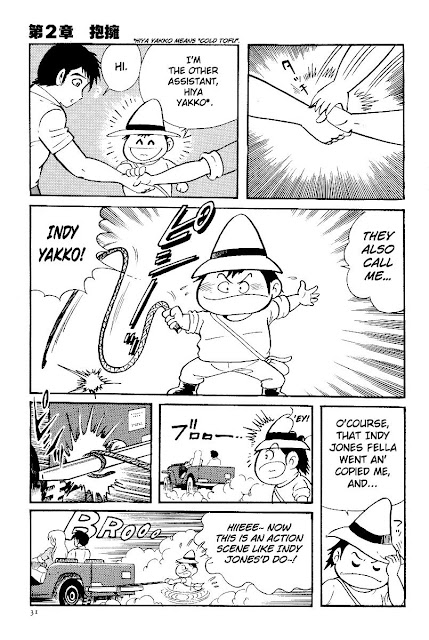


Since the actual Kamasutra sex-manual from the 2nd century CE is just a collection of instructions about the many methods of human intercourse, the manga is not a straight adaptation of that work. If it was, this manga would not be admissible to my mythcomics project, which is all about original (or mostly original) comics-stories. Nagai (and I'm going to use his name as shorthand for Nagai-Nagatani) structures KAMASUTRA as unrestrained pulp adventure with a metaphysical theme. Some indebtedness to Spielberg's RAIDERS OF THE LOST ARK is signaled through one of the story's support-characters: a Japanese comedy relief who dresses like Indiana Jones, complete with whip, and who calls himself "Indy Yakko." 
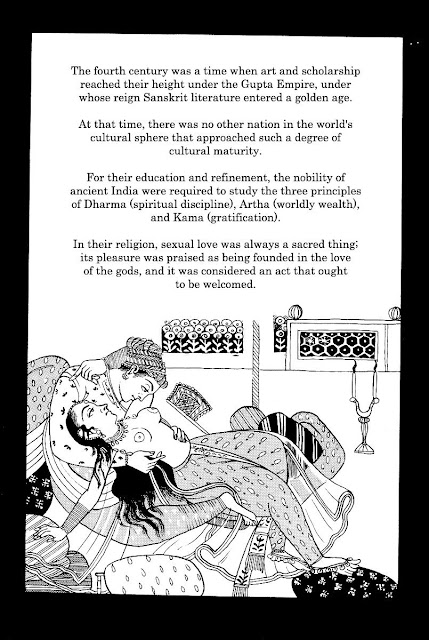


Like RAIDERS and its sequels, KAMASUTRA depicts a struggle between good guys and bad guys for possession of some arcane artifact from ancient times. But whereas in the Spielberg-Lucas films, possession of the artifacts gives one side temporal power, Nagai is more focused on a pulpish version of the Greek hieros gamos, often if not always defined as a "sacred marriage between a mortal and a god or godlike entity." The Greek term lines up well with the Hindu/Buddhist religious variant sometimes called "Shaktism," which focuses on rituals symbolizing the union of male (Shiva) and female (Shakti) principles. Illustrated passages from the Kamasutra are interspersed throughout the manga-narrative, serving to gloss the events.

Some such transcendent union is suggested by the opening chapter of KAMASUTRA. Ordinary Japanese teen Ryuu Aikawa tells his randy girlfriend Yukari Tsuji that he Ryuu can't have sex because his grandfather Isamu, a famed archaeologist, predicted that someday Ryuu would marry Surya, a fourth-century Hindu princess. Yukari is more than a little pissed off by Ryuu's credulity, not least because this Surya ought to have been dead for centuries. Then Ryuu receives a message that Grandpa Isamu has gone missing in India, where he's been seeking an artifact called the Sex Grail. Ryuu drops everything and takes a flight to Calcutta-- though not without an opening encounter with some agents of an evil power.


In Calcutta Ryuu meets two of his grandpa's assistants, the aforementioned Indy and the lissome female known as "Shakti." Shakti seems less concerned with locating the missing archaeologist and more with following his instructions, that she should take Ryuu's virginity to give him experience for his impending nuptials with Princess Surya. (This sort of things happens so often in the course of the story, I won't bother to note each separate interaction.) Once the cherry's been popped, it's off to Khajuraho, a series of 12th-century temples west of Calcutta, temples well known for depicting sexual postures of male and female statues. 


On the way Shakti gives Ryuu the basics about Isamu's quest for the Sex Grail, and the artifact's power to confer immortality. But during this flight, the agents of the evil "Naga Cult" hijack the plane, with some very gratuitous use of "snakes on a plane" (yes, sixteen years before the American movie). The Nagas (named for a mythical species of Indian snake-demons) force the plane to land and then bus most of the passengers away, except for Ryuu and Shakti. The two youths are interrogated by "The Sage," master of the Naga Cult, a man whose extreme age makes him look like he possesses reptilian scales. Then both Ryuu and Shakti are imprisoned. This section also introduces the heroes to the Sage's henchman "Bearded Godzilla," a doppelganger of a goofy Nagai character seen in his "Harenchi Gakuen" manga.


I won't cover every twist and turn of the adventure. Suffice to say that not only do Ryuu and Shakti win free, they liberate Grandpa Isamu from his prison at the Naga hideout. Isamu takes his young helpers to Khajuraho, where they find the Sex Grail with ridiculous ease. In the ensuing chapter, Isamu and friends are also able to unearth the immortally-preserved body of Princess Surya from an icy tomb beneath a Himalayan mountain and to bring her back to Calcutta for treatment. There's also a reference to the Grail having been forged in the legendary otherworld of "Shambala," which reference pays off later.


At this point Nagai decided that the story required a more virile villain. The Sage's son Rudra is summoned to the Naga hideout, just in time to watch his aged patriarch succumb to old age, due to the Nagas' failure to acquire the Sex Grail's power of immortality. Rudra-- whose name is derived from a Vedic god, believed by some to have been an early version of Shiva-- lays his plans to acquire both the Grail and Princess Surya, so that he can become absolute ruler of Earth. Not only does Rudra manage to abduct Surya single-handedly, Bearded Godzilla witnesses the advent of Ryuu's girlfriend Yukari showing up in Calcutta, trying to track down her fugitive boyfriend. In a subsequent chapter, Yukari's used as a pawn by the Nagas, though none of the good guys ever hold this against her afterward. 


Rudra not only gets both Surya and the Grail in his power, he consigns Ryuu and Yukari to that most venerable of cliffhanger-perils, the "closing walls"-- which, like most other situations here, leads to yet another sexual encounter. Indy Yakko sets the young lovers free, but before the three of them can escape the Naga stronghold, Rudra uses his supernatural powers to manifest energy-snakes, which form themselves into a huge rolling ball, so that the heroes can emulate "Indiana Jones running from the big boulder."


Rudra then attempts to marry Surya in a ceremonial "Garuda boat." (This may have been a mistake by Nagai, since in Hindu lore "Garuda" was a bird-spirit who was generally opposed to all snake-spirits.) Enemy forces interrupt these nuptials, but Rudra, nothing daunted, managed to use the Grail to propel himself and Surya into the land of Shambala. Ryuu and Indy follow, and though they eventually find that Shambala is no longer inhabited save for temple ruins, there's a mysterious "space egg" hanging in the sky. Nagai does not articulate the egg's full nature, but it's likely that the idea stemmed from the Vedic concept of the Hiranyagarbha, the cosmic womb from which creation proceeded. The Wiki article notes that the "golden womb" was sometimes associated with Surya, the (male) Hindu god of the sun.


Isamu then shows off his archaeological chops (and his perversion, as he belongs to Japan's inexhaustible supply of dirty old men) by coming up with a sexy way to follow Ryuu and Indy into Shambala-- though it only proves possible when Bearded Godzilla goes along for the ride.


Rudra plans to enter the space egg and use it as a wedding-chamber for his first impregnation of Surya, but Ryuu horns in. Thus the two men find themselves in the position of rival sperm seeking to fructify the same ovum, which is at once Surya and the "space egg." In addition, the space egg launches into space, leaving Isamu and Company to find their way out of Shambala by their own resources.


Out in space, both Ryuu and Rudra are tested by phantom sex-workers called "egg angels," who all look a lot like Shakti. Initially the contestants are told that the one who lasts the longest in these sex games will win Surya. However, Nagai evidently decided that wasn't dramatic enough, so a giant snake manifests inside the egg, ostensibly "the snake god Naga" himself, turning on the man who claims to be his worshipper and dragging him outside the egg into deep space.


Then at last Ryuu and Surya have sex-- but not the sort of marriage Ryuu imagined, for it's purely a hieros gamos, a cosmic marriage to bring together mortality and immortality. The space egg separates into two halves, one taking Ryuu back to Earth, while in the other, Surya enters another long sleep, planning to awaken only when life on Earth goes extinct and she gives birth to Ryuu's child as the father of a new race. And things go back to normal on Earth, as Yukari starts bugging Ryuu about having slept with another woman, but with the clear implication that they'll remain together for a happy ending.

This is the first mythcomic I've personally encountered that makes fruitful use of the complexities of Hindu myth for a fictional story (as opposed, say, to non-fictional retellings of traditional myths, which have apparently shown up in Indian comic books.) In fact, I'm not aware of any prose fantasies that excel KAMASUTRA in this respect--and yes, that includes Roger Zelazny's LORD OF LIGHT. So it's rather remarkable that two Japanese manga-artists-- both of whom coincidentally have something like the Sanskrit word "naga" in their names-- should be able to accomplish such an impressive level of mythopoeic insight. Whether I can find any similar works by Go Nagai alone remains to be seen.
