Featured Post

SIX KEYS TO A LITERARY GENETIC CODE

In essays on the subject of centricity, I've most often used the image of a geometrical circle, which, as I explained here,  owes someth...

Friday, December 11, 2015

NULL-MYTHS: "DAVID BORING" (EIGHTBALL #19-21, 1998)


At some point in his career, Woody Allen made the public claim that he suffered from a condition he called *anhedonia,* which signified an inability to feel pleasure. Allen made indirect reference to the psychological term in the title of his 1977 film ANNIE HALL, wherein the two romantic leads are unable to reach any sort of "happily ever after" rapprochement in their relationship, and so are forced to part. Despite all of the characters' neurotic quirks, they are still recognizable as human beings with many different emotions.

Dan Clowes never references anhedonia in his incredibly overrated opus DAVID BORING, but the graphic novel is permeated with a staggering lack of affect: far more than any section of ANNIE HALL. For amusement's sake I went through each page to see how often in the GN's hundred-plus pages any of the characters smiled. If I include smiles that appeared in the comic book that protagonist Boring obsessively re-reads, I counted about seven. If I included ironic half-smiles, it might go up to ten.

I'm not faulting Clowes for failing to provide the reader with tons of sweetness and light. I'm sure he chose to downplay the normal range of affect in his characters for what he considered sound intellectual reasons. I deduce the same ironizing strategy in his giving his protagonist the name "Boring," perhaps anticipating that many comics-readers would find the GN "boring" if they read it at all. But the perpetual gloom of the story-line calls so much attention to itself that, in contrast to the no less pretentious ANNIE HALL, the work as a whole loses all claim to mimetic fidelity. Given that most of the narrative is assorted sexual encounters-- protagonist Boring is an experienced, if not especially credible, pick-up artist-- I find it counter-intuitive that nobody is seen experiencing so much as a balmy afterglow.

But it may be fairly asked, should BORING be judged as a failure of mythopoeic art, given that it focuses so much on intellectual tropes? Many of the ones in BORING don't rate as anything but leftovers from French New Wave cinema-- inexplicable doppelgangers, ambivalent doomsday-scenarios. The one exception, however, is a leitmotif involving an ironic reading of commercial comic books-- a reading that lacks any of the wit or ingenuity found in this week's ironic myth-comic.

Presumably Clowes wants us to believe Boring to be an unreliable narrator, given that he tells readers on page eight that "I'm not the least bit nostalgic and my aesthetics are up-to-date"-- yet throughout the narrative, he continually mulls over the pages of a scanty number of comic books drawn by his absentee father (a character never seen "on-panel," and who is said to die during the course of the story). The comics panels comprise the aforementioned leitmotif, in that they repeatedly interrupt the very serious main narrative with moments of childish whimsy.


I don't know what Dan Clowes actually believes regarding the content of mainstream comic books. He may or may not be as obsessive as his character about comics, particularly DC's Superman comic books of the Silver Age (the author patently names the protagonist after Superman-artist Wayne Boring), or he may simply be exploiting their supposed lack of content to please his main audience, the bloody comic book elitists, who want to believe that there's nothing but whimsy to stupid superhero comics. However, in addition to Clowes' verdict on the topic being extremely derivative and unimaginative, this too violates any claim the character might have to mimetic fidelity. A real human being, seeking to make some imagined connection with a parent he'd never known through the medium of that parent's art, would be obsessively seeking meaning in even bad commercial-art, and in all likelihood would project meaning even if nothing could be credibly proven to "be there." In contrast, because Clowes wants to reproduce the appearance of a fetishistic obsession without giving it any emotional heft, he has to elide any imaginative response Boring might have to the comics he reads. As a further, and thoroughly artificial, elaboration of this distanciation-formula, late in the story Boring's mother tears his comics into pieces, so that all that Boring can reflect on are isolated panels, disconnected from any linking narrative. This too is no more than a play to the prejudices of readers who can't tell art from artsty-fartsy.


I may as well add that the only reason this superficial pseudo-artist has become so celebrated is that he possesses a formidable skill at staging visual scenes in comics narrative. For elitists who have been brought up to venerate Alfred Hitchcock's mastery of cinematic storytelling, Clowes offers the closest parallel within the medium of comic books. But in his chosen material Clowes resembles Hitchcock less than Woody Allen at his most insular and indulgent-- making him the perfect choice for the face of elitist comics-art.

ADDENDUM: I may as well add that Clowes' entire orientation, here and elsewhere, depends upon the process of "overthinking the overthought," as I explained here-- to the extent that his ironic renditions misrepresent even the simple narratives of commerical comics. This stands in marked contrast to my "good myth" counter-example of Kurtzman's 'Superduperman," which seeks to read beneath the surface of a particular text and then critique it-- but in an imaginative way, rather than in a manner designed to please dull-witted elitists.

MYTHCOMICS: "SUPERDUPERMAN" (MAD #4, 1953)

Looking through the seminal early MAD issues, one often finds a lot of clever puns and inversions of pop-culture tropes. However, the famous "Superduperman" story goes a little further into the realm of psychological myth than its contemporaneous fellows, like "Plastic Sam" and "Batboy and Rubin." At a time when the superhero genre was at its arguably at its lowest ebb in the history of American comic books-- when said genre certainly was nowhere near dominating the medium as would be the case from the 1980s onward-- Harvey Kurtzman and Wally Wood crafted a story that embodied the anti-mainstream arguments of Adorno and Wertham: the argument that I summarized thusly:

In elitist criticism, it's a given that all escapist fiction is by its nature a "negative compensation" that insulates the audience from reality, as I've noted with respect to Theodor Adorno in particular. "Positive compensation," if one could put the elitists' convictions into Adler's terms, would presumably be the sort of "high literature" that validates the intellectual's struggle for personal meaning.
Kurtman and Wood, being concerned with gonzo slapstick and puns, don't put forth any grand schemes of meaning in "Superduperman," but by making their spoof-hero a real nebbish instead of a pretend-one, they cast a critical eye upon the idea of superheroes as compensation for one's failures in life-- a fair enough subject for satire, given that creator Jerry Siegel himself framed Superman's appeal in such terms:


Clark Kent grew not only out of my private life, but also out of Joe Shuster's. As a high school student, I thought that someday I might become a reporter, and I had crushes on several attractive girls who either didn't know I existed or didn't care I existed.-- Jerry Siegel.
In addition, over ten years before Julies Feiffer suggested that Superman might be a "secret masochist," Kurtzman and Wood present their nebbishy ne'er-do-well "Clark Bent" as the helpless thrall of "Lois Pain's" charms.


Shortly after this encounter, Bent changes into Superduperman and goes looking for the story's mystery thief, "the unknown monster."  The heist artist obligingly reveals himself to be a fellow superhero, Captain Marbles, who has decided to quit fighting crime and to begin looking out for number one. Countless critics have mentioned that the year of this story's publication was the same year Fawcett Comics quit publishing Captain Marvel features as well as discontinuing their comics-line, largely in response to the expensive plagiarism suit DC Comics had filed against Fawcett. It's hard to tell whether or not the outcome of the super-dudes' battle is a comment upon the legal battle, but it's at least significant that Superduperman must resort to a dirty trick in order to win.


Lastly, Kurtzman and Wood undermine the wish-fantasy implicit in the Superman mythos, and in many-- though certainly not all-- superhero narratives. Instead of responding to Superduperman's bulging muscles, Lois rejects the hero and knocks him on his ass just as she did when he was Clark Bent, averring that his super-bod doesn't obviate him still being "a creep."


 I might argue that no single comics-story of the period-- not Kurtzman's war-stories, not Barks' duck-stories-- had more effect on the intellectual development of comics-fandom than "Superduperman." I can't say that it was always the *best* effect. But "genre politics" aside, it's no less a masterful story of its kind.

Wednesday, December 9, 2015

THE DOMAIN GAME PT. 2

As stated in Part 1, the term "domains" can apply to any number of the multifarious principles, or groups of principles, that I've introduced on this blog since its inception. Obviously I could have continued to call them "principles," "rules," or "laws" just as easily. The word "domain," however, communicates a potential image of home and hearth, for all that in recent years that meaning may have been shoved aside for its connotation of "an address on the Internet," which is not much less abstract than a "principle."

Nevertheless, even the modern Internet usage is not without its "homey" associations. I compared my pluralist theory of art and literature to a "house with many mansions," where the separate rooms could contain such separable concepts as "Gene Phillips' version of Northrop Frye's generally accurate idea of the comedy-mythos" and "Gene Phillips' take on Todorov's thoroughly misguided idea of 'the uncanny.'" Since it's my house, it's inevitable that all of the rooms will reflect the owner's priorities.

But of course, just because I have priorities in my views of art and life does not mean that they have relevance only to me. Every philosophical posture is a open challenge to readers: it seeks to invite those who can agree with that posture, if only in part, and to downplay the priorities of those who disagree. A positivist would view all of these interactions from an atomistic standpoint: people agree and disagree purely according to their own interests.

Jung's concept of the "collective unconscious" was the psychologist's solution to science's tendency to view all psychological activity as belonging purely to what Jung called the "personal unconscious." From an entirely personal vantage, there can be no points of meaningful commonality between figures as removed in time as, say, Arthur Schopenhauer and Theodore Gaster. Yet, by seeing these philosophers' priorities through an archetypal lens, it may be possible to see what conceptual "mansions" they hold in common, rather than assuming that they just experienced similar patterns of toilet-training or the like.

Artists are not quite as focused on issuing conceptual challenges as philosophers. Sir Philip Sidney argued that "the poet never affirmeth." Surely "never" is certainly too strong given all the poets who trumpet their political affiliations to the world-- yet Sidney has correctly identified the archetypal nature of the artist far better than the ideologues who want to have their beliefs, be they ultraliberal or ultraconservative, supported by the artist's persuasive powers. The artist is one who potentially can see all things from all perspectives, even perspectives that may be alien to him. Thus, though most critics, including me, would judge Frank Miller's HOLY TERROR an artistic failure, it remains significant that he attempted, despite his limitations, to place some human face upon the political movement he wished to vilify.


On a related note, I spent a fair amount of time recently analyzing Frank Miller's SIN CITY in terms of my phenomenological NUM-project. SIN CITY is strongly indebted to the genre sometimes called "hard-boiled crime," and the shadow of Mickey Spillane's work looms long over Miller's crime-cosmos. Given Miller's status with his readership at the time SIN CITY began, he could have chosen to pursue the domain of a naturalistic phenomenality and left all the signs of the uncanny and the marvelous behind, as Mickey Spillane largely did when he moved out of comic-book writing and into the world of crime paperbacks.  But despite all the ways in which Miller chose to emulate Spillane's style and content, he did not set SIN CITY in the same sort of naturalistic domain as the majority of the Mike Hammer books. As my study shows, a large though not totally dominant proportion of Miller's SIN-works fall into the domain of the uncanny-- and though none of the comic-book works flirt with the marvelous, one story in the film SIN CITY: A DAME TO KILL FOR does allow for the presence of a literal, if nearly impotent, ghost.

The three phenomenal domains of my NUM-theory operate in what I deem an archetypal sense. Different artists are drawn toward images and tropes that promise, or at least suggest, different types of freedom. What Joseph Conrad deems to be artistic freedom relates to the perceived rigor of the naturalistic, while J.R.R. Tolkien associates freedom with marvelous creations like green suns. Yet both, as much as "heavy thinkers" like Gaster and Schopenhauer, are alike in searching for the formula that gives them a sense of transpersonal fulfillment-- which, in the last analysis, is what all persons, of all races and creeds, desire when they speak of their need for freedom. Yet it is a freedom that is only possible in terms of perspectivism and pluralism-- and any creed that takes a different stance is merely seeking the fulfillment of some favored group or groups.

DON'T BRING ME THE HEAD OF H.P. LOVECRAFT!

... is what over 2,500 petitioners said regarding the World Fantasy Award's use of HPL's image for their award. As a result the administrators of said award have decided to abolish the use of H.P. Lovecraft as an image for said award. 


But though they won't have HPL's head to kick around any more at WFA, in a symbolic sense Lovecraft has been "beheaded" in terms of his reputation. All of the writers who are cited in the linked article-- none of whom I have read, incidentally-- are of one mind in showing righteous horror at Lovecraft's opinions of persons he deemed inferior. (This, by the way, was not confined purely to all those who fall under the rubric "People of Color," for HPL expressed dislike of certain nationalities generally regarded as "dominantly Caucasian," such as Poles and Italians.)

While some of the writers who petitioned for the award-change doled out a few piddling accolades as to HPL's importance in the scheme of things, all of them were united in stating that he should no longer be allowed to represent the face, or one of the faces, of a prestigious fantasy award. In his place, a more current writer, Octavia Butler, has been announced as a substitution. Significantly, Butler is not only female, as her first name indicates, but a black SF-writer whose work also deals with race, albeit in ways that are much more acceptable to current readers-- more on which later.

As I've never paid any attention to the World Fantasy Awards in the past, I have no burning desire to see HPL remain its image now and forevermore. I do think that the reasons cited in the article are all extremely banal, bearing a strong resemblance to the arguments of the Huddites, in that both groups would like to think that art correlates with the artist's adherence to progressive politics.

I posted this on CBR Community:

the critic Barton Levi St. Armand... doesn't excuse HPL's racism, but he observes-- unlike the smugly righteous [Noah] Berlatsky [given a link at the thread's outset]-- that HPL's racism was tied in to his horror about any kind of broken boundaries-- between life and death, human and alien, and so on.

I may give St. Armand's book a re-read in future to be sure I've done it justice, but I feel some relief to see that at least some of the posters on CBR are able to consider the possibility that HPL's inarguable ethnicity-revulsion may have played a role in the unique, hyper-alienated consciousness that gave rise to the Cthulhu mythos.


On a related matter, I pointed out that the petitioners undermined their own conviction in the superiority of Butler's work by bringing race into the matter:

I haven't accused Butler of trying to pass as anything but herself; my accusation is directed at the anti-HPL campaigners. Joshi mentions Ellen Datlow and Daniel Jose Older as two of the more influential figures, but I've not been able to find any online statements by Datlow. Older, however, has had no hesitation about linking his critique of HPL's craft and his criticism of HPL's racism.
It would be interesting to see whether or not Older's criticism of HPL's craft would have gained quite so much traction had he Older not "played the race card," but now we'll never know. Because Older (among others) insisted that HPL's racism tainted all of his accomplishments, I think it very likely that the WFA representatives chose Butler in order to take the spotlight off themselves.

Are there other POSSIBLE readings? Sure. It's POSSIBLE that the complaints of Older and others simply made the WFA reps sincerely guilty for the abuses of white privilege, and they rushed to correct the abuse by giving belated attention to someone whose gender and race *might* have marginalized her more in other time-periods. One can certainly read things that way, and I can't prove otherwise. But I can *suspect* that the motivations may not have quite so noble.
I suppose Older considers it a win no matter how he got it.


More on these matters later, perhaps.


ADDENDA 1-19-19: At the time I wrote this, I hadn't read any works by Octavia Butler. I've now read, and been largely unimpressed by, her 1976 novel KINDRED.

Friday, December 4, 2015

THE DOMAIN GAME PT. 1

DOMAIN—“the territory over which dominion is exerted; hence, sphere of influence, hence, sphere of action, thought, influence, etc.”—secondary definition from Webster’s College Dictionary.
 In my father's house there are many mansions.—John 14.2, King James Version.

In this essay I specified my use of the term “domains” as my concrete approximation for such abstractions as my “three phenomenalities.” I may not have been clear in stating that the term could be equally efficacious for most, if not all, of the various dualities, trinities, and quaternities I’ve explored on this blog, which is part of the subject of this post.

Since I was focused only on the visual applications of the word, I didn’t give much thought as to its etymology. But the above definition indicates, even to a non-etymologist like myself, that the root-concept connoted not just places where people might live—not just “domain,” but also “domicile”—but also where certain persons, particularly the lord of the domain, can exert “dominion,” or even “dominance.” A close reading of certain of my blog-posts—particularly DOMINANCE, SUBMISSION and JUNG AND SOVEREIGNTY—should make clear that from the blog’s inception I’ve been engaged in sussing out, largely with relation to literature, what principles in literary works have “dominance” over other principles, whether those principles function *in posse * or *in esse. *

This dominance-identification does not serve the same purpose in the hands of a pluralist critic as in those of an elitist one. Though not all elitists venerate the same literary principles, they subscribe to the same agenda: to demonstrate that some set of principles are inherently “better” than any others. In each of their respective domains, there can only be one lord, one ruling set of principles, one mansion— and when they find some work that celebrates that lord, they use it to perform a “superiority dance” over their rivals, A recent example can be found in this idiotic JOURNAL essay, whose author's purpose is not just to extol the supposed virtues of Dan Clowes, but also Clowes' idea of:a “reality principle” that supersedes the “pleasure principle” of superhero fight-scenes.

This attitude stands in contrast to that of the pluralist, who dwells in a house of many mansions. In such a dwelling, every mansion has its own ruler, or ruling principle if one likes. Yet, perversely enough, the walls of the mansions are as permeable as the walls of living cells, so that influences from other mansions are continually “crossing over” to their own sphere of influence to others. That’s why, for instance, it’s not impossible to find valid aspects of “reality thinking” within works of a metaphenomenal nature—but that does not mean that the realistic content determines everything about the fantastic content.


More on these matters in Part 2.

NULL-MYTHS: THE PRICE (1981)


When I attempted to come up with a "Bizarro version" of this week's "mythcomic," I wanted a work that tried to do something akin to what Jack Kirby began in 1971 with his "Fourth World" series-- a work that sought to deal with the metaphysical concepts of good and evil, but did a really horrible job of it. Sadly, I was forced to choose THE PRICE, which is the second section of Jim Starlin's bloated space-and-sorcery opera, THE METAMORPHOSIS ODYSSEY. I didn't reread any other sections of this unholy mess-- which by its title alone offends the memories of both Ovid and Homer-- but I may review some or all of these sections for future null-myth essays, since I remember disliking every part of the opus in its original publication.

Why do I say "sadly?" Well, the ODYSSEY's lack of overall quality rivals that of Mark Millar's WANTED, which I panned in this review, following which I further critiqued it as being "practically inconsummate in every way."  But Millar never showed any real talent, while Starlin had showed himself a superior superhero artist in such Marvel Comics works as CAPTAIN MARVEL and WARLOCK. However, the direct market's boom in the 1980s made it possible for many graduates of the Big Two to attempt their own creator-owned works. In Starlin's case, the first part of his ODYSSEY appeared in EPIC ILLUSTRATED, while THE PRICE was published by Eclipse Comics. But some raconteurs also made themselves "independent" of good storytelling practices, and so THE PRICE, like WANTED, fails in terms of all four of the potentialities. Since I'm trying to focus here upon the work's failure as symbolic discourse, I'll get the other failures out of the way quickly:

DRAMATIC-- though the story's set in a far-flung cosmos, it begins like a murder mystery, as master magician Syzygy Darklock, a priest in the service of a religious order called the Instrumentality, tries to find out how his brother was slain by a demon assassin, and why. The story fails as drama because at the beginning Starlin barely devotes any time to establishing the nature of Darklock's character, or that of his confidante Sister Marian, but he does dump a lot of character-backstory at the story's conclusion, almost as an afterthought. When Darklock does find the man behind the assassination, he finds that the villain did it so as to force Darklock to become a kind of super-magician, the better to deal with a major cosmic crisis that will evolve in a future narrative.

THEMATIC-- his work on WARLOCK established that Starlin had an animus against organized religion, particularly Christianity. But whereas the argument against religion is moderately well presented in WARLOCK, here Starlin "coasts" on the same theme and doesn't really analyze what makes the Instrumentality evil-- except that it kills people, which Darklock himself does too.

KINETIC-- whereas Starlin could draw excellent superhero action, THE PRICE is mostly a conglomeration of talking heads, usually reciting tedious exposition. I would also rate an artist's ability to name his characters as an appeal to the kinetic, in that a good name rings well in the ears and a bad name has an irritating sound. And while "Syzygy Darklock" may sport one of the worst hero-names ever, the name of the villain-- "Taurus Killgaren"-- is even worse, especially when one suspects that Starlin unconsciously modeled the awkward name on that of a real-life celebrity: "Dorothy Killgalen," a reporter/game-show guest of the 1940s and 1950s.

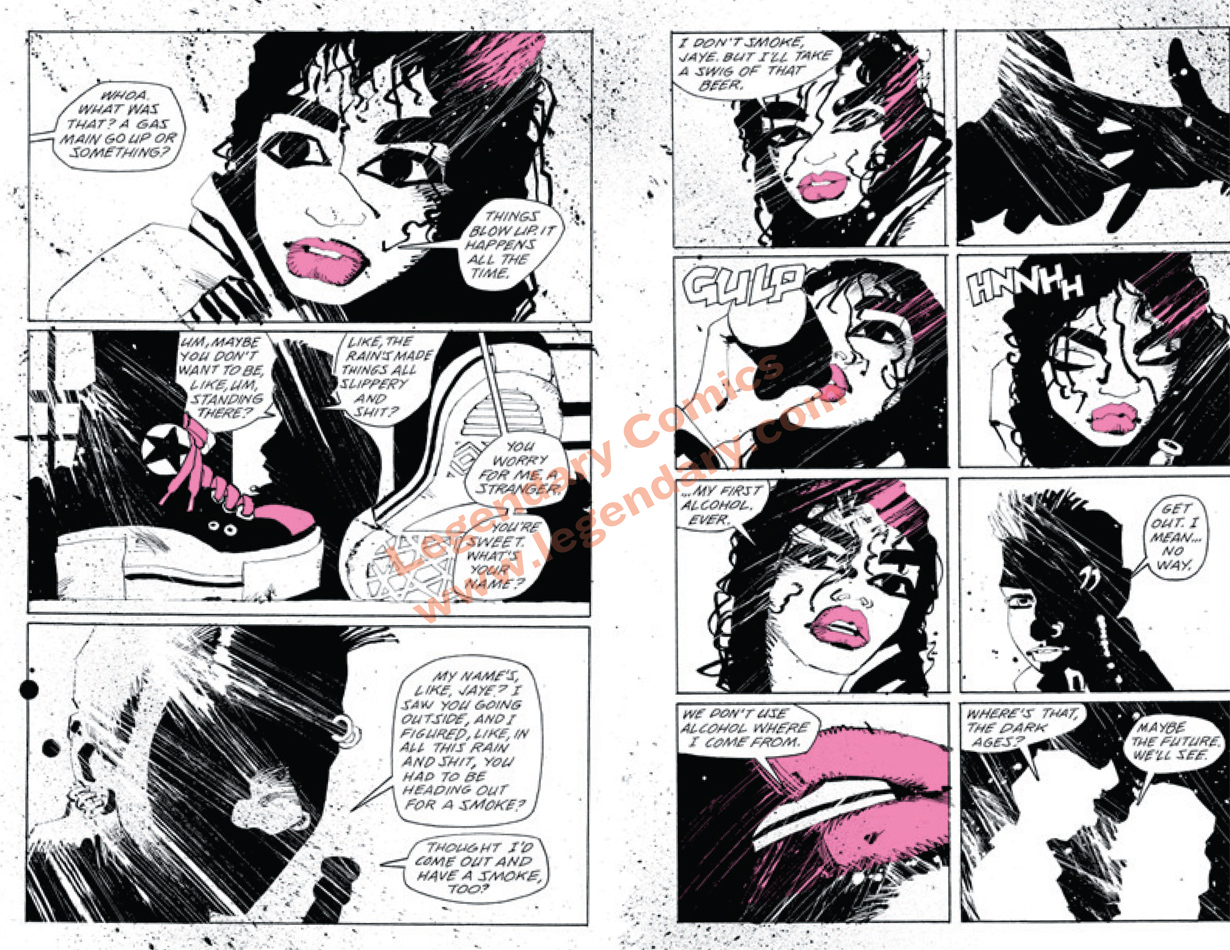
With all those failures, how does Starlin also manage to fail in the realm of the mythopoeic?  Well, putting aside all of the artist's phony-baloney attempts to reproduce the effects of ceremonial magic, the core of the story is seen below:


See, after Taurus explains everything he's done to make Darklock into a super-magus for this future crisis, the villain reveals that Darklock can only obtain his super-magic if he sacrifices the thing he loves most, which happens to be Sister Marian. 

Given the numerous indirect references to Christianity throughout the story, it's impossible not to read Marian's death as a reference to Christ's Passion-- except that this time, it's the Serpent who gets the upper hand:


Now, if Starlin's protagonist had asked Marian to sacrifice herself, and she had agreed, then that might have worked in one fashion or another, be it as a serious *imitatio Dei* or as a satirical version of same. But because Darklock does not give Marian a choice-- and yet he isn't abrogating to himself any superior freedom to act with cruelty, as one might argue of Agamemnon sacrificing Iphigenia-- Starlin's murder of "what he loves most" comes off as shallow in its self-aggrandizement. I've critiqued on various occasions the thin-skinned gender-complaints summed up by the trope "women in refrigerators." But even if I'd cross off the names of a lot of female characters on the "WIR" list, Sister Marian would probably remain on it-- and maybe even move to number-one position.

The real price of THE PRICE was the one this work levied on Starlin's capacity as an artist, since I'd argue that he never subsequently lived up to his initial potential.

MYTHCOMICS: THE NEW GODS SAGA (1971-72 / 1984)

…the gods are ever near—a part of men’s lives!! Giant reflections of the good and evil that men generate within themselves! —Orion, NEW GODS #10, 1972.

In my attempt to create a serious novel for our medium, I have chosen that most basic of experiences, one we have all shared at one time or another—survival! I have taken this innate response to danger, and have portrayed it in mythological terms.—Jack Kirby, “Kirby on Survival,” NEW GODS (vol. 2?), #6 (1984).

A handful of comics-artists working during the 1960s took special notice of the success of J.R.R. Tolkien’s “Middle-Earth” works-- not least among them Jack Kirby, one of the founding talents of the medium. Though the most famous work in Tolkien's fantasy-cycle was published in the 1950s, THE LORD OF THE RINGS did not achieve best-seller status in America until the mid-1960s, when the trilogy was re-packaged into paperback-book format by Ballantine Books.

 American comic books had been mining the themes of mythic good vs. mythic evil for many years prior to Tolkien's rise to international fame. So even though comics-professionals—including Kirby—might not have specifically pursued Tolkien’s themes, some comics-pros sought to find out if comic books could also follow in Tolkien's successful footsteps by creating a “secondary world” with a mythology-derived basis.


I cannot, in one blogpost, cover the complexity of Jack Kirby’s “Fourth World” concept—a tetralogy of sorts, which extended over four regularly published comics-titles—nor the business-based complications attending the epic’s cancellation in 1972 and its resumption in 1984. I also won't touch on three of the books that contributed to the epic tale: FOREVER PEOPLE, MISTER MIRACLE, and JIMMY OLSEN. The strongest mythic discourse of Kirby’s tetralogy appeared in the title NEW GODS, so that is my subject here. This comic-book epic is comprised of eleven stories published in the early 1970s, and two stories published in 1984: a new 48-page story that appeared as part of a reprint collection and a softbound graphic novel, THE HUNGER DOGS.

No one living knows how Kirby might have concluded NEW GODS in 1972 had he been given the chance to do so, or whether that conclusion would have strongly resembled the one he wrote and drew for the 1984 resumption. But the delay may have been fortunate. In the days of newsstand comics, it was rare to see any series conclude on a definite and coherent end-point. American comic books were designed to be indefinitely open-ended, and when a comic proved unsuccessful, the feature simply ended, usually with no effort at a send-off, much less a resolution. Many critics have sneered at the open-ended approach on aesthetic grounds, but it engendered a creative response that had its own peculiar power. Comics-professionals had to be peripatetic creators, constantly shifting from one bizarre image or motif to another, always with the aim of capturing the short attention span of juvenile readers. Jack Kirby was an early master of the peripatetic mode, possibly the most accomplished of his generation, in that he excelled in almost every genre popular in newsstand comics: war, crime, superheroes, science fiction, and even romantic tales.

But though the peripatetic mode allowed for great fluidity of myth-concepts, it didn’t allow for much coherence, except for what one could expect from a self-contained short story. I’ve cited examples of Kirby co-creations that managed to consummate their mythic discourses, here and here for example, while others, like this one and this one, were not so successful. In Kirby’s mind, he may have been creating a “serious novel,” but he had to frame it in terms that the market would recognize. 


Because of these market considerations, most of the stories in the NEW GODS mythos, the ones published in 1971-72, have been accurately critiqued for its rambling plots and problematic characterizations. Both of these circumstances were the result of long-standing creative habits Kirby had developed in his thirty years as a professional.

But where NEW GODS excels is in Kirby’s take on a theme that Tolkien himself had evoked. In a world where mythic good and mythic evil have palpable existence, and where their battle is the proper working-out of their joint destiny, how does good keep from becoming corrupted by the power of evil?


The book’s hero Orion embodies this conflict. Long before his birth, a major war erupts between the gods of good, who live on the vernal planet New Genesis...


...and the gods of evil, who dwell within the dark Satanic mills of Apokolips. 


Darkseid, a Machiavellian plotter who eventually becomes supreme ruler of Apokolips, engineers his world’s war with New Genesis—and then belatedly realizes that he stands to lose as much as his opposite number, Highfather of New Genesis. Highfather comes up with a way to end the conflict: the two leaders exchange their children as what Kirby calls “war hostages.” 


Thus Scott Free, the genial son of Highfather, is brought up in the infernal domain of Darkseid, while Orion, who inherits a savage disposition from his father and mother, is raised among beings who strive to rise about hate and violence. Scott Free eventually flees Apokolips and takes refuige on Earth, where he becomes the costumed hero Mister Miracle. However, the plotlines of his feature have only an indirect influence upon the NEW GODS continuity. NEW GODS focuses upon Orion, who suspects from childhood that he is the spawn of evil, though only during the renewed god-war does he learn that he is the spawn of Apokolips’ ruler.


On top of all that, the new war descends to the mortal world of Earth, for Darkseid has discovered a new means to exert his dominion: “the anti-life equation,” a quasi-mystical mental power that dwells within the brains of certain Earthpeople. Darkseid pursues a variety of strategies to detect the hidden power, and Orion seeks to stop him.

Yet, though the anti-life equation is a strong parallel to that of Tolkien’s One Ring, Kirby’s conclusion is quite different. The equation is something of a “McGuffin” sought by both good and evil powers, and it does not influence the struggle between Orion and his father. Indeed the equation is barely mentioned in Kirby’s long-delayed conclusion of his epic. Significantly, the evil of Apokolips is unable to conquer the good within Scott Free, in contrast to the way the Ring overmasters Frodo at the conclusion of LORD OF THE RINGS. Yet though Orion is tormented by his alienation from the pacific gentleness of New Genesis, he becomes the right hand of his new father and repeatedly renounces the old. Ironically, though Darkseid spawns Orion upon a wife forced on him by political considerations, and another son, the brutal Kalibak, upon a woman he Darkseid actually cherishes, Darkseid regards Kalibak as no more than a useful tool, and in issue #11 he flies into a fatherly rage when one of his aides, without his permission, almost kills Orion.

The 1984 story from NEW GODS #6 concludes in an anti-climactic manner compared to most good/evil battles in comic books. The final battle between Orion and Darkseid is foregrounded from the very first, but instead of Orion obtaining a martial victory, Darkseid springs a trap and apparently slays Orion. Yet the hero’s body disappears from sight, and the story concludes with a caption observing: “Who among us can convince the evil? Unmoved by guilt, they forever live with doubt!” Kirby’s phraseology is awkward, but it communicates a salient message: that the evil are not blessed by their lack of guilt, but that doubt, the perpetual fear of external retribution, takes the place of guilt’s internal monitoring.


HUNGER DOGS, though it suffers from various narrative problems, follows through on the theme of good finding a way to survive evil’s depredations. Some time after Orion’s apparent death, Darkseid manages to infect New Genesis with a species of “toxic rot.” Apokolips’ technology enters the computer age, and even Darkseid himself is flummoxed by the innovations of the artificial intelligence “Micro-Mark” (not one of Kirby’s better cognomens). Darkseid feels misgivings at the over-mechanization of his infernal domain, and he fears being superseded by “the voice of a pygmy—too small for the eye to see.” 


Orion storms Darkseid’s redoubt and destroys the Micro-Mark before it can discover the anti-life equation, but it’s Highfather on New Genesis who most decisively checkmates Darkseid’s technological superiority. Instead of assailing Apokolips itself, Highfather and all of his godly kindred flee their world in a flying city, just before the planet of New Genesis blows up. The planet’s detonation sparks a revolt from the underclass of Apokolips—the “Hunger Dogs” of the title-- and in the confusion, Orion is able to free his mother from Darkseid’s prison, and to escape Apokolips with both his mother and his newly introduced girlfriend Bekka. It’s stated that Darkseid will eventually quell the revolution, but that now, without the “sister planet” of New Genesis to bedevil, the overlord has become confined to his own “self-made prison of suspicion, hate and murder.” In contrast, the denizens of New Genesis survive on their own terms, pursuing a new destiny free of their evil mirror-image.


This summary does not by any means exhaust the many myth-motifs containing in the NEW GODS continuity. But it should be evident that even if Jack Kirby did not create anything like a “serious novel,” he nonetheless articulated a masterpiece of modern myth.