Featured Post

SIX KEYS TO A LITERARY GENETIC CODE

In essays on the subject of centricity, I've most often used the image of a geometrical circle, which, as I explained here,  owes someth...

Showing posts with label batman. Show all posts

Saturday, September 19, 2026

WEST FAILURE

 I came across this silly bit of trivia today:

How Adam West made the 'most comic book accurate' Batman version - AOL

Though the late Adam West is not quoted, I'm reasonably sure that I remember hearing the actor make this claim something like fifteen years ago. And no, it's not true that BATMAN '66 was the "most comic book accurate BATMAN version."


I love Adam West's work on the show. Fans will never know how much instruction he got from the writers and producers as to how to play "camp Batman." Yet, whatever guidance they gave West cannot take away from his own actor's instincts as to how to make such a fantasy-character seem consistent on its own terms. One has only to look at the test footage Lyle Waggoner did for the Caped Crusader to see how the showrunners lucked out in getting West and his faux-urbane persona (which had admittedly already appeared when the actor portrayed "Captain Q" for the NESTLE'S QUIK product).


All that said, I doubt Adam West ever did more than flip through a few of whatever comics ABC gave him. That's entirely appropriate for the job he was hired to do. But no fan of the period would agree that the TV show reflected the comics, either from the Julie Schwartz era (which was ongoing during the run of the TV show), or from the Jack Schiff editorship that had prevailed for roughly the previous nine years. (Schiff was a Batman editor before that, but I regard his tenure on the feature from 1955 to 1964 to be in its own category since everything after 1955 was in part a response to the newborn Comics Code.) Since the Scwartz era emphasized sober ratiocination as the heroes tracked down criminals-- even if they dressed like scarecrows or penguins-- West *might* have seen some of the generally wackier Schiff comics, so that he drew the conclusion that they were typical of all sixties Batman comics. Hence the "comic book accuracy" fallacy, whether it comes from West or anyone else.

I frankly don't know why anyone would make the claim. BATMAN '66 was successful, at least briefly, because it was its own animal. Producer William Dozier is credited with the idea of infusing the show with the sort of camp/pop art aesthetic that was enjoying popularity in the fine arts; Dozier just transferred the same highly-ironic approach to a show based on juvenile "commercial art."

Neither BATMAN comics nor any of DC's actual humor comics of the period had the slightest conception of irony. I've never seen a DC humor comic from the sixties or earlier that was anything but baggy-pants comedy. The closest the company came to irony was National/DC's acquisition of MAD Magazine in 1964. Some post-Code Schiff BATMAN stories are deliberately wacky in that baggy-pants manner, particularly the notorious Bat-Mite stories. But the ironic approach that made the series popular was not "comic book accurate." That's why dozens of staunch Bat-fans, whether juvenile or middle-aged, didn't like the TV show, and often expressed their disdain in the letters-pages of BATMAN titles, and even in related titles like JUSTICE LEAGUE.

The AOL article is just fluff and its writer seems to have done zero research on his subject. But he didn't need to make false statements about BATMAN '66 to build it up, because the truth is much more interesting.   


Sunday, July 19, 2026

DIDACTIC DOWNSIZING

 This may be a minor categorizing matter even to me, but if nothing else it's another excuse to explore a recurring question: how do the two "vertical values," the didactic and mythic potentialities, sometimes come into conflict?

In 2015 I wrote:

these examples raise another point: are only the "big events" worth considering in a pluralist "best of" list? Further, to extrapolate from a point Martin makes: are the first appearances of Batman's iconic villains their best "aesthetic" moments? Is the first Joker story the one every comics-fan ought to read? Will it tell the non-hardcore reader everything he wants to know about the Joker? Or would the reader be better off reading a less Gothic but arguably more "aesthetically pleasing" story like "The Joker's Millions" from DETECTIVE COMICS #180 (1952)? -- REFLECTIONS IN A MERCURIAL EYE, PT. 1.

This essay didn't concern the potentialities, much less the even later concepts of "ontocosm and epicosm," but the subject of "big events" showed up in a 2025 essay that did include such matters:

On a related note, while I was looking at my "greatest crossovers" series on OUROBOROS DREAMS, it occurred to me that my criteria for greatness were certainly not primarily epicosmic. There were some crossover-stories with strong vertical elements, like JIHAD and THE BOOKS OF MAGIC. But for the majority of my choices, I believe I responded to the elements of lateral storytelling. Thus I included Spider-Man's first encounter with The Avengers on the basis of both kinetic and dramatic elements, while the wall-crawler's first meeting with the Fantastic Four was, in a word, forgettable in ontocosmic terms. Other times, I might not think the lateral story was all that good in itself, but that it comprised some landmark crossover-event-- the first time the Avengers met the cowboy-heroes of Marvel's Old West, or that GAMBLER movie that brought together a dozen or so actors to play either real or simulated versions of their TV-characters. In these stories, it wasn't so much the actual execution of the concept but its potential that I found intriguing. -- A TALE OF TWO COSMS.


Now I'd say that I was incorrect to attribute, in the COSMS essay, my favoring of "landmark" crossover stories to lateral values-- even "potential" ones. If I've celebrated THE GAMBLER: LUCK OFTHE DRAW as a landmark crossover, while admitting that its lateral values are not that great-- then there must be some other factor that made me celebrate it alongside "To Become an Avenger," which did have such lateral values.           

So, while reconsidering the origins of my own take on "landmark stories," I happened to think of the REFLECTIONS essay, in which I was to some extent opposed to celebrating so-so "landmark stories" (Joker's first appearance) over better-crafted tales ("The Joker's Millions"). Why did I do in one essay what I faulted my "opponent" for doing? Well, because a liking for landmarks comprises an intellectual shorthand. "First Joker story," "first and only mega-crossover of TV westerns"-- these are quick ways of assigning didactic value to a particular story in terms of "making a breakthrough." Such a prioritizing is not exactly "wrong," because it also relates to the way the populace often judges stories. It's simply a very limited form of didactic thinking that can be incorporated into a wider perspective.           


Wednesday, July 8, 2026

NEAR-MYTHS: "THE SUPER-FOES FROM PLANET X" (WORLD'S FINEST #96, 1958)


I've written elsewhere about how science fiction content increased in the "Superman Family" books of the late 1950s, but I confess I usually wasn't factoring in the WORLD'S FINEST comic, which began co-starring Batman and Robin with Superman. starting in 1954. I can't see how this feature could have been ruled by the alleged dictum to make the SUPERMAN titles resemble the 1952-58 ADVENTURES OF SUPERMAN, though I may be prejudiced in that I saw heavy SF-content in the reprints I saw in my youth. Only a thorough study of the feature during the 1950s would answer the question one way or the other.

The only credited editor on WF 96 is Whitney Ellsworth, though the real work may have been any of his subordinates, such as Jack Schiff, who in these same years had been persuaded to insert more aliens into his two BATMAN titles. Most of these Bat-tales are not well regarded. But what didn't work well in the chronicles of the Dynamic Duo had often charming results for the "World's Finest" team, particularly thanks to the combined talents of writer Edmond Hamilton and artist Dick Sprang. 

Hamilton, one of the great space-opera writers of SF's Golden Age, outdid himself in "Super-Foes" with colorful alien monsters to test the united talents of Dynamic Duo and Man of Steel. Three times a disembodied voice warns the heroes of extraterrestrial menaces, starting with the "Solar Sponge."


On Batman's advice, Superman overloads the Sponge with amplified solar power. Then the voice warns of the menace of The Storm Top. a colossal whirligig that can whip up sea-tempests.


  The heroes send the Top spinning off into space (hope it doesn't land on J'onn J'onzz's Mars, or something). The voice then directs the good guys to a third locale, where they meet The Crawler, an insect that can make humans shrink with its antenna-vibrations.


  Once again, even in miniscule forms, teamwork vanquishes the ornery arthropod. Then the voice summons the heroes to yet another locale, where, after a little more trouble, they learn what's going on-- though it doesn't make a lot of sense when read by an adult.

So the sentients of Planet X lost the power to repair many of the machines with which they'd defended themselves from their world's natural predators. Ok, the message about not becoming too dependent on technology is okay, but the delivery needed some work. What Hamilton proposes is that despite the Xians' lack of overall knowledge, they conveniently retain the knowledge of how to operate one of their starships and to load it with specimens of Planet X predators for the Earth-heroes to overcome. The aliens' rationale for setting up the creature-fights is almost a recapitulation of the WORLD'S FINEST team's raison d'etre: having been given graphic examples of how nonpowered and super-powered heroes work together, the Xians claim they'll train themselves like Batman and Robin while having their robots perform super-feats. Of course, the real reason for the complicated deception was to intrigue the reader. And even at my current age, I found myself intrigued with the question of who started the trope of "hoax perpetrated by well-meaning types rather than thieves/murderers." But that's a question for another essay.         

Sunday, April 19, 2026

ACTIVE AND PASSIVE ANOMALIES PT 3


Arguably a lot more uncanny narratives invoke passive potency than do marvelous ones...-- ACTIVE AND PASSIVE ANOMALIES PT 2.

Aesop's famous tale, "The North Wind and the Sun," has often been used to describe the difference between "active power" and "passive potency"-- more typically known as "force and persuasion." The titular wind and sun make a bet as to who can make a certain mortal man take off his coat. The wind bombards the man with chilly gales, but that manifestation of force only makes the fellow clutch his coat around him more tightly. Then the sun slowly increases his heat-- and in due time, the man removes his coat of his own volition.


I just lied a bit, for effect. Both of the sky-entities are exerting force/active power; the sun's exertions are just subtler. A true illustration of passive persuasion might involve the sun assuming the appearance of another mortal, and in that form, he could mess with the coated man's head, suggesting how hot it was, until the power of suggestion caused the guy to remove his garment. Since the folktale-sun would not be exerting direct force, only indirect persuasion, my ad hoc revision of Aesop would fit the category I've termed "passive potency." The example loosely parallels that of Mulan's supernormal allies cited in ANOMALIES PT 1, who don't give the heroine any active aid, only bits of information or (often unhelpful) advice.      

In the quote above I mentioned the generalization that "the marvelous" most often deals with "power" and "the uncanny" with "potency," and in many past essays, I've drawn the distinction between marvelous and uncanny as that of "reality" and "fantasy," as in this statement from 2015's OUTRE OUTFITS OVERVIEW: 

When attire is not actually marvelous-- that is, when it does not confer marvelous power on a character, like Iron Man's armor-- it must conform to the rules of causal coherence. However, it can still be "uncanny" rather than "naturalistic" on the terms cited in POWER AND POTENCY PT. 2.  It's not that clothes "make the superman," as they do with Iron Man. But if they are uncanny, they can make the man SEEM LIKE a superman.


This is not so much a rule, though, as a broad generalization with respect to all twelve of the "uncanny trope" categories I devised.  (Tangentially, it doesn't look like I've done any surveys of all twelve categories here since 2014's THE INTELLIGIBILITY QUOTIENT PT. 2 -- and that was written before I severed the "outre outfits" category from those of "superlative skills" and "diabolical devices.") At present I can't think of any uncanny costumes that confer "passive power." They only confer "passive potency," in that they persuade witnesses to deem the wearers to be larger-than-life representations of justice or of corruption. 

However, in Part 2 I briefly referenced Tarzan. He doesn't "seem" like a superman within the uncanny domain; he would only "seem" like a superman if compared to a superman from the marvelous domain. But Tarzan possessing the utmost strength and speed attainable to a human makes his skill "superlative." Both Tarzan and Superman possess "active power" despite their disparate phenomenalities, while the previously mentioned Major Victory has only "passive power" by virtue of having been restored to life after his death. "Passive potency" applies to beings that may be marvelous or uncanny, but who operate more on the level of suggestion. Mulan's dragon is marvelous but cannot do anything beyond the level of "persuasion," and every hero who dresses up in a non-powered uncanny costume is using the art of persuasion to make himself seem more than normal. 


Finally, the best examples of "passive power" would seem to be in the category of "diabolical devices." As originally conceived, the Batarang was just a fancy version of a naturalistic boomerang, and so it possesses the same level of power when used. Aside from that usage, the Batarang can't do anything but look a little cooler than a regular 'rang.


However, if Batman attaches any sort of specialized tech to his Batarang-- even something as relatively simple as a smoke-bomb-- then it's no longer functioning as a boomerang, and the tech-addition registers as "active power" once more. Fin ally, examples of "active potency" are rare by my reckoning, with the most fruitful category being that of "enthralling hypnotism," since hypnotists are using specialized skills of persuasion. Somewhat similarly, the metaphenomenon that started these ruminations-- a Chinese doctor's use of weird acupuncture in LEGEND OF FRENCHIE KING-- coheres with active potency, since the doctor was working with his patient's "chi meridians" to produce a curious metaphenomenal effect.

ADDENDUM 5/28/2026: I just rewatched and reviewed MULAN, and I have to amend my above statement a bit. Mulan's ally, the dinky dragon Mushu, does render a little real physical assistance, but only because Mulan is smart enough to use his tiny flame-breath to light and fire her mini-cannon. But whether Mushu's minor power is active or passive in nature, his presence still places her within the superhero idiom. 


Thursday, April 16, 2026

MYTHCOMICS: "ENDS OF THE EARTH" (ALL-STAR BATMAN #6-9, 2017)

 The stories that endure? The "demons" that win? They're the ones that speak to who we want to be. Not the ones that scare us into being who we don't. They're true because we want them to be badly enough that we MAKE them true. -- Batman to Ra's Al Ghul, ENDS OF THE EARTH FINALE.  

A tagline on the back of the TPB reads, "This is not a Batman story. It's a villain story." It's a reprise of a line Ra's Al Ghul speaks to Batman, albeit in his Bruce Wayne guise, as part of a climactic dialogue between the two enemies. Yet it's not true, and I suspect writer Scott Snyder knew it wasn't true when he wrote the line. For roughly the last fifty years-- the period in which fans became the dominant writers of superhero comics-- an identity between the Dark Knight and his gallery of grotesques and arabesques has been irregularly suggested. The "old pros" of BATMAN's first thirty years probably would have found this imputation of identity too metaphysical, whether one was addressing the creator of Poison Ivy (Robert Kanigher), Mister Freeze (Dave Wood), or the Mad Hatter (Bill Finger). Denny O'Neil, one of the first of the fans to turn pro, possibly understood the identity-dynamic when he created Ra's. Yet Bill Finger seems to be the driving-force behind the dynamic-- Finger, who tapped the power of psychological obsession for heroes and villains to an extent not seen in earlier media like pulps and serials. I commented on this common element in my 2020 essay, THE BAT-BACHELOR THREAD.

Plot-wise, ENDS OF THE EARTH is in many respects a standard Bat-villain team-up. Ra's is trying once again to wipe out much of the Earth's population. He suborns the talents of Mister Freeze and The Mad Hatter. Batman interferes, this time with some assistance from Poison Ivy. Snyder injects some elements that are probably original to his take on the Dark Knight-- an armored adult partner named Duke (whom I found tedious), and some new iteration of the Blackhawks. But Snyder surely knew he was selling his particular take on four of the celebrated rogues, by delving into their obsessions as the hero seeks to take them down.


Mister Freeze is one of Snyder's best conceits, with the writer framing Victor Fries' apocalyptic nihilism as springing from a childhood reading of Robert Frost's "fire and ice" poem-- and thus not purely a consequence of his quest to restore the health of his cryogenically preserved wife. In the service of Ra's Al Ghul, Freeze has perfected world-killing spores in his Arctic sanctum-- and even though Batman knows that a squadron of The New Blackhawks plans to firebomb the frigid fiend's laboratory, the Knight is compelled to get there first. Perhaps Batman feels he must be sure of ending the threat up close and personal. Perhaps he still pities the demented scientist, despite his murderous project. Or--

--Maybe Batman just wants to vanquish the cool, cruel villain with his nemesis, that of "heat." I frankly don't know what the propensity of real bats to generate high levels of body heat has to do with Batman using his own anti-virus to destroy Freeze's spores. But it does give the villain the chance to imagine his apocalyptic world of icy stillness ending in a cataclysm of fire.


The hero's triumph is mitigated in Part Two, in that some of the spores escape destruction, and so Batman must seek the help of another old foe. This time the Princess of Plants is off in some wasteland, conducting her biological experiments for the love of pure science. Knowing that Ivy's feeling for humanity is strained at best, Batman still seeks to prune knowledge from his enemy-- while additionally, for some vague reason, the Blackhawks menace Ivy as well. Ivy does help Batman after a fashion, though she makes him listen to a lecture about a supposed true ancestor to the legendary Tree of Life. If Freeze looked forward to a still, cold world of the future, Ivy is by comparison a being who seeks truth in the imponderable world of life's pre-human origins.


But Ivy's aid only slows the fatal influence of Freeze's spores. Batman uses his detective skills to track down a corporation that helped Freeze in some unspecified way and finds himself in the Carrol-esque domain of The Mad Hatter. Freeze and Ivy might not see themselves as aspects of Batman's own psyche, but the Hatter is an enthusiastic advocate of solipsism. But there's only one fantasy to which Bruce Wayne is beholden to, and that's "the window moment," the moment when he saw a bat come into his window and beheld the metaphor to which he dedicated his life.


And so, the Hatter, despite his love of fantasy, provides the real-world clue that leads Batman to confront Ra's Al Ghul in America's capital. The hero doesn't seem to make much of how he found several of the Blackhawk agents working with Hatter, and for all the reader knows, Batman learned nothing from them. He knows only that their confederates are holding Duke prisoner and planning to execute him at a particular time-- as if the threat of Ra's to exterminate half the world isn't sufficient to motivate the crusader. There's a confusing scene indicating that Batman gets Catwoman to masquerade as Batman to draw the villain's fire, and overall this segment doesn't show Ra's at his best. Still, the dialogue describing their conflicting visions-- one demon-haunted, the other haunted by a vision of perfectibility-- makes the more baffling details less worrisome.         

And so ends ENDS OF THE EARTH. Snyder packed in far too many extraneous details to make ENDS an outstanding Bat-story. (For instance, the last section reveals that the Blackhawks weren't working for Ra's after all-- so why were they working with Hatter?) But I can appreciate that Snyder and his five artist-collaborators went the extra mile to spin a new story of the hero and the villains who define him.    
        

Saturday, February 7, 2026

COORDINATING INTERORDINATION PT. 4

 At the end of Part 3 I wrote: "Having addressed here the structural differences of monads and serials in terms, Part 4 will deal only with the interordination of icons within differing narratives."  

The icons within both pure and impure monad-works alike are judged solely by qualitative escalation. IVANHOE, unlike OLIVER TWIST, is an impure work because it includes alongside its completely fictional characters the legendary Robin Hood and his merry band as support-characters to Ivanhoe, as well as the historical figure of Richard the Lion-Hearted. But Robin and Richard exist only in the novel as Scott's fixed portraits of them. All of the icons in IVANHOE have a default valence of BASAL ICONICITY.   


Serial-works, whether by one author or several authors, have the ability to evolve over time, which means that the status of icons may change in many ways in terms of both forms of escalation. Serials that possess an ensemble of Prime icons need not be as inflexible as those with a solo protagonist; a character in the ensemble may be killed for any number of reasons without affecting the longevity of the series. If anything, the termination of the character Thunderbird during the early issues of "The New X-Men" probably benefitted the series in terms of making the other characters seem more at-risk. Yet because Thunderbird appeared in two ensemble-stories before he was killed, he possesses ELEVATED ICONICITY-- an elevation due entirely to quantitative escalation in his case.         

I've mentioned earlier that the prose icon of Fu Manchu possesses durability born of both qualitative and quantitative escalation. The first cinematic adaptation of the character in film's sound era, though, possesses only the quantitative type, consisting of just three rather cheap films from Paramount Films in 1929, 1930, and 1931. Moreover, in the third and last film, DAUGHTER OF THE DRAGON, Fu Manchu is slain early in the movie, because the script downgrades him to support-status in order to make his daughter Ling Moy the Prime icon of this installment of the series. I doubt that this people behind this low-budget series planned for any more appearances for Ling Moy when they began the project; they were probably simply told to play up Fu Manchu's daughter because Rohmer's book DAUGHTER OF FU MANCHU was being sold around the same time. As the star of a single film, Ling Moy would, like Ivanhoe, possess only BASAL ICONICITY. However, she like Ivanhoe would still possess stature, rather than charisma, even though Ling Moy was just a knockoff of Fah Lo Suee, a character who in the Rohmer books was only a charisma-type, and who never became a cultural touchstone as her prose-father did.

The distinction between base and elevated forms of iconicity is particularly important in serials wherein Sub icons make repeated appearances. Almost none of the canonical Sherlock Holmes stories contain "repeat offenders" among Holmes' foes, and the celebrated Professor Moriarty only escapes sharing the lowly basal status of Stapleton and Grimesby Roylott by having full appearances in two Doyle stories-- even though one of them is a prequel to the story in which Moriarty appears to bite the big one. Other prose serials toyed with bringing back favorite villains to oppose series-heroes, though it would seem that no one exploited "elevated iconicity" for Sub icons as thoroughly as did Golden Age comic books.      


A Sub icon who appears only once can only possess Basal Iconicity with respect to quantitative escalation but may take on greater durability in terms of qualitative analysis. The Death-Man, who made his only appearance in BATMAN #180 (1966), was never meant by his creator to have any future appearances, and indeed he's only been "bought back" in a couple of later iterations that may not be identical with the original evildoer. Most Bat-fans did not want to see Death-Man keep returning like Joker and Penguin, because Death-Man's only schtick was that of making himself appear to have died-- something he only did so to cheat the executioner. The single "Death-Man" story also does not give him more than basal iconicity, but he does have durability in Batfan-circles because of the perceived high quality of the story.      


The rule of "one doesn't count but two does" can be illustrated with two other Bat-foes, but from the '66 teleseries. In one episode, "The Sandman Cometh," Michael Rennie makes his only appearance as master crook Sandman. This episode counts as a "villain-mashup" since Sandman teams up with Catwoman, a high-charisma "repeat offender" in the comics and one who'd been the main Bat-enemy in three previous episodes. But because Sandman possesses only basal iconicity, it's not a "villain-crossover." 


However, though Sandman is not more than an average one-shot villain-- not nearly as good as either False Face or Chandell-- he gets outscored in terms of iconicity by two-timer Olga, Queen of the Cossacks. She like Sandman first appears in the company of an established Bat-foe-- though Vincent Price's Egghead had only made one previous appearance-- and if she'd never appeared again, she would have stayed at the basal level. But the "Olga-Egghead" team made one more appearance, and so she earns the "elevated" level. (And since I brought up qualitative analysis before, Olga's maybe a little better than Sandman, but not anywhere as bad as Anne Baxter's previous one-shot evildoer, Zelda the Great.)      

More on these matters as they occur to me. 


Thursday, July 3, 2025

HOSTS, HEAVENLY AND OTHERWISE PT. 3


I started thinking once more about the topic of "story-hosts" after re-reading Batman's visit to "The House of Mystery" in BRAVE AND BOLD #93, courtesy of Denny O'Neil and Neal Adams. In a previous installment of this essay-series, I had talked about how certain issues of that rotating team-up title, because those stories paired Batman, a superordinate icon, with such subordinate icons as The Joker, the Riddler and Ra's Al Ghul, none of whom have ever progressed beyond the subordinate level (in contrast, say, to a rare character like The Catwoman, who made her superordinate mark in the 1990s and who has kept that stature thereafter). 


But at least all of the villains so featured were actual icons. In the story "Red Water, Crimson Death," the two "headliners" are Batman and Cain from DC's "House of Mystery" title-- but not only do they not interact with one another, the latter character has, as far as this story is concerned, no power to interact with Batman or anyone else. He might best be termed a "null-icon" here, as he is in most if not all of the horror-stories he hosted. Thus, in contrast to what I wrote in COSMIC ALIGNMENT PT. 6, in all such narratives Cain would be neither Prime nor Sub. I'm aware that he becomes a Sub in the SANDMAN comic, which parallels what I also wrote in the above essay about the EC story "Horror Beneath the Streets." In that tale the three EC horror-hosts come into "reality" to berate the comic-book makers-- but only to make the humans assign the hosts to their already established venues. Technically they are Primes and the comic-book authors are Subs-- though the categorization is made more difficult in that story-hosts are essentially identical with their authors. They serve the same purpose as omniscient narrators, but as "null-icons," they convey a sense of personality absent in such narrators.


So in my book, "Crimson" is essentially a Batman story, concerning his adventure when he tries to take a vacation from being Batman. He meets a young Irish boy, Sean, during an ocean voyage , and though Bruce Wayne has no idea that Sean is involved in a criminal case, he ends up accompanying the boy back to his small fishing-isle, and thus, getting some necessary exposition-- and an introduction to a supernatural manifestation.          


I won't recount the whole story here, but suffice to say that there's a human agency behind the so-called "red tides" and the never-specified deaths of Sean's parents. However, there's also a superhuman agency that manipulates the Gotham Guardian into intervening to capture the criminals and save Sean's life. And yet, though as scripted this is a Batman story, with no crossover elements, O'Neil and Adams structured the tale as the sort of thing that could have run in HOUSE OF MYSTERY. And suppose that it had been reworked to be just such a story, with Batman ejected and replaced by just some basic one-shot viewpoint character? Then the centricity would have shifted from that POV type to either King Hugh, the ghost that renders aid to the boy's protector-- or even to Sean, since O'Neil's backstory slightly suggests that the boy, still grieving for his lost parents, may have subconsciously summoned the spirit of his dead relative to enact vengeance.


Wednesday, May 14, 2025

MYTHCOMICS: BORN TO KILL (BATMAN AND ROBIN 1-8, 2011-12)


Not long after Grant Morrison finished his run on various Bat-titles with DEMON STAR, writer Peter J. Tomasi and artist Patrick Gleason launched a new BATMAN AND ROBIN title. The first eight issues continued Morrison's narrative regarding the Caped Crusader's relationship to his ten-year-old son, whom Batman agrees to train as the New Robin. And just as Morrison rewrote some elements of the 1987 SON OF THE DEMON story for his narrative, Tomasi did the same for Morrison. In SON, Batman has a consensual love affair with Talia Al Ghul and departed without knowing he'd left a bun in her oven, after which Talia put up the child for adoption. Morrison revised this scenario, in which Talia drugged Batman into having sex with her and thus knocking her up, and then kept the child Damien, but raised him as one of her assassins, capable of killing without remorse. Tomasi alludes to the copulation but implies that it was once more consensual. Tomasi may have done this because he wanted to de-emphasize Talia's role in the molding of Damien in order to better focus on the main conflict of the BORN TO KILL arc: how does a crimefighter dedicated to fighting evil without killing evildoers get through to a young boy who's been taught to "destroy your enemies before they destroy you?"                       

                           
A short prelude introduces the reader to a new Bat-enemy: a professional assassin named Nobody. He targets one of the various "international Batmen" whom Bruce Wayne funded during the Morrison run, and the killer later comments that the appearance of a particular European Batman provoked Nobody to journey to Gotham for a confrontation with the original. This event takes place around the same time as Batman's annual pilgrimage to Crime Alley, to venerate the memory of his slain parents. He encourages Damien to go along for the first time ever, and the boy does so, though he complains of his father's "sentimental nonsense." In truth, Damien desperately wants his father's approval, this being the reason he set himself to become the New Robin. However, the apple has not fallen far from the tree, for like his father Damien also does not like to admit needing anyone but himself. For Batman's part, his new role as a parent may have moved him to break with tradition for the sake of the future. He tells Damien that he will no longer honor the date of his parents' hideous deaths, but rather the date of their wedding, as a means of celebrating life. Batman concludes his last vigil in Crime Alley by taking a memento of that fateful night-- a ticket or brochure from the movie Bruce Wayne and his parents before the latter two perished. He makes the keepsake into a paper boat and watches it sail off into the sewer-river beneath Crime Alley.                                                                                                                                                                
Shortly thereafter, Batman and Robin contend with a gang of gunrunners. The criminals appear to get away but in truth they're caught and killed by the newly arrived Nobody. The villain makes a telling reference to his earlier slaying of the Euro-Batman, whom he regards as part of the crusader's "new global circus act." (Was the "circus act" metaphor a Dick Grayson reference?) Meanwhile, Bruce Wayne frets about Damien's barely repressed tendencies toward homicidal violence. The hero wonders if he's as perverse as Talia, for though Batman was born to prevent other children from meeting terrible fates, he shows an uncanny penchant for attracting younger people to serve in his crusade. But soon Batman has bigger problems, as he encounters, for the first time in many years, Morgan Ducard, grown son of Henri Ducard, one of the men who tutored Bruce Wayne in certain crimefighting skills. As a result of this new encounter with an old enemy, Batman grounds Robin from going on patrol.                                                                                                                                   
Not surprisingly, the volatile son of Batman takes the restriction as a personal affront, refusing to stay under cover from a threat his sire will not identify. Robin duly takes down some thugs harassing a couple of victims, with a very timely scene in which one thug tries to take phone-photos of Robin's death and the young crusader punches both the creep and his phone. However, his being out and about gives Nobody the chance to play mind games on the boy. Nobody correctly notes that one of Robin's opponents, while alive, is now all but brain-dead from the beating, and the assassin finishes the man off. He also paralyzes Robin, moments before Batman arrives. The older hero contends with Nobody, instantly realizing it's Morgan Ducard despite the concealing costume.                                                           

   Batman loses the fight, but Nobody, like many an earlier Bat-foe, wants the chance to gloat. He binds both heroes and makes them watch a homemade movie on an otherwise deserted drive-in movie screen, showing "Batman's Greatest Failures"-- that is, all the chaos made inevitable because Batman would not simply execute the villains he battled. Alfred comes to the rescue with Bat-tech, and Nobody is forced to flee. However, the fact that Batman didn't bare all regarding the origins of Nobody leads to new friction between the two crimefighters. Robin once more escapes Wayne Manor, though this time he plans to fake allying himself to Nobody in order to bring the villain down. While searching for Robin, Batman records, for his son's potential benefit, the full story of Bruce Wayne's experiences with Henri and Morgan Ducard. I won't elaborate that backstory here, except to say that Wayne's training under Father Henri resulted in creating Morgan's jealousy of the new student, thus leading to this current jeremiad.                                                         

    
Refreshingly, though, Tomasi reveals that Nobody never really intended to make Robin his new apprentice just to screw with Batman's head. Rather, because Morgan Ducard tried to kill Bruce Wayne, who retaliated by beating Morgan bloody and dumping Morgan in Henri's lap, Nobody intends to visit the same violence upon Damien, just to one-up Batman in symbolic terms. "You stole my father, so I'm stealing your son! Quid pro quo!" The two foes battle, and Batman wins, predictably sparing Nobody's life despite Batman's earlier "and you expect to live?" rhetoric.                                                                         


                                                                                                                                                                  However, because Nobody knows the heroes' civilian identities, and thus can strike at them again and again, Damien does what his mentor won't do: using the same paralysis technique Nobody taught him, in order to terminate the villain's life. Yet Batman does not upbraid his son this time. He only tells him that he will have to live with his act for the rest of his life-- even as Bruce Wayne lives with having come close to killing Morgan earlier-- but that he can still "be the best Damien Wayne you can be." And so, going back once more to my distinction between problems and conundrums, the "dramatic problem" of what to do about Nobody's menace is solved, but the "mythopoeic conundrum"-- as to whether killing is ever justified-- always remains partly open.      


Sunday, March 16, 2025

MYTHCOMICS: "ROBIN DIES AT DAWN" (BATMAN #156, 1963)


There might not be a lot of subjects on which long-time Batman-fans agree, but almost all seem united in despising the Caped Crusader's "alien period" of roughly 1958-1964, largely under the influence of editor Jack Schiff. Schiff, who was not personally a fan of the science fiction genre, didn't rely only upon pitting the hero against weird ETs. I noted in my essay PARADIGM SCHIFF that he also introduced more costumed villains in Batman's post-Code adventures, possibly in order to downplay the Wertham-created stigma of "crime comics." Batman's alien invaders were also probably Schiff's attempt to emulate the financial success of the Superman books under fellow DC editor Mort Weisinger, who increased the frequency of sci-fi elements in the Man of Steel's stories around the same time. However, though Batman had encountered alien threats sporadically during the Golden Age, few if any fans embraced the importation of so many extraterrestrials into a Bat-cosmos that was usually comparatively mundane. Yet one Schiff-story proved the exception to all that fan-hostility.                               
Before launching into the contents of said story, the Bill Finger/Sheldon Moldoff opus ROBIN DIES AT DAWN, I should note that writer Finger almost certainly took inspiration from the debut episode of CBS's TWILIGHT ZONE series, first airing in 1959. The Rod Serling script for the debut story, "Where is Everybody?", depicted a solitary man wandering about a deserted town, freaking out at the total absence of other people while equally concerned at not being able to remember his own identity. The Big Reveal is that the man is an astronaut trainee who has hallucinated his experiences in the empty town after having been confined for many hours to an isolation booth. Finger utilizes the same basic notion of a government experiment, meant to train astronauts in resisting the rigors of loneliness, but takes that basic idea in a direction specific to Batman's mythos.                                                                   

 Like the protagonist of the TWILIGHT ZONE tale, Batman experiences a sudden shift into a world he does not recognize. Unlike the trainee, Batman remembers everything about himself, but he has no clue as to who brought him to this place, or why that entity deprived him of his weapons. As with the other protagonist, everything Batman perceives is a hallucination conjured from his own mind due to being isolated from human contact. But instead of seeing an Earthly world bereft of people, the crusader imagines himself on a night-shrouded alien world, where he encounters only beasts, mutated plants, and one huge symbol of the world's past habitation.   

  Batman finds a deserted city as does the ZONE protagonist, but not only does he find no sentient life, he's attacked by a mutant plant. Unable to free himself, he wishes that his boon companion Robin would render aid, and in marked contrast to the ZONE story, the object of Batman's desire for companionship does materialize and frees the senior hero. The two heroes walk around a bit-- if they compare notes on their respective advents, we don't hear it-- but Batman feels even more acutely the surveillance of some unseen intelligence. The sun dawns, but this only presages a new horror, as the duo stumble across a four-armed idol that comes to life and pursues them.                                                                                         

Unable to fight such a threat, the heroes hope to maneuver the giant into falling into a chasm. It's Robin's idea to provoke the colossus into a rash attack, and the Boy Wonder's ploy succeeds-- but at the cost of his own life. Finger's caption implies the irony that the dawning sun, so often associated with life and human activity, bears witness to Batman's "terrible catastrophe." There had been various Batman stories in which the hero had become enraged when criminals injured or threatened Batman's young partner. But this seems to be the first in which Robin suffers from the fact that Batman called upon his partner for succor-- making it the first time Robin's injury can be seen as directly Batman's fault. There is nothing remotely like this "survivor guilt" in the Rod Serling story.                              
Batman continues to experience the feeling of being watched, and this feeling manifests in a four-footed alien beast with huge eyes that glow yet possess no pupils. It's just when Batman is about to give up on life that the scientists behind the isolation-experiment terminate the hero's torment. As in Serling, the whole test has been to gauge how well even a superb specimen like Batman can cope with the demon of loneliness, all in some dubious service to the space program. But the consequences of the experiment have yet to play out.                                                                                                            

It's while Batman and Robin undertake a nighttime attack upon a band of thieves, the Gorilla Gang that Batman experiences a new hallucination, and in trying to prevent Robin's death a second time, the hero almost kills both of them. 
On yet another night, history repeats itself: this time, Batman re-experiences a sense of sacrificial guilt and almost lets himself be run down by a car he associates with the glow-eyed monster of his nightmare. Now that the psychosis has occurred twice, Batman concludes that he must now hang up his cowl, for he can no longer function in a crimefighting partnership that endangers him, his ward or both of them.                                                                                         

  Ironically, it's these small-timers in the gorilla-suits who make possible Batman's continued career. They capture Robin and send Batman a message that they're going to execute the Boy Wonder at dawn. Batman's mad detective skills show that he can still suss out clues that take him to the gangsters' hideout, and Finger teases readers one last time with the possibility of a Bat-blackout.                     

 But a true threat to Robin's life activates Batman's "reality principle," and provides a shock to his system that permanently erases the effects of the deprivation-test. It can be fairly said, too, that Batman's return to a protective parental status-- where he's the one who does the rescuing of his junior partner--also banishes what may be seen as fears of inadequacy. And so this time, when the sun dawns, it's to banish nightmares, rather than to reveal them.  

Monday, March 3, 2025

NULL-MYTHS: "THE ARROW OF ETERNITY" (BRAVE AND BOLD #144, 1978)

 While I don't retract anything I said about the two Bob Haney stories I analyzed in this post, here I want to show that even a story constructed from a tissue of coincidences can be pretty entertaining-- the more so since this one is a "rediscovery," one I didn't remember reading the first time round.                                                                                               


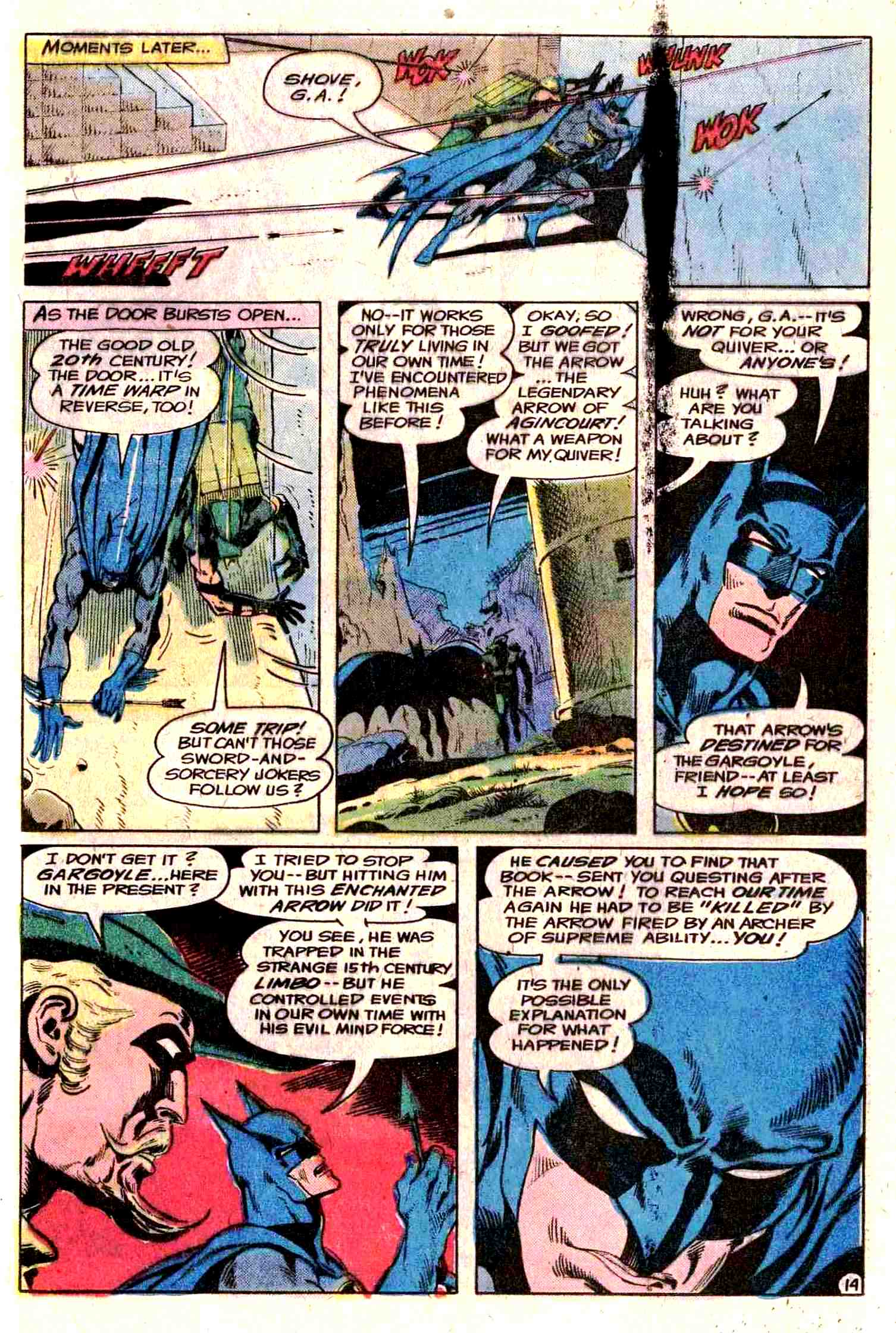
 So the action starts when Green Arrow, that noted bibliophile (sarcasm emoji), approaches Batman in his secret ID as rich guy Bruce Wayne, about a discovery the archer made. Arrow came across an old tome talking about a magic arrow made by Merlin himself. This arrow turned up much later in the 1415 Battle of Agincourt, and though history lies and tells us that the English won the battle thanks to superior archery weapons, the book tells Arrow that the English won because of just ONE arrow, when the magic bolt was used to bring down one particular French champion. Arrow being a bug of all things related to archery, the financially restricted hero asks Bruce for a lift to France. Bruce agrees.                                       

 So Arrow bails out of the Batplane, but after he leaves, Batman discovers that Arrow left his book behind. Batman doesn't plan to do much about this, but Some Mysterious Watcher fears that the crusader might launch an investigation of the tome's provenance. The Watcher spirits away the book, and-- causes the Batman to launch an investigation, tailing Arrow to his French destination.       

   
Batman then gets whipped back to 1415 at Agincourt, to which point in time Green Arrow has also been deposited. The mysterious manipulator is none other than The Gargoyle, one of the better Teen Titans villains created by Haney. He didn't want Batman, only Green Arrow, whom he manipulates into shooting him with the magic arrow of Merlin. Seems Gargoyle got exiled to the dimension of Limbo at the end of both of his previous two adventures, and though for some reason he's entered Earth back in the 13th century, he dopes out that he can return to the 20th if he gets shot by the arrow. Why does he have to be shot only by Green Arrow, and only during the Battle of Agincourt? Because the script says so, of course.                                   

                      
Gargoyle succeeds in getting shot, sending him back to the 20th century of his origins. Batman and GA follow, pour on tons of exposition, and eventually send the evildoer back into limbo by shooting him a second time. Despite all these tortured plot contrivances, this is a fun story based just on how well Haney succeeds in playing up the respective strengths of the bat and the archer. And how often do modern comics-stories even reference important historical events like Agincourt, even if the events are rewritten for the purpose of wild fantasy?                                                       

  Similarly, though artist Jim Aparo is no Hal Foster, I can't even imagine a modern comics artist attempting the sort of knightly grandeur seen in the above illustration.