Featured Post

SIX KEYS TO A LITERARY GENETIC CODE

In essays on the subject of centricity, I've most often used the image of a geometrical circle, which, as I explained here,  owes someth...

Showing posts with label jack the ripper. Show all posts

Tuesday, December 7, 2021

A CONVOCATION OF CROSSOVERS PT. 4

The third and fourth categories deal with narrative presences who are dominantly known for being Subs, which means that they may possess charisma but have rarely or never possessed stature in any iteration. 

Since charisma is judged with regard to the ways in which audiences have received various presences, HIGH CHARISMA crossovers are usually seen in situations where two or more Subs, both of whom have earned considerable approbation from audiences, interact. In the last section I mentioned that the Joker has almost always been a Sub, and since his existence as a Sub largely places him within the cosmos of Batman's adventures, this status gives him no stature.


However, his charismatic qualities may be boosted when he comes into contact with other Bat-villains with similar pedigrees-- though this may depend upon when the interaction takes place. When the Joker first crosses paths with the Catwoman-- one of the first villain-crossovers in comics-- neither has made more than one appearance apiece. It could be argued that at the time this story appeared, neither one had accrued all that much charisma-- and so a better example of high charisma might be the first-time meeting of Joker and Penguin, from 1944:


By the same principle, teams of villains, often meant to parallel those of the featured heroes, also display the same charismatic crossover, as long as some of the members have appeared more than once, as we see with the Injustice Society.


In theory, one might also have a charismatic crossover just from crossing over other types of Subs-- a League of Sidekicks, perhaps, including Snapper Carr, Pieface Kalmaku, and Rick Jones.

Moving away from this type of High Charisma crossover, I want to return to the matter of "crypto-continuity" introduced in Part II, I asserted that "King Kong II," though not technically in continuity with "King Kong I," borrows enough motifs from the original that the later character may be seen as  what I term a "weak template deviation." 

However, there are also "strong template deviations," which often involve authors totally overwriting not totally fictional characters, but characters from myth, legend, and history-rendered-into-fiction.


For instance, the 19th-century outlaw Billy the Kid has a certain documented history, even if there's much about the real-life William Bonney (or whatever his real name was) that moderns will never know. But the cowboy-hero of BILLY THE KID VS. DRACULA borrows nothing from the historical personage but the name, I would tend to view this totally fictionalized Billy is the main character of the 1966 film, while Dracula, despite having originated as a Prime character in the 1897 Stoker novel, has been demoted to a Sub, Yet the film's Billy has no more stature than would any cowboy-character who'd had never appeared before. The effect of the title is to suggest that the titular characters intermingle their respective charismas, though only one of the two possesses any stature, albeit minor.


Even more problematic are characters who lack anything more than a circumstantial history. While Dracula is a fictional character whose depiction may change as any author pleases to change him, Jack the Ripper was at least one real person in real history-- but because he was never identified, he becomes in a narrative sense even more insubstantial than the vampire count. In this 1985 mini-series, reviewed here, Dracula and Jack the Ripper do indeed enjoy a crossover. But because the Ripper is different in every iteration, whereas the Count is comparatively stable, I don't think they possess comparable stature-- though they both do possess high charisma, which stems from the investment audiences have in their respective forms of monstrousness.


Wednesday, January 23, 2019

MYTHCOMICS: FROM HELL (1989-96)


A graphic novel as dense as FROM HELL might seem to challenge my assertion that any work with a significant underthought can be boiled down to a concise “myth-theme statement.” Here’s what I came up with:

Royal surgeon Doctor Gull, the epitome of Victorian erudition and respectability, comes to embody the principle of male-over-female ascendance when he takes on the mantle of Jack the Ripper, at once serving the British Crown and his own personal project, that of ascending to mystical supremacy through the killing of women.

As I’ve frequently done in analyzing other collaborative works, I’ll focus on the creative partner whom I consider the dominant influence. Thus, regardless of what artist Eddie Campbell brought to the table in creating this graphic novel, I’ll only discuss Alan Moore here—not least because FROM HELL reflects one of Moore’s most interesting facets. I’ve often recounted how Moore himself has frequently taken on “politically correct” positions in his work, as seen here—and yet, he’s also been attacked for any number of supposed literary sins, often from pundits whose idea of art comes down to being “more politically correct than thou.” It may be significant, as a bellwether of Moore’s artistic impulses, that FROM HELL includes copious references to the non-conformist English poet William Blake, who is not exactly a familiar figure in Ripper-fiction. It was Blake, in one of his most quotable quotes, who said that in writing PARADISE LOST John Milton did better with Satan than with God because Milton was “of the devil’s party” without knowing it. I will show that some of the overthoughts of Moore’s works may “talk the talk” of ultraliberal politics, while the underthoughts don’t always show the author “walking the ultraliberal walk.”

Consider the graphic novel’s title. The proximate relevance of “From Hell” is that the phrase appeared in one of the various letters purportedly written by the Ripper during the killer’s reign of terror. Since in real life “Saucy Jack” was never identified, no one can know with certainty that the real murderer wrote that particular letter. Yet whoever did write it, regardless of his or her reasons for so doing, was clearly conjuring with the idea that Jack the Ripper was akin to a demon from the “bad place.” In Moore’s Ripper-cosmology, the very first letter to coin the name “Jack the Ripper” is a journalistic fraud, born from a capitalistic desire to sell newspapers. However, the “From Hell” letter, which is sent to police some time later, does come from the killer, and mad William Gull has an even more complex reason for invoking the spectre of the devil’s domain, as he confesses to his uncomprehending partner-in-crime Netley:

…in [Dante’s] INFERNO he suggests that the only true path from hell lies at its very heart—and that, in order to escape, we must go further in.


Given the thoroughness with which Moore cites his many references in the back of the novel—including not just other fictional and non-fictional takes on the Ripper, but also copious other aspects of British culture or history that Moore finds relevant—it’s fair to say that he’s sought to synthesize all of the major treatments of Jack the Ripper. One view of the Ripper, that he was a sexual deviate titillated by the killing of women, finds some representation in FROM HELL, as does a more politicized reading, in which the Ripper is a murderer sanctioned by the ruling class to eliminate enemies of the British Empire.  Further, Moore builds upon the historical suggestion that the real Gull was a Freemason to make the fictional Gull a practitioner in the English tradition of High Magick. Gull’s idea of escaping hell—which I understand to be the grubby “real world” of death, endless suffering, and frustrated sex—is to “derange his senses” through the act of brutal murder.


 It’s true that the repressive British government—the incarnation of male rule, despite the sovereignty of Queen Victoria-- begins the career of Jack the Ripper. First, an illicit romance and marriage takes place between Crown Prince Edward and a shop-girl. After the relationship is quashed by those in power, four prostitutes, made desperate by the crushing poverty of their lives, attempt to blackmail the throne with their knowledge of the scandal. This causes Victoria herself to call upon her surgeon—who has somehow become something of a royal hitman—to solve the problem. Gull’s murders of his victims, however, are far more brutal than necessary for the British Crown’s purpose. Gull's purpose is to “derange” himself out of his own intellectual sphere, in order that he can achieve some sort of mystical attainment. Thus Gull is akin to a demon unleashed by an unwise conjurer, one who brings forth the worst in all of London’s inhabitants.


Even Moore’s viewpoint character, Inspector Abberline of Scotland Yard, finds his life compromised by the Ripper’s activities. Though Moore’s Abberline is a stolid, unimaginative man unaware of Gull’s magical aspirations, he’s unknowingly pulled into Gull’s greater project via an attempted extra-martial (on his part) affair with one of Gull’s intended victims. Abberline, like the victimized prostitutes, is also a lens through which Moore allows the reader to see the hellish sufferings visited by the upper classes on all the lower ones—though ironically Abberline, in one of his first lines, states that he’s unimpressed with socialists, who are all “middle class”types.

I won’t attempt to explicate Gull’s “Mystic History of Great Britain” and how that discourse fits into the greater history of worldwide patriarchal dominion.  But even though Gull is unquestionably a devil, he is, like Milton’s Satan, a fascinating one. He sums up the copious mythological altercations of males and females thusly:

‘Tis in the war of Sun and Moon that man steals woman’s power, that Left Brain conquers Right—

While Gull’s employers may be concerned with keeping their reign over unruly women, as well as other outsiders like Jews and revolutionaries, Gull is not defined by their political motives. Though I find Moore’s use of the “left brain-right brain” paradigm anachronistic, the writer makes it explicit that Gull kills women so that he can gain access to their mysterious, irrational “right brain” power. This hyper-intellectual version of the Ripper is validated insofar as his murders do vouchsafe him visions of other times and places, so that FROM HELL, unlike many Ripper-stories, enters the domain of the marvelous. Yet, despite Moore’s condemnation of Gull’s brutality and masculinism, the author can’t help but make Gull a “sacred monster” whose evil outstrips that of his contemporaries. When his fellow Masons call Gull to account, he tells them frankly that he does not deem any of them his peers.  Following his final whore-murder, Gull has a vision of the 20th century’s marvels, and he excoriates the dwellers of the future for their shallowness:

With all your shimmering numbers and your lights, think not to be inured to history. Its black root succors you. It is inside you… See me! Wake up and look upon me! I am come amongst you! I am with you always!


Naturally, the idea of Jack the Ripper equating himself with Jesus Christ can’t help but carry a satirical tone. Yet Moore seems altogether serious about seeing the Ripper as a “black root” at the heart of all mankind.  This “root” seems more or less akin to Jung’s “Shadow,” which for Jung remains part of human psychology no matter how advanced humans may become. Because of such moments, in which Moore seems to have become fascinated with his incarnation of evil, he escapes the banality of merely political creators, who ceaselessly promote the idea that all darkness will give way to some intellectual light.

In keeping with its title, FROM HELL is a profoundly pessimistic novel, drenched in a Spengleresque mood of historical futility. Perhaps its most depressing—albeit bracing—aspect is even though no reader is likely to believe that Gull can escape hell through his techniques of derangement, Moore offers no light at the end of the tunnel for anyone else, either.   

Tuesday, May 16, 2017

MYTHCOMICS: BLOOD OF THE INNOCENT (1985-86)

“There are six things which Jehovah hateth; Yea, seven which are an abomination unto him: Haughty eyes, a lying tongue, And hands that shed innocent blood; A heart that deviseth wicked purposes, Feet that are swift in running to mischief, A false witness that uttereth lies, And he that soweth discord among brethren” (Prov. 6:16-19).

Upon the 1985 release of BLOOD OF THE INNOCENT, publisher WarpGraphics touted the four-issue series as America's first weekly comic book. But in retrospect BLOOD is far more interesting as a crossover of two literary/cuiltural myths born out of the matrix of Victorian society.  Both myths had their origins in the acts of real historical persons. Jack the Ripper, the Victorian serial killer, has never been identified, and even in Victorian times assumed the character of an "urban legend." Bram Stoker's Count Dracula was fiction based on both the vampire folklore of Transylvania and the historical records of Romanian tyrant Vlad Tepes. To be sure, the narrative of BLOOD makes very few references to the story of Vlad, though like most Dracula-tales there are indirect references to the Count's aristocratic heritage, and in one issue co-author Rickey Shanklin contributes a history of the tyrant's historical reign.


BLOOD-- presumably named with the above Proverb in mind-- doesn't feature any sort of epic battle between the vampire and the serial killer, as the cover of #1 depicts. The Ripper, being limited to the sphere of realistic historical studies, has no power capable of opposing a supernatural creature. However, it's the Ripper's narrative that determines the scope of the story, since it must take place in the one year, 1888, during which the killer's "canonical" murders took place. Writers Rickey Shanklin and Mark Wheatley collaborated with penciller Marc Hempel (Wheatley also inked) in bringing the vampire-lord to London in the same year, ostensibly to investigate England as a future stomping-ground, in line with his future visit in the 1897 novel.

Naturally, the authors' version of both the vampire and the killer tend to follow specific cultural models. In this iteration, Jack the Ripper is the syphilitic Duke of Clarence, usually called "Eddy," the oldest grandson of still-reigning Queen Victoria, and he begins killing prostitutes because he picked up a social disease from a lady of the Whitechapel slums. And this Dracula is not at all like Stoker's ruthless predator: during his sojourn he only exsanguinates one victim, a female who may or may not be a lady of the evening. The Shanklin-Wheatley vampire also is made basically sympathetic because he falls in love with a potential victim, and thus seems closest in tone to the 1979 cinema-Dracula played by Frank Langella. 

The authors repeatedly stress the parallel of Dracula and the Ripper due to their role as sexually oriented predators, but arguably one sees more differences than similarities. Both men are aristocrats, but the Count has dignity and compassion, while Eddy Duke of Clarence seems to be little more than the incarnation of a Victorian contempt for women, particularly those who have been forced into "the life" by economic oppression.


Dracula, who accidentally encounters Eddy after the latter's first hooker-murder, is put in a position where he might kill the Ripper before his bloody rampage. The vampire chooses not to do so because he smells that the Duke's blood is "diseased," and thus he makes "allowances" for the maniac's bad manners. This lordly indifference becomes more pronounced later in the story; the vampire is seen watching from a distance as Eddy kills another prostitute. By that time, though, Dracula has met a London woman and fallen in love with her, so that he has sex with her but does not vampirize her. However, it never occurs to him that since she too is a prostitute, she might fall victim to the Ripper-- which indeed she does, as she happens to be Mary Jane Kelly, one of the canonical five Ripper-victims.

Shanklin and Wheatley interpolate a number of secondary plot-lines into the story, usually involving other persons suspected of being the Ripper, such as Dr. William Gull, physician to Queen Victoria, and Montague Druitt, who in this iteration is a teacher who has expertise in vampire mythology and actually witnesses one of Dracula's transformations, thus leading Druitt to the incorrect conclusion that Dracula is the Ripper. But none of the side-stories are of much consequence.


Perhaps the greatest difference between the two legends is that when the Ripper kills, he "murders to dissect," leaving nothing but dead meat. Dracula is obviously a killer as well, but he can bring some of his victims back to a semblance of life. Indeed, Mary Jane fantasizes about being Dracula's Transylvanian countess, even as Eddy sees her as nothing but "the queen of whores." The Ripper is an arch-realist; he sees nothing but evil in women, and thus reflects much of the Judeo-Christian ethic of his time. Dracula, however, is not just a shape-changer: in this version the vampire who can't see himself in a mirror automatically "mirrors" the fears or desires of whoever beholds him. When the vampire first comes to England, two sailors see him according to their own prejudices. One sailor thinks the Count looks like a dashingly royal figure, while the other fellow thinks Dracula looks old and corrupt. Oddly, the second sailor characterizes aristocrats as "royalty what comes o' a sister's love of her brother! " I've no idea what the authors meant by this reference, since sibling incest is not a big part of Dracula-mythology-- though it's arguable that since Dracula is centuries older than his victims, there might well be a "daughter-father" vibe about his alliance with Mary Jane Kelly.  

Dominantly BLOOD is all about the clash of sociological narratives: that of the aristocratic seducer versus the corrupt lordling. Shanklin and Wheatley don't provide a lot of vampire mythology here, but there's some metaphysical content in their idea of Dracula's image changing to reflect the beliefs of onlookers.

Tuesday, November 3, 2015

A MOVABLE HELLFEAST PT. 2

...in his last work, Nietzsche insisted that his point was merely that there was more hope for the man of strong impulses than for the man with no impulses: one should look for 'even a Cesare Borgia rather than a Parsifal.' ...This leaves no doubt that Nietzsche considered Cesare Borgia far from admirable but preferred even him to the Parsifal ideal"-- Daniel Conway, NIETZSCHE: ON MORALITY, p. 125.

In Part 1 I cited Jack the Ripper as an example of a killer who, if he indeed wrote the famed "from hell" letter, was in essence seeking to "theatricalize" his propensity for murder, to portray himself as a virtual demon from hell. Since the Ripper was mentally adept enough to commit his crimes without being caught, I'd assume that he did not expect anyone reading that letter to literally believe that a demon was committing the murders. However, if he wrote the letter, then by that act he made himself more than just a random killer. The murders might have been forgotten a century later-- as indeed the deeds of many other serial killers have faded over time-- but "From Hell" makes the Ripper into a figure of immortal dread.

However, the psycho himself does not necessarily need to announce his dreadfulness to a waiting audience. Ed Gein's "theater of the dreadful" was intended only for his own viewership, but even a partial recitation of his ghoulish alterations of body-parts can bring forth the shivers of dread:

Bowls made from human skulls
A corset made from a female torso skinned from shoulders to waist
Human skin covering several chair seatsSkulls on his bedposts

In the first part of this essay-series, I quoted Virgil's famous line:

'If I cannot bend the will of Heaven, I shall move Hell.'-- Virgil's AENEID.

Interpreting this aphorism purely from a psychological standpoint--as indeed Sigmund Freud did, since he used the same motto to preface THE INTERPRETATION OF DREAMS-- the "hell" in one's own psyche is the realm of unrestrained desire. Long before Freud elaborated the three-part structure of the psyche as "id, ego, and superego," Nietzsche pursued a parallel line of thought. Nietzsche esteemed the ability of "the superman" to practice "self-overcoming" of his own impulses. Thus Borgia, who allegedly gave into his baser impulses, is no superman, any more than Ed Gein or the Ripper could be. But they were able to "move the hell" of their own desires in such a way that history still remembers their deeds.

Thus do real human beings take on the appearance of something beyond the ordinary, even though we know that they are, in the final analysis, human beings who are much more defined by contingent circumstances than fictional characters. Yet there is a degree of freedom in displaying the ability to "act" as if one is more than one is, and it can be used no less for producing the beneficent affect of *fascination* as for the destructive one associated with *dread.*  It would be interesting-- though beyond the scope of this essay-- to posit what sort of real-world "supermen" go beyond the level of mundane heroics, even as the Ripper acted the part of one beyond the mundane reality of a serial killer.

I said at the end of HELLFEAST PART 1 that I would explore these matters in terms of the question of freedom, but for now I will postpone that discussion to pursue other concerns.


Saturday, October 31, 2015

A MOVABLE HELLFEAST

'If I cannot bend the will of Heaven, I shall move Hell.'-- Virgil's AENEID.

In this 2014 essay I wrote:

I do not render any final verdict here as to whether "the causality human beings experience in life" is entirely naturalistic or not.  But it is certainly of a different order than anything we experience through fiction, and so the two are not homologous.  That said, when I think of the historical figure of Jack the Ripper, I opt for the default characterization that almost everyone does: that he was a real human being who killed out of some lunacy and eluded the law.
That said, because the Ripper was never identified, he presents an ontological problem that comparable "psychos" do not.  Even without being able to identify the Ripper as authorities were able to identify Ed Gein, practically no one doubts that the Ripper was a real human being, unlike the many fictional renditions modeled after him. As a real human being, he cannot be "uncanny" the way a fictional re-creation can be.

But can one say that even though he was subject to all the laws of the naturalistic universe we all share, that Jack the Ripper does not share in any way with the concept I've entitled "affective freedom" in this essay?

While a human being cannot be "uncanny" in the same way that a fictional character would be, any human being-- no matter how debased-- has the freedom to imagine himself within a fictionalized posture. This self-theatricalization would not change the actual phenomenality of the real human being. Nevertheless, the capacity for such a mental attitude, even in a negative moral state of being, still impacts on the general concept of freedom nonetheless.

For sake of this argument, assume that the historical Ripper is the same person who wrote this infamous "letter from hell," which I copied from this site:

From hell
Mr Lusk
Sor
I send you half the
Kidne I took from one women
prasarved it for you tother pirce
I fried and ate it was very nise I
may send you the bloody knif that
took it out if you only wate a whil
longer.
signed
Catch me when
you Can
Mishter Lusk. [sic]


The individual who wrote this letter was, without doubt, attempting to "fictionalize" himself in terms of the Ripper-persona, to become a figure of "dread" through the reference to the Ripper's psychotic violence and to the domain of hell itself.

How this impacts upon the general concept of freedom will be explored further in Part 2.


Saturday, May 17, 2014

PSYCHO VS. PSYCHO

At the conclusion of GHOSTS AMERICAN STYLE I wrote:

The mere fact that the mystery killer is not exceptional in his dynamicity would keep this from being a "combative" film.  However, would things be different if the killer had a more prepossessing aspect, if he had some sort of bizarre identity like "the Bat?"

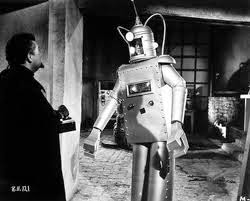
First, just to get this tidbit off my mind, there actually were a trio of Mexican films from the late 1950s and early 1960s in which a supernatural avenger-- albeit not a ghost like the one in TOPPER RETURNS-- had regular encounters with a villain called "the Bat."  This was what might called the "Aztec Mummy trilogy," in which a mummy named Popoca continually defended an Aztec temple from a mad scientist with a chiropteran cognomen.  He's seen in a shot below, readying a "human robot" for its coming battle with the Aztec Mummy.


But I started here on the subject of "the phenomenality of psychos" by considering the opposition of two megadynamic figures, Sherlock Holmes and Jack the Ripper, taking the initial position that this was also a metaphenomenal combative film because the Ripper almost always qualifies as an "uncanny" being, even though Sherlock Holmes is "naturalistic" in most iterations.  In my system the anti-intelligibility of the "monster" trumps the intelligibility of the "hero" (which terms I put in quotes to denote their relation to my discussion of "persona-types.")

It is possible for one of the two [combatants] to be *naturalistic* in nature-- which was my original estimation of this version of Holmes-- but for a work to be both combative and metaphenomenal, the other combatant must be either uncanny or marvelous.

Most films about "perilous psychos," however, do not employ the combative mode. The dominant mode is subcombative.  Usually a megadynamic character-- whether "exemplary" in his level of power, like Norman Bates, or "exceptional," like the original "uncanny" version of Jason Voorhees-- is able to mow down his (or her) victims like grassblades. Typically the perilous psycho is opposed by a viewpoint character who is either microdynamic or mesodynamic, and this character's survival-- if he or she does survive-- comes about due to dumb luck, not because of superior dynamicity. Films like STUDY IN TERROR or the seventh outing of FRIDAY THE 13TH are exceptions to this pattern.

Oddly, though, "psycho stars" on television in recent years come somewhat closer to the combative mode. While I have not yet examined the original "Hannibal Lecter" novels of Thomas Harris, I found that the first two Lecter films-- MANHUNTER and SILENCE OF THE LAMBS -- did not satisfy my criteria for both the narrative and significant values of the combative mode.


The 2013 teleseries HANNIBAL-- which will air its season finale the Friday after I write this-- comes much closer to the mark. The series' conceit is to trace in greater detail the events of the first encounters of Lecter and his nemesis, FBI  profiler Will Graham-- encounters that were only sketched out in the Harris novel and the 1986 film. The film, directed by Michael Mann, conveys a keen sense of the extent to which Graham has been polluted by the disturbing power of the godlike killer, which he witnesses first in Lecter and later in "the Tooth Fairy."  However, at no time is Graham himself a "psycho." He is, in the end, a figure like Holmes is in STUDY IN TERROR, a man capable of intuiting the thought-patterns of killers but not a "perilous psycho" himself.

The teleseries' version of Graham is far more ambivalent. Even though the internal continuity of the Lecter story establishes that Graham will take Lecter prisoner and go on to pursue the Tooth Fairy in later years, producer Bryan Fuller creates a mood of baroque pessimism that implicates all of the characters, not just Graham, in Lecter's insanity.  Not every episode culminates in a literal combat, though some stories establish that Hannibal Lecter can kick ass on a Jason-esque level of dynamicity. But on further examination of the completed series, I may come to the conclusion that Fuller's version of Lecter and Graham is not "sanity vs. insanity," but "psycho vs. psycho."


Kevin Williamson's THE FOLLOWING debuted the same year as HANNIBAL.  Just as Hannibal is the star of his titular series, Joe Carroll, the Poe-loving leader of a murder-cult, is the true star of THE FOLLOWING. Carroll's persistent foe is another FBI profiler, Ryan Hardy, who like Will Graham has become compromised by his contact with evil. Unlike Graham in HANNIBAL, though, Hardy, though tormented on many levels, does not become quite as implicated in his enemy's madness. In addition, THE FOLLOWING depicts incidents of spectacular violence far more regularly. Joe Carroll's murder-cult also qualifies for the uncanny version of "outre outfits," in that they are sometimes-- though not always-- seen dressed in outrageous costumes, particularly those episodes in which some of the killers wear Edgar Allen Poe masks.  But as with HANNIBAL, I would have to study the collected episodes in order to determine whether or not this is a combative serial.


The novel and television serials of Dexter Morgan will bear further investigation as well.  Jeff Lindsay's concept places the titular psycho in the role of the avenger of crimes, in essence melding the character-types of Lecter and Graham. I have not read Lindsay's novels, any more than Harris.' But based on viewing a handful of the Showtime TV episodes, Dexter Morgan is a man who is born with the same psychotic tendencies as Hannibal Lecter, but who is able to channel them into relatively altruistic acts, killing exceptionally evil criminals who have escaped the justice system. Apparently on occasion he has even contended against other "master psychos" like himself, though on the whole most of his enemies tend to be more mundane, and he is almost as much an invincible dispenser of justice as Jerry Siegel's Spectre. Still, even if Dexter had never encountered a psycho on his own level, DEXTER the teleseries would be as combative as the SPECTRE comic-book series, in that the criminals Dexter attacks represent an exceptional level of evil, as I discussed here in GHOSTS AMERICAN STYLE:

...criminals in THE SPECTRE represent more than just ordinary crooks: collectively they are the evil that forces the undead avenger to keep up his crusade, rather than going to his eternal rest.


Friday, February 21, 2014

OF SHERLOCK AND PSYCHOS PT. 3

In CAUSAL CONUNDRUMS AGAIN PT. 2 I wrote:

I'm now asserting that causality in a literary context-- which, contra Todorov, is not homologous with the causality human beings experience in life-- has both a cognitive aspect and an affective aspect, summed up as "regularity" and "intelligibility." 

And in the first installment of OF SHERLOCK AND PSYCHOS I defined the uncanny aspect of the film as inherent in Sherlock Holmes' foe Jack the Ripper:


 ...in what qualities does Jack the Ripper's metaphenomenality inhere?  As his only qualification for the metaphenomenal is his status as a "perilous psycho," that metaphenomenality must inhere in a mental, "non-body" quality.  His madness is his method, and therefore his metaphenomenality.

I then debated whether or not Sherlock Holmes' "polymath" qualities might qualify him for as a "mental metaphenomenality," but decided that I would have to re-view STUDY IN TERROR to see whether or not Holmes showed such uncanny qualities himself.  However, in OF SHERLOCK AND PSYCHOS PT. 2 I acknowledged that the Holmes of the 2009 SHERLOCK HOLMES film definitely did use his special deductive powers in an "uncanny" fashion:


What I did not then note is that in this scene Holmes-- who is obviously less heavily muscled than his opponent-- is utilizing his deductive skills as Doyle never did and probably would not have: to suss out his opponent's weaknesses and to plan his attack with machine-like efficiency.  Thus this film, which I have not yet reviewed, would fit the uncanny version of my trope for "uncanny skills." The film's use of graphics to depict the way Holmes thinks-- projecting words or images onto the screen, to share diegetic space with the actors-- also imparts an aura of "strangeness" to Holmes' computer-like cogitations.
I have no problem in stating that this sort of mental acuity, while it does not violate the regularity aspect of causality, does defy its intelligibility aspect, even as does Jack the Ripper's madness. And though I explored a couple of Arthur Conan Doyle's short stories briefly, I have not yet decided whether or not Holmes' unusual command of arcane knowledge can be termed "anti-intelligible." I am tending currently to think not.

Fictional reiterations of Jack the Ripper, though, do not show the same ambivalence. 

I do not render any final verdict here as to whether "the causality human beings experience in life" is entirely naturalistic or not.  But it is certainly of a different order than anything we experience through fiction, and so the two are not homologous.  That said, when I think of the historical figure of Jack the Ripper, I opt for the default characterization that almost everyone does: that he was a real human being who killed out of some lunacy and eluded the law.

I have yet to encounter a fictionalized Jack the Ripper, however, whose spectre does not suggest either "the uncanny" or "the marvelous."  This is in contrast to many other perilous psychos. 


In this essay I showed how Norman Bates, though his character was based on the real-life aberration Ed Gein, exceeded what I now call the intelligibility aspect of causality.  Despite attempts by writer Bloch and director Hitchcock to inject standardized psychological readings of Norman Bates, Norman is not reduced by these readings.  He remains a figure who dominantly suggests the antipathetic affect of dread, as signified by the famous shot of Anthony Perkins at the film's conclusion, which I like to call the "Mona Lisa Death's Head."


Ironically, the A&E BATES MOTEL teleseries manages to reduce Norman to the more mundane level of "fear"-- although to be sure, the opening episodes focus more on the fearful nature of his mother, Norma Bates, and softening Norman as the series works toward its "evolution of a psycho."


I admit that I have not seen or read every fictional portrayal of Jack the Ripper, which this Wikipedia list purports to cover.  There may be renditions of the Ripper that do to him what A&E did to Norman.  Yet because the real Ripper was never apprehended, his figure resists the naturalistic straight-jacket.  Of course, many "imitation Rippers" may fall into this category.


 This 1927 Hitchcock film departs from its source by renaming the serial killer "the Avenger." Further, though Hitchcock had wanted to keep some ambivalence as to the guilt or innocence of the man suspected of being the killer, he was overruled, with the result that the accused man is proved innocent and the real killer, though his capture is mentioned, is never seen on-screen.  Without question Hitchcock introduces visual motifs to suggest the dread associated with a serial-killer boogieman, but one may argue that these are overpowered by the film's naturalistic focus.

And of course, Hitchcock himself did a seventies-era version of this type of serial murderer in 1972's FRENZY, reviewed here.  I noted in the review that despite an early comparison between the film's "Necktie Killer" and the legendary "Jack the Ripper," there was no "strangeness" in Hitchcock's handling of FRENZY's strangler, in contrast to his handling of Norman Bates.

By contrasting Hitchcock's approach to the serial killer in this and a genuinely uncanny film like PSYCHO,  I find that Hitchcock's approach with FRENZY has more in common with his 1943 film SHADOW OF A DOUBT.  In my earlier essay I asserted that the psycho-killer of SHADOW lacked any of the "strange or unworldly aspects" I find in Norman Bates, and the same is true of the "Necktie Killer" in FRENZY, even though he's compared to Jack the Ripper in the film's first ten minutes.

To my knowledge, though, whenever a modern writer attempts to write of the actual Jack the Ripper-- the tendency is to see him through the lens of the uncanny affect of dread, whether he is seen as a man hiding a psychotic secret (A STUDY IN TERROR),  a delver into supernatural secrets (Moore and Campbell's FROM HELL), or even-- as in one novel I won't name to avoid giving away the "big reveal"-- Sherlock Holmes himself.  There are, as I said above, also versions in which Jack the Ripper is some marvelous being, as in Robert Bloch's short story "Yours Truly, Jack the Ripper." But more than any other famous madman of reality or fiction, the Ripper seems to work best as an image of dread--one that bends, but does not break, the normal configurations of the causal world.