Featured Post

SIX KEYS TO A LITERARY GENETIC CODE

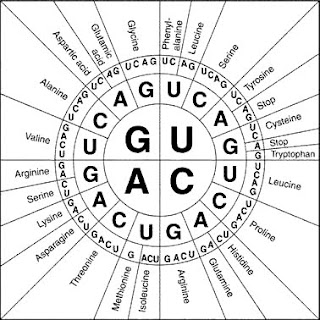
In essays on the subject of centricity, I've most often used the image of a geometrical circle, which, as I explained here,  owes someth...

Friday, December 9, 2016

JUDGING DREAD

During 2013 I devoted a great deal of blog-space to investigating the source of C.S. Lewis' trinity of "fear, dread, and awe" as he expressed them in THE PROBLEM OF PAIN. These terms, in less organized form, stemmed from Rudolf Otto's 1917 THE IDEA OF THE HOLY, which Lewis had read and appreciated. Both writers fall into the philosophical category of "Rationalists," whom Kant defines as those who "intellectualize experience."

I also wrote, in HOLY NUMINOSITY PART 2, that I believed Sigmund Freud may have encountered Otto's book and the author's use of the term "the uncanny" to describe a Rationalist's conception of religon, and that Freud then hijacked the term for his own Empiricist project. However, on reconsideration it's more likely that Freud derived the term from a 1906 essay by fellow psychologist Ernst Jentsch, especially since he's mentioned in the text on Freud's work. I don't imagine there's any way to prove that Rudolf Otto did or did not read the Jentsch essay, and in any case it's perhaps more likely that he was drawing upon the way the word was used in demotic speech.

Otto's religious conception of the word is central to his argument, as he argues that tribal cultures were governed by what he called "daemonic dread," the fear and fascination of imagined spirits. Otto didn't argue for any one-on-one equivalence between this form of worship and later forms, particularly the author's own Christianity. Yet he suggested something of a teleological relationship, in which the greater form more or less grew from the latter, even as Aristotle imagined great tragedies growing from the crudities of satyr-plays. This was plainly a different approach to the idea of "superstitious dread" than that of Freud, who would largely consign all religious to the dustbin of failed ideas.

These Empiricist-Rationalist intellectual arguments have not died out in these later decades: they simply found new expression, such as that of James Twitchell's 1987 DREADFUL PLEASURES. I'm in the process of rereading this book, but I'm not so much concerned with tracking its highly Freudian interpretation of the horror-genre, as I am with Twitchell's attempt to reduce the genre's appeal to the "physiological factors" that Freud used as the bedrock of his system.

Freud's disaffected disciple Carl Jung was perhaps the first major voice to detract from Freud's emphasis on the physiological. In my essay WAKE ME UP BEFORE I IMAGO-GO,  I featured this segment from Jung's 1936 essay outlining his opposition to Freud:

Now religious ideas, as history shows, are charged with an extremely suggestive, emotional power. Among them I naturally reckon all "representations collectives," everything that we learn from the history of religion, and anything that has an "ism" attached to it. The latter is only a modern variant of the denominational religions. A man may be convinced in all good faith that he has no religious ideas, but no one can fall so far away from humanity that he no longer has any dominating "representation collective." His very materialism, atheism, communism, socialism, liberalism, intellectualism, existentialism, or what not, testifies against his innocence. Somewhere or other, overtly or covertly, he is possessed by a supraordinate idea.

I tend to think that Jung's "superordinate ideas" probably come closer to what Otto was trying to say about the relation of "the uncanny" to "the numinous," even though as a religious man Otto would have opposed Jung's tendency to subsume religion into pure psychology.

Just in reading the first chapter of DREADFUL PLEASURES, I'm impressed by Twitchell's foursquare effort to define the horror-genre through "physiological factors." He quotes Otto just once in the first chapter, clearly doing so in order to distance himself from Otto's concept of "dread." (After a quick summary of Otto's project, Twitchell avers that "My concerns are thankfully less transcendental.")

I don't for a moment believe that Twitchell's project as a whole has broad applicability to either the specific genre of horror or metaphenomenality in general. However, I think that some of his observations may impact upon the concept of *artifice* that I broached here, and in future essays, I'll be investigating these matters more fully.

THE LONG AND SHORT OF WILL

At the end of one of Colin Wilson's books-- probably MYSTERIES, though I have not hauled it out to check-- I recall that he made a gender statement that would prove utterly unacceptable with many modern readers. Paraphrasing from memory, I believe that Wilson typified women as being "close-sighted" in that they tended to be concerned with immediate reality, while men tended to be "far-sighted," concerned with making long-range plans.

I would imagine that most people can think of examples in which this or that person does or does not conform to the generalization. I'm not interested in the gender statement as such, but only in the contrast of "close sight" and "far sight." These formulations, which are abstractions of the human eye's capacity for both types of visual perception, dovetail fairly well with my notions of the way the literary experience works for readers, as I noted here.


It may be that my revised versions of overthought and underthought will in future serve me as shortened forms for the respective effects that "the function of thinking" and "the function of intuition" have upon literary narrative.  I concluded in REFLECTIONS IN A MERCURIAL EYE PART 3   that both myth-critics and ideological critics were in a similar unenviable position as far as converting the majority of readers to pursue more abstract readings of texts. Most readers quite logically are concerned with lateral meaning, which takes in both "the function of sensation" and "the function of feeling"-- and in truth, the abstractions of both overthoughts and underthoughts are only possible when constructed on the foundation of concrete experience. 

Plainly, what I call a work's "lateral meaning," glossed with a combination of two of Jung's psychological functions, is confined to what sort of things happen to the story's characters (sensation) and how they feel about those developments (feeling). The function that Jung calls "intuition" finds expression through the author's sense of symbolic combinations, which provides the *underthought* of a given work, while the function of "thinking" finds expression through the author's efforts at discursive cogitation, which provides the work's *overthought.* It's possible for a work to be so simple that both its underthought and overthought amount to nothing more than cliched maxims, like "good must triumph over evil," but even the most incoherent work generally intends to engross the reader with some lateral meaning.

A further comparison of the two forms of "sightedness" extends to my terms of the two types of will in literature: "the idealizing will" and "the existential will," on which I descanted in the 2013 essay APES AND ANGELS:

First, "existential will" lines up with a focus upon immediate reality:

This will I'll term the "existential will," because it is a will to remain attached to all the affects that call up everyday sensory existence; our feeling of being inextricably a part of the physical world.

While "idealizing will" lines up, not so much with "long range plans," but with ideals that have a sweeping, long-range applicability to humankind as a whole, whether those ideals serve "good" or "evil:"

This will I'll term the "idealizing will," because it seems obvious to me that any "idea" to which a subject becomes emotionally attached becomes an "ideal."
By the power and glory of the transitive effect, then, a given work's lateral meaning may be said to incarnate the "existential will" of all of the characters combined, who are inextricably focused upon their own interests within the diegesis. The work's underthought and overthought, whatever their quality of expression, would then incarnate the "idealizing will" of the plot-action as a whole: that which often receives the cumbersome and inaccurate term of "the theme." I've tended to speak of the two types of will in identifying characters within the diegesis as being heroes, villains, monsters, or demiheroes. However, here I'm addressing the dual ways in which the reader interacts with the text: identifying with the characters' travails within the diegesis even as he may (sometimes) seek an extra-diegetical meaning to the entire narrative, and so the two types of will have a different function when applied to the possible reactions of the reader rather than the functions of the characters.

Wednesday, December 7, 2016

MYTHCOMICS: DEFENDERS #139 ("HUNGRY LIKE THE WOLF," 1985)


I've commented numerous times on the positive effect of the "long arc" form of narrative on the potential mythicity of stories. However, as with everything else there are good and bad ways to pursue the structure of the long arc. It's for this reason that I've found it hard to discern a mythic underthought in many of the influential Claremont X-MEN stories. The potential is always there, but Claremont always seemed in a hurry to tick off plot-points, so that he often neglected to get the full mythopoeic potential out of his situations. However, I will admit that the bigger an author's ensemble gets, the greater will be his tendency to tick off plot-points.

The Marvel team THE DEFENDERS, launched in 1971, was a refreshing change from most of the Marvel titles of the period, with their heavy emphasis on a soap-operatic form of plotting. The project's initiator Roy Thomas had been as instrumental as any other writer, save Stan Lee, in the use of soap-opera plotting, as indicated by his long run on the AVENGERS title. In contrast, DEFENDERS seemed a comparative throwback to Marvel's Golden Age, in which powerhouses like the Human Torch and the Sub-Mariner occasionally teamed up purely to beat up a lot of Axis opponents. DEFENDERS, which started out as a teamup of Doctor Strange, the Hulk and the Sub-Mariner, was similarly uncomplicated by subplots: the three powerhouses simply encountered the menace of the month and kicked its ass.

Continuing plot-lines did surface, of course, along with some melodramatic content, and many of these featured the ongoing character of The Valkyrie, who debuted in issue four and remained with the group for most of its run. However, subplots were not a major focus of the title in the 1970s.

By the 1980s, of course, Claremont's X-MEN had become the defining model for team-up books, and in the last few years of the DEFENDERS title the group become more like a standard Marvel ensemble-title. The three powerhouses of the original book had been sidelined as the creators chose to combine a motley crew of characters to become "The New Defenders." The new team was comprised of three characters from the original 1960s X-title (Angel, Beast, and Iceman), one from the AVENGERS of the 1970s (Moon Dragon), the perennial Valkyrie, and one team-member created explicitly for the title, The Gargoyle (about whom, the less said the better).

The last phase of the DEFENDERS title was written first by J.M. deMatteis and later by Peter B. Gillis, while most of the issues were drawn by Golden Age artist Don Perlin. None of them did their best work on the title, and Perlin's work, while competent, was not likely to win favor with eighties X-fans whose idea of good art started and ended with John Byrne. Most of the stories from this period are horribly complicated, and the characters rarely if ever have room to "breathe," strangled as they are by an overabundance of plot-threads.

One issue, however, managed to focus on a particular character's psychological struggle without neglecting the role of the other ensemble-members: "Hungry Like the Wolf." To be sure, it's not a stand-alone story as several preceding issues are devoted to examining the situation of Moon Dragon. The character's brief tenure as a superhero in AVENGERS did nothing to eradicate her long-standing "god complex," and in that title her former allies are forced to bring her to justice when Moon Dragon attempts to become a tyrannical deity on an alien world. Her fellow Avenger Thor hauls the would-be god before the Asgardian lord Odin, who once sentenced Thor himself to mortality as a means of promoting his humility. The Omnipotent One imposes a similar verdict on Moon Dragon. while on Earth, she must wear a metal headband to curtail her mental powers. She ends up in the company of the Defenders but keeps seeking ways to remove her imprisoning band, Finally, in issue #139, she has a sort of psychological meltdown, shown below:


The dominant plotline, though, is not directly about Moon Dragon. Angel gets wind of mysterious murders being committed on the reservation of the Jicarilla Apaches. While investigating, the group meets and joins with Native American hero Red Wolf (long without a regular berth since the cancellation of his title in the mid-1970s). When the heroes descend into a mine associated with the murders, they are translated into another world: the domain of Asgard's trolls. The trolls capture the heroes, and their leader reveals that he's crafting a new array of weapons for an assault on Odin. To this end, the trolls have been capturing Apache victims to drain them of their blood, that mortal fluid being necessary to temper the trolls' newly forged weapons.


Though Jack Kirby was the pre-eminent designer of many Marvel Comics characters, his trolls in the THOR title were just big hairy orange-skinned guys: they're nothing to conjure with. Perlin's consciously crude approach to the villains' rendering actually makes them look more imposing, like the hideous boogiemen they are in European folktales.

I must admit that there's nothing startlingly original about Gillis' plot: in some ways it's a standard Marvel situation, wherein a character with delusions of grandeur gets his or her ears pinned back. Indeed, one of Marvel's earliest continuing characters starts out as a guy getting a lesson in humility. But Gillis does strive, more than most mainstream authors of the time, to make Moon Dragon's struggle mythically resonant. I don't even need to get into the involved subplot about her association with an alien temptation-figure: the core of her personal struggle is that she wants to rebel against Odin's authority, and she gets the opportunity to do so when the trolls' leader offers her a Faustian bargain. With just a little help from her, he can take off the restricting headband, which he wants for his own purposes. Moon Dragon, still shaky from her earlier ordeal, is mightily tempted, but at the last moment she not only refuses the bargain, she manages to free her fellows from captivity, resulting in the defeat of the trolls' designs.

I can understand the priorities of those comics-fans who abjure the sort of involved plots in mainstream comics: they like a strong, organized story that shows respect for Aristotle's "unity of action." My take on said unity owes something to the Greek philosopher, but I part company from him in that I don't believe that the conscious "overthought" is the sole definition of a work's dianoia.
I'm influenced by philosophers like Cassirer and Langer, who averred that discursive thought is always preceded by what Cassirer called "mythical thought." A mythic "underthought" needs to be developed, just as a discursive overthought does, but each is developed according to its own dynamic-- and just as real myths are born from dozens of interlacing stories, so too are the mythic underthoughts of modern literature. I admit that some of my liking for "Hungry like the Wolf" may stem from the interaction of familiar Marvel characters like Odin and Red Wolf. Yet Gillis does try to give his pleasingly-vicious trolls some of the archaic diction of fairy tales, rather than the quasi-Shakespearean lingo seen in the Lee-Kirby title. Here's the troll leader, addressing Moon Dragon on the subject of the headband:

"He was ever most fond of rings, was nasty Odin! But we trolls are oldest of smiths-- older than dwarves, older than Aesir!"

And later:

"Odin is mickle (very) powerful, little mind-witch-- but trolls are clever!"

I admire Gillis for sneaking, into a superhero book, a quick reference to the role of rings in Norse literature, a role most popularized in the Niebelungeid (even if that work was more concerned with dwarves rather than trolls). It gives what would otherwise be a standard superhero melodrama a little added depth-- even if the remainder of the title's run unfortunately fell victim to the curse of overcomplication (to say nothing of being cancelled to make way for Jim Shooter's New Universe).


Thursday, December 1, 2016

MYTHCOMICS: DANCE IN THE VAMPIRE BUND (2005/2014)


As I discussed in MYTHIC MANGA, the serial DANCE IN THE VAMPIRE BUND is an unusual beast. The first "super-arc," so to speak, was reprinted into 14 collected volumes, but did not have an ending as such. In 2014 author Nozomu Tamaki began a new arc, SCARLET ORDER, that proved short enough to be collected into 4 volumes. It's still not quite the end of the story, for Tamaki purposely left some plot-threads dangling. However, there's now enough of a "beginning, middle, and end" to judge the nature of the underthought informing BUND.

Here's the summary of the serial's setup that I wrote in this 2011 post:

I reviewed Kim Newman’s alternate-world take on the DRACULA mythos, in which Dracula became consort to the Queen of England and turned Old Blighty into a haven for his vampire spawn. I wasn’t enthused with the Newman work, but Nozomu Tamaki wreaks wonders with the same basic idea. Here it’s a man-made island that becomes a haven for a kingdom of bloodsuckers: quite naturally for a manga-series, the island has been built off the coast of Japan. The heroes of DANCE are Mina Tepes, queen of the vampires, who facilitates the worldwide emigration of her people to the island, and Akira, her werewolf bodyguard. DANCE also sports a large cast of allies and villains, most of whom are incredible hot-bods. But Mina and Akira are the focal heroes, and their complicated relationship is the core of the series as they defend their makeshift kingdom (the “bund” of the title) against assorted threats—meddling human beings, assassins, conspiracies, and, most formidably, three vampire overlords, the last survivors of “the 100 vampire clans.” Grotesque horror and frenetic action dominate the storylines, though Tamaki makes considerable time for comic byplay and the Japanese “cult of cuteness.”

Since the original manga came out, BUND has been targeted for some of its "lolicon" elements. I wrote, quite presciently if I may say so, that I didn't think Tamaki was simply presenting these elements either to sate the taste of lolicon-readers, or even just to appeal to the aforesaid "cult of cuteness." I wrote:

...Tamaki is clearly playing around with the concept of “lolicon,” teasing the reader with the possibility while making clear that Humbert Humbert doesn’t live here. In the first DANCE continuity, Mina meets Akira for the first time in seven years, and uses an assortment of stratagems to make him want to serve as her bodyguard willingly, rather than out of a sense of impersonal duty. One of these stratagems includes disrobing in front of him. Her pre-pubertal form doesn’t entice Akira, but making him uncomfortable accomplishes the same end: that of helping her manipulate him into her service. This is made palatable by the fact that she does have an abiding love for him, and clearly would like to assume her mature form in order to be with him. During a dream-sequence in TPB volume 6, Mina imagines herself living a normal human life, which attests to her romantic desires for Akira, though only in mature form.

I might have added that because Mina has the form of a child-- even though technically she's much older than the college-age Akira-- sex isn't a force that can get in the way of their friendship. To be sure, since it's a Japanese work, it's strongly suggested that the "Vampire Bond" between the two was brought about by the forces of destiny. Still, Tamaki goes to considerable lengths to make the relationship work on its own dynamic, apart from its basic samurai/daimyo structure.


I also remarked in MYTHIC MANGA upon the tendency of some manga-artists to structure their long arcs after the model of prose novels. This was clearly evident in the original arc's use of numerous subplots, and it pertains just as much to the shorter arc as well. The principal subplot concerns Mina and Akira's encounter with a pair of vampires-- one Japanese, one American-- who date from the period of Admiral Perry. (MADAME BUTTERFLY is even wittily referenced, as Tamaki knows that this is a touchstone for many readers.)


There's also some follow-up on subplots from the previous arc. One is that of the character of Josie, Japan's diplomatic liaison to Mina's bund.


Both Josie and the vampire couple function in the SCARLET ORDER help Mina and Akira come to understand the significance of a mystic gemstone known as the "Akamitama." Both Mina's allies and her enemies struggle to acquire this particular McGuffin, but for once, the item in question is not just something for the opponents to fight over. Rather, the gem proves to be a gateway into the distant origins of the vampire race, which even the oldest "living" vampires are not privy.

I'll hold off on discussing that origin in detail, but aside from its strong construction, I find it particularly pleasing that it confirms the "anti-lolicon" theme that I discerned in the earlier arc. Vampires are in essence spawned by a mystic force known only as "the Darkness," and its goal is much the same as that of the three vampire-lords from the first arc: to successfully begat a child to perpetuate its heritage. Tamaki's description of the Darkness' methods reminded me somewhat of the Hindu myth of Prajapati, who creates a woman to be his mate. Like Prajapati, the Darkness must then seek to overcome the woman's resistance to spawn the offspring he desires. But the unnamed "Woman" does resist the dark god's purpose, just as Mina resisted the corrupt desires of the three lords, and from the fact of the Woman's defiance springs the history of the vampire race.

As yet I haven't read the original criticisms of BUND as summarized in this Wikipedia essay. I assume that those criticisms stem from a misreading-- purposeful or otherwise-- of Tamaki's intentions, Frankly, I think even Nabokov's original LOLITA-- which generally gets a critical pass because of all the high-falutin' philosohizin' that makes it sound Really, Really Literary-- is constructed with enough ambiguity that it's possible for the Patron of Lolicon to enjoy it on that level, rather than interpreting the novel morally, as Nabokov *may* have intended. In contrast, while the aforementioned Patrons *might* be able to get some jollies from BUND, it seems to me that Tamaki does everything possible to de-eroticize the sight of Mina, in such a way that it might work against the fantasies of the Patrons even better than Nabokov's staid academic hauteur. Additionally, the fact that both Mina and her distant ancestor prove themselves formidable in fighting against being kept "barefoot and pregnant" by an obnoxious male gives them much more relevance to feminism than one could find in Dolores "Lolita" Haze.

I will note in closing that not everyone will be pleased with the cliffhanger-like conclusion of SCARLET ORDER. It doesn't bother me because I'm reasonably sure Tamaki means to use that cliffhanger as a jumping-off point for a new arc, one that will probably, like ORDER, take place some time after the previous arc's culmination.


Monday, November 28, 2016

MYTHIC MANGA

Though contemporary Japanese manga (and its various Asian cousins) can be episodic, they're best known today for their sprawling, multi-chapter story-arcs. I don't have an in-depth knowledge of the development of comics in Japan, though I'm aware that the medium's best-known early exemplar, Osamu Tezuka, varied his approach between generally episodic works (ASTRO BOY) and longer, more involved storylines (PRINCESS KNIGHT). Many manga-serials of the past twenty years have gone even further than Tezuka. Eiichiro Oda's ONE PIECE, initiated in 1997, depicts a fantasy-world replete with enough characters and character-arcs to rival (in quantity at least) the novels of Dickens.


Very few American comic books sought to go beyond purely episodic stories until the mid-1960s, when Marvel began making its storytelling mark. Some of the "long arcs" at Marvel resemble simple film-serial cliffhangers, but others may have been more influenced by the narrative example of American comic strips. This online essay asserts that post-WWII Japan was definitely affected by the importation of newspaper strips, though of course there may a host of other factors that influenced the country's fascination with long, involved story-arcs. It's possible that, while the American comic book remained strongly wedded to the short story, Japan made greater strides in the realization of the "novel in graphic form," simply because they had no preconceptions against the idea.

Now, in earlier essays like this one, I've asserted that narratives have 'had their greatest capacity for mythicity when they possessed the traditional "beginning, middle and end," which worked to maximize a given story's potential for "connotative associations."' However, the majority of "long melodrama" comic strips of the classic period lack the scope of the novel in terms of such associations, because "each of these story-lines is just one narrative arc, without a lot of complementary development," 

I certainly wouldn't say that all of the long multi-chapter arcs in manga are necessarily better developed than those of the best classic American comic strips, but the potential has generally been better realized, perhaps because some Japanese authors have emulated the intricacies of the prose novel. At present ONE PIECE has not yet concluded, so it can't be judged in its entirety, but Oda has often laid down involved plot-threads in one sequence that would not culminate until a much later sequence. Whether or not Oda's execution of those plot-lines proves felicitous or not is a separate matter; he's using novel-like narrative devices that were only very rarely utilized in "long melodrama" comics, with an occasional exception like this DICK TRACY sequence.

This week's mythcomic will be DANCERS IN THE VAMPIRE BUND, which boasts a heady complexity of plot and character. However, the original 14-book sequence of BUND, completed in 2012, was something of a novel-fragment. Two years later, the author came forth with SCARLET ORDER, a four-volume follow-up, which might be loosely regarded as the "end of the novel" (although some plot-threads were not resolved, and were certainly intended as lead-ins to further tales). Despite its heavy fantasy-content, BUND is written largely like a political thriller, and this raised the danger that the author might have created too many characters and story-arcs to allow for a reasonably clear "beginning, middle, and end." However, I'm pleased to see that there is a sense of resolution in SCARLET ORDER, so that I can finally put the series on my list, after having alluded to its potential excellence back in this 2011 quasi-review.


Saturday, November 26, 2016

X-POLITICS

"The X-Men are hated, feared, and despised collectively by humanity for no other reason than that they are mutants. So what we have..., intended or not, is a book that is about racism, bigotry, and prejudice."-- Chris Claremont, 1982 quote.

Ever since I analyzed GOD LOVES MAN KILLS a few weeks ago, I've been intending to blog something about the politicization of the X-Men.

In a post entitled QUICK NON-POLITICS POST, I wrote that, "...one can believe that, in the real world, nothing is free from political associations. However, in fiction that freedom does exist, even if it's only a freedom of the imagination."  I also said that those critics who would equate everything in art with "political rectitude" are in effect saying that "Man really is made for the Sabbath, not the other way round."

Yet many artists, like Claremont, draw attention to their political allegiances, and one cannot know if a given artist does so out of a sincere desire to change the world or merely to cash in on a particular social trend.

The downside of doing this, of course, is that as soon as one declares a political position as representative of one's art, some critics will begin circling like sharks. Most shark-critics care nothing about what the author intended; their passion is to subject the work to a moralistic purity test. I can't count the number of times I've seen forum-posters complain that X-MEN is no good because it doesn't reflect their political perceptions. Some even go so far as to assert that reading about mutant prejudice is just a dodge for not talking about real-life forms of prejudice. And then there are critics whose heads are so far up their butts that they can't even organize a coherent thought.

In The X-Men as racial allegory, blacks are indeed a serious threat to the white social order. And let us make no mistake: it is the white social order. No blacks appear in that first issue. The soldiers on the base are entirely comprised of good Aryans. Moreover, The X-Men offers us a racial allegory (of black and white) in black and white: “evil” mutants or blacks who want to take over America and “bad” mutants or blacks who will put their lives where their mouths are andfight their rebellious brothers for the very social order that cannot accept them.-- Julian Darius, X-MEN IS NOT AN ALLEGORY FOR RACIAL TOLERANCE.


I found this old 2002 essay while looking for an example of the "politics above everything" attitude, but the essay's fervid, Werthamite rhetoric exceeded all of my expectations. It anticipates the worst of Noah Berlatsky, using ridiculous hot-button words :like "good Aryans" and ignoring basic facts of comic book publishing. Even if one could tentatively agree with the idea of a one-to-one equivalence between "mutants" and "blacks," the author conveniently sidesteps the fact that comic books of this period, the first half of the 1960s, rarely depicted blacks at all. I suspect this state of affairs came about largely because one of the assaults made by Original Wertham was the stigmatization of race in Golden Age comics. Thus, by the late 1950s: allusions to non-whites, like allusions to sexuality, were elided because the publishers sought to placate the Comics Code organization (which, admittedly, they themselves founded to avoid governmental controls). Saladin Ahmed comments in this 2014 essay:

The Code also contained the surprising provision that “ridicule or attack on any religious or racial group is never permissible.” Given the countless depictions of monkey-like Japanese and minstrel-show black people in Golden Age comics, one might think this provision a good thing. But Murphy soon made it clear that this provision really meant that black people in comic books would no longer be tolerated, in any form. When EC Comics reprinted the science fiction story “Judgment Day” by Al Feldstein and Joe Orlando (which had originally been printed to little controversy before the Code), Murphy claimed the story violated the Code, and that the black astronaut had to be made white in order for the story to run.


Given that the "purity tests" of ideological critics are worthless for evaluating art, the pluralist critic should be aware that even an author who calls attention to his own politics may not be entirely truthful. I don't doubt that Claremont consciously evoked racial and political themes, but he did so in the context of an escapist action-adventure. It should go without saying that one of the primary functions of "racial difference" in Claremont's X-Men is not to lecture (implicitly white) readers about their political shortcomings, but to evoke strong individual characters about whom the readers can give a damn. 

This basic fact of fiction-making makes absurd the sort of readers who fault a given X-title for not being diverse enough, or for distracting readers from the "real world" and its problems. Such readers are not interested in the art of fiction, but the artifice of non-fictional diatribes.

Monday, November 21, 2016

MYTHCOMICS: ["PERIL IN PARIS"], DETECTIVE COMICS #34 (1939)


In this essay I cited Haney's "Origin of Metamorpho" as an example of a narrative dominated by its symbolic underthought. Another comics-story that I've praised for its "symbolic amplitude" is Gardner Fox's 1940 "Origin of Hawkman," but prior to Hawkman Fox was also a key player in the forging of the mythos of the  Batman. In the two months preceding this week's selection, Fox gave the Caped Crusader his first encounter with the world of the supernatural, forcing Batman to deal with a master vampire, The Monk. The ensuing story, entitled "Peril in Paris"on GCD, is not as well known, but it better illustrates my concept as to how the "unity of the underthought" can appear even in the most delirious of pulp-tales.

A little while after his vampiric encounter, Bruce Wayne decides to stay in Europe for a time. Strolling through the streets of Paris, he mistakes a stranger for an old acquaintance-- apparently by the man's build, since there's no other point of similarity.


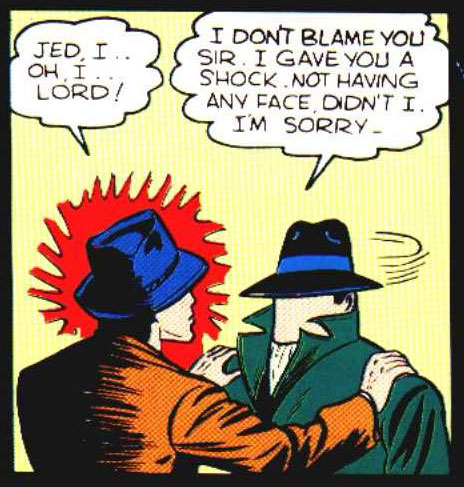
The blank-faced man disappears into the crowd, and Wayne doesn't immediately seek to investigate. Then, by the sort of coincidence beloved by pulp authors, Wayne encounters a young woman menaced by knife-wielding Parisian thugs known as "Apaches." The young woman, Karel by name, just happens to be the sister of Charles Maire, the blank-faced man, who regales Wayne with the story of his tragedy. At a bal masque (masked ball) the siblings encountered a strange man, the royally-named "Duc D'Orterre," who courted Karel with an eye to gaining her money. When Charles interfered, the Duc summoned his Apache agents and had Charles taken to his subterranean lair in the Parisian sewers, where Charles' features were burned off with a strange ray. (It goes without saying that the story does not bother with any niceties of verisimilitude, like explaining how Charles can talk without a mouth.)

Wayne volunteers the services of the Batman to investigate the Duc's perfidy, but the hero finds that the villain has ample weapons and devices of torment ready and waiting.


It's interesting that the Duc calls his torture-instrument a "wheel of chance," for this is a common synonym for the roulette wheel or its many analogues-- not to mention the medieval idea of the "wheel of fortune," which would lift mortals to victory at times before dashing them to death. Nothing in the 10-page story specifies that the Duc is a gambler, but his attire comes closer to suggesting that profession than it does that of a mad scientist or a crime-boss living in the sewers. The cane that projects a blinding ray adds something to the total effect, though to be sure the Duc's dominant image is that of a pointy-eared Satan, complete with a dolicocephalic skull that gives him an inhuman appearance. (Were it not for the various marvelous aspects of the story, the Duc's eerie physiognomy would be enough to place him in the uncanny trope of "freakish flesh.")

Batman gets free of the wheel, though it's not one of his more clever escapes: he simply breaks his bonds by main strength. However, the Duc manages to propel the hero into a "flower garden," in which all of the blooms have female faces.


The human-faced flowers are never explained, though one is tempted to suppose that the same ray the Duc used to erase faces could transpose other faces onto any medium he desired. The Duc then leaves Batman in his new prison and has his Apaches kidnap Karel and Charles, bringing them to his lair. However, the villain apparently does not know that his flower-women can speak to the crusader telepathically. They guide Batman out of the garden, just in time for him to rescue Charles from the wheel of chance. The Duc tries to escape with Karel in a car, and Batman pursues in his Bat-gyro. The hero manages to descend to the car, battle with the Duc, and then to leave the villain to a fiery death as he leaps free with the young woman in tow. The story concludes with Bruce Wayne bidding farewell to Karel and her still faceless brother.

Both the Duc's appearance and his subterranean location align him with Satan, and the idea of stealing faces, or placing them in some incongruous situation, aligns with the idea of the Devil tricking men into surrendering their souls and then consigning them to various punishments of Hell. Dante's "Wood of Suicides" would be the best known example of transposing human souls into plant-life. However, the Devil usually doesn't confine himself to one gender or the other, so the Duc's garden of female flowers may also owe something to Bluebeard, who kept the bodies of his previous wives in an abbatoir. It may also be no coincidence that Fox had Batman battling a Satan-like entity so soon after vanquishing a vampire. Fox doesn't invoke any images of Christianity in the "Monk" story, but that two-parter does borrow heavily from Stoker's DRACULA-- and Stoker associates his bloodsucker with the Christian devil fairly early in the book. For that reason, I consider "Peril in Paris" to be a metaphysical myth, in which the hero defeats either Satan or an agent of the devil, though the villain's metaphysical evil is displaced through such genre-tropes as "the mad scientist" and "the Parisian crime boss."