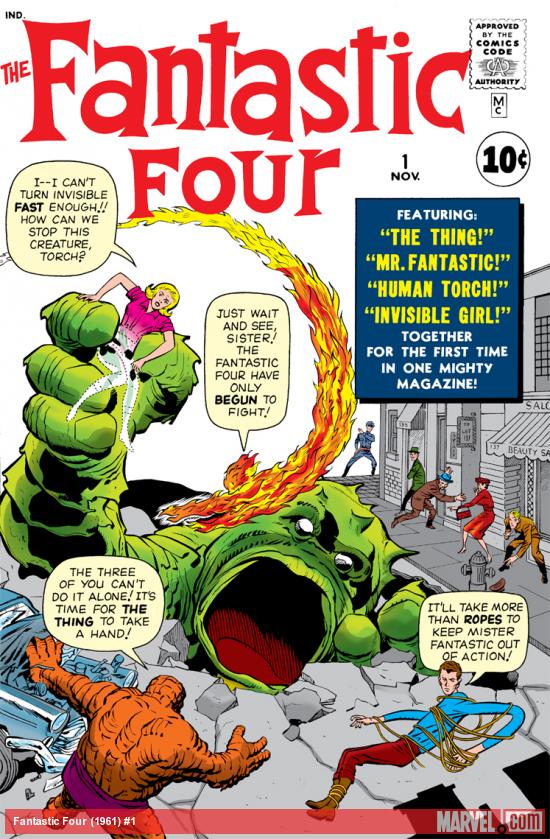
The following analysis was originally
part of a larger essay analyzing the first FANTASTIC FOUR story in
terms of its symbolic discourse. I found that the main story—the
narrative in which the four heroes contend for the first time with
the Mole Man and his subterranean creatures—did not meet my
standards for a mythcomic, unlike several other FF stories. However,
in more recent years I’ve decided that certain vignettes within
full-fledged stories may be more mythic than the story as a whole,
examples being “The Origin of the Batman” and “The Heart of
Gold.” I’ve decided that, for my 300th post mythcomics
post, that the Origin of the Fantastic Four deserves the pride of
place. Readers may observe that my writing-style for this overall
project proves a little different here than my usual blogposts.
_________________________________________________
At the conclusion
of the main story’s 8-page “teaser,” in which nothing
substantial is revealed about the foursome, there ensues a five-page
explanatory flashback that establishes that the heroes are not
aliens, but began as ordinary-- if quarrelsome-- human beings.
Indeed, the first panel of the flashback begins with a quarrel
between Ben and Reed. The substance of that quarrel is almost all we
readers ever know of the characters in the introductory story.
The four characters
speak to one another as if they have been acquainted over a long
period, though readers don’t get any of the backstories circulated
in later retellings of the origin. Readers are told that Reed is a
scientist who has designed a moon-rocket and that he wants Ben, an
experienced pilot, to fly the ship to the moon, with Reed along for
the ride. Ben refuses. He asserts that the venture is too dangerous
because humans don’t know enough about possible peril from “cosmic
rays” in outer space.

About Sue and
Johnny, we know even less. Sue is Reed’s fiancée, Johnny is her
younger brother, and both of them enthusiastically support Reed’s
moon-jaunt without hesitation. Ironically Ben, later seen to be the
most caustic and reckless of the foursome, is the sole voice of
caution. At this point Reed, Sue and Johnny are little more than
living personifications of the “space race” that dominated
American feelings in the early 1960s, for Sue emphasizes that they
must reach the moon “unless we want the Commies to beat us to it.”
The political rationale is merely a cover for the real motives
behind the trip-- more on which later-- but what persuades Ben to
join the team is not patriotism but a challenge to his manhood. Sue
implies that Ben’s caution is rooted in cowardice. Ben’s
reaction—in which he agrees to pilot the moon-rocket after all—is
perhaps unusually intense, suggesting that he may have ulterior
motives for overvaluing the opinion of another man’s fiancée.
Later events bear out this supposition.
With the conversion
of the “doubting Benjamin,” the foursome’s next act is to
commit what looks like high treason. The rocket designed by Reed
Richards is being kept launch-ready at a nearby “spaceport,”
which is guarded by a man wearing an American army uniform. No
military organization is ever mentioned by name, but since Richards
does not want to wait for “official clearance” before mounting
his lunar expedition, one can only assume that Richards constructed
the ship for American authorities and then had a falling-out with
them over the best time to launch. In later retellings the military
is no longer involved: Reed uses his own resources to construct the
rocket. In short order the four adventurers—whose qualifications
for space travel remain anyone’s guess-- sneak aboard Reed’s ship
and successfully launch the rocket, unaided by any ground crew.

During the flight,
we finally get the real motive for Reed’s wish to undertake the
forbidden flight. In the first panel of the story’s tenth page, a
voice from within the rocket—not attributed, but probably
Reed’s—asserts, “We had to do it! We had to be first!”
This is the true motive for Reed’s desire to make the flight as
soon as possible: the desire to win the race against all comers, to
have the glory of being “first.” Such Promethean endeavors have
been undertaken by hordes of “mad scientists” since the type came
into being. In most “creature features,” the act of overreaching
results in the scientist himself being cursed with some evil fate or
fantastic transformation. But here it is not Reed, the overreacher,
who is punished for his hubris. He, Sue and Johnny—the three who
believe in their doomed cause-- are transformed, but not in a truly
undesirable manner. It is Ben, the doubter, who reaps the bad
fortune that would usually devolve to the hubristic scientist. Is
it because he knew better than the others the potential peril of the
journey, and went anyway, with a divided heart? Or is it because he
coveted the fiancée of another man—the man who “got there first”
in an affair of the heart?
The creators
provide no details about the mysterious cosmic rays suffusing Earth’s
atmosphere; rays which in the next issue they will portray as a
“belt” surrounding the Earth, like the authentic “Van Allen
radiation belt.” In 1912 cosmic rays were identified, as well as
being misnamed, since these “rays” were actually super-charged
particles, called “cosmic” because they were supposedly generated
from the depths of space. Other Marvel Comics heroes would also
become empowered as a result of encountering radiation—the Hulk,
Spider-Man, Daredevil—but these other early heroes gained their
powers from man-made ventures into the world of radiation. Only the
Fantastic Four gain their powers from venturing into
forbidding—though not literally forbidden—territory, and only in
their case is the radiation that affects spawned by the universe
itself. Given that their powers make it easier for the foursome to
explore many aspects of that universe, one might view the failure of
Reed’s original mission as a blessing in disguise—at least for
three out of the four explorers.

Ben’s earlier
fears are justified. Reed’s brainchild does not have shielding
adequate to screen out the radiation of the “cosmic storm area”
through which the ship must pass when it tries to leave the Earth’s
atmosphere. The would-be astronauts lose control and the ship
crashes back to Earth. All four survive the crash, but in a sense,
they are “reborn” from their brush with the mysteries beyond the
familiar realm of Earth. Sue’s mutation is the first to manifest.
This seems fitting, given that she’s the reason that both Ben and
Johnny undertake the flight, and the factor that makes it possible
for Reed to have his pilot. The sole female, in one way or other
the focus of attention by all three men, disappears from their sight
just long enough for Johnny to worry that she may never come back.
A Kleinian psychologist might read this scene in terms of the primal
fear of infant life: that the mother, the primary female in an
infant’s life, may leave and never return. Then Sue’s
invisibility wears off. This cues a new outbreak of hostility
between Reed and Ben. Moments after Reed embraces Sue, Ben
criticizes Reed for having possibly cursed them all with even
stranger powers.
In later issues,
Reed will become the very epitome of the hand-wringing Marvel hero,
tormented with the memory of how his actions turned his friend into a
misshapen freak. But in this origin story, Reed never expresses a
single regret, before or after Ben loses his humanity. The great
scientist is on the whole arrogant and self-absorbed, at most
irritated that Ben should challenge the purity of his motives. “I
didn’t purposely cause our flight to fail,” he rationalizes,
tacitly refusing any responsibility for the inadequacy of the ship’s
shielding. Though Reed never shows any awareness of Ben’s unvoiced
affection for Sue, obviously the creators knew all about it, and may
have chosen to “punish” Ben as Reed might have wanted to punish a
potential rival.
Ben threatens to
attack Reed, at which point he transforms into the rock-bodied Thing.
His true feelings also spring forth as he rants, “I’ll prove to
you that you love the wrong man, Susan!” Reed transforms as well,
becoming the rubber-limbed Mr. Fantastic, and he subdues the Thing,
though not without an expression of horror at his own transformation.
Immediately thereafter, the excited Johnny displays his newfound
power of turning into a man of fire. As the flashback draws to a
close, all four of them are so sobered by their sudden acquisition of
super-powers that Ben’s coveting of Sue is dropped and never
mentioned again in the story, though his unrequited feelings do crop
up later in other stories. Even the emotional consequences of Ben’s
grotesque transformation are put on hold, and the four adventurers
swear to dedicate their powers to becoming the “Fantastic Four.”
_________________________________________________
Few if any of the
myth-tropes from the vignette are reflected in the main story about
the Mole Man. However, I will note that even though creators Lee and
Kirby never made any further direct references to Ben’s hidden
passion for Sue Storm, they found a way to compensate for their
monster-hero’s amour by giving him a consolation prize: Alicia
Masters, a near-lookalike for Sue who showed up seven issues later in
“Prisoner of the Puppet Master” and remained the Thing’s
inamorata for the remainder of the Lee-Kirby years.