Featured Post

SIX KEYS TO A LITERARY GENETIC CODE

In essays on the subject of centricity, I've most often used the image of a geometrical circle, which, as I explained here,  owes someth...

Sunday, June 18, 2023

THE LOVECRAFT CONUNDRUM


The works of H.P. Lovecraft present a challenge to the newly born science of crossover-ology. Though there were assorted crossover stories in prose fiction prior to HPL, the Providence author, along with Cross Plains scribe Robert E. Howard, was among the first to tie together several fictional narratives with a common mythology.

But are all of those references true crossovers? I've formulated the theory that such crossovers require "agency" between at least two distinct icons or icon-groupings. A simple reference to the activity of a given icon in one narrative within a second icon's narrative is not sufficient, as per my reading of Dennis Wheatley's 1953 novel TO THE DEVIL A DAUGHTER.

Many Lovecraft stories don't directly show the horrific beings invoked in the narrative. THE DUNWICH HORROR is about the half-human spawn of a human woman and the extradimensional demon Yog-Sothoth, so the spawn is an icon, but Yog-Sothoth is never seen, and so has no agency in the story. "The Whisperer in Darkness" references most of the Great Old Ones of the so-called "Cthulhu mythos," but they're not actually in the story, and so that too may not be any sort of true crossover, but only a "null-crossover."

I've fantasized about doing a massive re-read of HPL, but that doesn't seem likely at present, However, a tome called THE NEW ANNOTATED H.P. LOVECRAFT has gathered together all the stories that editor Leslie Klinger thought most relevant to the Mythos, which, as Klinger helpfully notes, HPL only called "the Arkham Cycle" in his correspondence. Klinger does not include every story with a "Cycle" reference, for he omits the short novel DREAM QUEST OF UNKNOWN KADATH. But the 22 stories selected probably comprise the better part of the Cycle, and so may be useful for my purposes here.

Just to bring up a minor comics-context, the annotated collection sports an introduction by Alan Moore, but IMO he doesn't say anything of importance about Lovecraft, much less crossovers (though Moore did work various HPL references into his LOEG works, including a "true crossover" appearance for Nyarlathotep in BLACK DOSSIER.


Thursday, June 15, 2023

R.I.P. JOHN ROMITA SR.

 I've no special observations on the significance of Romita's contribution to mainstream American comics, and I'm sure countless fans are singing his praises on that score. I will say that DC had his talents at their disposal in the early sixties, but they neglected to keep giving him work and so steered his course toward Marvel. There he became an inestimable asset to the company in his interpretation of Spider-Man. None of the other artists then available to Marvel-- Andru (who seems to have auditioned for the post), Kane, Kirby, Colan, or any of the DC stalwarts-- could  have channeled the sexy soap opera of Spidey in the late Silver Age. 

It wasn't a smooth transition. Lee, possibly anticipating difficulties with Ditko on the Spider-title, had Romita pencil a Spider-Man guest-shot in DAREDEVIL in 1966, apparently a few months before Ditko departed Marvel entirely. But it's a pretty pedestrian outing.


But Romita grew into the job quickly. In SPIDER-MAN #40-- incidentally, the second Spider-comic I ever owned-- Romita served up great action in the then-final Spidey-Goblin climax, but the soap operatics were more intense than they'd been under Ditko.


Romita was never known for huge fight-scenes like Kirby and Kane, but he outdid himself with Spidey's new villain The Rhino.

Not to neglect the girls of gorgeosity at all...


Here's a neglected moment in history: Gwen Stacy getting fed up with Aunt May and her apron strings.


And just to indulge a private theory... Romita has stated that he designed the Kingpin on his own in 1967, with no input from Stan Lee. I don't disbelieve his assertion that Lee gave Romita no description, since Lee wasn't an artist. But I've always thought Romita might have modeled his "my-fat-is-all-muscle" sumo-gang-boss on a slightly earlier character. To be sure, I can't imagine Romita going out of his way to read KID COLT as a regular thing. But he could have just seen the issue in passing on visiting Marvel offices, with the result that one "my-fat-is-all-muscle" tub o'lard begat another. From KID COLT #117 (1964), written by Stan Lee and penciled by Jack Keller:


MY TEN FAVORITE BATMAN '66 EPISODES

 Going in each case by the first episode-title of each multi-parter...

DEATH IN SLOW MOTION-- the best Riddler episode, adapted from a comics-story in which the villain was the Joker. All the tropes referencing silent cinema-- damsels in distress, pie-fights-- are perfect for the camp nature of the series, and for Riddler's more frenetic style. The "slow motion" reference is odd because undercranking often made re-screenings of silent flicks look like they were moving too fast, not too slow.

HIZZONER THE PENGUIN-- Penguin runs for mayor. Lots of good jabs at the political process.

THE JOKER IS WILD-- the first Joker is the best Joker, and even improves on the comic-book original, "The Joker's Utility Belt."

THE ZODIAC CRIMES-- the best villain-teamup, as Joker and Penguin devastate Gotham with a series of astrological crimes. The first three-parter.

A PIECE OF THE ACTION-- the best (and only) hero crossover, with some good interplay between B&R and GH&K. Roger C. Carmel chews the scenery mightily as one of the few Bat-villains who doesn't leave clues for the Dynamic Duo.

THAT DARN CATWOMAN-- the best Catwoman episode, in which she turns Robin evil and tries to force Batman to become her partner in crime. And also-- "one night in the Batcave makes a hard crime-fighter humble." 

THE DEVIL'S FINGERS-- Lorenzo Semple took a so-so John Broome comic script and made it into the dismal "Zelda the Great" in the first season. But he redeemed himself by reworking the script into this camp masterpiece, with dueling Liberaces, a trio of Scottish-themed beauties with killer bagpipes, Aunt Harriet packing heat, and both the most magnificently absurd death-trap and equally absurd heroes' escape from same.

THE SPELL OF TUT-- Tut tries to enslave Gotham with the hypnotic drug "Abu Rabu Simbu Two." I think this is the one where Tut whines, "everyone's being mean to me!"

TRUE OR FALSE FACE-- a vast improvement on a very forgettable Batman comics-story featuring one-shot villain False Face, who gets a humiliating unmasking at the end. The show's False Face is also a one-shot but he comes off as a wily, masterful opponent, even though actor Malachi Throne had to wear a thick face-mask and only communicated his menace through his voice and actions. And even though he's captured at the conclusion, the heroes DON'T unmask him, which would have spoiled the illusion of his mastery of the deceptive arts.

THE LONDINIUM LARCENIES-- the only Batgirl episode that I found outstanding (though the "Shame" episode's a good runner-up). "England Swings Batman," with mod British fashions, bad British accents, a cool pub-brawl and smoking English hotties.

DEPARTMENT OF COMICS CURIOSITIES #21: "MEN IN BLACK" (MENACE #3, 1953)/"THE HIDDEN FACE" (TOS #25, 1962)

 I found this minor story looking at early works by the newly-deceased John Romita Senior. It's not symbolic enough to stand as a near-myth or a null-myth, but is pretty much a straight "social relevance" story by Stan Lee and Romita. I would guess that the anti-bigotry message is something Stan could have been emulating from EC Comics, though this story predates EC's best known story about the rebounding of vigilante justice, "The Whipping," from a 1954 SHOCK SUSPENSTORIES. Stan's story, interestingly, has the bigot even hating on foreigners of Caucasian ancestry, for when his wife leaves him, he rails against her for being "a Swede."


It's also of minor interest to see the now famous phrase "Men in Black" used with zero E.T. connotations. The reference is to the fact that the main bigot and his buddies don imitation KKK robes, but black instead of white. This leads to a Poe-esque orgy of self-flagellation, as the bigot punishes himself by imagining that he can't take off his black mask.


ADDENDUM: Stan Lee later recycled this story with a new SF-angle in "The Hidden Face," TALES OF SUSPENSE #25 (1962), with art by Steve Ditko.


Wednesday, June 14, 2023

TIME OUT OF ALIGNMENT

 A major aspect of my crossover-theory is that of alignment; the principle that every literary cosmos, particularly with regard to serial concepts, is dominated by one or more superordinate icons whose are the "center" of the narrative, while all subordinate icons orbit around the central icon or icons. In CROSSING GODS I gave several examples of innominate figures from mythology being "crossed over" with one another, and sometimes with newly created serial characters, the example of the latter being Atticus of "the Iron Druid Chronicles." In COSMIC ALIGNMENT PART 3 I spoke of a different form of innominate character, that of a fictionalized version of a historical personage. I asserted that no crossover took place when a narrative associated legendary characters already associated in history-- Jesse James and Cole Younger-- but that it was one if the author depicted an association between characters not known to have encountered one another, like Jesse James and Belle Starr.


Characters involved in time-travel, though, break down normative categories of alignment, and for that reason even figures I've rated as properly "legendary" don't rate as crossovers when they interact with characters who (more or less like authors) are no longer bound by restrictions of the time-space continuum. Thus, a goodie-good Billy the Kid meeting a version of Dracula? Crossover. A vampire-version of Billy the Kid, who has no real connection with the historical figure, meeting Bloodrayne? Crossover. But Billy the Kid, as portrayed by Robert Walker Jr. in the scene above, meeting one of the Time Tunnel guys? Not a crossover. And the same principle applies to works in which the time-travelers bring together assorted characters from different eras, as Billy the Kid, Napoleon and Socrates are brought together by those excellent time-dudes Bill and Ted.


The same applies to figures of myth and folklore, as when Bill and Ted take a bogus journey that brings them into contact with both the Easter Bunny and Satan, or when the Time Tunnelers meet the equally innominate figure of Merlin.


There's also a cognate figure of characters who summon up innominate characters without those icons leaving their own time-frame. In comics the hero who did this most often was Quality's Kid Eternity, who was forever enlisting characters from both myth (Nepture, Midas, Achilles) and from history (Annie Oakley, Abraham Lincoln). None of these would even be charisma-crossovers, either with one another or with Kid Eternity.


However, unlike the time travelers Kid Eternity did possess the power to plumb the vasty deeps of fiction as well-- and so, when he conjured up Sherlock Holmes or (more amusingly) Blackhawk, THOSE would count as crossovers with nominative icons.

Monday, June 12, 2023

SILVER SCREEN PSYCHO KILLERS

 Responding to remarks about the influence of Hitchcock's 1960 PSYCHO on the history of the psycho-killer subgenre...

I'm only aware of one year-by-year "psychofilmography" of this subgenre, and that's the one compiled by John McCarty in his 1993 MOVIE PSYCHOS AND MADMEN. I don't agree with a number of his inclusions, such as "Jekyll and Hyde" films and "evil mastermind" films like those of Fu Manchu and Doctor Mabuse. But he's generally good about focusing on killers who seem motivated less by gain than by some mad pleasure in killing, usually more than just one victim. His list suggests that, aside from Mister Hyde, supernaturally-endowed psycho-killers barely existed in any quantity before the 1980s, so that most of the malcontents on the list are either uncanny or naturalistic. 

According to McCarty, there's barely anything relevant in cinema's silent years, though Hitchcock's 1926 THE LODGER builds on the legend of Jack the Ripper. I don't consider the original LODGER a true psycho-killer film, though, because the evildoer is mainly important as a catalyst, causing an innocent man to be falsely accused.

Fritz Lang's M heads up the sound era, but it, like most of the other psycho killer films of the thirties, doesn't beget more of its own subgenre kindred. The strongest pattern I see are a series of one-offs on a theme I would call "the mad hobbyist." This means a character who's so obsessed about his hobby that he makes murder integral to his pursuits, thus taking in 1932's MYSTERY OF THE WAX MUSEUM, 1935's THE RAVEN, and 1936's THE DEMON BARBER OF FLEET STREET. 

By contrast, the forties really develop the subgenre as cinema never had before. Many years during this decade can boast (according to McCarty's parameters) as many as four or more psycho-killer films each year. Was there an upsurge in the public's perception of psychology, particularly of the Freudian brand, so that ticket buyers took the subject more seriously as a way to explain deviant behavior? Es posible.

In 1944 we get the first psycho-killer film that spawns, not a sequel or remake, but a wholly different movie in the same idiom. John Brahm's THE LODGER is a wholly different film from Hitchcock's, for the psycho-killer is the focus of the story. The killer's mental makeup is described in much more detail than most thirties parallels, even more than in Lang's M. LODGER was successful enough that the studio got Brahm to do an idiom-sequel for 1945 release, adapting the novel HANGOVER SQUARE in such a way as to duplicate the appeal of LODGER.

A lot of crime-films started using crazed killers, too. Scarface and Little Caesar had their obsessions, but they didn't murder for pleasure like the psycho-crooks of BORN TO KILL, KISS OF DEATH, or Hitchcock's ROPE.

The fifties show roughly roughly the same pattern as the forties, though in this decade we get an idiom-sequel to a "mad hobbyist" flick, when the success of Vincent Price's 1953 remake of MYSTERY OF THE WAX MUSEUM leads to his appearance in 1954's THE MAD MAGICIAN. Toward the end of the fifties we're beginning to get a few films like 1958's SCREAMING MIMI and 1959's HORRORS OF THE BLACK MUSEUM, which might have encouraged (if not literally influenced) the provenance of not only PSYCHO, but the same-year PEEPING TOM by Michael Powell.

In terms of the history of psycho-killers, PSYCHO's biggest influence was that it provided a pattern that proved easy to follow. Instead of one or two idiom-knockoffs of a successful movie, the "hills" of the 1960s were alive with the sounds of psycho-killings. Going purely by McCarty, year 1966 is the only one that has as few as four such movies, and that's with me eliminating the irrelevant FRANKENSTEIN CREATED WOMAN. After 1970, McCarty's list, which concludes with Year 1992, shows almost every year with at least ten such films listed.

And to think-- it all started with a noisy shower.

Friday, June 9, 2023

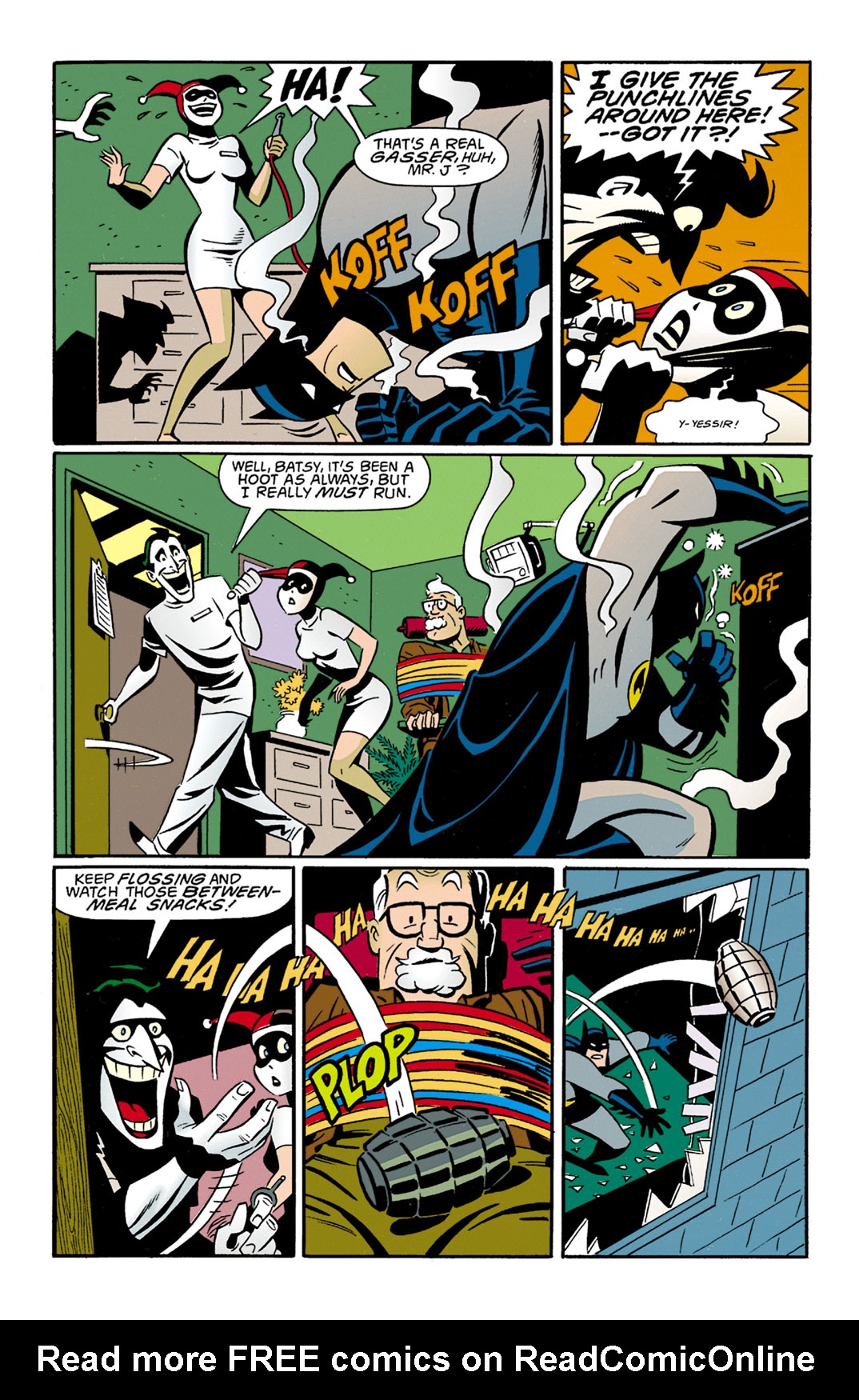
"MAD LOVE" (BATMAN ADVENTURES, 1994)


I've already done a short review of the animated adaptation of this one-shot comic here and gave that episode a strong mythicity rating. While a number of beat-for-beat adaptations don't necessarily duplicate the myth-discourse of their originals, both original and derivation are equally good at depicting the psychological morass in the mind of Harley Quinn.

Harley's co-creator Paul Dini has stated that he had no notion that the girl in the jester outfit was going to become one of the most enduring characters of nineties comics. Originally Dini only meant to give Joker a female henchwoman loosely akin to the molls who accompanied many male villains on the 1966 BATMAN teleseries. However, even the few molls who patterned their attire after that of their male leader were usually just there to look pretty. Even though Harley was not intended to appear more than once, Dini had her voiced by his college buddy Arleen Sorkin, and even in that one episode there was more back-and-forth between Harley and Joker than one ever found in a 1966 Bat-episode.

Since Harley's character evolved organically, it's possible that Dini never really thought about the Harley-Joker relationship changing in early episodes. However, MAD LOVE shows the writer, teamed with artist/co-creator Bruce Timm, finally decided to portray that interaction as fundamentally toxic. Joker was, after all, a manic killer, and it may not be coincidence that in her animated episodes Dini didn't actually show Harley callously killing anyone, however often she fought with Batman and his allies.


So LOVE starts out showing Joker and Harley trying to knock off Commissioner Gordon. Batman prevents this, but Harley is instrumental in stunning the crusader so that the two criminals escape. (Note: the cartoon improves on the Joker's farewell line, having the villain say, "may the floss be with you.") On the same page, though, Joker is seen to be completely ungrateful for Harley's help.


Batman then converses with Alfred, musing on Harley's origins. Two details that were omitted from the cartoon: that Harley got into college on a gymnastics scholarship, and that she apparently used sex to pad her college resume.


Meanwhile, Joker is taking it hard about getting defeated again, and he's so desperate for a new Batman-slaying scheme that he starts reviewing old schemes he already discarded. After being maltreated by her "puddin'" once again, Harley almost has a moment of clarity about her rotten love-life. 


This leads to an extended flashback, in which she goes to work at Joker's perennial prison, Arkham Asylum. She's secretly hoping to garner big-time secrets from some of the celebrity inmates in order to write a best-selling tell-all book, But Joker sees in Doctor Harleen Quinzell a mark to be played, and he plays her so well that she abandons all her small-time ambitions, making her into what she believes to be the perfect "Clown Princess of Crime."


But at the end of her flashback, Harley ends up blaming Batman for all of her troubles. She uses Joker's discarded piranha-fish death-trap and traps Batman in it. Batman's only hope is to play on her psychological vulnerabilities, in a more honest manner than Joker did, by convincing her to call Joker in to witness his eternal foe's demise.


Joker comes. Joker is not pleased that his girlfriend trumped him.


So Harley's reward for patterning herself after a clown-themed stone killer is almost getting killed. Batman escapes thanks to having brought Joker into the mix, and Joker seems to "die" in his own big fall. At story's end, Harley returns to Arkham but as an inmate. This time, she almost comes to terms with her own egotistical follies. But Dini wasn't quite ready for Harley's reform, and LOVE ends with her re-descent into the best known "amour fou" of the superhero genre.

But she didn't stay lost in that delusion, and over time Harley became the poster girl for women working their way out of toxic relationships with men, as seen in the 2016 SUICIDE SQUAD. (No one seems interested in whether her girl-on-girl friendship with Poison Ivy might prove equally-- or even literally-- just as toxic, but -- baby steps, baby steps.)