Featured Post

SIX KEYS TO A LITERARY GENETIC CODE

In essays on the subject of centricity, I've most often used the image of a geometrical circle, which, as I explained here,  owes someth...

Tuesday, August 8, 2023

QUICK CROSSOVER CORRECTION

 In ESCALATION PROCLAMATION PT. 2 I wrote:


This is the most important aspect of escalation with relevance to cultural significance. It does not matter that Ivanhoe had just one literary outing while Fu Manchu had twelve novels and four short stories; what matters most is that they became cultural touchstones. Once this happens, these iconic characters, no matter how much they may be changed in later adaptations, have had their stature escalated to the highest level possible for a purely literary character; the level of Qualitative Escalation.

At the time I wrote these words in 2021, I hadn't yet formulated the linked terms of "novelty and familiarity," first seen in slightly different form in 2022's THE DANCE OF THE NEW AND THE OLD. Once I had made this formulation, the description of Qualitative Escalation became strained. Yes, Ivanhoe became a "cultural touchstone" despite the fact that in his original medium he enjoyed only one story, and possibly would have become just as "escalated" had Scott not included the subplot of Ivanhoe's crossover with Robin Hood. But if I truly restricted Qualitative Escalation only to famous works, then it would be impossible for me to term the minor Edgar Rice Burroughs novel A FIGHTING MAN OF MARS in the ranks of crossovers, because its hero only enjoys one appearance but never becomes a touchstone of any kind.

So I will revise the exclusionary terms of my criteria for Qualitative Escalation. I was seeking in that criteria to come up with a form of "durability" to parallel that of the Quantitative type. But an icon's assumption of the stature of superordination, whether that icon appears just once or not, is de facto a Qualitative Escalation in comparison to all the subordinate icons within the text. So Tan Hadron, though never able to match Ivanhoe in any other way, does possess the same superordinate status.


This does not apply, however, to "back-door pilots," episodes of regular serials (usually but not always television shows) which attempt to launch new serials. A few such pilots may take over almost the whole run-time of a given episode, so that the pilot-characters can amass more time onscreen than the regular serial-icons. Nevertheless, such pilot episodes are still under the aegis of the ongoing serial's main characters, and if said episodes do not generate even one independent monad, and are not adapted from previous narratives, then the characters have no crossover-mana whatever. One comic-book example of this practice are the three issues of Marvel's INVADERS, in which Roy Thomas created the "Kid Commandos" team in order to hustle the sidekick characters out of the title. In this essay I expressed the notion that I might regard that team as an "adjunct" to the regular superordinate icons, but I now reject that line of thought to be consistent with my statements on other forms of "pilots" that go nowhere.

Sunday, August 6, 2023

THE READING RHEUM: THE SPIDER VS THE EMPIRE STATE (1938)


I preface this review by stating that I'm far from an expert on the pulp character The Spider. Over the ten years in which the character appeared in his own magazine, a little over fifty novel-length stories appeared, of which I may have read a dozen or so in reprinted forms. Norvell Page wrote the vast majority of these novels, and it's probable that most of the works I've read, with their grotesquerie and blood-curdling ultraviolence, were stories by Page. What I value most in SPIDER stories is their apocalyptic delirium, in which the hero's domain of New York City is often razed to the ground in one narrative, only to appear in the next totally back to normal. So when I heard that Page had written a big story, "The Black Police Trilogy," which extended over three consecutive issues of the magazine, I ordered it.

The short verdict: delirium is hard to sustain over a long haul.

An excellent foreword by scholar Thomas Krabacher explains that Popular Publications, the house that issued the SPIDER adventures, also came out with a magazine with a similar apocalyptic feel. OPERATOR FIVE began in 1934, the year after the SPIDER began. Whereas the arachnid protagonist confined himself to menaces to New York, in OPERATOR FIVE hero Jimmy Christopher always dealt with huge invasions of the United States by predacious foreign armies. While many modern readers might deem this focus on foreign threats to have fascist overtones, Krabacher demonstrates that publisher Harry Steeger was a thoroughgoing liberal. His publications conjured up larger-than-life menaces so that heroes, whether empowered by the government or operating on their own, could vanquish them and return a devastated populace to normalcy. Krabacher asserts that Steeger may have been trying to cross-pollinate the approaches of the two magazines by having the Spider battle a more long-range threat. 

In EMPIRE-- a title apparently imposed on the trilogy by some modern editor-- a criminal schemer called "The Master" duplicates Hitler's 1933 feat: that of getting a repressive political party legally elected to supreme power, if only in the state of New York. (Very little is said in EMPIRE about how the other 48 states react to this state of affairs, much less the Federal government.) The Master immediately enacts through his proxies draconian laws, and liberates from the state's prisons a horde of ruthless criminals. These hardened crooks become the Black Police, who devote all their time to collecting illegal taxes and torturing citizens who don't pay. The Spider, a,k.a. millionaire Richard Wentworth, cannot counteract this peril with no more than his usual small band of helpers. Instead, the Spider must become a revolutionary figure, inspiring countless brave citizens to take up arms against the tyrants and their servitors.

Though Page's trilogy is never completely dull, its many scenes of inspiring derring-do and sacrifice become repetitive after a while. My overall impression is that, since Page could not concentrate his imaginative talents in a compact story of apocalyptic action, he resorted to repeating his revolution-themed scenarios as a strategy to simply extend the story artificially. A handful of new characters appear to assist the Spider's band, but none of the newbies are memorable. Nita Van Sloan, Wentworth's inamorata and the pulps' epitome of the courageous woman, gets some strong scenes but these too fall into something of a rut, while familiar aides like Ram Singh are often sidelined. The Black Police are one-note villains and the Master is just a standard mystery-fiend. (Given the evildoer's name, Page foregoes to use the hero's usual epithet, "the Master of Men.") The Master has a few gimmicks, like a virulent plague he uses to quell rebellion. But he has no personality and the Big Reveal of his identity carries no weight.

So THE SPIDER VS. THE EMPIRE STATE adds up to little more than a so-so pulp adventure with no real political connotations and excessively padded. It's surely one of the few times I found the foreword more entertaining than the novel proper.


Thursday, August 3, 2023

GENETIC FREAK-OUTS

I was barely reading any Marvel Comics in the 2010s, but I followed in a loose sense the consequences of the company's bizarre decision to play down the successful X-Men franchise and promote that of the never-successful Inhumans. I'm not sure I knew that plans for an Inhumans film were initiated in 2014, but I certainly saw the result that same year in the AGENTS OF SHIELD teleseries. The first season of that ill-conceived cockup had already been lousy, but the show reached new Heights of Stupid with an attempt to shoehorn the Inhumans concept (though not the familiar comics characters) into a secret agent format. After plans for a movie stalled, in 2017 the principal Inhumans of the so-called "Royal Family" appeared in an eight-episode ABC teleseries. The series proved a huge bomb, critically and commercially. I found in it but one virtue-- a strong performance by actor Anson Mount as the silent king Black Bolt. In my book that put the INHUMANS show on the same quality-level as AGENTS OF SHIELD, whose only strength was the casting of Ming-na Wen as agent Mathilda May.

All these idiotic machinations almost certainly came about because some genius in Disney Marketing decided that the company wasn't getting enough bang for its buck by playing up the X-Men franchise, since that property's movie and TV rights were then owned by Fox. I can imagine the conversation going like, "Hey, Marvel still totally owns the Inhumans, right? The fans will just accept anything we push at them as long as it has a bunch of weird, colorful people in costumes to help them (the fans) compensate for their drab lives." And once this blockhead came up with this genius idea, no one else could point out its fatuity, lest that person seem like he wasn't in favor of the company making more money. One hopes the genius got kicked to the curb for whatever monetary losses Disney suffered for the failure of the INHUMANS teleseries.


As I said, none of these Marvel machinations affected me back in the day, since I wasn't reading the X-books, or for that matter the FANTASTIC FOUR features that also got downplayed for an analogous reason. But when I recently caught sight of a TPB collection of a 2016-17 Marvel series, INHUMANS VS. X-MEN, I wondered if the story, written by Charles Soule and Jeff Lemire,  might signal some of the company's priorities during that historical moment. 

I also dipped into a handful of Inhumans stories published around the same time as IVXM, but I'm sure I've missed a lot of fine points about the execution of the Inhumans franchise. That means that any conclusions I make here are partial at best. But IVXM by itself sets up a situation that COULD have been used to shunt the Unwanted X-Franchise off Planet Earth and to play up the Inhumans, though this possibility does not actually come to pass by the end of the story. Overall the Soule-Lemire story conforms to the "Marvel heroes fight over a misunderstanding" trope, though I will say that, unlike a lot of multi-character crossovers, the writers manage to give most of the characters therein a "spotlight moment" or two. 

Perhaps more tellingly, IVXM attempted to "democratize" the process of genetic-diversity-with-superpower-benefits. The 1970s X-MEN capitalized on this trope far more than its 1960s iteration by disseminating that diversity over countless human cultures and ethnicities. By contrast, the concept of Marvel's Inhumans, as initiated in 1965, was that of an insular culture that had a thing for inducing mutations in its populace, even though the people came from the same stock as common humanity. Following the 1960s, most of the attempts at giving the Inhumans ongoing serials were hampered by the difficulties of endowing such exotic characters with any relatability. Some of the Inhumans stories produced in the middle 2010s, though, sought to modernize the franchise by introducing an assortment of younger Inhumans, sometimes termed "Nuhumans," who in my opinion were designed to compete with the more numerous and successful X-spawn.

I don't have enough information to render any aesthetic judgment on the various INHUMANS comics of this period. There may be some very good works in the actual books, whatever the motives of the marketing people who were responsible for the X-Men X-cision. Still, history will record that Marvel customers still wanted the X-Men, no matter how much the company pushed its favored franchise. Perhaps the fact that the comic-book version of Kamala Khan, originally retconned into an Inhuman as part of the "Inhumans First" project, is now being touted as being "both an Inhuman AND a mutant."

In 2019 Disney bought out Fox and now has the right to monetize any X-adaptations the company might want to do. I suspect, though, that the failure of the Great Inhumans Push will not teach Disney anything about the folly of trying to manipulate their customers' desires for entertainment purely to help the company's bottom line.


Saturday, July 29, 2023

THE LAST TIMELY-ATLAS CROSSOVERS?

My earlier essay THE FIRST MARVEL CROSSOVER remains accurate, given that it describes the first encounter of starring icons since the publisher variously known as "Timely Comics" and "Atlas Comics" began using the name "Marvel Comics" for the entire line. However, there were developments in the late 1950s that can be seen as precursors of that 1961-62 event-- or at least, just as a barometer of how bored Stan Lee was with his job.


First, in WYATT EARP #5 in 1956, the Atlas version of the famed marshall met the second of two Atlas versions of the celebrated Annie Oakley, after the latter character lost her short-lived title. (The first Atlas-Annie was just one of the company's standard "pretty-girl humor" features.)


Then in SHERRY THE SHOWGIRL #5 (April 1957), the titular Sherry (introduced I believe in issue #1 of the series) had a minor encounter with the long-running Millie the Model.


Then came the oddest mutation of the pretty-girl humor genre; a two-issue wonder called SHOWGIRLS. I'm reasonably sure that I saw this cover for issue #1 (June 1957) at one time or another, but I probably thought that it was just one of the many "phony-meeting" covers often seen on comics-covers since the early 1940s.


But no, the first issue has a single-page gag in which Millie and her support-character Chili-- despite the fact that they're models, not showgirls-- are hanging out with Sherry Storm and Pearl Dimly, the latter the star of the "My Girl Pearl" feature initiated in 1954. (As yet I have no idea if Pearl was ever a showgirl and I'm not sure I want to know.) Everything else in the issue, though, just focuses on separate pretty-girl stars.


Then, issue #2 offers a full four-page story in which the aforesaid four girls, along with Hazel Haze (catty rival to Sherry Storm in that series), go on the road and have some forgettable things happen to them.


The same five girls also get a one-page gag in the same issue.


For some reason, the title then jumps to #4, possibly the result of re-numbering some other title, and though there are no literal crossovers therein, there is a cutesy reference to another company icon, Patsy Walker.

Like the Marvel crossovers described earlier, all of these were piddling stories that could not possibly have been intended to impel readers to check out other established titles. They just show Stan Lee futzing around, trying to keep himself entertained while he churned out gags. He may not have initiated the 1956 Earp-Oakley crossover (GCD credits that script to Hank Chapman), but it took place under Lee's editorial aegis, just like all the cute-girl strips Lee did write. In addition, about two years had gone by since Atlas had attempted its revival of its "Big Three" superheroes. These strips also did not have more than minor crossovers, one of which was the recycling of a failed 1948 superheroine, Sun Girl into the Human Torch's partner. Still, possibly those failed books caused Lee to think back to the glory days of early Timely, when the Human Torch-Sub-Mariner battles were big money-makers. Lee wasn't ready to undertake anything ambitious in the late 1950s, and the journey to "Marvel Continuity" was a slow one even in the early 1960s. But sometimes the seeds that seem not to grow at first are merely slumbering for a later rebirth. 


DEPARTMENT OF COMICS CURIOSITIES #25: SUN GIRL #2-3 (1948)

 From 1948 here are two separate Sun Girl stories in which she faces off against colossal monsters. The first one is seen here ripping up a train-track like Kong in the 1933 film, though he's immune to cannon-fire like the later Godzilla. Sun Girl eventually figures out he's a deep-sea critter and drives him into the ocean.


The other, name of Bokk, is a more conscious King Kong copy, though he has an analogous "Godzilla moment" in that he gets "riddled with bullets" but does not succumb to them. Sun Girl beats Bokk by tricking the goliath into eating poisoned food, but in the last panel she slightly regrets doing so, noting that the people who brought Bokk to civilization were truly at fault.


Both of these Kong-copies predate the giant-size gargantua who is the star of the 1949 MARVEL TALES story, "The Gool Strikes."

Thursday, July 27, 2023

MYTHCOMICS: ["THE DEMON DOORWAY"] (DOORWAY TO NIGHTMARE #2, 1978)


In the comment-section for my 2021 analysis of Gerry Conway's SUB-MARINER story "A House Named Death," I said, somewhat tongue-in-cheek, that "if I can find mythcomics for writers like Len Wein and Cary Bates. surely I can find something for Conway." I wasn't thinking of Conway at all when I decided to do an overview of the early MADAME XANADU stories, since I didn't associate him or any other raconteur with the short-lived series. Only during re-reading all the issues and their editorial pages did I learn that editor Joe Orlando made the conscious decision that DOORWAY TO NIGHTMARE would not be executed by any steady writer-artist team, but would instead continually change up the combinations of raconteurs. The only constant elements would be the Michael Kaluta covers and the general setup of fortune-teller Madame Xanadu, who would help tormented young lovers out of supernatural trouble, after which she would often capture malignant entities in mystical glass jars.

As noted in the overview all of the other DOORWAY stories are not much more ambitious than an average story from one of DC's horror-anthologies. Possibly Conway, who scripted stories for many DC and Marvel titles, managed to cut loose somewhat with the story I've titled "The Demon Doorway," though the art by Vicente Alcazar is largely pedestrian. Since the nature of Madame Xanadu's participation in the narratives remained static, here Conway could give more mythic emphasis to the one-shot pair of young lovers menaced by the psychological flaws in the mind of Melissa Mann.


When Douglas Holt escorts Melissa to the fortune-telling shop of Xanadu, Conway shows them moving through a festival in Greenwich Village. (The season is later said to be winter, though no one in the story dresses like it's a New York winter.) The festival's only purpose in the story is to illustrate that Melissa finds herself uncomfortable around all the celebratory rituals, and Douglas underscores her antipathy by stating that he wants her to visit Xanadu's shop so that she can forget her role as a physicist at New York University. Douglas also mentions here and two other times that he's an artist, but his profession plays no role in the story, unless it's to contrast "art" with "science."


Xanadu welcomes the lovers and does a Tarot reading, though she's apparently already learned their names from her cards. While most of the Tarot readings in the Xanadu stories eschew specifics, Conway does mention that Melissa's significator is "the Queen of Rods," but does not enlarge upon the symbolism. Xanadu tells Melissa to "leave your pursuit of science" and "find renewal in life," though without further explanation. Melissa assumes that Douglas set up the reading to scare her out of her association with a university-sponsored "Doorway Project." 


As Douglas unburdens himself to Xanadu, it turns out his opposition to Melissa's scientific obsession isn't concerned purely with her psychological balance. The Doorway Project is the creation of a senior scientist, Hampton Hill, and Douglas suspects that Hill is seducing Melissa, "not emotionally, but intellectually." Douglas even goes so far as to claim that his older competition is not just a "father-figure," but the embodiment of Melissa's desire that life should "logical, orderly, sane-- and Hampton Hill was sanity personified." Douglas worries that Melissa's blowup means that she'll fall fully under Hill's control, but Xanadu assures the young fellow that the cards indicate he still has a role to play. 

That very evening, Melissa meets Hill at the university as they plan to initiate Project Doorway, an attempt to use a computer-matrix to open a doorway into another dimension. No practical purpose is cited for this endeavor; Hill merely hopes to "unlock ancient mysteries," though he mentions that the university doesn't fully approve of the experiment, believing that he is "tampering with forces beyond our knowledge." It may not be coincidence that the man professing this Frankensteinian ambition apparently was born in or lived in Geneva, which is the Swiss locale with which Mary Shelley's mad scientist was most associated. Anyway, for a moment Hill lets a bit of animal passion steal past his facade of utter sanity as he tries to kiss Melissa before they activate the doorway. Melissa avoids the intimacy, which may suggest that though she's found a father-figure in Hill, she's not obsessed enough to desire symbolic incest. Yet the Doorway Project is the symbolic child of their joined intellects, for as they activate the machine Conway states that the device "hums into life, struggling to awareness like some dark, mythological giant."
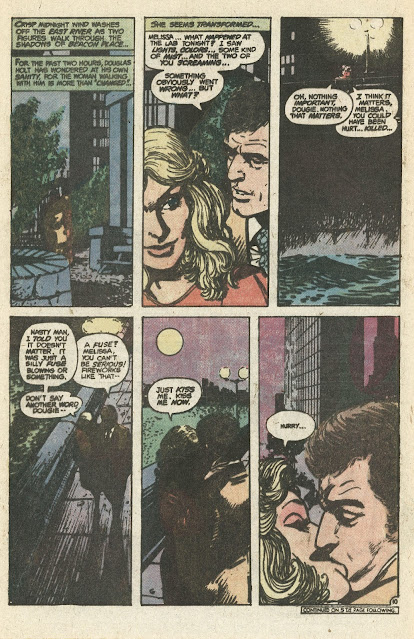


If the giant metaphor means anything, it aligns best with the idea of the Greek Titans who sought to overthrow heaven. This aligns in turn with the nature of the dimension opened up by the Mann-Hill brain-child, for Conway calls the otherworld "the depths of Hell," i.e., the domain of rebellious angels. Douglas's jealousy saves Hill and Melissa from their folly, for he hears them screaming at the sights they behold, breaks into the lab and wrecks the machine. The dimension-door closes, but something has changed. Melissa refuses to discuss what happened with the device, and demands that Douglas take her out to eat at an expensive restaurant, where Melissa discards her normal abstemious diet and chows down. 

As Douglas later tells Xanadu, at first he liked the change in her attitude, because Melissa became more affectionate. However, when the two attended a party, Melissa left with a complete stranger. Unable to reach her, Douglas checked the university lab, and tells Xanadu (without going into detail) that Melissa was there, but wearing "the same outfit she'd worn the night before." Melissa then  underscored the previous night's infidelity (sort of a "walk-of-no-shame") by kissing Hill-- only to shove him away and start bashing the Doorway computer. Hill then had the raving woman institutionalized at Bellevue, after which Douglas ended up at Xanadu's door. Madame Xanadu tells Douglas that Melissa's problems are now metaphysical rather than psychological: that she's possessed by a demon that has unleashed her emotions not for love, as Douglas wanted, but for pure self-indulgence. (Poor Hampton Hill: he gets rejected both by the real young woman and by the demon in her flesh.)


At Bellevue Douglas and Xanadu convince the attending physician to let them attempt an exorcism, which of course the super-rational Hill opposes. Xanadu requires Douglas to read the exorcism, apparently so that he can lure out the demon the way Father Karras did in that other possession-story, by offering up his own soul. However, when the demon does emerge, Xanadu traps it in one of her jars. Melissa is freed of the possession but ironically, Mister "Sanity Personified" suffers a nervous breakdown from beholding the demon he unleashed-- implicitly his punishment for poaching on a younger dude's territory.

Conway's story is not especially religious, for all that it clearly trades on the trope of "seeking forbidden knowledge trespasses against the natural order of God." Unlike many such stories, this one is stage-managed by a woman who implicitly knows more about "ancient mysteries" than Hampton Hill could even imagine, so one might state that profane science is incapable of plumbing such mysteries. Melissa and Hill are both too "sane" to imagine that their endeavor can invoke the demons of Hell, and these demons can be seen as being just as much the spawn of irresponsible science as the Frankenstein Monster or the atom bomb. Hill, who desires Melissa, tries to make her his "mind-mate" through their collaboration, and Melissa, for whatever reasons, wants an older man in her life that doesn't disturb her reason with the allure of youth and life, as Douglas does. Both are guilty of over-reaching the limits of what reason can accomplish, but only Hill pays the price, while Melissa gets some measure of integration, which *may* be the meaning that Conway had in mind with his mention of the Queen of Rods card.

I don't normally think of Conway as being a good coiner of names, but he does pretty well with "Melissa Mann." The young woman wants to put aside the chaos of life for pure reason, the sort of reason that is often thought the masculine domain. In Greek "melissa" means "honeybee," and while honeybees normally follow the egg-laying queen of the hive, this Melissa follows a type of "man" she considers neutered from the threat of sexuality. The other two names suggest some less concentrated symbolism. One definition of "holt" is an animal's den, while "Douglas" in Gaelic means "dark stream," so these connotations of natural phenomena may cohere with Douglas' attempts to persuade Melissa to be more spontaneous and natural. A "hill" is also a natural feature, but the name "Hampton" connotes the inhabitant of a settled community, such as one built upon a hill. So together these two names could signify human rather than animal habitation, and the faculty of reason humans use to separate themselves from the beasts. In any case Douglas doesn't have to sacrifice his life and goes on to enjoy a "natural" existence with Melissa, but his rival's power of reason is forfeit. As for Melissa, the implication is that she's reached a balance, neither too emotionally reserved nor too emotionally indulgent. 

So, in conclusion, Conway wasn't immune to the allure of myth after all.

But-- sigh-- now I have to find something for Tony Isabella...

Wednesday, July 26, 2023

ICONIC BONDING PT. 2

My entire formulation of bonded ensembles is oriented upon trying to discern which subordinate icons are, or are not, bonded to which superordinate icons in terms of alignment.

Here's my first statement on the ways in which a given subordinate icon, in particular a famous villain, is aligned with a given superordinate icon:

The first appearance of an antagonist often determines his alignment for the foreseeable future. No matter how often the Joker appears in features other than those of Batman, he remains known as a Batman foe.

Now, I said "often" because there have been times that a subordinate icon (I may as well say "villain" for the rest of the essay, since that's the only icon I'll address here) is introduced under the mantle of a given "hero," but the latter has not yet been aligned with a strong superordinate icon, Thus Thanos first appears in an issue of Iron Man, alongside a heroic subordinate icon (Drax the Destroyer), but Thanos is in a "floating alignment" until he's aligned with Captain Mar-Vell.

I've established so far that if the Joker had appeared in a Batman story before Batman teamed with Dick Grayson Robin, Joker would still be aligned with Grayson-Robin, but that no Bat-foe who meets Batman after the dissolution of the bonded ensemble is aligned with Grayson-Robin. But how does this theory apply to the next strongest form of ensemble, the "semi-bonded" ensemble?

Here, I will draw, as specified, upon the AVENGERS title as an example of a semi-bonded ensemble. 


In the earliest AVENGERS stories, all members of the team had their own features. In AVENGERS #6, Baron Zemo, making his first appearance, brings together three villains from each of three heroes' features: the Black Knight from GIANT-MAN, the Melter from IRON MAN, and the Radioactive Man from THOR. As soon as these established villains appeared fighting heroes with whom they were not aligned, this resulted in a charisma-crossover.

However, the reverse is true when a villain introduced as a foe to the Avengers-team fights one Avenger, because by fighting one Avenger, he has in essence declared war upon them all.


So when the Living Laser debuts, he's obviously aligned with all of the Avengers he fights.


But say for argument's sake the Laser never fights the Avenger Iron Man within the sphere of the AVENGERS feature, but that his first one-on-one encounter with the Armored Avenger takes place in the first of two Iron Man stories I analyzed here. This would not be a charisma-crossover, because of the ensemble-bond between Iron Man and the other Avengers. I will leave open the question of whether this bond extends to Avengers who have very limited stints as Avengers, though. Spider-Man was an Avenger for a time, but his time in the group was so short that this membership did not become a major part of his mythos. Thus in his case the Laser fighting Spider-Man in the latter's solo feature probably would qualify as a charisma-crossover, because the bond between Spider-Man and the Avengers is so transitory.


Short-lived team memberships characterize the last form of ensemble discussed, the unbonded ensemble. In addition to the example of a short-lived membership in a greater group, this applies also to such phenomena as "rotating teamups" (such as THE BRAVE AND THE BOLD) and to short-lived partnerships. For instance, for about two years the CAPTAIN AMERICA feature was transformed into CAPTAIN AMERICA AND THE FALCON, but the escalation factor was not sufficient to create a bonded ensemble. Therefore the Falcon is in alignment only with those Cap-villains he encounters, but not any villains before or after the limited partnership.


Rotating teamups have a similar impermanence, but they incorporate a different alignment-dynamic. I've stated earlier that when the Second Molecule Man debuted in MARVEL TWO-IN-ONE, wherein he fights the temporary team of The Thing and The Man-Thing, the villain became equally aligned with both icons, despite his father's association with the Fantastic Four. But if one of the temp-team's villains has fought one of the two hero-icons, that villain remains in alignment with the hero with whom he (or she) has been previously acquainted. The above seen villain Blackstarr first appeared as a Supergirl villain. Then said villain appears later in a DC COMICS PRESENTS teaming up Supergirl and her cousin Superman, and thus there is a charisma-crossover there between Blackstarr and Superman. This crossover-over vibe would not exist, hwoever, if Superman were simply guest-starring in a Supergirl story wherein he and his cousin fought Blackstarr as the menace of the day, and both Blackstarr and Superman were subordinate icons within Supergirl's story.