Featured Post

SIX KEYS TO A LITERARY GENETIC CODE

In essays on the subject of centricity, I've most often used the image of a geometrical circle, which, as I explained here,  owes someth...

Saturday, October 3, 2015

HYPERVIOLENT LECTER


It's been a few weeks since Bryan Fuller's HANNIBAL came to a conclusion. Eventually I'd like to explicate the entire series-- even in the knowledge that Fuller had hoped it would run at least one season longer, and that he may in future manage to realize his version of Thomas Harris' character in another form, possibly a film or streaming series. But I wouldn't mind if the saga ended on with the series' finale, as I felt it sufficiently tied up most of the principal story-lines.

In my 2014 essay PSYCHO VS. PSYCHO I debated with myself as to whether or not HANNIBAL felt into the combative mode. I'd determined to my own satisfaction that Lecter's initial two cinematic appearances did not, but that the series might go that way:

Not every episode [of the TV series] culminates in a literal combat, though some stories establish that Hannibal Lecter can kick ass on a Jason-esque level of dynamicity.

No doubt I was thinking about scenes like the one that initiated HANNIBAL's second season on 2-28-2014, where the cultivated cannibal is seen throwing down against Will Graham's FBI boss Jack Crawford:


By the beginning of Season 3, Hannibal has finally been exposed as a psycho-killer, and eventually Will Graham does capture him as established in the Harris mythology. Fuller's version of this capture does not involve any form of violence as such; not even the subcombative type of violence I detailed in my review of the 1986 MANHUNTER. The third season, rather than presenting viewers with a one-on-one opposition between hero Graham and monster Lecter as some might expect, chooses to focus upon how Graham and Lecter become allies against common enemies, the better to stress the psychological bond between them. The above mentioned finale even forces the profiler and the serial killer to "team up" against the menace of Francis Dollarhyde (aka "the Tooth Fairy" and "the Red Dragon"), resulting in a brutal, bloody battle-- one very much in the combative mode, unlike the conclusion of MANHUNTER, where Graham simply shoots the Tooth Fairy before a fight can ensue.

So is the series as completed a combative one? I would tend to say that the element of the "combat myth" is much more important in Fuller's mythos than it is in that of the cinematic "series." And though the majority of the episodes don't end with all-out combat-scenes, two facts-- that some episodes establish Fuller's Hannibal as a more forceful figure than the cinematic version, and that the series as a whole culminates in a major display of "Kantian dominance"-- qualify it for that status. Thus, Bryan Fuller's muscular version of Harris' psychotic psychiatrist can be added to the list of works that went from a subcombative to a combative mode seen in MYTHOS AND MODE PT. 4.

ADDENDUM: I don't plan to revisit the HANNIBAL series, but have decided, based on the argument of PASSIVELY AGGRESSIVE, that the combative elements in the series constitute a "passive share."

Friday, October 2, 2015

MORE QUICK HU POSTS

Damnit, it's like eating heroin-laced potato chips. I go in to make one lousy post and I'm sucked in again.

Noah Berlatsky contends that the film FOXY BROWN marginalizes womankind's historical experience with rape and racism because the narrative doesn't dwell overlong on the psychological consequences of her rape and forced drug-addiction. I posted:

There's a reading that I'm sure that neither you nor [Stephanie] Dunn are likely to favor: to wit, Foxy shrugs off the ordeals of rape and heroin addiction not as a means of some "disavowal of history" but because she's a super-tough heroine who can do such things. Male film-heroes rarely have to suffer rape, of course, but I'll bet there have been heroes who had to overcome forced drug addiction just through manfully gritting their teeth. And of course male heroes survive all sorts of elaborate tortures, a representative example being Conan being hung on a cross and left to die in the desert.
So if Conan recovers from his ordeal and apparently never has so much as a bad dream from the experience, is that too a disavowal of some aspect of "history?"

Noah also chose to judge the entire "spaghetti western" subgenre on the basis of two examples, so I wrote:

Is [your] point that--
(1) it's wrong to judge people as "types" based on superficial impressions ("such-and-such a woman is a bitch, therefore all women are bitches")
(2) but it's OK to judge a body of works based on looking at one or two works from that body?
No, Noah, nobody expects you to reserve comments until you've read every work in a given genre or subgenre. But if we're dealing with a body that has, say, a couple hundred films overall, a few more than three would be good before making any pronouncements.

We shall see what comes of this latest plunge into the depths...

------

ADDENDUM:

As I half expected, NB didn't really engage with my idea that Foxy Brown was being a typical tough-ass hero by shrugging off her traumas. He even managed to make it seem like even an archetypal hardass like Conan was also participating in psychological erasure (or some damn thing) by not wallowing in his trauma.

Amusingly, though, while on one hand he thinks that fictional characters ought to be judged by the same terms than real people, he doesn't think he has to show to fictional genre-works the same deference that people ought to show to other people.

Yes, because stereotyping people is morally wrong, but talking about works of art is talking about works of art.

Somehow I suspect that NB's inconsistencies are not evidence that he "contains multitudes" a la Whitman...

Wednesday, September 30, 2015

NULL-MYTHS: CAPTAIN MARVEL #1 (1966)

From the sublime to the ridiculous-- what could provide a better contrast than comparing the 1966 Captain Marvel (briefly published by Myron Fass Enterprises) to the classic Fawcett character?


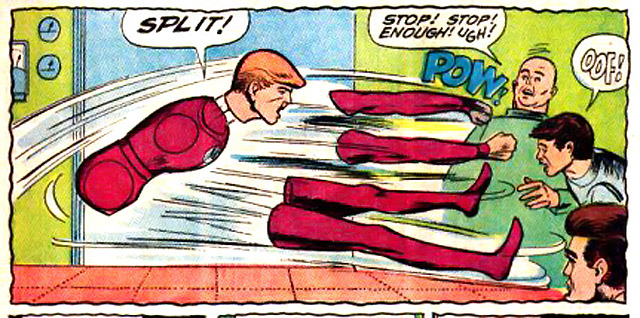
Of the many bad superheroes spotlighted on the Internet, '66 Cap Marvel may have received the most attention to date. As the cover shows, the titular hero's distinction is that his power seems so counter-intuitive for a superhero. Instead of being able to withstand the slings and arrows of outrageous villains with the brio of Billy Batson's alter ego, '66 Cap can separate the sections of his body-- hands, arms, feet, legs, head, and torso-- so that they're able to go flying around on their own. It's not impossible to confer power upon particular body-parts when they're separated from their proper form-- one thinks of "killer hand" movies like 1946's BEAST WITH FIVE FINGERS, and "hideous head" flicks like THE THING THAT WOULDN'T DIE. But all parts are not equal, and the idea of a superhero's torso or legs-- or even his disembodied head-- zooming around the sky has proven endlessly risible. 

There are three stories in Cap's first issue, and they're all pretty dismal, though not totally without interest from a psychological standpoint. 

The first tale falls back on the old "hero can't remember who he is" in order to give the readers the lowdown on his true nature. An unnamed blonde man finds himself in a house in some American city, and can 't remember who he is. However, with only minimal effort, he recalls that he is an android named Captain Marvel, created on an unnamed planet torn apart by warfare. His creators, a group of unnamed humanoids, know that their world is doomed, so they want him to personify "the knowledge of our people" and to "use it to help others." 

As for the "splitting" power-- this is almost the only idea in the story that's given a degree of logic. The head scientist tells Marvel that the purpose of this power is "to prevent an attack by more than one person," after which they demonstrate how said power can be used:


I suppose the intent was that this power might seem appealing to a person who's ever had more than one opponent "gang up" on him. Yet I tend to think even the most naive young reader still would've preferred the idea behind the original Captain Marvel: that you could both assume a bigger, better version of your own body *and * gain a multitude of powers that allowed you to beat up any quantity of enemies.

After a few panels of training, Captain Marvel dons a pair of astro-boots that will allow him to traverse space, and flies away from the only home he's known, watching as it explodes behind him. 


His memory breaks off at this point, but for the last three pages, a young boy named Billy Baxton shows up to fill in the rest of the gaps about how the android happened across Earth, and how Billy helped the Captain acclimate and take on an Earth-identity.

The idea-- but not the actual execution-- of this Captain Marvel is credited to Carl Burgos, who's best known for the Golden Age Human Torch. Like most Burgos superheroes, the Torch was an android, and off the top of my head I'd say he was the only artificial hero of the Golden Age who enjoyed enough popularity to headline his own title. Fans will never know why the editors of the new title, having decided to co-opt the name "Captain Marvel" on the assumption that it had fallen into public domain, also decided to go with the idea of the new hero being an android. Maybe the editors weren't sure about their legal position and wanted something that wasn't too close to the original.

Ironically, aside from the hero's use of "magic words" to activate his powers-- he says "Split" to separate his body-parts, and "Xam" to bring them back together-- the '66 hero seems to swipe more from Superman. Not only does he rocket to Earth from a doomed planet, he's also the repository of his alien culture-- though technically, this idea didn't become popular in Superman comics until the late 1950s and early 1960s. '66 Cap also shared the Man of Steel's tendency to whistle up new powers whenever he needed them: laser-beam eyes, thermal waves, and so on.

The other two stories, both of which feature Marvel taking on alien invaders, aren't worth analysis, but the last one in the book is amusing in one respect. For eight pages, the tale is a cut-rate version of "The Day the Earth Stood Still," as it starts with aliens coming to Earth to remonstrate with Earthlings for their warlike ways. Then for the last eight pages, the aliens are relegated to back-seat status, for the story suddenly becomes all about the weird character in their ship, who gets loose and causes trouble on Earth-- a character named... "Plastic-Man!"


According to some fannish speculations, MF Enterprises's attempt to pilfer the name of yet another Golden Age character may have alerted DC Comics to the fact that they actually owned the right to publish Plastic Man since purchasing an assortment of Quality Comics properties in the mid-1950s. As a result, DC Comics quickly rushed an ersatz verison of the classic Plastic Man into the "Dial H for Hero" feature, about three months after CAPTAIN MARVEL #1 had appeared on newstands, and then launched a series proper toward the end of 1966.

I rate the MF Captain Marvel a "psychological myth" because I think its creators had some notion that their peculiar idea of a "body-in-pieces" hero should actually have been empowering to young readers. Since it was not, that alone would qualify the android as an inconsummate null-myth.


Tuesday, September 29, 2015

MYTHCOMICS: WHIZ COMICS #2 ("CAPTAIN MARVEL," 1940)

“For … various offenses Tantalus was punished in Tartarus.   For he was kept perpetually famished and parched, standing chin-deep in water and with laden boughs of fruit just above his head … Alternatively (or additionally) a great stone hung over his head, suspended by a thread, so that he lived in everlasting terror.”—Grant and Hazel, Who’s Who in Classical Mythology, p. 309.


By way of following up on my assertions in STRIP NO-SHOW, I find that the origin story of Fawcett Comics' Captain Marvel provides the best-known example of a comic book story which conjures up a wild set of mythopoeic images to support a fairly simple story.

The earlier success of DC's Superman was the proximate cause for Captain Marvel to come into existence. However, as chronicled in Jim Steranko's HISTORY OF COMICS, writer Bill Parker's original idea was to present a team of characters with powers derived from the Greek gods. Thanks to Superman, this idea was converted into the notion of a single superhuman who could draw on an assortment of powers from mythic personages.  Yet this particular Superman-imitator-- which in its genesis at least, seems mostly the creation of scriptwriter Parker rather than artist C.C. Beck-- ventured more deeply into what I've called "the realm of intuition and its mythic images."

Consider the opening, in which homeless preteen Billy Batson is approached by a dark stranger.


In the hands of most uninspired imitators, the stranger would have quickly doffed his hat and coat and revealed that he was X of the planet Y, and that he planned to give Billy fabulous new powers. Instead, Parker troubles to imply that Billy's descent into the subway is also a descent into a figurative underworld, with a weird subway train taking the place of Charon's boat. Parker's description of the car having headlights "like a dragon's eyes" inevitably suggests that Billy is traveling within an analogue of a living creature. It's significant that one of the figures from whom Billy will derive power, Hercules, survived passing through the belly of a giant beast.


The journey, though short by comparison with Dante's subterranean tour, brings Billy into contact with devil-like figures: the "Seven Deadly Enemies of Man," who are in essence a reshuffling of the Seven Deadly Sins of early Christianity.


Billy then finds himself in the company of the beneficent-looking old wizard, while his shadow-guardian-- possibly patterned on the Greek notion of the *psychopompos*-- simply isn't around any more. The old wizard Shazam shows Billy the personages from his name is derived, and then informs the boy that he knows how the boy was flung out into the cruel elements by his nasty uncle following the death of his parents.


Immediately following the scene of the evil uncle counting his ill-gotten gains, the story reveals that Shazam is standing under a stone block, suspended by a thread close to breaking. Shazam's only explanation of this extraordinary circumstance is to say that his time  is almost up, which is the reason he's summoned Billy to his domain, so that Billy will take Shazam's place as a fighter against evil-- in essence, replacing Shazam as the younger generation inevitably replaces the older. By pronouncing the wizard's name, Billy can become Captain Marvel:


After a quick demonstration that this transformation is reversible, the wizard asks Billy to transform into Captain Marvel a second time-- and just as the youngster does so, the stone block drops down. Shazam's implicit death is concealed by decorous thunderclouds. In addition, as soon as Shazam dies, Billy finds himself back on the city-street, where he remarks that his experience seems like a dream.
However, by the end of the story, Billy finds that he can bring the power of Captain Marvel into the real world as well.


Not only does Billy use his new power to thwart the designs of the mad scientist Sivana-- who bears a slight resemblance to Billy's evil uncle-- the hero's altruism is rewarded when he's given a job as a radio-reporter, a job which to my knowledge the character keeps for the entirety of the feature's run. It's interesting that though the main narrative function of Billy's job is the same as that of Clark Kent, being a means of keeping the hero on the scene for various troubles-- it also alleviates the boy's poverty-stricken condition. In essence, the much later origin of Spider-Man recapitulates the same pattern, in which the path of heroic altruism also rewards the hero with a source of remuneration for his efforts. Unlike Captain Marvel, Spider-Man even contemplates finding a job that will pay him for his exploits, but that somewhat non-heroic notion was quickly squelched.

I haven't come close to reading all of the fantasy-oriented comic strips of the early 20th century, but I have sampled most of them, and I've not come close to finding any strip-- "Little Nemo," "Popeye," or the overrated "Krazy Kat"-- that displays this density of mythopoeic images for a given sequence.
Admittedly, those three strips are probably on the whole better than Captain Marvel in a formal artistic sense. But by my lights none of these three really commit to their fantastic concepts in a manner that Parker and Beck do here.

Further, though most stories headed by either the Captain or his "Marvel Family" relations are not this dense in their imagery, there always seems to be a total commitment to whatever fantastic entities, events or objects come into the heroes' purview. This may have been the key to the long success of the Fawcett "Marvel Family" line. If so, it was a strategy that DC's Superman titles did not manage to pursue with any regular success, as noted in this essay on the Weisinger-era titles. Though Fawcett closed its doors in 1953, it seems it took roughly five years for the DC editor to feel that he had the freedom to bite the Fawcett style.


Saturday, September 26, 2015

STRIP NO-SHOW

I addressed some of the problems with finding strong mythic discourses in comic strips in the three essays of the series THE LONG AND SHORT OF MYTH, beginning here.  In addition to the LITTLE NEMO analysis that I posted this week, I have a couple more comic-strip candidates in mind for future installments. However, there won't be a "Bizarro version" of the NEMO strip this week. Since NEMO managed to pull off a consummate myth while remaining within the restrictions of the form, I felt that any "bad example" ought to be another comic-strip, but one that failed to consummate its discourse. But though I could find a lot of strips that were inconsummate in other ways, it was tough to find anything that worked for me. (If I was looking for comic strips that were inconsummate with regard to the thinking function, I could pick pretty much any MALLARD FILMORE strip.)

Since I believe that I have a pretty fair knowledge of the best-known comic strips, I find myself asking the question, "Is it possible that I'm not finding much because the restrictions of the comic strip form actively mitigate against the functions of thought and poetic intuition?"

In Part 3 of REFLECTIONS IN A MERCURIAL EYE I posited that these functions are secondary in a developmental sense to those of sensation and feeling. I won't get into the frightfully complicated schema Carl Jung provided for the four functions in PSYCHOLOGICAL TYPES. I've mentioned that he even subdivided his functions into "concrete" and "abstract" aspects, and that's further than I want to go at this time. I suppose I'll just say that all of the functions I address probably fall into the abstract aspect and leave it at that.

As every comic-reader knows, American comic books developed out of comic strips. The best known comic strips were syndicated in nationally distributed newspapers and were often used as attractions with which to sell the paper as a whole to a predominantly adult audience. A number of the strips were overtly aimed at children, but the only way that the kids could get them was if their parents, or some similar authority, either bought every paper every day or subscribed.

In contrast, American comic books were largely aimed at kids from the first, since individual comics were so cheap that they could be purchased with pocket money. In the early days some features aped the "continued next time" structure of comic strips, which would in theory force the buyer to purchase the next issue as well. For the most part, however, comic books of the Golden Age soon evolved away from the newspaper model-- suggesting to me that although subscriptions was possible with some titles, the majority of the juvenile readers wanted their comics "done in one" so that they wouldn't have to worry about purchasing the next issue.

Based on that quick comparison, one might think that the comic-strip form, being aimed at the adults, would be the more "advanced" medium, if one accepted the priorities of elitist criticism. Comic strips were allied to formidable syndication organizations, so they generally attracted the most formally accomplished artists. Throughout the run of the COMICS JOURNAL print magazines, its editors and raconteurs almost never ceased the sing the praises of the great comic-strip artists-- Caniff, Foster, Raymond-- and to devalue most comic-book artists, aside from a favored few like Eisner, Cole, and most of those associated with EC Comics.

What the elitists missed, however, was that comic strips, even at their greatest levels of excellence, were always hampered by the factors of serial progression. Certainly Sunday pages like NEMO and PRINCE VALIANT could get away with a somewhat "painterly" approach to comics-narrative, but they were the exceptions. Most story-strips, whether they appeared only on weekdays, on Sundays, or in a combined form, chose to pursue a straightforward linear narrative-- again, one designed to seduce the readers into regularly partaking of the newspaper that carried the comic. Caniff may have been the paradigmatic figure here, in part because one can see him channeling the "invisible style" of most Hollywood films of his time.

This linear narrative, in essence, followed the same association I've outlined for the sensation and feeling functions. The visual part of a given strip communicates what kinds of sensations that the characters are experiencing, and the verbal part gives it feeling-context: whether the reader is supposed to be happy or sad when a given character is killed.

Because this was the most efficient means of communicating narratives in a medium that was serial by nature and truncated by form, even the best artists tended to follow the "invisible style."

The comic book medium largely began by reprinting re-arranged comic strips, but as soon as it was evident that an original feature could make big money-- one guess which feature provided that proof-- most comic books began to rely on original material.

But this eventuated in a change in narrative strategies. The comic-creators might have a limited space to tell his story in each comic. But even a 4-page story allowed the creators to expand on narrative aspects that a comic strip could rarely indulge. It's true that the great majority of comic book features in the Golden Age were formulaic-- but they, unlike the best comic strips, possesses the power to expand into the realms I've called "thinking" and "intuition." On the whole most Golden Age comics did not encourage a lot of thinking, with the obvious exception of the EC books. But they could venture more deeply into the realm of intuition and its mythic images-- and they did so, though often only on a sporadic basis. I've commented that a lot of PLASTIC MAN stories aren't well written in terms of any function, but then, there's the one from POLICE #43 that I analyzed here.  I suggest that because Cole felt free to slap down any kind of wild fantasy that occurred to him-- a freedom denied to the Fosters and Raymonds of the "big time"-- he was sometimes able to come up with a fascinating psychological myth like this one.

Possibly next week I'll work on some of the other fascinating myths of the Golden Age, since most of these stories are utterly ignored by current comics criticism.


Wednesday, September 23, 2015

MYTHCOMICS: "LITTLE NEMO IN THE PALACE OF ICE" (1907)

In Part 3 of THE LONG AND SHORT OF MYTH, I discussed in some detail the circumstances under which I would currently rate gag comic strips as having or not having symbolic complexity. One of my examples was Winsor McCay's DREAMS OF THE RAREBIT FIEND, in part because I'd listed that strip in my 2008 ARCHETYPAL LIBRARY. As LONG AND SHORT should clarify, I've changed my mind on this matter. My current view is because most if not all FIEND-strips are no more than short gags, that structure keeps it from demonstrating true plurisignativity.

But thus the queston arises: what about McCay's subsequent and more famous strip, LITTLE NEMO IN SLUMBERLAND-- an admitted classic, though I didn't mention it in my 2008 LIBRARY.  Since NEMO unlike FIEND did allow for story-arcs, that means it had the capacity for mythic complication, whether or not it took advantage of that capacity.

Though I admire LITTLE NEMO in terms of its artistic accomplishment, it's never been a favorite of mine. I esteem it more than a lot of its comic-strip contemporaries, but the repetitive structure never grabbed me, dealing as it does with a child-protagonist who wanders through assorted dream-world wonders until he wakes to prosaic reality. Thus I don't have a lot of NEMO stuff in my collection. However, I do have Dover's 1976 album, LITTLE NEMO AND THE PALACE OF ICE AND FURTHER ADVENTURES. Fortuitously enough, the "Palace of Ice" adventure does meet my criteria for a "mythcomic."

This story-arc lasts eight installments, which appeared initially as full-page strips. As I've established, brevity in itself doesn't absolutely prevent a comic from displaying mythicity; it just stacks the odds against it.

Dover begins their reprint with nine-year-old Nemo and his female friend, the daughter of King Morpheus, about to be admitted to the ice-bound palace of Jack Frost. However,Nemo and the Princess are pursued by another recurring character, the troublemaking Flip, son of the dawn-god. Though he's visually reminiscent of Negro stereotypes of the period, one source says that Flip is supposed to be an "ill-tempered Irishman."


Not only does Flip intrude upon Nemo and the Princess' visit to the palace, in the first strip he has a malign witch pursuing him, presumably a carry-over from a prevous continuity. Fortunately, the guards of the palace grounds bar the witch, and so she plays no real part in the arc. Flip himself becomes the source of conflict in the arc, which seems to have been the role he played throughout the strip. Nemo and Flip become companions in many adventures, though in this arc Nemo seems diffident toward Flip's presence-- probably because Nemo wants to see Jack Frost and his icy wonders, while Flip keeps disrupting things. He constantly demands to have his whims satisfied by threatening to summon his sun-god uncle to vaporize Jack Frost's world.

Though it's a short sequence, "Palace of Ice" does an exemplary job of potraying a world in which one sees an array of fantastic sights associated with cold phenomena. It is of course a child's version of the metaphysics of ice and snow, taking in from juvenile pleasures like toboggan-riding and snowball-fights as well as the more profound wonders of the Northern Lights and the mysterious North Pole, from which all the winds of the world originate. Every episode necessarily ends with Nemo's dreamland-journey being interrupted by some accident, be it one of Flip's antics or something native to Jack Frost's realm, like a snowball-fight by brainless snow-people.


The big meeting with Jack Frost is also a visual wonder, though actually nothing much happens as a consequence of the ice-ruler greeting Nemo and the Princess.


Sharp-eyed readers will note that Flip isn't present in Jack Frost's courtroom, and this turns out to be a set-up for the arc's resolution. Flip, almost always seen with a cigar in his mouth, resents being told that he can't smoke in the throne room. He disappears, and two strips later, he shows up with a series of ice-trucks in his wake. The truck-drivers then proceed to dismantle Jack Frost's fabulous ice-palace, breaking it up into square ice-blocks of the type used in household ice-boxes prior to the refinement of artificial refrigeration.  It's not explicitly stated that Flip summoned the trucks, and in one dialogue-balloon he claims that Jack Frost's people are forced to allow their palace's destruction "'cause they need the money, I guess"-- though given that Flip has been repeatedly threatening to destroy the realm, he seems more than a little implicated.

The decimation of the ice palace might tie into sociological myths on the evils of consumption, in which the beautiful art-objects of a declining aristocracy are broken up and turned into raw material for the use of the average consumer. He need not have been a Marxist to think of this; after all, he himself was creating beautiful art that was being used to sell periodical newspapers. In addition, the breakup of the palace mirrors the dominant narrative trope of LITTLE NEMO: that all the beautiful conjurings of the artist's pen are doomed to be dispelled by "cold" reality.

Another sociological motif would be the fact that while Nemo generally seems demure and respectful to everyone he meets, whether or not they are in positions of authority, his "shadow" Flip is irreverent and a frequent troublemaker.As others before me have suggested, Flip may be the "shadow" of Nemo's conscious mind, always more interested in strutting his own stuff than in anything else.

Since I have a deep interest in the history of fantasy literature, I suppose NEMO also leaves me less than enthusiastic because its type of fantasy depends entirely upon the vagaries of dream-- not unlike Carroll's Alice books, which may have influenced McCay somewhat. Five years before NEMO, L. Frank Baum created Oz, which some deem to be the first fantasy-cosmos created by an American author. Unlike Slumberland, Oz was supposed to be a real place with its own rules and culture-- though it's a further irony that the best-known cinematic adaptation of Baum chose to banish to the same gates of dream that contained Slumberland.

Tuesday, September 22, 2015

INCORRECTLY CORRECT

Reader A. Sherman Barros brought to my attention a comment that HU columnist Robert Stanley Martin made about Milt Caniff's TERRY AND THE PIRATES: After linking to Digital Comics Museum's copy of TERRY AND THE PIRATES #7, Martin wrote: "Those who click to read the online scan should be aware the stories feature racist caricatures." He wrote some other stuff in the comments-section as well, but first I'll deal with the actual comic book itself, which reprints a selection of Caniff's famous comic strip. What exactly happens in the issue to merit the caution about racist caricature?

Well, as far as I can tell, the only "racist caricature" in the story is that of recurring character Connie. Here's a representative scene:


As far as I can tell, Connie's offenses are twofold: he speaks in a comic dialect, and he's as homely as sin, with big ears and buck teeth.

Now, I'm not at all a fan of Caniff's character. I think Caniff writes his dialect in an ootsy-cutesy manner I find abominable. However, he's far from the only character who speaks in an affected or stilted manner, and that includes the titular Terry's nominal guardian Pat Ryan. What I take away from Connie's fractured dialect is not that he's part of some racist conspiracy to make Chinese people look stupid, but that Caniff wasn't especially good at rendering English in dialect-form. 


As for his ugliness-- well, yes, Connie's not pleasant to look at, but I for one would look for other evidence that proved him to be a racist construct. For instance, Connie would definitely be racist if all other Asians in the strip were similarly depicted. If they're not-- and I think Martin would admit that they are not-- then Connie may be more in the vein of the "funny looking sidekick" than of the "racist caricature."


Most of the funny looking sidekicks of comic strips are forgotten now, but superhero comic books gave the form a new lease on life-- and a fair number of them are Caucasians.


One of the most famous is Doiby Dickles from GREEN LANTERN:


And here's Stretch Skinner from WILDCAT:


Notice the common factors: both sidekicks talk funny, and both are homely.  Both function, in essence, to make the main hero look and sound even better than he ordinarily would.


Now, I'm not denying that it's possible for an artist to create a racial caricature that does communicate ill will toward the race depicted, and to do so subtly . It's even possible that an artist might depict most of the characters in his story as relatively normal, yet choose to single one character out to make him the butt of racist jokes. Certainly Connie is the target for sidekick-humor. But is it racist humor?


Here's an interesting scene from TERRY #7:


To fill in some blank spaces: the fellow getting hung up on the dragon by Big Stoop-- a Swedish character very improbably disguised as a Chinese laborer-- is a rich white guy named Sandhurst. Not long after some of the locals disparage him for being an American who puts on airs by talking Brit-style, Sandhurst orders his car's driver to run Connie down. Stoop pulls Connie out of the way. Sandhurst orders the car to stop. Then he attacks Connie, hitting him with his cane-- at which point Stoop introduces him to the dragon. So the sequence ends with Connie the racist caricature having the laugh on the rich WASP. Moreover, when the story was first published readers did not yet know that the silent strongman was not Chinese, and so the original effect is that of two Asians having the laugh on a nasty white guy.

All of which raises two questions:


(1) Is it possible to have a POC sidekick without having him look at least nominally handsome, as with the reboot of THE SPIRIT?


(2) If the only ugly, dialect-using sidekicks out there are white guys like Doiby and Stretch-- does that not constitute a subtle form of racism in itself?