Featured Post

SIX KEYS TO A LITERARY GENETIC CODE

In essays on the subject of centricity, I've most often used the image of a geometrical circle, which, as I explained here,  owes someth...

Tuesday, September 12, 2023

WHY MATERIALISM JUST DON'T MATTER

In any occasion of cognition, that which is known is an actual occasion of experience, as diversified by reference to a realm of entities which transcend that immediate occasion in that they have analogous or different connections with other occasions of experience.... Also... every actual occasion is set within a realm of alternative interconnected entities.-- Alfred North Whitehead, SCIENCE AND THE MODERN WORLD, p. 227-28.

I've been playing off of concepts introduced in Whitehead's process philosophy, but have admitted that some of his more abstruse uses of jargon have confounded me. So I decided to get a better grounding in such concepts as "prehension," which by one account the great mathematician first introduced in this book, SCIENCE AND THE MODERN WORLD, a series of lectures on a unitary theme that saw book publication in 1925.

I foregrounded the above quote because it is one of many similar statements with which Whitehead critiques scientific materialism. In the first part of the quote, the author makes clear how the process of knowledge, in particular that of scientific cognition, depends upon drawing comparisons between different entities that "analogous or different connections with other occasions of experience." For instance, to create my own example of such a cognition, a scientist will classify one group of creatures as mammals because they have "analogous connections," and will classify other creatures as belonging to other categories because they have "different connections." 

This first statement is all but identical to the way scientific materialists proceed with their cognitions. Whitehead, however, faults them on their over-willingness to abstract "discrete occasions of experience" from their connections with other entities. Continuing my example, other entities might be the ecosystem in which assorted creatures exist, and from which science abstracts them.

Although Whitehead's main project is to outline his concept of a science responsive to organic existence, he makes clear that his philosophy embraces all forms of human cognition, including ethics, religion, and aesthetics, which he calls "cosmologies." This is not a major feature of his theory, but it bears an interesting resemblance to Ernst Cassirer's theory of knowledge-forms, apparently first circulated four years prior to these lectures (so no likelihood of cross-influence between the two scholars).

Until reading SCIENCE, I didn't comprehend that his formulation of the term "prehension" was intimately linked to Whitehead's concept of a unity within discrete entities that standard materialism chooses to overlook. A couple of times he even speaks of "prehensive unification," once with explicit comparison to the opening lines of Percy Shelley's poem MONT BLANC. This tracks with separate references I've encountered, emphasizing prehension as "non-epistemological knowledge." Whitehead applies this form of unity both to biological organisms and to subatomic phenomena, asserting that both share an "inherent transitoriness" that is offset by their "actual unity," a unity that is by its nature outside the sphere of cognitive knowledge.

Though Whitehead does not devote many pages to such cultural pursuits as art and literature, he makes clear that he feels that scientific materialism, with its emphasis on discrete phenomena, resulted in a de-valuing of human experience. I was pleased to see that, though Whitehead does not use the word pluralism, SCIENCE supports a pluralist ethos. Following the opening quote, he explains that the "realm of alternative interconnected entities" is "disclosed by all the untrue propositions which can be predicated significantly of that occasion. It is the realm of alternative suggestions, whose foothold in actuality transcends each actual occasion.The real reference of untrue propositions is disclosed by art, romance, and by criticism in reference to ideals." Whitehead does not expand on this statement, and I confess that he eventually goes off on a mathematical demonstration of "possibility" that's outside my wheelhouse. But I'm egotistical enough to cite one of my own statements that shares some commonality with Whitehead's take on "untrue propositions," as seen in the fourth part of my essay-series LET FREEDOM RIDE:

For the pluralist the best understanding of freedom may be seen through an appreciation for a plurality of choices, rather than the ritualized choices between "good" and "bad" as encoded by religion or by philosophy, particularly that of Kant, who at times seems to be reinstuting the old maxim that "service is perfect freedom."  I do not define freedom as service, but neither is it rebellion against service.

I am not arguing for relativism, but rather a form of Nietzchean perspectivism.  Free will proves difficult not because it's hard to choose the straight path over the crooked path, or to choose tough-minded reductive realism over escapist fantasy.  It's difficult because we as humans can see every situation from many perspectives, and can only choose in terms of what we think may lead to the best conclusion... Ergo, pluralist freedom is the free will to choose-- even when one makes the wrong choice-- with the knowledge that *the wrong choice always has the potential to be the right choice in another set of circumstances.*

Saturday, September 9, 2023

HOW MANY WESTERN MYTHS HAVE I FOUND?

I stated in the previous essay that on my two main review-blogs I had not devoted much space to any isophenomenal westerns, mythic or otherwise. Despite this caveat, I did devote two long posts to two such non-fantastic western works:


So of the all other westerns, or western-associated productions I will list here, they will all have some metaphenomenal content.

Not all of them take place, however, within the same era as the traditional western, or even as the so-called "Eastern western," which concerned the American Revolutionary era. I find that western iconography spans three broad periods:

THE PRE-WESTERN ERA

Stories fitting this heading take place prior to any major European incursions in any of the Americas, North or South. Typically this will concern only stories about Indian tribes who have not yet encountered any persons associated with the colonial efforts from the 16th century onward-- though I would have no problem with stories in which Indians met Viking travelers or even Phoenician sea-traders. In literature, there's really only major pre-western narrative.


In theory, certain comic-book series like Gold Key's TUROK SON OF STONE and DC's SUPER CHIEF would qualify for this category, if they possesses the sort of mythopoeically rendered epistemological patterns that constitutes good mythicity.

Then at the other end of the temporal spectrum, there is--

THE POST-WESTERN ERA

This includes any narrative with western iconography taking place after the dawn of the twentieth century, whether or not the narratives takes place in the American West or even in any physical place corresponding to the North and South American continents. In addition to 20th-century stories with some major connection to western story-tropes or icons, this category can also embrace so-called "space westerns," though the significance of the trope or icon has to be very strong. I for one do NOT deem STAR WARS a "space western," even though the series used western tropes (like the "cantina scene") from western cinema. And I would not regard the entirety of Edgar Rice Burroughs' "Mars series" of books to be space westerns either, though the first one counts, because its 20th-century protagonist starts out his narrative fighting wild Indians. So the first book qualified for high mythicity.


And so does this Osamu Tezuka take on Western mythology:


I also include here stories where some significant character uses western iconography, even if some other genre is dominant. Thus the story in SPIDER-MAN #10 is predominantly a superhero story, but it is "western-adjacent" because one of the villains wears a ten-gallon hat and twirls a lasso as his only weapon.


Finally, I come to the meatiest category, taking in all narratives centered within the domain of the Americas from the 16th through the 19th centuries, though obviously not all of these have western iconography. (For instance, stories about the Civil War take place in the same time-frame as the "winning of the West" stories, but only a few of these tales are likely to boast strong western tropes or icons.)  All of my other Mythic Westerns are as follows:


Technically, SCALP HUNTER, one of the "Son of Tomahawk" stories, is not a metaphenomenal story, and might better be listed alongside Django and the Purple Sage Riders. I've also left off this list all of the individual "good" episodes of the teleseries KUNG FU. This program sported a high percentage of stories with either a "good" or a "fair" mythicity rating, and so I prefer to associate the series as a whole with my next category: all the "fair" westerns that weren't quite epistemologically complex enough to be good, but which at least included important myth-motifs.


And finally, I made brief reference to a very "post-Western" storyline in THE WEST COAST AVENGERS here.

I may add to this list over time, as I encounter new "good myths" or "fair myths" worth collating.


MYTHICITY ACCORDING TO GENRE-DISPERSAL

 In the American academic criticism of both prose literature and film, so-called "myth criticism" is fairly spotty, without a dominant theoretical voice. Not that I would want everyone to sound the same. But there were a better general understanding of what distinguishes mythopoeic discourse from didactic discourse, authors like the ones who assembled this travesty might have a harder time promoting their drivel.

I believe American film criticism has one important advantage over its prose kindred, though. Because of the way commercial films were and are marketed, film critics have paid more attention to the ways mythic content can be expressed according to genre-expectations. No one has to my knowledge ever attempted a myth-history even for American popular films, and thus every interested critic, be it Raymond Durgnat, Richard Slotkin, or Geoffrey Hill, simply focuses on whatever genres or genre-products each finds most rewarding.

As a generalization based on personal reading, I find that three genres have generally attracted the most attention from myth-critics: horror, science fiction, and westerns. There's considerably less focus upon war and crime/mystery/espionage, except where critics have concentrated a particular creator with a particular genre-specialization, as with Hitchcock. And although one might argue that even silent film employed characters one might call "superheroes," understandably this quintessential comic-book genre has remained out of favor with most critics.

In comics criticism, I would say the bulk of myth-criticism has focused upon particular characters, be it perennials like Superman and Wonder Woman or relative upstarts executed by a particular creator, as with Frank Miller's Daredevil. So when I state that the bulk of comic-book criticism focuses upon superheroes, I'm talking about such focused examinations, and not so much on seeing myth broadly, through examinations of overall genre expectations. At least I'm not aware of any parallels in comics criticism to Slotkin's 1992 GUNFIGHTER NATION, which embraced a wide variety of frontier/western narratives of the 20th century.

I'm not thumping my own tub to claim that my blog seems to be the only one that has searched through the majority of comic-book  genres In Quest of Myth; it is, as far as I know, simple unadorned truth. Despite my efforts to be open to all generic forms, though, there can be no doubt that I too have found myth-discourse most often in the comic-book genre of the superhero. Probably the superhero-tale's nearest rival on this blog is the horror comic, with considerably fewer exemplars in the domains of science fiction, teen humor, and westerns.

Now, this is not so much the case on the blog I've dedicated to metaphenomenal film. Movies and television episodes with a "good" mythicity rating may actually be stronger there for both "horror" and "science fiction" than they are for "superheroes," though again, I have not attempted a precise breakdown, nor do I tend to do one.

 Now, the very fact that the NUM blog focuses only metaphenomenal film means that I almost never examine in detail one of the film-genres that earns the widest plaudits from academics: the western. Whereas horror, science fiction, and superheroes all might be expected to have heavy mythicity thanks to their evocation of metaphenomena, western narratives, even relatively simple efforts by "non-auteurs," often generate complex symbolic discourses even within purely (or largely) isophenomenal worlds. And I would say, again without making any attempt at a statistical breakdown, that western films do so much more frequently than other genres that tend to be dominantly isophenomenal, such as crime and mystery, romance, teen humor, and war.

I may come up with a theory to explain this discrepancy after doing more research into western-myth criticism as it exists, but for now, this essay serves mostly as a lead-in to my next essay: How Many Western Myths Have I Found?

DEPARTMENT OF COMICS CURIOSITIES #26: STANISLAW LEE

 While buzzing through the Timely comic ALL SURPRISE in hot pursuit of another meaningless crossover, I came across the following in-joke in a story featuring "Gandy and Sourpuss," two very off-model incarnations of the Terrytoons animated characters:


Since "Stanislaw Lee" has nothing in common with Timely editor Stan Lee but a similar name, this is probably just some antic name-dropping than satire. Lee was, however, not in charge of Timely when this joke came out in issue 3, because during his army service he'd temporarily ceded his Timely editorship to Al Fago, and Lee would not re-assume his editorial duties until he got out of the army in 1945.

A total coincidence is the similarity of the goofy Englishman's name to that of real-life Polish SF-writer Stanislaw Lem, who would commence his literary career two years after this Timely tale was published. 

Tuesday, September 5, 2023

WHAT VS. HOW

 One key notion I argued in the cited essay was the importance of epistemological patterns to the process of concrescence in fiction. It's not that any work of fiction necessarily seeks to make definitive statements about epistemology. But in the process of any act of imitation, it's natural though not inevitable for authors to attempt buttressing their fictional works by drawing upon patterns that represent the "real world." Often these patterns are based upon propositions that the consensus-audience no longer accepts, or does not accept universally, ranging from the Oedipal theories of Freud to the 19th-century theories of "the Hollow Earth." To the audience, what's important is whether or not the author can make even the most absurd proposition "entertaining"-- and this, not real-world applicability, is what gives even the weakest of weak propositions a peculiar endurance, if not strength in the usual sense.-- THE FULL VALUE OF THE HALF-TRUTH.


Today I thought of a simpler way to distinguish "problems" from "conundrums" as I originally defined them in  2021's PROBLEMS VS. CONUNDRUMS, to wit:

A narrative's "problems," its lateral/literal virtues as expressed through either the kinetic potentiality, the dramatic potentiality, or a combination of the two, concern WHAT THINGS HAPPEN in the narrative.

A narrative's "conundrums," its vertical virtues as expressed through the either the didactic potentiality, the mythopoeic potentiality, or a combination of the two, concerns HOW THINGS HAPPEN in the narrative.

I gave a few examples of specific problems and conundrums in the 2021 essay, but rather than go over the same ground, I'll try to show how one of the examples I gave in FULL VALUE can apply across the "problem/conundrum" continuum. I haven't encountered a surfeit of stories about the Hollow Earth, but certainly there should be a number of ways in which Freud's Oedipal theory has been used for both lateral and vertical formulations.

In the interest of testing my theory on as broad a canvas as possible, I'll choose my examples from among the most recent analyses I made of Oedipal narratives on my movie blog, rather than choosing examples from famous franchises like DRACULA or PSYCHO.

The very last Oedipal narrative I examined happens to fall into the category of "what things happen." The cheapie sword-and-sorcery adventure EYES OF THE SERPENT uses what might be termed a feminine "Oedipal conflict," but it uses the pattern only for the dramatic potentiality. In the rambling narrative, young princess Fiona falls in love with roving (and somewhat kooky) swordsman Galen. Fiona enlists Galen to help Fiona's mother Neema fight Neema's enemies and regain control of the kingdom. However, Neema covertly puts the moves on the younger Galen. It's loosely implied that Neema does so in order to keep control of the warrior, rather than her doing so just because she's attracted to him. In this, Neema is the mirror image of her sister Corva, in that both are ruthless in their pursuit of power, and the movie's conclusion, in which the two sisters destroy one another in battle, indicates that the "lateral meaning" of EYES is to validate the more innocent Fiona as the royal figure who deserves to control the realm. I will happily admit that the story of EYES has only a fitful claim to the dramatic potentiality. However, the scene in which Galen tells Fiona about Neema's treachery, and Fiona refuses to believe him, does have the bare function of establishing that at some point Fiona must come to terms with Neema's corrupt nature and bind herself to the comparatively virtuous Galen.

In contrast, the last Oedipal narrative I examined which concerns "how things happen" is 2010's THE WOLFMAN. In my review, I contrasted the clear Freudian schema of this film in comparison to the 1941 classic.

There's no rational-minded, overbearing dad this time. Scripters Walker and Self wanted a Heavy Father straight out of Freud's TOTEM AND TABOO. The original Larry Talbot left the British Isles for America for reasons loosely associated with sibling rivalry. In contrast, Lawrence is sent to an asylum after he, as a child, claims to have witnessed Sir John's act of uxoricide, slaying Lawrence's mother during one of the lord's beast transformations. (Lawrence, unlike Larry, at least has a mother in his story.) After years of being treated by the barbaric alienists of the late 1800s, Lawrence recants his story and becomes an actor. (I'm convinced Walker and Self made this alteration to the protagonist's background simply so that they could reference HAMLET, which Freud famously associated with Oedipal urges.) 


One point I didn't cover in detail is that the film implies an equivalence between both violence and sex in the wolf-persona of Sir John, though I did address somewhat the Freudian concept of the "primal scene:"

Freud hypothesized that children who witnessed their parents having sex for the first time-- the so-called "primal scene"-- might believe that the mother was being attacked, or even murdered. Lawrence sees his mother murdered for real, and then his brother is slain because his father craves the brother's future wife. 

To expand on this formulation slightly, even though Sir John gets his werewolf curse from an outside source, his actions can only be explained by Freudian dynamics about sex and violence, which explain "how things happen" in the WOLFMAN world. Sir John's murder of his wife can logically be viewed as the beast's way of satisfying both a lust for sex and for violence, though the film does not make this proposition explicit. But if it is true that the beast slew Lawrence's mother to satisfy both bloodlust and sex-lust, then it follows that deep down Sir John intends to wreak the same violence upon Gwen, whom Sir John believes to have a resemblance to the unnamed mother of Lawrence and the late Ben. (Viewers don't see the mother, so the default assumption would be that Sir John is correct about the resemblance, and it certainly fits the Freudian paradigm that both of the mother's sons fixate upon Gwen for the same reason Sir John does.)

So the TOTEM AND TABOO paradigm of a father-son battle is carried out in a very different manner from a similar trope in 1941's WOLF MAN, meaning that Lawrence must defeat his vicious father in lycanthropic battle. In the review I mentioned in passing that Lawrence, unlike Fiona in EYES OF THE SERPENT, does not prosper after slaying the Heavy Father. I stated that Gwen shoots Beast-Lawrence with a silver bullet to spare him further suffering. However, Beast-Lawrence is by his nature as great a physical threat to Gwen as was his nasty dad, and so there's certainly an element of self-protection in Gwen's action as well. By her action Gwen alone is spared the holocaust of the Oedipal conflict, though of course the film has no interest in what happens to her once the story is over. 

I may conceive of other demonstrates between the pathways taken by "what" versus those of "how," but for now these two suffice for my purposes.


Friday, September 1, 2023

FORMAL AND INFORMAL EXCELLENCE PT. 2

 I first used the terms "formal postulate" and "informal postulate" here, but I've devoted many earlier posts to sussing out which aspects of  a story appeal to the intellect, which to the imagination, and which to a combination of both abstract "vertical values."

But as I want to try out the new terms on something, it's time to break down some examples in terms of the didactic and/or the mythopoeic potentiality.


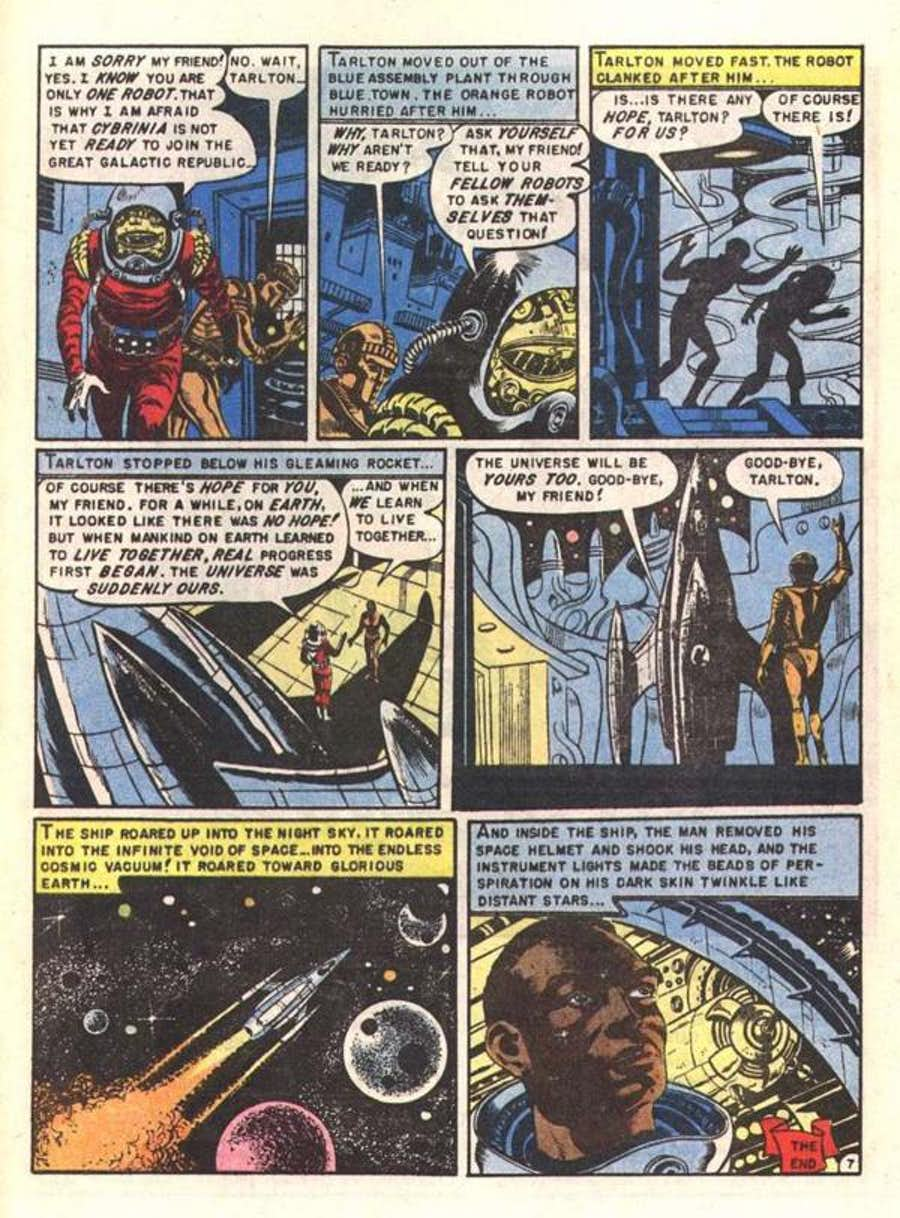
The famous EC Comics story "Judgment Day" (WEIRD FANTASY #18, 1953) is my selection of a story that appeals only to the didactic potentiality, and thus is a pure formal postulate. Symbol-hunters like myself would search in vain throughout Al Feldstein's story for any of the symbolic discourses familiar in prose science fiction-- discourses about whether robots can take on a wide variety of human traits, or man's quest to conquer the cosmos. Feldstein subordinates everything in this one-story universe to making one pedagogical point: that even in the far future, the scourge of bigotry will still exist, improbably incarnated in artificial beings-- despite the intimation that actual humans have overcome bigotry, which is the point of showing the galactic inspector to a Black man.

Since this essay-series started with Stan Lee and Jack Kirby, the reader will notice that it's no coincidence that I'm going to pick particular stories by each to illustrate two other types of vertical value.


I mentioned that some stories combine the didactic and mythopoeic potentialities, and this combination appears in the Stan Lee-John Buscema story "Origin of the Silver Surfer." For this story, Lee-- almost certainly the dominantly creative member of the team-- sought to give the character more humanity than the "science fiction angel" in the pages of FANTASTIC FOUR, who was essentially beyond commonplace humanity. Lee's new origin not only posited that the  Surfer had once been a mortal alien humanoid, Norrin Radd, but also that he hailed from Zenn-La, a civilization that had advanced so far that it held no challenges for one as restless as the future hero. This new element had a didactic purpose-- beware of becoming too coddled by advanced technology-- but there's a mythopoeic quality to Norrin's discontent as well. He's seen as a throwback to a more venturesome era, one who would be more suited to Zenn-La's frontier era. In other words, the Silver Surfer was just a "space cowboy."


Then Galactus comes calling, making a mockery of Zenn-La's defenses as the gigantic alien prepares to devour Norrin Radd's homeworld. Here Lee follows through on the loose God the Father/Jesus the Son opposition that arguably appeared in the Galactus Trilogy. But this time the Surfer is not an inhuman angel sacrificing himself for Earth-humanity; he's a mortal sacrificing his freedom to save his own world. So he's a cosmic Christ-cowboy, but significantly, this mythopoeisis still carries a didactic message. As the Surfer bids his beloved farewell before beginning his servitude to Galactus, he tells her. "Let not the spirit of our ancestors be lost a second time! Let not our people grow soft and indolent!" Norrin Radd gets his earlier wish, to emulate the ways of Zenn-La's early explorers, for now he can range the entire universe in his quest to find non-inhabited worlds for his master. Even the Surfer's estrangement from his girlfriend resembles the sacrifice of similar pleasures by heroes in Western films, in order that they may serve a greater cultural cause. So "Origin's" vertical values include a blend of formal-didactic and informal-mythopoeic postulates, though in this case I find that the mythopoeic postulate predominates.


Lee's story-- which may be the finest single story he ever wrote without input from "The Other Big Two"-- was the beginning of a series, but for my selection from Kirby, I choose a conclusion, the end of the NEW GODS series, issue #11, which bears the curious title, "Darkseid and Sons." Some fans speculate that prior to scripting this story, Kirby had been told the axe was about to fall upon the majority of the Fourth World. Thus he had but one issue to present some rough thematic conclusion to his series, while leaving the door open for a follow-up. An earlier issue had established Kalibak, son of Darkseid, had been captured by humans following Kalibak's inconclusive battle with his frequent rival, the heroic Orion. So Kirby chooses to match the two powerhouses against one another for his NEW GODS finale.


In early NEW GODS issues, Kirby had dropped broad hints that Orion might bear some shadowy relationship to Darkseid, Lord of Apokolips, and then he let fall the other shoe in NEW GODS #7. That story explicitly stated that Orion, Darkseid's son, was raised on New Genesis from perhaps age five onward, while Highfather's son Scott Free was raised on Apokolips, in an exchange one might call "hostage-fosterage." So it's a little anti-climactic when Darkseid makes a reference to Orion and Kalibak having fought as "children," though apparently neither warrior remembers growing up alongside the other. During Orion's battle, he more or less guesses that he and Kalibak are brothers. Kalibak himself has apparently never told of his parentage, but even the basic idea inflames him with nascent sibling rivalry.


The title actually gives the game away: the final revelation is not that either sibling, but that of Darkseid's own history. NEW GODS #7 also introduced the reader to both Heggra, Darkseid's mother, and Tigra his wife, also Orion's mother. There's no didactic point to this revelation, but there's a very big mythopoeic quality evoked by Kirby. Darkseid he complains that his two sons "darken my future as surely as their maternal forbears ruled my past! My mother, Queen Heggra! Orion's mother, Tigra! And the sorceress Suli!" It's not just an instance of misspeaking for him to include Heggra, who was obviously not mother to either of Darkseid's sons. Symbolically, he's including himself alongside his sons as having been "hag-ridden" (or "Heggra-ridden?") by powerful women. He wanted Suli, who possibly complemented Darkseid's own evil by spawning the brutish Kalibak. But Tigra, the choice of Darkseid's mother Heggra, unleashed from the seed of Darkseid's loins a force for good, a son capable of opposing his father rather than serving him. The story strongly suggests that Darkseid comes to admire the son who fights him, even though he retaliated for Heggra's murder of Suli by an act of indirect matricide. 

Kirby got one final chance at a sequel to NEW GODS in the graphic novel HUNGER DOGS in 1985, but he didn't bring up this maternal trope again. Did the artist, who was at least lightly conversant with some of the famous plays of Shakespeare and the Greeks, just happen upon the same trope so frequently evoked by Greek playwrights, in which stalwart heroes are undone by conniving females like Medea, Electra, and Clytemnestra? I think he incorporated the maternal motif into NEW GODS because he understood its dramatic appeal, at least on an instinctive, mythopeoic level. But because he doesn't have a didactic point to make with these revelations, "Darkseid and Sons" can only be what I term an "informal postulate," because there's no attempt to subject the correlation to intellectual cogitation.

Thursday, August 31, 2023

FORMAL AND INFORMAL EXCELLENCE

I've mentioned elsewhere on this blog that I'm a big fan of one of Leslie Fiedler's quotes from his 1982 book WHAT WAS LITERATURE?: "Mythopoeic excellence is independent of formal excellence." I've never invoked the quote in any of my various analyses of Stan Lee and Jack Kirby, either singly or in collaboration. Yet the quote came to mind while I was mulling over some recent friendly arguments between fellow comics-bloggers Kid of CRIVENS and Rip Jagger of RIP JAGGER'S DOJO, if only because both of them made some allusions to "myth."

Now the thing called "myth" is a many-splintered thing, and no one entirely agrees on how to define it. My overall concept of myth is probably not the same as that of Kid, Rip, or Leslie Fiedler. However, one possible common element may be the idea that mythic elements in fiction are those we commonly call "larger than life," and possibly all of us would agree that these two titans of comic-book storytelling predominantly told stories that were "larger than life." (I include Fiedler because he did make a couple of positive remarks on the Fourth World, though I believe he credited the opus to Stan Lee.)

I'll get to quotes by Kid and Rip soon, but first I want to clarify that I'm not entirely sure what specific targets Fiedler was reacting against when he coined his quote. In the book he generalizes a lot about the literary elitism of his time, without naming specific opponents. The way his quote is worded, one assumes that there were critics who believed that "formal excellence" in literary works was everything. If a writer like Virginia Woolf (my example, not Fiedler's) could turn out highly finessed prose that one could admire for its own sake, it would seem that Woolf's lack of any "larger than life" story did not matter to such critics. Fiedler represented himself as someone who could appreciate what he called "myth" in popular as well as elite culture; could appreciate a bestseller-type like Margaret Mitchell as much as he appreciated a literary light like William Faulkner, if not in the exact same way.

OK, so here are the relevant quotes from Kid and Rip from this comments-section of this Dojo post. First Rip mentions two of the more "mythic tales" of Jack Kirby's Fourth World  cosmology, and Kid responds:

I think it likely that many of the themes that people saw in Kirby's work, weren't actually there (or were exaggerated) and had probably never even occurred to him. The Fourth World is laid against a superficial backdrop of 'myth', purely for the purpose of telling stories about good guys versus bad guys.


And Rip responds:

I disagree with you adamantly that Kirby's tapping of mythic themes was by chance. He was intentionally evoking those themes. The "Anti-Life Equation" is a core idea that permeates the stories and is all about the individual freedoms we aspire to.


Now at this point one may be thinking, "okay, all three quoted persons said something about myth, but where does all the fuss about 'formal excellence' come in? Neither Jack Kirby nor Stan Lee was any sort of 'literary light' with a reputation for fine wordsmithing." Quite true. But Kid makes clear that he didn't find Jack Kirby's solo works, Fourth World and otherwise, to be as "readable" as the collaborative works between Kirby and Stan Lee, and this has been a frequent complaint from many other fans over the years in assessing the virtues of the Lee-Kirby collaborations as against the "Solo Kirby" stories, including but not limited to the Fourth World.

It's true that the sort of critics Fiedler was responding to would have deemed both comics-makers to be melodramatic trash. However, I believe that Fiedler was arguing that certain authors did tap into a special type of creativity, one that didn't require a well-turned literary phrase at all. But "readability" was another aspect of story-crafting, and it's as good a word as any for what fans liked in the Lee-Kirby collaborations that they didn't find in the Solo Kirby stories.

Since I'm not trying to make any new enemies, the only reason I quote Kid and Rip is to ground my own responses to their estimations, not to attribute to either blogger something he did not say. And my response is as follows. I agree with Rip that there's a lot of intentional myth-making in the Fourth World, though not so much in the rest of Kirby's solo oeuvre. But I also think Kid is correct that many contemporary comics-readers found the Fourth World hard to follow, and I believe that the hardcore comics-fans didn't invest themselves in Kirby's myths because by 1970 many of them had come to expect a certain level of "formal excellence" even in funnybooks. 

What does "formal excllence" look like on the low level of comic-book melodrama? I see one crucial element that Lee brought to the collaborations that Kirby was not able to master despite his best efforts-- and I'm going to capitalize this element to indicate its importance--

THE APPEARANCE OF CONSISTENT TWO-DIMENSIONAL CHARACTERS (defined as characters who seem to have two or more dominant characteristics that give the impression of consistency)

Now, I say "appearance" because of course there were dozens of Marvel characters, either by Stan and Jack or by other creators entirely, who were only one-dimensional (defined by just one trait) or no-dimensional (defined by the function the character performs in the story). Both Lee and Kirby grew up with comics in which one-dimensional and no-dimensional characters practically defined the medium, and the main exceptions were in the works of particular raconteurs like Will Eisner and Carl Barks. Lee and Kirby separately experimented a little bit with two-dimensional characters, mostly in one-shot anthology stories, where they didn't have to worry about a serial status quo. 

I might argue that both authors had made minor inroads toward two-dimensional characterizations, Kirby in the comic strip SKY MASTERS, and Lee in his collaboration with Joe Maneely on the five issues of THE BLACK KNIGHT. But they weren't moved by any lofty literary aims in either case. By the late 1950s the comics-business was in chaos, and no one was sure what would sell. DC, long the home to the reigning super-dude, had started pushing superheroes in the last years of the decade. But even these were at best one-dimensional. Barry Allen was a dogged police scientist, Hal Jordan was a slightly more venturesome test pilot. 

Then Lee and Kirby, who had both been doing a lot of stand-alone SF/horror stories for the Company That Would Be Marvel, came together for FANTASTIC FOUR. In those anthology stories both men had sometimes emulated the two-dimensional characters in 1950s SF-films, and they brought a similar dynamic to this new group of superheroes. The feature's success was a blend of Kirby's great talent for character design and Lee's sensitivity to the different "voices" each character might possess. I would never credit all the "myth-elements" to Kirby alone, or all the "characterization-elements" to Lee alone. But each of them had their primary strengths, and together they were able to present a variety of larger-than-life fantasy-situations that seemed more "relatable" because the characters had an apparent consistency of voice and attitude.

I may build on some of these considerations elsewhere, since Fiedler's use of the word "formal" reminds me of my distinction here between "formal and informal postulates." But none of those hypothetical essays are likely to involve the eternal "Stan and Jack" question.

QUICK ADDENDUM: Here's an example of what I would deem a two-dimensional character by Stan Lee, which story he completed with John Romita long before Kirby returned to Martin Goodman's company.