Sunday, June 23, 2024
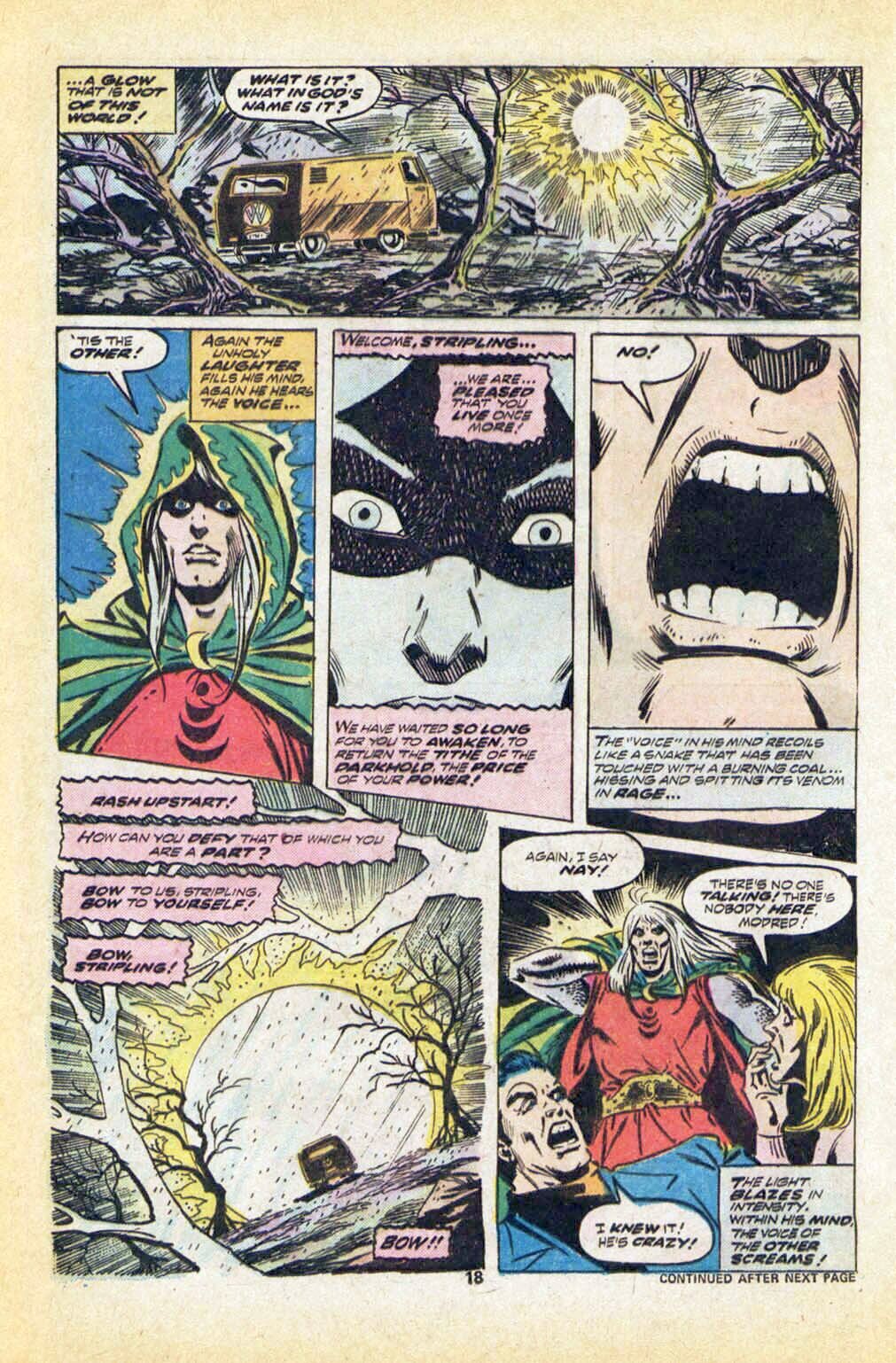
NEAR MYTHS: KNIGHTS IN BLACK SATIN
Monday, June 17, 2024
NEAR-MYTHS: "JIMMY'S INTER-DIMENSIONAL ROMANCE" (JIMMY OLSEN #73, 1963)
In many ways "Romance" is just another of the many OLSEN stories in which Jimmy, after getting turned down by his fickle girlfriend Lucy Lane, gravitates toward another woman-- usually someone who ends up being a bad match for one reason or another. But this tale is a little more intriguing because of the way the writer-- whom I will assert to be Jerry Siegel though there's no absolute proof of this-- played with a couple of well-known mythic tales.
At the opening "Romance" makes a quick reference to Jimmy having proposed to Lucy on some previous occasion. Nothing daunted, not only does he buy an engagement ring for his next attempt, the young reporter rents a studio and plans to win Lucy over by immortalizing her in stone. There's a tossoff explanation as to how he picked up this rather demanding skill, but as he's working on the statue, a strange force takes over Jimmy's hands, so that he sculpts the image of a totally different woman. After an offended Lucy flounces off, the statue comes to life, claiming that she is Rona, inhabitant of the seventh dimension. She further claims that the stone from which Jimmy released her was a sort of an interdimensional vehicle.
Rona informs Jimmy that the two of them are now betrothed. But before the unusually dim youth even thinks to protest an engagement with a woman he doesn't know, Rona offers him the chance to compensate for his perceived lack of masculinity. She gives him a drug designed to make Jimmy as big and muscular as his idol Superman, and within about a day, it works. Lucy is terribly jealous, not just because she's losing Jimmy, but Jimmy-as-a-hunk. For his part, Jimmy's no better, rubbing salt in Lucy's wounds by asking the former girlfriend to pick out the new one's trousseau-- and he seems to be marrying Rona, whom he still barely knows, just to show off his ability to bag a hot chick.
The story then rushes to its foregone conclusion. The happy couple agree to be married before a "judge" (who wears a Catholic collar) and with only "best man" Superman in attendance. Again Rona gets Jimmy to drink some unknown potion, and again he obliges. Then cops from Rona's dimension show up, reveal that she's a female Bluebeard who kills her mates. (With possibly unintentional comedy, the cops prove what she is by showing that she has a blue tongue.) But Superman whips up a poison cure and talks the judge into keeping quiet. Jimmy reverts to his normal size but now enjoys being able to keep Lucy under his thumb-- at least until the next story reasserts the status quo.
The only thing that makes me think Jerry Siegel wrote this one is the risible term the writer gives to Rona's rocky prison: "the Stone Zone," an overt riff on The Phantom Zone. And as in some of Siegel's other stories, there's a very loose mythopoeic parallel here. This time the parallel is between how the tale begins with life arising from dead rock-- and ends with the villain's attempt to turn the rock's sculptor into lifeless matter.
HETERO FORMATIVE
The idea that sex functions to provide variation for natural selection to act upon was first advocated by August Weismann and it has dominated much discussion on the evolution of sex and recombination since then... In summary, although Weismann's hypothesis must be considered the leading candidate for the function of sex and recombination, nevertheless, many additional principles are needed to fully account for their evolution.-- NIH abstract.
All normal human beings have soi-distant mixed-up glands. The race is divided into two parts: those who know this and those who do not. --Robert Heinlein, FRIDAY, 1982.
I haven't written as much as I used to about the excesses of academic "queer theory" since the Hooded Utilitarian site closed down. But HU's demise was not an indicator of a general trend. This is confirmed by a recent jeremiad from London's School of African and Oriental Studies regarding philosophers who were too "white" and "heteronormative."
SOAS, perhaps after thinking deeply about this for the past seven years, is now reviving the debate. It has issued a “toolkit” for secondary schools and universities who wish to teach philosophy (although you’d hope that other universities would have ideas of their own)... The toolkit sets out its position from the start. “Much academic philosophy in the UK, US, Australasia and continental Europe masks its structural antagonism to everything that is not white, bourgeois, male, heteronormative and able-bodied,” it begins. The document continues along very much the same lines for 27 pages.-- Roland White, THE TELEGRAPH, 2024.
The only possible defense for anyone to use a term as stupid as "heteronormative" is that they've allowed their minds to be polluted with Mickey Marx bullshit, and the knee-jerk inclusion of the word "bourgeois" confirms as much. And this narrow-minded, neo-chauvinist screed is rendered even more fatuous than usual when one views "normative sex" through the lens of evolutionary theory.
On a slight tangent, I read a lot of academic film criticism in the eighties and nineties. I'm not sure when I realized that almost all of the critics worshipped at the altars of either Marx, Freud, or some syncretic combination of the two, possibly to be named "Marfreud." Film critic Richard Grenier was a welcome exception. While I didn't agree with every essay in Grenier's 1990 collection CAPTURING THE CULTURE, he made clear how much the academic world had been influenced by Marxist Antonio Gramsci, who used the phrase "capture the culture" to describe the devious social conditioning of the bourgeoise. Grenier wittily pointed out that modern Leftist academics were just following the same program Gramsci projected upon "normative" culture, by undermining everything that "normals" valued. An example, from some book whose title I forgot long ago, was the assertion that the "romantic clinch" seen at the conclusion of countless Hollywood movies was merely a social construction designed to please the bourgeoise-- which was stupid even if the forgotten author didn't use the word "heteronormative."
I probably read that lunkheaded judgment sometime in the nineties, long before anyone thought of using four-or-more letters to mainstream the idea of "homonormative" pride. But even then, the judgment struck me as amazingly presumptuous. If there was no heterosexuality, there would be no human race to give birth to new offspring of any sexual proclivity. Heterosexuality was not something that existed to shore up non-Marxist values, as one might argue with some logic regarding racism. Nevertheless, some thirty years later, Marxists are still whining that if most of the world still trends boy-girl, it's a terrible sin against the Marxist ideal of totally capturing the culture so that homosexuality of one kind or another becomes "the norm."
Now, had evolution not chosen the path of heterosexual conjugation as August Weismann theorized, asexual reproduction might have continued, but there's little if any reason to suppose those life-forms would have arisen to their current level of complexity. Thus heteronormativity, which gets such massive disrespect, is the factor that promoted the immense variety of life-forms on this planet.
Now stating that fact in no way supports real bigotry against any of the many paraphilias-- which includes LGBT etcetera in my book-- that also evolved alongside vanilla old hetero sex. Contrarian conservative Robert Heinlein was certainly being facetious when he had the fictional characters of his novel speak of "mixed up glands." I largely included the quote because I happened to read FRIDAY for the first time while planning this essay. Yet even back in the early 1970s, Heinlein somewhat charted the course for many non-Marxists, who simply looked upon "gay rights advocates" as justified in their rhetoric, striking back against a chauvinism that often made the homosexual paraphilia illegal. This aspect of history should always be acknowledged, not least for the many abuses perpetrated by various types of heteronormative chauvinism. But the answer to one chauvinism is not another chauvinism, and statements like those of the SAOS are nothing but a chauvinism that exaggerates the significance of homonormative behavior at the expense of the entire range of human sexual behavior.
I feel sure, for example, that there exist other persons with non-homosexual paraphilias who view their sexual persuasions as being just as opposed to "the normal" as are homosexual paraphilias-- but some if not all of these may be able to produce offspring. For instance, a macrophiliac who's stimulated only by very tall women may not have a large range of potential mates, but mating and producing offspring is not impossible. But if he (and it's usually a "he") only gets stimulated by literal giants, then he will probably contribute no more to the gene pool than anyone confined to purely homosexual hookups.
But paraphilias like macrophilia will never get courses devoted to their kink as universities, partly because most of them keep a much lower profile than LGBT. A truly liberal philosophy would embrace all sexual variations-- with the obvious exception of the one that will and should remain illegal-- without regard to who's given the most attention by lunkheaded academics.
Sunday, June 16, 2024
MYTHCOMICS: "THE SMILING INVADER" (A.I. LOVE YOU, 1994)
A.I. LOVE YOU was the breakthrough manga for mangaka Ken Akamatu, later known for such popular works as LOVE HINA and NEGIMA. A.I.'s premise was that Hitoshi, a high schooler with zero social skills, used his computer skills to design a program to allay his loneliness. He's able to interact with "Program 30," who has the image of a cute girl, the better to fantasize about having a real girlfriend. A freak accident brings the program to life, so that Hitoshi now gets to live with a pretty girl, though being a living computer program, she doesn't understand sex. So A.I. falls into the category of many similar comedies-- from I DREAM OF JEANNIE to URUSEI YATSURA-- in which an ordinary guy maintains a more or less monastic existence with a hot babe, getting the experience of emotional bonding but without sex. As a compensating perk, though, "Saati Namba"-- the rendering of "Number Thirty" into a combination of Japanese and English-derived slang-- can manifest all sorts of cyber-magic, like illicitly increasing Hitoshi's bank account by "talking" to the bank's computers.
As is often the case with romances involving artificial beings, it's almost inevitable that the A.I. character will take on increasing humanity. "The Smiling Invader" is interesting in that the human Hitoshi is the one who must learn more about the ways of A.I., as they are affected by the evolving technology of the Internet-- specifically, the way in which programs can be infected by viruses.
The story starts off with Hitoshi catching the flu, while Saati chastely tends him. Not knowing much about human diseases, she attempts to research the subject online. But because she's literally interacting with the computer, she catches a computer virus.
After a number of incidents in which Saati either malfunctions or collapses outright, Hitoshi realizes that she's been infected, but since he's keeping her existence a secret, he alone can cure her malady.
Reading this 1990s story today entails something of a flashback experience, as one of the main tools Hitoshi is the now extinct tech of "floppy discs." To build suspense, Akamatsu has Hitoshi go down a false trail, one that only appears to cure Saati, before her illness undergoes a resurgence.
In trying to see what happened, Hitoshi is hailed by an automatic program, "Peter 4," constructed by the unknown virus-designer. Peter 4 takes the form of a clown, implicitly to mock the futile efforts of the "computer geek" seeking to reverse the infection.
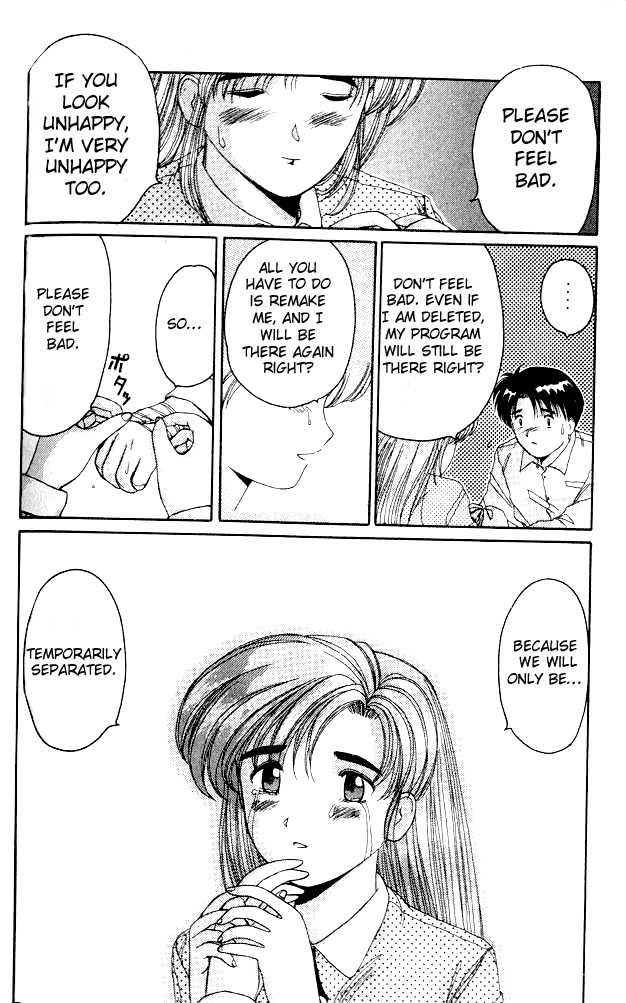
Saati tries to soothe her creator's worries by remining him that even if she is erased, he can still recreate her with the original program. But in classic romance-story tradition, Hitoshi only wants the original Saati, no imitations need apply. In later stories, which I have not re-examined, Hitoshi and Saati encounter the malicious designer of Peter 4, whom Akamatsu named "Billy G" as part of some arcane reference to Bill Gates.
Since it's a serial romance, of course Hitoshi saves her with his tech-insight, albeit with only minutes to spare. But the core myth of the story is that if an A.I. intelligence comes to life, then it will be just as individual, and hence irreplaceable, as any organic creature.
Wednesday, June 12, 2024
CURIOSITIES #35: "THE MONSTER'S EYE" (PEP #157, 1962)
I have to credit the writer of this forgotten story for cramming four impossible things into a six-page story and making it kinda fun:
(1) A hero with animal powers,
(2) An alien girl (smokin' hot as drawn by John Rosenberger) who can change animals into other animals, or into other versions of themselves,'
(3) A hurricane with a monster in its "eye,"
(4) A giant snail, the epitome of slowness, juxtaposed with the epitome of speed and force.
Friday, June 7, 2024
THE READING RHEUM: THE GREEN EYES OF BAST (1920)
SPOILERS SPOILERS SPOILERS
I probably read THE GREEN EYES OF BAST some thirty or more years ago, thanks in large part to a series of Pyramid paperback reprints of Sax Rohmer's non-Fu Manchu works. I remember enjoying the novel, but this time around, my main reaction was that Rohmer had a great idea and wasted it in a pedestrian mystery novel.
The viewpoint character of BAST is London journalist Jack Addison, who has had some mostly unspecified experiences in Africa, though not enough to make him one of Rohmer's experts in exotica. He has a professional friendship with Scotland Yard Inspector Gatton, which is the main reason Addison gets in on the ground floor regarding a mysterious murder. This killing has personal ramifications for the reporter, because the victim is a man named Coverly, the cousin of an aristocrat who has become affianced to Addison's true love Isobel. Though Isobel has not yet married her intended, the experienced mystery-reader will anticipate that at some point the competing fiancee will get knocked off, leaving Addison's path to Isobel cleared. But though we don't learn the nature of the murderers for over a hundred pages, Rohmer teases the reader with intimations of a strange female watching Addison at his house. He sees the titular "green eyes" through his kitchen window and finds evidence that some intruder-- apparently female, due to leaving tracks from high-heeled shoes-- vaulted the wall around his house in order to gain access to his grounds.
After that intriguing opening, though, Rohmer fills lots of pages with dull ratiocinative exchanges between Addison and Gatton about the investigation, and those exchanges aren't helped by the dullness of both characters. Addison unknowingly encounters the green-eyed woman a couple of times, but Rohmer doesn't make her a compelling character either. Not until about page 90 does Addison meet the prime mover involved in both the murder and the mystery of the green-eyed female athlete. Doctor Damar Greefe is a Eurasian physician, ostensibly in service to one of the Coverly family, and like many of Rohmer's Oriental masterminds he is brilliant, reserved, and obsessed with an idee fixee.
The great idea Rohmer wastes is based on this folklore-notion that pregnant women can have their offspring affected by seeing certain animals. As the online Brittanica puts it:
An old wives’ tale that exists in several cultures suggests that when a pregnant woman looks at an unpleasant or ugly animal, her baby will take on a resemblance of that animal.
As Greefe informs Addison and Gatton at the novel's close-- given that even by then they're nowhere near solving any mystery-- he, being a "hybrid" between white and not-white parents, became fascinated with evolutionary hybrids. In Egypt he found evidence of children born with animal-like characteristics, and his rationale, knowing that they were not sired by actual animals as in folklore, was to suppose that such people were "psycho-hybrids." He happens to be on hand when a British matron in Egypt gives birth to one such hybrid, after having met one of the strange wildcats that prowls around the long-deserted Temple of Bast, the Egyptian cat-goddess. Greefe tells the matron and her spouse-- two elder members of the Coverly family-- that the delivery is stillborn, when in fact Greefe absconds with the infant, precisely because she is one of the hybrids he's obsessed with, with cat-like eyes and cat-like reflexes. When the girl has matured, Greefe takes her to London so that he can blackmail her high-society parents. But during that sojourn, the cat-woman-- named Nahemah after a Jewish demon-- sees Addison from afar and falls in love with him.
There's other stuff about who killed who and for what reason, but it's dull stuff. Nahemah, who being the "monster" behind the scenes ought to be the story's imaginative center, never comes alive. Does she regard Greefe as a father, before he informs her of her parentage? Rohmer tells us that she conceives a hatred for the Coverlys, knowing that she was denied her patrimony, but there are no scenes in which she directly interacts with any of her blood relations. Rohmer treats her as if she's absorbed the purported tendency of Eastern women to fall in love quickly, even though she's entirely English. And at no time does Rohmer give her the tragic air he bestows upon a superior character like Fah Lo Suee.
Greefe is easily the novel's most interesting character. In some ways, he's "Fu Manchu Lite." Greefe comes to London with a mute Negro servant armed with a strangling-cord and sets up a weapon with which he can shoot poison gas shells at anyone who gives him trouble! Yet Greefe, unlike the usual penny ante pulp villains, has a genuine beef with the two cultures that spawned him, both of which have rejected his very existence. In one of the book's better scenes, Addison interviews a London pub-crawler regarding the physician, whom the bigoted local calls "the black doctor." For once, a Rohmer protagonist openly scorns this ugly chauvinism. Yet at the same time, the author is still getting some mileage out of the fear of insidious Orientals invading jolly old England.
I don't have a good chronology for Rohmer's published works, but one point of interest is that BAST was published two years after THE GOLDEN SCORPION. In my review I noted that in 1918 Rohmer loosely tied the villain of that story to Fu Manchu, last seen the previous year, as well as implying that the antagonist of 1915's YELLOW CLAW was also allied to the Si-Fan. But for whatever reason, Rohmer seems to have dropped the Fu Manchu concept for the next nine years. In my GOLDEN SCORPION review I noted that the author sought to distance himself from "Yellow Peril" associations despite his using a Chinese villain. In BAST, Rohmer admits that both "white" and "non-white" societies have usually been unjust to biracials, and clearly Greefe's rejection by both cultures is the foundation of his obsession. Though I'm sure many modern readers would find these observations insufficiently political, I find them relatively enlightened for 1920.
I really wanted BAST to be a myth-novel. But at best, it falls into my category of "near myths," which don't quite manage to take full advantage of their imaginative content.
Thursday, June 6, 2024
SUFFER THE LITTLE MASTERS
I've just finished reading NOTES FROM THE UNDERGROUND for the first time. I probably have not read any Dostoyevsky in twenty years, despite my admiration for his major novels and my knowledge that he was a major influence on Friedrich Nietzsche's philosophy.
I won't review the book as a whole, since there's far too much to unpack in the space of a blogpost. The wider context of UNDERGROUND is that the book consists of the diary-like ramblings of an unnamed Russian clerical type. He addresses many of Dostoyevsky's own concerns about the pending modernization of Imperial Russia and the project to make the nation able to compete with the great countries of Western Europe. Parts of the narrative are a coded response to another Russian intellectual of the period, who advised a utilitarian, reason-based conception of culture.
The strangest thing about UNDERGROUND is that Dostoyevsky makes no attempt to make his narrator seem admirable, which is a frequent strategy for authors trying to sell whatever philosophy their characters expouse. Rather, Nameless Man admits that he's perpetually full of spite and given to imagining grand schemes of revenge against those who offend him-- schemes which he has absolutely no real desire to carry out, even if he possessed the will to do so. He seems in many ways the incarnation of Nietzsche's "ressentiment," except that he's aware of his own absurdity, excusing it only in the sense that all of humankind is no less absurd.
Because Nameless Man is something of an unreliable narrator, one can't be entirely sure that everything he advocates is what Dostoyevsky himself advocated, any more than Captain Ahab represents the totality of Herman Melville's beliefs. But the author clearly meant for readers to carefully weigh the opinions set forth by the narrator, and one of the most interesting opinions concerns the rejection of utilitarian "reason" as the defining characteristic of human beings.
You see, gentlemen, reason is an excellent thing, there's no disputing that, but reason is nothing but reason and satisfies only the rational side of man's nature, while will is a manifestation of the whole life, that is, of the whole human life including reason and all the impulses. And although our life, in this manifestation of it, is often worthless, yet it is life and not simply extracting square roots. Here I, for instance, quite naturally want to live, in order to satisfy all my capacities for life, and not simply my capacity for reasoning, that is, not simply one twentieth of my capacity for life. What does reason know? Reason only knows what it has succeeded in learning (some things, perhaps, it will never learn; this is a poor comfort, but why not say so frankly?) and human nature acts as a whole, with everything that is in it, consciously or unconsciously, and, even if it goes wrong, it lives. I suspect, gentlemen, that you are looking at me with compassion; you tell me again that an enlightened and developed man, such, in short, as the future man will be, cannot consciously desire anything disadvantageous to himself, that that can be proved mathematically. I thoroughly agree, it can--by mathematics. But I repeat for the hundredth time, there is one case, one only, when man may consciously, purposely, desire what is injurious to himself, what is stupid, very stupid--simply in order to have the right to desire for himself even what is very stupid and not to be bound by an obligation to desire only what is sensible. Of course, this very stupid thing, this caprice of ours, may be in reality, gentlemen, more advantageous for us than anything else on earth, especially in certain cases. And in particular it may be more advantageous than any advantage even when it does us obvious harm and contradicts the soundest conclusions of our reason concerning our advantage--for in any circumstances it preserves for us what is most precious and most important--that is, our personality, our individuality.
The Nameless Man doesn't really define the nature of the "will" that he believes a fuller expression of humanity, so there may be no way to know if he's referencing something akin to Schopenhauer's "universal will." He does seem to have some of the Gloomy Philosopher's attitude toward suffering, however.
And why are you so firmly, so triumphantly, convinced that only the normal and the positive – in other words, only what is conducive to welfare – is for the advantage of man? Is not reason in error as regards advantage? Does not man, perhaps, love something besides well-being? Perhaps he is just as fond of suffering? Perhaps suffering is just as great a benefit to him as well-being? Man is sometimes extraordinarily, passionately, in love with suffering, and that is a fact. There is no need to appeal to universal history to prove that; only ask yourself, if you are a man and have lived at all. As far as my personal opinion is concerned, to care only for well-being seems to me positively ill-bred. Whether it's good or bad, it is sometimes very pleasant, too, to smash things.
I agree that "will" should be seen as the totality of human thought and expressivity, and that the full expression of will is indeed the key to "our personality, our individuality." It's also universally true that people chafe against living their lives only for "advantage," and that they may rebel against their own interests, seeking to "smash things" to assert their individual will. George Bataille built much of his philosophy upon the opposed ideas of "consumption," all reason-based activities that keep a culture alive and viable, and "expenditure," those activities that have no real rational ends.
I would part company from Dostoyevsky on the subject of suffering, however. Without doubting that many persons "kick at the slats" of their cultures simply to feel the thrill of defiance-- or else use fictional proxies for the same purpose-- there is a broader context to suffering in world cultures. Here's Nietzsche on the subject:
“The discipline of suffering, of great suffering—know ye not that it is only this discipline that has produced all the elevations of humanity hitherto? The tension of soul in misfortune which communicates to it its energy, its shuddering in view of rack and ruin, its inventiveness and bravery in undergoing, enduring, interpreting, and exploiting misfortune, and whatever depth, mystery, disguise, spirit, artifice, or greatness has been bestowed upon the soul—has it not been bestowed through suffering?” -- BEYOND GOOD AND EVIL.
This particular Nietzsche quote does not directly cite his concept of uberwinden, "self-overcoming," for which I substitute (for possible greater clarity) the term "self-mastery" in my own philosophical ruminations. But clearly, he has stated that suffering can bring forth all of the "inventiveness and bravery" that humankind has used to mitigate or alleviate misfortune.
As I am not an expert on Dostoyevsky, I don't know if anything comparable to Nietzsche's concept appears in his other works, but it's not in UNDERGROUND. I believe that the great Russian writer was just as opposed to small-minded utilitarianism as the great German philosopher. But my best guess is that Dostoyevsky was narrowly focused upon the goal of refuting a particular utilitarian writer through this nameless spokesperson, and so he did not make any connections between suffering and self-mastery. Or perhaps Dostoyevsky made some such connection, and thought it contravened his ideal of a "will" that had absolutely no practical applications.