Featured Post

SIX KEYS TO A LITERARY GENETIC CODE

In essays on the subject of centricity, I've most often used the image of a geometrical circle, which, as I explained here,  owes someth...

Saturday, April 1, 2017

MYTHCOMICS: [THE NAGAI INVASION], STAR WARS #94-107 (1984-86)

My essay XX MARKING THE SPOT works as something of a preface to this week’s mythcomic. Only in the last week of March, publicly allotted as “Women”s History Month,” did it occur to me devote at least one entry to a mythcomic relevant to this topic. I’ve often covered the mythic incarnations of women in fiction throughout the "1001 myths" project, but very few of the female characters I surveyed were actually created by female authors. To be sure, even had I thought about what month it was earlier, I’m not sure that I could isolated three more female-authored mythcomics. Whether the lack of such creations is the fault of nature or culture is a matter for each individual to decide. But I have found one for this week, and from a rather unlikely source.


Marvel’s licensed STAR WARS comic book began in the same year that the original Lucas film debuted and ended about three years following RETURN OF THE JEDI, the final installment of the original film-trilogy. While the earlier SF-series STAR TREK became well-known for having inculcated a strong and lasting female fandom, STAR WARS has not been quite as well celebrated for its female adherents.  On one hand, Lucas’ space-opera concept has been viewed by many as a quintessential form of “boys’ enterainment,” which some critics, notably Ursula LeGuin, have considered irrelevant to female interests. On the other hand, the sheer kinetic and emotive appeal of the original trilogy crossed barriers of both age and gender to become a genuine American myth purely in terms of mainstream popularity. That said, I don't know that any of the various iterations of the franchise  in other media enjoyed the same degree of mainstream approval.

Marvel’s STAR WARS title was not in any sense of “fan-favorite” during its nine years of publication. Thanks to the popularity of the film, the comic sold extremely well, so much so that in more than one interview Marvel editor Roy Thomas credited the franchise with having saved the company from economiccatastrophe. For most of the title’s history, one would be accurate to assume that the majority of its stories were at best good formula space-opera, devoted to depicting the main characters of the franchise—Luke, Leia, Han, Chewbacca, and the droids—having assorted non-canonical adventures. Along the way, raconteurs created their own characters, whose character-arcs could be much more elastic than the ones licensed from Lucasfilms. In the long sequence I’m examining, which I’ve entitled “The Nagai Invasion,” one particular character, created by writer Jo Duffy, becomes the central mythic persona in a continuity that, in some ways, put the “war” back in STAR WARS.


For most of the comic’s history, Jo Duffy contributed formula stories largely indistinguishable from those of male writers like Archie Goodwin and David Micheline. Not surprisingly, male artists illustrated all of her stories prior to issue #84. With this issue, Cynthia Martin then took over penciling duties for almost every subsequent issue, and arguably she added a grimmer, more restrained aesthetic, rooted in the use of fined-lined artwork and generous use of white space. Presumably, her main influenced were from manga artists: I note the use of the surname of manga-artist “Go Nagai” being used as the name for a new breed of aliens menacing Luke Skywalker’s Rebel Alliance. In addition, the physical model of the Nagai resembles that a body-type often seen in manga, one in which the men are all lean, epicene, and pale-skinned.


I won’t dwell overlong on the main plot of the long sequence, except that the incursion of the Nagai—and their team-up with assorted leftover stormtroopers—forces the STAR WARS characters to go to war once more. During this continuity, Duffy’s original character Dani—a humanoid woman belonging to a red-skinned race called “Zeltrons”—becomes a sort of “walking wounded” that I've never found in any George Lucas narrative.

In the critical subplot of “Invasion,” the Nagai—led by military officer Den Siva—are curious about the battle-abilities of the Zeltrons. Den’s forces capture Dani, and he personally suhjects her to a process designed to analyze her biological nature. It also causes the young woman—typically portrayed as something of a “fun-time girl,” despite being a warrior—to intense pain. The structure of scenario is almost identical to scenarios in which a captive soldier is tortured for information by his captors, though in this case the torture itself supplies the Nagai with the information they want, irrespective of the victim’s suffering. While watching the torment Den informs an aide that the process often kills its subjects. 


Dani survives an experience that may he compared to that of rape—the machine penetrates her body with assorted light-beams, though none strike the most obvious area—and in consequence, she becomes highly traumatized. Den, however, becomes fascinated with the Zeltron’s strength of character. When she is liberated from imprisonment by her ongoing boyfriend Kiro, Den personally tracks the two of them down, engages Kiro in a knife-duel, and apparently kills him. A later issue, #102, gives Kiro an ambiguous revival, though he never returns to Dani’s side and thus leaves her doubly traumatized.

However, Duffy and Martin handle the trauma in a manner more in line with Japanese samurai-dramas than with American Lifetime movies. Dani’e experiences cause her to focus upon Den Siva as the incarnation of her nightmares, and he for his part goes to great lengths to track her down and possess her. 


However, in a twist one won’t find in the average melodrama, Den becomes so besotted with the Zeltron that he betrays his own people to save her life, and eventually becomes an ally to the Alliance. 


Dani, despite her consuming hatred of the Nagai general, eventually becomes reconciled to this particular fortune of war. There is no attempt to mitigate Den’s “mental rape” of his prisoner, though Duffy may have intended to comment on the way real war usually treats its combatants. In the final issue, Den and Dani are last seen in one another’s company, even though the most she can say of him is, “I don’t love him, or even like him-- but at least we understand each other.”


George Lucas’s unique take on American action-serials and space-opera has many virtues that go overlooked by elitist critics, and the Duffy-Martin work on the STAR WARS comic does, to be sure, include many of the aspects that made the original film-trilogy popular, such as light humor and non-stop action. But I would imagine that the type of trauma depicted in Dani's character-arc would have been beyond Lucas's skill-set. Dani's degradation might be said to place her within the sphere of "the abject" as the concept was formulated by Julia Kristaeva. I touched upon said concept in this essay, though probably not in total agreement with Kristaeva. For instance, I would view Den Siva, the source of Dani's degradation, to have also entered a state of abjection simply because he has become infatuated with her, thereby causing him to betray his own people. In my view this is the only common ground that the characters share-- certainly Duffy and Martin never suggest that Dani and Den can lose themselves with the bounties of romantic love-- as well as the only reason Dani could say that the two of them "understand each other."

As a coda, I chose not to research any statements made online by Duffy or Martin before finishing my essay. That done, I was not surprised to learn that from this 2011 interview that the STAR WARS comic was cancelled while Duffy had yet to complete her long-term narrative, and that she was forced to condense her conflict as rapioly as possible in order to give her sequence an effective conclusion. While as a reader I would have liked to have seen her continuity played out to its full effect, I can't say that I am enamored of Duffy's plans to conclude Dani's character-arc by having her sacrifice her life in battle. Perhaps it would have been an impressive sequence. Yet I confess that the ending as it stands-- in which Dani and Den remain together, bound in a non-romantic alliance-- seems far more original, and more evocative of the mythology of wartime alliances.   

Friday, March 31, 2017

GOOD WILL QUANTUMS

I preface the discussion referenced in the last post with another citation of my definition of the four potentialities:

The KINETIC is a potentiality that describes the relationships of sensations.
The DRAMATIC is a potentiality that describes the relationships of discrete personalities.
The DIDACTIC (formerly "thematic") is a potentiality that describes the relationships of abstract ideas.
The MYTHOPOEIC is a potentiality that describes the relationships of symbols.

Merriam-Webster defines "potentiality" as "the ability to develop or to come into existence," and I chose it in accordance with my belief that all human creators of art are capable to drawing upon these potential matrices of relationships. Not all creators will use all four equally, for reasons I've already detailed, but all are potentially capable of invoking such intra-literary relationships because such relationships are the essence of all discourse. Naturally, I'm only interested in discourse that either falls within the rubric of "fiction" or has an ambiguous relationship to it (see my review of ED GEIN, which I termed a work of "fictionalized reality.")

Now, by certain criteria everything fictional is "unreal," as I demonstrated in my essay HERE COMES DAREDEVIL  THE MAN WITHOUT IDENTITY. Still, even though fictional characters exist only for readers to identity with them in some manner, characters may take on the appearance of reality because they repeatedly reproduce the relationships we as readers/audiences expect of them. This illusion of reality is primarily sustained by the readers' sense of what Raymond Durgnat called "density of specification." This was a slight misquote of a tossed-off term from Henry James, and in Durgnat's original essay he seems to apply it largely to the potentiality that I have called The Dramatic:

English masters instructed us all in the necessity for realistic and deep characterization, logically consistent behavior, penetrating studies of motive, and that proliferation of vivid detail suggested by Henry James' phrase, "density of specification." 

In certain circumstances one might argue that the last of Durgnat's phrases, "the proliferation of vivid detail," could signify the world of The Kinetic, but it's impossible to know what Durgnat had in mind, and I would speculate that in the type of realistic fiction he referenced, such "vivid detail" usually serves more as backdrop from dramatic developments than as a source of varied sensations. But in this one germ from Durgnat's essay, I perceive a general principle: that density is the means by which the reader subconsciously rates one creator above another: because the reader believes that Creator A can better describe a set of relationships so "densely" that it takes on the quality of "lived experience." Thus, using comics-creators as shorthand for these positions: abstract ideas take on great density in Dave Sim, sensations take on great density in Frank Miller, "discrete personalities" take on great density in (say) Gilbert Hernandez, and symbols take on great density in (say) Grant Morrison.

Such shorthand assignments are, of course, entirely unfair: Miller, Sim, Hernandez, and Morrison have all earned places in my mythcomics assessments, which indicates that all four possess some ability to work with the matrix of The Mythopoeic. But I would say that the dominant works by each artist show that one particular potentiality has what Jung called "sovereignty" over the others, as I detailed in JUNG AND CENTRICITY:

Jung does not invoke "sovereignty" as a specific term, in contrast to the way Bataille uses it to mean what I'd translate as "megalothymotic dominance."  What Jung is really addressing is the proposition that though a subject's psychological makeup may include influences from all four functions-- once again, sensation, intuition, feeling, and thinking-- only one can be dominant.

Yet the question of centricity and/or "megalothymotic dominance" is not a vital one for me at this time. I'm more interested in exploring the consistency of unreality: the various types of non-existent fictional items that exist in assorted relationships within each respective potentiality. All of these items-- sensations, discrete personalities, symbols and ideas-- derive from things that people feel and/or do in the real world. But in fiction, they have their own reality, one that I have called, following Susanne Langer, gestural.

And in the next essay I'll finally draw, as promised, upon my essay THE QUANTUM THEORY OF DYNAMICITY, if only to come up with a better term than "items" for these intangible whatyacallems.

Thursday, March 30, 2017

MERCURIAL RISINGS

My current contemplation of the four potentialities leads me to return to the 2015 essay-series REFLECTIONS IN A MERCURIAL EYE. I wrote this series one month before I started using the terms "overthought," "underthought" and "lateral meaning" to describe my conception of the literary process.  In Part 3 I drew some general comparisons between Jung's ideas about his "four functions" and what parallels these did or did not have with said literary process.

Drawing on Jung's comment about the purpose of each function... in literature [I consider that]"sensation" refers to the readers' identification with the physical sensations of fictional characters, while "feeling" refers to the extrinsic value that the readers place upon the characters' actions.

By contrast, in the previous passage, I said that these were the functions through which the majority of audiences interact with fictional narrative, as opposed to the functions that concern either images and symbols (intuition) or discursive ideas (thinking). This prioritization is at odds with the ontogenesis Jung presents in PSYCHOLOGICAL TYPES, where the two irrational /perceptual functions, sensation and intuition, develop first in the human organism, and are only later followed by the rational / judgment-making functions, thinking and feeling.

In REFLECTIONS I did not so much dispute Jung's prioritization as declare it irrelevant to the literary process:

Now Jung calls intuition an "irrational, perceiving function" while thinking is a "rational function of judgment." Despite this difference, both of them seem to be secondary processes for purposes of literary identification.

The obvious reason for this-- though I didn't state it at the time-- is that while the human organism may have one ontogenetic order, a given literary narrative has another. In fact, it must have a different ontogenetic order, given that while humans are born as children and progress to adulthood, literary works are presented to their audiences in "adult" form. That is, not only are they supposed to have refined away all the confusions of their early conceptions, they are by and large produced by adults who have lived with all four functions since their own childhoods. It is for this fundamental reason that the functions of sensation and feeling are primary in both the artist's creation of his works and his audience's interactions with them, while the functions of thinking and intuition become secondary, requiring a great deal of education before one can navigate their more abstract depths.

In Part 3 I also said:

...I cited a Jung passage in which he spoke of the intuition's "mythological images" as "the precursors of ideas." Given Jung's love of symmetry, he probably contemplated a similar indebtedness between the other two functions, given that the base input of sensations-- as to whether they were agreeable or disagreeable-- can be easily seen as the basis of the feeling-function's more sophisticated decisions about what people and things ought to be accepted or rejected.

Leaving Jung's love of symmetry out of the matter, my own similar love prompts me to observe that I can see how narrative in its most elementary states-- say, stories in Golden Age comic books-- often seem to have nothing on their respective minds than establishing (1) the range of sensations possible and (2) basic (i.e., not "more sophisticated") judgments on whether people or things thus perceived should be accepted or rejected. Thus sensation retains its status as being a function both irrational and perceptual, and feeling keeps its nature as being a function both rational and judgment-oriented.

In my recent meditations on "complexity" and "density," I've come to the conclusion that all four functions, as they manifest in literature, must depend on complexity as a measure of merit. In COMPLEXITY, MEET DENSITY PT. 1  I rejected Raymond Durgnat's 'aesthetic of simplicity," in part because I think his notion of symmetry-- i.e., elementary myth-motifs must be opposed to more finely rendered renditions of verisimilitude-- was, ironically enough, too simple. Certainly I don't think of the free flow of images and symbols, as expressed by the function of intuition, is in any way less complex than any mimesis produced by any representative of realism, be it Henry James or Ben Katchor. Maybe if Durgnat had read more of Jung than of Levi-Strauss, he might have modified his stance.

I've already devoted many words to the ways in which the products of the human intuition provide the groundwork for the conceptualizations of the thinking-function. But only in this essay, THE QUANTUM THEORY OF DYNAMICITY, did I come close to verbalizing the potential connections between the sensation-function and the feeling-function as seen through my lit-crit lens. More on this in a separate essay.

Tuesday, March 28, 2017

XX, MARKING THE SPOT FOR-- FEMALE MYTHS?

The month devoted to "Women's History" is almost over, but I decided to assemble a shortlist-- aided by various Trina Robbins works--  as to some of the early (up to 1980) landmark comics-creations of female creators, whether alone or in collaboration with male creators: This is not an all-inclusive list: just a snapshot of the more notable accomplishments.

1909-- Rose O'Neill creates a somewhat intermittent series of cartoons and/or comic strips called THE KEWPIES, which become a marketing sensation in the early 20th century.

1934-- Martha Orr creates a soap-opera strip, APPLE MARY, that is revamped into the better known MARY WORTH by other hands later on.

1935-- "Marge" creates LITTLE LULU as a one-panel strip, though the character becomes more famous through cartoons and comic book incarnations.

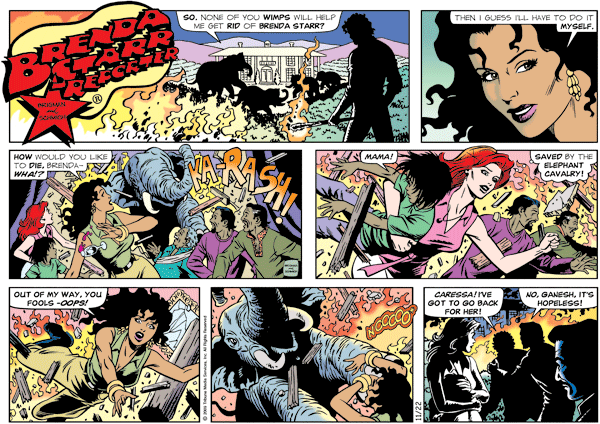
1940-- Dale Messick creates the comic strip BRENDA STARR

1941-- Tarpe Mills creates a female superheroine in MISS FURY.

1965-- Ramona Fradon collaborates on DC's METAMORPHO

1972-- Marie Severin and Linda Fite collaborate briefly on the short-lived THE CLAWS OF THE CAT from Marvel Comics.

also in 1972, Trina Robbins edited and contributed to the underground WIMMEN'S COMICS

1978-- Wendy Pini's co-creation ELFQUEST debuts.

also 1978-- Rumiko Takahashi debuts her break-out comic URUSEI YATSURA

Now, one of the reasons I compiled this list was because I was trying to see whether early female creators had at any time equaled their male compeers in terms of creating literary myths in comic strips and books. I think I can dismiss a lot of the earliest works, like those of Rose O'Neill, as being either too focused upon either kid-cuteness or upon girly glamour at the expense of any more involved storylines. Orr's APPLE MARY-- which as R,C. Harvey speculates, was probably influenced by the 1933 Frank Capra film LADY FOR A DAY-- sounds like it might have more potential, especially since Orr worked on it for about five years. But there don't appear to be any readily available collections of MARY WORTH's precursor. It does have mythic potential in that Apple Mary was supposed to be a once rich woman reduced to poverty by the Depression, which means that the strip as a whole might have incarnated a sociological myth, as do many of Capra's contemporaneous films. But there's no way I can tell for the present.


As a one-panel strip, LITTLE LULU is probably not too mythic, though it would be interesting to see how John Stanley's later comic-book work stands up to the mythopoesis test. I also confess general ignorance of BRENDA STARR, but it doesn't seem to have the symbolic richness of contemporary strips like DICK TRACY, which was taking on deeper symbolic intonations in the early 1940s.


I have read the early years of MISS FURY, and those adventures don't seem to be more than passable thrillers, though I applaud Mills' ability to do action-scenes and take chances with risque material. I actually see more potential in an earlier series Mills did for comic books, MANN OF INDIA, but I wouldn't term this as more than a "near myth."


I liked at least "The Origin of Metamorpho" well enough to put it on my mythcomics list, but I tend to think that the dominant creative partner on that series was writer Bob Haney, stylish though Fradon's artwork might be.


As for Marvel's CAT series, only the first issue, chronicling the heroine's feminist origins, succeeds as even a "near myth," The next three issues in the series' short run for some reason focused on pitting the Cat against Marvel villains with animal-names: the Owl, the Man-Bull, and Commander Kraken. Happily the Cat was revamped as the character of Tigra, and her costume was assigned to one of Marvel's early teen-humor characters, Patsy Walker. All very interesting, but none of that came about due to female creators.


I admit that I don't have a thorough grasp of European or Asian comics from the early 20 century, so there may be some literary comics-myths promulgated from female creators in those domains, But at this point it begins to look like the first verifiable comics-myths unequivocally marked by "XX" creators both appear in 1978: ELFQUEST and URUSEI YATSURA. 


Monday, March 27, 2017

COMPLEXITY, MEET DENSITY PT. 2

For the most part, whenever I've used the term "complexity" on this blog since its beginning in 2007, I've been referring to "symbolic complexity," a.k.a. "mythicity." As I recall my earlier writings for THE JOURNAL and AMAZING HEROES on myth-criticism didn't define the potential of literature to be "myth-like" in terms of a level of symbolic activity, or, if I did, I may have followed the lead of Joseph Campbell in declaring narratives to be "myth-like" if they closely followed a template derived from authentic myth. Over time, though, I've tended to view narratives in terms of Jung's idea of phenomenology, which emphasized the multifarious nature of the human personality. This was the type of "complexity" with which Jung dealt, and of his many dissections of the human soul, the one that I find most persuasive is his concept of the four functions, which he boils down thusly:


The essential function of sensation is to establish that something exists, thinking tells us what it means, feeling what its value is, and intuition surmises whence it comes and whither it goes. 

Jung did not apply the functions to literature at all so far as I know, so I did so, extrapolating from the four psychological functions four potentialities, as described in FOUR BY FOUR. The potentialities don't follow the same ontogeny as the functions, because the former apply not to general perception but to the application of the functions in human art, which result in four potential modes of literary action:

The KINETIC is a potentiality that describes the relationships of sensations.

The DRAMATIC is a potentiality that describes the relationships of discrete personalities.

The DIDACTIC (formerly "thematic") is a potentiality that describes the relationships of abstract ideas.

The MYTHOPOEIC is a potentiality that describes the relationships of symbols.

In Jung's schema every human psyche must include all four functions, though inevitably individuals will favor one over all the others. However, not every work of art is designed to reflect all four potentialities. An artwork can favor one potentiality and display no direct reference to any other, as I also said in FOUR BY FOUR:

I might attempt to use Jung's function-terms to assert that Dave Sim's cerebral CEREBUS privileges the function of "thinking" more than any other, and that Frank Miller's SIN CITY privileges the function of "sensation." 

Naturally, even authors who may be fixated upon a particular function always have the potential, so to speak, to try their hands at the other three.

Now, throughout this blog I've largely been analyzing works from the standpoint of the mythopoeic potentiality. This concentration stems from my rejection of ideological criticism, which centers principally upon the the didactic. I've distinguished between "functional" and "super-functional" uses of symbolism, in which "super-functional" implies largely the same as "high symbolic complexity," as well as Wheelwright's notion of "the plurisignative." But in previous essays I had not evolved a symmetrical approach to the other three functions, which is what I seek to do at this point.

For instance, here's Dave Sim, with his focus on "thinking," providing a complex (though not irrefutable) take on the philosophy of one particular character:


In contrast, Miller doesn't tend to give his character particularly complex didactic outlooks:


I could muster other examples of "complex vs. simple" applications of the other two potentialities as well, perhaps one that would be more to Miller's advantage than to Sim's. But the point is that any excellence within a particular potentiality stems from a given author's mastery of the narrative complexity relative to that potentiality. Raymond Durgnat's term "density" has some application as well, for it is through the density of details that even sensational fictional effects have the greatest impact upon readers.

For instance, these three DAREDEVIL action-panels by Miller--


Are innately more complex than these two rather static DAREDEVIL panels from Bob Brown.


I don't plan to continue tracing the different forms of complexity/density within each of the four potentialities: the mythopoeic is still my particular obsession. However, I have a bit more to say in future essays on the general theory of the four potentialities.

Sunday, March 26, 2017

QUICK "WHITE GODDESS" COMMENT

An example of a jungle-hero who does conform to [so-and-so's] description [of a jungle hero who excels the natives at their own arts], rather than Tarzan or Phantom, would be Sheena of the Jungle. She's a white woman brought up in the jungle, and in her introductory stories at least, there's no particular reason why she's as good a fighter as any of her Afro-Tartar people. (Yes, for some reason not evident to me, the writer decided that Sheena ruled over a lost people made of a Tartar expedition that made its way down to Africa, staked out a colony, and intermarried with the natives.) Later she stops being a queen as such and just hangs out in the jungle with her "mate," waiting for trouble to strike the local tribes-- all Black Africans by this time-- whom she then saves with her extraordinary skills.

There had been white jungle-queens before Sheena, like the one from 1931's TRADER HORN, but they seem to rule by some implied "white authority" principle. Sheena is at least an exceptional fighter, which could explain why she awes people-- and she does have a vague perceptor, a witch-doctor named Koba who raises Sheena after he (maybe) kills her real father with magic. He sets her up as a goddess and then fades from the picture for the most part, so I guess he had taken his "white goddess" lessons from watching TRADER HORN or reading the Tarzan comic strip.

Saturday, March 25, 2017

COMPLEXITY, MEET DENSITY PT. 1

In order to explain why I'm choosing to devote a lot of space to one essay in Raymond Durgnat's 1967 collection in FILMS AND FEELINGS, as I said that I would in this essay, some personal reflections by an amateur literary theorist may provide some context.

I'm not certain as to when I read the Durgnat book, but since I was exposed to a lot of esoteric materials while working for a college library in the early 1980s, that's as likely a time as ever. I already had quite a bit of grounding in Jung and Campbell, and I probably discovered Frye around the same time as Durgnat. Durgnat didn't offer a lot of heavy theory in his essays, but in one essay, "Tales Versus Novels," he propounded a theory with which I both agreed and disagreed.

I lacked a certain amount of context to Durgnat's argument when I first read it, for the essay was in part a response to a type of literary elitism the writer found in a 1884 Henry James essay, "The Art of Fiction."  To my consternation Durgnat did not cite the source of James' remarks, which I later tracked down thanks to the wonders of the Internet. "Art of Fiction" itself was written in response to a diatribe by a more obscure writer of James' time, whom I chose not to seek out. In brief, James sought to set forth his parameters for excellence in literary fiction, and in the excerpt from "Tales Versus Novels" I'll print below, it should be evident that Durgnat is arguing that James' standards are based purely upon the art of the novel, not of fiction generally. Thus, Durgnat contrasts the virtues of "tales," meaning not only bonafide folktales but also pop-fictional creations like "Li'l Abner and James Bond," with the more celebrated virtues of largely naturalistic novels.

To the aesthetic of the "tale" academic culture has, by and large, turned a blind eye. As recently as my grammar school days, English masters instructed us all in the necessity for realistic and deep characterization, logically consistent behavior, penetrating studies of motive, and that proliferation of vivid detail suggested by Henry James' phrase, "density of specification." We were besought to insist upon the "texture of lived experience," and many of the exegeses we studied had strained to detect such "density" in such improbable places as folk ballads, or Chaucer's tale of Patient Griselda. Yet it was curious that, rich and complex as was the showpiece of the "complexity" school, HAMLET, each critic struggled to isolate its hero's "real" motives, to simplify, to synopsize, him into a figure almost as systematic and simple as another famous procrastinator, Li'l Abner. For, as Erich Auerbach remarked in his study of the development of European literary realism, "To write history is so difficult that most historians are forced to make concessions to the technique of legend."

A minor point first: in the essay to which I linked, James actually speaks of "solidity of specification" when he extols the ability of modern fiction to bring forth that texture of lived experience.  However, Durgnat's inaccurate memory is more inspired than the original, for the ideal of literary realism is based not so much in how "solid" things are-- which is "not at all" since fiction is not real-- but rather, in how "densely" an author provides all the details that produce the illusion of reality.

Now to a more substantial point: Durgnat is suggesting is that academic culture ought to appreciate not just the aesthetic of complex specification, but also the aesthetic of simplicity that one finds in folktales and popular fiction, and even in "high art" (like HAMLET), whose complexities ultimately reduce down into many of the same simple oppositions one finds in "low art." Here's Durgnat celebrating the symbolic oppositions one finds in Mary Shelley's famous creation:

The Frankenstein Monster is brutal but pathetic; he's a creature who masters his creator; he's brute material capable of a lofty idealism that, turning sour, makes him a devil-- but a sympathetic one.

I agree with Durgnat's readings of folk-lit and pop-lit in general, but the "disagreement" I mentioned above comes in when he tries to make these rather Levi-Straussian oppositions emblematic of his "aesthetic of simplicity." I don't think that, say, his Frankensteinian oppositions are simple; I think that they're just as "dense" as all the verisimilitude that Henry James ladles into his novels. I think I understand fairly well why Durgnat sought to create a contrast between his notion of tale-like simplicity versus academia's received opinion that "proliferation of vivid detail" was the defining virtue of all fiction, with the prose novel standing in as the best representation of that aesthetic. But I also think it was a mistake, because the academic community flourishes on the demonstration of hidden complexity beneath the surface of any narrative. As far as I can tell, Durgnat's aesthetic of simplicity had little effect on academia, be it concerned with the critique of prose or of cinema. In contrast, while the influence of Carl Jung's analytical psychology proves less popular than the pseudo-scientific formulations of Freud and Marx, there are still assorted critics who advocate the exploration of symbols through a Jungian lens-- in large part because Jung, like literary critics, was all about finding complexity amid apparent simplicity.

In future essays within this series, "density" will prove useful in further identifying the virtues of what I've termed, with due reference to Jung, the four potentialities.