Featured Post

SIX KEYS TO A LITERARY GENETIC CODE

In essays on the subject of centricity, I've most often used the image of a geometrical circle, which, as I explained here,  owes someth...

Sunday, February 6, 2022

NULL-MYTHS: “WONDER GIRL’S STOLEN FACE” (WONDER WOMAN #153, 1965)


Despite Robert Kanigher’s considerable creativity, I’ve yet to see anything he wrote for the WONDER WOMAN feature—which he wrote and edited for over fifteen years—that qualified as a mythcomic. His use of myth-ideas was both derivative and desultory, giving one the impression that he could barely summon any enthusiasm for the series, even when dealing with characters he himself created, or at least substantially re-worked, like the idea of “Wonder Woman as a girl,” as I discussed here.


All that said, Kanigher gets a little closer to the mythic mark with the 1965 story “Wonder Girl’s Stolen Face,” though it’s such a jumbled mess that it only qualifies as a “null-myth.” Strangely, in other venues Kanigher seemed to be a fan of “strong women,” since he had created such DC Comics characters as Black Canary, Poison Ivy and Mademoiselle Marie. But the closest he comes to expatiating on a feminine theme in a WONDER WOMAN comic is the old saw about women being ruled by their vanity.


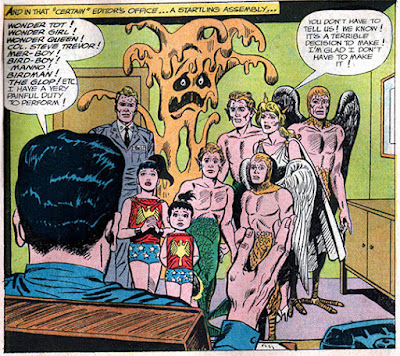
“Face” begins by showing Wonder Girl (a teenaged version of Wonder Woman, who could co-exist with her older self via a complicated time-trick) being celebrated by both her immediate family on Paradise Island, and by two young swains pursuing her: Mer-Boy, a half-fish merman who dwells in the ocean with his kindred, and Bird-Boy, who lives in the sky with his fellow bird-folk. But the teen Amazon’s good cheer is sabotaged by a longtime WONDER WOMAN villain, the alien Duke of Deception, who wants the entire Wonder-family eliminated so that he can invade Earth with his flying saucers. He decides to sow the seeds of dissension by depriving Wonder Girl of her normal good looks and making her into a monster embittered against society and her family.


Sure enough, the first part of the Duke’s plan works fine. At the very moment when Wonder Girl’s two beaus are singing praises for her Cleopatra-like beauty, the ray literally steals the heroine’s face—we know this because we see the disembodied face later on-- and replaces it with a half-human, half-gargoyle physiognomy. Upon finding herself transformed, does the teenager rush off to Paradise Island, to have her mother and the Amazon scientists examine her? No, she raves at her boyfriends for being taken aback by her face-lift, even though neither of them forswears her for her sudden hideousness. In fact, each in turn invites the gargoyle girl to attend functions in their respective domains, trying to buoy up her spirits. However, at both functions the mer-people and the bird-people both think Wonder Girl is putting them on with her horrific visage, and they laugh at her. In both domains the angry Amazon tears up a lot of real estate and flees back to her family’s island. However, the other members of the WW family-- Wonder Woman herself, her mother Hippolyta and Wonder Tot (don’t ask!) -- make the exact same mistake, with the result that once again the tormented teen tears things up and fights with her family.


This of course is just what the Duke wanted. However, the other members of the family refuse to strike Wonder Girl. This bit of charity clears some of the rage from the heroine’s mind, and instead of attacking further, she flies off, intending to exile herself (still with no reason to know that the transformation is permanent). The frustrated alien traps Wonder Girl, planning to draw the other Wonders into an ambush. The teen’s innate heroism asserts itself, and she wins free in time to give warning—after which the four fighting females demolish the Duke’s invasion force. From one of the destroyed saucers Wonder Woman saves her younger self’s stolen face—it really does look like just a disembodied face, of course—and later Amazon science manage to get rid of the gargoyle-visage and restore to Wonder Girl her normal cuteness, as well as returning everything to the status quo.


The best part of this story is not the villain’s predictable plot, but the wacky lengths to which Kanigher goes to justify the Duke’s face-swapping technology. In a monologue spoken for the reader’s benefit, the deceptive demon claims that he performed this perfidious act twice before on two famous icons: mythology’s Medusa and Robert Louis Stevenson’s Doctor Jekyll. I feel reasonably sure that the original story of Medusa—a beautiful mortal woman, whom a god transformed into a snake-haired horror—was probably the main inspiration for “Face,” and aside from the Duke’s participation, the Medusa story hews close to the original story’s outlines. However, the revision of Stevenson’s Doctor Jekyll narrative is a classic example of an author playing the part of Procrustes, the manic innkeeper of myth who cut off his victims’ limbs so that they would fit on a bed. According to Kanigher, Jekyll wasn’t transformed into Hyde by his experimental potion as Stevenson claimed, but by the Duke replacing Jekyll’s normal face with a monstrous physiognomy. It’s of minor interest that the transformed Wonder Girl acts more like Hyde than like Medusa, which may be the only reason that Kanigher bothered to rewrite Stevenson. Further, it may be revealing that the Duke says he struck at Medusa and Jekyll out of envy for their accolades. Maybe the real reason Kanigher rewrote those classic stories was also out of envy, albeit of the authorial kind…

A SERIES OF UN-UDDERABLE EVENTS


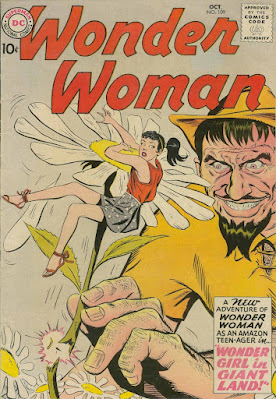
The “events” to which my title refers are all the 1959-1966 appearances of DC Comics’ original “Wonder Girl” character, whose name I will henceforth abbreviate to “WG1.” Prior to 1959, the WONDER WOMAN continuity had made loose references to the idea that the heroine had passed from childhood to adulthood on Paradise Island before taking on her costumed mantle. However, in no previous period was a younger version of Wonder Woman a frequent element of the series. But in WONDER WOMAN #105, dated April 1959, writer/editor Robert Kanigher and artist Ross Andru began making repeated use of a teenaged version of the heroine, much as the feature SUPERBOY told stories of Superman when he was a youth. WG1’s adventures were sometimes featured on WONDER WOMAN covers, while at other times the teen Amazon was just a backup to her better-established older self. Not a lot of fans, even back in The Day, were especially fond of the character, though ironically WG1 indirectly spawned DC’s second Wonder Girl iteration, and that character enjoyed considerable cachet in the TEEN TITANS series-- more on which later.


Many fans, then, would have deemed WG1 an unfortunate result of editor Kanigher’s tendency to write down to the readers of WONDER WOMAN. But it only recently dawned on me that WG1 was also “un-udderable,” in a way I can only express in song:


No boobs at all,

No boobs at all,

Double-U Gee-One

Had no boobs at all!


(Approximate melody based on a song about Fawcett’s Captain Marvel, who was said to have no “balls” at all.)


While looking through one of the WG1 stories, a question occurred to me. If one presumes that Kanigher began writing stories of a teenaged Amazon, logic would dictate that he was doing so to improve sales. Movies about the new breed of American called the “teenager” had proliferated in the middle 1950s. Such films varied between stories about “clean teens” or about adolescents with somewhat raunchier proclivities. But all teen movies dealt with youths over fifteen, meaning that the female teenagers no longer looked like kids. However, WG1, despite being called a teen, always looked significantly undeveloped.


The WG1 stories do not explicitly state how old the young Amazon is. Yet in all the character’s appearances, she goes around clothed in a very loose tunic, whether it’s some Graeco-Roman garment or a version of the famous Wonder Woman costume. Since the mature Wonder Woman was reasonably well endowed, the logical conclusion is that the creators of WG1 meant to imply that the character was too young to have significant breastitude. If Kanigher was at all consistent about deeming WG1 a teenager, the youngest she could be would be thirteen, and for some individuals this can be too young for full development.


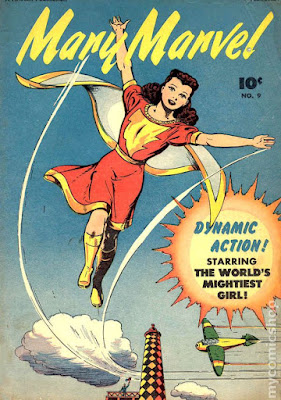
Of course, though WG1 was not technically a kid sidekick, I believe most if not all “young allies” of older superheroes were supposed to be in this same age-range. Michael Fleischer’s ENCYCLOPEDIA OF BATMAN offers evidence that Robin the Boy Wonder was supposed to be a perpetual thirteen or fourteen before he finally started aging in the late 1960s, and most boy sidekicks looked no older than Robin. Prior to WG1, there were few teenaged superheroines in comics, and the only long-lived one was Fawcett Comics’ Mary Marvel, sister of the aforementioned Captain Marvel. Mary’s age probably wasn’t stated either, but on the whole, her figure also suggested the appearance of a girl who had just recently passed into adolescence. All this circumstantial evidence suggests that the raconteurs who worked on Golden Age superheroes were convinced, probably not without merit, that most of their readers were pre-teens, and that the only ages they wanted to see represented were either (1) kids of middle school age or (2) adults, the latter embodying the fantasy of attaining temporal power. That’s also probably one reason that Kanigher decided to devote space to stories of a thirteen-year-old Amazon. The baggy clothing may have been calculated to dodge any question of the not-yet-budding youth being exploited, since a reader couldn’t even tell if she had breasts.


Of course, if you lived back in the 1950s and listened to the Abominable Doctor Wertham, all comics in all genres were replete with what the psycho psychiatrist called “headlights.” There can be little doubt that a few superheroines were especially well endowed, particularly some versions of the Phantom Lady. But most of the genres that accentuated the positive power of cleavage were those of crime, jungle-adventure, and teen-humor—the last being the only genre in which developed female teens regularly put their goods on display.


I doubt that during the middle 1950s the very conservative DC company had to clean up very much in the boobage department. Before the Code, the potential lubricity of Wonder Woman’s costume was restrained by the quasi-Classical art of H.G. Peter. After the Code, Andru and others tended to draw her as being a bit on the slender side. Most regular female characters—Lois Lane and Lana Lang (in the SUPERBOY feature) -- sported modest cleavage, while Catwoman, one of the few well-endowed DC femmes, found herself placed in exile for having drawn the wrath of Wertham. One character, Saturn Girl of the Legion of Super-Heroes, made her first appearance as a supporting character in a 1958 SUPERBOY story, and in that story she barely appears to have any tits at all. However, once the idea of the Legion earned some plaudits from the readers, Saturn Girl’s second appearance gave her a better costume and cleavage about the same as that of Lois and Lana. But then, she, unlike WG1, was supposed to be at least fifteen. On a side-note, though the lady Legionnaire’s first appearance predates that of Kanigher’s WG1, neither Saturn Girl nor any of her compatriots appeared in a regular feature until 1962.


In any case, there’s some irony in the fact that WG1 was the first teen heroine of the 1950s to appear on a semi-regular basis, for she only appeared on newsstands about a month ahead of ACTION COMICS #252, dated May 1959. The first version of Supergirl is explicitly said to be fifteen, a topic which comes up when she auditions to join the Legion of Super-Heroes. (In a twist typical of the period, the heroine washes out when she temporarily becomes an adult and violates the group’s “no one over 18” rule.) More relevantly, from the first Supergirl, unlike WG1, did have fully developed knockers, and though they probably weren’t any bigger than Lois Lane’s, the girl’s girls got a little more emphasis because of the “S” emblem she wore on her chest.


As for WG1, Kanigher had her making references to teenaged pursuits like dancing, dating, and listening to “platters.” But she was always a pale shadow of her older self, in contrast to Superboy, whose small-town background gave him a little distinction from his mature persona. So, in 1966, fading sales on WONDER WOMAN impelled Kanigher to make a show of dumping WG1 and many other wacky creations out of the comic. The gesture didn’t prevent the writer-editor from losing his access to the venerable Amazon property. Yet just as WG1 was being knocked off, her sort-of doppelganger, Wonder Girl II, debuted in TEEN TITANS.


In the first appearance of the TITANS, three kid sidekicks—Robin, Kid Flash, and Aqualad—assembled to fight a menace. Writer Bob Haney and artist Bruno Premiani made them all look like they were in the thirteen-year range, but this didn’t last long. In the group’s second appearance, WG2—who was never decisively stated to share the complicated origins of WG1—joined the group, and remained a member for the series’ initial run, and later revivals as well. Yet from WG2’s debut in the TITANS title, the artist did not follow Kanigher’s lead in terms of putting WG2 in a baggy toga. Instead she wore a version of Wonder Woman’s costume that conformed to the contours of her body. Naturally, the new character began with the same modest breasts of other DC heroines. But unlike her predecessor, her costume was tight enough to demonstrate that at least she HAD boobs.


By the end of the sixties, WG2, like both Wonder Woman and Supergirl, became better endowed. Further, Catwoman returned to the comics, and some new characters were breast-monsters from the first, like the Barbara Gordon Batgirl and the vampy Legionnaire Dream Girl. All of which just proves the non-existent adage, “You can’t keep a good--” …no, I just can’t say it. I invite my few readers to write their own bad pun.


Saturday, February 5, 2022

CROSSOVERS VS. MASHUPS

 In this essay I wrote:

MONSTERS VS. ALIENS does not qualify as any kind of crossover, though it is a "mashup," in which diverse characters with some similar aspects but also with different backgrounds are jammed together in one narrative. It might be fairly argued that all crossovers may be called mashups, but that all mashups are not crossovers.

I'm not going to advance a "theory of mashups" to go with the crossover-theory advanced in the CONVOCATION series. But for the purpose of this essay, I'll formulate a rough definition: that, unlike crossovers, mashups don't always have to feature at least one character with some established story-history. For instance, the cited example, MONSTERS VS. ALIENS, is a monster-mashup even though all four of the starring monsters appear for the first time in the movie. But it's not a monster-crossover because none of the featured characters had any established history in a previous narrative.

I reviewed the two WAXWORK films back in December 2014, but that was long before I was thinking much about crossover-theory. Whereas the heroes of MONSTERS VS. ALIENS only indirectly reference the movie-characters on which they're based, both WAXWORK films provide various incarnations of "famous monsters of filmland." What's interesting is that some of the incarnations are very generic, and would hardly count in a mashup except for the sheer diversity of their types, while a comparative few are specific enough in their references that they could be considered at least high-charisma crossovers.

In the first WAXWORK, the protagonists are menaced by assorted doppelgangers of evil entities. Two segments are devoted to generic versions of a werewolf and a mummy, and there's a climactic fight-scene in which the good guys contend with a small army of freaks, also mostly generic like zombies and vampires, though there are some very loose visual references to figures like The Invisible Man and Audrey II of LITTLE SHOP OF HORRORS. Yet there are two extended sequences devoted to the protagonists contending with both the canonical Dracula and a very fictionalized version of the Marquis de Sade-- both of whom count as "monsters" in my system. So by the terms I've used earlier, WAXWORK qualifies as a "high-charisma" crossover, even though none of the evil entities are "real."

The second WAXWORK, which includes a markedly different origin for the doppelgangers, also includes lots of generic types: more zombies (with an obvious hat-tip to DAWN OF THE DEAD), a disembodied hand, various aliens (including The Aliens), and a "ghost girl" possibly patterned on the spirit from THE HAUNTING. However, this time the "high-charisma" entities include versions of Doctor Frankenstein and his Monster, Mister Hyde, Jack the Ripper, Godzilla, Nosferatu, and a sorcerer based on the villain from Roger Corman's 1965 film THE RAVEN. To be sure, the sorcerer fits the persona of a "villain" rather than a "monster," but the others all register as monstrous presences, even though all of them, except for Frankenstein and his creation, only appear for a minute or so. 

Still, it's not hard to imagine the WAXWORK concept being done with no strong references to any established characters. Had this been done, the movies would not be crossovers, only mashups, like the one seen in the Mexican kiddie-film TOM THUMB AND LITTLE RED RIDING HOOD-- though that film is a "hero-crossover" because of the teamup of the titular fairy-tale protagonists.

Friday, January 28, 2022

LIMITED AND LIMITLESS CREATED HE THEM PT. 4

My last post (for now) on the subject of the limited/limitless dichotomy concerns a certain irony about the many concepts of archaic myth. On one hand, this sort of authorless myth is the essence of literature's combinatory mode, in that its unknown creators allowed their imaginations to roam freely in spawning stories about the Earth being formed from the bones of giants or giant bird's-eggs. And yet, the most developed forms of myth are also grounded in the world of limitations, as the mythmakers often invoke what I call "epistemological patterns," which are based in observations about the ways of human psychology and sociology, and of the ways of nature both in cosmological and metaphysical aspects.

As seen in my paraphrase of passages in Susanne Langer's PHILOSOPHY IN A NEW KEY, the author disparaged the humbler forms of folklore in favor of her idea of myth-stories:

...the psychological basis of this remarkable form of nonsense [the fairy tale] lies in the fact that the story is a fabrication out of subjective symbols, not out of observed folkways and nature-ways [in "myth," with which Langer contrasts fairy tales].-- Susanne Langer, PHILOSOPHY IN A NEW KEY, p. 173.

In subsequent essays I've remarked that I have found a great deal of mythicity-- i.e., storytelling tropes linked with epistemological patterns-- in folktales and fairytales as well. Langer's not totally wrong, though, because full-fledged myths tend to develop their myth-ideas more thoroughly than do folk-stories. In a strange anticipation of the "high art/low art" dichotomy mentioned in this essay-series' first installment, myths were canonical "high art" and the tales were the "low art" that few cultures sought to preserve. 

Yet while modern "high art" does reference epistemological patterns as well, it does so with what Frye calls "high seriousness" as well, which often (though not always) obstructs the free flow of the imagination. In contrast, modern "low art," even though its basic form is comparable to that of simple-constructed folktales, demonstrates a greater tendency to develop its myth-ideas freely. This probably comes about because modern low-art stories are no longer being crafted for an oral audience, and so the raconteurs are more likely to weave together simple plots with involved myth-ideas-- one example being the delirious Origin of the Golden Age Hawkman.


LIMITED AND LIMITLESS CREATED HE THEM PT. 3

 My recent discourses on "the limited and the limitless" aspects of creative expression reminded me of a passage from Northrop Frye. I discussed it in greater detail in this 2009 essay, but here I'll confine myself to looking at the passage from a new perspective.

...all critics are either Iliad critics or Odyssey critics. That is, interest in literature tends to center either in the area of tragedy, realism, and irony, or in the area of comedy and romance... Many of our best and wisest critics tend to think of literature as primarily instructive... They feel that its essential function is to illuminate something about life, or reality, or experience, or whatever we call the immediate world outside literature. Thus they tend... to think of literature, taken as a whole, as a vast imaginative allegory, the end of which is a deeper understanding of the nonliterary center of experience... They value lifelike characterization, incidents close enough to actual experience to be imaginatively credible, and above all they value 'high seriousness' in theme...-- Northrop Frye, "Mouldy Tales," A NATURAL PERSPECTIVE, pp. 1-2.

Frye brackets two of his literary mythoi, tragedy and irony, as having appeal for the "realist" critic, while the other two, comedy and romance, are the preference of the "romantic" critic. In the essay Frye's principal distinction between the "Iliad critic" and the "Odyssey critic" is that the latter reads the narrative to enjoy the story for its own sake, while the former is looking for an "imaginative allegory" whose purpose is to illuminate "the immediate world outside literature." 

Frye doesn't precisely formulate a reason as to why the Iliad critic seeks his illumination in two of the four mythoi, irony and the one I've renamed "drama."  Nor does he do so for the Odyssey critic with respect to comedy and the mythos I've renamed "adventure." But I believe the essential contrast is that between "the happy ending" and "the unhappy ending." The Odyssey's denouement is moderately "happy," insofar as Odysseus, despite many ordeals and lost years with his family, succeeds in his goal to return to his homeland and to be reunited with his wife and son. In contrast, The Iliad concludes with Achilles yielding the dead body of slain Hector to his father, an outcome that looks forward to the fact that in the greater continuity Achilles too is doomed to perish before the walls of Troy come tumbling down. The Iliad fills the reader with an awareness of the dramatized limitations of life, and while The Odyssey is not unaware of those curtailments on freedom, the adventurous elements of the journey fill one with a sense of limitless potential, in that a mortal hero has managed to survive against the ill will of the gods.

Though I didn't address the limited/limitless dichotomy in my four essays on THE FOUR AGES OF DYNAMIS, the fourth essay touches on similar territory.

Now, as it happens, in arranging the four mythoi, I followed Frye's season-based arrangement, which to the best of my recollection did not involve Ovid's "four ages." In the first two FOUR AGES essays, I said that the *dynamis* of each mythos compared well with one of the "ages of man:" child, adolescent, mature adult, older adult. Thus I perceive that even though adventure is "serious" in terms of how its readers are expected to invest themselves in the character's struggles, it is a "light seriousness" that canon-critics do not regard as covalent with their "high serousness." Adventure-stories, while they may not involve adolescent characters, are often regarded as adolescent in nature because they tend to have happy endings, no matter what sufferings their characters may endure  to reach said ending. Not all works within the dramatic mythos have unhappy endings, of course. But critics tend to prefer dramas because there is a certain expectation of a stronger chance for a dolorous, and therefore more bracing, conclusion to the story. Thus dramas meet the critic's desire for high seriousness.

With the two "mythoi of levity," comedy, more than irony, still allows for more identification with its characters than does irony, and thus comedy also shows a predilection for happy endings. Though the phrase "light comedy" does not apply to all comedies across the board, it suggests something of the attitude that the Iliadic critic has toward comedy in general: there's still enough of a tendency for viewers to invest in the characters' fates and to want to see said characters validated to some degree. This is not true of the irony, for the creator of the irony has, so to speak, turned up the dial on his levity-making machines until everything in the story floats free of any readerly attachment. Again, some ironies-- such as Voltaire's CANDIDE-- may have relatively "happy" endings in comparison to other, more relentless ironies. But there is no sense, to paraphrase Frye, that the world has been reborn by a ritual of jubiliation: if anything, even the worlds with relatively happy endings are doomed, just as "older adults" are doomed to end their days and their experience of the ongoing world.

Thus, this current rethinking invalidates the verdict of the GRAVITY'S RAINBOW series, in that I would now opine that both adventures and comedies show a greater tendency toward encouraging reader identification than one sees in dramas or ironies. To pursue the metaphor of the four ages once more, it's as if the comedy and the adventure allow for the most identification because their characters were designed to be triumphant, while the drama and the irony are designed to allow the reader to pull back from the characters, even if for very different reasons.

One more installment to go...


Thursday, January 27, 2022

LIMITED AND LIMITLESS CREATED HE THEM PT. 2

 The main deficiency of my "realism/escapism" dichotomy mentioned at the conclusion of Part One can be found in this sentence from THEMATIC REALISM PART ONE:

By contrast, a tale like Coleridge's MARINER, or (to give a superheroic parallel to the JLA tale) WATCHMEN, are clearly tales that are much concerned with analyzing the ways mortal men deal with the moral elements in life, no matter how fantastic their situations. 

I stressed the "moral elements" in that essay because I was following up on certain remarks by Samuel Taylor Coleridge, who was of course not attempting to define all of literary realism and escapism, just making a particular point. But although I don't reject the particular point I made in the context of the essay, "moral elements" are not the basis of "realism." I believe I came closer to the main distinction in my 2018 BOUNDED WITHIN INFINITE SPACE:


I always meant to draw some comparisons between Anaximander's apparent categories of apeiron ("the boundless") and "perata" (the limited) with my categories of freedom and restraint. Admittedly, Anaximander was addressing the origins of the physical universe, which has no direct bearing on my explanation of the universe of art and literature. For my system "the boundless" is not the physical universe-- "infinite space" though it may be-- but the universe of the human mind, as it stands in comparison to humanity's physical environment.

Morality, of course, is not a sufficient criterion, since there are any number of literary authors who scorn, or appear to scorn, any system of moral evaluation. Yet morality is part of the equation, for moral systems arise in response to the limitations of human beings and the societies into which they assemble. 

Morality can also be aligned with the concept of societal "work" as well, and in his book EROTISM Bataille explicitly contrasts productive work with all the extravagances of "play." But why do morality and societal work arise at all? Simply put, because humans are limited by what I called "physical environment," no matter how unlimited they may feel in their imaginations. The folkloric grasshopper dies because his brethren the ants buckle down and store up food for the winter. And pure mortality also renders all things mutable. "Time keeps movin' on, friends, they turn away," sings Janis, while Marilyn warbles that "we all lose our charms in the end." 

Now, what does all this have to do with the original question seen in Part One: whether or not "high art," which most persons would align with "realism" of some sort, is more or less mythic than "low art?" My basic feeling is that both literary forms have equal potential. In terms of execution, there are dozens of highly mythic examples of "high art"-- not least the greatest of them all, MOBY DICK, However, many people who attempt "high art" become preoccupied with emulating what I called (in PLAYING WITH FUNCTIONS) the "elements of work," which I compared to the "rational thinking and feeling potentialities." In contrast, most persons working in so-called "low art" are more focused on the "irrational kinetic and mythopoeic potentialities," and so these raconteurs tend to produce a greater number of works with high mythicity-- though of course there's also a larger market for "escapism," so there are more "low art" works overall than those deemed "high art."

More on these matters later, perhaps.


LIMITED AND LIMITLESS CREATED HE THEM PT. 1

On January 13 reader AT-AT Pilot helped spur a new line of inquiry by writing the following in the comments-section of TAKING STOCK OF 2021:

I keep looking at the Archetype and NUM blogs noting the titles you've rated as having good or high mythicity. I think you've mentioned that high-art films are not usually mythically potent...

I don't doubt that I've said something along those lines, and since it reminded me of my various essays on "work and play," I scanned some of those posts first. I found this section in 2019's CONVERGING ON CONCRESCENCE PT. 2:


I have to reiterate that it's always possible for an author to "dumb down" the expressive symbolism in a narrative in order to get across some limited didactic message. When an author does so, he has to some extent sacrificed "play" on the altar of pure "work" by making the narrative function as persuasive rhetoric. That said, creators who have deep reservoirs of imagination may still at times produce narratives that have the qualities of mythic play even though the authors are trying to convert an audience to some position.

This essay was not in itself a statement of principles regarding the various forms of "high art" and "low art," but I've certainly analyzed the differences between those literary categories many times over the years, and the earliest ARCHIVE essays on that theme are probably the two THEMATIC REALISM essays from 2008.

Here's a relevant section from Part One:

Coleridge's example of the Arabian Nights tale is, like the JUSTICE LEAGUE story I critiqued, not especially concerned with morals as such-- or at least, not to the extent that the ANCIENT MARINER is. Both tales are, in a formal sense, "escapist," though I note that I use the word non-pejoratively. Neither Gardner Fox nor the Arabian Nights scribe existed in a time before fiction had been used for didactic moral purposes, of course, but both stories can be fairly regarded as "vacations from morals." It is not that the protagonists of the tales do not perform actions that the reader considers "good" rather than "bad," but that there is not a true moral dialectic as such.


By contrast, a tale like Coleridge's MARINER, or (to give a superheroic parallel to the JLA tale) WATCHMEN, are clearly tales that are much concerned with analyzing the ways mortal men deal with the moral elements in life, no matter how fantastic their situations. There's nothing wrong with this kind of fiction, and I don't necessarily share Coleridge's opinion that MARINER would have been improved by lacking a moral, especially since he proved himself more than able to summon such a non-moralistic expressiveness in poems like KUBLAI KHAN. However, there is in comics-fandom a considerable prejudice toward a belief opposite to the one Coleridge expresses: that a narrative is *always* superior because it addresses specific dialectical moral issues. Not only is not the case, it can be a prejudice that falsifies the genuine polysemous quality of literature, as I'll show with another example in Part II.

And here's some similar discourse from Part Two:


I noted earlier that much of what we deem to be “real literature” can be distinguished by its thematic commitment to what Freud famously called “the reality principle,” no matter whether the narrative in question portrays a “realistic” version of the world (Tolstoy’s WAR AND PEACE), outright fantasy (Ursula LeGuin’s WIZARD OF EARTHSEA), or something between the two (Pynchon’s CRYING OF LOT 49). The same principle obtains with those works that fall squarely within the category of “thematic escapism,” which is oriented on what Freud calls “the pleasure principle” and wish-fulfillment. One may envision a middle-ground between the two categories for works that may strike a balance between these opposed themes, but it would seem beyond question that there are notable works that are polarized enough to belong far more in one camp rather than the other. 


I also stated in Part Two that both "thematically realistic" and "thematically escapist" works could be rich in mythicity, and I still believe that, though in recent years I've moved more toward aligning literary works with newer terms like "cognitive restraint" (for "realism") and "affective freedom" (for "escapism.") The aforementioned dichotomy of "work and play" has also been around almost as long as realism/escapism, and I wrote a series of three essays, whose main point I summed up in the 2015 essay PLAYING WITH FUNCTIONS:


In the third essay of the series THE ONLY DEFINITION OF ART YOU'LL EVER NEED, I started from Jung's proposition that art should be fundamentally defined as "play," but that so-called "serious art" and "escapist art" respectively would have to be separated out as "play for work's sake" and "play for play's sake."

FUNCTIONS also correlates this work/play dichotomy with my formulation of the four potentialities, but I'll put this matter to one side for the moment, in order to address some possible deficiencies in my definition of realism, and how it might be better elucidated with reference to my titular categories of "the limited and the limitless."