Featured Post

SIX KEYS TO A LITERARY GENETIC CODE

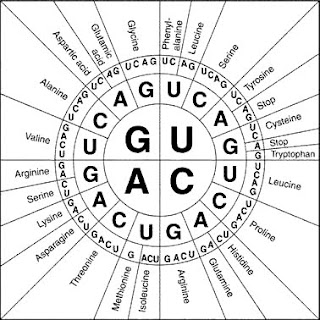
In essays on the subject of centricity, I've most often used the image of a geometrical circle, which, as I explained here,  owes someth...

Monday, March 6, 2017

QUICKIE BEAT-COMMENT #7799

I hope to write more fully about the asinine concept of "cultural appropriation" at some future time, but for now, here's a quickie BEAT-comment that may get deleted from this thread soon:

-----------------

Anyone want to "educate" me as to how Haron can claim that Asian martial arts originated in Africa? I mean, with a straight face?

But of course "appropriation" is perfectly OK when it's done by anyone but a Caucasoid.

If I were Asian, I'd be a lot more irate to think that the origins of a major part of my culture was being cavalierly ripped off, just for the sake of making common cause against non-POC. But I suppose a lot of people will buy into anything.

ADDENDUM: To her credit, Heidi did not delete my comment or that of anyone else who objected to P.C. thinking; she merely closed the thread. I love that one of the posters labeled any protests against the PC mentality  as "false outrage" and associated all such outrage with Donald Trump. Way to have an open conversation, all right-- and in the same spirit, Heidi said that all anti-PC posters ought to "check their privilege." Once again I'm reminded of more than one guest who appeared on the happily defunct Larry Wilmore show, claiming that they wanted to "have a conversation" about race. The tenor of their remarks, like those of Heidi, reveal that they didn't want to "have a conversation" any more than Heidi does: they wanted, and she wants, purely to "win the argument."

Still not as vapid and as prone to prevarication as Berlatsky, though...

Saturday, March 4, 2017

DEMIHERO RALLIES

I've been giving a little thought recently to the concepts of "monster rallies" and "villain rallies," and how often these have been featured in various media, as opposed to the more frequent "hero rallies," better known simply as "team-ups."

However, since I'm the only one that uses the neologism "demihero," denoting thereby a fourth essential literary persona there are of course no "demihero rallies" as such. They do exist, but audiences merely think of them as plain old "character crossovers."

From the 61 entries I completed on my possibly abortive 100 GREATEST CROSSOVERS OF ALL TIME, here are the ones featuring demiheroes. I'll add a comment only when the demihero persona is mixed with of the other three personae.

DYNASTY AND THE COLBYS

STEVEN UNIVERSE (hero) AND UNCLE GRANDPA (demihero)

THE MAN WHO HATED LAUGHTER (mostly demiheroes, though some of King Features' heroes, like Mandrake and the Phantom, make brief appearances)

WHO FRAMED ROGER RABBIT? (Non-toon Eddie Valliant is a hero, all the rest, from Roger to all the cartoon revivals, are demiheroes)

FONZIE AND MORK

SIMPSONS AND FUTURAMA

DREAM-QUEST OF UNKNOWN KADATH (mingles demiheroic protagonists and monstrous entities and settings)

ARCHIE BUNKER AND MAUDE

More on this subject later, possibly.


Thursday, March 2, 2017

MYTHCOMICS: "LOIS LANE'S SUPER-DAUGHTER" (LOIS LANE #20, 1960)


This story was actually the second in a series of two imaginary "what if Lois married Superman" stories, which ran back to back in issues 19 and 20 of the LOIS LANE magazine. I presume from this that editor Mort Weisinger accepted an initial pitch for both stories, instead of choosing-- as he sometimes did-- to wait awhile to gauge audience interest. There may have been a sequel or two that followed, but these two were produced so as to be read back-to-back.

The first story from #19, "Mr. and Mrs. Clark (Superman) Kent," however, is not as symbolically resonant as the second one from #20, though both stories were written by Jerry Siegel and drawn by Kurt Schaffenberger. "Mr. and Mrs" is not much more than a "beware what you wish for" homily. Superman marries Lois Lane, thus supposedly fulfilling the dream she's cherished since she first met him (at least in Weisinger's universe), finds out her dream isn't all it's cracked up to be, for in public she's simply the wife of the hero's alter ego Clark Kent. The fact that he's Superman is of course kept secret from the populace, so that no one-- especially Lois' longtime rival Lana Lang-- knows that the superhero is off the romantic market. It's a pleasant enough story, but "Lois Lane's Super-Daughter" strikes a deeper chord.

About three years after this story appeared on newstands, Betty Friedan's THE FEMININE MYSTIQUE was published. Building on material the author had gathered during the late 1950s, Friedan sought to make clear that modern American women had become desperately, symtomatically unahppy due to the imposition of a "mystique" upon their lives; one that kept them from fulfilling themselves as rounded human beings. MYSTIQUE was a major influence upon Second-Wave feninism from that time on. But Jerry Siegel's "Super-Daughter" presciently taps into some of the same discontents, though obviously it does so within a juvenile context, and within the context of a continuing superhero melodrama.

A few fans of Silver Age Superman have wondered why, after Superman's cousin Supergirl appeared on Earth in 1958, he didn't "man up" and adopt her in his identity of Clark Kent. I don't think the question was formally addressed in the actual continuity, and I'm sure that the proximate reason the character did not do so was that his editor and writers didn't want him playing Adoptive Daddy in every story. But there was still a kernel of logic in Clark's reticence, for during this time-period social services personnel generally took a dim view of single men or women adopting children of any age. Given this state of affairs, having the teenaged Kryptonian placed in an orphanage to seek adoption by a bonafide married couple-- which eventually does transpire-- doesn't strain my credulity.

What's interesting from the story's beginning is that the moment Clark and Lois are married, Clark springs it upon her that he'd like them to adopt this teenaged cousin that he's never mentioned before.


Lois looks a little bit poleaxed by this revelation, but she's married "for better or worse," and when the adoption agency complains that she might not be able to handle a new child and a job, Lois does what anyone in the period would deem The Right Thing.


Keep in mind that this Lois is not the fire-eater from the Golden Age. Though it would be absurd to assert that the Lois character was thoroughly consistent, since her moods could fluctuate according to the needs of a given story, it is at least part of Weisinger's conception of Lois that she has an irreducible domestic side to her personality. Mort Weisinger may well have been the sort of man whom Betty Friedan criticized for wanting women to become wholly domestic once they became wives. Nevertheless, for the time, the demands of the adoption agency seems not unusual, and the strength of Siegel's story is that one does see certain disadvantages to the world of domestic bliss.

True, there's almost no trace of mother-daughter bonding in the story, except for minor scenes like this one:


But it probably would have been a little beyond Siegel's skill-set to be THAT attuned to the ways of modern women, and besides, the main thrust of the story is all about Lois's discomfort with this perky intruder who's been thrust into her domestic world before the former lady reporter has even had a chance to get used to her new husband. The problem is only aggravated by the fact that both Lois' husband and her de facto daughter belong to a world of super-powered endeavors to which Lois cannot aspire. Here's one of the tandem "super-feats" to which Supergirl alludes on the cover of #20:


Worse by far, though, is that Supergirl's powers make Lois's function in the household irrelevant.


There's an exquisite irony in this setup that I wonder if Betty Friedan could have appreciated, even without the fantasy-content. Lois sacrifices the "exciting life" she enjoyed as a girl reporter, but her reward is to be marginalized within the household that is supposedly her domain. Yet through it all, Lois masks her pain, a veritable Stella Dallas of the comic books, an icon of maternal martrydom. Yet, where Olive Prouty's character accepts her marginalization, Siegel's Lois manages to manifest her hidden hostility in one of the most roundabout ways ever conceived, even in a Mort Weisinger comic book.


Yes, that's right: not only does Lois "just happen" to whale on the backside of a robot who looks just like Supergirl in her secret ID, a snoopy women from the adoption agency literally invades Lois's private home just in time to catch Lois in the act of unleashing her fury at the (first) unwanted intruder. I particularly enjoy how tearful Lois is in the story's final panel, perhaps revealing just a touch of the schadenfreude she may be experiencing from Supergirl's "unhappy ending." Will Lois ever make things up to Superman? Well, maybe or maybe not, but either way, she won't have a fifth wheel getting in the way.

I should note that though a fair number of stories from this time-period contain hints at some sexual stirrings between the two super-cousins-- particularly "Superman's Super-Courtship"-- "Super-Daughter" actually works just as well without any such elements of sexual transgression as it would with it. I could see the story entering new terrain if it were ALSO about a nubile young adoptive daughter nudging out an older wife from the affections of the adoptive father. But mythically speaking, the story works quite as well as a melodramatic-- as well as comical-- look at the marital disadvantages of a former working woman in the era of the Comic-Book Silver Age.

Wednesday, March 1, 2017

LOIS, MANSPLAINED

Since I remarked in the previous essay that I thought Lois Lane was a more intrinsically "mythic" figure than Jimmy Olsen, I'll provide a little justification of that statement here.

In the first official "mythcomics" post here, I only touched upon the significance of Lois Lane in passing, but I've noted elsewhere that she's highly significant as the "chosen bride" of Jerry Siegel's "Christ with Muscles," no matter how far in the future their unison might take place. This 2014 essay provides a refutation to Noah Berlatsky's rhetoric of victimization-- i.e., that Lois was always being maltreated by the main hero-- and shows that, even though she had her share of faults, she was on the whole an admirable character, and something of a "tough cookie" for her time.


In the next day or so, I'll devote a mythcomic essay to one particular Lois tale, and it comes from DC's long-running LOIS LANE comic book, which presented a somewhat different version of the character. Whereas the comic-book Jimmy Olsen was strongly modeled on the radio/television character-- even if comics-Olsen showed some significant departures-- Lois seems to have been remodeled less with reference to the "Adventures of Superman" TV show and more in line with what editor Mort Weisinger thought would sell to his readers. There's a fair amount of anecdotal evidence to the effect that SUPERMAN'S GIRL FRIEND LOIS LANE was more oriented toward female juvenile readers, and even though all of the raconteurs on the title were male, it seems a safe bet to say that they re-modeled Lois in line with their perceptions regarding feminine soap-opera, albeit adjusted for a juvenile audience. If Lois had held on to any of her streetwise toughness and courage during the period when Jerry Siegel was drummed out of the DC ranks, that last remnant of that previous characterization was well and truly gone by 1958, when the magazine was launched (following a tryout in the SHOWCASE magazine, by the bye). Lois wasn't seen to slug anyone, as in the panel above, until about 1966.

Perhaps because Lois, unlike Jimmy, was viewed as a full adult, there are more adult concerns in the stories, albeit filtered through a juvenile lens. Many of the stories are just as silly as the ones in the JIMMY OLSEN title, but there is a greater propensity to allude to Lois as a mythic concatenation of womanly traits. This often reflected negative characterizations typical of men's humor, like accusations of overweening feminine curiosity-- but even these retain a certain larger-than-life quality. In the remainder of this essay, I'll briefly touch on some of these myth-kernels, though with the caveat that nearly none of them qualify as mythcomics.

Though the character of the Weisinger Lois was a little too hard-nosed to go in for occult matters, I find it symbolically significant that the first issue of her series attributes to her a "witchy" power. Note Superman's apparent fear of having his powers surpassed.


Here's the first of many issues in which Lois is "body-shamed" in some way. Some find these sort of tropes to be representative of the whole series, which is certainly throwing out the baby with the bathwater.


Though Lois isn't really any sort of tough jungle-babe in this story, it's amusing to see her take a leaf from the book of Sheena. Some will recall that Sheena preceded Superman in being the first major comic-book character published, even though the jungle-queen's sales didn't take off until after the Man of Steel became a superstar.


One of the first stories really condemning Lois for the sin of curiosity. The big giveaway? Lois has the head of a cat, or rather, she thinks she does, having been given a post-hypnotic suggestion to punish her for an act of intrusive curiosity. It's interesting that the hypnotist in this case is female, though.


Weisinger recycles a trope used by Siegel in an earlier story, in which Lois was supposed to get powers from a super-blood transfusion.


Jimmy Olsen's relationship with Superman never lent itself to stories like this one.


Second of a two-part story in which Lois marries Luthor and spawns an evil son. However, he later marries into the family of Superman and Lana. Ah, if only Weisinger had edited Greek plays!


"The Snoopiest Girl in History" reveals that Lois traveled in time and gave rise to the legend of Pandora.


Lois again travels in time, gets stuck on Krypton, and decides it's a good idea to steal Superman's father from Superman's mother. Only at the end of the story does she realize that she might have ended up becoming the mother of the man she always wanted to marry. Writer Otto Binder must have been digging into his Freud the day he scripted this one.


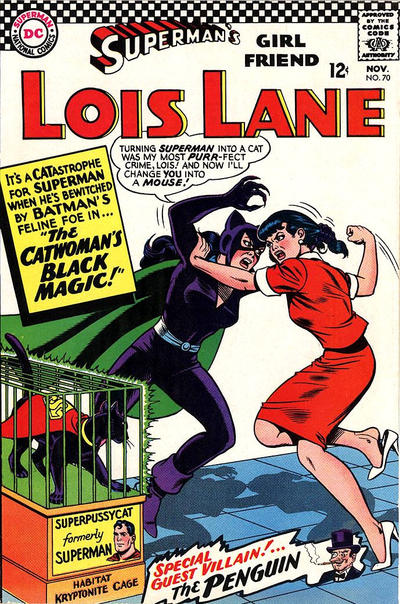
Lois has the distinction of re-introducing Catwoman to the DC universe after the villainess had been exiled for eight years, probably because of her being mentioned in SEDUCTION OF THE INNOCENT. Sadly, no actual catfight takes place between the two Golden Age icons, though Lois does get to take a walk on the wildcat side by assuming Catwoman's identity.


"Shock story of the year," indeed. It's hard to believe no one at DC knew that Joe Shuster had done not entirely dissimilar work for a 1954 skin magazine.


Aside from a reprint issue, here's the last issue edited by Weisinger. Appropriate, since she starts off as a witch and ends up as the bride of Satan.


Tuesday, February 28, 2017

NEAR MYTHS: [WOLF-MAN JIMMY], (1960/1961)

In this post I wrote:

As a matter of critical process I want to specify that I'm not simply critiquing this story's presentation of Jimmy Olsen in terms of the character's verisimilitude. If it were simply a matter of the character acting atypically in different sections of the same story, that would be simply a failure of the dramatic potentiality, which deals with the interactions of conscious personalities. What I'm critiquing is the degree to which Olsen's character is put into a mythopoeic situation-- that of transgressing on the sexual hunting-grounds of a friend / father-figure-- and then fails to follow through on that mythic potential. 

I happened to re-read a couple of JIMMY OLSEN stories published about three years after "Wedding of Jimmy Olsen," and it seemed to me that these stories came closer to "following through" on what little potential one might find in the trope of a simple character like Jimmy Olsen macking on his best friend's girl (or girls).

To be sure, Jimmy-- in contrast to Lois Lane, whom I view as a character of greater mythicity-- displays a pretty low amplitude in this regard. Jimmy was introduced by name in the SUPERMAN radio show, whose basic pattern was largely imitated by the successful 1952-58 teleseries. Prior to the major film adaptations of Superman, American audiences largely knew Jimmy, if they knew him at all, from the TV show, except for kids who read the JIMMY OLSEN comic, which indubitably came about in reaction to the show.

It's important to note that the dominant image of Jimmy from the show was that of a lovable goof, and for the most part this is the image that has remained ingrained in the minds of comic-book fans. The first three issues of the character's solo feature actually started out making him fairly competent, but I would guess that some editor clamped down on that, declaring that Olsen of the comics must be just as dorky as Olsen on TV. For most of his run-- which I discussed in this essay-- Jimmy remained a lovable goof, although with an important difference from the TV version: the character had a lot more romantic encounters in his own comic book.

I don't plan to sit down and hash over Jimmy's assorted love-connections, but I do think that cumulatively they contributed to his overall personality as a story-character. Thus, by 1960, the same fellow who wrote "The Wedding of Jimmy Olsen," Otto Binder, puts Jimmy in the position of a junior-level lothario, albeit for humorous effects.


Thus in the first of the two stories, "The Wolf-Man of Metropolis," his girlfriend Lucy gives him static about his amorousness:


Later, yielding to his tendency to do stupid things like drink untested magic potions, Jimmy becomes afflicted by a curse, causing him to change into a wolf-man at night, though unlike most fictional lycanthropes, Jimmy possesses no beastly urges. In fact, he can't even take advantage of Lucy when she obligingly dresses up like Red Riding Hood.


The second Curt Swan panel is refreshingly grim given the overall light tone of the story, though of course it's very politically incorrect today for him to muse about the unattractiveness of any woman. He does have a particular reason for so doing, though, since the curse can only be reversed by the kiss of a pretty woman. (Binder was perhaps conflating his werewolf tale with both "Beauty and the Beast" and "The Frog Prince.") Still, humor takes precedence over potential tragedy, particularly when Wolf-Man Jimmy tries to proposition a hot number to kiss him-- in the park, of course.


Superman eventually solves his buddy's problem, arranging for the cursed reporter to meet an unnamed (but presumably comely) woman in a dark room and receive her kiss. The reader later learns the female is Superman's cousin Supergirl, who alone possesses enough intestinal fortitude to suck a hairy face. At this point in time, Supergirl is unknown to the public, still being kept under cover by her avunucular cousin. A few stories, particularly this one, suggest a buried incestuous vibe between the two Kryptonians. If so, then Superman is being extraordinarily generous in pimping out his cousin in this manner. As icing on the clansgressive cake, the cover above shows two women fleeing from the Wolf-Man, who are probably supposed to be Superman's regular romantic interests Lois Lane and Lana Lang: however, Lana isn't in the actual story and Lois, who is, never sees the Wolf-Boy, though she does aggravate Lucy's suspicions about Jimmy's secret shame.


The second and last story of the reporter's adventures in lycanthropy-- scripted this time by Jerry Siegel-- doesn't seem to be as popular as the first on the Internet. It's significant that again, Wolf-Jimmy is presented on the cover as scaring the bejeezus out of a group of female characters-- respectively, Lucy, Lois, and Lana-- who are all in the story this time.

This time, though, Jimmy's not to blame for his curse. Mischievous Mister Mxyzptlk pops into Metropolis, spots Jimmy squiring around Lucy, and promptly falls in love with Lucy, just as the imp had previously gone gaga over her sister. Lucy rejects Mxyzptlk's suit by protesting that she has a boyfriend. Mxyzptlk decides to get rid of the competition in the usual roudabout way of all Superman stories from this period: he inflicts the curse on Jimmy with his magic but makes him think that he's imbibed the magic potion again.

In some ways Siegel ratchets up the comic absurdity of the "Frog Prince" trope. Again Jimmy seeks his Kryptonian pal's help. But though Supergirl imparts to Jimmy the same secretive smooch she did before, the affliction doesn't go away. In short order nearly every female character of the Superman universe at the time finds out about Jimmy's hairy problem. The result that he not only gets liplocked by his girlfriend, but also by Superman's inamoratas Lois and Lana, AND by the hero's former squeeze, the mermaid Lori Lemaris. Mxyzptlk watches them all fail, confident that Lucy will desert Jimmy in due time.


Then a strange woman appears, kisses Jimmy, and instantly reverses the curse. It turns out to be Mxyptlk's own inamorata, Miss Gsptlsnz, another magical imp from the Fifth Dimension, making her first comic-book appearance. Jimmy, having been bussed by so many hot girls in the last few days, can't help thinking a rather uncomplimentary thought about his savior.


However, this touch is also a neat reversal of the original curse's parameters, since the reversal of the pesky imp's magic doesn't depend on matching the curse-victim up with a hot girl. Everything goes back to normal and the story ends with Lucy calling Jimmy a "wolf" again, this time because he got a lot of smooches from other women.

Again I'll repeat that I'm not endowing these stories with anything more than minor mythicity, the result of some clever mucking-about with fairy-tale tropes. But to the extent that Jimmy Olsen the Character possesses even a minor penchant for mythicity-- that of the young rival to his older buddy-- these stories come closer to the mark than "Wedding." I'll also observe that I wouldn't have a problem with the earlier story if I thought that the dominant character of Jimmy was that of an unromantic klutz, like say, Dilton Doiley of the ARCHIE universe, seen here in all his glory:


Monday, February 27, 2017

NEAR MYTHS: PRINCESS KNIGHT (1953/1963) and THE TWIN KNIGHTS (1958)


Though I'm obliged to judge certain stories to be relatively undeveloped in terms of their mythicity, that doesn't mean that they aren't necessarily of societal consequence.

Take as example Osamu Tezuka's PRINCESS KNIGHT series, which began in 1953, was reworked at least three times (the 1963 version is apparently the one translated by Vertical Inc.), and given one sequel, THE TWIN KNIGHTS, about the two children of the previous series' heroine. Fred Schodt attested that before PRINCESS KNIGHT-- as the manga-series became known in the U.S.-- Japanese shojo ("girls' comics) lacked the narrative drive of the boys' comics. The franchise's entry on Wikipedia is full of many other such accolades as to the series' importance to fans, and I included a short writeup on the character here.That said, the 1963 version is extremely episodic, and I suspect that the earliest version may have rambled about even more.

If PRINCESS KNIGHT is known at all to audiences outside of both Japan and the world of hardcore comics-devotees, it's only from the 1967 animated adaptation. However, despite running for 52 episodes, PRINCESS KNIGHT did not attain the cult fandom experienced by other anime shows of the period, such as SPEED RACER and Tezuka's own ASTRO BOY.

KNIGHT begins with a strong concept. A mixup in heaven-- a heaven right out of early animation shorts-- causes Princess Sapphire of Goldland to be born with two hearts. Normally every child, even before being born, has his or her gender determined by being given a "boy heart" or a "girl heart," which imbue the child with the fixed qualities of the gender. (In Tezuka's world, then, essence does precede existence, though it will be seen that existence can radically modify essence.) As it happens, Sapphire's dual nature comes in handy, for only a prince can inherit his parents' throne. The king and queen of Goldland agree to conceal Sapphire's physical femininity and pass her off to the kingdom as a boy-- which is easier than one might expect, since Sapphire's "boy heart" gives her a macho fortitude rarely seen in average females.


That said, Tezuka is writing to a largely female audience, so he doesn't entirely want to alienate them from their desires-- whether socially created or not-- to like "girly things." Thus Sapphire is constantly alienated by her inability to do girl-things like wearing pretty dresses-- suggesting that the "girl heart," the one in tune with her actual body, is the one in ascendance.


Yet the fantasy of being able to do "boy things" is ever-present. At one point, the bumbling angel Tink succeeds in removing Sapphire's "boy heart" from her body, which will enable her to live as a full-fledged female. However, Sapphire happens to be engaged in a deadly swordfight at the time, and losing her "boy heart" saps her of her fortitude. Tink has to return that heart to her so that she can win her battle. To be sure, this isn't pure gender essentialism at work. Later in the story Sapphire loses her "male nature" and seems to win her battles as easily without it as with it-- which is where the matter of existence modifying essence comes in.


The downside of this promising concept is that Tezuka has too many irons in the fire to allow for a strong symbolic discourse. It would be contrary to my task as a myth-critic to assert that any author ought to bulldoze over his expressivity in order to accommodate some didactic theme. But I suspect Tezuka plotted PRINCESS KNIGHT somewhat on the fly, without much thought as to what was going to happen overall. Throughout most of the early chapters of this version, Sapphire's most persistent foe-- aside from courtiers who want to dethrone her-- is a witch named Madame Hell. I couldn't find an image of what she looked like in the 1953 version. But given Tezuka's stories love for all things Disney, there's not much serious doubt that the 1963 version was modeled on "Maleficent" from the 1959 animated classic SLEEPING BEAUTY. Not only does the Good Madame have the supernatural power to manifest huge thorned plants as did Maleficent, Hell even perishes in almost the same way: transforming herself into a huge beast-- this time a monstrous owl rather than a dragon-- only to be killed by a prince. Madame Hell is even more overtly affiliated with the Christian Devil, while Maleficent merely looks devilish and makes an oblique reference to "the powers of hell."


Unfortunately, Tezuka kills off Madame Hell too soon, so that for the remaining chapters he must introduce a new opponent out of the blue. Madame Hell was an indirect threat to Sapphire's relationship with her true love Prince Franz Charming, in that Hell wanted the prince to marry her daughter so that the latter would become a queen. However, this relatively mundane motivation hurt the Bad Madame's potential to be a superior villain, and once both she and her daughter perished, Tezuka had to introduce a new "Big Bad." For the final chapters of the series, the goddess Venus herself falls in love with Franz and wants to steal him from Sapphire-- thus making her the worst kind of "bad mother:" the kind that poaches on the younger generation.


I could imagine Tezuka having created a truly mythic story had he focused on one or the other of the two major villains, while continuing to use the lesser courtiers as comic foes. However, Sapphire's struggle is vitiated by the serials "and then this happened" approach. In some ways the problematic structure of PRINCESS KNIGHT and certain other Tezuka works, such as APOLLO'S SONG, may stem from the same "problem" one finds in the works of Jack Kirby: both artists were just so damn creative they sometimes overwhelmed their own narratives with "new stuff."

The irony is that a lot of real fairy-tales and romances may tend to ramble as much as PRINCESS KNIGHT does, but one can excuse that, since many of those stories descended from oral cultures.
Still, Tezuka certainly does create in Princess Sapphire a liminal figure with which many Japanese girls obviously did identify. The story is certainly not "ideological correct" enough to please many modern readers, but there are indications that Tezuka was willing to endorse feminist concerns-- at least, as long as they served the purpose of delivering an entertaining story.


TWIN KNIGHTS, on the other hand, is not nearly as wide in its scope. Years after Sapphire marries Franz, she bears twins, a son and daughter, both given flower-names (the boy is "Daisy," the girl "Violetta.") Thanks to the actions of two courtly conspirators-- whose motives are extremely hard to fathom-- the male child is exposed in the forest, only to be raised to adolescence by a magical deer. In Daisy's absence, the king and queen compel Violetta to pose as her brother so that she can take the throne, which means that she has to learn all the demands of being a boy without the advantage of a "boy heart." This is also a very rambling adventure and suffers from the lack of a strong villain. Additionally, Tezuka tosses out loads of flower-metaphors-- there are even two "flower-spirits," brothers who respectively love and hate Violetta-- but none of the symbolism comes together, and even the fated reunion of the siblings is fairly disappointing. KNIGHTS' only saving grace is Emerald, one of Tezuka's gamin-type characters, who exists to help Violetta through her exploits but is actually much more interesting than either sibling.


Thursday, February 23, 2017

JUST ANOTHER TOSS-OFF KIRBY KOMMENT

Fourth World is a good, if regrettably cut-off-too-soon,, body of work, but I don’t think of it as being “similar.” to the Marvel works. I think FW shows Kirby returning to the tropes he preferred in both his pre-Marvel and post-Marvel work: mostly balls-out pulp-action with occasional sentimental moments– nothing quite like the “epic soap opera” he worked on when collaborating with Stan Lee.
Yes, yes, Stan was no great shakes before JK and SD– although I don’t think anyone’s really fully evaluated all of his 50s work with Joe Maneely– but he was an editor first and a writer second, and Kirby’s talents were such that he needed some reining-in. I think the S&K studio provided some reins in the more realistic work– particularly the S&K romance stories, which might be the closest to Lee-Kirby Marvel in structure– but I’m just not seeing that JK could do it all alone, genius though he was.