Featured Post

SIX KEYS TO A LITERARY GENETIC CODE

In essays on the subject of centricity, I've most often used the image of a geometrical circle, which, as I explained here,  owes someth...

Thursday, September 30, 2021

THE FULL VALUE OF THE HALF-TRUTH

 The first time I encountered the following quote online, I didn't think it sounded much like Aristotle, even speaking as someone who's not an expert on the philosopher:

It is the mark of an educated mind to be able to entertain a thought without accepting it.

And sure enough, it turned out that an accurate version of the quote from the NICOMACHEAN ETHICS reads:

It is the mark of an educated mind to rest satisfied with the degree of precision which the nature of the subject admits and not to seek exactness where only an approximation is possible.

The first quote apparently comes from an early mistranslation of the ETHICS. Possibly the translator was misled by the passage dealing with the relative nature of "precision" that one can discern regarding a given subject. (For instance, the chemical composition of a particular compound can be determined with far more accuracy than the nature of a process such evolution, which can't be broken down and analyzed in the same manner.) The mistranslation seems to be an endorsement of relativity for its own sake.

Now, I believe that in philosophy one can only entertain thoughts up to a certain point before accepting or rejecting them. However, in literature, "thoughts" are not truths, but rather "half-truths" as I argued here.  "The poet never affirmeth," said Sir Philip Sidney, which I interpret as meaning that the nature of "poetry" (i.e., literature) is one that changes depending on the viewpoints of both its authors and its audiences. Art is primarily meant to be an activity of "play," no matter how often it's used to perform "work." 

Now, even though the fake Aristotle quote doesn't apply to his philosophy, it does hew a little closer to one of his pronouncements in the POETICS, where the philosopher states that the act of poetry is mimesis or imitation, and that the poet must imitate one of three categories of phenomena: 

things as they are, things as they are said or thought to be or things as they ought to be

In Renaissance times mimesis became equated with verisimilitude, with imitating "things as they are," and thus the term passed into literary history with a meaning that endorsed a form of real-world fidelity that Aristotle would never have endorsed. Whatever the philosopher preferred to read or watch on stage, he explained that the range of imitation had to extend beyond the observable world, even though presumably Aristotle would have desired some "degree of precision" even when dealing with the hypothetical, with "things as they ought to be."

In my earlier essay I emphasized the idea of "half-truths" as a form of "weak proposition," meaning that the author may be as unserious about what his narrative proposes as the audience is in entertaining the notion. Of course, some authors and some audiences can become very serious about how much a given proposition represents reality, but it can even be difficult for an author and his audience to remain on the same page. For instance, take the well-known phrase, "Hell is other people" from Sartre's play NO EXIT. Sartre himself argued that he didn't mean to give the line the connotation that most listeners got from it. Yet the listeners are not necessarily wrong in the way that Aristotle's translator was wrong. 

One key notion I argued in the cited essay was the importance of epistemological patterns to the process of concrescence in fiction. It's not that any work of fiction necessarily seeks to make definitive statements about epistemology. But in the process of any act of imitation, it's natural though not inevitable for authors to attempt buttressing their fictional works by drawing upon patterns that represent the "real world." Often these patterns are based upon propositions that the consensus-audience no longer accepts, or does not accept universally, ranging from the Oedipal theories of Freud to the 19th-century theories of "the Hollow Earth." To the audience, what's important is whether or not the author can make even the most absurd proposition "entertaining"-- and this, not real-world applicability, is what gives even the weakest of weak propositions a peculiar endurance, if not strength in the usual sense.


Wednesday, September 22, 2021

MYTHCOMICS: "THE ICEBOUND MAIDENS" (WONDER WOMAN #13, 1945)

 One of the most intriguing images in the entirety of William Marston's WONDER WOMAN canon appears on page eight of "The Icebound Maidens." The Amazon, having voyaged to Paradise Island to counsel young Amazons in facing their challenges with willpower, is assigned to do the same for "the daughters of Venus." Prior to this tale, Marston had built four stories around the planet Venus, inhabited by beautiful winged girls who, like the Earth-Amazons, worshipped love and beauty in the incarnation of the Greek goddess Aphrodite. "Maidens" is the final Marston story using the Venus-women, and this time the writer merges this myth-trope with that of an icon of Judeo-Christian belief, that of the Garden of Eden. In the Old Testament, God commands that Eden is off limits to mortals once Adam and Eve are expelled, appointing one or more cherubim to stand guard with a "flaming sword." In an audacious image, Marston's Aphrodite is seen commanding a hand with a flaming sword-- presumably a denizen of Heaven, not exactly on speaking terms with pagan goddesses-- to propel the entire Garden of Eden to a subterranean domain beneath the ice of Earth's South Pole.


To be sure, Marston has no interest in engaging in involved cross-comparisons between Greek and Jewish myth. He wanted a broad contrast between Eden, a land of life, and the frozen wastes of the Antarctic, a land of death. Aphrodite transforms one Venus girl into an Earth-female (which effectively means clipping her wings) and sends her to live in Eden, renamed "Eveland" to stress its new status as a "land of women." Providentially, the girl's name is Eve, so even if the First Man is gone from Eden, an avatar of the First Woman is still allowed to rule therein. And as the Hebrew God gave Eve to Adam for company, Aphrodite gives the second Eve a "spirit daughter" with the odd cognomen of "Eve Lectress" (a labored pun on the Greek name "Electra," more on which later). Somehow, possibly through parthenogenesis, dozens of other maidens join Queen Eve and Eve Lectress in the subterranean garden. 


But though the Eveland girls have left men out of their hortus conclusus, the ruthless male element asserts itself. Though one might expect that Eden has all the pleasures that the Venus-girls could want, Eve Lectress is lured into Bitterland, the "dark ice caves" where dwell the brutish Seal Men. Periodically the Seal Men, who cannot stand strong light, capture Eveland girls and make them work in their gardens. These gardens require blinding light to nurture the males' favorite delicacy, "pomoranges," and so the Seal Men want the maidens to toil on their behalf, even though eventually even the Eden-girls will lose their sight with these labors. The title "Icebound Maidens" refers to the fact that the cold-hearted villains literally keep a supply of replacement girls on ice for future use.


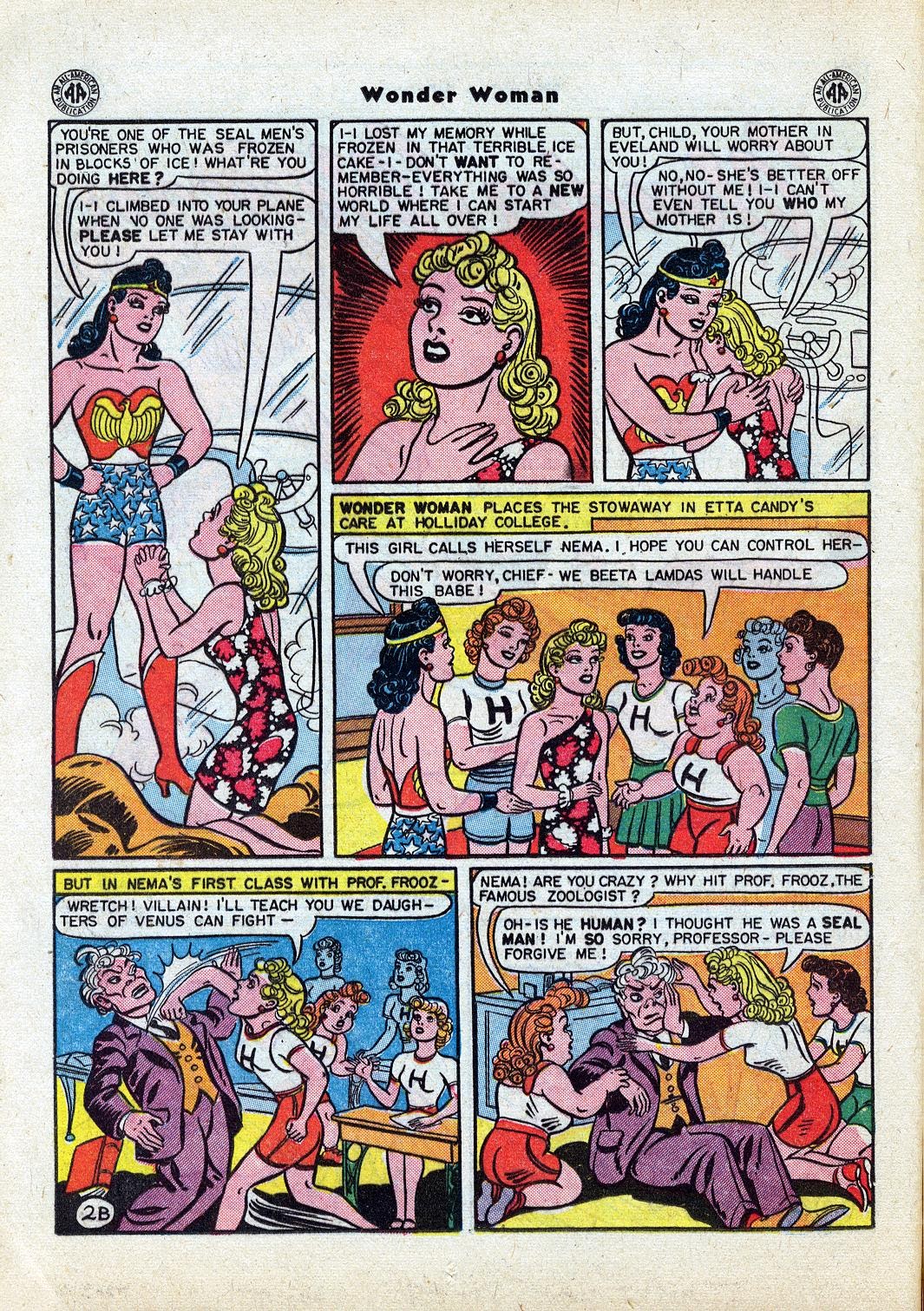
Wonder Woman ventures into the domain of the Seal Men and frees all of their prisoners, but somehow conveniently forgets about looking for Eve Lectress, nor does Queen Eve mention not having recovered her daughter. As the heroine journeys back to man's world, she finds she has a stowaway on her invisible jet: a young Eveland girl who claims her name is "Nema." The origin of this Marston-name is fairly obscure: it doesn't seem to scan well whether one compares it to "Nemea," the Greek valley from which the Nemean Lion hailed, or to the Hebrew word "amen," which is what "nema" spells backwards. Whatever the name's meaning, Nema is Eve Lectress, running away from home because she's guilty of her transgressions-- though Marston doesn't explicitly condemn her for seeking out Bitterland for unstated (maybe sexual?) reasons. 


Wonder Woman allows "Nema" to mingle with the Holliday Girls, so evidently she doesn't figure out the girl's true identity. But after a few days someone from Eveland rings up the Amazon on her mental radio, summoning Wonder Woman back to the garden. The heroine takes along all of the Holliday Girls and Nema, who still doesn't reveal her true nature to anyone. It seems that because Eve Lectress is missing, Queen Eve, acting the part of the Greek fertility-goddess Demeter, goes looking for her in the unfertile domain of Bitterland. The queen is almost executed by King Rigor (like "rigor mortis?"), the nasty lord of the Seal Men, but the Amazon rescues Eve and all other prisoners once again.


By Part Three of "Maidens" Princess Diana must have started  to feel like a bouncing ball, for a little later she'/s again forced to return to the South Pole. This time, however, it's her own ingenuity that provides the excuse. Diana has invented a "telepathograph" which has potential value to spy on the thoughts of foreign agents. (I don't know if Marston plotted the story before or after the surrender of Germany in May 1945, but it probably wasn't before the dropping of the atom bomb on Japan in July; in any event, this segment contains no explicit reference to the WWII conflict.) In any event, the new spy-device can only be tested at the South Pole, so the Amazing Amazon takes Steve Trevor to test the device.


The subject of the telepathograph gets abruptly dropped after it functions much like the mental radio, alerting WW to the fact that those Eveland girls are in cold water again. The heroine meets with Nema, who still hasn't come clean to her mother, and they go in quest for King Rigor's new captives. Steve follows, but he's caught and sentenced to work in the blinding light of the pomorange gardens. Around the same time, Wonder Woman and Nema are captured, and for some reason King Rigor is the only one who figures out that Nema is Eve Lectress with a dye-job. Rigor tries to blackmail Queen Eve into sending him a steady tribute of girls for servitude by threatening to flood the fertile garden with the destructive waters of male potency (or something like that). 


Wonder Woman escapes imprisonment and runs a scam on the otherwise clever king. When the monarch attempts to sacrifice several de-thawed maidens to the Seal Men's effigy, a fire-mouthed "walrus god," the Amazon substitutes statues for the sacrifices, and then fools Rigor into thinking she can revive the slain girls from death. This road-company Lord Hades capitulates and signs a treaty with Queen Eve, and the latter generously claims that the women of Eveland will still supply the Seal Men with their precious "pomoranges," though nothing is said about what the women will get in exchange.

Despite the references to the Eden trope in the early pages of the narrative, clearly the Demeter-Persephone myth was central in Marston's mind. While Eve Lectress has nothing in common with the most famous owner of the "Electra" name-- the daughter of Agamemnon who gave her name to the "Electra complex"-- but Marston may have known that an Oceanid named Electra was supposed to be one of Persephone's companions before she was abducted by Hades. Queen Eve never quite duplicates Demeter's feat of laying waste to the Earth while she searches for her lost daughter. Possibly this was because "Bitterland" stands in for the image of the Earth made infertile? To be sure Marston's handling of Eve Lectress's motivations is clumsy in the extreme, and I tend to believe that Marston was dancing around the possibility of Eve the Second having a fling with one of the Seal Men. Though Rigor is a standard homely monarch, he has a fairly handsome son, Prince Pagli, though Pagli and Eve II are never seen together. ("Pagli" seems derived from the name of the Italian opera Pagliacci, which means "clowns"-- and if there's any symbolism there, it went past me.) The "pomoranges" are visually modeled on ordinary oranges, which flourish in the very light that the Seal Men despise-- but symbolically, these made-up fruits are more strongly linked to the Greek fertility symbol of the pomegranate. In the Persephone myth, the daughter of Demeter makes the mistake of eating pomegranate seeds in the underworld, which means that she must return periodically to the world of Death-- during which time Demeter causes the mortal world of living things to undergo the "rigors" of winter. 

In closing I'll note that Marston's assistant Joye Murchison recapitulated many of these Persephone-elements in the 1946 story "In Pluto's Kingdom." This time, however, Pluto-Hades abducts women not to make them labor in harsh light until they go blind, but to serve as sources of light to Pluto's dark kingdom.


Wednesday, September 15, 2021

INHUMAN DESIRES


 In a recent post on RIP JAGGER'S DOJO Rip devoted a few posts to Marvel's Inhumans features and noted, "The Inhumans always proved to be a hard sell for a self-titled ongoing series."

I had made a similar observation in my review of the 1998-99 INHUMANS graphic novel by Paul Jenkins and Jae Lee:

The Inhumans were introduced in the mid-sixties by Stan Lee and Jack Kirby in FANTASTIC FOUR, and the prevailing wisdom is that they were mostly Kirby's designs. However, subsequent attempts to launch the characters in their own series were largely unsuccessful. Though personally I liked the characters, I found that they were too static and lacked a viable group dynamic. The pattern for THE INHUMANS slightly resembled the Lee-Kirby THOR. In both features, the stories alternated between a fabulous otherworld where most of the characters had super-powers, and visits to the mundane world of humanity. Yet, what worked for Thor-- a central character with a retinue of support-figures-- didn't really work for the five main characters of THE INHUMANS. One reason was that four of the continuing heroes-- Medusa, Gorgon, Karnak, and Triton-- were eternally deferential to Black Bolt, who was not only the leader of their group, but their absolute monarch, and the ruler of all the Inhumans who dwelled in the remote city of Attilan. This meant that it was difficult for writers to evoke the standard formulas of Marvel interpersonal drama.


Now, to pull at these threads somewhat, I should not that a "viable group dynamic" is not a guarantee for success. The Silver Age (roughly 1956-1970) gave rise to a larger number of adventure-teams than had been typical for the Golden Age. One of the few teams that had endured from the early 1940s until the mid-fifties was Quality Comics' BLACKHAWK, and this was the only feature that DC Comics continued, starting in 1956, after allegedly purchasing all of the properties owned by Quality once that company dissolved. It may be no coincidence that Jack Kirhy and Dave Wood initiated another team of uniformed crusaders the very next year, resulting in the CHALLENGERS OF THE UNKNOWN, which endured throughout the remainder of the Silver Age. Then within the next three-four years DC and Marvel respectively debuted JUSTICE LEAGUE OF AMERICA and FANTASTIC FOUR, which both enjoyed more long-lasting success than any team that debuted in the Golden Age. JUSTICE LEAGUE survived even though it did not originally boast any sort of "group dynamic," while the FF practically defined said dynamic. Both BLACKHAWK and CHALLENGERS, which were "old school" in terms of interpersonal drama, were gone by the early seventies. At least one of Marvel's team-books with the new emphasis on drama, THE AVENGERS, prospered. However, a good group dynamic didn't save X-MEN, which concluded its first run in 1970, even though it was resurrected to spectacular success in 1975. And of course a number of solo Silver Age characters from both Marvel and DC also pooped out by the early seventies, notably THE SILVER SURFER, which had received just as much promotion in the pages of FANTASTIC FOUR as had THE INHUMANS.


All that said, the thing that currently interests me most about the Inhumans is that Jack Kirby designed them at a point where Marvel was doing very well with most of its line, even if Kirby himself felt that he was getting the short end of the stick in a business sense. Some fan-sources assert that Marvel had some notion of launching THE INHUMANS as a full series sometime in the mid-sixties, but that this plan was dropped, so that the characters didn't get their own berth until debuting as a "co-feature" in 1970's AMAZING ADVENTURES. I tend to believe that Kirby thought the characters up without much input from Lee when the group appeared in 1965 (not counting the solo appearance of the character Medusa, who had appeared sans origin a year or so earlier). But the fact that Kirby didn't seem to have imagine any raison d'etre for these characters suggests to me that in his own work he didn't focus on interpersonal drama to the degree that Stan did. Kirby certainly knew how to evoke drama and pathos, and he probably contributed his fair share of such moments in FANTASTIC FOUR. Nevertheless, I think he did it largely because that's what his editor Lee wanted, not because the continuing "heroes with problems" was his creative preference. Indeed, most if not all of the "team-books" that Kirby did after ending his collaboration with Lee hearkened back to the "old school approach" of the Golden Age. Whether Kirby did the Boy Commandos or the Forever People, a Newsboy Legion for the forties or for the seventies, the team-members were mostly "a swell bunch of guys," which phrase was once applied to the Justice Society of the forties.

To be sure, Kirby's Inhumans, whether in the pages of the FF or in their own feature (a few of which Kirby wrote and drew), were more dour than brimming with bonhomie. But I'm not sure that anyone who followed Kirby's act with these characters ever managed to give them more complex or evocative characterizations-- even though, as noted above, Jenkins and Lee did a better than average job.


Thursday, September 9, 2021

MYTHCOMICS: "THE HORRIBLE HOUSE" (ADVENTURES INTO TERROR #29, 1954)

 Probably no trope has been as heavily used in horror comics than that of "the biter bit," where some nasty or even merely unpleasant person meets some terrible comeuppance at the hands of some monstrous entity. Most of these stories depend on a fairly simple turnabout, but this 1954 horror-tale from pre-Marvel Atlas has an extra level of complexity to it.


Unlike many such stories, there is no interest in the psychological outlook of the main character, known only as Mister Belding. The unknown author of the story, who may have been the attributed artist Al Eadeh, presents Belding as a man terrified, like many real people of the 1950s, of an impending nuclear holocaust. Belding is also revealed to be a misanthrope, who states on the second page that "I hate people! I've lived alone all my life." There's no authorial interest in how he got that way; only in his colossal ego: "If anybody survives an atom bomb attack, it should be me!" 


When he has a house built far from the cities that will be the logical targets for A-bombs, his builders give him two related warnings. One builder claims that he'll "go crazy with loneliness," but Belding claims to be immune to any need for human companionship. Another builder warns that the remote area is swampy and that it won't bear a proper foundation-- which alone ought to signal to Belding that there's a logical reason why no else lives in the area. But Belding is obsessed both with being alone and isolated from the atom bombs, so he has the house built anyway.


Unfortunately, one night Belding receives a visit from neighbors he didn't know he had. It seems that at some point someone constructed a cemetery on the swampy land, but the graves all sank into the earth and were apparently forgotten by everyone. 


The "gotcha" then transpires, as Belding's house collapses not from nuclear assault but from the instability of the marsh lands, and Belding's refuge becomes just another of the sunken graves. As an added insult to the injury of suffocating to death, Belding's conversation with the specters suggests that he won't just die and lose all his earthly goods, he'll have to put up with the company of other repulsive dead people like himself for eternity-- a hellish fate for a would-be hermit. (Though one might argue that the spectres may be things that Belding is simply imagining as he dies, which would make the tale uncanny in its phenomenality, the story would lose much of its horror if Belding wasn't about to be tormented throughout his afterlife-- and so I judge the story "marvelous.")

The last ironic twist is a character making the risible comment that the house must have sunk in accordance with Belding's wishes: that he built on the land because he wanted an "underground shelter" against the holocaust. This does raise the question as to why Belding didn't simply construct a real bomb shelter in a more dependable place, but the realistic inconsistency is what makes Belding's misanthropic mania mythic in nature. The author is not interested in a psychological study of nuclear apprehension, such as Philip K. Dick produced about a year later in his similarly themed short story "Foster, You're Dead." But in addition to giving the comics-reader his expected "gotcha-grossout," "House" catches much of the same equation between privacy and death found in this famous couplet from Andrew Marvell:

"The grave's a fine and private place,

"But none, I think, do there embrace."


Monday, August 30, 2021

NO FOOL LIKE AN OLD PRO

 By odd coincidence, just as I decided to devote a little attention to the oeuvre of Gerry Conway, I became aware that back in May of this year he'd been fulminating against manga, as covered by this BOUNDING INTO COMICS essay. The substance of Conway's rant is that he wishes Japanese manga would be taken to task for "rampant sexism and misogyny."

Some respondents to the piece were quick to point out that Conway was a hypocrite, given that he had a hand in creating one of DC Comics' most outstanding (ha ha) sexy heroines, Power Girl. 


There's a pinch of truth in this riposte, but on the whole, I tend to think that Conway only barely sexualized Power Girl in the few "Justice Society" stories for which he was responsible. I suppose she basically fits with the "titillation" category I suggested here, but the stories are just basic superhero fare, so for the most part any later hyper-sexuality attributed to Power Girl in later years is really not Conway's fault. Further, though I have not read all of Conway's work, I would tend to state that in all of the considerable number of  stories that I have read, Conway tended to "work clean." Some of his collaborative artists-- particularly Wally Wood, the co-creator of Power Girl and her boob-window-- had a strong effect on how some of Conway's stories turned out. Further, if I were to compare Conway to another mainstream work-horse like Doug Moench, my verdict would be that Moench works a lot more sexuality into even theoretically G-rated material than Conway ever did. 

But even if one agrees that Conway tended to work clean, does that in any way validate his opinion of the Japanese manga industry, beyond the level of a statement of personal taste? Any regular reader of this blog will know that my own taste allows for quite a lot of transgressive material in my reading, so clearly my answer is likely to be "no," even IF Conway had mounted an articulate campaign against sexy manga. His tweets against "sexism and misogyny" as cited in the above essay provide no examples of the things he found offensive, and in a follow-up tweet, cited here, Conway merely conflates all manga sexism with the fetishization of underage girls.

Another riposte against Conway is that, even though at one point he largely left the comics field for the greener fields of television, he's filled with envy of the way that manga has eclipsed American comics-work in terms of American purchases. This is certainly very possible, though in theory one would not be wrong in pointing a particular publisher's sins despite the success of that publisher's wares. But Conway's tweets don't even come up to the level of Frederic Wertham's fulminations, which were often misleading and poorly sourced at the best of times.

In contrast, even though I have similar disagreements with Tony Isabella for a more recent tweet on comic-book sexuality, at least his rant is more focused. This month he was apparently filled with high dudgeon because DC Comics still makes use of the character Deathstroke, whom Isabella claims to be guilty of "child molestation." This article on BIC speculates that Isabella's ire may have raised because DC is due to debut a new mini-series, "Deathstroke Inc"-- which would be the first time the popular villain would enjoy his own series since his nineties feature.

I personally have little investment in the character, beyond recognizing that he has generally proven to be an effective villain in other characters' features, though considerably less so as a headliner. His claim to fame in the "offensive sexualization" sweepstakes is clearly his dalliance with the underaged psycho-villain Terra in NEW TEEN TITANS.


I thought the original sequence was nothing special. During their lauded NEW TEEN TITANS gig, creators Marv Wolfman and George Perez had put forth a number of stories in which Evil Older People attempt to take advantage of Pretty Younger People, whether in a non-sexual sense (Batman constantly bullying Robin) or in other sexual scenarios (the Greek god Zeus attempting to seduce Wonder Girl). It's my opinion that when Wolfman and Perez depicted, somewhat obliquely, a relationship between forty-year-old Deathstroke and fifteen-year-old Terra, the creators were just flogging a new version of a clansgression-trope they'd been using to good effect. I don't remember that in the day the storyline became a huge controversy, but in any case, it's now become enough of a hot button issue that some DC raconteurs even rewrote the story to elide the offensive material. 

Isabella's rant, though more focused, is not any better articulated than Conway's. Even though Wolfman and Conway presented Terra as both violent and demented, current politically correct fans have tried to eradicate any sense that she might be responsible for her own actions. The relationship, whatever it was, must be entirely the fault of the older man. To be sure, Isabella himself does not demand that the character should cease to exist, the way Conway would apparently like to see all manga scourged of their transgressive content; Isabella seemingly just wants to make sure Deathstroke doesn't star in any new series. Surprisingly, Isabella doesn't make an issue, as does Conway, of a deleterious effect on young readers, though I would not be surprised to find that to be one of his considerations.

The thing that both of these "old pros" have in common is the notion that comics in general ought to be held to the standard of the mainstream industry for which they have worked. Unlike a lot of the Journalistas of decades past, I personally can appreciate the need for a "G-rated" mainstream, and I've not been especially sanguine about the virtues of underground comics and their "let it all hang out" aesthhetic. But as far as I'm concerned, the genie got out of the bottle as soon as the American comics-medium became inevitably focused upon older readers. Some of these readers may yearn for the simple G-rated comics of their youth. But sex sells as much to them as to anyone else, and if current comics have any advantage over current Hollywood, it would be that the former can still occasionally do good stories (as well as bad) with transgressive sexual subject matter-- which I may define a little more extensively in a future essay.

TENDER LOVING SADISM PT. 2


The NAGATORO manga I examined in Part 1 is more nuanced in its depiction of psychology than your average goony manga-comedy. That said, an analogous series like Naoshi Komi’s NISEKOI engages with the subject of female-male sadism in ways that are both more complicated and more complex (which are not the same). Three particular stories stand out as relevant to this topic.


The introductory tale, “The Promise,” establishes a sketchy background for male protagonist Raku Ichijo. Raku, who has just begun his first year of high school, lives on an estate with his father, the head of a Yakuza mob, and with several other male Yakuza who don’t seem to be family relations as such. I say “sketchy” because according to the English translation Komi makes no comment as to the disposition of Raku’s mother, who’s only revealed to be living in America late in the series. The translation says nothing about whether Raku’s parents are divorced or separated, though the former seems more likely since the two remain in separate worlds at the story’s conclusion. The mother’s absence becomes relevant in that Raku, who wants nothing to do with the violent activities of the Yakuza (comedic though they are in the narrative), has assumed a quasi-maternal role in the house. Since he doesn’t like fighting, Raku’s become an expert cook and serves his Yakuza brethren all of their meals. The gangsters insist that some day Raku will assume the “capo” status of his father. Raku repeatedly denies that he will do so, fretting, “How come I’m always surrounded by violence? I look forward to the day when I can leave it all behind and lead a peaceful, quiet life.” 

Sensible as this desire may be, it would have made Raku a very dull subject for his creator. Thus he’s flung into a new conflict in high school, which ensures that “my life became an even worse never-ending struggle!” Late-arriving first-year transfer Chitoge Kirisaki bounds into Raku’s life when she vaults the wall around the high school and accidentally knees Raku in the face. The two teens repeatedly quarrel with one another, with Chitoge insulting Raku for being an unmanly whiner. His purported unmanliness becomes underscored by the fact that the model-gorgeous Chitoge is also a superb athlete who does not hesitate to knock Raku’s block off when he insults her. Then Raku learns that Chitoge, half-American and half-Japanese, is the daughter to the head of an American gangster organization that’s moved to Japan. To prevent Raku’s Yazuka and Chitoge’s gangster-group from fighting with one another, the respective heads of the two gangs convince their offspring to fake a love-connection. Further complicating Raku’s life is that he already pines after Kosaki, a fellow student he’s known for years, and though Kosaki feels the same way toward him, neither has been able to get up the nerve to confess their feelings. Ergo, more “never-ending struggle.”


Naturally there would be no story if Raku and Chitoge did not develop feelings for one another, despite her tendency to lose her temper with him. Yet though Raku never becomes physically tougher, he does often end up playing the typical male role of the rescuer, particularly since Chitoge loses her nerve when confined to any dark or confined place. More wacky complications ensue when other girls become drawn toward Raku—principally Chitoge’s bodyguard Seichiro and Raku’s “family-arranged fiancée” Marika.


The second story for consideration is “Transformation,” occurring at least one year later. By this time Chitoge has become consciously enthralled with Raku’s ordinary-guy charms but she hasn’t confessed her feelings. Raku feels some degree of attraction to all four members of his “harem,” but he steadfastly believes that Kosaki is the girl for him. On New Year’s Day Chitoge gets together their whole “gang”—Kosaki, Seichiro, Marika, Raku’s friend Shu and Kosaki’s friend Ruri—and they all barge into Raku’s house to celebrate the New Year. (Some Yakuza are around but they’re kept off to one side and don’t actively participate in the story.) All the girls get drunk on “whiskey bonbons,” and all except Ruri become erotically charged toward Raku. In fact, Chitoge threatens to beat him up if he doesn’t kiss her. Then there’s an intentionally ambivalent scene in which the four girls gang up on him—though the reader doesn’t see what they do to him, while Raku himself blocks out the memory of the incident. Since the reader has repeatedly been assured that the four teenagers are all “good girls” at base, it’s unlikely that anything more than an osculatory assault took place. But this speaks to the fact that the “rape of Raku” proves amusing, as it (almost) never would with a female protagonist, specifically because male rape by female is so improbable.


At the time of “Test,” it’s still only been “over a year” since the beginning of the false love. Chitoge considers confessing her infatuation to Raku, who remains clueless that their fake relationship has become real to the both of them. Though he’s spent much of that year being clobbered by the irritable Chitoge, he seems to have accepted this fate as the consequence of dating a “gorilla girl.” Here he voices a fairly rare complaint about his status as her punching bag: “we've been through a lot.... like you hitting me… and hitting me… and hitting me.” This provokes Chitoge to claim that “it was your fault all of those times,” and Raku replies that, “I’m pretty much totally defenseless.” To be sure, the above translation deviates from the official one, but I choose to believe that the latter translation is closer to Komi's thought, since it's funny to see a boy talking about being defenseless before a girl’s anger. Further, as with the “sort-of rape” in "Transformation," it would not be amusing were the genders reversed. Raku almost sounds like a masochist, though it might not be unfair to state that he has some submissive characteristics. Oddly, though, Chitoge defers to him to function as the “leader” of the group, particularly during the events examined in the long arc I’ve entitled “Limit.” And Raku does end up (SPOILERS) becoming the new head of the Yakuza sect, which he somehow makes over into a law-abiding organization. One might say that his ability to accept the chaos of Chitoge in his life makes him better suited to deal with all other forms of cultural chaos.

In any case, though these three stories don’t plumb the full depths of Komi’s take on the male-female power dynamic, they are among the most crucial for seeing how Komi both deviates from and reinforces gender tropes. 

Friday, August 27, 2021

TENDER LOVING SADISM PT. 1

 I've taken on many ambitious projects on the ARCHIVE over the year, but one project I'll never attempt is to figure out the role that fictional sadism plays in Japanese pop culture, even though I've often pointed examples of manga that were particularly engaged with this psychological concept. Still, I can point out some interesting variations on the theme.

I've finished a still-in-progress manga with the wordy title of PLEASE DON'T BULLY ME, NAGATORO, in which a minor form of sadism is used as a means of improving a potential romantic partner's intestinal fortitude. The premise begins with second-year high schooler Naoto, an extremely withdrawn young man who loses himself in the school's art club-- of which he's the only member-- in order to avoid engaging with his peers. His life changes, largely for the better, when a first-year student, a girl named Nagatoro, notices him and makes her mission in life to constantly torment the fellow, constantly insulting him for being a "virgin" and committing minor acts of physical abuse on Naoto's person.

Given that Nagatoro is a comely damsel despite her aggressiveness, Naoto is not entirely unhappy with her bullying. Even though she's being sarcastic when she calls him her "senpai"-- allegedly her superior in age and stature, with her being his "kohai"-- she brings Naoto out of his shell, sitting for him as his model so that he stops painting safe subjects like flowers and fruit. As of this writing the relationship is still in flux, with Naoto asking Nagatoro on their first date. But one particular episode is worth examination.

Because Nagatoro is one of the "cool kids" at the school, some of her female friends become interested in making fun of Naoto as well, though not with Nagatoro's personal motives. Since Nagatoro constantly calls Naoto a "pervert," the other girls in her pack do the same but with a significant difference.


In the story "Senpai is a Quiet Pervert," Nagatoro's peer calls Naoto a "herbivore," meaning that he has no sexual nature whatever. Nagatoro is quick to correct this misimpression:


The two girls argue, and Nagatoro offers to prove her judgment of Naoto's "quiet perversion" by searching out one of the erotic manga he keeps in the art room. Naoto alone knows that though he has an erotic manga nearby, it's not in the art room, so Nagatoro's quest is doomed to failure. But because he'd rather be thought a sex-obsessed loser than a sexless loser, he covertly gets hold of the manga and brings it into the art room-- thus supporting Nagatoro's vision of him.


It's not clear as to whether Nagatoro realizes what Naoto has done, but either way, she doesn't spare him her scorn. But in comparison to the opinions of the other girls, Nagatoro's insults will in future act as a goad, encouraging him to take a shot at finding a non-manga girlfriend.