Featured Post

SIX KEYS TO A LITERARY GENETIC CODE

In essays on the subject of centricity, I've most often used the image of a geometrical circle, which, as I explained here,  owes someth...

Showing posts with label coordination and subordination. Show all posts

Monday, December 6, 2021

STALKING THE PERFECT TERM: ENTER PRIMES, EXIT COES

 In SUBS AND COES PT. 1, I wrote:


While cogitating on the possibility that centricity might be described through some better metaphor, I meditated a bit on Jung’s use of the term “superordinate.” Since this word is  defined as  “a thing that represents a superior order or category within a system of classification,” it seemed to apply to my idea of a centric will that was simply a given of the author’s whim, rather than through intra-textual discourse.

I believe I had already used "superordinate" loosely in previous posts, but while researching the opposite term "subordinate," I came across the grammatical terms "coordinate and subordinate." In a half dozen posts I used these terms to describe "centric" and "eccentric" presences in a narrative, while using "coes and subs" respectively as terms for the presences themselves. However, as I started playing around with evaluating types of narrative ensembles, I found that the term "coordinate" just didn't work for repeated usage, and so I started to employ the terms "superordinate" and "subordinate" for the two types of ensembles, as I did here.

However, now that I'm about to delve into an involved analysis of the crossover-phenomenon, I still need short and pithy terms for the different types of presences, and while "subs" still works for "subordinate presences," I'm not about to call the superordinate presences "soups" or anything similar. So I'm arbitrarily reaching into synonym-territory, to wit:

SUBORDINATE PRESENCES are still SUBS.

SUPERORDINATE PRESENCES are now PRIMES.

The necessity for short, pithy terms for these narrative constructs will be apparent as I begin the crossover-project proper. First up, though, a working analysis of narrative itself.


Tuesday, October 8, 2019

HOW WEAK IS TOO WEAK? PT. 3

At the end of the second part of HOW WEAK IS TOO WEAK, I said:

In a future essay I'll develop further the notion that leadership sometimes engenders the privilege of combative status-- but also, sometimes not.

Given that I started this series talking in part about the sixties animated series JONNY QUEST, it's natural that one of my examples of a leader who does have combative status-- despite not being all that dynamic-- is Benton Quest of the same series. (I'll pass on making any judgments of later iterations of the franchise.)

First, like Benton's son Jonny, the scientist takes a back seat to the hyper-dynamicity of bodyguard Race Bannon. The good doctor is never seen fighting hand-to-hand, and is only occasionally seen using a pistol or rifle.


Clearly he can use a more exotic form of weaponry when pressed--


And he even creates weapons that can take out giant eye-robots.


So, even though Benton's not seen kicking a lot of ass, he contributes considerable dynamicity to the ensemble.

In contrast, there's the portentously named Commander Adama of BATTLESTAR GALACTICA.


Despite his being theoretically in command of the "battlestar" and of the entire stellar wagon train it escorted, Adama always seems generally removed from the action whenever the Cylons attack. I'm not going to say that he never gives a crucial command in a given narrative. However, the entire attitude of the GALACTICA production frames Adama as a figurehead-- which is perfectly true, in terms of actor Lorne Greene's star-power compared to the appeal of his less-known co-stars. Further, Greene had become internationally famous for playing Ben Cartwright for fourteen years. and though Daddy Ben did his share of fighting and shooting alongside his sons, the Ben Cartwright character became invested with a paternal gravitas-- which is almost certainly what the GALACTICA producers wanted from Greene. In contrast, all the action is given to Adama's "sons"-- the real one, Apollo, and the figurative one, Starbuck-- who are the ones who get out there and battle Cylons.


Indeed, even though Adama and a handful of other non-combative characters are indubitably *centric" with respect to the characters important to the serial narrative, none of them are important with respect to the combative scenes. Thus, from the combative standpoint, Adama does not share the combative status of the younger space-soldiers, who in general tend to go out and fight the enemy without any input from their "old man."

Friday, June 14, 2019

HOW WEAK IS TOO WEAK?

Back in 2013's essay TO THE POWER OF XYZ PT. 2, I wrote:

The purpose of extending this concept to types of narrative dynamicity is to account for the way in which many stories find ways for characters of lesser dynamicity-- and thus lesser stature-- to conquer entities with greater dynamicity/stature.  Whenever this formula is employed-- that of *megadynamicty* being overthrown by *mesodynamicity* (as with the film THE DEADLY MANTIS) or by *microdynamicity* (as with MIGHTY MAX), one is generally dealing with a refutation of-- or at least a temporary avoidance of-- the logic of the combative mode, which generally declares that exceptional force can only be overcome by exceptional force, or at least by exemplary force gifted with some measure of strategic ability, as we see at the conclusion of the film BIG TROUBLE IN LITTLE CHINA, cited here.

In the case of fictive situations wherein *megadynamicity* is overthrown by *mesodynamicity,* the exception I've provided is one where mesodynamicity is given a "boost" of some strategic sort, as when Jack Burton, whose personal power in no way equals that of his nemesis Lo Pan, pulls one specific trick out of his bag that defeats the villain.

Over the years I've cited a number of narratives wherein one member of an ensemble group is "lifted up," so to speak, by sheer association with other members who are more powerful. Here too "strategic ability" often ennobles the merely mesodynamic member. Jonny Quest, the ten-year-old boy from the eponymous cartoon, knows a little judo but is more likely to run from villains than fight them, or to strike from hiding to overcome a foe. But if he were the only star of his show, he wouldn't make the cut, any more than another cartoon-boy mentioned above, 1993'S MIGHTY MAX.

In contrast to Max, Jonny is elevated by his constant association with the "heavy lifter" of his ensemble, Race Bannon. In large part this elevation takes place because there is much more of an overt connection between Jonny and Race, in that Race is Jonny's masculine model for behavior, far more than Jonny's actual father, who shows courage in various situations but is far more invested in the life of the intellect than his offspring.


Mighty Max has a "heavy lifter" in his entourage, too: a big Viking with the supposedly humorous name "Norman." But there's no necessary connection between Max and Norman, so that Norman's toughness does not uplift or ennoble Max. Norman's just there to haul Max's ashes out of the fire when needed, and so Norman only rates as an "subordinate" ally, not a "coordinated" co-starring member of an ensemble.


Now, in the case of my most recent film-review, the 1998 QUEST FOR CAMELOT, I find its heroine Kayley to be a difficult nut to crack. In the review I mentioned briefly that despite her desire to be a heroic female knight, she does nearly nothing that smacks of heroic action.


 She does partner up with the character of Garrett, who, as I mention in the review, is a blind man who can fight well a la Marvel's Daredevil. But Kayley only has three scenes in the whole film where she personally fights back against much more powerful enemies:

(1) In the forest, she lassos, and somehow pulls down, a big tree (possibly a dead growth, though the film doesn't explain things very well), so that the tree falls atop her pursuing antagonists and delays them for a time.

(2) In the big climactic scene, when the main villain menaces King Arthur, Kaylie gets atop a roof-beam suspended on a rope, sets the beam free and pilots it so that it clobbers the villain, at least temporarily.

(3) At the very end she and Garrett together manage to fool the villain into striking the magical Stone with Excalibur, so that the sword gets stuck again and the bad guy can't use it any more.

So does she pass the "Jonny Quest test," or not?

My conclusion is that Kayley just barely crosses over into the world of combative heroes, and for the same reason that Jonny Quest does. Garrett is the only one who can really fight, and he's tied to her metaphorically in that (a) Garrett like Kayley nurtured the ambition of becoming a knight, though he obviously trained himself a lot better than she did, and (b) Garrett had a limited contact with Kayley's father, in that during his blindness Kayley's father succored Garrett to some small extent, though apparently not enough to keep Garrett from retreating into hermit-dom.

Another contrast, perhaps more instructive than that of MIGHTY MAX, is 2012's SNOW WHITE AND THE HUNTSMAN.  This film reworks the venerable fairy tale more skillfully than QUEST FOR CAMELOT reworks Arthurian motifs. However, SNOW WHITE is content to invest all of its combative energies in Eric the Huntsman, while Snow White's role is to reflect the myth of the "innocent maiden:"

Snow White's character has more flexibility.  As noted she incarnates the virtue of "innocence" as against the sordid "experience" of Ravenna, though it might be asserted that only the good luck of the script keeps Snow from undergoing a fate much like Ravenna's.  In contrast to many modern versions of the character, Kristen Stewart's Snow is not innocent in the sense of being vacuous, lacking any energy to fight for her own life.  She's never an exceptional fighter, despite getting tricked out in armor and trying to kill Ravenna at the climax, but she does try. The thing that allows her to triumph over the sorceress is the power of innocence, which the script compares the power of life itself. Only this can defeat the death-force represented by the Queen.  Such "life-force" gives Snow the ability to discourage at least one forest-denizen, a giant troll, from attacking her and her retainer, and this trope might be regarded as a loose rewriting of the Disney Snow White's ability to charm wildlife.  One can't precisely call Snow's "purity" to be a power as such: she never charms hordes of animals like the Snow White-manqué of 2007's ENCHANTED.  The script, though it never directly references specific religious icons or concepts, seems to be invoking something comparable to the Christian rewrites of pagan myths that we moderns know best from Arthurian stories. 

 Kayley may not be a very impressive knight, but at least her ambition to become one informs her dramatic arc, while Snow's dramatic arc is far more focused upon her overthrowing her older competitor as the realm's queen. And of course, there's no necessary connection between Snow and Eric, not even the rather simple one I demonstrated between Kayley and Garrett.

Tuesday, April 23, 2019

HOSTS, HEAVENLY AND OTHERWISE PT. 2

One of the biggest problems for my theory of centricity pertains to the concept of the "rotating team" franchise.

I consider myself fully cognizant of the most important crossover-permutations of crossovers in popular fiction. The earliest examples seem to be short-term, usually dealing only with two established characters or concepts encountering one another, like the 1920 SHE AND ALLEN. John Kendrick Bangs' four "Associated Shades" stories, which I have not read, may be the first time someone invented the idea of a "team" whose members were fairly fluid, though most of Bangs' characters were historical rather than fictional figures.

As far as I can tell, the first true "rotating team" concept appeared in 1963. Since 1955 DC Comics had been trying to score a hit in its anthology series THE BRAVE AND THE BOLD. Though DC was sometimes able to use the title as a showcase for serials that graduated to their own series, such as the Justice League, nothing caught fire within the magazine, until issue #50 teamed up two of the company's lesser lights, Green Arrow and the Martian Manhunter. Batman began enjoying team-ups irregularly in issue #50, but not until issue #74, in 1967, did he become the exclusive co-star in the series, using his TV-amplified clout to help DC try to hype its vast array of non-bat characters.


In many respects, this innovation resembled the core idea for the Golden Age Justice Society, whose principal raison d'etre was to use the more popular DC heroes to spark readers' interest in lesser lights. I tend to doubt that any of the 1960s lesser lights burned any brighter thanks to hobnobbing with Batman, any more than 1940s flops like Starman and Hourman had benefited from their temporary association with the Flash and Green Lantern. But once BRAVE AND BOLD became dominated by the Caped Crusader, the series provided its writers with a dubious challenge: that of finding rationales for teaming up the urban hero with characters rooted in wild concepts of SF and fantasy, like the Metal Men and Green Lantern, or even in different time-frames, like Scalphunter and Sergeant Rock.

Now, had any of these short-term team-ups appeared in one of Batman's own books, then the team-up characters would be mere "guest stars," and the charismatic action would be non-distributive, descending only to the Big Bat. But in theory, even though Batman is a constant presence after 1967, the concept of the franchise should mean that Batman shares charisma with any of his co-stars--

-- with just a few exceptions. Most of the time, the co-stars either had their own franchises, or had enjoyed such regular berths at some point in DC's history. However, on a few occasions the Bat teamed up with one of his famed enemies, and I would consider all of these to be subordinate rather than coordinate figures, because the villains had not previously enjoyed their own franchises.

Here's the crusader being forced to team up (sort of) with the Riddler--


And here he is with Ra's Al Ghul.

And then there was Bats and the Joker:


Admittedly, by the time that the Brave and Bold Bat had to make a temporary alliance with the Joker, the Crown Prince of Crime had enjoyed a short-lived nine-issue solo series. But since he wasn't really known as a starring character despite that series, I would say that he too became as much a subordinate figure as Riddler and Ra's, due to the dominant approach of the BRAVE AND BOLD series.

A similar aesthetic came to pass when Marvel attempted to sell Doctor Doom as a regular co-star in the title SUPER VILLAIN TEAM UP.  Though the Sub-Mariner was also a regular for the first nine issues, issues 10-12 11 focus upon Doom's (non-team) encounter with a genuine Marvel fiend, the Red Skull. Admittedly #10, seen before, still shows the "team" of Doom and Namor above the series-title, the next two spotlight Doom and the Skull.


Namor gets the above-title billing in #13 again, but then it's Doom and Magneto in issue #14.


Following a reprint of an earlier Doom-Skull tale, the series then finishes up with a two-parter with neither Doom nor Namor, but presenting the Red Skull working alongside a far less popular Marvel menace, the Hate-Monger.


Since at the time Red Skull, Magneto and Hate Monger had not enjoyed serials of their own, all of them would be subordinate figures, even as the Joker, Riddler and Ra's are within the context of BRAVE AND BOLD, and so Doctor Doom alone is the sole coordinate in the stories without the Sub-Mariner. HOWEVER-- in the final two issues, it can be fairly judged that both the Red Skull and the Hate-Monger share the centric position. In the absence of a figure who dominates the narrative, the way Batman dominates most texts in which he appears alongside one of his vilains, the two villains here are coordinated as the unchallenged stars of the story.


Monday, March 18, 2019

INVESTMENT VS. FASCINATION PT. 2

At the end of PART 1,  I asserted that the dominion of the process of fascination over that of investment came about when "the other" received more narrative charisma than "the familiar." The former category doesn't have to be evil as such-- the Japanese "Mothra" films are a case in point-- but in some way the incarnation of the other cannot be subsumed within the audience's concept of what is familiar.

Today I finished a review of the 2005 film DOOM, in which I compared the movie to its video game iterations and to its supposed filmic influence, the 1986 ALIENS. DOOM, unlike ALIENS, presents a rather complicated dynamic of centric will, so I'll begin my analysis with the simpler dynamic of ALIENS. As I stated in the review, I view all works in the ALIEN franchise to be "exothelic," in that they depend more on fascinating the audience with the bizarre nature of the killer aliens than on building up the audience's investment in the human heroes, primarily Ellen Ripley. That's not to say that such investment does not exist. Obviously, no other hero to be found in the subgenre of "killer alien movies" has been more important to audiences than Ripley. But the ALIEN films emphasize the fascinations of the exothelic over the familiarity of the endothelic.

Now, rather than addressing DOOM as yet, I'll segue to a film-franchise that resembles the ALIEN franchise in having a simple dynamic: the live-action STARSHIP TROOPERS serial, whose films I reviewed here and here. The first film is, like the source novel, centered upon the activities of the various Earth-soldiers who go to war against a race of alien "Bugs," and the next two films in the series more or less follow the same formula. I confess that in the original review I regarded STARSHIP TROOPERS 2 to be something in the nature of an ALIEN-clone, which meant that within my system the centric will would be represented by the Bugs. Further, this determination caused me to determine that the film fell within the mythos of the drama rather than the irony seen in the other two films. However, upon re-viewing TROOPERS 2, I've decided that the Bugs still weren't emphasized as much as the humans. Indeed, Captain Dax, the soldier who perceives the insanity of the Earth's military fascism, is the most important character in that film, just as John Rico is for the first film and Lola Beck in the third one. Further, the fact that Dax perishes and fails to change the destructive course of his people makes the film cohere with the mythos of irony (I've added a correction to the original review).

Now I mentioned that the process of investment did not necessarily mean that the audience endorsed everything that a centric character said or did; it only means that the audience feels able to understand where that character comes from. Thus, even if a character like John Rico has been effectively brainwashed by his culture, the audience still feels in him a familiarity about the nature of his fictional will; how he lives and what he desires. So, now that I've revised my view to state that Rico, Dax and Beck are all investment-type centric characters, I can state my determination that the franchise as a whole (including the somewhat marginal animated video) is endothelic.

So, with these examples in mind, is DOOM endothelic (investment-centered) or exothelic (fascination-centered)? I stated that I felt that none of the starring human characters incarnated the narrative charisma, even though the character of Reaper is the nominal "hero," even as Ripley is the nominal "hero" of the first four ALIEN films. More precisely, I said:

Whereas ALIENS is a film in which the titular extraterrestrials are on center stage, dwarfing the importance of the space-marines fighting them, determining the "main characters" of DOOM becomes a little more dicey, given that the actual Martians are all dead. However, their genetic legacy-- that of passing on the mutagen  that can enhance either "good" or "evil"-- has more central importance to the narrative than any of the three human characters. A quick check of Wikis about the video game suggests that there's no generic name for the "Doom Monsters," probably because they are largely supposed to be either Hell-demons or humans possessed by demons. So for my own satisfaction, I'll state that the stars of DOOM are indeed the Doom Monsters-- and, since both Sarge and Reaper become affected by the mutagen, they become reflections of the mutagen's potential to create both monsters and monster-fighting heroes.
So in DOOM, neither Sarge nor Reaper is really "the hero," but both together can be subsumed by the ensemble-concept of "the Doom Monsters," since both are infected by the mutagen, which makes it possible for them to re-play the catastrophe that destroyed the Martians. The mutagen furnishes the connective tissue between the "good guy" and the "bad guy" so that they're both part of the same ensemble. I observed the same dynamic prevailing with the two opposed monsters of THE WAR OF THE GARGANTUAS and the two opposed psychics of John Farris' THE FURY. Of course the ensemble "Doom Monsters" also includes the long-vanished Martians and the humans who become mutated menaces-- though not any of the "victim" characters who don't become transformed.

Saturday, March 16, 2019

STATURE REQUIREMENTS PT. 6

Before going on to the essay I mentioned in PART 5, I'll follow up on my remarks regarding distributive and non-distributive applications of charisma.

I mentioned in PART 4 that there were situations in which heroic characters could remain on the periphery of a ensemble while remaining subordinate to the ensemble. It's also possible for a very large group to be subordinate to one centric protagonist, even when that group has elements in common with the centric ensemble.

I've already discussed my determination that Ivanhoe, the protagonist of Scott's novel, is inextricably the focal presence of the narrative, even though the character may not be nearly as interesting as many other characters in the story. But few of the support-characters of IVANHOE play off one another to the extent one expects of a real ensemble-narrative.

To turn to an example generally deemed the centerpiece of Western fiction, Aristotle opined in the POETICS that THE ILIAD served as a model for his concept of "unity of action." The philosopher states that, despite all the many side-stories involving both Greek and Trojan warriors, the epic poem is primarily about "the anger of Achilles," in that the story begins with Achilles withdrawn from the battlefield in anger, and concludes with the hero mastering his rage to some extent when he releases the body of Hector to Priam. If Aristotle is judged right, then all of the other characters in THE ILIAD are subordinate to Achilles. Thus the charisma of the Greek warrior, at least in Homer's rendition, is non-distributive.

In contrast, at a much later date Apollonius Rhodius attempted his own epic, THE ARGONAUTICA, which like THE ILIAD consisted of imposing a single order upon an assortment of myth-tales. That said, although one may argue, after Aristotle, that the quest of heroic Jason for the Golden Fleece is a single action, the quest isn't as indubitably tied only to Jason's charisma as THE ILIAD is to the charisma of Achilles. Not a few comic-book people have asserted a basic identity between Jason's assemblage of many heroes for the quest and the 20th century's invention of the "superhero team." Questions of direct influence, however, are less important than discerning basic structural similarities, and I would say that the idea of  a multi-character ensemble is far more important to THE ARGONAUTICA than it is to THE ILIAD. The most prominent warriors of Homer's epic-- Odysseus, Ajax, et al-- tend to have adventures that are simply side-notes to the theme of the great Achilles' anger, which, both extrinsically and extrinsically, determines the course of the poem. However, in THE ARGONAUTICA, there are assorted moments where this or that hero performs a task that advances the achievement of the quest. Examples of these feats include Calias and Zetes driving the harpies away from Phineus, and Polydeuces using his specialized boxing skill to defeat a mountainous enemy. So in Apollonius's work, the charisma is clearly distributive, and characters like Polydeuces and Heracles are clearly coordinated with Jason's centricity .

That said, it isn't necessarily the case that every single character who went along with Jason is a crucial part of the ensemble. Hylas, allegedly the lover of Heracles, exists in the poem simply to be swept away to his doom by a water-nympth, and this event provides the occasion for Heracles to leave the quest. Whatever the provenance of this story-element in oral myth, this circumstance does give Apollonius the chance to create suspense as to whether the endeavor can succeed without the presence of the Greek strongman.

So perhaps the true determining factor here is whether or not the characters associated with the ensemble undertake a particular type of action important to the story-- possibly "charismatic action." I devoted Part 4 to explaining why the Black Widow in the 1960s AVENGERS series did not belong to the centric ensemble, in contrast to Marvel's Hercules, and my distinction was not that the Widow simply was not a member of the team, but the fact that her actions in the story did not contribute substantially to the ensemble's assorted "quests."

Thus, even though THE ARGONAUTICA, unlike THE ILIAD, distributes its charisma to a group of characters, all of whom are "coordinate clauses" to one another, some characters allied to the group remain subordinate, or, as the lingo of the theater has it, they remain 'spear-carriers."

This brings me back, in my usual circuitous fashion, to the comment I made at the end of ENSEMBLES DISASSEMBLED:

....if I were ever moved to list exactly which characters in the compendious CRISIS [ON INFINITE EARTHS] belonged to the ensemble, I would probably include only those that had a very strong influence upon the outcome of the overall plot.

At some future point I may investigate why I deem that certain long-running serials, like the manga-serials DRAGONBALL and BLEACH, are non-distributive like THE ILIAD, rather than distributive like the Jason epic.

Thursday, February 21, 2019

STATURE REQUIREMENTS PT. 4

Continuing my ruminations from Part 3 re: centricity in "serial narratives focused on ensembles"...

In contrast to live-action television shows, comic books experience no special expense when they bring in new characters, whether as new members to an ensemble, or as recurring guest-stars, or as allies who simply don't belong to the ensemble-mix. Case in point: the 1960s continuity of Marvel's AVENGERS title, following the period when Stan Lee passed the title into the hands of scripter Roy Thomas.


As most readers of Silver Age Marvel know, Lee decided, for whatever reasons, to make the AVENGERS feature look less like DC's JUSTICE LEAGUE, with the result that founding members Thor, Iron Man, Gi(ant) Man and the Wasp decided to leave the team. The latter two returned to the ensemble a little later under Thomas, but the immediate replacements, led by the new addition of Captain America, were two former X-Men adversaries, Quicksilver and Scarlet Witch, and one former Iron Man opponent, Hawkeye. All three of them were forgiven for their earlier missteps and soon became sterling examples of reputable super-heroes.


Absent from the mix, though, was Black Widow, who had been an Iron Man foe prior to Hawkeye's appearance in that venue. Despite the fact that she had been retooled in the IRON MAN feature to make her into yet another costumed hero-type, Thomas did not bring Black Widow into the Avengers. In fact, the writer raised a certain amount of "sturm and drang" by having Giant-Man (rechristened Goliath) oppose the Widow's admission to the group, largely on the basis of her Communist past. (Later fan-writers might've added that the size-changing superhero had had more than a few bad encounters with Commie villains, though Thomas never went into that much depth.) Though the Widow was eventually inducted to the super-group in the 1970s, that was some time after Thomas's tenure, during which she was something of a hanger-on at best. Thus, in the terminology I've introduced, the Black Widow was a subordinate figure to the regular ensemble of coordinated centric heroes.


However, I should clarify that membership alone was not the only factor capable of making a character a coordinated member of an ensemble. Here I return to my definition of centricity as stemming from narrative emphasis. Thomas's Black Widow hung out with the Avengers and helped them from time to time, but she wasn't coordinated not because she wasn't a member, but because Thomas didn't tell stories that relied on her presence.


As contrast, there's the example of Marvel's Hercules. This character was introduced as a "friendly adversary" to Thor in various issues of the Asgardian's title. Then in AVENGERS #38, the Olympian strongman was used by a pawn against the mortal superheroes by their old enemy the Enchantress. By the end of that story Hercules managed to throw off the villainess's control, but Herc's heavenly father Zeus conveniently exiled the demigod to Earth. For the next six issues, Hercules was no more than a guest at Avengers Mansion. He became a full member of the group in AVENGERS #45-- but during the issues in which he was just a guest, was he also just a "guest star?"

Not so. Even the stories in which the Greek hero was not an official member, Thomas wrote all of the stories to emphasize the ways in which Hercules mixed and mingled with the rest of the ensemble: challenging Captain America to a fight, darting lusty looks at the Scarlet Witch, and so on. Even a casual reader of the time could've probably guessed that the Olympian was being groomed for permanent membership, probably as a replacement for the verboten God of Thunder. Hercules didn't remain a regular member all that long in the scheme of things, but he was indubitably part of the ongoing ensemble. To be sure, some later appearances were more in the nature of guest-starring shots, but these appearances bore this nature because of a *lack* of narrative emphasis.

An even more pertinent example-- even though it takes the argument away from the Thomas tenure-- is that of the character Mantis. She came to the super-group as part of a package-deal when they agreed to bring a rogue member, her boyfriend the Swordsman, back into the fold. However, in one of her earliest appearances, she denies any desire to join the group.


However, she became, to all intents and purposes, a regular ongoing member, fighting at the sides of the other heroes, and only at the end of her association with the group do all of her superheroic friends make her a member by acclimation. But from her introduction to her last appearance, Mantis was always a part of their coordinated ensemble.

Saturday, February 16, 2019

STATURE REQUIREMENTS PT. 3

In SUBS AND COES PT. 1  I wrote:

Within serial narratives, the ongoing composition of the centric will may change over time.  However, each change takes place within either a new story or a new story-arc. In the first few exploits of Batman, he alone incarnates the centric will of the feature. After Robin enters, the Batman and Robin team becomes an ensemble of two, still incarnating much the same centric will. Twenty years later, Batman plays a lone hand again, and then, if Robin only occasionally appears, his status is that of an “eccentric” guest-star. However, when a new story presents a new Robin, the ensemble-of-two is reborn as if it never left.

To anyone concerned with the subject of narrative centricity-- in other words, just me-- it can prove vexing to seek a coherent definition of stature that can encompass all of the variations possible in serial narratives focused on ensembles.

The most familiar examples of ensemble-narratives are those focused on teams. However, the mere existence of a team does not prove that everyone on the team is part of an ensemble of coordinated, autonomous characters. In STATURE REQUIREMENTS PT. 2 I mentioned one example, that of the 1960s teleseries IRONSIDE, noting that Ironside was the focus of the series while his helpers were clearly subordinate types. Yet in another sixties series like MISSION: IMPOSSIBLE, it's evident to me that the team's leader is simply a "first among equals."

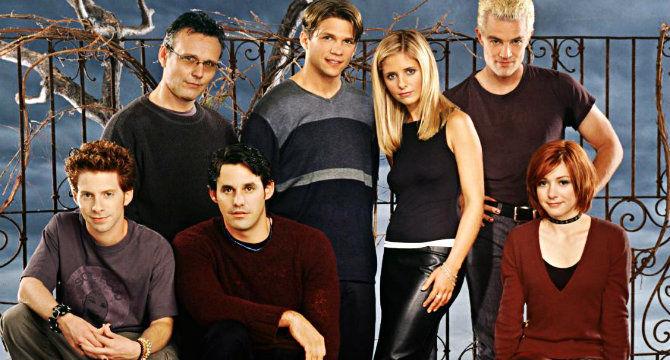
These differing dynamics seem to evolve without reference to the author's conscious intent. For my money, Joss Whedon's BUFFY THE VAMPIRE SLAYER (1997-2003) follows the IRONSIDE model. Buffy Summers is the star of the show and remains so from start to finish, even though there's a lot of narrative time lavished on the support-characters-- Xander, Willow, Angel, and former adversary Spike-- and even though one of them, Willow, arguably becomes more powerful than Buffy.


Conversely, ANGEL (1999-2004), from the same producer, begins its first season by focusing principally upon its "noir vampire" character Angel, who receives aid from two assistants,  Doyle and Cordelia. However, for reasons I've never bothered to learn, Doyle's character was killed off and his sole talent, that of prognostication, was transferred to Cordelia. In the tenth episode of ANGEL, however, a subordinate character who'd appeared on the BUFFY show shifted the balance away from Angel as the superordinate focus. Wesley Wyndham-Price, though initially played for comedy, soon emerged as a coordinated character alongside Angel, and Cordelia followed suit. Other new characters joined the ANGEL cast and projected the sense of being autonomous allies to the vampiric hero, rather than his subordinates. There were some characters I would still deem to be of subordinate stature, like "Lorne the Empathy Demon" and the ditzy vampire Harmony. And naturally, whenever Buffy or any of that character's support-cast appeared on ANGEL, they had the status I mentioned above: that of "eccentric guest-stars."


Complicated though these parsings may seem, they've like a walk in the spring rain next to the convolutions on finds in comic books-- which I'll address in Part 4.


Saturday, February 9, 2019

INVESTMENT VS. FASCINATION PT. 1

In my 2011 essay NEGATIVE I.D, I cited some comments by Curt Purcell on the topic of reader identification with fictional characters, or other entities/presences:

 I certainly wouldn't say there's any encouragement to identify with the villains in the movies I discussed, if only because they tended to be repellently nonhuman--sometimes little more than a writhing mass of tentacles. How does one identify with that?

One of my responses went as follows:

 Identification need not always connote one's sense of participation in a given character's bodily reality, although when speaking of erotica, that would be the natural assumption.  It's equally possible to identify with a nonhuman creature, or even an inanimate phenomenon, by identifying it as an expression of a particular will to do something within the sphere of a narrative.

Most of my response in the essay dealt with the reader's potential for identification with various negative narrative presences, ranging from tentacled demons to dead girlfriends to "phenomena that don't really have benign or malign intent." Their effects within a narrative are all different from one another, but they would seem to share one factor: that it's difficult to imagine the reader investing any personal emotion in them-- which seems to have been Curt Purcell's yardstick for identification.

My current insights regarding identification, as well its consequences for gauging a narrative's centric will, don't invalidate anything I've written on these subjects to date. However, the revelation that identification has two distinct and often complementary aspects may serve to clarify the gulf between what Curt thinks (or thought) about identification and what I think about it.

The two complementary aspects I'll now label *investment* and *fascination.*

In a sense I've indirectly addressed these aspects of identification when I began writing about the centric will in two manifestaitons: the exothelic and the endothelic:


...I defined the philosopher's idea of "Will" as "the radical root of all literary activity." This means that, no matter what sort of viewpoint character the author may choose, he may focus as easily upon the "will" within the viewpoint character (or on some figure allied to him, or an ensemble of such characters), OR upon things, people, or phenomena that are perceived as "the other" to the viewpoint character's will.
*Investment* is the form of identification that the reader experiences when the author has organized his narrative around some focal presence that the intended reader can engage with in a generally sympathetic manner. This does not necessarily mean that the reader endorses everything that the focal presence may think or do-- Humbert Humbert comes to mind here-- but nevertheless, the reader invests himself by participating in the focal presence's way of relating to the world.

*Fascination* better describes the form of identification the reader experiences when the focal presence is perceived as "the other" to the viewpoint character's will. This narrative strategy-- for which I cited EVIL DEAD as an example-- does not ask the viweer to invest any sympathies, critical or otherwise, with the entity that embodies the centric will of the film. Indeed, the film's demonic entities evoke fear because the viewer does not what to make of them or what they will do next. However, as the film progresses, and the viewer gets scraps of new information about the Evil Dead, the viewer becomes somewhat more fascinated with their alien nature, for all that he never really participates in it. This process of fascination becomes so pronounced that the characters in whom the viewer can invest sympathetic emotion, the victims of the Evil Dead, are soon subordinated to the film's monstrous entities. Patently, this is the reverse of what happens in many "investment' narratives, where the reader rejects everything about the protagonist's enemies and their will proves subordinate to that of the main focal presence or presences.

However, a crucial further insight is that investment and fascination can work together in coordinated harmony. In my review of EVIL DEAD II, I noted how Ash Williams, who in the first film is the  last human survivor of the Deadites, becomes a force to be reckoned with:

EVIL DEAD 2 is certainly a much better film than its precursor, and a lot of that can be credited to Raimi's decision to give Ash a more slapsticky vibe, up to and including quotes from Three Stooges routines. Still, the improvement in Ash didn't extend to any of the other characters, who were just as much throwaway cannon-fodder... The film's highlight is Ash's decision to fit a chainsaw onto his missing hand, which is almost as much of a grabber as his final confrontation with the main demon. 
The viewer hypothetically starts out the film investing some emotion in Ash as a sympathetic character, who seems to have no advantages that will keep him from becoming "cannon fodder." However, his maniacally comical struggle against his own demon-possessed hand-- which he lops off to keep it from infecting his whole body-- moves the viewer's identification in another direction. Suddenly, it is Ash, not the malignant demons, who takes center stage, and his later feat of suturing a chainsaw to his arm makes his will even more fascinating. Thus the process of fascination becomes coordinated with the process of identification, so that Ash becomes the embodiment of the film's centric will and the Deadites become subordinate presences.

 To be sure, most serial narratives don't change their centric will so suddenly from one installment to the next. Superman and Batman inspire both investment and fascination from their first adventures to their last. Fu Manchu never allows for full sympathy but the fascination of his character overrides the investment process represented by his goodguy enemies. And, as I've often noted on this blog, Frankenstein and his creation sometimes coordinate with one another in terms of the level of fascination they inspire, and sometimes one is subordinate to the other, usually in the same pattern as Fu Manchu: where "the other" proves more interesting that the familiar.

Saturday, February 2, 2019

STATURE REQUIREMENTS PT. 2

I introduced the term "stature" into my ongoing investigations of focal presences in SUBS AND COES PT. 1.  I doubt that I or anyone can provide a systematic description as to how stature works in narrative, and how it operates in some cases to bring about the coordination of some presences with one another, while in other cases it brings about the subordination of some presences to others. A simple, non-systematic description would simply consist of my re-stating my conviction that stature correlates with the "narrative emphasis" that the author(s) use to structure the narrative. However, being non-systematic is not one of my strengths.

One way to approach a literary process that is not defined by discourse-- where the property under discussion is a given once the narrative is complete-- is by process of elimination. In other words, what qualities do NOT define stature?

In SUBS AND COES PART 1, I indicated that in the BATMAN feature, Robin was coordinated with Batman, while in the DICK TRACY feature, Junior Tracy was subordinated to Dick Tracy. But this might not have been the most balanced comparison. After all, both the original Robin and various later iterations appear regularly in the Batman-mythos over many decades, whereas Junior largely disappears from TRACY once the artist ran out of things to do with him.

Therefore, a better side-by-side comparison would be one between Robin and Doctor Watson of the Sherlock Holmes mythos. I'll concentrate here on the canonical Holmes series of Conan Doyle, though I think it's inarguable that nearly every other later iteration of Sherlock Holmes brings in some version of Watson as well. By this standard, one might argue that the character of Watson is actually more thoroughly imbricated with the character of Holmes, whereas there have been many more Batman stories in which Batman has no partner at his side. So longevity within a serial narrative *might* be seen as a possible quality relevant to stature.


However, two characters in a serial narrative are not necessarily coordinated even if they appear together in every story. In order to be coordinated, each character in such an ensemble must have an independent, autonomous existence, just as, to reiterate my previous metaphor, two coordinate clauses in the same sentence must be able to stand alone.


In contrast, a subordinate clause cannot stand apart from the structure to which it's attached, which is, ideally speaking, a sentence that can stand alone without the clause. Going by these two definitions, longevity is irrelevant.

The question then arises: does dynamicity bear any relation to the stature of characters as being either coordinated or subordinated? When one sees that there have been one or two features devoted to Robin or one of his later epigoni, while to my knowledge Doctor Watson has no ongoing serials devoted to his exploits, one might think it had something to do with the fact that Watson, while courageous, doesn't usually bring much to the table in terms of his ability to trounce evildoers, while Robin's acrobatic abilities give him the ability to take on a variety of enemies without any help from his senior partner.

However, though megadynamicity insures that a given character doesn't need someone else to handle fights, it doesn't necessarily mean that said character and his partner are coordinated. The woods are full of superheroes who have tough sidekicks who are plainly subordinated to the stars of the features, with two prominent examples being "Doiby Dickles" from the Golden Age GREEN LANTERN and "Stretch Skinner" from the Golden Age WILDCAT.


Further, since most incarnations of the Sherlock Holmes concept are more about detection than fisticuffs, the fighting-ability of either Holmes or Watson has little significance in the Doyle stories. It's not impossible to imagine a take on the canonical Doyle stories in which Holmes and Watson are two detectives whose different strengths complement one another, along the lines, say, of the teleseries BONES. But to my knowledge Watson is always both intellectually and physically secondary to Holmes, with the exception of the spoof-tale seen above, WITHOUT A CLUE. There are even some serial concepts in which there's a starring detective who handles all the mental work while he has some legman do his heavy lifting, as per Nero Wolfe and his aide Archie Goodwin, or Ironside and his little coterie. But in these cases, the super-thinker is superordinate to his stooges.


Thus dynamicity, going by these disparate examples, would also seem inapplicable to the concept of stature. The only guide would seem to be that of pure functionality. Robin is coordinated to Batman because the reader expects a hero's sidekick to be able to operate on his own from time to time. In contrast, Watson's main function in the Holmes mythos is to be "the cat who looks at a king," and nothing more. His main status is to be a "subordinate clause" that adds important information to the main sentence-- if only that of making Holmes's feats of detection emotionally relatable-- but he's not important in and of himself.

More to come.


Monday, January 14, 2019

SUBS AND COES PT. 2


The principles of subordination and coordination also serve to further elucidate many of the complications regarding focal presences that I’ve touched on in earlier essays.

In CREATOR AND CREATED ENSEMBLED HE THEM, I gave various examples regarding the ways in which figures in horror-fiction did or did not share center-stage (and thus the centric will).

I opined that in Mary Shelley’s FRANKENSTEIN, the titular medical student and his abominable creation share center-stage, which means, in my current jargon, that they are “coordinated.” However, the Universal film-series promotes the Monster to the position of the sole focal presence, while both his creator and all of the other scientists who interact with the Monster are “subordinated.”  The Hammer film-series takes the opposite tack: Baron Frankenstein incarnates the centric will of all his films, and his various creatures are subordinated.

Stevenson’s JEKYLL AND HYDE anticipates this same pattern. No one reading the tale  cares that much about Jekyll, because he is subordinate to the presence of the mysterious Hyde. Of the film-adaptations I’ve seen, only THE TWO FACES OF DR. JEKYLL subordinates the peril of Hyde to the tortures of Jekyll.


Though most narratives have tended to emphasize the creator over the created, or vice versa, I’ve always explored some of the situations in which two opponents share center-stage, rather than following the more common paradigm in which a superordinate protagonist faces off against a subordinate antagonist.  However, in the former situations there’s usually some intrinsic connection between the characters of this sort of ensemble. I mentioned in ENSEMBLES ASSEMBLE the kaiju film THE WAR OF THE GARGANTUAS, in which a good giant monster contends with a bad giant monster. However, though the monsters are separate entities, the bad one is the de facto clone of the good one, so that they are almost as intimately tied as Jekyll and Hyde. There are no literal links between the characters of my other example of “opposed centrics,” Hjalmar Poelzig and Vitus Verdeghast of 1934’s BLACK CAT. However, though these two war-weary enemies are not even related to one another as much as are the Gargantuas, the narrative emphasizes their many similarities, to the extent that they seem like symbolic siblings.


Of course, this too is a question of emphasis. Just as creators and creations can take on individual superordinate status, so can siblings. The two films examined here, 1935's THE BLACK ROOM and 1964's DEAD RINGER, contain siblings who are aggrieved with one another, but neither film focuses on both siblings. In BLACK ROOM the “good twin” is subordinate to the bad twin, who then attempts, unsuccessfully, to emulate the good brother. DEAD RINGER takes the opposite tack: it’s a good twin who must masquerade for a time as the bad twin, and the film emphasizes that character’s “Jekyll-like” agonies rather than the menace of the film’s Hyde-figure.

The Jekyll-Hyde paradigm is the most common model for fantasy/SF narratives: the supernormal "creation" is the focus of the story, not the person who created it. However, when there's a particular type of "intrinsic connection" between creator and created, this can result in a greater focus upon the creator-figure. For instance, in the 1956 FORBIDDEN PLANET, the menacing Id Monster is the concatenation of Doctor Morbius's unleashed passions, so the centric will focuses on him, not upon the deadly thing he's created.  


To cite a (deservedly) more obscure example, I noticed upon reviewing Ulli Lommel's 1980 BOOGEYMAN that the viewpoint character had an unusually close relationship to the titular monster, unleashing the evil spirit in much the same way that Morbius releases the Id Monster:

...it's slightly interesting that although Willy is set up to look like another Michael, Lacey is both the person who revives the evil ghost and the person through which it manifests. She's also the one who apparently fantasizes about her brother killing hot women, which isn't totally off-the-beam since he almost does kill one woman. But the fact that she's both the one who unleashes her brother's madness and the malice of her mother's lover makes me wonder if she's not the true "boogieman" of the movie.

The concept of coordination is also one that allows me to break down the way centricity works with large ensembles that may, for a time, include individual members who are out to cause harm to the group as a whole, much as Hyde has a hostile attitude toward Jekyll. Some examples of this narrative strategy would include:

Wonder Man and the Swordsman in THE AVENGERS


Terra in THE NEW TEEN TITANS


Both Plastique and Lashina in SUICIDE SQUAD


Demonia in OMEGA MEN


However, again some sort of “connection” is necessary before such a “stealth enemy” might be considered as being coordinated with the rest of the ensemble. Terra, Lashina and Demonia remain in their respective ensembles for many exploits before their perfidy is uncovered, so that for a time readers may internalize them as being “real members.” However, I've stated in Part 1 that each story’s centric will is separate from that of every other story. Therefore, as long as Plastique, Wonder Man and Swordsman have functioned as members of an ensemble even for the better part of one story, then they are coordinated with the other members of the ensemble,  even if that one story ends with the “stealth enemy” being exposed and ejected. 

SUBS AND COES PT. 1


Upon re-reading my May essay TRANSITIVE AND INTRANSITIVE ENSEMBLES, I now believe that transitivity does not apply to the principle of centricity.

The word “transitive” descends from the Latin verb “to go across.” In past essays I’ve applies the term to other literary domains, such as dynamcity and phenomenality. Because there are gradations between the constituent levels within these domains. I’ve often investigated narratives in which it’s unclear as to whether a fight within a narrative “goes across” the conceptual barrier separating the subcombative from the combative, or whether a particular focal presence within a narrative goes across the conceptual barrier separating the naturalistic from the uncanny.

However, there are no comparable conceptual barriers in the domain of centricity. When I wrote the ENSEMBLES essay referenced above, I tried to apply “transitive” to characters who, though they might seem subordinate in some way to a featured character, actually participated in an ensemble with that main character, and so qualified as centric presences. My example of this was Robin, boy sidekick to Batman. Conversely, another “boy sidekick” could be “intransitive” even though that character served some of the same narrative functions as Robin to Batman, and here my example was Junior Tracy with respect to his preceptor Dick Tracy. Whereas Robin would align with the “centric will” expressed by the narrative, Junior would align with the “eccentric will,” as he existed to enhance the “centric will” incarnated only in Dick Tracy.

An author’s decisions about how much emphasis to place upon a character, or set of characters, may be made consciously, or he may proceed subconsciously, simply following other author’s templates. However, a given decision as to who gets ‘center-stage” in a given story is not constructed from the same sort of intra-textual discourses that I find in the construction of dynamicity or phenomenality. Whether the author is writing a stand-alone narrative or a serial one, each story or story-arc must keep a single focal presence, or a single ensemble of focal presences, and that is a predetermined decision, made for the sake of narrative clarity.

Within serial narratives, the ongoing composition of the centric will may change over time.  However, each change takes place within either a new story or a new story-arc. In the first few exploits of Batman, he alone incarnates the centric will of the feature. After Robin enters, the Batman and Robin team becomes an ensemble of two, still incarnating much the same centric will. Twenty years later, Batman plays a lone hand again, and then, if Robin (sometimes in the ID of Nightwing) appears, his status is that of an “eccentric” guest-star. However, when a new story presents a new Robin whom Batman must train, the ensemble-of-two is reborn as if it never left.

In contrast, the phenomenality of the BATMAN feature is built up through a discourse.  As long as Batman, with or without Robin, fights crime wearing a wild costume, this confers an element of the uncanny upon any adventure, even if the hero fights nothing but commonplace pool sharks and holdup-men. In such stories, the element of the uncanny vies with that of the naturalistic, and dominates it, satisfying the reader’s desire for a discourse in which something unreal dominates specters of the allegedly “real.” But centric will does not dominate eccentric will. The latter simply exists as a contrast to the former.

While cogitating on the possibility that centricity might be described through some better metaphor, I meditated a bit on Jung’s use of the term “superordinate.” Since this word is  defined as  “a thing that represents a superior order or category within a system of classification,” it seemed to apply to my idea of a centric will that was simply a given of the author’s whim, rather than through intra-textual discourse.

So I then meditated whether or not the different functions of “characters in an ensemble” and “characters not in an ensemble” could be related to the superordinate position of the centric will. I started playing with the terms “coordination” for the first and “subordination” for the second, and then promptly looked them up on the Net to see if anyone had made previous use of them.

As it happened, I found that the terms did have a previous usage in linguistics, albeit not one that I remember from early language classes. These terms can apply to either conjunctions or to clauses, but the clauses seem most applicable to my project.

A subordinate clause is a clause that would make no sense if taken out of the whole sentence. A coordinate clause is a clause that has meaning independent of the sentence.

It seems axiomatic that the total meaning of a given narrative can be rendered into a single sentence, since students are perpetually forced to come up with such sentences when teachers assign them to boil down a work’s “theme statement.” With that in mind, from a structural standpoint, every character, setting, or event in a narrative is not unlike a clause within the narrative’s overall “theme sentence.”

Just as it’s possible for a sentence to consist of just one clause, a narrative can have a centric will represented by just one focal presence/ clause (Batman by himself).

However, as a sentence can also consist of several clauses, the centric will can also be comprised of an ensemble of two “clauses” or more. In the latter case, the individual members of the ensemble have, at least within my analytical system, the status of “coordinated clauses.”

There are, of course, other presences within the narrative, presences that I have identified as incarnations of the “eccentric will.” Their stature is not on a par with that of any of the “coordinated clauses.” They have, as per the cited definition, no meaning when taken out of the narrative’s  “theme sentence.” Thus Junior Tracy, unlike Robin, can only be a “subordinated clause.”

What makes Robin “coordinated” and Junior Tracy “subordinated” is essentially a matter of what I’ve called *stature.” Originally I used the term in STATURE REQUIREMENTS  to denote the stature that characters in different mythoi had with respect to one another. However, in that usage as in this one, stature is a quality that can only be deduced from the author’s arrangements of the story’s focal presences, and not—as I’ll say again, hopefully for  the last time—not from intra-textual discourse.