Featured Post

SIX KEYS TO A LITERARY GENETIC CODE

In essays on the subject of centricity, I've most often used the image of a geometrical circle, which, as I explained here,  owes someth...

Showing posts with label bill mantlo. Show all posts

Sunday, September 8, 2024

NEAR MYTHS: "THIS MORTAL COIL" (ALPHA FLIGHT #50, 1987)


Bill Mantlo's tenure on the original ALPHA FLIGHT series wasn't much more distinguished than that of the feature's creator John Byrne. Yet curiously, one of the few times Mantlo delves into the world of epistemological myth was a story in which he was clearly attempting to jettison a couple of characters he didn't like writing-- that is, Northstar and Aurora, whose history I briefly examined in TWINSANITY.

To the extent "Mortal Coil" is remembered at all, it's as the issue in which writer Mantlo made the big reveal that ambiguously gay superhero Northstar was actually a "fairy"-- but in the literal sense (though this didn't keep some commenters from assuming that this revised origin was meant as gay-bashing). Such invidious remarks didn't take into account (1) that Mantlo was also stating that Aurora, who was not gay/lesbian, shared the same human/fairy heritage, and (2) that Mantlo was a fairly conspicuous Liberal, who was unlikely to have been bashing even an implicit gay character.

Bill Mantlo took over writing the regular ALPHA FLIGHT title after John Byrne departed with issue #28, and he continued on the feature until issue #66. I would judge Byrne's stories to be no more than standard Marvel soap-operatics, in which a team of disparate individuals bounce off one another with lots of emoting and hand-wringing in place of substantial characterization. Mantlo's run was largely more of the same, and it can be argued that he made an honest attempt to follow through on most of the character-arcs Byrne had established. The two authors had roughly opposite strengths and weaknesses. Byrne could not plot an arc to save his life, but he was able to give his characters distinct voices. Mantlo was a better plotter, but all of his characters talk like they just graduated Exposition 101.

I glanced over the Mantlo issues prior to "Coil," and for the most part he keeps the Byrne status quo with respect to the mutant twins. Northstar is jealous of Aurora's dalliance with men in a way that would seem incestuous were he not supposed to be implicitly homosexual. As it is, Brother Northstar just comes off as judgmental for no particular reason. After the death of Aurora's former lover Sasquatch, she begins a love-affair with technician Roger Bochs, a legless paraplegic. Throughout these issues, Aurora's split personality remains unaltered, and her superhero persona is that of a flirt who has only light, insubstantial loves. Mantlo clearly had no interest in improving the fractious characters, and "Coil" is a story in which he sought to get rid of the twins-- and, for that matter, another Byrne original, the dwarf-hero Puck.


Since issue #44, Mantlo introduced the notion that Northstar had a "pre-existing disease" that made him cough in every succeeding issue. Unconfirmed rumors of the period asserted that Mantlo meant to imply that Northstar had contracted AIDS and to have the mutant hero perish of that disease. Allegedly, Marvel Editorial refused to let him make even indirect allusions to homosexuality, so Mantlo revised whatever plans he had to rid himself of the mutant siblings. Thus, Northstar's illness, as well as Aurora's mental instability, become serious enough that the team takes both of them to a potential place of healing, a mystical conduit that links to many of the Marvel magic-worlds.


Despite some nice art by June Brigman, most of the perils the Alphans face are standard and uninvolving. Thus there's some irony to my assertion Mantlo saved his creative energies to craft a new origin for the characters, just so that he could be rid of them. This new origin claims that the twins' mortal father, who died before either sibling could have met him, found his way into the Faerie World, and caught a female elf, Danae, who wanted to be caught by him. However, after the two were married and Danae conceived the twins, an Elf Purity Squad tracked the wayward fairy down. The twins' father expires in an accident and Danae, despite being immortal, perishes for some reason Mantlo does not bother to discuss.


This revelation by Loki, Norse God of Mischief, is taken at face value by both twins as they seek to survive in the darkness of the conduit. This situation engenders the closest thing the two characters have to a "mythic moment." John Byrne, during some of his last issues, had Aurora declare her independence from her snobby brother by altering her genetic makeup so that the two of them lost their powers when they made physical contact. Faced with the prospect of death in an otherworld, Aurora makes a sacrifice, radiating her store of light-energy-- which I guess is now mystical in nature-- into her brother's body. This depletes her so that Aurora is captured by some of the conduit's demonic denizens. 


Northstar locates the rest of Alpha Flight, but because their leader Vindicator is suddenly antsy about letting the demons out of the gate the heroes opened, she then seals it, with both Aurora and Puck inside. With two of the three characters Mantlo didn't want to write out of the way, he then came up with a way to usher Northstar into the Faerie-World of his mother's race-- though it's not clear why the elves suddenly welcomed a half-elf, half-human when twenty-something years ago they wanted to keep their bloodlines pure. 


The book's heroes have to slink away with their tails between their legs, but Mantlo makes certain that the readers don't condemn him for consigning two regular characters to horrible fates. I won't get into Puck's disposition, except to say that he's relieved of an ongoing curse. Loki then tells some irate deities that Aurora, by hurling all of her light-force into her brother, not only cured him but purged her own elf-nature as well. Loki claims he delivered her to some unspecified mortal custodians and that he supposedly cured her of her split personality.

I don't pretend that "Coil" is a good story, and as soon as Mantlo left the feature, the subsequent writer reversed the "half-elf" solution and both Northstar and Aurora came back, though I haven't re-visited at those stories for years. But I will give Mantlo some credit for coming up with a climax for the Northstar-Aurora sibling relationship, in marked contrast to the characters' creators John Byrne, who was content to have them simply snipe at one another endlessly. The idea of Aurora surrendering her essence to cure her ailing brother could even carry a loose clansgressive motif, which plugs in to Northstar's jealousy of his sister's sexual relationships-- though I won't claim that this was intentional on Mantlo's part. The name he gives to the twins' elfin mother also has an inverted connection to the use of "light" to signify "intercourse." In Greek mythology, the mortal maiden Danae begets Perseus after the hero's godly father Zeus appears to Danae as a "golden shower," usually translated as rain, though the shower's color has stronger associations with sunlight. And though I don't have reason to think Mantlo a "mythophile," it's interesting that the name Danae resembles a Celtic name for the faerie-folk: the "Tuatha de Danaan."


Sunday, June 23, 2024

NEAR MYTHS: KNIGHTS IN BLACK SATIN

This week, before I get to my second mythcomic of the month, I have to precede it with a whole lotta near myths that went into its making, thanks to Marvel Comics' palimpsest approach to universe-building.

I begin with the five-issue BLACK KNIGHT comic, appearing in 1955, right on the cusp between Golden and Silver Ages. Through most of the Golden Age, the company then known as "Timely Comics" generally had a reputation of slapdash but energetic product, represented largely by the superheroes. That genre began fading in popularity in the late 1940s, and in 1951 publisher Martin Goodman re-branded his company as "Atlas." For the last six years of the Golden Age, the look of Atlas comics was arguably more streamlined than that of the best-selling Timely titles. Still, even editor Stan Lee didn't speak well of Atlas's general output, though he had nothing but praise for his sometime collaborator Joe Maneely. Lee collaborated on the first two BLACK KNIGHT stories and Maneely drew most of them, though Fred Kida and Syd Shores also contributed pencils. 

Despite the popularity of the PRINCE VALIANT comic strip, launched in 1937, my impression is that comic book publishers did little memorable work with the "knights in armor" adventure-genre. Hollywood by contrast, came with a smattering of knighthood-films in the forties and fifties, one of which, the 1954 BLACK KNIGHT, may have played some minor role in the genesis of the Atlas title. 


What Lee and Maneely produced was a medieval take on the Superman/Clark Kent trope. In the sixth century, King Arthur reigns over most of Britain, but there are conspiracies against him by his kinsman and nephew Modred (significantly called "Modred the Evil" on the first issue of BLACK KNIGHT). Merlin wants an agent to spy upon Arthur's enemies at court, so he convinces the noble aristocrat Percy of Scandia to pretend to be "Clark Kent," a contemptible weakling. Once Percy susses out the schemes of Modred, his wife Morgan Le Fay, or any other evildoer, the apparent wimp dons the armor and helmet of The Black Knight and thwarts the plot.


Barely any marvelous material appears in the five issues. Merlin has a crystal ball in which he sees visions of distant events, and on one occasion he obscures his movements with "powders" that create a concealing cloud. The other marvelous element is the weapon Merlin gives to Percy as the knight's primary weapon: a sword always called "The Black Blade." No origin is given for the weapon, and only once is it seen to perform an act beyond any commonplace blade, when the Knight uses the sword to chop his way through an iron door.


The stories are all decent though unexceptional formula. The only stories that come close to myth involve the relationship between the aristocracy and the commoners, as when Percy liberates a town from the onerous taxes of a local official. The standout aspect of the series is Maneely's refined art, and that of other raconteurs emulating his approach.


The medieval Black Knight was then forgotten, but in 1964 Stan Lee used the name for a Giant-Man opponent in TALES TO ASTONISH #52. This Knight used an assortment of gimmicks incorporated into medieval weapons and flew around with the help of a winged horse. Three years later, after the evil Knight had made only a handful of appearances, in AVENGERS #47, Roy Thomas introduced a heroic Black Knight: Dane Whitman, nephew of the deceased villain. There was no attempt to connect either costumed cavalier to Percy of Scandia until MARVEL SUPER HEROES #17 (1968).


In this story, delineated by Howard Purcell, writer Roy Thomas posited a conclusion to the story of the original Knight. At the fall of Camelot, Modred and his forces ambush Arthur and his men at Percy's castle. Percy for some reason is not as his own castle, but Merlin sends him, as the Black Knight, to succor the King. The rescue attempt is of no avail. Arthur is slain, and so is Percy, struck from behind by Modred, though the hero manages to slay his assailant as well. Thomas adds two major details: that the Black Blade was forged from a meteor with mysterious properties, and that Merlin forged another weapon with leftover meteor-material. Somehow Modred got hold of the weapon, which either was a dagger or was reworked into a knife (Thomas is confusing on the point). For centuries the Black Blade lies concealed in the castle of Sir Percy. Then Dane Whitman visits the castle, and the ghost of Percy informs them that they are not only distant relatives, the 20th-century Black Knight must now employ the magical sword against modern evil. Then the ghost of Modred, repeatedly called "Modred the Evil" by Thomas, provides Dane with his trial by fire. Modred enthralls a modern-day man, transforms him into a knight with a flying gargoyle for a steed and gives the pawn the deadly dagger. Dane, atop his own airborne mount, defeats the pawn, though the meteor-dagger is lost at story's end.

One interesting aspect of the Thomas story is that the author attempted to promote Modred as a supernatural opponent for Dane in case a series was greenlighted. No such series came about in the seventies, though the Knight had a couple of adventures with his enchanted blade. Then he was sidelined for a time so that in THE DEFENDERS the newly minted Valkyrie could assume both Dane's weapon and his mount for her exploits. 

Though medieval characters like Merlin were sometimes evoked in the early seventies, there had been no knighthood-serials since the 1955 BLACK KNIGHT. But monsters were on the rise in that period, and in a 1972 WEREWOLF BY NIGHT story, Gerry Conway alluded to a book of evil magic, the Darkhold, which was plainly Marvel Comics' version of Lovecraft's Necronomicon. The evil book was referenced a few more times, but in 1975 the tome received an explicit role in the story of Marvel's first "new" medieval character-- though he was more wizard than warrior.


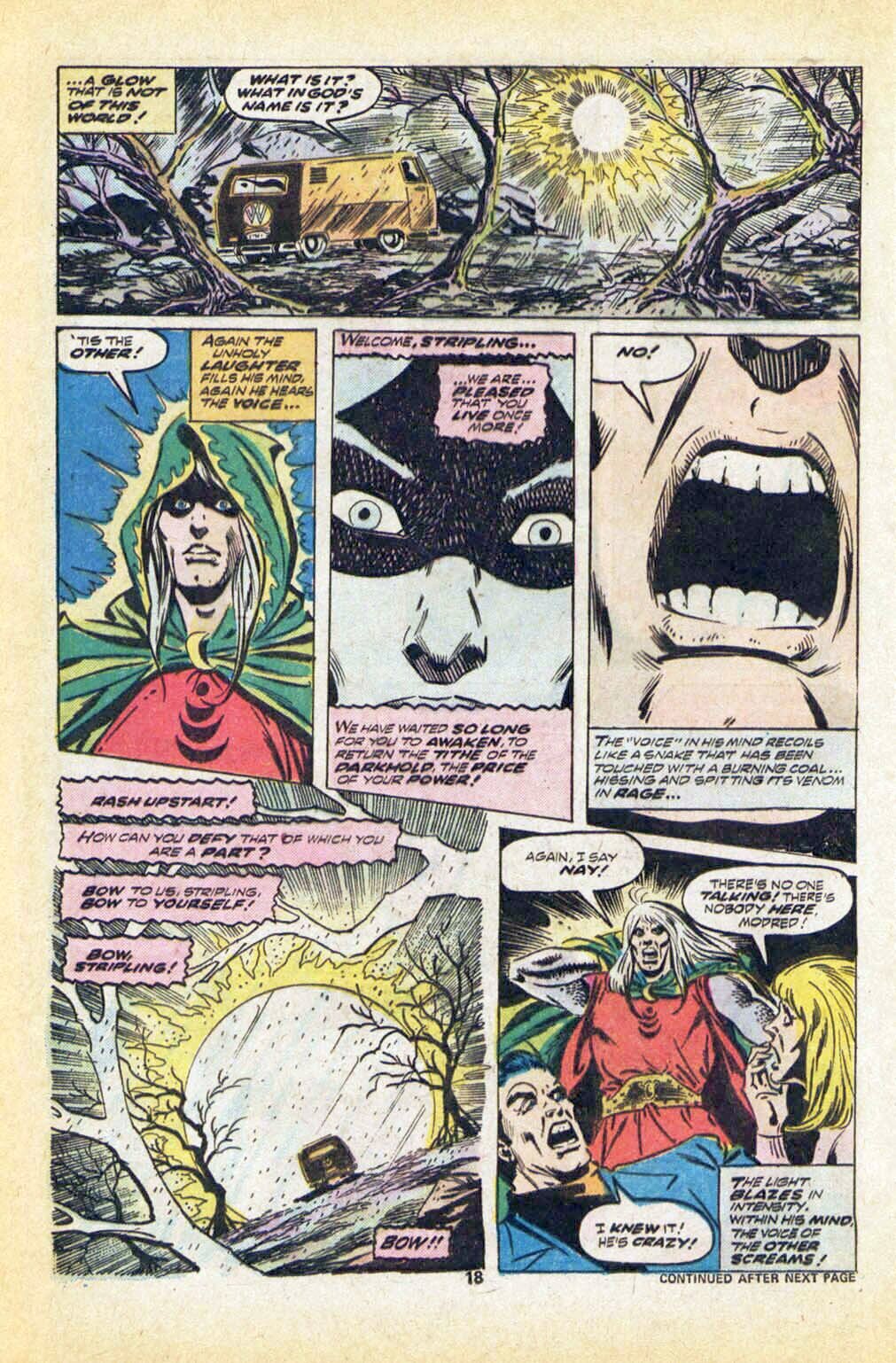
The first two issues of MARVEL CHILLERS were devoted to "Modred the Mystic," a sorcerer from the Arthurian era, but one whose life was preserved until 1975, at which point two modern archaeologists revived him from a deathless sleep. Both of Modred's exploits are written by Bill Mantlo and drawn by two separate artists. Marv Wolfman is credited with having "inspired" the story of issue #1, which is edited by Len Wein, while the second issue has no additional writing-credits but Wolfman is credited as the editor of Modred's second and last appearance.

The two issues contain no creator-observations regarding Modred's provenance, nor are there any references to any version of any Black Knight. It is faintly conceivable that none of the three writers had read the 1968 Thomas story, though not likely. But it's impossible than none of them would have heard of the established role of Modred in Arthurian lore, where he was still the schemer who dooms Camelot, though he's more often Arthur's illegitimate son rather than the king's nephew. Morgan LeFay, usually a sorceress in most iterations, is not anything of the kind in the 1955 comic, and she's not mentioned by Thomas, though in Thomas Modred the Evil is made into a supernatural threat.  


The second Modred, though nominally a "hero," also partakes of one major horror-trope: that of a man possessed by a demon. Back in the Arthurian era, King Arthur commands that Young Mage Modred, apprentice to a wizard named Gervasse, must report to Camelot and become apprenticed to Merlin. Arthur and Merlin are not seen "on stage," but the tempestous Modred does not want to accept anyone's tutelage. He is so rebellious that, against his mentor's advice, the young man seeks out "The Tower of the Darkhold," the repository of the forbidden magical book, in order to empower himself. Through an involved set of circumstances, the power of the Darkhold possesses Modred and then propels him into an unaging sleep, until he's awakened to a new life in 1975. Once he has awakened, he soon finds that though he has the superlative magic power he coveted, the unnamed demons/spirits of the Darkhold expect him to serve them.


Not much happens in the first story except Modred's revival, his backstory, and his use of magic to free himself and his two support-cast members from being buried alive. The second story loosely implies that, had Modred's adventures continued, he would have faced a continuing struggle with the Darkhold. In line with this plan, Modred spends the rest of CHILLERS #2 fighting a demon called "The Other." After some very unimpressive pyrotechnics by artist Sonny Trinidad, the story closes with Modred telling his friends that he expects to suffer further attacks by the Darkhold's malefic influence.

The only time the Modred mini-saga comes close to the mythic is when Modred awakes from his sleep, a scene well rendered by Yong Montano. This trope was clearly a callback to stories in which King Arthur is unnaturally preserved so that he may rise to defend England from future threats-- though there's a weird irony about shifting that story-trope to the history of a character who shares the name of Arthur's greatest enemy.

Whereas the five issues of THE BLACK KNIGHT are efficient if simple formula work, MODRED THE MYSTIC is messy and rushed, lacking a strong concept that might given some depth to the narrative of a semi-possessed sorcerer from the sixth century. A few years later, Roger Stern made Modred a vital part of an extremely intricate AVENGERS continuity, sometimes known as "The Yesterday Quest," and some Marvel fans know him mostly as a puzzle-piece in that design.

But before Modred was initiated into that design, he had one more limited guest-starring role to play-- and that would link him to a modern superheroine. That heroine did have a sort of "knighthood" connection-- though, as my next essay will show, she was less likely to have known a "Sir Bors" than a "Sir Boar."  

Saturday, July 16, 2022

NEAR MYTHS: CONTEST OF CHAMPIONS (1982)


I wondered if a review of this 1982 curiosity-- put together when Jim Shooter still ruled Marvel Comics with an iron editorial hand-- might be the first to show up on the Internet, at least by Google search. I didn't remember much talk about this three-issue mini-series on any of the boards I used to visit, even though it precedes the more famous mega-crossovers of 1986, Marvel's SECRET WARS and DC's CRISIS ON INFINITE EARTHS. However, I did find one essay here, which articulated a few facts not present in the explanatory writeup furnished in issue #1 of the actual comic.

From the comic itself, I knew that writers Mark Gruenwald, Steven Grant and Bill Mantlo conceived the CONTEST storyline (with Mantlo alone credited with the dialogue). I did not know before reading the Science Fiction.com essay that the same threesome had authored a 1980 Marvel Treasury Edition which had Spider-Man fight the Hulk with the Winter Olympics as a background. For CONTEST this team brought together all, or nearly all, extant Marvel heroes for a contest that also would have been  Olympic-themed had the U.S. not withdrawn from 1980's Summer Olympics. This was at least one reason that the completed John Romita Jr. art for this planned Treasury Edition was shelved for a couple of years, until Marvel finally published it as a limited series in regular comics format-- albeit after many corrections to the art were made to bring it in line with 1982 continuity.

The most interesting thing about CONTEST from a contemporary POV is that John Romita Jr's art looks nothing like what readers expect of his work today. At this point in his career, Romita Jr.'s art didn't even look that much like that of his famous father. If only because of the need of stuffing dozens of heroes into one narrative, here he looks a lot like George Perez, particularly in this two-page crowd scene:


(Note: in the real Marvel Universe, Sub-Mariner would probably squash Ant-Man if the latter stood on his shoulder. And maybe the Werewolf, off to the far left, is relatively calm because his human half in control, though the script never says so.)

The art on average is just adequate, though it's still better than the Mike Zeck pencils on SECRET WARS-- though it's been rumored that Zeck was obliged to follow thumbnails from his scripter-and-boss Jim Shooter. I can see Shooter advocating such a project because he was aware that Marvel's strength was its shared-universe of long-underwear characters, and he may well have modeled SECRET WARS on this mini-series-- with one important difference.


In SECRET WARS, every character abducted to "Battleworld" has something to do, no matter how banal the actions might be. Here, nearly all the 1982 heroes are abducted to partake in a game played between two cosmic beings-- but of those dozens of heroes, only twenty-four are active participants. The two game-players, the Grandmaster and a mysterious entity revealed to be the Marvel incarnation of Death, decide that they will play four games with Earth superheroes with their pawns, pitting three of Grandmaster's choices against three of Death's in a treasure-hunting schtick. All of the other characters apparently just chill out in some bunker until the four games are done, and eventually everyone's allowed to go home.


The motive for the game is that the Grandmaster wants Death to revive his brother The Collector. Mantlo et al try to give this boring idea a twist at the end, but clearly the only real attraction of the story is the crossover aspect. And because Mantlo et al were modeling this selective conflict on the real-world Olympics, they created a bunch of newbie non-American heroes-- Australian, French, etc.-- who get heavily featured in the match-ups. I interpret this as the authors' awareness that the New X-Men's success was partly attributable to its multi-national makeup. However, to the best of my knowledge none of the newbies went on to great fame, at best showing up as guest-stars here and there-- so the writers didn't quite manage to tap into Marvel's new mythos of Superheroes, International Style. 

Though the story is routine and the characters deliver long expository lectures at the drop of a hat, Mantlo does keep the characterizations relatively consistent and even pens a few funny bits here and there. And for my purposes, CONTEST provides an apt illustration of my theory about the  difference between superordinate and subordinate ensembles. In other mega-crossovers that I've analyzed, I have to show how particular "starring" characters stand out from "supporting" characters. But in CONTEST, it's clear that only twenty-four characters comprise the serial's superordinate ensemble, while everyone else, no matter how winsomely Romita Jr draws them, is relegated to the subordinate bunker.