Featured Post

SIX KEYS TO A LITERARY GENETIC CODE

In essays on the subject of centricity, I've most often used the image of a geometrical circle, which, as I explained here,  owes someth...

Showing posts with label christmas. Show all posts

Wednesday, December 25, 2024

MYTHCOMICS: "SANTA'S LITTLE HELLION" (JINGLE BELLE #1-2, 1999)


I didn't find but one concrescent Christmas-myth this year. (Grant Morrison, the last two issues of your KLAUS project let me down.) For several years, I had been familiar with the comical character of Jingle Belle, impish daughter of Santa Claus, but I hadn't read her earliest appearances from Oni Press. The two-part story I feature here, whose second part sported the title I'm using for both, was only the second time Paul Dini's character had appeared in a story, though an artist named Lynne Naylor is credited on Wikipedia for having made early concept drawings. Stephen DeStefano penciled the first story as well as this second outing.


One interesting aspect of this tale is that it draws upon a motif I've identified once or twice before: the trope of Santa Claus being "the master of the frozen North."  In the backstory to the main heroine's birth, a frost-creature, the Blizzard Wizard, controls the North Pole and uses his icy foot-soldiers (made of rancid ice-cream) to enslave the Northern elves. When the elves' queen Mirabelle seeks to free her people, the evil Wizard threatens to imprison her.

Enter Kris Kringle, which here is another name Dini uses for Santa, and one I'll use here just for variety's sake. Kris has mastered many of the animals of the arctic or has at least made common cause with them against the Wizard's tyranny, and with their help he invades the frosty fiend's sanctuary and defeats him. The liberated elves swear fealty to Kris by vowing to help him make toys for children, while Queen Mirabelle marries the hulking old fellow.


A century or so later, the only offspring of Kris and Mirabelle has reached her teenaged years, and she's a daddy's girl in reverse, alternately seeking to impress him and to put him down. In the story's first part, Jingle (whose technical full name would be Jingle Kringle) makes a combat-toy to impress her sire, but she fills it with live ammunition-- suggesting at very least a lack of ability to think critically. Then, knowing that Kris is supposed to make an appearance at a department store, she reroutes him to a Hanukah celebration and tries to fill in for him-- though again, in a half-hearted, distracted-teenager manner. However, before she reaches her goal, the Blizzard Wizard makes his move. He creates an ice-storm to sidetrack Jingle, feeding her a line that the bad weather proves that Santa's weather-subduing snow-globe must be malfunctioning. The villain rather easily talks Jingle into bringing him the globe, and while she's on her little jaunt, he uses the device to initiate his re-conquest of the North Pole.


Dini doesn't mean for the reader to think that Jingle is dumb, even though she does dumb things. Rather, a flashback at the start of issue #2 establishes that as a small child (presumably only a few decades old) she has considerable ambivalence about sharing her father with thousands of other children, so she always remains similarly ambivalent about Kris Kringle's mission in life-- meaning that she screws things up because she secretly wants her father to devote all of his attention to her. Conversely, when Kris and Mirabelle discuss their wild child, they conclude that they were too indulgent with her when she was young, so that now, when they attempt to instill discipline in Jingle, she merely resents it and keeps yearning for the happy days when she alone was the center of her parents' world.

And that ends the psychological myth, which I imagine Dini will never alter because it's the source of his comical conflict. But after her father and mother are captured by the Wizard, Jingle gets the chance to emulate her father's feat of defeating the tyrant. This means enlisting the arctic animals as Kris did, although, since Jingle is not as powerful, she ends using more scatterbrained methods...               


 Like dueling with the mammoth king of the narwhals, and winning the duel only because she comes up with the improbable strategy of plugging up the creature's blowhole...


And sending an incompetent assistant to enlist the polar bears, only to gripe when the elf comes back with a bevy of lemmings-- which manage to save the day anyway (not unlike Jingle herself).


The Wizard is defeated, but not surprisingly, she's still in the doghouse for her carelessness. So her "imitatio Santa" fails, but it's questionable as to whether she really wanted to make herself over into her father's image. Indeed, in all the subsequent JINGLE BELLE stories I've read, she just keeps rebelling against Kris's authority in one way or another-- which seems to be the perfect way to keep drawing his attention away from all those other kids. I don't think Dini had any desire to "solve" Jingle's psychological problems, since she's not meant to mature any more than Dennis the Menace. But "Hellion" is one of the few times Dini brought her psychological quirks into line with a metaphysical myth about Santa of the North Pole.    

Since Santa Claus is a legendary figure who possesses charisma rather than stature, the attempt to "spin off" Jingle from his "cosmos" only constitutes a charisma-crossover. However, when a later story featured the bratty elf-girl meeting with the characters of BLUE MONDAY, that tale stands as a stature-crossover. 

Monday, December 11, 2023

NEAR MYTHS; KLAUS AND THE WITCH OF WINTER (2016)


The second KLAUS story, following the first less than a year later, thrusts the former 16th-century gift giver to the 21st century, where he seeks to free two abducted children from the evil Snow Qu-- er, the Witch of Winter.


It's a serviceable Xmas adventure, with an interesting take on another famed craftsman, the Gepetto of (public domain) PINOCCHIO.


The story's most mythic moment concerns Klaus reforming the Winter Witch into an avatar of Spring. I bet that other Santa wished he could do that in a Xmas tale I imagine Morrison never encountered: the 1942 SANTA CLAUS IN TROUBLE.

Thursday, December 23, 2021

NEAR-MYTHS: “SANTA IN WONDERLAND,” SANTA CLAUS FUNNIES #2 (1943)


This Santa-tale, which might have been crafted by the same creator(s) of “Santa Claus in Trouble,” isn’t nearly as strong in the mythic sense. But since I’ve been writing a lot about crossovers lately, I can’t resist the temptation to hold forth on the novel idea of having the folkloric figure of Santa interact with the literary creations of Lewis Carroll.


The reader may suspect that the old “all a dream” resolution is in the offing when Santa, about to go to bed before making his Xmas Eve ride, encounters young Alice, who wants him to bring Christmas to Wonderland. Good-hearted Santa can’t resist her appeal, and she leads him to the rabbit-hole into Wonderland. Since the author has a lot of Wonderland-tropes to condense into a very short tale, Alice gets the old fellow to try a few bites of a “magic mushroom” (minus its resident Caterpillar). The two of them spend a couple of pages changing size, until Santa finally gets into Wonderland (“At least this is easier than going down a chimney”). 


He soothes the weeping Mock Turtle with a toy of its own species, but the White Rabbit gives Santa attitude, so that the frustrated old elf calls him “mad as a March Hare” (more condensation). Later Santa duplicates Alice’s feat of growing too big for the house of the Duchess, and visits the Mad Tea Party, consisting of the White Rabbit, the Dormouse, and the Mad Hatter.


Santa tries to introduce the joys of Christmas tree-trimming to the partiers, but the Hatter screws things up with another size-change that takes them into “Mother Goose Land,” apparently for no reason except that the author remembered that the next Wonderland character Santa meets, Humpty Dumpty, did not originate with Lewis Carroll. “Mother Goose Land” or not, the Red Queen’s court is playing croquet in this territory, and she gets mad when Humpty spoils the game by falling upon her wickets. In the story’s best exchange, the Queen orders her card-soldiers to cut off Humpty’s head, and one guard responds, “He’s nothing but head!” The soldiers turn on Santa—Alice having absented herself from the last two pages—but he blows all the cards away just as book-Alice does, wakes up, and immediately rushes off to begin his world-wide ride.


It’s a pleasant confection of a story, whose main point seems to be exasperate Santa’s genial personality by exposing him to the terminal naughtiness of the Wonderland crew, none of whom express the least desire to learn about any aspect of Christmas, not even gift-gettting-and-giving.

MYTHCOMICS: “SANTA CLAUS IN TROUBLE” (SANTA CLAUS FUNNIES #1, 1942)


I had picked out my last mythcomic for the year of 2021 when something occurred to me: of all the 300 comics-stories I’ve analyzed, I don’t think any of them directly build upon either of the principal myths of this season, be it the birth of the Messiah or the folklore surrounding Santa Claus. I believe the closest I’ve come is the SON OF SATAN story “Dance with the Devil, My Red-Eyed Son,though it’s only of incidental importance that the narrative takes place on Christmas Day. I didn’t expect that the comics medium would have turned out anything on the level of Dickens’ CHRISTMAS CAROL, or even A CHARLIE BROWN CHRISTMAS (whose storyline was not derived from any PEANUTS continuity, though a few “quotes” from the strip are worked into the tale). Still, I thought that during the long history of comics, someone somewhere must have played with the complex symbolism of the Yule holiday.

Not surprisingly, the figure of Santa appears in commercial comics a lot more often than the Christian savior. But to be a myth in my reckoning, the story must have some epistemological content, and can’t just grind out all the expected Santa-tropes. As it happens, the story I selected touches on one of the less well-traveled of these tropes: “Santa as the Master of the Frozen North.” This was used to some good effect at the opening of the 1985 SANTA CLAUS, though it was pretty much the only good moment in the flick.


“Santa Claus in Trouble” doesn’t have an author attributed, but thanks to the story being posted on Pappy’s Golden Age Blogzine, a reader identified the artist as George Kerr. I will assume for the convenience of my essay that Kerr was the sole author.


Though Kerr never claims that his Santa Claus actually rules the fantasy-land of the North Pole, there’s the suggestion of one-upmanship in the first panel of “Trouble,” in that Santa’s eventual antagonist, “Belinda the Ice Queen,” lives “just a little north of the North Pole,” as if to say that she’s a little “north-ier” than the jolly toymaker. The Ice Queen, who may be loosely based on the folk-figure of Jack Frost, is in charge of crafting all the “snow and ice” that contribute to a “white Christmas,” and her “faithful snow men” mass-produce all of these frosty phenomena—including “26-inch icicles”—in a manner that clearly bites the style of Santa’s workshop.


Santa stops by Queen Belinda’s castle to inquire about the Xmas weather, only to find that the enterprising snow men have begun making “ice toys.” This clearly bugs Santa, who wants Belinda to stay in her own lane. He’s less than diplomatic in claiming that “I thought making toys was my job.” Belinda defends her snow men’s creations against the toys made by “those silly little gnomes of yours,” but Santa astutely points out that if humans touched, or even breathed upon, these icy objects, they’d simply melt. Belinda turns Santa out of her castle, but Santa’s such a jolly old elf that he doesn’t even suspect that she’s going to counterattack.


While Santa goes to bed that Christmas Eve—making a side comment about the complications of delivering toys during “war time"-- Belinda’s snow men abscond with Santa’s sleigh and reindeer. Santa can’t track the thieves in the heavy snow, but he has a winsome weapon in his arsenal: magic snowshoes that allow him to bound above the snow-clouds in order to find his missing possessions. He still doesn’t suspect Belinda of the deed, and when he accidentally steps through a cloud and lands outside the ice queen’s castle, he naively enters her domain, seeking aid.


Belinda and her snow men broadcast their guilt so strongly that even good-hearted Santa figures out what’s going on—though it helps when he hears the jingling bells of his sleigh in the next room. Santa doesn’t exactly become violent, since that wouldn’t have fit with his saintly demeanor, though in taking off in his flying sleigh, he does demolish Belinda’s castle, remarking, “That will teach you to try to keep toys from boys and girls on Christmas Day.” Since we never see Belinda again, the young reader is left to assume that she is duly chastised and from then on will stick to doling out ice and snow. Thus, even if Santa isn’t the undisputed Master of the North Pole, you don’t mess with the jolly elf when it comes to making toys.


Wednesday, December 25, 2019

COMBATIVE CHRISTMAS COMICS #8-9

"Look what's coming down the chimney! It's an imitation of ALIEN (though technically it's a supernatural demon-thingie...)"


And let's not forget how Marvel put the "Sweet Christmas" in the Xmas season, when HERO FOR HIRE #7 pitted Luke Cage against a villain called "Marley" in a story titled "Jingle Bombs."


Sunday, December 22, 2019

COMBATIVE CHRISTMAS COMICS #5-7

"You see this cat Claus is a bad mother--"
(Shut your mouth!)
"But I'm talkin' 'bout Santa!"

_________

Here's a team-up between Santa Claus and Superman, where the jolly old elf helps the superhero fight Toyman. Claus himself doesn't participate in the action, but his elves make a bunch of toys that out-fight the villain's killer devices.

________

One of the better comics-versions of a "bad Santa" appeared in BADGER #70. The hero meets a fat greasy biker-type in a bar, and it turns out he's "Klaus," who's sworn off delivering toys on Xmas.  Badger goes with him to the North Pole, watches as Klaus beats up a rebel elf, and talks the foul-mouthed fellow into making his Xmas journey. Badger does end up having to discipline Santa when he's naughty, though. Lots of good jabs against political correctness.

______

Not nearly as good is this LOBO CHRISTMAS SPECIAL. Some Lobo-stories combine a certain amount of wit along with the skull-busting ultraviolence. Not this one, though.


Monday, December 16, 2019

COMBATIVE CHRISTMAS COMICS #2-4

This 1976 reprint includes four Xmas-superhero stories, only three of which are combative.


First up is a story from a special Superman one-shot, "Superman's Christmas Adventure," in which the Man of Steel battles a mad-scientist, Doctor Grouch, who wants to force Santa and his elves to convert to capitalism. Grouch does boast a sky-ship and a gas-gun, and almost kills Lois Lane in a fire, but he gets religion at the end, so all's well.


Wonder Woman, while not explicitly celebratiig Christmas herself, solves the problems of a troubled marriage, gives a couple of kids a happy holiday and nails some Nazis for good measure in "The Story of Fir Balsam."


Finally, the Sandman and Sandy don't meet Santa per se, but end up both fighting crooks and helping a wrestler in Santa-gear, in "Santa Fronts for the Mob."


Thursday, December 12, 2019

COMBATIVE CHRISTMAS COMICS #1


The vast majority of Christmas comics are about extending the olive branch of peace and brotherhood to all humankind.

But of course, superheroes are about extending knuckle sandwiches to the unrighteous, and so sometimes they gotta dish out some Krampus-style violence.

Case in point: this 1975 story from MARVEL TWO-IN-ONE #8. The title "Silent Night, Deadly Night," anticipates a later slasher-franchise, and the typically weird Steve Gerber story teams up the Thing and the Ghost Rider against the FF's occasional foe the Miracle Man. Seems that the evildoer has chosen to follow the supervillain-version of the "Imitatio Dei," creating a "miracle child" through whom he call rule blah blah blah.

There aren't a lot of these combative stocking-stuffers, but I'll see how many I can come up with during the month of December.

Monday, December 24, 2018

NEAR MYTHS: STOCKING STUFFER #2


This Xmas season’s second and last near-myth comes from the same series as the forthcoming mythcomic: the venerable series British series Judge Dredd.

In the first “stocking stuffer,” I opined that good sentimentality doesn’t always make good mythicity. However, sardonic irony doesn’t always provide the Keys to the Kingdom of Myth, either.

This cover, first appearing for a 1987 American reprint., seems to sum up one of the primary themes of JUDGE DREDD: no free rides for the pleasure-principle while Dredd, the incarnation of the displeasurable reality-principle, is on duty. 


However, most of the stories collected in this Quality Comics reprint, JUDGE DREDD v. 2, #6, make only niggling use of Xmas elements. The only tale that even deserves the status of a near-myth is 1985's “A Merry Tale of the Chiistmas Angel.”

That said, “merry mix-up” would be a better title, since scripter John Wagner and artist Steve Dillon simply tossed together four loosely-related plot-threads involving the terminally addled citizens of the futuristic Mega-City. One, the least memorable, involves a performance of the Nativity by a troupe of actors with bad Italian accents. In the second, Dredd’s perpetual sparring-partner, the manic Mean Angel, is lobotomized in order to make him into a model citizen, and in the third, a Christmas-hating terrorist named Flymo takes the Nativity-performers hostage. Lastly, there’s a frame story that starts out by suggesting that the Judges of Mega-City are extending the hand of charity to the grotty mutants outside the city’s borders.


Regarding the first and third plots, Wagner doesn’t even bother developing them past functional status, with Dredd commenting, after Flymo’s demise, that they (and the readers) will never know why the terrorist had a mad-on against the holiday season. Mean Angel is always fairly amusing with her berserker-rages against the incarnation of law and order. However, in symbolic terms the best part of this thread doesn’t involve the battle of hero and villain, but a comical bit where Mean receives a Christmas package containing a “Dredd-in-the-box”—which gift inadvertently helps break down the savage thug’s conditioning. As for the frame story, I’ll just say that it’s sort of plot that insures that JUDGE DREDD, despite its adventurous aspects, always keeps one foot planed in the realm of irony. Wagner’s Judges take no holidays from dispensing justice, and the Mutants—who are, very conveniently, all “known murderers”—find that the hand of charity is actually concealing the sword of Old Testament justice.

Sunday, December 23, 2018

NEAR MYTHS: STOCKING STUFFER #1

Not to be a Grinch about it, but though there's a lot of mythicity in the actual rituals and customs of Christmas, to say nothing of the intersection of pagan myth and Christian worship, not that much mythicity appears in pop-cultural Christmas entertainment. I like sentiment as much as the next fan, but with a few exceptions, like possibly Seuss's original Grinch-fable, holiday cheer doesn't seem to translate into what I've called (in my windy way) "hyperconcrescent symbolic discourse."

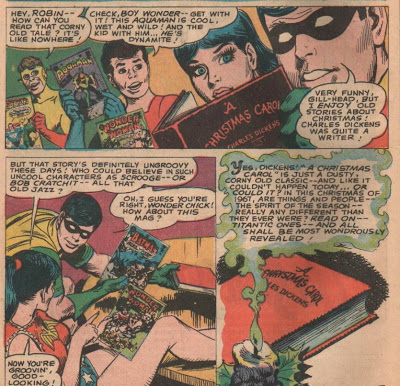
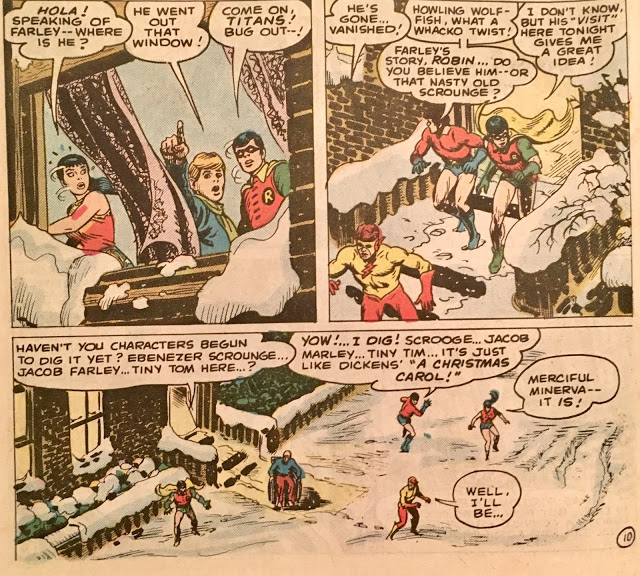
Case in point: TEEN TITANS #13, Bob Haney and Nick Cardy's winsomely corny reprise of Dickens' CHRISTMAS CAROL, blended with faux-hip teenaged superheroes. Haney probably guessed that most if not all of his readers had "grooved" on various adaptations of Dickens, and so what better grist for the story-mill than to have the Teen Titans experience almost the same story in "real life," with only minor changes of names and situations:

First the teen heroes sit around reading comic books, while Robin loftily recommends a more portentous author:


And then they start to experience almost the same events of the CAROL.


At no point, surprisingly, do any of the heroes start worrying, a la Will Farrell, that they may be helpless pawns of some capricious author. They just go about solving a crime that involves the skinflint "Mister Scrounge," his employee "Ratchet" and Ratcher's crippled son "Tiny Tom." I'd be lying if I said I hadn't enjoyed the pants off this cornball version of metatextuality back in the day, and that I still enjoyed Cardy's masterful mise-en-scene upon recently rereading same.

However, the closest the comic comes to mythicity is the weird, eye-catching cover:


The idea of having a bunch of good guys pinned to a Christmas tree like living ornaments is by itself nothing special. However, the idea of the faux-tree being  made out of a collection of junk is inspired, since Xmas presents usually connote the promise of The New, while Junk connotes the Old and the Unpromising. Further, seeing the heroes are bound by old tires and radiators and bedposts makes it seem as if the junk is alive, preying on the energies of youth. However, even Haney's lunatic imagination couldn't figure out how to justify "junk-that-eats-teens-as-food" (in contradistinction to the more familiar "teens-eat-junk-food"). So in the story proper it's not a tree of junk, just a big conical pile of trash that somehow has the power to magnetically attract the good guys, though not any of the bad guys they're fighting at the time. An added, almost Old-World touch is that the two figures in the foreground-- the "Scrooge" doppelganger and modern-day crook "Mister Big"-- are making deep, flourishing bows to one another as if emulating those turn-of-the-century personifications of politeness, Alphonse and Gaston.