Featured Post

SIX KEYS TO A LITERARY GENETIC CODE

In essays on the subject of centricity, I've most often used the image of a geometrical circle, which, as I explained here,  owes someth...

Showing posts with label will eisner. Show all posts

Tuesday, December 30, 2025

NEAR MYTHS: [LI'L ADAM"], THE SPIRIT (1947)

 This seven-page SPIRIT strip, dubbed "Li'l Adam" in reprints, was one of many clever parodies Will Eisner produced in the postwar period. "Adam" is arguably somewhat mythic in terms of one narrative commenting upon the underlying propositions of other strips. 


Following an establishing page, the hero, preparing to leave on a fishing trip, is forced to return to the crimefighting grind when Al Slapp, creator of the popular "Li'l Adam" hillbilly-humor strip, is severely injured by an unknown assailant. The manager of Slapp's syndicate helpfully implicates two other comic-strip rivals of Slapp: Elmer Hay (Harold Gray) and Hector Ghoul (Chester Gould). The manager also mentions a "Maggie Malone," but as I'll discuss later, there was good reason that both Eisner and the Spirit did not pursue that particular quarry.


   Page 3 establishes one of Eisner's main conceits: all of the suspect-artists both look like, and hang out with, characters from the strips being parodied. Thus Elmer Hay, creator of the "Little Homeless Brenda" strip looks like Daddy Warbucks of "Little Orphan Annie," and has in his company doppelgangers for Annie's dog Sandy and Warbucks' Hindu aide Punjab. (Annie/Brenda is represented by a drawing on the wall.) After dispatching the minor threat of Punjab, the Spirit learns from Hay that he had no reason to attack Slapp, because "Adam" has so outpaced "Brenda" that the older strip only excites interest in the public whenever Slapp skewers the orphan-girl.   


The Spirit then seeks out the low-rent apartment of Harold Ghoul, who looks just like Dick Tracy, while in a flashback Slapp is seen to look roughly like Li'l Abner. Ghoul spins an even sadder tale of woe, telling the hero how he poured his heart and love into the exploits of hero-cop Nick Stacy-- only to see Slapp's parody, "Fearful Fooznick," reduce the heroic policeman to a publishing non-entity. The distraught artist tries to take his own life and is knocked out by the Spirit-- but by the time Slapp has emerged from his coma at some hospital, the Spirit has doped out that the syndicate manager tried to kill Slapp for reasons also related to economic disadvantage. For an end-joke Slapp gets clocked by a dead ringer for Li'l Abner's pappy, albeit a Pappy who's got bodybuilder-muscles like his "son."

I took these images from this extant but discontinued site. The comments-section contains some interesting speculation, that Eisner probably intended this story to be part of a phony "artist-feud" between him and Capp-- but if so, Capp never reciprocated by spoofing the Spirit. Other respondents mention that Capp also participated in a "phony feud" with Allen Saunders of "Mary Worth," and that Capp also spoofed "Peanuts" in addition to "Dick Tracy." However, the most consequential spoof in the history of "Li'l Abner" was Capp's attempt to spoof the popular novel GONE WITH THE WIND. Margaret Mitchell-- aka Eisner's "Maggie Malone"-- assailed Capp with so much legal firepower that, despite the law's protections of parody, the artist and his syndicate decided to discontinue the WIND parody, with Mammy Yokum explaining to the audience why the story would never be finished. Contrary to Eisner's pronouncement on Maggie Malone, Mitchell in real life had in fact shut down Capp's mockery and forced an independent syndicate to do her bidding. I'm sure in 1947 Eisner knew that Capp's mockery had nothing to do with Mitchell never writing another novel, since GONE WITH THE WIND was such a hit that not only was Mitchell made wealthy, she was unlikely to ever write anything that would not be overshadowed by that one big novel. But I doubt Mitchell ever read Eisner's toss-off joke-- and as one of the blog-respondents noted, Harold Gray probably took no notice of the fake feud.


     Perhaps less well known than the Eisner strip, however, was this "Hey Look" strip by Harvey Kurtzman, appearing one year after Eisner's strip. According to my recollection of a Kurtzman interview in COMICS JOURNAL, the artist, in addition to drawing assorted junky humor strips for Timely, got permission from Stan Lee-- who admired Kurtzman's turn of mind-- to do one-page, free-form humor strips under the title "Hey, Look." Usually there was almost no point to these strips from the creator of MAD Magazine (four years in Kurtzman's future). However, using a schtick not unlike MAD's habit of distorting the names of celebrities or characters for parodies, the unnamed speaker of this one-pager sticks the consonants "Shm" in front of every name evoked, beginning with "Shmill Shmeisner." There's not much question that the story Kurtzman is referencing is "Li'l Adam," though I doubt the majority of Timely's kid-readers knew what the monologist was talking about. They might have just barely grasped that "Shmill," whoever he was, had parodied Li'l Abner and Dick Tracy, which was true. Interestingly, Kurtzman does NOT mention "Shmeisner's" parody of Little Orphan Annie, though the figures of that strip would have been just as recognizable. 

Instead, Kurtzman makes it sound as if Chic Young's "Blondie" was somehow part of the mix. I don't think either Eisner or Capp ever parodied "Blondie." However, though I can't verify it from GCD, I have read somewhere that Kurtzman might have done some work for the Timely comic "Rusty," whose star "Rusty Rumple" was a knock-off of "Blondie Bumstead," complete with an idiot husband who was the series' goat. Whether Kurtzman worked on the "Rusty" strip or not, "Hey Look" also appeared in the "Rusty" comic, so Kurtzman had to be aware of the comic's existence. Maybe Kurtzman was implicating himself in the whole "knock-off/parody" concept-- though in 1948 he could hardly have guessed how dependent his own career would center upon parody.         

Friday, November 28, 2025

EMINENT ICONS AND PROPOSITIONS PT. 3


So if centric icons within a narrative are "organizational matrices," is there a better term to assign to the organizing principle? Astute readers of this blog (are there any other kind?) will guess that the previously unused term of "eminence" will now assume that position...-- EMINENT ICONS AND PROPOSITIONS.

Looking over this essay and its companion from last July, I don't think I adequately defined the organizational interactions of icons and propositions, which takes place through the agency of a master trope, rather than just tropes in general, as I said here.

I offered a definition of tropes long ago, back in 2018, but the best breakdown is that tropes describe actions: "orphan must learn the secret of his birth," "hero may refuse the call to adventure but must in time answer said call and do heroic things." In contrast, icons are like "solidified" tropes, concretized into particular entities, forces, or settings in order to invite the identification of a work's audience. --MY SHORTEST POST YET. 

The one thing I left out in the above formulation is that any professional author decides in advance what sort of proposition will govern his narrative, and this means becoming more specific as to what sort of icons will work best for his master trope. Charles Dickens can't just put "orphan must learn the secret of his birth" out there; he must decide who the orphan is-- Oliver Twist-- and what the secret is; that Oliver still has a living relative from whom he and his mother got separated. 


Thus, there's an operative difference between a "generalized trope," which can be applied to many works, and a "specialized trope," which applies only to a particular work, or a particular linked set of works. Other aspects of the work will include "bachelor tropes" that are not nearly as important as the master trope. Oliver must meet some opposition so that his discovery of his secret heritage doesn't seem to be too easy. That opposition doesn't have to be Fagin and his faux-family of thieves, so that part of the proposition comprises a bachelor trope in relation to the master trope.  


OLIVER TWIST is a monadic work with no further iterations, so its proposition is unitary. Serial works are cumulative, given that even the most stereotypical serial-- I might cite my earlier example of the Golden Age BLUE BEETLE from a related essay-- may have a specialized trope (Blue Beetle protects his city from crime) that is barely distinguishable from a generalized trope ("hero protects his city from crime.") 


However, in cases where the cumulative narratives of the series are not broadly stereotypical, the specialized trope must be refined. Will Eisner's SPIRIT varies between direct confrontations with evildoers and indirect encounters with either human error or simple fallibility. In the cover Will Eisner prepared for a Kitchen Sink reprint of the 1940s SPIRIT stories, the artist depicts a scene that doesn't literally transpire in the story "Gerhard Shnobble," but one which symbolizes a key moment in the tale. The Spirit's crimefighting activities take second place in "Shnobble" to the tragic end of the title character, which the Spirit doesn't even personally witness. Nevertheless, even in stories where the dominant action takes place in the life of a one-shot character, the Spirit still provides a moral compass for Eisner's implied reader, even when he has no impact upon the one-shot character's life. So even though the SPIRIT series started out with a specialized trope like "The Spirit protects his city from crime," that master trope became in time inaccurate because of changes in the propositional priorities. Thus a more appropriate specialized trope, capable of taking in all of the propositions Eisner offered to readers, would be something more like, "The Spirit bears witness to the many manifestations of human fallibility."  


Tuesday, November 26, 2024

NEAR-MYTHS: "EUSTACE THE TURKEY" (THE SPIRIT, 1943)


I'm aware of no fully mythic Thanksgiving stories. But Will Eisner managed a cute near-myth with a tale of a turkey who is seemingly spared his grisly holiday fate, but who ends up sacrificing his life to save his fellow birds (sort of). Strangely, Eisner does not make the predictable comparison to the Nazarene, but to-- that gloomy Dane, Hamlet?


Just for good measure, here's a bit from GIGGLE COMICS in which an endangered turkey pleads for the main cat-hero to become his "Lincoln."


Thursday, April 20, 2023

MYTHCOMICS: "THE MONGROL MAN" (UNCLE SAM QUARTERLY #4, 1942)

 When I went myth-hunting in the pages of Quality's publication UNCLE SAM QUARTERLY-- a short-lived attempt to give the ultra-patriotic hero his own title, lasting just eight issues-- I thought it likely that any mythcomics there would be authored by Sam's creator Will Eisner. But though Eisner's contributions in this series are amusing, the most mythic story here is by an unknown writer and stalwart artist George Tuska. Neither collaborator attempts any of Eisner's well-known tics with respect to lettering or panel composition, but "The Mongrol Man" does evince the sort of bloody-mindedness I associate with Eisner's sometime collaborator Jack Cole. However, so many fans have sought out Cole's work that "Mongrol" probably would have been identified by now if it was one of his works.


The title is an anomaly in two respects. First, there isn't just one "Mongrol Man," there's three of them. Second, the name seems to be punning on the two words "Mongol" and "mongrel," but only the second word actually has any significance in the story. This is surprising because during WWII a favorite trope of American superhero comics was that of a "20th-century Mongol invasion." Strangely, although "Mongolian" was informally used to describe, not just inhabitants of Mongolia, but all Asians roughly east of India, none of the comics I've read actually conflates any of these various recrudescent Mongols with the Japanese. Perhaps even comics-writers, far from concerned with fine points of cultural history, couldn't associate the Japanese opponents, usually pictured as small-statured, with Mongols, who were portrayed as tall hulking brutes.


Nazi eugenicists concerned themselves primarily with creating racial purity by excluding all supposedly inferior races from interbreeding with the Aryan stock of Germany. This story's villain, biologist Jeremiah Korntooth, goes to the other extreme: creating a "perfect brute race" by somehow combining aspects of humans of different climes and possibly animals as well, meaning that he was taking leaves from the books of both Frankenstein and Moreau. Hence, the brutes he invents are actually "mongrels," which sounds like the opposite of the Nazi ideology.

The common ground, however, seems to be that Korntooth has some roughly parallel beliefs about the fetishization of raw power, since he describes the three leaders of the Axis powers as those who "share my ideals." He views the advance of Western technology as a weakening influence upon humankind, and he decides to create a new breed of superhumans to offset human dependence on technology. Having bred just three Mongrol Men, he bestows one apiece on each of the Axis leaders and then vanishes from the story.

Now, Quality's Uncle Sam was supposed to be a heavy-hitter like Superman, able to fling around tanks and proving invulnerable to bullets. Two issue previous, the top-hatted hero had engaged in a grueling battle with a similarly powered opponent, and the cover for USQ #2 described the story as a "14-page powerhouse battle." Actually, the story was 14 pages, and the battle only lasted six, but for a Golden Age story, that was still pretty long. All this to say that a reader in 1942 could have reasonably expected Uncle Sam to take on the exemplars of the "brute race" and beat them in hand-to-hand conflict.


However, the "Mongrol" writer isn't concerned with matching Korntooth's mongrels against the strength of American willpower. Instead, by the way Sam and his ordinary-joe servicemen aides dispose of the creatures, the moral seems to be: use anything you have, technology or trickery, to overcome threats to freedom. So in the encounter with the Mongrol Man serving the Italian army, the sailor "Tex" lassoes the monster from his plane (don't try this at home) and successfully dashes the "invulnerable" Mongrol against a cliff-side.


The second one is defeated more by tricky use of the surrounding environment. When Sam and friends arrive to take on the monster serving the Germans on the Russian front, the second of the two aides, "Bayou Bill," tries to drug the Mongrol by pouring vodka in his drinking water. It's not certain that the Mongrol is weakened by the alcohol, for he comes after the serviceman. Uncle Sam comes to Bill's rescue and after a short battle knocks the creature into a handy quicksand pond, where he asphixiates.


The last of Korntooth's creations joins a couple of Japanese fighter-planes in trying to destroy an Allied vessel. This time Uncle Sam forms no particular strategy; he just dives down into the sea to duke it out with the Mongrol. But the last of the brutes is defeated by another manifestation of the technology hated by Korntooth: when one of the Japanese fighters is downed by Allied fire, the plane crashes on top of the Mongrol, whose invulnerability is something less than Superman-esque. The Axis' use of pure strength is invalidated, though Sam's useless sidekick Buddy sounds a little like Korntooth, complainnng about "sissy stuff." 

On a side-note, I have no idea why the writer named his villain Korntooth. The expression "corntooth" is an old putdown accusing a person of bad dental hygiene, in that he's so neglected brushing that one of his front teeth has turned corn-yellow. It doesn't seem to have any actual relevance to the villain's depiction, so probably the writer just thought "corntooth" would be an amusing name for a pretentious evildoer.


Monday, December 19, 2022

SEQUENTIALITY IN A SINGLE PANEL

 A line of thought from a thread talking about what types of illustrative work may combine art and text without being comics--

__________

Going back to my thoughts about how to distinguish between one-panel comics (many of which don't have continuing characters) and illustrations that combine pictures with text, I began wondering if there was any way in which Eisner's idea of "sequentiality" applies to one-panel comics. (I read his Sequential Art long ago but remember none of it.) 


Obviously if there's only one panel involved at a time, there's no sequentiality-- of images. But there can be sequentiality between art and words. 


Case in point: I remember a 1960s one-panel girly cartoon in which an onlooker is in the midst of walking along the street when he goggled at a busty woman standing against the wall. But he's not just goggling at her, but at the combination of her appearance and the wall-sign she's standing beside: a cigarette-slogan current at the time, reading, "It's what's up front that counts!"


I imagine there are exceptions, but it seems to me like most one-panel comics work by contrasting whatever odd thing is going in the art with some quirky thing in a caption or line of dialogue. In contrast, one-panel illustrations, whether for books or whatever, just underscore whatever is in the text, rather than showing a tension between art and words.


ADDENDUM: Since I'll probably never come across my "up front" example again, here's a similarly structured cartoon by Gary Larson, depending on a printed message in the panel to convey the joke.


Monday, December 13, 2021

MYTHCOMICS: "THE SHADOW OF DUSK" (THE SPIRIT SECTION,, 6-16-42)

 Though READ COMICS ONLINE has become my go-to site for scans of obscure comics, even they couldn't provide assistance for this essay: reviewing "The Shadow of Dusk," thus far reprinted only in the fifth issue of THE SPIRIT ARCHIVES, and nowhere online.


The titular adversary featured in "Shadow," in fact, was only used four times by Will Eisner (and any collaborators involved). Mister Dusk first appears in June 1941, and appears to be a loony who kills a man for no particular reason. He then comes across the Spirit, invites him to his lair to meet his crazy wife Twilight (called a "savage" but not given any particular nationality). Inevitably both Dusk and Twilight try to kill the hero, who captures them and has them put away in an asylum. The two of them get free that same year for a Halloween story and then obligingly go back to the asylum once the holiday is over. Both of these are amusing but not particularly mythic.


The third story, though, shows Eisner in a different sort of antic moon-- metaphysically antic, that is. He starts out with a splash panel that shows the Spirit standing in a roughly cruciform position with his own amplified shadow behind him, while to the right appears a quote from a Walt Whitman poem about the questionable identity between the speaker and his own shadow.

The story proper opens with a thunder-storm erupting over the asylum where Dusk is imprisoned. (His wife Twilight is mentioned but not seen.) The madman dances in his cell to the "symphony" of thunder and  lightning, only to stop when he notices that his shadow has wandered off. Providentially the storm then blasts open Dusk's cell, so that he can go looking for his missing other half.

Meanwhile, at the Spirit's lair, his buddy Ebony sees a menacing shadow show up and try to strangle Ebony's own shadow. The bad shade disappears when the Spirit shows up.

Dusk goes looking for his other half at police HQ, and Commissioner Dolan, apparently infected by the villain's nuttiness, takes Dusk home with him. Dusk then handcuffs and slugs Dolan and abducts the cop's daughter Ellen. Moments later the Spirit shows up at Dolan's house, bursting to tell the commish about Ebony's weird experience and to go into a diatribe about shadow-folklore-- at least until the hero finds out his girlfriend has been kidnapped.

The Spirit and Dolan decide to check out the villain's former hideout, and the Spirit is highly amused to see that Ellen has somehow turned the tables on Dusk, threatening him with nothing but her fists. Possibly Dusk was de-powered by the loss of his shadow? In any case, Dusk's shadow appears and starts strangling the shadow of the hero, who chokes as if personally assaulted. However, the Spirit just happens to have brought along a camera, and he "captures" the spirit in the camera-film. (Here one presumes Eisner was playing around with the belief attributed to primitives, that a camera could capture the spirit of anyone photographed.) 

Dolan then hauls Dusk back to the asylum. The Spirit shows the camera-film to a scientist, who confirms that the image of the shadow is there. However, somehow the shadow gets loose again, and when it's seen elsewhere, the Spirit and his scientist friend confirm that the image has vanished from the film. At story's end the shadow remains on the loose and is never reunited with Dusk.

With or without his shadow, Dusk makes one more appearance, but in reduced stature. In a story spoofing the late forties' rise of Jane Russell's star, Dusk tries to kill the Spirit and launch a blackmail operation-- all far from the sustained looniness of his first three appearances.


Monday, May 4, 2020

MYTHCOMICS: "MAD MOES" (THE SPIRIT, 1947)

For a city boy, Will Eisner occasionally displayed a flair for emulating the feel of country folklore. MAD MOES isn’t quite as good as his two-years-later hillbilly-yarn THE CURSE, in that the former jams a few too many events into its short space. But Eisner does succeed, more than in other tales using personification of non-human things or entities, in transforming a force of nature into something akin to a deity.


Eisner begins in a mock-Biblical mode, telling the reader that “In the beginning there was the desert, the dust, Mad Moes the river, and Lizard.” The character named Lizard is one of Eisner’s many eccentric old coots, and his nickname presumably stems from his habit of lazily sitting in the sun outside his shack, erected on a small island amidst the river. But Lizard is only important as an ally to Mad Moes, “a no good, shiftless, ornery river.” “Shiftless” in this case means being useless to most forms of life, for a caption relates that for vague reasons the river can’t be used for human trading and even fish can’t live in it. The “ornery” part comes about every spring, when snow melting in the mountains causes the river to flood the surrounding habitations of man—all except Lizard’s shack, which always gets miraculously spared.


The state authorities finally get fed up with Moes’s madness, and plan to dam the river. Surveyors ask Lizard for assistance, but the old fellow runs them off, claiming that he and Mad Moes are bosom friends. Much as the authorities would like to evict Lizard, they live in some peculiar state where eminent domain is trumped by squatters’ rights. Nevertheless, the old man can’t keep the authorities from setting up a boom town to house the personnel building the dam. But to make sure Lizard stays out of the way, the forces of law and order designate the land around Lizard’s island to be a national park, so that if he leaves, he gets arrested for trespassing. The story moves so fast that no one asks where Lizard gets his food (leftover victory garden?), and the scene shifts to the technical hero of the tale.

The Spirit happens to be in a neighboring city, breaking up an illegal gambling operation (supposedly aimed at “minors”) and sending its operators packing. But experienced criminals know how to use the law to their own ends. The gambler Stud Sharpe and his moll Queeny find their way to the boom town, which spells easy fleecings, and then stumble across Lizard’s island-shack. When they find out that the old guy’s shack is technically outside the bounds of the law, the gamblers set up a very humble version of a poker palace on his island. By luring in the local dam-workers, the gamblers not only line their pockets, they please Lizard, who’s willing to do anything that impedes the dam’s construction.

The unlikely ploy works, and the dam-project suffers from absenteeism (sort of like the dam-workers, who are talked about but not seen). Because the authorities are stymied by their own laws, they resort to calling in that famed “outlaw,” the Spirit. While the vigilante lays his plans for acing out the gamblers, the occupants of the shack have a falling out. Lizard tries to get romantic with Queeny, and to entice her, he reveals that he has a cache of gold nuggets, a bounty perpetually washed up on his island by the shiftless river. Up to this point the gamblers have apparently been planning to cut out as soon as they made a pile, but the promise of gold changes their plans. Sharpe easily swindles Lizard out of the rights to his land (a good trick, since Lizard doesn’t actually own the land) and kicks the old man out. Providentially, the Spriit shows up, and with a lit stick of dynamite forces Sharpe to play cards for everything the gamblers made off their victims.


While the card-game proceeds, Lizard seeks to invoke the river-god for vengeance. Though Eisner tells us that the dam-work has stalled, apparently it got far enough to confine part of Mad Moes’s bulk behind a sluice gate— and because it’s been raining hard, Moes once more has enough water to unleash a killing fury. Lizard unlocks the sluice gate, hoping that his friend the river will annihilate his former allies in the shack.

Back at the shack, the Spirit shows that a clean gambler can always beat a dirty one, recovering all the lost winnings. This is apparently not a good enough reason to extinguish his stick of dynamite, which has to remain lit so that Lizard can use it. Best not to ask how Lizard, swept along by the river-waters, manages to reach the island before the worst of the deluge, but the old coot grabs the dynamite, trying to use it against Sharpe and Queeny. Instead, the explosion somehow blocks off the deluge, so that no one perishes. Presumably once the Spirit delivers the workers’ lost wages, they hunker down and get the job done, for the last panel shows “the great renegade river” at last penned up behind a mammoth concrete dam, and the forces of law and order triumphant. Since the authorrties no longer need to isolate Lizard’s shack, the park-order is rescinded, and what was once Mad Moes’s river-bed is paved over for a superhighway. Yet in a visual sense at least, Lizard continues to attach himself to Mad Moes like a votary of a deserted temple, for now his shack has become a gas station, and the desert rat is still there, sunning himself.

Online research shows multiple origins for the name from which the river takes its monicker. “Old Man Mose” can be viewed as a generic term for any old guy, as a figure in American folklore, as a character in a LI’L ABNER story and as the subject of a Louis Armstrong song, possibly based on the Al Capp strip. Eisner’s use of the name plays to his love of puns, but the process is the reverse of what he would later do in THE CURSE. There, the famed bay known as the Zuiderzee is transformed into the name of the story’s female character, Cider Sue. Here, Eisner tinkers with the name of a folklore-figure and makes him into a river, a river somehow coeval with a real old man. Though MAD MOES is haphazard in terms of verisimilitude, this doesn’t affect Eisner’s ability to use a force of nature to illustrate the mythic war between law and lawlessness, a war that ends by dethroning a rather ornery minor god.

Friday, February 22, 2019

MYTHCOMICS: "BLACK GOLD" (THE SPIRIT, 1947)

Like most of the SPIRIT stories I've classified as mythcomics, "Black Gold" is not one of the better known stories in the canon. To make a loose generalization, I would say that most of the stories that other critics esteem-- whether for Will Eisner's mastery of storytelling tropes or for their appeals to comedy or sentimentality-- don't represent Eisner "digging deep" into his own power of symbol-making.

I've occasionally commented that Eisner showed a penchant for spoofing ethnicities and nationalities, and one can see an example of this in his comic Arab villain Ahmed-the-Trader in the late-1947 story "Money, Money." However, about six months prior to that tale, Eisner produced a somewhat elegaic look at the Arab world, playing off the West's discovery of oil-- a.k.a. "black gold"-- in various North African countries following the end of WWII.

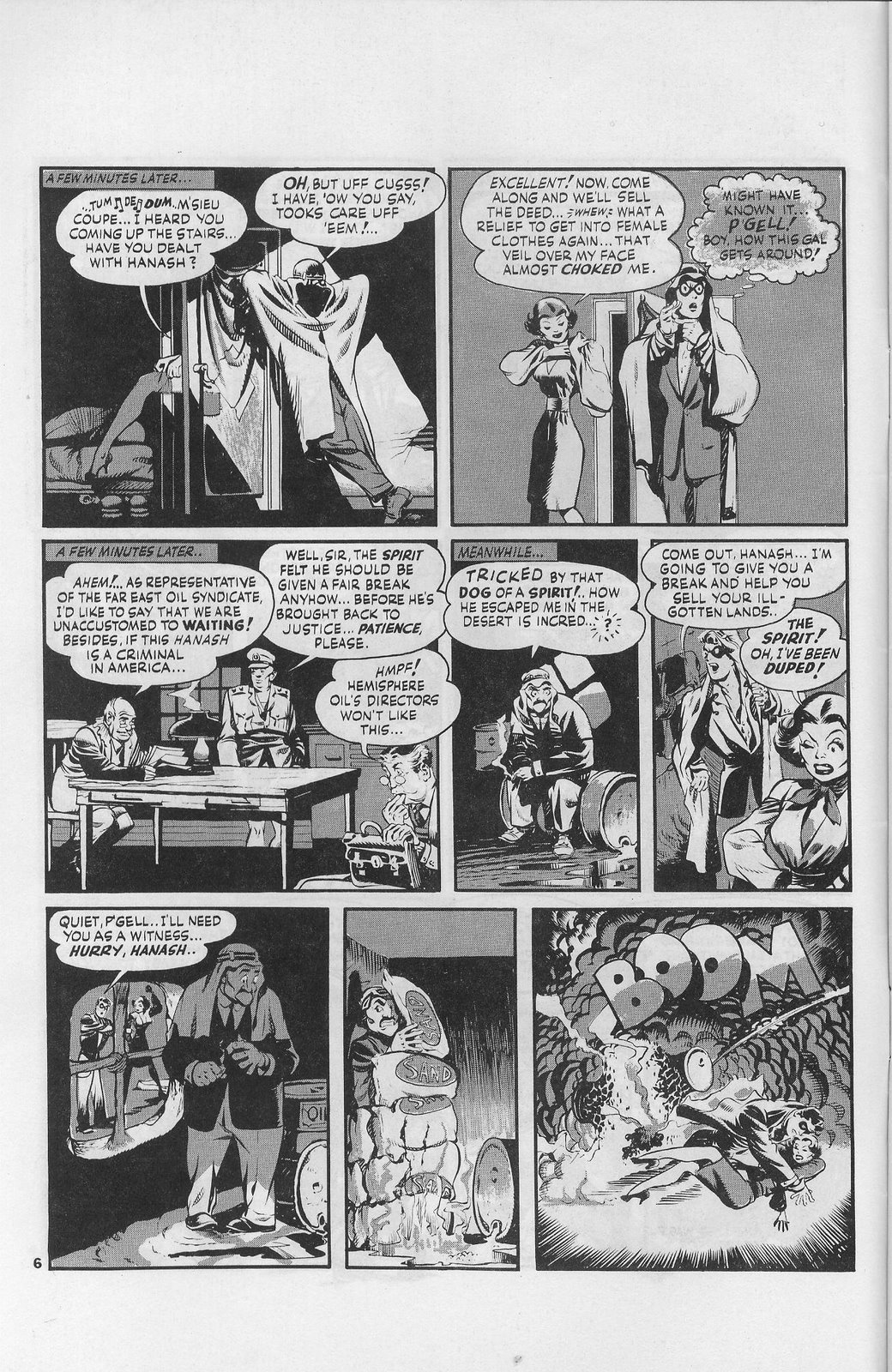
Eisner begins the story with an improvised, but none the less serious, elegy for the waning fortunes of an Arab landholder, Abu Ben Adim. (Presumably the author chose the surname to signify "son of Adam," for reasons that become clearer later.) Though in antique times Abu's tribe was rich, in 1947 his land has become unfruitful and Abu is almost the last of his line. Like the original Adam, Abu has two quarreling sons, Abu's being named Hanash and Ali. Both are, to borrow from a much later Christian text, "prodigal sons" insofar as they both deserted their father's orchards to seek success in the Western world. The only reason Hanash and Ali return to their father's house is because he's on his death-bed, and both "jackals," as Abu calls them, want nothing but their unearned inheritance. Further, both of them are thoroughly rotten. Hanash in particular brings a prisoner in tow: none other than the crime-fighting Spirit. As for Ali, he has a Western woman in his company, though her face is cloaked by a veil, and as soon as he receives his bequest, he heartlessly leaves the woman behind, presumably having enjoyed some romantic tryst with her previously.


As for the bequest, Abu leaves to Ali all of his land, which Abu considers barren, and bequeaths the "family sword" to Hanash, though in dying he curses both sons for their faithlessness. Hanash believes that he's been given the stick's short end, since both brothers know that the Ben Adim land is rich in oil, and that Western petroleum companies will pay top dollar for access. Hanash retaliates by making a particularly odd attempt on his brother's life: bludgeoning him with the covered-up body of the Spirit.


This doesn't serve to kill Ali, but while one of Hanash's henchmen takes the crimefighter away for an eventually fatal encounter, Hanash executes Ali, impaling Ali with the family sword, and in effect "exchanging" their bequests.. Ali's widow pretends to go along with Hanash, who then decides to kill off the Spirit by shooting the bound and covered figure. To no reader's surprise, it's soon revealed that the hero escaped and left the henchman bound and covered, so that the henchman dies and the Spirit can keep following Hanash. (Hanash seems a particularly dim villain, not to even check the face of the enemy he plans to execute.)


Within a few pages of this fast-paced tale, Hanash makes plans to sell off the deed he's stolen from his dead sibling, and the Spirit, trailing the villain, learns that the veiled woman is none other than his old sparring-partner P'Gell. This time the money-hungry adventuress is working hand-in-glove with the Western powers to make sure her employers get the deed, and the Spirit is fine with that, so long as he still gets to take Hanash into custody for his assorted crimes.


The story then rushes to the big twist ending: P'Gell's employers don't want just the land, they also want the family sword with which Hanash killed Ali, because there's a map on the sword that will guide the buyers to the only oil cache on the Ben Adim land. Crazed by this revelation, Hanash escapes and runs into the desert, intending to regain the sword from his murdered brother's body, but he simply perishes in the desert heat. Eisner then adds a double twist, revealing only to the reader that Ali survived his stabbing for a time. Ali crawled away from the scene of his murder, trying to slake his thirst with water, and all he found was-- oil.

In Kitchen Sink's 1986 reprint of "Black Gold," commentator Dave Schreiner elicited from Eisner the observation that "If I were doing the story today, I'd have done something about Israel becoming a state." Though this did not take place in real history until 1948, I would guess Eisner knew, even in 1947, that revolutionary Jews in Palestine were trying to oust British rule with the object of forming such a state, which become possible when the Brits left and the Israelis defeated the Arabs in the 1948 war. However, "Black Gold" is a much more mythic story by not referencing politics directly. Archaic Israel is mentioned only fleetingly, and the real bone of contention stems from the quasi-colonial efforts of the European powers to get access to the oil hidden with the earth controlled by the impoverished Arabian people. That said, Eisner certainly does not make the European powers any sort of villainous figures, and even P'Gell is relatively tame this time around. One may hazard that for Eisner the Europeans' interests would have been in line with those of America, while the interests of the Arabs would have been, to say the least, unfriendly to the interests of Jews everywhere. The idea of the cursed bequest brought to my mind the wrangling between two other Biblical siblings, Esau and Jacob, in that Jacob manages to steal Esau's birthright. In "Black Gold," though, both siblings attempt to supplant one another, and end up bringing about one another's deaths. Whether or not this is a comment on the dwindling fortunes of Arabs as Eisner saw them in 1947 is up to the individual reader.

Tuesday, September 13, 2016

NEAR MYTHS: SAND SAREF AND ELEKTRA

I've been re-reading Frank Miller's first run on DAREDEVIL to suss out its possible status as a myth-comic.Though I've not finished the re-read, it's evident that most of the issues are strong in terms of the kinetic and dramatic potentialities, there's not a single symbolic thread weaving through all of the issues. The closest thing to such a thread is Miller's famous character Elektra, who, as Miller himself has admitted, owes something to a 1950 SPIRIT story by Will Eisner.

A pause for confession: over 15 years ago, I played around with putting together a book proposal that would have focused on myth-analytical essays. One of the stories I sought to analyze at the time was that Eisner story, a two-part tale focusing on how the law-abiding hero found himself pitted against a criminal who had once been the love of the Spirit's juvenile years. (Note: the story had originally been designed as a stand-alone work featuring a new Eisner character, John Law, but Law's comic book never got off the ground, so the artist reworked the pages into a Spirit episode.)

I haven't reread the old essay, but I wouldn't seek to rework it today. In my current view, the Eisner story lacks the symbolic amplitude that I look for in determining a mythcomic, and so only qualifies as a "near myth." The single mythic idea of the Eisner story is that "best friends divided by fate." The trope was a favorite one among many melodramatic crime-films that appeared in the Classic Hollywood of Eisner's youth, perhaps best exemplified by the 1938 film ANGELS WITH DIRTY FACES.

Eisner chose to make the law itself the factor that divided two young people, a young law-abiding boy with a somewhat shady uncle, and a young girl with a cop-father.


Sand Saref then turns against the rule of law as represented by her father, while young Denny Colt, the future Spirit, becomes dedicated to keeping order to atone for his uncle's misdeed. The aptly named Sand soon drifts away from young Denny and embarks upon a career that's not initially criminal, though she's largely defined by her own self-interest. When she returns to America, she becomes affiliated with a scheme to smuggle a postwar germ-warfare weapon. The Spirit shows up and foils the scheme, but she recognizes him despite his mask and saves his life. In return, the hero lets her get away. The lady crook and the crimefighter encountered one another a few more times before the end of the SPIRIT feature, but this noir-ish ode to lost romance remains the most significant story for Sand Saref.


Long before Elektra ever appeared, Daredevil's backstory turned upon the hero's paternal influence. Boxer Jack Murdock pressured his son Matt to excel at school and become a lawyer so that Matt would never get bogged down in the dubious world of the fight-game. After the father's murder, Matt Murdock chooses to both disobey his father and to imitate him, by becoming a superhero devoted to fighting evildoers. However, in Miller's added backstory in DAREDEVIL #168, Murdock does more than study at college: he also meets his first love, Elektra Natchios. Everything goes well until terrorists take Elektra's ambassador father hostage. Murdock, who has not yet assumed the Daredevil identity, tries to rescue the ambassador, but the man is killed by the "friendly fire" of the local police.


Though Elektra has as much reason as Sand Saref to be cheesed off at the law, Miller chose not to follow that trope, though Elektra becomes just as self-oriented as Sand.

In Classical mythology, the original Electra plots the downfall of her mother for the latter's murder of her husband, Electra's father Agamemnon. The Greek character does not have an "Electra complex" in the modern sense of the word. Still, according to some theorists she's mad at her mother not just for killing Daddy, but because Electra can't be legally married with her father dead. I can't judge the truth of this, but in Miller's continuity, Elektra rebels not against the abstract law but against the possibility of romance with Matt Murdock-- much less with a crime-fighter like his alter ego, Daredevil.


Perhaps because Miller originally meant Elektra as a one-shot character, he never quite articulates the conflict between her and Daredevil in the fullest sense. When the two first meet she's not doing anything illegal; just pursuing her interests as a bounty-hunter, and though she does clout Daredevil to keep him out of her business, she also binds one of his wounds while he's out-- and that's before knowing that the red-clad adventurer is her old flame Murdock.

Perhaps thanks to fan-response, Miller chose to integrate the character into his ongoing DAREDEVIL saga. Yet in re-reading the early issues, they've quite frustrating in terms of dramatic motivation. In issues #174-76. Elektra twice thinks of Daredevil as an enemy, even though (1) he's done nothing against her, (2) he's professed his love to her and even tells her about a newly acquired physical weakness, and (3) she comes to his aid, or that of his friends. She does contravene Daredevil's code of no-killing by slaughtering the ninjas of The Hand, who are belatedly mentioned as a band of assassins who trained Elektra in the martial arts. Yet given that they're all murderers, it's hard to imagine the hero shedding any tears over their deaths.


At the conclusion of #176, though, Elektra does deliberately kill the defenseless boss of the Hand ninjas-- who, incidentally, put out a hit on Elektra because she chose not to sleep with him (another rejection of sex, albeit not romance). Daredevil witnesses this and threatens to take her to jail, but he faints before he can make the attempt. Again Elektra spares his life, and yet, for some reason, this threat pushes her over the edge. The sai-wielding siren suddenly accepts the Kingpin's offer to be his new assassin, and following this decision, readers do see her kill an innocent, as well as making attempts on the lives of reporter Ben Urich, Murdock's friend Foggy Nelson, and Daredevil himself. This sequence of exploits ends in DD #181, when she's killed by an even more ruthless assassin, the psychotic Bullseye.

A later sequence displays more mythic potential, and will be addressed in a future essay. But as far as the issues up to #181 are concerned, Elektra's dramatic arc mirrors the sudden criminal turnabout of Sand Saref in her original story. In a purely dramatic sense, neither sudden development proves satisfying. However, Miller does explore deeper symbolic currents with Elektra than Eisner ever did with any of his femmes fatales-- as future essays will show.

Wednesday, March 9, 2016

MYTHCOMICS: "WILD RICE" (THE SPIRIT, 1948)

This down-side of the "myth of money" appears the year after the more jovial P"Gell story, and this time Eisner is concerned with tragedy, not comedy.


The titular character's real name is Rice Wilder, though she garners the nickname "Wild Rice" because she rebels against her privileged life. Born with a silver spoon in her mouth, Rice-- whose image Eisner specifically modeled upon that of upper-crust film star Katharine Hepburn-- experiences a feeling of being "trapped in a world of gold and jewels that made an invisible cell around her." She runs away from her overprotective family a few times, and when she commits a few petty thefts, her family's wealth protects her from the consequences of these actions. She allows herself to participate in a "business-merger" type of marriage, but rejects her husband's embrace at the wedding reception. The unnamed husband is only seen in one panel and so does not stand as a character in his own right; he's merely another manifestation of the world of privilege that imprisons Rice.

However, as Rice flees to her room, she discovers a petty thief attempting to loot the place. He slaps her down before she can alert the partygoers, but the pain actually intrigues her. Presumably Eisner didn't wish to suggest that Rice was any sort of masochist, merely that the experience of being struck provided a huge contrast to the sterility of her rich girl's life.  Her very next words are to ask the thief is his life is "exciting," but he's only concerned with getting his loot and leaving, though he does evince a small attraction for the "society dame." This niggling validation inspires Rice to force him to take her away from her cloistered existence, particularly when she tells him that she recognizes him from wanted posters as "Mike Caliban."

Caliban reluctantly takes her along, but romance isn't on his mind; by the next day he's sent a ransom note to Mister Wilder (like the unnamed husband, barely a character at all). The Spirit promptly gets on the case, and his task is made easier by the fact that Rice decides to take up the role of a gun-moll for real, holding up a bank on her own. It's not clear whether or not Caliban allows her to do this. When Rice returns to Caliban's hideout, she hears him conversing with a confederate about the ransom-scheme. Rice rebels, and Caliban beats her down-- this time, with no suggestion of any sexy turn-ons. The Spirit, having traced Rice's path thanks to her careless clue-leaving, intrudes on the scene, and informs Rice and the two thugs that a squad of cops are waiting outside.

Caliban's crook-buddy tries to rush out of the hideout, and is shot down, though not killed. The Spirit tries to persuade Caliban to give up without violence, but he's concerned with being tried for ransom. He pathetically asks Rice to intercede; to admit that she went along of her own free will-- and though she's seen him for what he is, she agrees to testify to the truth. After Caliban gives up-- though his buddy remains wounded and defensive-- Rice tries to make a break for it herself, less because she fears prison than because she's never been able to attain the freedom she's desired. She bursts out of the hideout, only to be shot dead by the wounded hoodlum. Yet she dies with a smile on her lips, regarding death as the freedom she's always sought.

I don't want to over-interpret Eisner's unquestionable Shakespearean reference, but I don't think it's sheer chance that he appropriates the name "Caliban." The Bard's character is a brute whom the play's leading-lady rejects outright, and his sexual attempt on Miranda is a classic example of "lower class" trying to infringe on an "upper class" specimen of femininity. Though Eisner provides no other references to "The Tempest," it seems probable that the comics artist is reversing the playwright's meaning: this time it's the privileged upper-class female who foolishly seeks freedom with a brutish lower-class crook. Given the limitations of story-length, Eisner provides no details as to why Rice felt so restricted by upper-class life, but her unhappy fate may be glossed by the more eventful lives of characters like P'Gell and Silk Satin. The "femmes fatales" of the Spirit don't depend on men or other women to give them what they need; they learn how to employ womanly wiles to achieve their ends. Rice, for all of her rebelliousness, still wants someone to extend to her the "silver spoon" of happiness-- and in Eisner's world, total dependence on others, even if it doesn't lead to actual death, comprises an ineluctable dead end.


MYTHCOMICS: "MONEY, MONEY" (THE SPIRIT, 1947)

I remarked in THE SPIRIT KILLETH THE MYTH that the Spirit's most mythic aspect was the sexual vibe he had with the many female foes and support-characters he encountered. Certainly Eisner was never interested in building the standard superhero "rogue's gallery," and although he turned out some memorable grotesques, few of them hold a candle to the galleries of contemporaneous heroes like Batman or Dick Tracy.

By the same token, though, though there were many comic-book artists who sprinkled gorgeous man-killers throughout their heroes' adventurers, Eisner seems to be the only one who really gave some thought to the nature of women. Eisner might not be anyone's model of a socially-concerned proto-feminist, but Eisner's world is not exclusively a man's world, as is the case with most action-adventure comics. Even Caniff, who rivals Eisner in terms of presenting many glamorous women with considerable agency, largely writes as if women exist to be both a comfort and a disturbance to men. In THE SPIRIT at least, there's a greater sense that the world belongs to women as much as men, no matter what the former may have to do to get their slice of the pie.

In addition, Eisner seems to be one of the few Golden Age artists who really thought about the effect of money on society's denizens. Though every artist of the time surely had some experience with the Depression, most of the stories deal with money as that stuff crooks stole from banks, or as fabulous treasures unearthed by enterprising young delinquents. The story under consideration here does, in truth, deal with a buried treasure, but only as a device to move the story along, not as a goal in itself.

Of all the Spirit's feminine foes, P'Gell-- named for a disreputable French district, "Place Pigalle"-- is the one who most pushes the boundaries of the 1940s' G-rated society with respect to sex:


Though of course one never sees anything, there's not much doubt that P"Gell is the kind of woman mothers don't want their sons to meet. She marries many times in her career, and though one never knows exactly how many times she actually "gives it up" to her husbands, P"Gell remains something of an inexhaustible well. She and the Spirit naturally fancy one another, though his perpetual Boy Scout persona forces him to keep her at arm's length-- possibly not just because of her shady tendencies, but also because she might well reduce him to the status of a burnt-out husk. Thus their only "intercourse" consists of him seeking to prevent her from committing crimes, and her skirting past him, often as she does at the conclusion of "Money, Money."


One of P'Gell's past lovers initiates the story: a never-seen-before rogue named Ahmed-the-Trader. The Spirit ambushes this burnoose-clad villain as he sneaks into Central City, but Ahmed gets away. Later the Arab confers with an accomplice, Mr. Quinse, The two of them have somehow learned that there's a lost pirate treasure buried under the girls' school run by P'Gell, during one of her infrequent attempts to "go straight." Qinnse has used P'Gell's sordid reputation against her, so that all of her students are removed, leaving her and her stepdaughter Saree penniless.

P"Gell lucks out, though, for she notices that the impatient Arab has broken into her school, though at the time she doesn't know why. She sics the Spirit onto Ahmed in exchange for a profitable bounty, and then makes a deal with Quinse to share in the treasure. ("Ho hum," she sighs, "Wonder why people work so hard when it's so easy to make money.") P'Gell and Quinse return to the school just in time to see the Spirit engage Ahmed in a sword-battle. (Saree, standing to one side, sees the life-or-death fight through the rosy glasses of a romance-paperback.) P'Gell warns Quinse that if the Spirit is killed, Ahmed will come after Quinse for having double-crossed the Arab. Once again Quinse must share his wealth before P'Gell will intervene to help the Spirit.

Ahmed is jailed, after which the Spirit reveals to his cop-confidante Dolan that despite all of P'Gell's conniving, she's worse off than before, thanks to being sued by her students' parents and taxed heavily for her income from the treasure. However, the siren gets the last laugh, revealing that she's seduced and married Mr. Quinse. Thus, she now owns a piece of the same fellow who put her in financial difficulties in the first place, and one suspects that Quinse, like most of P'Gell's husbands, will not be heard from again.

What gives this short tale the heft of a sociological myth is akin to the one analyzed here. Quinse, in the interests of filthy lucre, uses P"Gell's lurid past against her in an attempt to eject her from her house. He succeeds in enraging the upper-class mothers of P'Gell's students, but P'Gell rises to the challenge by outmaneuvering him in the rest of their encounters-- after which she essentially co-opts his wealth by seducing the gullible chump.

Though many Spirit stories give the titular hero no more than a walk-on role, here he does have some symbolic resonance, in that he's the protector of a masculinist social regime that governs who owns what and how money is used in society. However, P'Gell confounds him with her ability to get around the restrictions of the law, as much through her cleverness as her sex appeal. In this she bears a striking resemblance to the con-woman played by Barbara Stanwyck in the 1941 Preston Sturges comedy THE LADY EVE. Certainly Sturges and Eisner display the same enthusiasm for the Myth of the Clever Woman, though Eisner goes even further in positing a woman who gets away with having a lot of sex but is never "tied down" by any of her encounters with the largely male world of "law and order."

Tuesday, March 8, 2016

THE SPIRIT KILLETH THE MYTH

I don't imagine that Will Eisner's THE SPIRIT occupies as much importance for younger comics-fans as it did for my generation.

Even in the salad years of THE COMICS JOURNAL, few critics could avoid making some assessment of Eisner's seminal SPIRIT work, consisting of weekly comics-stories-- usually seven or eight pages in length-- which were published from 1940 to 1952. Though a portion of these stories were ghosted, particularly during Eisner's military service, Eisner is dominantly credited with bringing a level of craft to the comic-book short story of the Golden Age.


From the elitist view of most Journalistas, most Golden Age work was crude and uncompelling save for a few occasional gems. Eisner sometimes promoted himself as a lone crusader for stylistic creativity amid the pedestrian trash represented by most genre-fiction of the time, particularly the superheroes. Though the Spirit was clearly modeled after the example of other masked mystery-men, Eisner avoided most of the tropes associated with the genre and made his domino-masked crimefighter into a sort of genre-dilettante. The great majority of the SPIRIT stories are crime stories that take equal inspiration from the tropes of the "gangster drama" and of the "hardboiled dick," with a modest sprinkling of some more fatalistic tales resembling postwar "films noirs." In addition, the Spirit also wandered into the genre-terrains of the horror-tale, science fiction (usually Earth-based, though one sequence took the hero on a space-voyage), romance, farce, and even a little satire. Eisner showed an uncanny chameleonic talent to reproduce almost any genre-aesthetic he set out to emulate. If he had a parallel to any of the great directors of Hollywood's Golden Age, it would probably be Howard Hawks, who showed a similar ability to shift across a variety of genres.

However, most SPIRIT stories were done-in-one episodes, and even when Eisner extended a sequence over several weeks, each episode was still constructed so that readers didn't necessarily need to read any other segments of the overall story-arc. This emulation of the short story's tight construction had its strengths, for it allowed Eisner to provide a level of what I've called "lateral meaning" beyond the abilities of most Golden Age practitioners:

Most readers quite logically are concerned with lateral meaning, which takes in both "the function of sensation" and "the function of feeling"-- RETHINKING THE UNDERTHOUGHT.
In the series THE LONG AND SHORT OF MYTH, particularly Part 3, I expatiated on the many ways in which the comic strip's physical limitations limited its ability to expand into the realm of super-functional symbolic discourse, a.k.a. "mythicity." Comic-book stories, even short ones, seemed to display more potential than comic strips in this regard, if only because the former could deliver a coherent "beginning, middle and end," and because symbolic complexity functions best against such a developmental background.

Now, though I've enjoyed dozens of Eisner's SPIRIT stories, I would say that their main appeal is the aforementioned "lateral meaning." Whereas many Golden Age stories were almost entirely about sensation, Eisner could usually bring out a wide variety of feelings-- comic, tragic, adventurous and even ironic-- in a manner comparable to the best Hollywood directors. This facility with genre-tropes led some critics, notably Gary Groth, to devalue Eisner even as Eisner devalued his fellow laborers in the comic-book vineyards-- a definite case of "what goes around comes around."

Eisner's space-limitations didn't inherently restrict his ability to infuse a genre-tale with a deeper symbolic underthought, as one may see in my analysis of his story "The Curse." However, very few Spirit-stories seem to traffic in matters symbolic-- and even in "The Curse," the Spirit himself is a figure of low mythicity in a story dominated by his one-shot "guest stars."

In this 2009 essay, I noted that even though the Golden Age BATMAN comic lacked the dramatic heft of the SPIRIT stories, BATMAN was the superior feature in terms of "evoking mythopoeic fantasies." Part of this may be due to what I perceive as Eisner's disinterest in the superhero's "rogue's gallery." Characters like "the Octopus" and "Mister Carrion" had their visual appeals, but they tended to be rather flat as myth-characters.

The only myth-trope which Eisner exploited with great ardor was that of the femme fatale. Some of these were fairly ordinary types, like the first major female foe, the Black Queen:


However, because Eisner had the chameleon's gift for facial expression, he could evoke in his female characters more emotional intensity than one found in the works of most Golden Age comics-artists.


While many of Eisner's genre-tales lack any significant underthought, the "femme fatale" tales-- regardless of setting or plotline-- form a consistent symbolic motif in the SPIRIT tales. "The Curse," indeed, is predicated on the unpredictability of the female heart, and such characters as P'Gell and Silk Satin often displayed the same sphinx-like aura of mystery.


This is rather a long preface to this week's myth-comic. But the body of Eisner's work, whatever its shortcomings, deserves a little more attention to sort out the priorities of the artist who most deserves the sobriquet of "the Howard Hawks of Comic Books."

Wednesday, September 10, 2014

THE RIGHT READING OF REALITY

In BETTER THE DEVIL YOU KNOW PT. 2  I wrote:

...it's the nature of all [literary] constructs to be more unreal than real.  Their relationship to reality, then, is always more a matter of common cultural consent than of any objective measure of realism.

I return to this topic because the topic of verisimilitude in fiction is a complex one.  There's a widespread tendency in all criticism-- be it that of the hoity-toity elitst or the unambitious populist-- to critique fiction in terms of reality. "That's not realistic" may be the most fundamental of all complaints. It can take in representations of factual conditions, as when Carol Strickland's essay, referenced here, complains that the "rape of Ms. Marvel" story mishandled basic facts about pregnancy without even some sci-fi hocus-pocus as an explanation. It can also take in the subject's interpretations of factual conditions, which the subject is likely to deem as fact, and we see this in the fannish assertion that if superheroines existed, they'd never jump around in high heels because they'd break their necks.  In a similar vein there's also the frequent complaint about comics' "brokeback pose," in which a female character's body is twisted so as to put both boobs and butt on display.


I've done some 'reality-testing" complaints myself, as in the essay CARICATURE ANALYSIS.  I stated that although I did not deem Eisner's "Ebony White" character to be a racist creation as such, I did fault Eisner for "his inability to consider how the 'negative stereotype' of blacks was used as an indirect rhetorical tool by which real people were consigned to second-class citizenship."

Yet I've also demurred on some topics where I believe certain forms of  "common cultural consent" have become, in Emerson's phrase, "the hobgoblin of little minds." In GENDERIZATION GAP PT. 2
I wrote:

Janelle Asselin's complaints about "an underaged teen girl being drawn with breasts the size of her head" may be entirely sincere, but they are also in the JOURNAL's tradition of bear-poking. Unlike MacDonald, I don't think Asselin's comments "shed light on matters that are not discussed enough;" I think they're no more than preaching to the choir, though a bit more cogently than some of the critics I've assailed here.  No one but the members of that choir are going to care about Asselin's carping at unnatural breasts on a teenaged girl...

So again we have differences of interpretation. I'm aware that it's almost impossible for women to have boobs as big as their heads-- almost, given the example of Chesty Morgan-- but I feel it's basically a harmless male quirk, not a device to keep women down. OTOH, I validate the idea that "minstrel-show" physical distortions of Negroid physiognomy have been used in this oppressive manner.

Since no one ultimately has an infallible "take" on reality, it seems logical to me that in fiction-- which is not meant to be a true representation of reality-- reality takes more the position of "counselor" than that of "Supreme Court judge."

Tuesday, July 8, 2014

ONLY AN ARCHETYPE CAN BEAT ANOTHER ARCHETYPE PT. 2

In TRANSCENDENCE WHAT AIN'T SUBLIME, I printed a few excerpts from the 1951 Harvey Kurtzman story, "Man and Superman."  I did not, in that essay, address any questions of "stereotype vs. archetype," as my focus was on contrasting the two principal forms of transcendence as outlined by Aldous Huxley, "vertical" and "horizontal" transcendence.


However, "Man and Superman" works equally well to describe a battle between, not archetypes, but stereotypes about popular tropes.

Despite the use of the name "Superman" in Kurtzman's oh-so-Shavian title, the only trait of the DC hero being guyed here is the character's ability to defy scientific law by acquiring an unscientific level of physical density-- physical, that is, as opposed to the even greater mental denseness of the comic foil Charlemagne.  But though Kurtzman deserves credit for a clever satire, it is a satire that, as I pointed out earlier, depends purely upon a "reasonable and agreeable" conception of scientific law. There is no symbolic complexity to be found in Kurtzman's conception of scientific law: it's simply an amorphous taskmaster, set to punish those who try to step outside its unforgiving bounds-- which is indeed the fate of Charlemagne, who is stomped into nothingness by Imperial Entropy.


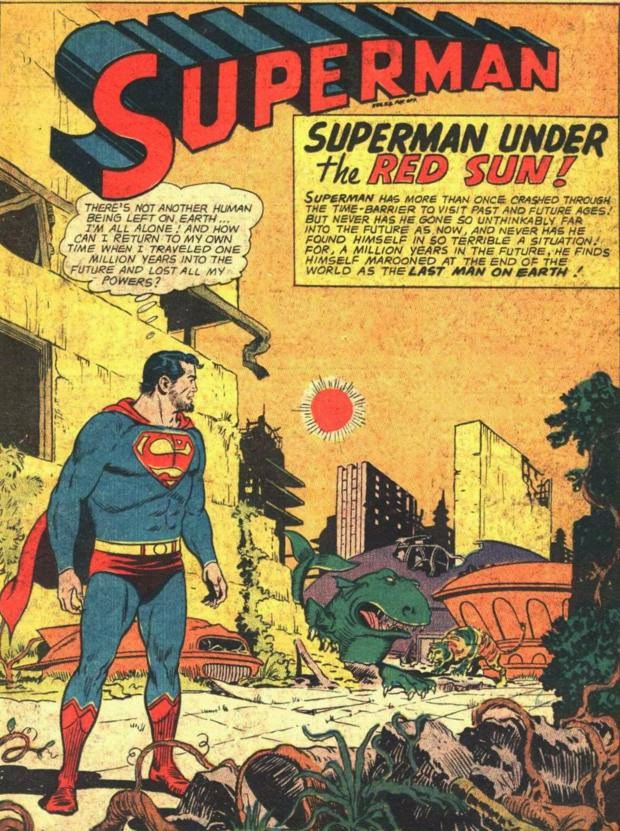
As noted before, Superman as Superman is not being spoofed here: Kurtzman mocks only one aspect of the character, his flagrant disregard for scientific law.  And though a myth-critic like myself can find symbolic complexity in many aspects of Superman's mythos, I have no problem admitting that the character is stereotypic in this respect. That he gets his science-defying powers from a yellow sun, or loses them in the presence of a red sun, are stereotypical devices to quickly explain why the hero does or does not have powers.


In neither case does one stereotype "defeat" the other, though. Readers of Superman often know that his powers make no sense in terms of real-world science, and so Kurtzman's satire cannot have any effect upon these readers' willingness to ignore verisimilitude for the sake of a pleasing fantasy.

It is possible for one stereotype to displace another, however. In Will Eisner's celebrated comic feature THE SPIRIT, the artist resorted in large part to "minstrel-show" stereotyping in producing the character of Ebony. None of the characteristics of Ebony-- his mush-mouthed speech, his blubber-lips or his deference to his white boss-- are acceptable stereotypes in modern culture.


However, was the Ebony stereotype displaced by anything comparable to an archetype? I would say that, while such a displacement was conceivable, what displaced the old stereotype was a new one.  Eisner, in this defense of Ebony, implies that the stereotype of the "Malcolm X-style radical" has usurped, or wishes to usurp, Ebony's place in the cultural scheme of things.


Eisner can be fairly criticized for distorting his past representations of Ebony. However, he seems to have been at least near the mark, as the stereotype of the "angry black man" is entirely acceptable to modern readers, however banal its representations may be.  I think this is the sort of usurpation my nephew was thinking about, where a "good stereotype" displaces a "bad stereotype"-- and archetypes as such are not really involved at all.


Next: Archetypes vs. Archetypes.