Featured Post

SIX KEYS TO A LITERARY GENETIC CODE

In essays on the subject of centricity, I've most often used the image of a geometrical circle, which, as I explained here,  owes someth...

Showing posts with label league of extraordinary gentlemen. Show all posts

Sunday, November 13, 2022

NEAR MYTHS: THE LEAGUE OF EXTRAORDINARY GENTLEMEN 1999 (1999-2003)


Though I gave higher mythicity ratings to two later iterations in the LEAGUE franchise, BLACK DOSSIER and the last third of CENTURY, I must admit that the first two episodes of the series, featuring both the formation and dissolution of this 19th-century "Justice League," are the most fun to revisit. 


The main reason for the greater fun quotient is almost certainly that in these stories Alan Moore was far more focused giving the reader the thrill of adventure rather than the Olympian perspective of satire. Moore and O'Neill still work in a sizable number of cross-references involving both fiction-history and real history, but herein there's no unwieldy attempt to weave together a couple hundred such quotations into a super-pastiche, possibly the most ambitious crossover of all fiction. Here the creators of LEAGUE concentrated on charting the interpersonal relationships of the five protagonists: Allen Quatermain of KING SOLOMON'S MINES, Mina Murray of DRACULA, Edward Hyde of DR JEKYLL AND MISTER HYDE, Captain Nemo of 20,000 LEAGUES UNDER THE SEA, and The Invisible Man of the Wells novel of the same name. There's such a rich tapestry of dramatic interactions that in this work alone, Moore effectively usurps the title of "Master of Melodrama" from its preceding title-holder, and so wins the coveted award of "The New Stan Lee."


I joke, of course. Though I would consider such a title  complimentary, it would direly insult Alan Moore to be considered like Stan Lee in any way, since he's made it clear (particularly in the final pages of TEMPEST) that he holds nothing but contempt for the late Marvel writer-editor. And of course there are many differences between the dramaturgical strategies of both Lee and Moore. Yet the give-and-take between the often quarrelsome "Gentlemen" resembles nothing in comic strips or books-- not Caniff, not Eisner, not Kurtzman-- so much as it resembles the trailblazing "heroes with problems" mindset of Stan the Man. It's possible that Moore had some notion of deconstructing Marvel Comics, as he had in the "1963" series from 1993. If so, Moore was spectacularly unsuccessful, and for that many readers can be profoundly grateful.


LEAGUE does approach myth-status insofar as it crystallizes Moore and O'Neill's often contradictory feelings about their native country. On one hand, the United Kingdom was, if not the womb from which modern popular culture was born, the midwife to its creation, and this is reflected in the fact that four of the five Gentlemen were created by UK subjects, with Nemo standing as the lone representative of La Belle France. On the other hand, from the 17th century through the 19th, the UK was also a major player in the spread of imperialism, and LEAGUE's creators constantly remind the reader that they should never forget the jingoism and material exploitation that stemmed from the British Empire. And yet the quintet of heroes, despite their uneasy alliance to the Empire, never fall into the trap of being spokespersons for sociopolitical causes. Nemo is the great rebel who finds himself helping the Empire because he wanted adventure in his life once more. Quatermain is more or less dragooned into espionage by the officious Miss Murray, which ends up being a prelude to their erotic encounters. Monstrous Mister Hyde largely subsumes his alter ego Jekyll but evinces a more profound form of humanity than the good doctor did, while The Invisible Man betrays his comrades in order to forge his own empire.


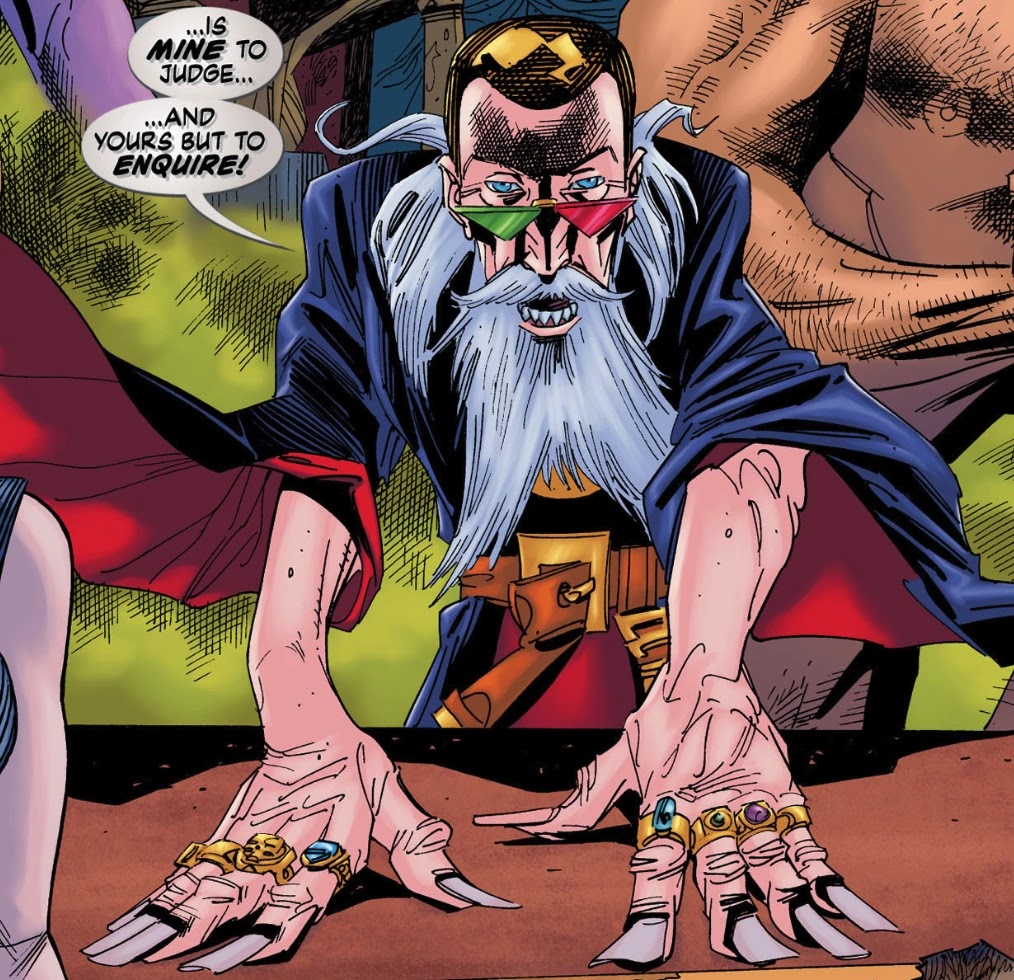
The creators choose the opponents just as deftly, and also from the pages of British fiction-writers. The first six-part adventure unites the Gentlemen against two master criminals vying for power, Conan Doyle's Professor Moriarty and a devil-doctor who is clearly supposed to be Sax Rohmer's Fu Manchu (but whose name is still trademarked and so can't be casually invoked even for pastiche purposes). The second six-parter, which chronicles the dissolution of the unstable team, is arguably even better as the Gentlemen cross swords with the heat-rays of H.G. Wells' Martians. Some of the dramatic turns are all the more impressive given that Moore has testified (in an interview for Jess Nevins' A BLAZING WORLD) that he did not have a long-term plan for both sequences. He suggested a future conflict between Hyde and Invisible Griffin in Book One before he even knew how said conflict would play out in Book Two. Mina Murray, the former victim of Dracula, bore the wounds of the vampire's brutal assaults on her throat, and this visual depiction later dovetailed impressively with certain parts of Allen Quatermain's backstory as elucidated by original creator Rider Haggard.


There are a few dozen "guest-stars." Some are preludes to more famous figures of later eras, such as the unscrupulous Campion Bond, whose perfidy prefigures Moore's trashing of his descendant James later on. But most of the guests are icons from famous fictional works, with even a few American ones, like Auguste Dupin and John Carter, making the cut. In the later volumes I could complain of Moore and O'Neill's treatment of Ian Fleming's Bond, and even more, of their maltreatment of Haggard's She-Who-Must-Be-Obeyed. But in GENTLEMEN 1999, I found their every choice note-perfect, just as I found that O'Neill's art captured the mythic vraisemblance of the Victorian era. 

I should note that crossovers, like popular fiction, really took off in the 19th century, with Scott's IVANHOE ringing in as one of the first, combining its fictional hero's exploits to those of Robin Hood. Haggard and Verne each wrote one famous crossover, with the former having Quatermain meet She, while the latter revived Nemo to encounter the castaways of the Mysterious Island. But GENTLEMEN 1999 is definitely one of the greatest pastiches, even if it's arguable that the "super-pastiche" of later years may turn out to be just as overburdened as... 

(Yes, I will say it...)

...THE MARVEL UNIVERSE!!!!

Friday, November 11, 2022

NEAR MYTHS: LEAGUE OF EXTRAORDINARY GENTLEMEN: TEMPEST (2018-19)

I put off reading the final collaboration of Alan Moore and Kevin O"Neill on LEAGUE OF EXTRAORDINARY GENTLEMEN in part because of the extraordinary un-evenness of CENTURY, which managed to shuttle from very bad to very good without any sense of transition. That said, a part of me wanted TEMPEST to be as good as the third part of CENTURY, if not BLACK DOSSIER.

However, this was also the project with which Moore and O'Neill purported to end their careers in comics (though O'Neill actually worked in the medium a little longer). I suspected that TEMPEST would wrap up the LOEG universe much the same way Moore concluded the PROMETHEA series, of which I wrote:

One of the myth-images that Moore invokes most frequently is that of the Biblical “Whore of Babylon,” though naturally the author turns the Christian connotations around, so the “whore” is just the other side of the “virgin” coin, and both are seen more as vehicles through which the energy of the Godhead manifests. Indeed, in some vague manner Promethea is also consubstantial with the Great Whore, in that both are supposed to bring the world to an end. Moore attempts to give his heroine this myth-status without delivering anything but an “apocalypse deferred,” which might seem fairly original if the author hadn’t used a similar trope at the end of his SWAMP THING run.

Given the above sentiments, one might think I'd welcome Moore committing to an actual apocalypse, in which he and O'Neill decisively "let it all come down" for not one but two fictional planets, Earth and Mars. But one would be wrong, for the simple reason that Alan Moore is much better at creating worlds than destroying them. 


Since the final book is named TEMPEST, and since the Moore-O'Neill version of Prospero stands behind the scenes pulling various strings, it was to be expected that the writer would abjure all the "rough magic" he used to create his world. This too he also did after the conclusion of an apocalyptic SWAMP THING run, where Moore, after a major crossover of DC's magical heroes, then spent pages lecturing his readers about the importance of ordinary life. And that's what Moore does here as well. He's not infrequently expressed ambivalence about delving into the archetypes of popular fiction, even though one can't imagine him having made such a mark in American comics had he sought to emulate Harvey Pekar. So here once again, Moore follows his dive into the archetypal subconscious by a renunciation of his fictional powers. Prospero is Moore's self-insert, bringing about the destruction of Earth and Mars for ill-conceived reasons, just to provide closure. Such closure isn't technically necessary. Unlike both SWAMP THING and PROMETHEA, Moore and O'Neill could, even after their respective deaths, legally ban any further iterations of the LEAGUE property. So in my opinion the real motive was that of desiring an end to the franchise that would distinguish it from the many endlessly-proliferating serial concepts.

Earlier episodes discoursed on the 20th century's development of costumed superheroes, but in contrast to the artist's general fidelity to the many creations of prose literature, Moore and O'Neill offer nothing more than an aimless concatenation of superficial pastiches. Marsman? Electrogirl? Hard to believe we got such bland spoofs from the co-creator of WATCHMEN. All of the stuff with the superheroes is a waste of space, and because CENTURY ended with the death of Allen Quatermain, Mina Murray doesn't get a very good character arc, though a little better than that of Orlando. In compensation, Moore and O'Neill give us the resolution of BLACK DOSSIER's conflict between their versions of Emma Peel and James Bond, both of whom gain their youth in time to greet the space-age delights of 2010 and beyond. But even if I didn't dislike Moore's jaundiced take on Ian Fleming's creation, this wouldn't be enough to hold my attention.


So in the end, it's mostly about Moore and O'Neill using their loose plot as an excuse for as many crossovers and references as they can fit in. And no one can accuse them of skimping. Some characters are named outright, like the Thinking Machine and Stardust the Super Wizard, while Sherlock Holmes and Professor Moriarty are worked into the continuity once more for this last hurrah. Many other characters just make unidentified cameos: the Beagle Boys, Tower Comics' Iron Maiden, a gorilla with a bandolier (probably Monsieur Mallah) and a house that seems to be "Usher II" from the Ray Bradbury story of that name. All of these O'Neill renders in his unique style, but I didn't get the sense that their parts contributed to a greater whole, as I did with BLACK DOSSIER.

The basic problem with TEMPEST is that it doesn't really depict the development of pop culture icons the way the first two volumes did. Possibly no one could manage to cope with the astounding proliferation of such icons not only in comic books and strips, but also in movies and television as well. Thus Moore and O'Neill just stuck in whatever characters caught their interest, be it a version of 1904 comic-strip obscurity Hugo Hercules or Grandpa Munster. There's some fun to be had with such freewheeling association, but they didn't manage to make a myth this time.


And I would be remiss not to comment that Alan Moore's tired anti-Stan Lee jeremiad is on display in a "funny" sequence riffing on a sequence from the Silver Age wedding of Reed Richards and Sue Storm. The tiresome joke didn't make me mad, and I might even examine its presumptions in a separate essay. But I will end by saying that it shows Moore's animus toward the very "century" in which he was born, toward his inability to make the world work the way he wants-- to which his fantasy-impulse is, of course, to blow it all away.


Monday, April 25, 2022

MYTHCOMICS: "LET IT COME DOWN" (LOEG: CENTURY #3, 2012)


Although my title references only the third part of the Moore/O'Neill CENTURY trilogy-- one of the last few offerings in the LEAGUE OF EXTRAORDINARY GENTLEMEN property-- I'm actually going to discuss all three parts, albeit briefly for Parts One and Two.

The title "Century" references the time-span of the three books, in which the three central characters attempt to head off a magical apocalypse. All three had appeared in earlier LOEG comics, with Mina Murray (of DRACULA fame) and Allan Quatermain having been charter League members, while Orlando, an amalgam of the medieval Roland and the immortal Virginia Woolf character, appeared slightly later. For most of the story Mina and Allan have become as immortal as Orlando, but their longevity doesn't seem to be of that much help. They spend most of their time chasing vague clues around London and getting railed at by their Blazing World boss Prospero, while Moore and O'Neill devote copious space to side-plots.


Part 1, dated "1910," is the least interesting of the chapters, largely because of Moore's peculiar conceit of subordinating his pop-fiction characters-- some semi-original, like the daughter of Captain Nemo-- to a long and pointless homage to Bertolt Brecht's THREEPENNY OPERA. The overbearing didacticism of Moore's script reduces this segment to the status of a null-myth, though Moore and O'Neill work in a ton of "occult investigator" types to set up the main menace. The most consequential homage is Oliver Haddo, who in Somerset Maugham's 1908 book THE MAGICIAN, creates supernatural entities called homunculi. Moore melds this Maugham concept with a "moonchild", a concept from real occultist Aleister Crowley and with the Antichrist of the Bible.


Part 2, dated 1969, takes place after both BLACK DOSSIER and a 1964 text-story I chose to bypass. Mina, Allan and Orlando return to London to pick up the trail of Haddo once more, but again there are a bunch of side-plots about gangsters and drug-addled musicians that don't come to much. In contrast to the three immortals, Haddo has managed to survive by continually transferring his consciousness into younger bodies. Mina foils Haddo's plan to transfer his mind into the body of a rich rock-star, but he still manages to take refuge in someone else's form, while Mina accidentally gets packed off to an insane asylum. Her disappearance estranges Allan and Orlando and they break up, with no intervention whatever from their mystic master. Moore and O'Neill don't succeed in emulating any aspect of the 1960s but the emphasis on psychedelia, though without getting into the reasons psychedelia was significant to the culture. Still, there's enough good psychological interaction between the principals that I'd term this a "near-myth."


With CENTURY #3, dated 2009, Moore and O'Neill finally get down to brass tacks. Prospero conveniently waits until the Antichrist Apocalypse is almost nigh to belabor Orlando for having lapsed in his duty. During that time, immortal Mina has remained in an asylum for forty years, and the bereft Allan has become hooked on drugs again. But thanks to Prospero's tardy bitching, Orlando decides to call upon British intelligence to find Mina. This plotline works because it follows logically from a subplot from BLACK DOSSIER, as Orlando encounters what is essentially a doppelganger for TV's Emma Peel. (In fact, all of the female characters from the two AVENGERS serials make appearances in CENTURY #3.)


Thanks to MI-6's information, Orlando finds and liberates Mina Murray. Unable to elicit further help from Allan the addict, the two heroines try to track down the Antichrist, who was born over twenty years ago and cultivated in what sounds like the other-world of Harry Potter-- all under the manipulation of the continually reincarnated Oliver Haddo. Finally Orlando and Mina confront the monstrous Moonchild, seeking to delay the demented creature until Prospero can send help, and Allan comes to their aid at the eleventh hour, only to meet his doom. The Moonchild, by the way, has some brilliant lines: seeing the two mortals challenging him, he complains, "I thought you'd at least be Jesus or an angel or somebody." 

Though the Moonchild/Antichrist isn't a pop-fiction character, Moore sagely chooses just such an icon to vanquish the abomination: a never-named female who is in essence a cosmic version of Mary Poppins. (She destroys the Moonchild by reducing him to a chalk outline.) Orlando and Mina are left to mourn Allan, though their ally "Not-Emma-Peel" helps them return the adventurer's body to his adopted land of Africa. I assume that this denouement is an indirect tribute to the second Quatermain book by Rider Haggard, in which the hero dies (despite getting about six "prequel novels" afterward). Oddly, the LEAGUE OF EXTRAORDINARY GENTLEMEN film contrived a similar death for Quatermain, but I think it axiomatic that Moore, who has expressed antipathy for all of the film adaptations of his work, probably did not mean to homage this movie.

Of the four or five remaining LEAGUE works, I've read one and found it below par. I may force myself to read the rest in due time, but I'd almost like to imagine that the series ended with "Let It Come Down," despite all the damned Brecht references.


Friday, December 31, 2021

CRYPTO-CONTINUITY AND DOPPELGANGBANGERS PT. 2


I ended Part 1 on this observation: that even though it was possible for raconteurs to use the name of a famous literary character for any number of secondary doppelgangers, the mere use of the name did not confer a prior status or charisma upon a doppelganger that shared no points of continuity with the original. Thus, a few dozen Dracula-doppelgangers may register as either strong or weak template deviations of the Stoker creation—but “Dracula, Superhero” did not. The latter would be a “total template deviation,” in that he has no gradations of “strong” or “weak” points of continuity.


A similar “total deviation” appears in the case of impostors who assume a familiar guise for some clandestine motive. A few months before Marvel Comics revived the 1940s hero Captain America, Stan Lee had a criminal impostor, the Acrobat, assume the guise of the WII hero in order to deceive the Human Torch. The Acrobat was a total deviation because he clearly shared no continuity with any previous version of the star-spangled adventurer. 


Once a continuity was forged between the forties and sixties version of the character, a “retcon” had to be devised to explain away a previous fifties-era iteration of both Captain American and his sidekick Bucky. Those characters then became demonstrably separate from the original iterations.


The clandestine motive may even remain hidden only from the doppelganger. In the amusing script for issue #4 of THE JOKER, an actor playing Sherlock Holmes suffers amnesia, and becomes convinced that he is Holmes. He then assumes the Holmes persona in order to track down and defeat the Clown Prince, though neither the Joker nor any reader of the comic thinks that the actor is the real thing.


Cycling back in the other direction, it’s possible to have a valid template derivation even without using a famous name, by invoking only images or tropes familiar to an audience. A major plotline of the first LEAGUE OF EXTRAORDINARY GENTLEMEN sequence includes a turf war in 1890s London between perennial Holmes-foe Moriarty and a mysterious figure called “the Doctor.” Moore used both images and verbal tropes to imply that the Doctor was Fu Manchu, but he never named the character since Fu Manchu is still trademarked, unlike all the public-domain characters in the LEAGUE franchise. 


Similarly, Moore may not have been sure as to whether the prose-and-film character Bulldog Drummond was free and clear. Thus when a version of the character appears in BLACK DOSSIER, Moore changed the doppelganger’s given name from the “Hugh” of the original prose books to “Hugo.” Ironically, the prose character is barely known to modern audiences, having been eclipsed by cinema’s heavily glamorized “strong template deviation,” but Moore’s “Hugo” bears more resemblance to the rude, brutish character in the original prose series.


However, also in DOSSIER we find a “total template deviation” of a different nature: the spoof. The story also includes “Jimmy,” an easily recognizable parody of James Bond, but Jimmy has no significant points of commonality with the Bond of either prose or films. Moore created Jimmy to mock what he deemed the unlikable aspects of James Bond, but he lays it on so thick that the reader no longer believes that there exists any continuity between the two agents, any more than one could believe that “Bats-Man,” a spoof of the 1966 BATMAN teleseries, had anything in common with any version of Batman.


Some points of continuity may exist when the doppelgangers are not merely impostors, but re-creations of the originals that invoke specific memories in those that observe them. In the story “Santa Claus in Wonderland,” Santa never actually meets any denizen of that Lewis Carroll domain; he merely dreams his encounters with Alice, the Mad Hatter et al. But these dream-figures maintain at least a weak continuity with the originals, because Santa imagines that they are like the characters in the books (which for the most part, they are).


However, in SCOOBY DOO 2, the teen detectives and their Great Dane encounter doppelgangers who are artificially concocted versions of ”spooks” who were all originally just costumed human beings. As entertaining as it is to see the Scooby Gang attacked by a “legion of doom” that seems made up of their old enemies, these artificial menaces no more share identity with their originals than a Hulk-robot does with the Incredible Hulk.


One more "total deviation" will suffice for the time being: the type openly based on some familiar characters but who are meant to be entirely separate characters. The four main characters of MONSTERS VS. ALIENS do not claim to be identical in any way with their 1950s SF-movie models, who are, going left from right, the Fly, the Fifty-Foot Woman, the Creature from the Black Lagoon, and The Blob. Because they don't share any continuity with their models, MONSTERS VS. ALIENS does not qualify as any kind of crossover, though it is a "mashup," in which diverse characters with some similar aspects but also with different backgrounds are jammed together in one narrative. It might be fairly argued that all crossovers may be called mashups, but that all mashups are not crossovers.

Wednesday, November 29, 2017

BLAZING RATIOCENTRISM

Alan Moore's 2007 BLACK DOSSIER was the first time I'd ever heard of THE BLAZING WORLD, a utopian fiction published in 1666 by Margaret Cavendish, the Duchess of Newcastle. From what I've read online, Cavendish's work has only been revived in the last decade or so by feminist scholars.

I've now read THE BLAZING WORLD, though not any of Cavendish's other works, most of which tended to fall into the format of Renaissance-era philosophical discourses. WORLD's level of philosophical thought feels fairly derivative of the Greek and Roman authors then being re-discovered in Europe, supplemented by a few tropes dear to the heart of English aristocrats, such as the topic of aristocratic rule. It's probably not fair to judge Cavendish by WORLD alone, since utopian novels are generally boring affairs, including the 1516 Thomas More work that started the whole thing. But though I can validate feminist academia's project to reclaim lost female voices from the days of a dominant patriarchy, I have my doubts, based on WORLD, that Cavendish ranks as more than a curiosity. Certainly it's silly to deem WORLD "the first science-fiction novel," just because Cavendish's utopian otherworld includes SF-tropes like hybrid animal-men. If you're going to judge a work as science fiction simply because of the presence of such tropes, then Cavendish is obviously still a long way from first, out-firsted by the classical author Lucian of Samosata. It's possible that the main reason Moore referenced Cavendish was because of the work of those aforesaid feminist scholars, because there's not a lot of common ground between the respective themes of Moore and Cavendish.

In short, Cavendish's WORLD is an example of what I've caused ratiocentrism. Her viewpoint character, a young noblewoman called "the Lady," is precipitated into what SF-authors now call a parallel world. The Lady is instantly married by the Emperor of the Blazing World. As Empress, she's in the position to learn about all the government and philosophy of her new realm, though there's never much of an explanation about the otherworld's most prominent feature: humanoids with animal aspects, such as "bird-men," "bear-men," and, perhaps most improbably, "lice-men." All of the animal-men have particular societal functions, which sounds like a simple restatement of the Great Chain of Being, as re-formulated by European Christian scholars. This is one of the things that seems least like Alan Moore's anarchic system of belief, and though he puts the animal-men into his version of the Blazing World, he doesn't assign them any particular thematic function. Either he or artist Kevin O'Neill did stick in a cameo shot of one moderately famous insect-man: "Turan," mentor to the Simon and Kirby Silver Age character "the Fly."

I believe that Moore's re-use of the Blazing World is in essence just another synonym for the occult concept of "the astral plane," on which Moore had already descanted in his 1999 PROMETHEA series for ABC Comics. But whereas Moore is fascinated with the influence of the irrational upon human thought and desire, Cavendish clearly falls into the category of reason-worship. In one section, the Empress rails against the abstruse syllogisms of the realm's logicians, who are satirically pictured as descended from magpies, jackdaws, and parrots. The Empress says:

I have enough, said she, of your chopped logic, and will hear no more of your syllogisms, for it disorders my reason, and puts my heart on the rack; your formal argumentations are able to spoil all natural wit; and I'll have you to consider: that art does not make reason, but reason makes art, and therefore as much as reason is above art, so much is a natural rational discourse to be preferred above an artificial: for art, is for the most part, irregular, and disorders men's understandings more than it rectifies them, and leads them into a labyrinth whence they'll never get out...

In the end, though the Empress does not forbid the bird-men to carry on their logic-chopping, she stresses that they need to keep these labyrinthine meditations to themselves, rather than letting them escape to cause societal unrest with the greater populace. I think I'm justified in seeing the long shadow of Plato-- or rather, of his own fictional utopia, the Republic-- as having provided the better part of Cavendish's ideas about reason's precedence over art.

I don't know exactly why Moore chose to allude to Cavendish's concept, though it may be largely because she's a female creator from the generation immediately after that of Shakespeare, whose influence is much more significant in DOSSIER. I strongly doubt that Moore worships reason as Plato' and Cavendish do, given that Moore concludes DOSSIER by talking about what I termed 'the opposition between "matter's mudyards" and the "radiant synthesis" of this multi-story mashup.' But then, no author ever really adapts another author with complete fidelity. Kenneth Branagh's adaptation of HAMLET is really Kenneth Branagh's HAMLET, not Shakespeare's, Steve Ditko's SPIDER-MAN is nothing like the raw Simon-Kirby concept with which Ditko started, and Alan Moore's idea of THE BLAZING WORLD is only minimally connected with that of Margaret Cavendish.

Tuesday, August 16, 2016

MYTHCOMICS: LEAGUE OF EXTRAORDINARY GENTLEMEN: BLACK DOSSIER (2007)


The first two volumes of the Moore/O'Neill LEAGUE OF EXTRAORDINARY GENTLEMEN are easily the most entertaining entries of this series. In contrast, many fans were put off by DOSSIER, which was not originally intended to be a part of the series proper, only a "sourcebook." However, despite what DOSSIER lacks in straightforward narrative, it does succeed in generating more mythic value from its use of characters from both "high" and "low" forms of literature.

The original LEAGUE is an ingenious crossover/ mashup of several public domain concepts and characters, most of which originated in British fiction of the Victorian period, though some figures from French literature (Verne's Captain Nemo) and American literature (Poe's Dupin) make appearances. There are some important myth-motifs in the first two adventures, but though I liked them much better than, say, Kim Newman's mashup-novel ANNO DRACULA,  there's not a single overriding theme in either volume.

BLACK DOSSIER may be fairly called over-ambitious. The story brings the series into the 20th century, as the remnants of the 19th-century League-- rejuvenated versions of Mina (DRACULA) Murray and Allan (KING SOLOMON'S MINES) Quatermain-- infiltrate the British spy-agency MI-5 in the year 1958. However, this 1958 Britain is one whose history has been compromised by Moore's interpolation of fictional scenarios. One scenario is the "Big Brother" government from Orwell's 1984, that has only recently been overthrown. Another is the development of both manned and unmanned space-flight, which allows Moore and O'Neill to work in references to a variety of British SF-adventure serials ranging from DAN DARE to various Gerry Andersen puppet-shows.

Murray and Quatermain manage to escape MI-5 with the organization's "Black Dossier" on the League's activities, after having a violent encounter with an agent named "Jimmy," clearly a satire on Ian Fleming's James Bond.


I've already commented extensively on my disagreements with Moore's estimation of the Bond character, so I won't repeat myself on that score. Still, Fleming's Bond is just the tip of the spy-berg. Much of BLACK DOSSIER is devoted to sussing out the history of British spycraft as seen through the lens of its fictional incarnations, ranging from the novels of John Buchan to the Graham Greene-scripted film THE THIRD MAN. As a reader with only a moderate interest in spy-fiction, I am intrigued but not fascinated with Moore's espionage mashups, which include an attempt to ground English espionage in a lost work by William Shakespeare, which includes in its cast Prospero of TEMPEST fame.

I seriously doubt that if Moore and O'Neill's work had actually appeared as a sourcebook-- that is, with no narrative content-- that it would have clarified anything for either new or ongoing readers of the LEAGUE. First and foremost DOSSIER is concerned with Moore's passion for literary mimicry, as he provides readers with detailed imitations of diverse authors-- the aforementioned Shakespeare and George Orwell, Virginia Woolf, John Cleland (of FANNY HALL fame), P.G. Wodehouse and Jack Kerouac. I doubt that there's any theme linking all of these authors, but some of them at least may be have been perceived by Moore as allies in his quest for erotic self-expression. DOSSIER is not an erotic work per se, like Moore's LOST GIRLS, nor a polemic in defense of pornography, like his essay 25,000 YEARS OF EROTIC FREEDOM.  Nevertheless, there's a fair amount of nudity and allusions to shagging, which are clearly meant to provide a leitmotif to all of the "troubles with spies."

Also used more as a leitmotif than an outright theme is the authors' concern with a near-ecstatic love of stories. The loose implication of the narrative seems to be that while mundane spies like Bond and Harry ("Third Man") Lime are merely concerned with promulgating real-world power, Murray and Quatermain have become the defenders of the imaginal world of stories-- which is of course the matrix from which both characters were born, and which they visit near the conclusion.


I don't imagine Moore and O'Neill worried that much about whether they'd made a sound argument distinguishing the opposition between "matter's mudyards" and the "radiant synthesis" of this multi-story mashup. They are concerned with persuading the reader through allusion to all of his favorite myths-- as long as those myths don't include James Bond--and as a lover of crossovers, I confess that they've succeeded in the affective sense. My cognitive side would argue that Moore is not enough of a poet or a philosopher to pull off this multi-referential synthesis, but I still find BLACK DOSSIER persuasive, despite all of Alan Moore's personal quirks.

Though tempted to wrap up here, I can hardly pass over the subject of the Golliwog.


This site relates a brief history of the Golliwog's history as a literary creation, as an icon derived from minstrel show imagery, and as a racial denotation which still causes no small irritation in modern times. Of course, in the current political atmosphere it's impossible for an author to utilize any racial myth unless he uses it as an ideological condemnation of racist belief-systems. Moore does imply such a critique in DOSSIER, not least because the googly-eyed, thick-lipped Golliwog is seen defending Murray and Quatermain against three agents of the repressive British hierarchy: the caddish Bond-knockoff and his allies, Miss Night and Hugo Drummond. The former is a rather hollow imitation of Emma Peel of AVENGERS tele-fame-- Moore's talent for mimicry doesn't extend to giving Night any of Peel's characteristic wit-- and she proves irrelevant to any argument involving racial representations. However, Hugo Drummond does not. It's likely that only Moore and a handful of his readers would know that this character is transparently based on the once popular British prose-hero Hugh "Bulldog" Drummond. In contrast to the Hollywood films featuring the character, which made Drummond into a sort of handsome gentleman-adventurer like The Saint, the original British novels are masterpieces of racial invective. The original Bulldog sinks his teeth in all of the enemies of White Britain-- mostly Jews, Commies, and "wogs" of all types-- and Moore is dead-on in portraying Hugo Drummond as equally acidulous to the aliens in his midst. Shortly after the scene in which the supernatural Gollywog stuns the pursuers with a great yell, Drummond calls the Gollywog a "coon" and goes after him, only to be diverted later and turned against the Real Enemy: namely the faux-Bond and his secret American bosses.

I've purposely avoided looking about the web to see how Moore may have defended his use of the Gollywog. I've repeatedly defended even offensive racial myths on the basis of imaginative freedom, and despite Moore's defense of the importance of stories and story-telling, I'm not quite sure he's on that same page in a conscious, ideological sense. Nevertheless, he and O'Neill clearly didn't just roll out this minstrel-show icon for the purpose of insulting black people, nor for the debatable pleasure of indulging in "white privilege." Their precise motive doesn't interest me, but what I think they've achieved is akin to Jung's coincidentia oppositorum: in which two diametrically figures are brought into contact, so that those observing them can better suss out their natures. At the very least, the ideological critics might have made something of the fact that the real-life racist "hero" was the tool of evil, while the cartoonish racial caricature was indubitably a supporter of liberation. However, it's no surprise to me that nearly no one could read BLACK DOSSIER as anything but Moore failing to fall into line with the lofty precepts of political correctness-- which in the 21st century have in effect become The New Face of Big Brother.


Monday, March 18, 2013

OUR ARMIES AT WAR, WITH MONSTERS

Part 1 and Part 2 of DYNAMICITY DUOS I discussed some of the ways in which individual characters, or small groups of characters, might pass from a lower level of dynamicity to a higher one.  With respect to such characters as Ellen Ripley of the ALIEN franchise, I demonstrated how such a character could begin at the "middle" level of dynamicity and then, in the course of the narrative, pull herself up by the proverbial bootstraps to the "high" level.  Even so, in the film ALIENS Ripley remained remained on the low end of that level, that of the "exemplary" as opposed to the "exceptional" level of her alien opponent. Later, ALIEN: RESURRECTION would transform the heroine into something more than human.

I also want to touch on the question of military might, which is often seen employed by large rather than small groups of characters, a might often pitted against the focal presences of giant monster-films.  I also touched on this principle with respect to small character-groups in TWICE THE MIGHT PT. 2, noting:

...whereas the sense of escalation to a final confrontation is absent from ANGRY RED PLANET, FORBIDDEN PLANET builds this sense by virtue of the baffled astronauts as they attempt to learn the nature of their invincible enemy.

To be sure, when the Id Monster is defeated, it isn't because of the clash between the weapons of Earth-science and the power of the Krell machines. The Monster is defeated by undermining the source of its power in Morbius, who is in essence the Monster's Achilles heel.

Nevertheless, without the clash of energies that establishes how potent the Id Monster is, there would be no narrative perception of the need to seek such a vulnerable point.
Prior to FORBIDDEN PLANET, another 1950s SF-spectacle followed essentially the same pattern.  In Ishiro Honda's 1954 GODZILLA, the audience witnesses the incomparable power of the focal monster.  Though the armies of this film are contemporary ones, as opposed to the far-future forces considered in TWICE THE MIGHT 2, the level of force unleashed by the Japanese military is functionally covalent with the forces unleashed by the heroes of FORBIDDEN PLANET.  The monster is at least affected by the intensity of these forces, though on the whole Godzilla is able to overcome everything humanity throws at him, including a huge electrified fence.


However, one genius-scientist, the war-weary Doctor Serizawa, is able to redeem mankind by unleashing a technological weapon which even Godzilla cannot resist: the deadly "oxygen destroyer," which reduces the giant creature to a skeleton-- though the resilient reptile manages to come back for further rampages in the many sequels.  Serizawa's invention is a tangible expression of the force that mankind as a whole can bring to bear.  So the 1954 GODZILLA qualifies as a combative film, since it both centers upon the results of the combat (the narrative value) as well as evoking the sense of sublime power (the significant value).

Consider in contrast, however, the 1953 adaptation of H.G, Wells' novel THE WAR OF THE WORLDS.  There's no question that the film evokes the grandeur of clashing powers as the American military strives in vain to bombard the near-invulnerable vessels of the Martian invaders.


However, though this would be another example of a work in which the X-level of dynamicity was expressed by both contestants in the significant sense-- exemplary for the military, exceptional for the Martians-- it would not be combative in the narrative sense.  In the film as in the Wells novel, what saves the human race is not some last-minute strategy or new weapon, but a lucky break having nothing to do with Earth's defenders.  In the book, Wells stresses only irony in the fact that the Martians perish from Earth-bacteria, while the 1953 film reverses this ideological interpretation, regarding the bacteria's presence as an expression of divine providence.  But regardless of which interpretation is favored, in neither case can Earth's defenders take any credit for the Martian defeat.


A very different rewriting of this Wells-conclusion appears in the last part of the Moore-O'Neill LEAGUE OF EXTRAORDINARY GENTLEMEN VOLUME 2.  The starring characters are all involved in the battle against the Martians' second invasion, though neither Nemo's submarine nor Hyde's supernormal strength are able to do more than to give pause to the aliens.  What defeats the Martians in this second encounter is a mutant strain of bacteria developed by the army and dispenses by the League's government contact Campion Bond.  As in the examples of FORBIDDEN PLANET and GODZILLA, this germ-warfare is yet another last-minute "new weapon" which should be racked up to the account of Earth's defenders, even though Moore typically has his characters express horror at its utilization.  Two of the League-members, Quatermain and Murray, are even implicated in this dubious triumpth in that the two of them unknowingly convey the germ-weapon to their commander.
Admittedly the British army in this story is not as central an opponent to the monsters as the armies seen in the 1954 GODZILLA and the 1953 WAR OF THE WORLDS; the members of the League are the central opponents.  Nevertheless, the combative mode is not dispelled simply because the particular triumph comes about because of the actions of supporting characters.  As long as those supporting characters are strongly allied to the central protagonists, they can be viewed as an extension of the central protagonists' unified will.

One sees this "triumph of the supporting ally" in many venues, so I'll confine myself to one from Marvel's IRON MAN #5, where Iron Man's battle against the computer-villain "Cerebrus" (no relation to the Dave Sim character) is concluded by one such support-character.


Monday, November 19, 2012

STALKING THE SYMBOLIC SNIPE


In a recent issue of my comics-apa, the question arose: can one fairly make symbolic interpretations of a work when there’s no evidence that the creator of the work intentionally structured the work to reflect that symbolism?

On one hand, any answer one gives must take into account the centrality of symbolic action to the experience of fiction.  The human mind has the ability to associate the nature of a fictional character—that is, whether he represents “goodness,” “badness,” or something in between-- with the reader’s concerns, so that the reader can identify (whether in a mood of sympathy or antipathy) with that character.  Without this ability, fiction holds no meaning.  It might be tempting to dispense with any symbolic associations that are not explicitly called up by an author’s text.  But direct allegory, while to some degree present in all fiction, is not the way most authors express themselves.  Perhaps the reason so many critics must hunt literary meanings is because authors have evolved so many ways to camoflague their symbolic themes and motifs.

On the other hand, everyone has seen examples of critics who can be fairly accused of “snipe-hunting”—with the modification that in such cases, it’s the critic who creates his own Monster of Deep Meaning and proceeds to hunt it anywhere and everywhere.  The first semi-thoughtful critiques of the comics-medium boiled down to snipe-hunts, where the critics found in comics symbols of immoral modernity and psychosexual perversion.

One approach, possibly designed to circumvent the problem, takes a relativist tack.  One of my apa-members described having seen a poet who, upon meeting a reader who subjected the poet to a long and earnest critique of his Real Meaning, responded to that reader, “If you see that there, then I meant for it to be there.”  The poet may have spoken this way to avoid a conflict, or he may have been of the honest opinion that there are no untrue responses to a given work.

I would frame the problem differently: there can be untrue responses, but they may spring from true causes.

In the same apa-issue that continued this mini-debate about symbol-hunting, another member cited the opinion of writer Alan Moore on the best-known character of another author: Ian Fleming’s James Bond.  Quoting from an introduction to Frank Miller’s THE DARK KNIGHT RETURNS, Moore said:

“…we begin to see that the overriding factor in James Bond’s psychological makeup is his utter hatred and contempt for women.”

Years later, Moore would produce a satirical version of Bond for BLACK DOSSIER, a chapter of his LEAGUE OF EXTRAORDINARY GENTLEMEN series, in which Moore’s Bond-doppelganger was in every way a rotter, an abuser of women, etc.


Moore’s second commentary on what he thought of James Bond, since it takes the form of fiction, cannot be deemed criticism as such.  His first comment can, although it’s extremely weak criticism. 

Nowhere in the introduction does Moore cite examples of the “utter hatred and contempt for women” he finds in the Bond books, nor is he clear as to whether Fleming presented his misogyny overtly or covertly.  I *suspect,* however, that at the time of the comment Moore knew that Fleming, though predominantly an author of “male” fiction, did have female readers.  Thus Moore would be most likely to claim that Fleming’s female readers did not pick up on the misogyny of either author or character because it was hidden, though not from the discernment of a dedicated snipe-hunter like Alan Moore.

In case it isn’t evident from my calling Moore a “snipe-hunter,” I do deem Moore’s critique of Fleming to be a case of an untrue response to the symbolism present in the Fleming Bond-books.  That response does however spring from true causes, both within the fiction being critiqued and within the critiquer.

Ian Fleming was, in essence, what critics today would call a “masculinist.”  Many authors have written fiction aimed at a predominantly male audience without being masculinists. Bond’s multiple conquests of beautiful women were a staple device in popular men’s fiction.  Fleming is often attacked for this trope, but that in itself does not make him excessively masculinist.  Moore’s animus for Fleming may have originated from Bond making sexist remarks that were typical for men of that period.  Some of these remarks mock women, or show confusion about women.  But do they connote “utter hatred and contempt for women,” or are they attempts to capture the real way men of the period spoke? 

Based on my own readings of the Bond books, I do consider Fleming an arch-conservative who had little empathy for anyone outside of his own bailiwick.  That lack of empathy for women, however, does not translate into “hatred and contempt.”  A woman-hater might pretend to defend women from attacks in order to bed them, but Bond does not bed Tiffy in “Man with the Golden Gun” after villain Scaramanga kills her pet birds; instead, he gives her money to buy new birds and never sees her again.  One can’t imagine Moore’s phony Bond sparing the life of the female assassin in “The Living Daylights” out of a knightly reluctance to kill a woman.  Despite Fleming’s masculinist tendencies, the Bond books are replete with powerful or imposing women, ranging from villainesses like Rosa Klebb and Irma Bunt to heroines like Domino Vitale and Tracy Draco—possibly one reason Fleming has sustained a female readership.

The other “true cause” results from the critiquer’s own biases and priorities, which are inevitably present in all readers.  The most desirable relationship between reader and work is one I call “projected reciprocity,” in which the reader faithfully absorbs everything the author says, whether direct or indirect, and projects it upon the “viewscreen” of his own priorities, to gauge in what ways he agrees and/or disagrees with the author’s world.

However, when the reader rushes to judgment as I believe Alan Moore did, what one gets is “pure projection.”  Here the reader is “set off” by whatever offends him and recognizes no ambivalences.  A reader like Moore may have “true” cause for his animus against, say, real-world misogyny, but he’s aimed his ire at the wrong target.

Whenever I attempt to “read” the latent symbolism of a work—by which I mean, whatever the author has not made literal and manifest—I frame it as a philosophical proposition, for which I can offer proofs drawn from my own experience of “projected reciprocity.”  Because so much symbolism is covert—sometimes hidden even from the author—the propositions of a symbol-hunter are not so much “X symbolism is there” but rather “X symbolism could be there, if it can be justified by some chain of associations.”  But even these justifications must be mediated by a reader’s subjective reaction to the work.  So it’s understandable that for many, even the most articulate search for covert symbolism may seem no better than an Alan Moore snipe-hunt.