Featured Post

SIX KEYS TO A LITERARY GENETIC CODE

In essays on the subject of centricity, I've most often used the image of a geometrical circle, which, as I explained here,  owes someth...

Showing posts with label bob haney. Show all posts

Sunday, August 10, 2025

VARIANT REVISIONS PT. 2

 Some of my current terminology re: "originary and variant propositions" was preceded by the two essay-series CRYPTO-CONTINUITY AND DOPPELGANGBANGERS, starting here. In those essays I more or less used "template" to stand in for the current "originary proposition," "template deviation" to stand in for "variant propositions," and "total deviation" to stand in for "null-variant propositions." All of these terms, though, are predicated on analyzing the propositions "from outside," seen from the POV of the "real" reader.

However, it's not impossible to see many if not all such variations "from inside," as if all of the propositions weren't just created by isolated raconteurs but were instead variations on archetypal tropes that precede even the first "originary proposition." 

It's true thar often the originary proposition is the strongest one in terms of evoking one or more of the four potentialities, which is why I previously compared such propositions to the sort of template used, say, in early printing technology. I mentioned in the CRYPTO series major icons like KING KONG and DRACULA, and it would be hard to argue that any of the variations on these figures, however entertaining, exceeded the originals in any way. 


  However, there are times that the originary proposition is not the most compelling, even on simpler levels. The durable Terrytoons stars "Heckle and Jeckle" are known by most viewers as a pair of wisecracking male magpies. However, the first cartoon in the series, 1946's "The Talking Magpies," posited them as a married male-and-female couple that caused no end of trouble for Farmer Al Falfa. Paul Terry then chose to issue a "rebooted" Heckle and Jeckle that same year with "The Uninvited Pests," and as two identical males with differing accents, the characters enjoyed another 51 theatrical cartoons. So in terms of popular success, the variant proposition was the more successful, not least because two obnoxious males could be used in many more slapstick situations than a married magpie pair.


Now, if one wanted to take the archetypal perspective I suggested above, one could imagine two parallel worlds, one in which Heckle and Jeckle were both male, and one in which they were a married couple. Most fictional propositions regarding parallel worlds are not much less chimerical. The parallel-world explanation for duplicate versions of DC characters such as Flash and Green Lantern sometimes verged on expressions of archetypal realities, though usually in fairly clumsy terms. The first Green Lantern begins very poorly-- I read the first volume of Golden Age reprints and could barely see any reasons for the success of the character beyond the base idea of a hero with a wonder-working "magic ring." Later in the series writers conceived a few subordinate characters-- Solomon Grundy, Vandal Savage-- evocative enough that DC Comics made them major figures in the company's later cosmology. But I'm not sure that, taken just on their Golden Age appearances, Grundy or Savage were as good IN THEIR TIME as the better villains of that era, from serials like Batman, Wonder Woman, or even Airboy and The Hangman. In contrast, the Silver Age Green Lantern, which crossbred the rudimentary Alan Scott concept with the "space ranger" ideas of the prose "Lensmen" series, displayed excellence in the kinetic and mythopoeic potentialities within a few years.


Even "soft reboots" within the same cosmos-- which make no use of "parallel worlds" as such-- are often treated as constituting variant propositions in, say, fandom-wikis like the DC Database. The 1988 ANIMAL MAN, reviewed here, dispenses with any idea that two separate Animal-Men co-exist in two distinct worlds. Rather, the first one knows that he was created by one author and rejected in favor of an updated hero with the same name by another author. Yet at the same time, Grant Morrison suggests that there's some loosely archetypal limbo where even the lamest characters ever created (hello, Ultra the Multi-Alien) continue to exist. And some soft reboots are performed not through intention but through error. In the first VARIANT REVISIONS, I took pains to analyze how Bob Haney first created a reasonably evocative mystery villain in one TEEN TITANS story. Yet when Haney later needed a make-work villain to plug into a hastily conceived scenario, the writer simply rewrote the established character's motivations to suit his current needs. As if to compound the error, George Perez constructed yet another ramshackle artifice on top of Haney's blunder and, to the extent that DC fans think of The Gargoyle at all, they probably defer to the Perez interpretation.

Some soft reboots even occur simply in response to changing tastes or priorities. Jerry Siegel's original Superman, while always devoted to justice, sometimes played fast and loose with legalities. DC editors didn't like that, possibly fearing a profitable character would get targeted by moral watchdogs-- which eventually happened anyway-- and so Silver Age Superman became an absolute stickler for obeying the law, even the law of made-up planets. Here too I would probably argue that Silver Age Superman surpassed the originary proposition in many though not all respects-- though the more creative Golden Age concepts of Siegel and his collaborators became the essential foundation for the Silver Age proposition.  

More to come.


Wednesday, July 9, 2025

MYTHCOMICS: "THE 1001 DOOMS OF MISTER TWISTER" (THE BRAVE AND THE BOLD #54, 1964)


Just as I didn't expect to find a mythcomic in one of the late "Spooky Titans" adventures of the TEEN TITANS' first run, as chronicled here, I also wasn't expecting to reread the first TITANS story and find any concrescent myth-tropes in it, not least because I didn't remember it as a strong story. (Part of the problem was the art by Bruno Premaini, who didn't suit this feature all that well.) But on rereading Bob Haney's first story with the nascent team-- which wouldn't get a formal name until B&B #60-- I found that the tropes were there. But just like "Scourge of the Skeletal Riders," it's not the heroes who incarnate the myth-tropes, but the one-shot menace to the protagonists.

Certainly the title-- which connotes nothing in the story but may be hyperbole meant to suggest the 1000 NIGHTS-- and the opening are nothing impressive. Like many of the Silver/Bronze Age TITANS stories, this one begins with the idea that the Titans-to-be are uniquely situated to solve problems between teenagers and adults. The quarrel in "Dooms"-- the teens of Hatton Corners want a clubhouse, and the adults want "more chores less play" from the adolescents-- is jejune in the extreme. Still, the teens are so hungry for mediators that they write separate letters to Robin, Kid Flash and Aqualad, and all three young heroes show up at the small town.


Contrary to expectations, the heroes see the teen club's old meeting-place wrecked. The local adults think the teens did it themselves and ran away, but after Kid Flash and Aqualad hunt about in all directions on land and in the sea, the Titans conclude that something weird is going on. The instigator of the weirdness quickly shows up, a man in colonial garb riding a tornado and calling himself Mister Twister. The mayor immediately recognized the man as "Brom Stikk" (more on the name later) and he freely admits that he spirited away the teens of Hatton Corners.


Even ten-year-olds reading this funnybook in 1964 would have recognized one trope from the folkloric story of "The Pied Piper of Hamelin" here. However, Haney adds some interesting new tropes, particularly one that some sites label "The Impossible Task." In colonial times, the land on which Hatton Corners was founded was owned by one Jacob Stikk. But he didn't give the land outright but required that "until the end of time the town will pay me and my descendants one passenger pigeon feather yearly or forfeit ne of your stalwart youths to labor in my service for that year." Jacob's pilgrim contemporaries consider this an elaborate joke, since at the time it's easy to acquire such feathers. So, while the Pied Piper just wants coin of the realm, Jacob sets up a task that's not impossible yet, but which will be in future-- for the implicit purpose of gaining the services of the community's youths. Apparently at some point both Jacob and his immediate descendants vanish, so that the elders of Hatton Corners get used to not paying the rental fee. Then in 1964 Brom Stikk, the alleged descendant of Jacob, shows up clad in a feathered robe and a tricorn hat, and demands all the back rent he's owed. Even though what Brom wants would be valueless even if passenger pigeons weren't extinct, the elders of present-day Hatton Corners laugh Brom out of town, just as the Piper was denied his legitimate fee.

Naturally, the Titans care no more about the justice of Brom's claim than the town-elders do; they care only about rescuing the missing teens. And though most folktales about Impossible Tasks don't involve payments of extinct-animal plumage, the entire "rental fee" comes to resemble a demonic bargain, morphologically closer to Rumpelstilskin more than the Pied Piper. Readers of "Rumpelstilskin" never know why the imp wants the firstborn of the young woman who accepts his bargain, which can only be cancelled by the completion of a seemingly Impossible Task (learning the imp's name). But "Dooms" offers a pretty fair motive: the Titans locate all the captive teens on a nearby island, laboring to construct a pointless monument to Twister's ego. (I note in passing that page 11 of "Dooms" also shows Kid Flash and Aqualad quarreling slightly about whose powers are better, a likely indicator of DC writers embracing more hero-conflict in response to Stan Lee's game-changing of the superhero paradigm.)


Here we see Brom repeating his Impossible Task trope, telling the teens they'll be punished if they don't complete the tower while he Brom is absent. Kid Flash functions as the "helpful animal/god" in similar folktales, completing the task for them, though technically the task isn't necessary, because before Twister gets back, Aqualad summons a whale to break the island from its connection to the ocean-floor and carry it and the captives away. Meanwhile, Robin tails Twister and sees him renew his staff's powers in the cave of an Indian medicine-man. Robin attacks and is defeated, after which Twister drops him off in Hatton Corners, along with a note that he will bring three (not 1001) dooms to the town if he doesn't get his pigeon feathers.


Since we're never in Twister's head for very long, once can't say that he's aware that the elders can't deliver the payment the villain wants. It's more likely that he always intends to destroy the town out of spite, and that's where his "broomstick" name becomes significant: he's a supervillain version of a malefic witch, who wants to wreak evil for evil's sake. The super-powers of Kid Flash and Aqualad are vital in forestalling the three dooms, but it's Robin, whose lack of powers Brom sneers at, who disarms the overconfident evildoer. (I note in passing that the artist shows Brom losing his feathered cape a la Icarus, even though his cape has nothing to do with his ability to fly by conjuring up twisters.)

The adults and teens of Hatton Corners are reconciled while Twister is taken away, never to reappear in his original identity, but only in retconned variants. I conclude that though I don't know how hip Bob Haney was to name-origins, I find it interesting that "Hatton" is often interpreted to mean (roughly) the "settlement of untamed land." In the case of "1001 Dooms," the settlement would seem to imply the banishment of such insidious presences as witches and devils before civilization can take hold-- which suggests that at times Haney allowed his storytelling instincts to roam more freely than he did in other instances.


VARIANT REVISIONS

 In ICONIC PROPOSITIONS PT. 2, I gave two examples of established literary works, ROB ROY and IVANHOE, which respectively represented PURE and IMPURE forms of variant propositions, said purity being based on how much the narrative is based on previously established figures. However, particular icons within variant narratives may be deemed originary.

In the previous essay I analyzed "Requiem for a Titan," a TEEN TITANS story which related the first appearance of the Gargoyle. The character didn't appear very often, but because he did not, he offers a fair illustration of the way an originary icon-- albeit one situated within a variant proposition about a team of sidekicks--gets changed over time, even by the icon's creator.


 Bob Haney returned to the Gargoyle twice, but the first story, "A Titan is Born" (TEEN TITANS #35, 1971), wasn't an auspicious return. In this tale Haney tried to find something interesting to do with non-powered Titan Mal Duncan, a character introduced by Robert Kanigher during the "Relevant Titans" phase. In these seven pages, Mal pulls solitary computer-watching duty at the Titans HQ. A scientist named Heller-- the Gargoyle in disguise-- intrudes on Mal's solitude, claiming to be a colleague of the group's patron. Haney's vague on a vital point-- that somehow the Titans computer, set to perform some unspecified experiment, opened a dimensional doorway, allowing the Gargoyle to return to Earth. By story's end Mal manages to reverse the experiment and send the villain packing. The odd variance in the tale is the Gargoyle's own creator seems to have forgotten his original idea. In "Requiem," there's no indication that the tale Gargoyle told about his being an ex-convict was anything but a dodge to seed doubt into the heroes' minds. Since in "Requiem" Haney gave Gargoyle no real identity, and since in "Titan" he needed a quick-and-dirty motivation for the villain's actions, he faked one. Haney could never have anticipated how many odd turns his minor deviation from his originary story would later generate.               


Haney wrote one last story with Gargoyle, which I reviewed in detail here, and I don't need to say anything more about it except that Haney just treats the villain like a demon escaping its domain. Then in TEEN TITANS #53 (1978), writer Bob Rozakis contributed another link in the confusion. Rozakis imagines a story that supposedly took place between the canonical first and second adventures. Robin, Kid Flash, Aqualad, Speedy and Wonder Girl team up for this "actual second Titans tale." All the sidekicks' mentors-- Batman, Flash, Aquaman, Green Arrow and Wonder Woman-- have suddenly turned into remorseless criminals. The young heroes prove their stuff by capturing the evil-ized good guys, and then, by dumb luck, the Titans stumble across the solution to the mystery by attempting to hold the Justice Leaguers at the JLA headquarters. There, the Titans meet one of the dumbest looking aliens ever conceived in comics (by artists Delbo and Fuller) -- The Antithesis. 

Rozakis gives no reason as to why the Antithesis is hanging out at the JLA HQ, and the heroes don't even smoke him out. The villain pops up to keep the Titans from contacting other Leaguers, but at the same time he shows absolutely no ability to attack anyone. He followed the Leaguers "from a far corner of the galaxy" because he could gain great energy by dominating heroes and making them do bad things. (This story has nothing to do with Haney's Gargoyle, but the Antithesis and Gargoyle are not dissimilar in that raison d'etre.) As the Titans attack Antithesis, he proves immaterial, but that's because they've cut off his supply of corrupted-hero energy. The evil ET seems to be hoping his last pawn will win in the field, though that pawn is defeated and Antithesis vanishes, wailing something about "power generators." From what Rozakis writes, the only "power generators" Antithesis has access to would be his heroic pawns.     


It was left to George Perez, long after he and Marv Wolfman had reworked the TEEN TITANS concept into a sales success, to link Haney's Gargoyle with Rozakis' Antithesis, and with a separate character as well. "Pieces of the Puzzle" (SECRET ORIGINS ANNUAL #3, 1989) is mostly a mashup of selected stories from the Haney, Rozakis and Wolfman-Perez eras, conveyed to the reader by dream-scenes experienced by Nightwing as he's tormented by a cowled enemy. As a story "Puzzle" may be worse than that the Rozakis "Antithesis" tale, though the art is much better. But to make his story work, Perez interpolates an odd new detail; that the Antithesis was hiding in the JLA's own computers. This detail seems to serve no purpose, and I hypothesize that Perez confused the origin of the Antithesis with Haney's "Titan is Born" tale, where Gargoyle gets out of limbo thanks to the Titans HQ computer. Perez recounts the Haney tale at the end of "Puzzle" as he's retconning it into the narrative of Mal Duncan, but that retcon doesn't actually require the revision of the Rozakis story.      

The big Three Reveals, if one can call them such, is that (a) the cowled figure giving Nightwing bad dreams is The Gargoyle, (b) The Gargoyle is really the Titans' first foe Mister Twister (which factoid could be used to justify Haney's erroneous 1971 story), and (c) Gargoyle got all his powers, in both identities, from the Antithesis. Whenever I read this, I remember thinking it was a good idea to combine the best enemy of the original Titans with their first one. But now I recognize that Perez was a little too desperate to shoehorn together unrelated stories for a superficial effect. In fact, there's are so many retcons in "Puzzle" that there was no room for the author to expatiate on the Gargoyle-Antithesis relationship in the story proper, so it all had to be explained in a prose sidebar. 

Of course, heavy-continuity stories can be done well. But since my next essay will discuss the mythic tropes surrounding the Titans' first antagonist, I felt it necessary to explain why I thought all of these variant propositions were badly framed.         

Monday, July 7, 2025

NEAR-MYTHS: "REQUIEM FOR A TITAN" (TEEN TITANS #14, 1968)


In this essay I distinguished three general periods in the first run of the TEEN TITANS feature: "Wacky Titans," "Relevant Titans," and "Spooky Titans." But "Requiem for a Titan" was an odd game-changer for long-time DC scripter Bob Haney. "Requiem" didn't mark a sea-change for the feature-- future stories still utilized a lot of wackiness revolving around the alliance of the teen sidekicks-- so it seems like Haney just had a sudden desire to thrust the innocent barely-adults into the chaos of guilt and moral breakdown.     


In a haunting sequence-- or as haunting as a comic with brightly clad superheroes can get-- artist Nick Cardy outdoes himself. Robin the Boy Wonder meets a new fiend, The Gargoyle, in a graveyard that includes prominent markers for Robin and his teammates. At the white-clad villain's command, Robin divests himself of parts of his costume, as if surrendering parts of himself. He balks at removing his mask, but the Gargoyle conjures up giant phantom images of the other Titans, all of whom mock the Boy Wonder. Robin capitulates and removes the mask, upon which action the villain projects a ray from his ring. Robin vanishes as the Gargoyle cackles that "the Teen Titans are embraced by Limbo-- and in Limbo rule I, the Gargoyle."

So what is Limbo, before it was the name of a Trinidadian dance? Early Catholic theology, particularly that of Augustine, posited Limbo as an intermediary realm between Heaven, which was a reward for believers, and Hell, a punishment for unbelievers. Since Bob Haney never defines the nature of the otherworldly dimension he calls Limbo, it's fair to speculate that Haney wants to get across the idea that the place is somehow an exception to the norms of good and evil, even if Limbo's under the control of a demonic-looking master.


A long flashback then transpires, as we are told how the Gargoyle came into the Titans' lives. Though none of them ever saw him before, the costumed figure claims that he went to prison, and that one of the Titans sent him there by falsifying evidence. Though Gargoyle produces zero evidence for his claim, three of the Titans-- Aqualad, Kid Flash and Wonder Girl-- simultaneously place credence in the notion, and all three suspect the detective member of their group of the malfeasance. But nothing about the Gargoyle's story is anything but gaslighting; he fed the heroes his phony story in the hope that all of them would suspect one another. Robin alone did not suspect his teammates, but the doubt nurtured by three of them allows the Gargoyle to consign them to his domain. 


Further, after exposing the doubt-ridden heroes to the influence of Limbo, Gargoyle can bring them back as giant phantom versions of themselves, but with their morals reversed, so that they now hate Robin and everything in the "real world." Gargoyle leaves the noble-minded Boy Wonder to perish in a fire, but he survives, though the world thinks the other Titans dead. Robin then seeks out the security of the Titans secret HQ, only to learn that Gargoyle and his "phantom titans" have taken it over, with the fiend claiming that he and his allies will "wreak crime and evil for the greater glory of the Gargoyle." (Note that nowhere in the story does Gargoyle ever disclose any simple, mundane motive for gain or power.) Robin escapes again, but he refuses to reach out to any other heroes, such as his mentor Batman or the Justice League. Though he's done nothing of which to be ashamed, he's immensely guilt-ridden by his failure to stop Gargoyle-- which is more regret than one sees in the story from the three "faithless" Titans.


After a couple more pages the flashback ends, and we see how Robin, after being hit by the rays from the villain's ring, has entered the free-form world of Limbo, now transformed into another giant phantom. However, the Boy Wonder tricked the villain into merely thinking he Robin had filled his mind with evil thoughts. (Gargoyle's raison d'etre seems to be the opposite of Peter Pan's, where "happy  thoughts" conferred power.)

  After Robin clobbers his ensorcelled teammates, he and Gargoyle have a battle in the bizarre Limbo-realm. Robin cleverly sabotages Gargoyle's ring, which action conveniently strands the villain between dimensions, but delivers all four Titans back on Earth and none the worse for wear. The three "traitors" have forgotten all of their evil deeds, and there's no firm evidence in the story that Robin tells any of them what happened.

Haney, like other DC writers of his generation, must have executed dozens of "scientific-Gothic" story-resolutions, wherein an apparently supernatural phenomenon is neatly explained by some technological gimmick. Not only is Gargoyle's true identity never revealed here, one sees no firm denial that he may indeed be some extra-dimensional being. Now, there are a few concessions to the possibility that he's just some clever Earthman. Nick Cardy's Gargoyle has claws on his hands and toes, but he also seems to have seams separating what might be gloves and boots from the rest of the silvery body. Robin calls the Gargoyle's appearance a "getup," meaning he sees it as a costume. But as I said earlier, Gargoyle certainly acts as if he just worships evil for its own sake, and as if he takes pleasure, like a medieval devil, in corrupting pure hearts. The Limbo-ring may be some form of "magical technology," and since Gargoyle admits he has no "power to remain in Limbo" without the ring, that mitigates against any view that he was actually a native of that dimension. Gargoyle did return for a small handful of stories, but no one, not even his creator, ever again gave him this level of mythic ambivalence.                             

Monday, March 3, 2025

NULL-MYTHS: "THE ARROW OF ETERNITY" (BRAVE AND BOLD #144, 1978)

 While I don't retract anything I said about the two Bob Haney stories I analyzed in this post, here I want to show that even a story constructed from a tissue of coincidences can be pretty entertaining-- the more so since this one is a "rediscovery," one I didn't remember reading the first time round.                                                                                               


 So the action starts when Green Arrow, that noted bibliophile (sarcasm emoji), approaches Batman in his secret ID as rich guy Bruce Wayne, about a discovery the archer made. Arrow came across an old tome talking about a magic arrow made by Merlin himself. This arrow turned up much later in the 1415 Battle of Agincourt, and though history lies and tells us that the English won the battle thanks to superior archery weapons, the book tells Arrow that the English won because of just ONE arrow, when the magic bolt was used to bring down one particular French champion. Arrow being a bug of all things related to archery, the financially restricted hero asks Bruce for a lift to France. Bruce agrees.                                       

 So Arrow bails out of the Batplane, but after he leaves, Batman discovers that Arrow left his book behind. Batman doesn't plan to do much about this, but Some Mysterious Watcher fears that the crusader might launch an investigation of the tome's provenance. The Watcher spirits away the book, and-- causes the Batman to launch an investigation, tailing Arrow to his French destination.       

   
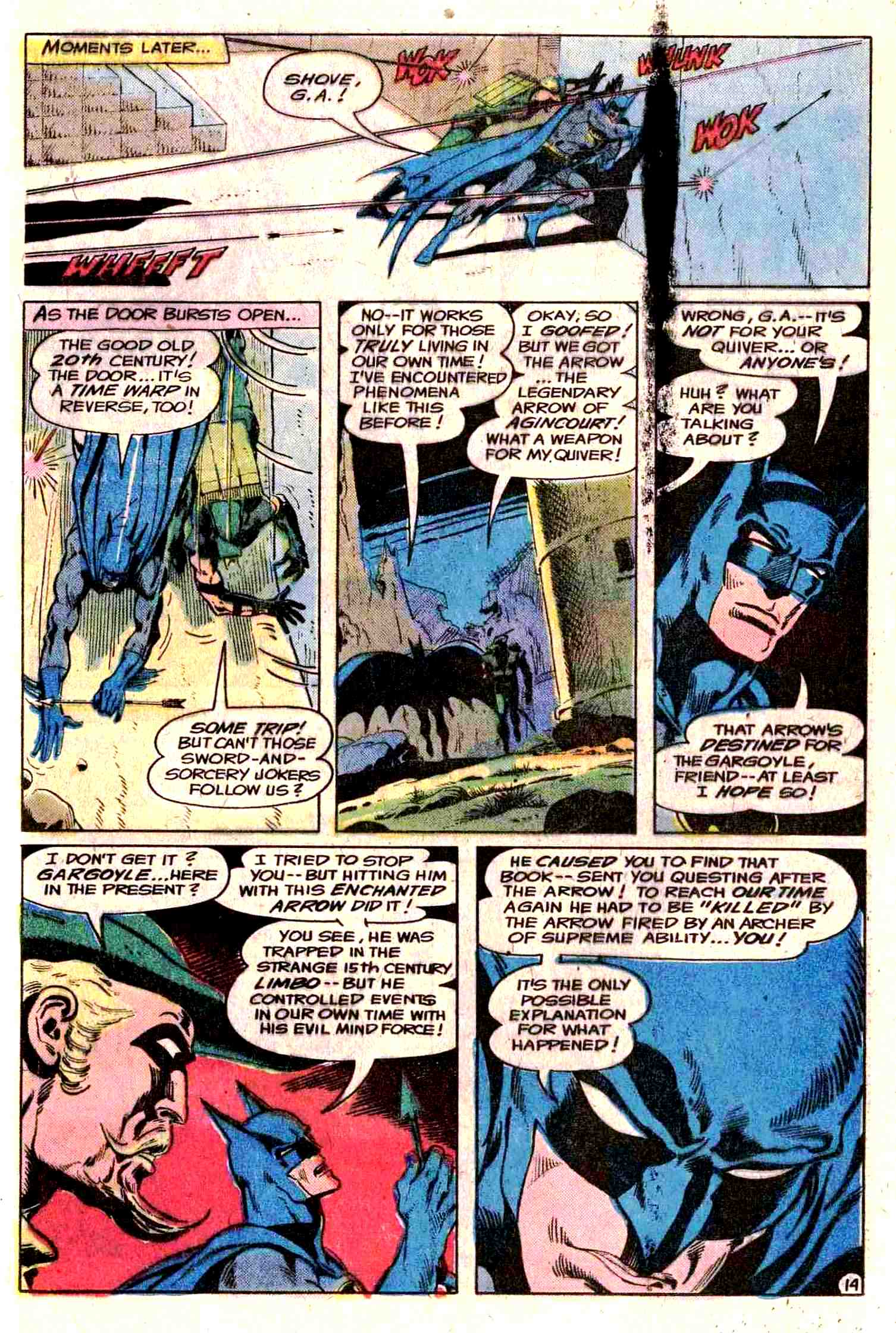
Batman then gets whipped back to 1415 at Agincourt, to which point in time Green Arrow has also been deposited. The mysterious manipulator is none other than The Gargoyle, one of the better Teen Titans villains created by Haney. He didn't want Batman, only Green Arrow, whom he manipulates into shooting him with the magic arrow of Merlin. Seems Gargoyle got exiled to the dimension of Limbo at the end of both of his previous two adventures, and though for some reason he's entered Earth back in the 13th century, he dopes out that he can return to the 20th if he gets shot by the arrow. Why does he have to be shot only by Green Arrow, and only during the Battle of Agincourt? Because the script says so, of course.                                   

                      
Gargoyle succeeds in getting shot, sending him back to the 20th century of his origins. Batman and GA follow, pour on tons of exposition, and eventually send the evildoer back into limbo by shooting him a second time. Despite all these tortured plot contrivances, this is a fun story based just on how well Haney succeeds in playing up the respective strengths of the bat and the archer. And how often do modern comics-stories even reference important historical events like Agincourt, even if the events are rewritten for the purpose of wild fantasy?                                                       

  Similarly, though artist Jim Aparo is no Hal Foster, I can't even imagine a modern comics artist attempting the sort of knightly grandeur seen in the above illustration. 

Tuesday, February 25, 2025

NULL-MYTHS: IT'S METAMORPHOSING TIME!

Before the Silver Age, if a series-character didn't sell, no publisher tried to bring said character back. But four years after the cancellation of METAMORPHO in 1968, writer-creator Bob Haney paired with editor Murray Boltinoff-- who had edited the Element Man's title-- to interest fans in the character. Their attempt failed, but a couple of the stories now give me examples of two species of "null-myths." In past essays, I've asserted that this category covers two types of story: those that are just flatly stereotypical, bringing no insight or emotion to the symbolism of their content, and those that make inconsummate use of those symbols. I'll now distinguish these as "passive null-myths," in which no real mental activity is in evidence, and "active null-myths," in which the mental activity goes down some weird pathway.                                                                                               

In 1972 Haney had been writing most if not all of the scripts for DC's teamup title THE BRAVE AND THE BOLD for seven years, and although Metamorpho had appeared once before in that title, the pulpishly-titled story "Cold Blood, Hot Gun" re-introduces the hero to readers. The 1968 title, BTW, had ended on an unresolved cliffhanger, but to my knowledge neither Haney nor anyone else ever tried to wrap up that story.                                                                   

  According to Haney's new scenario, Metamorpho has been off the grid for four years because he's been undergoing an experimental treatment to undo his freakish mutation, courtesy of conniving rich guy Simon Stagg, father to Metamorpho's beloved Sapphire Stagg. Much to the Element Man's frustration, Simon prematurely aborts the treatment because Simon has received news that an assassin seeks to kill Sapphire, who needs extra protection.                               
The source of this info is none other than Batman, but the means by which the Dark Knight acquires the intel is extremely dicey. After a businessman is flung to his death from his office on a high floor, Batman investigates. Haney needs the detective to find a list of the other people the assassin plans to knock off, but the author isn't content with simply having the hit man drop a written list in the office. Instead, after offing his target, the killer sits down and types out such a list in the office and takes it with him-- but Batman's able to reconstruct what was typed from analyzing the typewriter ribbon. And you thought the Internet was bad about preserving deleted content. Inevitably Batman and Metamorpho team up to prevent heiress Sapphire from getting killed, though Sapphire doesn't take the threat seriously and makes the heroes' job harder. The only distinction of this routine formula-tale is the typewriter nonsense, but this is a failure of verisimilitude, not mythicity.                               

 Haney managed to sell DC on giving Metamorpho a backup feature in ACTION COMICS, but the Element Man only hung in there for six installments before getting pushed out by the Human Target. However, by that time Bob Haney was writing WORLD'S FINEST, so he used a story in issue #217, entitled "Heroes with Dirty Hands," to re-relaunch Metamorpho. Fans sometimes complain about modern writers expecting the readers to remain clued in on whole histories of characters, but Haney is no different here, clearly expecting that the WORLD'S FINEST reader is going to remember the setup about Metamorpho undergoing the experimental treatment. The splash above barely shows the hero stewing in a nearby laboratory vat, while focusing mostly on a burly fellow wearing a costume that's half Superman and half Batman, who were, as most will know, the co-stars of the title. Is this some freaky return of the team's old villain, The Composite Superman?                                                               

But no, it's Java, Simon Stagg's dull-witted assistant, a Neanderthal man pulled from a bog and restored to something like sentient life. I'll forego citing Java's lame reasons for wearing the half-and-half costume, but the last panel of page 2 is one of those examples of an active null-myth I spoke of-- though I'll elaborate on it later.                     


   Haney then throws in a BS explanation about how the computer programmed the powers and propensities of Batman and Superman into the makeup of the Element Man, so that when he emerges from the vat, he's now wearing the half-and-half costume. He doesn't seem to be able to change back to his regular form, but maybe that's because hes been a D-lister for about seven years now, and he kind of likes biting the style of the World's Finest team. Simon Stagg dubs Metamorpho "Super-Freak," anticipating the Rick James song hit by eight years. Off goes Super-Freak to fight crime, and in jig time he's embarrassed Superman and Batman by doing their thing better than they can. So the heroes do the logical thing and defect to a foreign country, Slavia.                                                                                           

                                                               
I doubt that even the dumbest kids in 1973 didn't anticipate that DC's foremost heroes were just running a scam. In this case, they're hoaxing Rastinyak, Slavia's evil ruler, so that he'll accept their allegiance and reveal to them his special secret weapon. Apparently, this overly complicated "mission impossible" also requires the US President to ask Metamorpho to fetch the renegade heroes back to their country, as if they don't have the right to defect, just because. Metamorpho isn't informed of the deep fake and fights the heroes for real, so they have to throw the fight so that the evildoer will show his hand. The villain is defeated and Super-Freak's career ends with the fading of his bogus powers. This guest-star appearance led to Metamorpho getting a handful of backup strips in WORLD'S FINEST. But there was no real comeback for the Man of a Thousand Elements, and even membership in that lame super-team THE OUTSIDERS didn't get Metamorpho off the D-list.                                                                                                                                                                                                            Unlike "Cold Blood," "Dirty Hands" does have the kernel of a myth at its mostly hollow center. In a literal sense, the costumes of Superman and Batman don't confer any power on the heroes. But on the symbolic level, even imitations of the heroes' actual costumes incarnate the mana of the two crimefighters, and it's that mana that's being transferred to Metamorpho, rather than attributing such a power-boost to Simon Stagg's computer. As an extra added attraction, Haney blows his own fantasy-rules for Metamorpho's powers. Supposedly Metamorpho can only alter his body into new shapes if those shapes are made of elements naturally in the human body. So-- how does he manage to imprison Superman in a globe made of "anti matter?"                                                                                                      

Tuesday, January 28, 2025

MYTHCOMICS: "SCOURGE OF THE SKELETAL RIDERS" (TEEN TITANS #37, 1972)


As I stated in my previous post, I only revisited the 1966-73 TEEN TITANS comics-run because I wanted to cross-compare one of the stories with one of the TITANS cartoons of the 2000s. I had no expectations of finding a concrescent mythcomic in any of those 43 issues. Even though TEEN TITANS went through three distinct marketing phases, most of the stories were written by longtime DC journeyman Bob Haney, which didn't make for great variety. Like most of the people writing for comics in those days, Haney turned out a huge volume of tales, usually predicated on some wild premise that would theoretically grab the fancies of juvenile readers. Much like Robert Kanigher, Haney's ideas weren't always logical, though he was capable of producing tight plots around them. I considered all of his TITANS tales to do no more than time-killers, and I certainly did not expect to find any mythicity in a story from the title's least impressive phase, what I called "Spooky Titans." During this period, BTW, the heroes-- four costumed crusaders and two non-costumed-- were being sent on assorted assignments by a grey-haired eminence named Mister Jupiter, who I believe largely disappeared from DC continuity after the first TITANS series perished.                                 


To my great surprise, the routinely titled story "Scourge of the Skeletal Riders" started off with the heroes having a close encounter with a mystery that's never entirely solved. On their way to finish an assignment for Mister Jupiter, the Titans crack up their camper, rendering it undriveable. The only sign of civilization is a "weird old shack," where an unnamed blacksmith plies his trade. Though he speaks in an archaic fashion, he accepts the job of fixing the vehicle, but only after he finishes shoeing four lively-looking horses. The blacksmith hints darkly of some danger if he doesn't finish the shoeing on time, but the Titans are focused on their mission. They leave the camper behind and catch a ride to their destination (no roadside assistance back in 1972). Once reaching their home base, the Titans learn that their next assignment is to look for a famous teenaged photographer, Grady Dawes, who went missing in a country torn by civil war. The Titans all claim to have been well acquainted with Grady, though it's axiomatic that the character never appeared before this.                                                                                     


So off go the Titans to war-torn "Ranistan," pledging not to get involved in the conflict while looking for their friend. For a time I thought "Scourge" might be one of the many "anti-war" stories DC was producing in this time-period. However, though the heroes do get involved, they only seek to prevent loss of life on both sides, and the nature of the quarrel is never specified. And their first hint of something unusual is that Kid Flash seeks to warn a troop of soldiers from being attacked. A rider on a red steed overtakes the hero despite his super-speed and stuns him, so that the troop gets slaughtered.                                                                                         
Though the previous incident involved the Titans trying to save soldiers of the current regime, they seek out a rebel stronghold, looking for info on Grady. They try to liberate stores of food for starving rebels, but another weird horseman appears, beats down the heroes, and sets the food on fire. The Titans then continue their journey, with Robin playing skeptic when the psychic Lilith theorizes that they are been opposed by the legendary Four Horsemen of the Apocalypse, the first two riders having been War and Famine.                                                               

    The Teen Wonder is duly converted, though, for their next mission is to deliver a vital serum to mountain tribes. Plague, who naturally wants more suffering from disease, booby-traps the heroes, and though all the good guys survive, the serum is destroyed.                               


Naturally, there's one more Horseman to encounter: Death. The heroes are on the way to the fortress where Grady's being held for ransom, but on the way, they see "a rider on a pale horse" menacing two refugees with a scythe. Kid Flash rescues the refugees and exults in having beaten Death. However, when they get to the fortress, they learn that Death has already been there, and that the pale rider tricked Grady into getting killed. Mister Jupiter tries to assuage the despondent heroes' feelings by saying they won a "small victory" by saving the refugees (without mentioning that the heroes failed at their other three efforts). However, Haney explicitly states that Death only menaced the refugees to delay the Titans before they could reach Grady, so if they hadn't been there, the refugees would not been threatened. So this is one of the few superhero stories of the period in which the heroes have no success whatsoever in their endeavors.                                                                                              
As a capper for this dolorous downturn, the Titans return to America to get their camper. The blacksmith and his smithy have been replaced by a car repairman and his modern-day shop, and he professes not to have done any blacksmithing for decades. There is an old smithy there, but clearly this exists only so that Haney can close out the story with a "what is reality" schtick. Yet the framing narrative of the "fairyland blacksmith" confers some extra mythicity on what could have been just another spook-tale. The Four Horsemen clearly don't set up the encounter, for they have no trouble overcoming the mortal champions at every turn. The blacksmith assumes the role of a prophet of doom, casting a minatory shadow over the heroes, as if to say, "You can win a lot of battles, but against fate, even Titans strive in vain."