
Featured Post

SIX KEYS TO A LITERARY GENETIC CODE

In essays on the subject of centricity, I've most often used the image of a geometrical circle, which, as I explained here,  owes someth...

Showing posts with label daredevil (1940s). Show all posts

Monday, February 28, 2022

NEAR MYTHS: THE CLAW (1939-1944)


"Better fifty years of Europe than a cycle of Cathay!" declared Lord Tennyson in the 1842 poem "Locksley Hall," crystallizing his people's belief that China, aka "Cathay," was the antithesis of European progress. Almost a hundred years later, American funnybook-makers distilled a vision of the claw-fingered Oriental beyond even the most fevered dreams of Sax Rohmer-- though of course comic book creators like Jack Cole thought of American democracy as the perfect counterpoint to Eastern tyranny.

In A PAUSE FOR CLAWS I addressed some of the cultural reasons as to why Western people may have started picturing evil Orientals with long, bony, taloned fingers. I plan to investigate the Marvel character "The Yellow Claw" more in future, but no comic-book character has concentrated the archetypal image as well as The Claw, a villain starring in his own series from the company Lev-Gleason. 


I mentioned Jack Cole, but though he did create The Claw in SILVER STREAK #1, he didn't create the villain's most well-remembered opponent, the original Daredevil (from SILVER STREAK #6). But according to Don Markstein, Cole was the one who conceived of making the mocking, super-acrobatic mystery man into the Claw's nemesis for the space of a five-issue continuity (though other hands than Cole's finished the crossover). 


If Daredevil was to some extent a typical hero of the period, the Claw was like nothing else. Asian evildoers had haunted the pages of pulp magazines and popular books long before comic books were viable, but not only did the Claw exaggerate other racial motifs-- pointed ears and fangs for teeth-- he also brought in the fairy-tale appeal of the Evil Ogre. The Claw could be a man of ordinary size, but he had the power to grow to Godzilla-like heights. Throughout his five-year run, the tyrannical villain frequently maltreated his own henchmen, gorily crushing them in his taloned fist or stomping them beneath his sandaled foot. Even after Cole left the series, the Claw was unremitting evil, devoted to subjugating America to his will.


The last part of the five-part tale strongly implied that The Claw was in the service of Satanic powers, though strangely, he calls on the powers of "Lucifer the genii" rather than the standard Judeo-Christian tempter. Lucifer sends monsters and flaming meteors to help the Claw against Daredevil, and yet the hero perserveres. The Claw is defeated, but generously, Lucifer only confines him to Asia, which was as good as saying that he wouldn't be allowed to cross Daredevil's path in America again. 


However, the two did encounter one another one more time, the injunction clearly forgotten. The crossover made Daredevil popular enough to get his own title, and to start the new book with a bang, Daredevil enlisted the protagonists from SILVER STREAK in a running battle with the worst real-life villain possible: Adolf Hitler. So Daredevil brought together such disparate characters as the speedster Silver Streak, Dickie Dean Boy Inventor, the pilot Cloud Curtis, and jungle-man Lance Hale to fight the Nazi menace. 
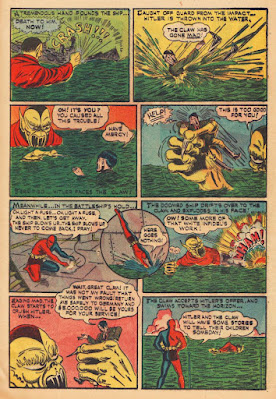


The one partial exception was The Claw: he collaborated with Hitler, but only while planning to eventually to betray the dictator. The two fall out thanks to Daredevil's maneuvers, and the Asian villain even does "his bit" for the Allies by allowing Hitler to deplete his resources to ransom his life. 


Following that stellar issue, The Claw remained one of the features in DAREDEVIL, which was filled with a variety of other crusaders (my favorite being the blind hero "Nightro," whose name was a pun on "nitro.") The Claw then continued trying to conquer America, being most often opposed by a new costumed athlete, The Ghost, who never managed to escape the Claw's gargantuan shadow. For the next thirty issues, the villain tried many different schemes, the most inventive being one in which he transformed several of his Asian henchmen into winged monsters called "clawites." The splash above shows the giant malefactor astride an equally huge unicorn; it's nowhere in the actual story, but it sure does make The Claw look like a Oriental version of an apocalyptic horseman.


He even got an origin: he was fathered by a Tibetan brute and a woman named Zola, who by some freak of nature possessed huge fangs. Shortly after being born, The Claw somehow forces both of his parents to commit suicide, and he grows into the scourge of Asia, though his ability to become a giant is never really explained. By 1944, though, some of the villain's ogre-ish appeal had worn off, and in DAREDEVIL #31 he was given a very anti-climactic execution by a scientist's "electric ray."


 He made one more Golden Age appearance in a 1953 four-part story within the continuity of a Lev Gleason space-hero, "Rocky X," in which it was posited that the inhuman looking villain was really of alien origin. After a few more decades, The Claw was revived by Americomics as a peripatetic opponent for the super-ladies of FEMFORCE. But to the best of my knowledge, The Claw has not surfaced again.

In conclusion, while I would concede that Lev Gleason's Claw did appeal to certain racial myths, particularly with respect to the source of his name, the very thing that made him unique among Asian villains-- his ability to turn into a skyscraper-sized colossus-- distances himself somewhat from more mortal representatives of the species, thus making him a little harder to see as a purely sociological construct.


Saturday, September 5, 2015

REFLECTIONS IN A MERCURIAL EYE, PT. 1

For once I'm going to link to a UTILITARIAN post without dumping on its author. I'll still disagree with him, but this time I can see the difficulty of his position.

For some time a writer named Robert Stanley Martin has providing HU with an abbreviated look at the chronological publication of key North American comic books. He focuses only on what he calls "the aesthetic cream of the crop," an elitist position with which I disagree, as did a poster who replied:

Apparently, the “history of North American comic-book publishing” includes almost nothing other than Captain Marvel, Wonder Woman, and Plastic Man books, with a bit of Disney thrown in. Seriously??? -

Martin defends his concentration on the cream of the crop, stating that he doesn't plan to include anything from, say, the Batman title except things like "the first appearances of Batman and Robin" and "the debuts of the better known villains."  By so doing, it goes without saying that Martin is deferring to the community of comics-critics who tend to marginalize Batman in favor of, say, Plastic Man. I might advance the counter-argument that even though Cole's Plastic Man may boast superior design-work than the best of the Batman artists, the former is not necessarily better written than the latter. Indeed, many of the Cole issues Martin cites are bland tales from the standpoint of the writing, and would never have earned their place amid the "aesthetic cream" if they had been drawn by a less heralded artist-- even if it was by one who was arguably Cole's equal in formal talent, like Paul Gustavson or Lou Fine.

Still, though I disagree with Martin's emphasis on artists who have been validated above their peers for dubious reasons, one of his points is unassailable. Neither he nor anyone else could or should try to include everything. If I attempted such a list, I'm sure that on first consideration I would default to the fannish tendency seen in comic book price guides: to focus on events in DC or Timely Comics that affected the later avatars of those companies-- the first battle between the Sub-Mariner and the Human Torch, or the first appearance of the Injustice Gang of the World in the JUSTICE SOCIETY feature. Yet on second consideration, I think I'd realize that these events shouldn't be any more important than events that influenced comics whose publishers did not survive into the Silver Age.

Companies like Hillman, whose big seller was AIRBOY, seen here encountering the ghoulish villain Misery...


Or Lev-Gleason, which gave us the memorable multi-issue crossover of the villainous Claw and the original Daredevil-- part of which was drawn by Jack Cole.


As a pluralist I would maintain that these are as good examples of their genre as Plastic Man is, so I wouldn't concur with the elitist POV that puts them beyond consideration. (The reasons for that superficial opinion I'll detail elsewhere.) However, these examples raise another point: are only the "big events" worth considering in a pluralist "best of" list? Further, to extrapolate from a point Martin makes: are the first appearances of Batman's iconic villains their best "aesthetic" moments? Is the first Joker story the one every comics-fan ought to read? Will it tell the non-hardcore reader everything he wants to know about the Joker? Or would the reader be better off reading a less Gothic but arguably more "aesthetically pleasing' story like "The Joker's Millions" from DETECTIVE COMICS #180 (1952)?


Yet even with the most pluralist will in the world, something has to be left out, and one has to form some criteria for disinclusion. As a reader I feel less fondness for Carl Burgos' seminal "Human Torch" character than for his earlier, much goofier hero "the Iron Skull," shown below (with art by Sam Gilman) bouncing bullets off his indestructible noggin--


--yet I know that if push came to shove, my Golden-Age list would have to include some notation on Burgos' Human Torch, even if I thought it was a great concept that Burgos totally muffed. Old Iron Skull would have to be left behind in the annals of obscurity, because the Torch had one thing going for him that the Skull did not: a superior design, albeit by a less than superior artist.


I can't speak to Martin's aesthetic priorities, but I'll take a wild guess: like many critics influenced by the COMICS JOURNAL-- an influence he cites in another of his posts-- his choices are informed by a vision of comics becoming something other than what they were in the Golden Age. Cole's "Plastic Man" feature didn't really escape the genre-boundaries of the superhero, but a lot of critics, not least Art Spiegelman, pleased themselves to think that it did. That gave Cole's stretchy dogooder a luster that lifted it above the majority of Golden Age work-- not to mention the majority of Jack Cole's other comics work.

But, then, the question arises: how does one form standards for formula-work that was meant to be standard-less? I'm certainly not speaking only of the superhero genre, for which comics became famous, but all of the genres that were meant to be read quickly and tossed away. Is there anything in the first twenty years of ARCHIE that merits celebration, and if so, what makes those ARCHIE stories better than other comics in that genre, like Harry Lucey's GINGER and Morris Weiss' MARGIE?

My "mythcomics" feature was instituted to explore one of the four "potentialities" around which creators organize their narratives, and through which audiences experience them. This is an entirely feasible approach to assigning merit to formulaic material that sought to meet "aesthetic standards" only insofar as they promoted good sales, and thereby put money in the creators' pockets. However, though I consider myth-analysis to be a heuristic device to that of aesthetic criticism-- whose failings I pointed out here-- I must admit that the myth-criticism methodology must be firmly grounded in a sound understanding of the way popular art works-- which I'll cover in Part 2.