Featured Post

SIX KEYS TO A LITERARY GENETIC CODE

In essays on the subject of centricity, I've most often used the image of a geometrical circle, which, as I explained here,  owes someth...

Showing posts with label correlations and cogitations. Show all posts

Sunday, April 12, 2026

DENSITY=EXCESS

 This essay exists for the most part to draw a line between both 2013's THE NARRATIVE RULE OF EXCESS and its corollary from 2017, EXCESSIVE COMBINATORY FORCE, and the more recent LOVE, DENSITY AND CONCRESCENCE from 2025. In the last of these, I wrote:

because density has a stronger association than does concrescence with the quality of some physical substance, it also proves somewhat better for describing the finished product. I might say, using my most recent emendations of my potentiality terminology, that "Dave Sim's work excels at dealing with didactic cogitations, while Grant Morrison's work excels at dealing with mythopoeic correlations." That quality of excellence can be metaphorically expressed as a given work's density, in that such density shows how thoroughly the author was invested in a given set of fictional representations (sometimes, though not usually, on a subconscious level).


In contrast to my meager usage of the term "density," I probably have many references to "excess" scattered throughout this blog, since that philosophical concept was thoroughly explored by one of my major influences, Georges Bataille, particularly in the first of his works I ever read, VISIONS OF EXCESS.  In the two linked essays above, my main concern was to apply Bataille's concept to my own concepts of the two forms of sublimity. I won't get into those formulations here, for I'm concerned with showing that excess is a general standard, like density, for judging the presence or absence of excellence in fictional works.   

The difference between the two concepts relates to authorial motive. The author who achieves excellence in one or more of the four potentialities does so because he/she becomes engaged enough with the material to DESIRE to give it a density, a thoroughness, that seems to be like that of lived experience. The creator of a poor work, within whichever potentiality one judges the work by, has no desire, or next to none, to convey investment in the material to his audience. The creator of a fair work has some desire, but only up to a point. It's only the creator of a good work who's totally invested with respect to at least one potentiality.

One example of authors investing "excess effort" in various potentialities can be seen in a comparison I floated between the Lee-Kirby FANTASTIC FOUR and the Drake-Premiani DOOM PATROL. I still believe that the Lee-Kirby work shows an excess of the mythopoeic imagination and that the Drake-Premiani work does not. However, I now realize that the later issues of DOOM PATROL put forth a density of specification with respect to the dramatic potentiality. More simply put, even though the Lee-Kirby FF set the early standard for using soap-opera dramatics, one might argue that Drake was, over time, better than Lee and Kirby at finding interesting ways to exploit the dramatic conflicts of the team and its opponents, at creating the illusion of character progress. 


Further, though Stan Lee was the boss in his collaboration with Kirby, he often let Kirby "have his head"-- and Kirby was not really a "details man." On close study the sixties FANTASTIC FOUR has a rather herky-jerky progress with respect to its characters' serial development, even if Lee's dialogue usually managed to paper over any perceived discontinuities. I said that I doubted that artist Premiani contributed much original material to the collaboration; he probably just drew whatever Drake related in his full scripts. Drake wasn't often capable of mythopoeic imagination, unlike Kirby. But he conveyed a sense of density in the interrelations of the Patrol members, because that was the part of his inspiration to which he best related.


Monday, June 23, 2025

MORE TALES OF TWO COSMS

 While I don't know if my new terms "ontocosm" and "epicosm" are destined for permanent status in my system, I may as well take a shot at applying them to a series of interlinked stories-- what I'm tempted to call a "mosaic," coined as I recall by Thomas F. Monteleone for a novel he assembled out of separate narratives. (To be sure, Jules Verne might have been the first to tie together two independent narratives in his 1874 MYSTERIOUS ISLAND, a blending of plot-threads from both 20,000 LEAGUES UNDER THE SEA and IN SEARCH OF THE CASTAWAYS.) Under the influence of Stan Lee, Marvel Comics became the 20th century's greatest source of such mosaic-narratives, and the first one I explored on this blog back in 2007: what I might call something Marvel-esque, like "Rise of The Valkyrie." Here I'll take a stab at using this series of interlinked stories as a means of showing how an ontocosm evolves alongside an epicosm.


The first part of the mosaic is the 1964 Lee-Kirby THOR story, "The Enchantress and the Executioner." I noted various associations, which I would now call mythopeic correlations, that I found in the story. though I don't think I sufficiently emphasized the way each villain signifies aspects of gender: violence for the male, sexuality for the female. These correlations make up the epicosm of this story, for there are next to no significant didactic cogitations involved. But the correlations are communicated by the lateral values of the narrative. The factors of "energy," stemming from the kinetic potentiality, are not exceptional-- the erotic appeal of The Enchantress, the battle between Thor and The Executioner-- but the emotions of the dramatic potentiality are much stronger, drawing in the reader with its depictions of Jane Foster's jealousy, Thor/Don Blake's true-hearted devotion to her, and The Enchantress' wrath at being spurned. This is a quick illustration as to how a particular epicosm can grow out of a corresponding ontocosm.


    As I remarked in the THOR analysis, Enchantress and Executioner didn't exactly go on to great glory, as they were tossed into an assortment of AVENGERS stories where they were basically henchmen to master planners like Baron Zemo and The Mandarin. HULK #102 presented an exception, in which they attempted to conquer Asgard and were defeated in part by a certain green-skinned mortal. The ontocosm here is mostly focused on the kinetic energies of The Hulk contending with the evil duo and their pawns.


  Oddly enough, the next big phase of the Enchantress' career appears in an extremely weak story from Roy Thomas in AVENGERS #83. I already critiqued some of the intellectual and imaginative failings of the story in this essay, noting: 

By itself “Revolution” is probably not a fair representation of whatever Roy Thomas might think or have thought about feminism, but on the face of it the story bears strong resemblance to the “myth” (note the quotes) propounded by anti-feminists, viewing feminists as either deluded females or women resentful of not being able to get/keep a man.

Nevertheless, there was one really interesting correlation put forth here: that of a sorceress whose power lay in deceptive femininity caused her to take on an opposing feminine archetype: that of a forthright warrior-woman. Nothing in issue #83 suggests that The Valkyrie is anything but The Enchantress taking on a heroic form, albeit one derived from Norse mythology, that she thought would appeal to other female heroes and turn them against their male compeers.


Roy Thomas came back to the Valkyrie, though, in INCREDIBLE HULK #142. I covered these event in this essay, noting stronger correlations of "the war between men and women," i.e, Hulk and Valkyrie, as a limbo-bound Enchantress just happens to spy on the Hulk, giving her the idea to project her Valkyrie-persona onto a mortal pawn. It's hard to tell if Thomas had any plans to spin off Valkyrie into a regular Marvel character or not.


The mosaic's last piece is DEFENDERS #4, which I discussed here, along with some side-discussion of The Enchantress and the Black Knight. There's not much of an epicosm here, for it's almost entirely an action-opus, focused on kinetic violence. Enchantress belatedly seeks to battle the sorceress who stole Executioner from her, and gets imprisoned with her paladin-partner. But Enchantress finds a new pawn into whom she can project her female-warrior imago-- one assumes it would only work with another woman, since she doesn't try it on The Black Knight. There is an interesting correlation in that Valkyrie is "mothered" by Enchantress, who is seen as interested only in very tough dudes for her lovers. Is the Valkyrie's "father" The Executioner, or is The Black Knight, whose mount and weapon Valkyrie claims? I don't think any later iterations of Valkyrie explore that aspect of the heroine's character, though, so even though the epicosm in this mosaic-series is highly variable, the ontocosm is fairly steady, even if it varies in emphasis between the kinetic and the dramatic.        

Wednesday, June 11, 2025

THOUGHTS ON PETER DAVID

 I wasn't sure I'd write anything about Peter David following his passing on May 25 of this year. Though I once saw a fan fulsomely compare David's comics work to that of Steve Gerber, I'd probably see more comparison to Len Wein. With both writers, I read a fair amount of work that I liked, but probably more than I wasn't crazy about. But then, Steve Gerber himself said (and I paraphrase from his JOURNAL interview) that everyone who makes writing his career inevitably turns out some dreck in addition to some good stuff. Every invested reader makes his own estimation as to whether the good stuff outweighs the dreck or vice versa.

This principle inheres even with specialized criticism like mine. A writer who follows certain formulas in order to keep the checks coming may or may not be able to keep up an interesting flow of either correlations, cogitations, or both together. Said writer is more likely to concentrate on the lateral virtues, since those are the factors that draw in committed buyers. From what I know of David's comics-work, he almost always devoted his efforts to what I called "the basic serial," defined thusly here:

The basic serial in most iterations is not meant to possess an overriding structure. Rather only its constituent parts, be they short stories, long arcs, or other forms, usually display the sort of patterns that can be judged in terms of concrescence.     

Yet I must admit that I probably didn't have as thorough a knowledge of David's work as with others who worked on long-term serials. During the 1980s, when David rose to comic-book prominence, I bought none of his long-term serials-- HULK, AQUAMAN or SUPERGIRL-- as they appeared for purchase. I only picked up odd issues from quarter-boxes and later re-read them in correct sequence. So this week I decided to read through the first twenty-something issues of David's famous 12-year run on INCREDIBLE HULK, to gather a better sense of what he'd accomplished and how it differed from what others had been doing, that had resulted in HULK being a low-selling Marvel title.


Before David became the regular scripter, he was preceded by Al Milgrom, who set up two ongoing plot-threads which would also dominate David's first creative phase on the title. One was that Bruce Banner became associated with a SHIELD-sponsored project, The Hulkbusters, as  did his girlfriend Betty Ross and his perpetual foe General Ross-- all devoted to finding ways to counteract the Hulk's outbursts of violence. Another was that during one experiment to cancel the Hulk's power over Banner, a new "Gray Hulk" was born in HULK #324 (1986), somewhat smaller and less strong than Green Hulk. Milgrom clearly meant this Hulk as a callback to the very first issues of the character's debut, where the heroic monster had some brief moments of potential villainy and seemed more werewolf-like, transforming only at night. David collaborated with artist Dwayne Turner on one issue, HULK #327, but Milgrom remained the main writer until issue #330, which concluded with the death of General Ross. That issue debuted the work of the artist who would remain teamed with David during the aforementioned "first phase:" Todd MacFarlane, who had yet to become a top Marvel artist via his tenure on SPIDER-MAN, much less becoming even more generally famous for Image Comics and his feature SPAWN. 


I've never seen either David or MacFarlane go into detail about their pivotal collaboration. Given how the two of them feuded when David started negatively reviewing MacFarlane's Image works in the fan press around 1993, I doubt either of them would have yielded a balanced account of that interaction. But my critical impression is that both of them, though thrown together by circumstance, shared a desire to use Milgrom's Gray Hulk concept to give Banner's alter ego a meaner, more visceral edge. Milgrom may have intended to do something similar himself, but together David and MacFarlane managed to give the HULK title a more unpredictable, horror-movie mood, lasting from #331 to #346, with only one issue drawn by another artist. 

Throughout the first phase, Gray Hulk continued to contend against the Hulkbusters and grisly villains like Half-Life. But in this sequence of stories the dominant evildoer was a new incarnation of The Leader-- who, in keeping with the increased use of violence in 1980s commercial comics, was also no longer playing with kid gloves. Indeed, the first phase culminates with The Leader putting his old enemy through an emotional wringer by threatening to blow up a small town-- which he does, killing five thousand inhabitants just to produce a few gamma-mutants. This end sequence showed some decent myth-content-- not least the way the Leader's private endeavors mirror those of the government's plan to stockpile gamma bombs-- but it didn't meet my criteria for a mythcomic. 


I did find one mythcomic within the David-MacFarlane run, which I'll analyze in a separate essay. All of the Hulkbusters storylines were wrapped up in #346, except for the little matter of Betty Ross's revelation that she was pregnant with Banner's child. Yet, instead of following that plot-thread, David launched a new chapter in Gray Hulk's life. The character walked away from his old rampaging existence and took on the identity of "Mister Fixit," a bodyguard for a Las Vegas casino-owner. This was arguably the most famous development in David's long HULK run, and though I don't remember getting much out of this new phase, I'd have to give the series a re-read for further consideration.  I'm not sure what David had in mind for Betty's pregnancy, but as Wikipedia notes, David's editor dictated that Bruce and Betty would not have a child, and so she lost the infant by miscarriage. Ironically, David had Betty consider abortion of her child, who might or might not have carried gamma-genes, though the "A" word was never directly spoken. I mention David's original notion to spotlight it as one of many attempts to aim a commercial comic not at the vanishing audience of children but at older hardcore fans.

For whatever it might be worth, though I'm not David's biggest fan, I did assign to him one other mythcomic, discussed here. But that was something of a one-off. I appreciate that David vastly improved the reputation of the Incredible Hulk, albeit in what I'm curently calling "ontocosmic" rather than "epicosmic" terms, so I'm glad he did at one good Hulk-myth that ranks with the Lee-and-Kirby origin.                                  

Thursday, May 8, 2025

STIMULATING RESPONSES PT. 2

 Since absolutely no one asked for it, that means it's time for one of my "geometrical approximations" of an abstract principle. First off, here's what the lateral line of meaning looks like, the simple progression from stimulus to response, or, in Aristotelian terms, from complication to resolution.                                                                                                        

This progression also stands in for the mental activities of every non-human species, from amoebae to dolphins and chimps, which may have some inchoate potential for "higher," vertical mentation, but not anything comparable to the human level. I take the position that even the most incoherent human narrative represents an attempt to emulate more coherent narratives. Thus the progression of the lateral meaning is always static, since it's just about "what things happened," as I outlined in WHAT VS. HOW. However, the vertical meaning can vary greatly, depending thoroughly on how the author articulates the abstract values found in "correlations and cogitations." So the baseline for all human narrative mentation, at the level I've sometimes designated as "poor" in terms of complexity, looks like this:                                                                                 

  So the baseline for human mentation must progress both laterally and vertically, no matter how limited the "peaks and valleys." The up-and-down movement is not intended to represent increasing or decreasing amplitude, just a progression opposed to that of the lateral line. Next up is what I have termed "fair."                                       

 Here the peaks and valleys become more pronounced, indicating a greater concrescence of either the correlations, the cogitations, or both together. While the "good-to-superior" level I've articulated implicitly carries some variation between those two states, here's my third and last geometric approximation for that highest level of concrescence.                                                                                                     

Tuesday, April 22, 2025

LOVE, DENSITY AND CONCRESCENCE

I haven't written much if anything since 2017 about "density," when in the essay GOOD WILL QUANTUMS, I extrapolated a brief remark by Raymond Durgnat into a general principle, one applicable to all four of the potentialities. In that essay I wrote:

density is the means by which the reader subconsciously rates one creator above another: because the reader believes that Creator A can better describe a set of relationships so "densely" that it takes on the quality of "lived experience."'                                                                                                                                                                                Elsewhere in the essay and its follow-up, I qualified this statement by noting that all literary works, whatever potentiality they favored, were all *gestural" in nature, just to distance myself from associations with any criteria about fidelity to actual "lived experience." However, in due time I felt the need of a term that described the process by which such "potentiality density" came about, and for that purpose I freely adapted the term "concrescence" from Alfred North Whitehead.    


All that said, because density has a stronger association than does concrescence with the quality of some physical substance, it also proves somewhat better for describing the finished product. I might say, using my most recent emendations of my potentiality terminology, that "Dave Sim's work excels at dealing with didactic cogitations, while Grant Morrison's work excels at dealing with mythopoeic correlations." That quality of excellence can be metaphorically expressed as a given work's density, in that such density shows how thoroughly the author was invested in a given set of fictional representations (sometimes, though not usually, on a subconscious level).

Now, knowing that level of authorial involvement doesn't intrinsically make a given work, or set of works, engrossing to all members of a potential audience. In fact, tastes are so variable that one can practically guarantee that no works will be all things to all people, if only because we esteem (or do not esteem) all phenomena according to our respective abilities to relate to those phenomena in some way. And my carefully considered positioning of the word "esteem" brings me to the "love" part of the title.

Some setup: in chapter 40 of the romance-manga NAGATORO, main character Naoto, a high-school student, aspires to create good art. His senior Sana (the one clad in a towel) delivers the following critique of his recent effort, followed by her criterion for good art.                                                               


In the story the discussion is interrupted, and at no point in the series does this aesthetic credo get further articulated. Given that the author Nanashi devotes the bulk of NAGATORO to the dramatic potentiality, his main reason for having the Sana character make this statement is to imply a correspondence between the way a good artist is "in love" with his material, and the way Naoto specifically needs to invest himself in life, whether it's drawing his subject matter with passion, rather than with mere polished technique, or in his romantic relationship to the titular Nagatoro. I would tend to think that Raymond Durgnat, who was my original guide to the density-metaphor, probably would not have disapproved of Nanashi's use of "love" as a metaphor for artistic investment, for wanting to "know" a subject intensely (if not actually romantically).    

Saturday, November 4, 2023

DIDACTICISM DELIBERATIONS

Originally this essay was meant to build on my distinction between problems and conundrums. In my September 2023 post WHAT VS. HOW, I gave examples of two narratives which used a particular psychological source of knowledge, that of Freud, as a "half-truth" to set up conflicts between fictional characters. The first narrative dealt only with the ontological pattern in terms of "what things happened in the story," so it used its pattern superficially, just to create a "problem" that the characters could solve. (A superficial use of the pattern would also be a "problem" even if the characters failed to solve the difficulty.) The second narrative did make a thorough use of its epistemological pattern in such a way that it illustrated a "conundrum" for the audience. This level of difficulty would continue to exist for real people in their world, no matter whether the characters did or did not solve the way the conundrum manifested in their world. Originally, I wanted to emphasize that fictional works in which the author thoroughly explores a given epistemological pattern parallel the way real humans beings are obliged, by the nature of the reality they experience, to judge the patterns of that reality and make decisions on their interpretations of experience.

However, in the course of ruminating, I reread another epistemological post from May of this same year, FUNCTIONS OF KNOWLEDGE. In this post I distinguished two complementary terms, the "stereotype" and the "simple variable," as distinct from two other complementary terms, the "archetype" and the "complex variable," in that the latter possessed a greater than average functionality, itself termed "super-functionality."

All well and good, according to my system. But "stereotype" and "archetype" only apply to one of the two "vertical" systems by which authors and audiences derive knowledge-based meaning from stories. That virtue belongs to the "mythopoeic potentiality," which manifests through the elaboration of the *quanta* I term "correlations."

Still okay, but I've not said nearly enough about the other vertical system, the didactic potentiality, whose quanta I've termed "cogitations." Stereotypes and archetypes have often been applied to symbolic discourse, so those terms don't translate well to talking about didactic constructions of meaning. But I've certainly seen cogitations that I thought were simple and merely functional, as against those that are complex and super-functional-- but for the time being, I'm proposing no new terms for these respective states. 

In my survey of the individual episodes of Classic STAR TREK, I'm sure I generally confined myself to exploring the mythopoeic correlations of each episode. But in theory, I *could* have explored that particular series purely in terms of whether its didactic cogitations were "functional" or "super-functional." Here are two examples.

As most TREK fans know, showrunner Gene Roddenberry was an avowed atheist. Nevertheless, the scripts he accepted for filming (and which he always re-wrote to suit his beliefs) sometimes involved the role of religion in the future-culture of the Federation, and Roddenberry did not present a standard atheist's view of religion. He knew his audience would not accept overt atheism, so often the producer accepted scripts that simply talked in general terms about the role of religion in society.


I gave the second season episode a poor rating "Bread and Circuses" in terms of its mythopoeic correlations, but it doesn't fare any better in terms of didactic cogitations, as should be clear from this excerpt:


Kirk, Spock and McCoy are initially captured by a resistance-group fighting Roman hegemony. They are much puzzled by the members' claim to be worshipers of the Sun, and McCoy even states, with amazing falsity, that the Romans of Earth had no sun-worship. By the end of the episode, though, it's revealed that the renegades are actually the Christians of this pseudo-Earth; they just took an extra 2000 years to show up. Despite an early claim in the story that the Federation embraces many religions, the story ends on an egregiously proselytizing note. Safe back on the ship, the crew-members content themselves with the ideal-- derived from many a Cecil B. de Mille movie, no doubt-- that in due time the evil of the Romans will be conquered by the goodness of the Christians. One may safely assume that Magna Roma's destined religion will also eventually lead to liberal democracy.

In my view, the episode advanced the didactic view that the pattern of cultural development seen on Earth was going to be duplicated on the world of Magna Roma: brutal polytheism being succeeded by a kinder, gentler monotheism, which is turn would be succeeded (though the episode does not directly say so) by the sort of secular humanism one beholds in TREK. It's in such a secular humanism that it's possible, as my note specifies, that many religions can prosper alongside one another, though it's a mark of Roddenberry's true sentiments that one hardly ever sees religious celebrations either on the Enterprise or in Federation colonies. I think the proselytizing note with which "Bread" ends was nothing but protective coloration, to diffuse any possible accusations of "space atheists," but whether I'm right or not, the proselytization contradicts the earlier statement of overall tolerance, and so the "cogitation" is not well executed. Even the reference to "panem et circenses" in the title fizzles out after the first arena-scenes.


In contrast, another second-season episode, "Who Mourns for Adonais," while it only rates "fair" in terms of its mythic correlations, might enjoy a "good" rating in terms of didactic cogitations. I would surmise that Roddenberry was probably more in sympathy with the story's ethos, even though again he threw in a minor anti-atheistic statement:

The trope of "aliens who were once Earth-gods" has always been absurd, but Coon and Ralston strive to give it some gravitas. On one hand the future-men declare that they no longer need the parenting influence of gods-- though, perhaps to keep from sounding too atheistic, Kirk delivers a line about finding it adequate to have "one" god. On the other hand, the script attempts to capture the Glory That Was Greece in this science-fictional context, and to admit, however obliquely, that all human culture descends from early man's attempts to understand the universe through a multiplicity of deities.

This script is not interested in the actual dynamics of Greek religion any more than "Bread" was interested in the dynamics of early Christianity. Still, there's a much better understanding of how early religion provides a foundation for secular humanism, even though the two seem opposed. That's why, following Apollo's defeat and extirpation, Kirk wistfully wishes they could have burned one laurel leaf to the memory of the deities that brought humanity out of ignorance. And so "Adonais" provides a "super-functional" cogitation, and for good measure works as a elaborate "conundrum" within the didactic potentiality, while the story of Magna Roma is merely a superficial "problem."

Friday, September 1, 2023

FORMAL AND INFORMAL EXCELLENCE PT. 2

 I first used the terms "formal postulate" and "informal postulate" here, but I've devoted many earlier posts to sussing out which aspects of  a story appeal to the intellect, which to the imagination, and which to a combination of both abstract "vertical values."

But as I want to try out the new terms on something, it's time to break down some examples in terms of the didactic and/or the mythopoeic potentiality.


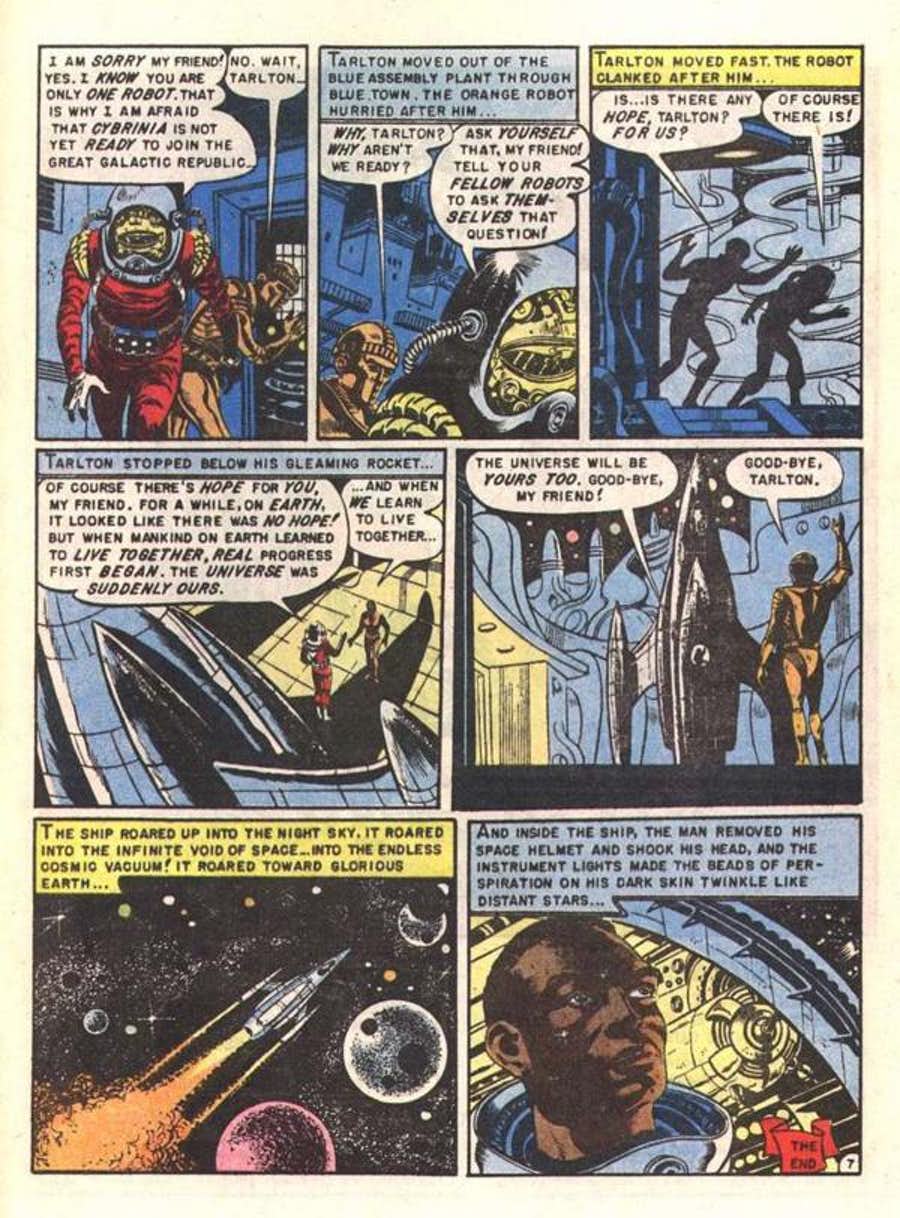
The famous EC Comics story "Judgment Day" (WEIRD FANTASY #18, 1953) is my selection of a story that appeals only to the didactic potentiality, and thus is a pure formal postulate. Symbol-hunters like myself would search in vain throughout Al Feldstein's story for any of the symbolic discourses familiar in prose science fiction-- discourses about whether robots can take on a wide variety of human traits, or man's quest to conquer the cosmos. Feldstein subordinates everything in this one-story universe to making one pedagogical point: that even in the far future, the scourge of bigotry will still exist, improbably incarnated in artificial beings-- despite the intimation that actual humans have overcome bigotry, which is the point of showing the galactic inspector to a Black man.

Since this essay-series started with Stan Lee and Jack Kirby, the reader will notice that it's no coincidence that I'm going to pick particular stories by each to illustrate two other types of vertical value.


I mentioned that some stories combine the didactic and mythopoeic potentialities, and this combination appears in the Stan Lee-John Buscema story "Origin of the Silver Surfer." For this story, Lee-- almost certainly the dominantly creative member of the team-- sought to give the character more humanity than the "science fiction angel" in the pages of FANTASTIC FOUR, who was essentially beyond commonplace humanity. Lee's new origin not only posited that the  Surfer had once been a mortal alien humanoid, Norrin Radd, but also that he hailed from Zenn-La, a civilization that had advanced so far that it held no challenges for one as restless as the future hero. This new element had a didactic purpose-- beware of becoming too coddled by advanced technology-- but there's a mythopoeic quality to Norrin's discontent as well. He's seen as a throwback to a more venturesome era, one who would be more suited to Zenn-La's frontier era. In other words, the Silver Surfer was just a "space cowboy."


Then Galactus comes calling, making a mockery of Zenn-La's defenses as the gigantic alien prepares to devour Norrin Radd's homeworld. Here Lee follows through on the loose God the Father/Jesus the Son opposition that arguably appeared in the Galactus Trilogy. But this time the Surfer is not an inhuman angel sacrificing himself for Earth-humanity; he's a mortal sacrificing his freedom to save his own world. So he's a cosmic Christ-cowboy, but significantly, this mythopoeisis still carries a didactic message. As the Surfer bids his beloved farewell before beginning his servitude to Galactus, he tells her. "Let not the spirit of our ancestors be lost a second time! Let not our people grow soft and indolent!" Norrin Radd gets his earlier wish, to emulate the ways of Zenn-La's early explorers, for now he can range the entire universe in his quest to find non-inhabited worlds for his master. Even the Surfer's estrangement from his girlfriend resembles the sacrifice of similar pleasures by heroes in Western films, in order that they may serve a greater cultural cause. So "Origin's" vertical values include a blend of formal-didactic and informal-mythopoeic postulates, though in this case I find that the mythopoeic postulate predominates.


Lee's story-- which may be the finest single story he ever wrote without input from "The Other Big Two"-- was the beginning of a series, but for my selection from Kirby, I choose a conclusion, the end of the NEW GODS series, issue #11, which bears the curious title, "Darkseid and Sons." Some fans speculate that prior to scripting this story, Kirby had been told the axe was about to fall upon the majority of the Fourth World. Thus he had but one issue to present some rough thematic conclusion to his series, while leaving the door open for a follow-up. An earlier issue had established Kalibak, son of Darkseid, had been captured by humans following Kalibak's inconclusive battle with his frequent rival, the heroic Orion. So Kirby chooses to match the two powerhouses against one another for his NEW GODS finale.


In early NEW GODS issues, Kirby had dropped broad hints that Orion might bear some shadowy relationship to Darkseid, Lord of Apokolips, and then he let fall the other shoe in NEW GODS #7. That story explicitly stated that Orion, Darkseid's son, was raised on New Genesis from perhaps age five onward, while Highfather's son Scott Free was raised on Apokolips, in an exchange one might call "hostage-fosterage." So it's a little anti-climactic when Darkseid makes a reference to Orion and Kalibak having fought as "children," though apparently neither warrior remembers growing up alongside the other. During Orion's battle, he more or less guesses that he and Kalibak are brothers. Kalibak himself has apparently never told of his parentage, but even the basic idea inflames him with nascent sibling rivalry.


The title actually gives the game away: the final revelation is not that either sibling, but that of Darkseid's own history. NEW GODS #7 also introduced the reader to both Heggra, Darkseid's mother, and Tigra his wife, also Orion's mother. There's no didactic point to this revelation, but there's a very big mythopoeic quality evoked by Kirby. Darkseid he complains that his two sons "darken my future as surely as their maternal forbears ruled my past! My mother, Queen Heggra! Orion's mother, Tigra! And the sorceress Suli!" It's not just an instance of misspeaking for him to include Heggra, who was obviously not mother to either of Darkseid's sons. Symbolically, he's including himself alongside his sons as having been "hag-ridden" (or "Heggra-ridden?") by powerful women. He wanted Suli, who possibly complemented Darkseid's own evil by spawning the brutish Kalibak. But Tigra, the choice of Darkseid's mother Heggra, unleashed from the seed of Darkseid's loins a force for good, a son capable of opposing his father rather than serving him. The story strongly suggests that Darkseid comes to admire the son who fights him, even though he retaliated for Heggra's murder of Suli by an act of indirect matricide. 

Kirby got one final chance at a sequel to NEW GODS in the graphic novel HUNGER DOGS in 1985, but he didn't bring up this maternal trope again. Did the artist, who was at least lightly conversant with some of the famous plays of Shakespeare and the Greeks, just happen upon the same trope so frequently evoked by Greek playwrights, in which stalwart heroes are undone by conniving females like Medea, Electra, and Clytemnestra? I think he incorporated the maternal motif into NEW GODS because he understood its dramatic appeal, at least on an instinctive, mythopeoic level. But because he doesn't have a didactic point to make with these revelations, "Darkseid and Sons" can only be what I term an "informal postulate," because there's no attempt to subject the correlation to intellectual cogitation.

Wednesday, November 9, 2022

THE INFORMAL POSTULATE

 As I started the prologue of the 2007 film criticism book HITCHCOCK AND PHILOSOPHY, I encountered this justification of the book's premise:

Many viewers have observed that Alfred Hitchcock focuses on ideas in the construction of his films. The French director-critics Claude Chabrol and Eric Roemer... claimed that each of his classic films is based on a sort of "formal postulate."

I wouldn't go so far as to say that all of Hitchcock's signature works are "idea-centered," but it's certainly fair to say that certain ones, particularly ROPE and VERTIGO, have a sort of ordered intellectual approach that I tend to line up with what I've termed "the didactic potentiality." However, I don't see so much focus on ideas in such films as 1943's SHADOW OF A DOUBT or 1960's PSYCHO. To invoke my own terminology once again, the latter two seem to belong to the mythopoeic potentiality, in that the films focus more on correlations than cogitations.

But I can understand the editors of the Hitchcock book seeking to draw parallels between the popular productions of the director and the high-toned cogitations of philosophy. In fact, even though I don't agree with Chabrol and Roemer, I'm glad that they advanced the term "formal postulate," because this fits in with the rational discursiveness of the didactic potentiality. In contrast, works heavily invested in the mythopoeic potentiality might be said to be more concerned with "informal postulates." This notion reminds me not only of my own notion of "half-truths," but also the way film-critic Raymond Durgnat summarized the appeal of the Frankenstein Monster terms of symbolic oppositions:

The Frankenstein Monster is brutal but pathetic; he's a creature who masters his creator; he's brute material capable of a lofty idealism that, turning sour, makes him a devil-- but a sympathetic one.

But when one wishes to convince others that a given work, medium or genre deserves respect, it's a lot easier to persuade an audience using the idea of formal postulates than informal ones. Informal postulates communicate, "I think this hidden complexity is there,"  while formal postulates make it sound as though the complexity is there for anyone to see. 

I also encountered this preference, possibly expressed on an unconscious level, when I finished Jess Nevins' interview with Alan Moore in the 2004 concordance A BLAZING WORLD. On page 254, one reads Moore claiming that his LEAGUE OF EXTRAORDINARY GENTLEMEN series is predicated, at least in part, in "pulling down the barriers between High Literature and pulp literature and pornography and low literary forms like that." Makes Moore sound like he's kissing-cousins with Durgnat's advocacy of "the poetry in pulp," right? But then on page 267 he advances this lofty sentiment:

Art is not about reassuring people. We don't read Art to be reassured, we read Art to be challenged and to challenge our assumptions and to maybe extend our ideas in certain areas, which you really can't do without challenging them.

No poetry here, despite the fact that Moore has produced some of the most resonant poetic-pulp in the annals of the comics medium. This "formal postulate" rather sounds a lot like what Northrop Frye wrote of those critics he called "Iliad critics" with respect to their idea of literature's purpose:

Many of our best and wisest critics tend to think of literature as primarily instructive... They feel that its essential function is to illuminate something about life, or reality, or experience, or whatever we call the immediate world outside literature. Thus they tend... to think of literature, taken as a whole, as a vast imaginative allegory, the end of which is a deeper understanding of the nonliterary center of experience...

Without repeating myself too much, I've also noted that Frye's two breeds of critic, "Iliad critics" and "Odyssey critics," seem to line up, respectively. with the mythoi of drama and irony for the first and with comedy and adventure for the second. One might agree with Moore that the former mythoi emphasize the challenging of assumptions, but if so, that would only be because those mythoi depend on putting their characters in deeply conflicted situations. In contrast, it's evident that a great deal of comedy and adventure does offer a kind of "reassurance," though maybe not in the way Moore imagines that reaction. That reassurance might be better compared to Tolkien's concept of "consolation."

The consolation of fairy-stories, the joy of the happy ending: or more correctly of the good catastrophe, the sudden joyous “turn” (for there is no true end to any fairy-tale): this joy, which is one of the things which fairy-stories can produce supremely well, is not essentially 'escapist', nor 'fugitive'. In its fairy-tale—or otherworld—setting, it is a sudden and miraculous grace: never to be counted on to recur. It does not deny the existence of dyscatastrophe, of sorrow and failure: the possibility of these is necessary to the joy of deliverance; it denies (in the face of much evidence, if you will) universal final defeat and in so far is evangelium, giving a fleeting glimpse of Joy, Joy beyond the walls of the world, poignant as grief.

(I note in passing that in the course of the interview Moore expresses a distaste for Tolkien's signature work in the context of complaining about "big, stupid clashes between good and evil.")

In conclusion, I realize that to some extent the preference for intellectual directness over intuitional indirectness is an individual one. However, knowing that does not make me amend my preferences in any way.


ADDENDUM: I thought I might expand further on the "formal/informal" dichotomy accidentally implied by the editors of HITCHCOCK AND PHILOSOPHY. However, upon re-reading my own CORRELATIONS AND COGITATIONS, I see that I included a reference to Whitehead's concept of "prehensions and apprehensions," glossed by another writer's assertion that the former focuses upon "soulful understanding" (aligned in my system to the mythopoeic potentiality), while  the latter focuses "intellectual understanding" (aligned in my system to the didactic potentiality). That's probably enough expatiation on the "formal/informal" dichotomy for now.


Wednesday, June 22, 2022

ABUNDANT EXCHANGES

I've now finished the remainder of Stuart A. Kaufman's INVESTIGATIONS. To be sure, I had to skip most of the heavily statistical stuff, but I flatter myself that I understood most if not all of Kauffman's abstruse concepts. 

In THE WHOLENESS OF HALF-TRUTHS PT. 1, I primarily contemplated Kauffman's response to Wittgenstein's philosophy vis-a-vis "codefinition," which parallels Kauffman's concept of "coevolution." Briefly summarized, Kauffman believes that evolution is not always, as in the popular paradigm, a matter of each individual organism blindly chancing upon whatever adaptations help that organism survive. Survival is still paramount in Kauffman's universe, but in some situations evolution may have taken place due to an exchange between two separate entities-- for instance, as may have happened when some prokaryotic cells bonded with others in order to produce eukaryotic cells. which unlike the earlier type of cell possess a nucleus and mitochondria. I note in passing that in 1967 Lynn Sagan/Margulis termed this process "endosymbiosis," but for whatever reason Kauffman does not use this term or mention Margulis in the bibliography to INVESTIGATIONS. 

Kauffman devotes most of the book to coevolution. This doctrine hinges on the concept that organisms co-evolve not by blind chance alone-- though Kauffman does not deny the chance-factor of mutations-- but out of some prehension (as Whitehead would term it) of a need for greater diversity and therefore abundance. From page 150:

...at the high risk of saying something that might be related to the subject of consciousness, the persistent decoherence of persistently propagating superpositions of quantum possibility amplitudes such that the decoherent alternative becomes actualized as the now classical choice does have at least the feel of mind acting on matter. Perhaps cells "prehend" their adjacent possible quantum mechanically, decohere, and act classically. Perhaps there is an internal perspective from which cells know their world.

The idea of such a "knowing" is of course anathema to reductive science, which cannot imagine organisms without brains as manifesting anything like consciousness, much less a desire for abundance. I interpose that word, which is not in INVESTIGATIONS, in keeping with my one use of it in the essay ABUNDANCE AND EXPRESSIVITY, just to keep myself on track about relating Kauffman's biological theories to my cultural/literary theories.

Kauffman devotes his next to last chapter, "The Persistently Innovative Econosphere," to a sustained comparison of biological exchange (in the "biosphere") with the human custom of trade (in the "econosphere," saying:

The advantages of trade predate the human condition among autonomous agents. Advantages of trade are found in the metabolic exchange of legume root nodule and fungi, sugar for fixed nitrogen carried in amino acids. Advantages of trade were found among the mixed microbial and algal communities along the littoral of the earth's oceans four billion years ago. The trading of the econosphere is an outgrowth of the trading of the biosphere.

Kauffman also disputes the definition of exchange as based in the scarcity of goods, and instead champions an aesthetic of diversity/abundance, saying on page 227: 

Think of the Wright Brothers' airplane. It was a recombination between an airfoil, a light gasoline engine, bicycle wheels, and a propeller. The more objects an economy has, the more novel objects can be constructed.

This statement bears on what I deem the "narratosphere"s" need for novel objects, which also depends on the recombination of elements taken from the co-defined spheres of "affective freedom" and "cognitive restraint," as discussed in WHOLENESS OF HALF-TRUTHS PART 2.  This is why, throughout the history of this blog, I have disputed "Iliad critics" who interpret fictional narrative as comprising a vast series of moral or rational lectures. While the cogitations of cognitive restraint are indispensable to fiction, said cogitations cannot produce novel objects in themselves. The correlations of affective freedom are necessary to break through habitual patterns of thought. (I note in passing a possible comparison between Kant's distinctions between productive and reproductive imagination, explored in 2011's FINDING SIGMUND PART 1.)

The belief that literature can and should pursue all imaginative linkages-- even those that some may find tainted by racial or sexual chauvinism-- lies at the heart of my devotion to the practice of archetypal criticism.

Sunday, February 27, 2022

CORRELATIONS AND COGITATIONS

 My attempt to distinguish between ideas and concepts in terms of narrative tropes isn't even four months old, and I've already decided to jettison those terms for another pair.

Though I labored with might and main to find a logical way to distinguish between ideas and concepts-- with the former leaning toward the mythopoeic potentiality, and the latter toward the didactic one-- the fact is that the two words have been used interchangeably for so long that nothing short of a major revision of all future dictionaries could dis-entangle them. This was borne out to me recently in a conversation with a friend who referred to science fiction as a "literature of ideas." I'd heard the phrase many other times, but hearing it once more convinced me that the word "idea" is conflated with "didactic utilitarian construct" as much or more than is "concept."

So I'm now using the words "correlation" and "cogitation." In keeping with my various observations on the combinatory mode, the mythopoeic is dominated by the process of correlation,  of bringing together disparate phenomena for the sheer pleasure of forging interesting combinations. Cogitation, however, is guided by a rational desire to suss out the imaginary relations of the phenomena in order to make some didactic point. 

I could cite examples of each mode, as I've done in other essays, but I've already cited various opposed examples of the didactic and mythopoeic potentialities in earlier essays, so there's no pressing need at this time. The point is merely to distinguish the different ways in which the tropes are formed as well as how they are used in fictional narrative. Didactic cogitations may be profitably aligned with Jung's concept of "directed thinking," while mythopoeic correlations are more in line with the psychologist's concept of "fantasy thinking." Somewhat more abstrusely, a similar dichotomy obtains with regard to Whitehead's distinction between "prehensions" and "apprehensions," an observation I reprinted in this essay:

Of central importance is Whitehead's idea of "prehension," which is dramatically defined, following Whitehead's specifications, "as that act of the soul, reaching out like an octopus to digest its experience." Fixing on "prehension" as the basic act in existentialism, an act carefully to be distinguished from "apprehension," which is based on intellectual rather than soulful understanding, Wilson rests his own case.

For that matter, though I've not written about Kant for some time, I might also align the pure pleasure of correlation-activity with the philosopher's notion of "the free play of the imagination," whose freedom stands in contrast to the restraints upon that imagination by what Kant calls cognitive understanding. But for now, I've probably put forth plenty of correlations for cogitation.


ADDENDUM: I haven't finished listening to this podcast in which Jordan Peterson hosts a discussion with Richard Dawkins. However, at one point, after listening to Peterson's Jungian rap for a while, Dawkins asks Peterson if he thinks more "in symbols or in ideas." Peterson says "symbols," and when he turns the question back on Dawkins, the latter says that he tends to think more in "ideas."