Featured Post

SIX KEYS TO A LITERARY GENETIC CODE

In essays on the subject of centricity, I've most often used the image of a geometrical circle, which, as I explained here,  owes someth...

Showing posts with label joseph conrad. Show all posts

Wednesday, December 9, 2015

THE DOMAIN GAME PT. 2

As stated in Part 1, the term "domains" can apply to any number of the multifarious principles, or groups of principles, that I've introduced on this blog since its inception. Obviously I could have continued to call them "principles," "rules," or "laws" just as easily. The word "domain," however, communicates a potential image of home and hearth, for all that in recent years that meaning may have been shoved aside for its connotation of "an address on the Internet," which is not much less abstract than a "principle."

Nevertheless, even the modern Internet usage is not without its "homey" associations. I compared my pluralist theory of art and literature to a "house with many mansions," where the separate rooms could contain such separable concepts as "Gene Phillips' version of Northrop Frye's generally accurate idea of the comedy-mythos" and "Gene Phillips' take on Todorov's thoroughly misguided idea of 'the uncanny.'" Since it's my house, it's inevitable that all of the rooms will reflect the owner's priorities.

But of course, just because I have priorities in my views of art and life does not mean that they have relevance only to me. Every philosophical posture is a open challenge to readers: it seeks to invite those who can agree with that posture, if only in part, and to downplay the priorities of those who disagree. A positivist would view all of these interactions from an atomistic standpoint: people agree and disagree purely according to their own interests.

Jung's concept of the "collective unconscious" was the psychologist's solution to science's tendency to view all psychological activity as belonging purely to what Jung called the "personal unconscious." From an entirely personal vantage, there can be no points of meaningful commonality between figures as removed in time as, say, Arthur Schopenhauer and Theodore Gaster. Yet, by seeing these philosophers' priorities through an archetypal lens, it may be possible to see what conceptual "mansions" they hold in common, rather than assuming that they just experienced similar patterns of toilet-training or the like.

Artists are not quite as focused on issuing conceptual challenges as philosophers. Sir Philip Sidney argued that "the poet never affirmeth." Surely "never" is certainly too strong given all the poets who trumpet their political affiliations to the world-- yet Sidney has correctly identified the archetypal nature of the artist far better than the ideologues who want to have their beliefs, be they ultraliberal or ultraconservative, supported by the artist's persuasive powers. The artist is one who potentially can see all things from all perspectives, even perspectives that may be alien to him. Thus, though most critics, including me, would judge Frank Miller's HOLY TERROR an artistic failure, it remains significant that he attempted, despite his limitations, to place some human face upon the political movement he wished to vilify.
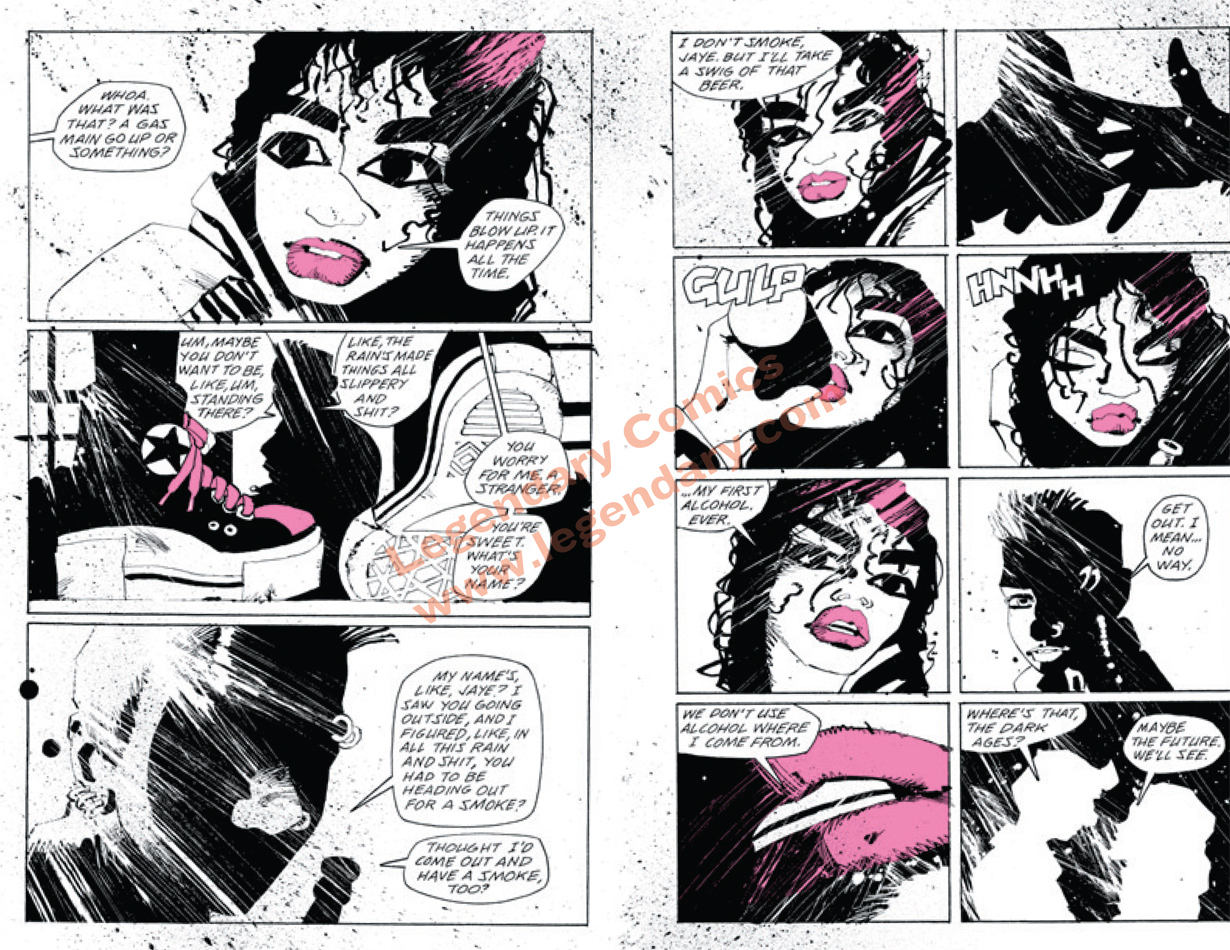


On a related note, I spent a fair amount of time recently analyzing Frank Miller's SIN CITY in terms of my phenomenological NUM-project. SIN CITY is strongly indebted to the genre sometimes called "hard-boiled crime," and the shadow of Mickey Spillane's work looms long over Miller's crime-cosmos. Given Miller's status with his readership at the time SIN CITY began, he could have chosen to pursue the domain of a naturalistic phenomenality and left all the signs of the uncanny and the marvelous behind, as Mickey Spillane largely did when he moved out of comic-book writing and into the world of crime paperbacks.  But despite all the ways in which Miller chose to emulate Spillane's style and content, he did not set SIN CITY in the same sort of naturalistic domain as the majority of the Mike Hammer books. As my study shows, a large though not totally dominant proportion of Miller's SIN-works fall into the domain of the uncanny-- and though none of the comic-book works flirt with the marvelous, one story in the film SIN CITY: A DAME TO KILL FOR does allow for the presence of a literal, if nearly impotent, ghost.

The three phenomenal domains of my NUM-theory operate in what I deem an archetypal sense. Different artists are drawn toward images and tropes that promise, or at least suggest, different types of freedom. What Joseph Conrad deems to be artistic freedom relates to the perceived rigor of the naturalistic, while J.R.R. Tolkien associates freedom with marvelous creations like green suns. Yet both, as much as "heavy thinkers" like Gaster and Schopenhauer, are alike in searching for the formula that gives them a sense of transpersonal fulfillment-- which, in the last analysis, is what all persons, of all races and creeds, desire when they speak of their need for freedom. Yet it is a freedom that is only possible in terms of perspectivism and pluralism-- and any creed that takes a different stance is merely seeking the fulfillment of some favored group or groups.

Monday, April 1, 2013

RUDOLF, MEET THEODORE

...[Rudolf Otto] explains the numinous experience in terms of the *mysterium tremendum,* the overwhelming mystery that compels fear and trembling in the viewer, and the *mysterium fascinans,* which compels the viewer to be attracted to the fascinating mystery.--  F/D/A MEETS AUM


...Gaster introduces two Greek terms that identify how the respective rites work. Rites of jubilation and invigoration are both characterized by *plerosis,* or "filling," because both give the sense that the ritual fills the community with new life. Rites of mortification and purgation are both characterized by *kenosis,* or "emptying," because they "empty out" the community of "noxious elements" one way or another.-- HERO VS. VILLAIN, MONSTER VS. VICTIM.
 
In the first of these essays, I made a parallel comparison between the three affects described by C.S. Lewis in THE PROBLEM OF PAIN and the three phenomenalities I deduced-- formerely called the AUM formula, revised to "NUM formula" in this essay.  Later, I sought to define the three phenomenalities in terms of my concept of "the sublime" in the essay ODDLY OR STRANGELY SUBLIME.  The terms proposed in that essay have now been superseded by this recent essay, but I have not forgotten one of the problems I associated with the Lewis essay:
Lewis' trinity of fear, dread, and awe-- which I've paralleled to my Todorov-derived trinity of the naturalistic, uncanny, and marvelous-- works quite well as long as one is considering only the *mysterium tremendum,* which seems to be the only aspect Lewis regards. But Otto's other formulation, the *mysterium fascinans,* suggests a less antipathetic attitude toward whatever-it-is that inspires the sense of something beyond ordinary experience. 
 
As an example of a *mysterium fascinans,* I chose a scene from Conrad's LORD JIM which depicted an onlooker's naturalistic "sense of wonder" on beholding a "marvelous stillness" in the world-- a scene in which natural beauty is at rest-- what basic physics terms "potential energy"-- and which scene is the exact observe of a Conrad-scene from TYPHOON, cited here. This depiction of a violent storm at sea is, as I noted, more typically with the sort of phenomena authorities like Kant have associated with "the sublime," violent, overwhelming phenomena, which can be generally likened to physics' concept of "kinetic energy."

I'm not saying that scenes of "energy at rest" inevitably correlate with the affect of the *mysterium fascinans,* or that scenes of "violent energy" inevitably correlate with the affect of the *mysterium tremendum.*  On the contrary, it's possible to conceive of being "attracted to a fascinating mystery" that happens to be sublimely violent; the Conrad storm-scene simply is not one such because the audience is likely to feel fear on behalf of the storm's victims.  Similarly, the "marvelous stillness" from the LORD JIM passage could just as easily inspire "fear and trembling" if he were describing the stillness of a desert where a human victim could not perservere. 

Just as Otto's terms can be aligned according to how a subject views a scene-- that is, whether he feels sympathy toward or antipathy against it-- the same dichotomy also applies to Gaster's terms of *plerosis/filling* and *kenosis/emptying.*  The former I have identified with forms of literature which are dominantly "life-affirming," while the latter compares with those forms which are dominantly "life-denying."  It now occurs to me that these wordings are a bit too value-laden, and that it would be more accurate to say "life-triumphing" and "life-defeating"-- the term "life" referring to those characters with whom the audience is meant to identify its interests.  (This is of course not to say that the audience does not identify with other characters, as I discussed in more detail here.)

I'll have more to say about the ways in which antipathy/*tremendum* and sympathy/*fascinans* apply to specific works in terms of sublimity, but for the purpose of this essay, it's enough to underline my conflation with Otto's dichotomy of "the Numinous" with Gaster's dichotomous division of ritual orientations.


Monday, August 13, 2012

SUBMARINE SUBLIMITY

At the end of THE THREE PART HARMONY OF DYNAMICITY I said:

In a future essay I'll relate these three levels of dynamicity to the more general concept of *sublimity,* which I relate to science fiction's "sense of wonder"-- of which Verne's book is a leading exemplar.
Possibly I shouldn't have implied that "sense of wonder" was characteristic of science fiction alone, since I devoted this entire essay to the proposition that isophemenal literaure could capture the sublime as well as any metaphenomenal work, using the specific example of Joseph Conrad,  noted pooh-pooher of fantastic tales. I said, among other things:


Plainly, in contrast to the TYPHOON passages I cited earlier in my Conrad analyses, this is Conrad picturing a naturalistic scene with just as much "sense of wonder" as anything in fantasy or science fiction.
And of course the literature of the metaphenomenal-- be it uncanny or marvelous-- may also draw on naturalistic descriptions to the same end of conveying wonder.  Here's another section from Chapter 24 of Verne's 20,000 LEAGUES UNDER THE SEA:


Actual petrified thickets and long alcoves from some fantastic school of architecture kept opening up before our steps. Captain Nemo entered beneath a dark gallery whose gentle slope took us to a depth of 100 meters. The light from our glass coils produced magical effects at times, lingering on the wrinkled roughness of some natural arch, or some overhang suspended like a chandelier, which our lamps flecked with fiery sparks. Amid these shrubs of precious coral, I observed other polyps no less unusual: melita coral, rainbow coral with jointed outgrowths, then a few tufts of genus Corallina, some green and others red, actually a type of seaweed encrusted with limestone salts, which, after long disputes, naturalists have finally placed in the vegetable kingdom. But as one intellectual has remarked, "Here, perhaps, is the actual point where life rises humbly out of slumbering stone, but without breaking away from its crude starting point."
Finally, after two hours of walking, we reached a depth of about 300 meters, in other words, the lowermost limit at which coral can begin to form. But here it was no longer some isolated bush or a modest grove of low timber. It was an immense forest, huge mineral vegetation, enormous petrified trees linked by garlands of elegant hydras from the genus Plumularia, those tropical creepers of the sea, all decked out in shades and gleams. We passed freely under their lofty boughs, lost up in the shadows of the waves, while at our feet organ–pipe coral, stony coral, star coral, fungus coral, and sea anemone from the genus Caryophylia formed a carpet of flowers all strewn with dazzling gems.
What an indescribable sight! Oh, if only we could share our feelings! Why were we imprisoned behind these masks of metal and glass! Why were we forbidden to talk with each other! At least let us lead the lives of the fish that populate this liquid element, or better yet, the lives of amphibians, which can spend long hours either at sea or on shore, traveling through their double domain as their whims dictate!
This dazzling vision-- very much in accord with one of the qualities Edmund Burke found in the sublime, "the richness and profusion of images"-- describes nothing that is either uncanny or marvelous, except for the brief reference to the futuristic diving-suits of Nemo and narrator Aronnax.  Nearly everything in this passage shows Verne attempting to capture the wonder of real submarine life-- most of which, I'm told, he managed to render with extraordinary faithfulness.  Yet without doubt the entire tonality of the scene is charged not with the "atypical-sublime" that one might find in a Conrad wonder-producing story, but with the "strange-sublime," which possesses a different character simply by virtue of the presence of the overall qualify of "strangeness."  Without the marvels produced from the genius of "superman" Nemo--  the diving-suits, the Nautilus-- this richness of imagery would be inaccessible to the eyes of humankind, at least in this fictional universe.  Thus even naturalistic details within a marvelous cosmos might be said to take on "the strange-sublime."

To touch on the concerns mentioned in THREE PART HARMONY, the above section from LEAGUES parallels the first section quoted in the earlier essay: all energies in the excerpt are "at rest," whether or not they are capable of greater activity.  This renders all agents in the except as "microdynamic."

How, then, is the section "sublime" if there is no sense of "might" or of danger?  Kant very definitely alloys the sublime with a sense of possible peril-- thus calling once more for what should now be a very familiar Kant-quote:

“…consider bold, overhanging, and, as it were, threatening rocks, thunderclouds piling up in the sky [and other examples of furious nature]... Compared to the might of any of these, our ability to resist becomes an insignificant trifle. Yet the sight of them becomes all the more attractive the more fearful it is, provided we are in a safe place. And we like to call these objects sublime because they raise the soul’s fortitude above its usual middle range..."-- Section 261.
Schopenhauer more or less agrees:

"The feeling of the sublime arose from the fact that something positively unfavourable to the will becomes [an] object of pure contemplation."
In this essay I disagreed with both Kant and Schopenhauer and allied myself somewhat more with Burke, for all that Burke was of the Empiricist faction:


I can agree with every aspect of [Schopenhauer's] statement but one. For the word "positively" I would substitute "potentially." Longinus, Burke and Kant all agree that the affect of sublimity comes into being only through a subject's contact with some overwhelming power/might/infinitude. However, none of them go so far as to say that this power must be invariably unfavorable to the human will.
Indeed, I would say that many of the most familiar "wonder-inducing" scenes in fantasy and science fiction-- of C.S. Lewis' kid-heroes stepping through a wardrobe to encounter the snowy world of Narnia, of 2001's space-station revolving in orbit to the strains of Johann Strauss-- represent nothing either "threatening" or "unfavorable."  These, I believe, are just one aspect of the sublime, which depends first and foremost on the sense that the subject experiencing the affect feels overwhelmed in some way, even as narrator Aronnax feels at the "indescribable sight" of the world of the coral realm.  Having already addressed the dual nature of the numinous in the above-linked essay, I won't repeat myself on this score.  But the multifarous nature of sublimity is worth keeping in mind as I continue to develop some of these distinctions re: dynamicity.


Tuesday, February 21, 2012

ODDLY OR STRANGELY SUBLIME

Does one necessarily *need* "arresting strangeness" to convey a sense of the marvelous? It would seem not, but at the same time there must logically be a coherent asesthetic governing these very different approaches to enchantment... -- from this essay.

As much as I admire the deductive reasoning behind C.S. Lewis' introductory essay in THE PROBLEM OF PAIN-- analyzed here and in my other essays referencing Lewis-- one might criticize Lewis for broadly implying that the "awe of the numinous" could be associated only with those things that suggested a "mighty presence," i.e., gods or God, while things of the ordinary/isophenomenal world could only imply "fear."  Clearly Joseph Conrad could find both wonder and terror in the "marvels and mysteries" he creates in his stories, most if not all of which take place in an isophenomenal world of naturalistic presences.

What can save Lewis' insight, however, is a closer look at the the terminology employed by Rudolf Otto, whom Lewis quotes briefly but does not explore in depth.

Quoting myself once more:


In my own conception the pure horror film doesn't necessarily need the element of the supernatural, but it does need the element of the *mysterium,* which is my shortened form for the two Latin phrases invoked by Rudolf Otto is his classic IDEA OF THE HOLY, where he explains the numinous experience in terms of the *mysterium tremendum,* the overwhelming mystery that compels fear and trembling in the viewer, and the *mysterium fascinans,* which compels the viewer to be attracted to the fascinating mystery.


Lewis' trinity of fear, dread, and awe-- which I've paralleled to my Todorov-derived trinity of the naturalistic, uncanny, and marvelous-- works quite well as long as one is considering only the *mysterium tremendum,* which seems to be the only aspect Lewis regards.  But Otto's other formulation, the *mysterium fascinans,* suggests a less antipathetic attitude toward whatever-it-is that inspires the sense of something beyond ordinary experience. 

For instance, regard the opening paragraph of Chapter 3 of Conrad's LORD JIM:

A marvellous stillness pervaded the world, and the stars, together with the serenity of their rays, seemed to shed upon the earth the assurance of everlasting security. The young moon recurved, and shining low in the west, was like a slender shaving thrown up from a bar of gold, and the Arabian Sea, smooth and cool to the eye like a sheet of ice, extended its perfect level to the perfect circle of a dark horizon. The propeller turned without a check, as though its beat had been part of the scheme of a safe universe; and on each side of the Patna two deep folds of water, permanent and sombre on the unwrinkled shimmer, enclosed within their straight and diverging ridges a few white swirls of foam bursting in a low hiss, a few wavelets, a few ripples, a few undulations that, left behind, agitated the surface of the sea for an instant after the passage of the ship, subsided splashing gently, calmed down at last into the circular stillness of water and sky with the black speck of the moving hull remaining everlastingly in its centre.


Plainly, in contrast to the TYPHOON passages I cited earlier in my Conrad analyses, this is Conrad picturing a naturalistic scene with just as much "sense of wonder" as anything in fantasy or science fiction.  In AGE OF WONDERS David Hartnell centers his definition of the term "sense of wonder" in an awestruck fascination with strange phenomena that does not suggest the aspect of the *mysterium tremendum:*


Any child who has looked up at the stars at night and thought about how far away they are, how there is no end or outer edge to this place, this universe – any child who has felt the thrill of fear and excitement at such thoughts stands a very good chance of becoming a science fiction reader. To say that science fiction is in essence a religious literature is an overstatement, but one that contains truth. SF is a uniquely modern incarnation of an ancient tradition: the tale of wonder. Tales of miracles, tales of great powers and consequences beyond the experience of people in your neighborhood, tales of the gods who inhabit other worlds and sometimes descend to visit ours, tales of humans traveling to the abode of the gods, tales of the uncanny: all exist now as science fiction. Science fiction’s appeal lies in combination of the rational, the believable, with the miraculous. It is an appeal to the sense of wonder.
Now, I've also gone on record as comparing the affect of the "sense of wonder" to the affect identified by Burke and Kant as "the sublime."  Burke and Kant do not make any distinctions as to whether the sublime affect arises from a phenomenon or a fictional work that has either isophenomenal or metaphenomenal characteristics, and as I pointed out here, Burke is as apt to find the quality of the sublime in works as far apart in phenomenality as HENRY IV and THE FAERIE QUEENE.

I have not previously referenced Arthur Schopenhauer's concept of the sublime.  Most of his meditations on it oversimplify its character due to his focus on its antipathetic, *mysterium tremendum* characteristics, as noted on this site:

For Schopenhauer, the sense of the sublime is attained by the aesthetic contemplation of an object that is inherently hostile to one’s will (or to human will in general).


This focus upon hostility, like Lewis' focus upon similar antagonistic states of mind, makes no allowance for the more "fascinated" state of sublimity.  However, in THE WORLD AS WILL AND REPRESENTATION, the gloomy philosopher does conceive one notion of the sublime not found in Burke or Kant: the idea that the sublime can appear in differering *degrees.*

I won't quote Schopenhauer's particular examples of sublimity's degrees, since they are all predicated on what I deem an incomplete vision of the concept.  But the notion of such a concept having different degrees proves very useful for my investigations of the sublime in fiction, for I too conceive that there are differing degrees of sublimity according to the phenomenalities of a given work.

Since works of an entirely naturalistic phenomenality are always defined by limitations, in which it is deemed impossible to transcend the cause-and-effect universe, such works do not evoke "arresting strangeness" in Tolkein's sense.  They do, however, depict worlds in which "the typical" is frequently superseded by "the atypical."  This may include anything from an anomalous event, such as a bank robbery, to a personal epiphany, such as Conrad's narrator describes by catching a ship at sea in a mood of sublime repose.

This kind of sublimity/sense of wonder, which does not break with the order of causality, I term the "odd-sublime," in that whatever takes place in the naturalistic world does not transcend either the cognitive or affective aspects of that orderliness.

Works in the sphere of the uncanny and the marvelous, however, fall into a category best termed the "strange-sublime."  Marvelous works break with both the cognitive and affective aspects of normative order, while uncanny works break with the affective aspect appropriate to causal relations but largely stay within the cognitive sphere of causality.

And of course, it should go without saying that the aspects of the *tremendum,* which Lewis's schema captures so well, also fall in line with this division, so that his "tigers" can be repositories of the "odd-sublime," whether they inspire fear or fascination, while his "ghosts" and "gods" incarnate the "strange-sublime" in all its aspects of dread, awe, and fascination.

I should note in passing that "the odd-sublime," where it occurs in naturalistic fictional works, sometimes has such a strong familial relationship with the "strange-sublime" that it can cause makers of film-compendia to incorrectly associate the two.  Many isophenomenal films by Alfred Hitchcock, for instance, are listed in such film-compendia as belonging within the sphere of metaphenomenal works.  But a film like 1972's FRENZY carries none of the "strangeness" of 1960's PSYCHO, even though the two films share a basic subject matter (the actions of a psychotic killer).  If FRENZY is sublime at all, it is only "odd-sublime," and shares more kinship in its phenomenality with LORD JIM, while affectively speaking PSYCHO is a phenomenal kissing cousin to THE LORD OF THE RINGS.


Monday, November 7, 2011

TIGERS AND GHOSTS AND GODS; OH MY!: PART 1

Philosophically speaking, what does it mean to be a metaphenomenalist?  Or, for that matter, an isophenomenalist?

In my conclusion of the Metagodzilla-Isoghidrah Wars, I clarified that in terms of taste, anyone was free to prefer whatever phenomenality one might prefer.  As a pluralist, I'm bound to recognize (to cite another of my old essay-titles) that "anything that can be done well is worth doing."  If Joseph Conrad does his best work within an isophenomenal conceptual framework, where all the "marvels and mysteries" are only mankind's vain imaginings in the face of a materalistic universe, then that's worth doing.  If J.R.R. Tolkien does his best work within a metaphenomenalist conceptual framework-- specifically dealing with metaphenomena within the "marvelous" category-- then that too is worth doing.

In my QUICK HAWTHONE POST I cited two longish quotes by Hawthorne in which he justified his practice of the form he called "the romance."  In contrast to Tolkien's focus upon marvelous metaphenomena, Hawthorne showed a perennial fascination with metaphenomena in the "uncanny" category, though of course Hawthorne never used this term.  Slightly after the lines I quoted from A THREEFOLD DESTINY, Hawthorne adds:

In the little tale which follows, a subdued tinge of the wild and wonderful is thrown over a sketch of New England personages and scenery, yet, it is hoped, without entirely obliterating the sober hues of nature.
Despite the fact that Hawthorne, as much as Conrad, values fidelity to "the sober hues of nature," I'd venture that his "tinge of the wild and wonderful" has a very different character than Conrad's "marvels and mysteries."  In the quotes I provided from Conrad here, it's clear that those "marvels" are intrinsically derived from, and thus entirely dependent upon, the world of sensory experience: of "effects of the visible and tangible world."  Hawthorne's statement above, though, never implies that "the sober hues of nature" are the sole source of his "wonderful tinge."  At the same time most of his works avoid the outright presentation of either the marvelous or the naturalistic: Hawthorne always seeks the uncanny, the liminal space between the two opposed states.

That said, because Hawthorne gives the world of fantasy its own identity, I deem him closer to Tolkien than to Conrad.  Many literary critics would dispute this, deeming Hawthorne and Conrad together within the corpus of canonical "literature" while Tolkien occupied a vague category of "paraliterature."  Nevertheless, such allotments are usually made by critics given to focusing on the rendering of isophenomenal reality as paramount, and so would be opposed to my statement in the Meta-Iso Conclusion:
In both its "uncanny" and "marvelous" manifestations, however, the metaphenomenal stands free to delve into the depths of what Kant calls the "productive imagination."
The isophenomenalist is usually indifferent to any concept like that of the "productive imagination," in that he's already committed to the proposition that all that we imagine derives from sensory experience; what Kant calls "reproductive imagination" and what Conrad calls "my consciousness of the marvelous."

It's certainly a beguiling enough proposition.  For me Freud was one of the great challenges.  Because his theory seemed to work so well for some works of literature and so poorly for others, I concluded here  that his theory was best seen as a example of "reproductive imagination." I added that such a theory could be adequately subsumed by a superior theory that took in both productive and reproductive forms of imagination, such as that of Kant, and to some extent the theory of Carl Jung.  The same formulation applies to Todorov, whose Freudian underpinnings slanted him to state that fantasy could only be judged in terms of "the real."

In the next part of this series (which will at last explain the title) I'll consider in greater depth the tripartite theory of "fear, dread, and awe" that C.S. Lewis presented at the outset of his nonfictional work THE PROBLEM OF PAIN.  I haven't explicitly written on Lewis since this 2010 essay, but though I part with him in terms of the "solution" he gives to his PROBLEM-- that of Christian hermeneutics-- Lewis is almost as important as Kant and Jung in having helped me formulate my entire NUMtheory.


Thursday, October 13, 2011

METAGODZILLA VS. ISOGHIDRAH: CONCLUSION

At the end of the first essay in this essay-series, I said:

...I'll wind up by describing the relevance of their respective intersubjectivities for the literary analyst.

"Their" refers to the two authors I've now compared and contrasted: Joseph Conrad, who championed the "marvels and mysteries" found in isophenomenal fiction, and J.R.R. Tolkien, who defended the more "arresting" wonders of faerie and fantasy, which is at least one major aspect of the metaphenomenal expanses of humanity's ongoing narrative universe.

Now, it must be said first of all that from the standpoint of taste, or what Kant calls "the agreeable," there can be no particular logical valuation placed on either the preference for realistic or fantastic wonders.  In the realm of the agreeable, Conrad is justified in finding the former marvels fascinating, and Tolkien is equally justified in "desiring dragons," as he once put it.

However, both of these paradigms of wonder-production are not confined only to these particular authors.  Both of them, in exploring their own creative preferences, translated their particular tastes into intersubjective literary myths, and so expanded the potentials of both paradigms by instilling such wonders, be they of natural typhoons or unnatural dragons, in the hearts of their readers.  Some readers preferred only realistic wonders, as Conrad apparently did, some readers bowed down exclusively at the fane of Tolkien, and some learned to appreciate both intersubjective wonders.  Since I have written with appreciation of both writers here, obviously I'll be disposed to use myself as a representative of the last type of reader.

That said, though I respect the party of Conrad, I hold more regard for Tolkien's POV despite the fact that I disagree with a number of his specific opinions.  For Conrad, taking a naturalistic stance, tends to treat fiction as if it had to be based upon one's view of the "real world."  But for me this is the domain of nonfiction.  Fiction will always be more about the hypothetically possible than the actual: more about "becoming" than "being" as it were.

Kant also believed that qualities such the beautiful and the sublime were not purely products of pure association, which he labeled as "reproductive imagination" and which seems to deal, like Coleridge's concept of "fancy," with what Samuel Taylor called "Fixities and Definites."  Conrad's type of "marvels and mysteries" are clearly of this nature, since Conrad takes pains to tell us that all such enchantments are simply impressions made upon our minds by the "visual and tangible world."  This is the limitation of all isophenomenal fiction.  Within those limits great work can and has been done.  But often the greatness of the work comes of exploiting the tension between the limitations of the real and human expectations of illimitability.

In both its "uncanny" and "marvelous" manifestations, however, the metaphenomenal stands free to delve into the depths of what Kant calls the "productive imagination."  Kant's remarks, cited earlier in my "Finding Sigmund" essays, bear repeating:

“For the imagination… is very mighty when it creates, as it were, another nature out of the material that actual nature gives it… We may even restructure experience; and though in doing so we continue to follow analogical laws, yet we also follow principles which reside higher up, namely, in reason (and which are just as natural to us as those which the understanding follows in apprehending empirical nature. In this process we feel our freedom from the law of association…”—Kant, CRITIQUE OF JUDGMENT, Section 314, tr. Pluhar).

Cassirer, whom I troubled to introduce in the INTERSUBJECTIVITY INTERLUDE, reifies Kant in such a way as to clarify that these "principles which reside higher up" are at once grounded in human subjective responses to the world and yet possess an objective nature by virtue not just of reason, but of their function within the overall human community.  Cassirer's concept of "magical efficacy" makes clear that the particular charm of metaphenomenal fantasy resides in one's embracing of that sense of infinitude and illimitability, even if it is something we can only know through the interrelated forms of myth and literature.

And that's why, even though the fight between Metagodzilla and Isoghidrah never truly concludes, the former, by the nature of the "homeground" advantage, will always be the victor.


Tuesday, October 11, 2011

METAGODZILLA VS. ISOGHIDRAH, PART 2

Fantasy, of course, starts out with an advantage: arresting strangeness. But that advantage has been turned against it, and has contributed to its disrepute. Many people dislike being “arrested.” They dislike any meddling with the Primary World, or such small glimpses of it as are familiar to them. They, therefore, stupidly and even maliciously confound Fantasy with Dreaming, in which there is no Art; and with mental disorders, in which there is not even control: with delusion and hallucination.


And in this corner we have the "Godzilla" whose 1939 essay "On Fairy Stories" has repeatedly been invoked to battle "Primary World" champions like Joseph Conrad/"Isoghidrah."  "Metagodzilla" is of course J.R.R. Tolkien, who may start rolling in his grave if his ghost ever hears that I've just compared him with a giant radioactive lizard.  It's meant to be a compliment, of course, not least in that the big lizard almost always wins the fight.

OTOH, this isn't a "winner take all" fight: more like an inevitable conflict between world-views.  Tolkien proclaims that:

Fantasy is a natural human activity. It certainly does not destroy or even insult Reason; and it does not either blunt the appetite for, nor obscure the perception of, scientific verity. On the contrary. The keener and the clearer is the reason, the better fantasy will it make. If men were ever in a state in which they did not want to know or could not perceive truth (facts or evidence), then Fantasy would languish until they were cured. If they ever get into that state (it would not seem at all impossible), Fantasy will perish, and become Morbid Delusion.

Compared to Conrad's sneer at the mental "elasticity" of those who believe in the supernatural-- which as noted in Part 1, doesn't even differentiate between literal belief and fictional credence-- this statement shows a far broader conception of the nature of literature as a whole, not merely those particular departments of it that one may term "ghost stories," "fairy stories," or even my "metaphenomenal fiction."  One can question some of Tolkien's conclusions here, but there's no question that he's looking at literature from a much more pluralistic stance than Conrad.  For me this statement wins Tolkien the fight "on points" as it were.

Of course it must be noted that both authors were writing about those aforementioned departments only, so neither is making a blanket condemnation or defense of all metaphenomenal fictions.  Indeed, at one point in the essay Tolkien, not content with taking swipes at the Conrad-like modernists who condemn fantasy as "unreal," also takes a jab at science fiction:

The maddest castle that ever came out of a giant's bag in a wild Gaelic story is not only much less ugly than a robot-factory, it is also (to use a very modern phrase) “in a very real sense” a great deal more real. Why should we not escape from or condemn the “grim Assyrian” absurdity of top-hats, or the Morlockian horror of factories? They are condemned even by the writers of that most escapist form of all literature, stories of Science fiction.


To be sure, there have been a lot of SF-writers and SF-critics who defend science fiction over fantasy as supposedly being more "realistic," by which they really mean "more tied to the naturalistic world of cause and effect."  But the dichotomy doesn't really hold.  While there are assorted science fiction stories that are scrupulous about translating real-world science into fiction, many of the best-known SF-concepts are not any more supportable than a Gaelic giant's-bag.  I appreciate that the late Isaac Asimov could write rings around me in terms of real-world scientific knowledge.  But he didn't draw on such knowledge to posit his "Three Laws of Robotics."  These "laws" are no more than concepts designed to make his robot-narratives function as he the author chooses, and those narratives depict not naturalitic "reality" but a far-flung fantasy-corpus tenuously bound together with strands of real-world scientific data. 
Of course, were Conrad actually battling Tolkien, if only in debate, Conrad might well stick to his guns that fantasy does indeed insult reason.  And since Conrad states that he considers that fantasies of life-after-death are nothing more than "a desecration of our tenderest memories," one would expect that he would have little interest in the Christian underpinnings of Tolkien's arguments, particularly his view of "consolation:"

 
And lastly there is the oldest and deepest desire, the Great Escape: the Escape from Death. Fairy-stories provide many examples and modes of this—which might be called the genuine escapist, or (I would say) fugitive spirit. But so do other stories (notably those of scientific inspiration), and so do other studies. Fairy-stories are made by men not by fairies. The Human-stories of the elves are doubtless full of the Escape from Deathlessness. But our stories cannot be expected always to rise above our common level. They often do. Few lessons are taught more clearly in them than the burden of that kind of immortality, or rather endless serial living, to which the “fugitive” would fly. For the fairy-story is specially apt to teach such things, of old and still today. Death is the theme that most inspired George MacDonald.


Yet in his next few paragraphs, Tolkien emphasizes that this consolation is more than just "the imaginative satisfaction of ancient desires."  Its principal purpose is the Eucatastrophe, or "happy ending." 

The consolation of fairy-stories, the joy of the happy ending: or more correctly of the good catastrophe, the sudden joyous “turn” (for there is no true end to any fairy-tale) : this joy, which is one of the things which fairy-stories can produce supremely well, is not essentially “escapist,” nor “fugitive.” In its fairy-tale—or otherworld—setting, it is a sudden and miraculous grace: never to be counted on to recur. It does not deny the existence of dyscatastrophe, of sorrow and failure: the possibility of these is necessary to the joy of deliverance; it denies (in the face of much evidence, if you will) universal final defeat and in so far is evangelium, giving a fleeting glimpse of Joy, Joy beyond the walls of the world, poignant as grief.


I omit here the parallels Tolkien draws to his own Christian belief, which I as a pluralist see as part of a more widespread cultural pattern, best summed up by Theodor Gaster in his book THESPIS.  I in turn summarized his concepts of *plerosis* and *kenosis* with respect to their applicability in literary terms in AN OPEN QUEST PART 2.

But even though I find Tolkien's literary view to be immensely more well-reasoned than Conrad's, I must add that it is not insignificant that Conrad believes that he sees "marvels and mysteries" in the "visible and tangible world."

Does one necessarily *need* "arresting strangeness" to convey a sense of the marvelous?  It would seem not, but at the same time there must logically be a coherent asesthetic governing these very different approaches to enchantment-- which I'll discuss in the last part of this essay-series.    


Tuesday, October 4, 2011

METAGODZILLA VS. ISOGHIDRAH, PART 1

Weighing in as the "Isoghidrah" of my title, we have the esteemed modernist author Joseph Conrad (1857-1924).

In 1915, Conrad wrote a story entitled "The Shadow-Line," which like many of his tales involved a psychological study of men at sea.  To Conrad's immense displeasure, a few critics interpreted the tale as some sort of ghost story.  This prompted Conrad to write a long "author's note" which not only disparages the verdict of those critics but seemingly of the entire concept of what he calls "the supernatural," whether in real life or fiction.  In so doing Conrad put forth a doctrine of what I term "the isophenomenal," a doctrine asserting that there are no phenomenon outside those that we commonly call "natural:"

This story, which I admit to be in its brevity a fairly complex piece of


work, was not intended to touch on the supernatural. Yet more than one

critic has been inclined to take it in that way, seeing in it an attempt

on my part to give the fullest scope to my imagination by taking it

beyond the confines of the world of the living, suffering humanity. But

as a matter of fact my imagination is not made of stuff so elastic as

all that. I believe that if I attempted to put the strain of the

Supernatural on it it would fail deplorably and exhibit an unlovely gap.

But I could never have attempted such a thing, because all my moral and

intellectual being is penetrated by an invincible conviction that

whatever falls under the dominion of our senses must be in nature and,

however exceptional, cannot differ in its essence from all the other

effects of the visible and tangible world of which we are a

self-conscious part. The world of the living contains enough marvels and

mysteries as it is; marvels and mysteries acting upon our emotions and

intelligence in ways so inexplicable that it would almost justify the

conception of life as an enchanted state. No, I am too firm in my

consciousness of the marvellous to be ever fascinated by the mere

supernatural, which (take it any way you like) is but a manufactured

article, the fabrication of minds insensitive to the intimate delicacies

of our relation to the dead and to the living, in their countless

multitudes; a desecration of our tenderest memories; an outrage on our

dignity.


Whatever my native modesty may be it will never condescend so low as to

seek help for my imagination within those vain imaginings common to all

ages and that in themselves are enough to fill all lovers of mankind

with unutterable sadness. As to the effect of a mental or moral shock on

a common mind that is quite a legitimate subject for study and

description. Mr. Burns' moral being receives a severe shock in his

relations with his late captain, and this in his diseased state turns

into a mere superstitious fancy compounded of fear and animosity. This

fact is one of the elements of the story, but there is nothing

supernatural in it, nothing so to speak from beyond the confines of this

world, which in all conscience holds enough mystery and terror in

itself.
The rest of the essay deals solely with Conrad's conception of the story and does not concern me.

I don't recall whether or not academics consider Conrad to belong to the literary movement called "Naturalism."  However, in the sense that I am using the term "naturalism," which is denote a particular type of literary phenomenality, Conrad speaks not just for his own particular tastes here, but for the whole literary tradition of isophenomenal naturalism, which explicitly rejects anything suggesting "fantasy" or "supernaturalism" as being very like what Conrad calls "vain imaginings."

Conrad, having taken umbrage at the slight that anyone should deem his "complex" work to be a mere ghost story, spends no time considering what the appeal of ghost stories or any other "supernatural" works might be for those readers that like that sort of thing.  Instead, the author vaults over the distinctions between a ficitonal consideration of the supernatural and a real-life belief in it.  Conrad places himself above any whose minds are "elastic" enough to credence the supernatural, which is "but a manufactured article, the fabrication of minds insensitive to the intimate delicacies of our relation to the dead and to the living."  Conrad may have had similar thoughts about other aspects of the alleged "real supernatural," but here he centers his polemic on the idea of its existence as a "fabrication" originating purely from human beings' "relation to the dead and to the living."  This part of Conrad's polemic seems much like an overcompensating reaction to the "ghost story" accusation and doesn't merit much discussion.

What is most interesting about Conrad's essay, however, is his assertion that even without the fabrication of the supernatural, the world is still a place of "marvels and mysteries," whose interaction upon human minds would "almost justify the conception of life as an enchanted state."

That "almost" neatly sums up not just Conrad's skepticism on things enchanted, but that of all or most works in the naturalistic-phenomenalist tradition.  In such works enchantment is not impossible, but author and reader must always remain aware that it does not arise from any link to supernatural realms or beings.  Rather, such human moods  are generated only by the "inexplicable" ways that wholly natural "marvel and mysteries" act upon "our emotions and intelligence."

Within the corpus of this essay Conrad does not give any examples of these enchantment-inducing "marvels and mysteries," and frankly, if he meant to put any in "The Shadow-Line," they failed to have any enchanting effect upon this reader.  However, other Conrad works, such as his story "Typhoon" (1902), proved far more successful.  Here's a section from the viewpoint of two sailing-men caught within the toils of a gigantic storm at sea:


The motion of the ship was extravagant. Her lurches had an appalling helplessness: she pitched as if taking a header into a void, and seemed to find a wall to hit every time. When she rolled she fell on her side headlong, and she would be righted back by such a demolishing blow that Jukes felt her reeling as a clubbed man reels before he collapses. The gale howled and scuffled about gigantically in the darkness, as though the entire world were one black gully. At certain moments the air streamed against the ship as if sucked through a tunnel with a concentrated solid force of impact that seemed to lift her clean out of the water and keep her up for an instant with only a quiver running through her from end to end. And then she would begin her tumbling again as if dropped back into a boiling cauldron. Jukes tried hard to compose his mind and judge things coolly.

The sea, flattened down in the heavier gusts, would uprise and overwhelm both ends of the Nan-Shan in snowy rushes of foam, expanding wide, beyond both rails, into the night. And on this dazzling sheet, spread under the blackness of the clouds and emitting a bluish glow, Captain MacWhirr could catch a desolate glimpse of a few tiny specks black as ebony, the tops of the hatches, the battened companions, the heads of the covered winches, the foot of a mast. This was all he could see of his ship. Her middle structure, covered by the bridge which bore him, his mate, the closed wheelhouse where a man was steering shut up with the fear of being swept overboard together with the whole thing in one great crash -- her middle structure was like a half-tide rock awash upon a coast. It was like an outlying rock with the water boiling up, streaming over, pouring off, beating round -- like a rock in the surf to which shipwrecked people cling before they let go--only it rose, it sank, it rolled continuously, without respite and rest, like a rock that should have miraculously struck adrift from a coast and gone wallowing upon the sea.

"As if taking a header into a void"... "as though the entire world were one black gully"... "this dazzling sheet"..."tiny specks black as ebony."  I can't be sure that these are the sort of sensory experiences that Conrad would have deemed properly "enchanting," but I think it likely.  Indeed, I can see how such descriptions capture, even in isophenomenal vesture, much of the same emotion science fiction has come to call "the sense of wonder," even if the "wonder" is confined in Conradian hermeneutics to the here-and-now.

Conrad's existential position reminds me of the empiricist philosopher Burke's postiion on the emotion of "the sublime," which similarly arose from naturally-inspired associations. Yet the aforequoted section from "Typhoon" most resembles this citation from Burke's opponent Immanuel Kant:
  “…consider bold, overhanging, and, as it were, threatening rocks, thunderclouds piling up in the sky [and other examples of furious nature]... Compared to the might of any of these, our ability to resist becomes an insignificant trifle. Yet the sight of them becomes all the more attractive the more fearful it is, provided we are in a safe place. And we like to call these objects sublime because they raise the soul’s fortitude above its usual middle range..."-- Section 261.


Kant's theory of the sublime was designed to demonstrate that sublimity-- which also bears some resemblance to sci-fi's "sense of wonder"-- did not arise purely from naturalistic associations.  However, Kant wrote too little on the subject of literature as such to be useful in combatting the naturalistic ethic of Conrad.

Next essay: Conrad Meets His Metagodzilla.