Featured Post

SIX KEYS TO A LITERARY GENETIC CODE

In essays on the subject of centricity, I've most often used the image of a geometrical circle, which, as I explained here,  owes someth...

Showing posts with label irony (mythos). Show all posts

Friday, March 7, 2025

THE READING RHEUM: THE HUNCHBACK OF NOTRE DAME (1831)

 In this review I'll use the English language title for Victor Hugo's novel rather than the French one. One reason is that the word HUNCHBACK is easier to use as a short form for the title. But I also think it's a better title. Quasimodo is indubitably the novel's central icon, and as important as the 15th-century Parisian setting is, that importance is secondary. Supposedly foreign tourists became more interested in the Notre Dame cathedral after the publication of Hugo's novel. But I'd bet few tourists came to observe the cathedral's architectural wonders, but rather thought about the setting in which the pitiable hunchback came to his sad end.                                                       

In contrast to some 19th-century novels that I have frequently reread, like MOBY DICK and FRANKENSTEIN, I only read HUNCHBACK once before, thirty-forty years ago. I don't remember most of my impressions from the first reading. I had probably seen the classic 1939 movie adaptation and may have heard that it was not entirely faithful to the Hugo novel. I probably didn't know that Esmerelda too meets a terrible fate, and back then, I might have called that end "tragic." But on this reread, I realized that almost everything about the Hugo book is oriented toward the mythos Northrop Frye termed "irony." Esmerelda is the only character who incarnates any potential for good, and that means that she must be sacrificed to the stupidity and venality of 15th-century Paris. Quasimodo's claim to goodness is shakier, but he starts out with all the odds massed against him, so he too is doomed. Of the few characters in HUNCHBACK who prosper, all are utterly unworthy. 

   Often HUNCHBACK has been adapted in other media that obscured the book's ironic mode, focusing on the pathos of Quasimodo rather than his inevitable doom. Some versions also give Esmerelda a "happy ending" with her beloved guardsman Phoebus, one of those worthless characters mentioned above. But I've yet to see a truly ironic version, one that follows the book in depicting the entire society as informed by cruelty and rapacity. Usually all the negative aspects of Quasimodo's world are channeled into the hunchback's father-figure Frollo, who becomes obsessed with the beautiful Esmerelda's physical charms. Ironically, Esmerelda herself is no less captivated by beauty, becoming smitten with Phoebus for his looks (the reference to Apollo is a telling one). Quasimodo may be the one individual, even with his limited mentality, who appreciates Esmerelda as much for her kindness as for her beauty.           


Hugo is sometimes linked with the artistic movement called "Romanticism," but I don't think HUNCHBACK is a Romantic novel, as are both MOBY DICK and FRANKENSTEIN. It contains larger-than-life scenes that everyone with a basic education knows, like Quasimodo's public flogging and the mercy shown him by his sort-of victim Esmerelda, and the hunchback's dramatic rescue of Esmerelda from the hangman's noose. But HUNCHBACK also contains reams of incredibly prolix prose, as Hugo burns up space descanting on the foolishness of the Parisians, from the highest to the lowest. Hugo acts as if he thinks he invented satire, with the result that most of the other characters are superficial. HUNCHBACK is one of those rare novels which has become a sort of secular literary myth, at least in the sense that most people have at least a broad knowledge of its contents. Yet Hugo's mythopoeic powers are at odds when his didactic ones. For instance, one of the novel's most mythic moments takes place when one of Hugo's POV characters is victimized by the denizens of The Court of Miracles, possibly the first "city of thieves" in canonical literature. This is a great nightmarish scene, potentially portraying the thief-society as the inversion of normal Parisian existence. But once I saw that "overground" Paris was just as rotten and arbitrary as "underground" Paris, I felt that Hugo was making a very superficial equation between the two. In the end, HUNCHBACK is a classic novel that I can admire in many respects. But because of the conflict I perceive between Hugo's intellectual and imaginative powers, it's not a novel I like.                                                                                                       
Unlike most of the "monsters" who appeared first in 19th-century fiction, Quasimodo is never as imposing a menace as Dracula, the Frankenstein Monster or even Mister Hyde. I still believe he belongs to the domain of the uncanny because his crippled-yet-powerful status is not completely in the naturalistic mode.   
          

Thursday, January 25, 2024

MYTHCOMICS: "WOMEN HOWLING AT THE MOON" (FUUSUKE, 1969)

Osamu Tezuka became widely associated, in both his own country and in others, with squeaky-clean (usually) kids' entertainment. But he had attempted more adult works even before his ASTRO BOY breakout, such as 1949's METROPOLIS. And toward the end of the 1960s, the God of Manga became increasingly involved in manga with pronounced sexual content.

FUUSUKE is a minor work, consisting of eleven installments in the life of the title character. There's no real continuity between the stories, a few of which take place back in Japan's feudal era. The only point the tales have in common is to show the hapless Fuusuke getting humiliated, like a "salaryman" version of Dagwood Bumstead. But for all Dagwood's ignominies, at least he didn't have his sexual capacities trashed. True, everything that happens in the one mythic FUUSUKE story, "Women Howling at the Moon," happens within the main character's dream. But Tezuka wasn't describing , Jules Feiffer-style, the shortcomings of one protagonist, but of the male sex generally, at least in 1969 Japan.


Fuusuke's dream imagines that Earth's hunger for the commodity of "moon rocks" following the 1969 lunar landing results in the strip-mining of Luna. Though the second panel gives us the image of the moon-rocket as penis, it's Earth's vaginas that are empowered by increased lunar radiation. (Tezuka's explanation of the moon's increased shininess oddly invokes an image associated with male aging.) Tezuka also loosely references the moon's much storied influence upon women's periods, though he doesn't sustain the allusion.


The lunar radiation has a pronounced effect on women (possibly in the rest of the world too, though Japanese life alone is spotlighted).  The females of the species become endlessly horny on full-moon nights, so much so that they not only attack their husbands, but any males they can find. To Fuusuke's immense aggravation, he seems to be the one Japanese male that none of these rapacious women will bother with. Meanwhile, women everywhere celebrate their newfound sexual freedom, just as if moonshine had taken the place of the Pill.


Though it's impossible to gauge passage of time in Fuusuke's jumbled dream-world, things swiftly escalate from isolated attacks to hordes of women attacking the police forces. Moreover, in a move that seems counter-intuitive, some females become "black widow" cannibals. Not surprisingly, Tezuka is careful not to include any references to the fate of Japanese children amid all this hullabaloo, but then, it is a dream, so excluding real-world stuff is logical.


One of Fuusuke's comrades avers that "none of this would have happened if men hadn't become so weak." This sentiment is echoed by the ending, in which, just before the protagonist wakes up, he's being lauded as the only male immune to being ravaged, though only because of his unexplained total lack of sex appeal. Tezuka's final word is, "This is the sad dream that the most unpopular men in the world have to comfort themselves."

But this isn't the final word according to the dynamics of the story. Tezuka certainly puts a lot more effort into elaborating his sex-scenario than he needed to simply explain Fuusuke's sexual alienation-- especially since the dream doesn't really "explain" anything. 

Traditional "the fox and the grapes" rationalizations usually follow some pattern of criticizing the tastes of the opposite sex-- women are superficially attracted to money, social position, good looks or displays of macho physicality. But the Moon-Howlers display no discrimination whatever. None of the victimized men are better looking than Fuusuke, and there's nothing to mitigate the opinion of Fuusuke's friend, that all Japanese men have become weak. And what do money or social position matter, since the women aren't forcing their conquests into marriage, and at least some of those conquests end up in a cook-pot?

In the Howlers' near-total lack of discrimination, they resemble the male of the species, who constantly want sex with any available female. Western culture, in fact, compares horny men to another creature known for howling at the moon: the venerable Canis Lupus. It's just as simplistic to say "rape is only about power" as it is to say "rape is only about sex," but clearly ravishment depends upon some power differential. Does the weakness of Japanese men trigger the Moon-Howlers to assume the role of rapacious males? Tezuka doesn't precisely say this, but claiming that lunar radiation makes women want to kill and devour their mates recalls a remark attributed to Simone Weil: that male rapists physically dominating women prior to sex is comparable to a butcher "tenderizing" meat.

The reason for Fuusuke's exclusion is a joke without a punchline. He's certainly not being excluded because he's bad breeding material, because the Moon-Howlers are utterly unconcerned with breeding, There's no answer to Fuusuke's existential question in the dream as such, but there's the suggestion of a clue in Tezuka's invocation of the menstrual cycle. Accepting the generalization that the cycle can be distinguished into two main phases-- the follicular, which encourages female horniness, and the luteal, which discourages sexual responsiveness-- then the Moon-Howlers seem to enter the follicular stage whenever they stalk Japanese men. Only Fuusuke, for whatever unknown reason, shifts them into the luteal phase, in which his mere presence "switches them off." 

"Moon's" image of rapacious women finds an echo in his next-year work APOLLO'S SONG. In this more developed work, Tezuka focuses on a young male who's just the opposite of Fuusuke-- being a more traditional aggressive male-- but who is still utterly trammeled by female influences that leave him "cut off at the knees," or some similar compromise of his masculinity.


Thursday, October 19, 2023

THE READING RHEUM: THE ALICE BOOKS (1865/1871)


What do you suppose is the use of a child without meaning? Even a joke should have some meaning-- and a child's more important than a joke, I hope.-- The Red Queen, THROUGH THE LOOKING GLASS.

Though both the Red and White Queens talk a great deal of nonsense, there's actually a good deal of sense in what this royal chess-piece says to Alice, even if the response is disproportionate to Alice's line, "I sure I didn't mean--" (the thing the Queen attributed to her).

Now, since Lewis Carroll was a self-appointed apostle of nonsense, "making sense" is not necessarily a good thing. The author had already expressed a dim opinion of a similar outlook in WONDERLAND, when the Duchess self-importantly informs Alice that "everything's got a moral, if only you can find it." 

Clearly Carroll means for readers to laugh at the presumption of both the Duchess and the Red Queen and to embrace the lunacy of the author's mad, mad worlds. The two ALICE books are meant to delight children (and adults) with every sort of word-play imaginable-- which is to say, telling jokes whose appeal is that they don't apparently mean anything. Though Carroll avoids taking a philosophical position in the books, since that would be too much like "sense," it seems obvious to me that he rejected the utilitarianism of his time that would say a child only has "meaning" if he or she is "moral." The ALICE books are in every way a "vacation from morals."


That does not necessarily mean, though, that Carroll's works are a "vacation from meaning." And by "meaning," I'm not talking about allusions, like the allusions to familiar nursery-rhymes or well known political figures. I'm talking about Carroll using his unique logical system to mirror mad dreams with their own internal logic, a logic drawn from common human fears and anxieties. The primary tropes I find in both books are:

(1) Frequent references to injury and death, starting in WONDERLAND with Alice speculating on what would happen after she falls off the roof of a house-- though I like better the second one, where she wonders what it would be like to he a candle-flame once it was snuffed out. LOOKING GLASS begins much the same, in that before Alice goes through the mirror, she remembers having playfully told her nurse to pretend she's a bone while Alice is a hyena eating the bone.

(2) A trope I call "omniphagia" is related to the death-and-injury trope but not identical. All children are obliged to grapple with the fact that they, as living things, must devour other living things to survive. Carroll's worlds are defined by the sense that "everybody eats everybody," and this trope extends from the cake and drink labeled "EAT ME" to the foodstuffs that come alive on the Queens' table before one can devour them. 

(3) Egotism and quarrelsomeness. Only rarely does any character tender useful advice to Alice (the Caterpillar is one exception), and that's usually because they're busy pontificating on whatever's important to them. When any of these butt-headed characters butt heads, they get into ridiculous fights, though LOOKING GLASS emphasizes such conflicts more than WONDERLAND. I tend to class all the size-changing episodes under the "egotism" trope, for when she's small, Alice has to worry about being eaten by crows or puppies, and when she's tall, she has to contend with getting her long neck stuck in the trees.

(4) Inconstant motion. In both books Alice experiences long falls that seem to take a great deal of time, and LOOKING GLASS stresses that the Red Queen must constantly keep running to stay in the same place. Though WONDERLAND includes many examples of sudden transitions, like the door in the tree that leads Alice back to the long hall, LOOKING GLASS provided a sort-of rationale for said transitions in the chessboard pattern of the domain. Not that Alice always needs to move between squares: she undergoes at least three transitions in the shop run by The Goat, a character I've yet to see appear in any adaptation.

(5) Finally, the meanings of both words and one's sense of identity are just as inconstant. Alice can't say a word without one of the Carrollian creatures inverting her words or interrogating her intent to looney effects. And when Alice can't remember the correct words to familiar poems like "Twinkle Twinkle Little Star" or "Father William," she immediately begins to doubt her identity. Throughout both books, various characters forget who they are and what they intend doing. Arguably WONDERLAND emphasizes this trope more than the other book, culminating in a group of jurors who can't recall their names unless they write them down. The arbitrariness of legal systems is also one that takes refuge in the meaninglessness of jargon, as with "sentence first, evidence afterwards." Most of Carroll's logic games in both books depend on the many-sided nature of words and expressions.

Because the ALICE books depict two nonsense-realms where all the denizens are mad and no form of logic applies, I deem them both to fit Northrup Frye's category of "the irony." With respect to focal presences, I've stated before that I consider Alice to be largely a viewpoint-character, even though her own egotism and sometimes erratic grasp of logic makes her a stronger character than most similar ones. But it's the denizens of the two weird realms who form the superordinate ensemble. In WONDERLAND, the narratively important characters are the Mad Hatter, the March Hare, the Dormouse, the Cheshire Cat (none of whom were in the 1864 draft), the Caterpillar, the Queen and King of Hearts, the White Rabbit, the Mock Turtle, and the Duchess. Others, such as the Gryphon and the various minor animals Alice encounters, form a subordinate ensemble. LOOKING GLASS is not nearly as rich in original characters, which is probably why many adaptations fold some or all of LOOKING GLASS's superordinate icons into the WONDERLAND universe-- usually Humpty Dumpty (whom Carroll did not invent), Tweedledee and Tweedledum, the Red and White Queens, and (more rarely) the White Knight. The aforementioned Goat and the Gnat seem more like undistinguished spear-carrier types. However, Carroll allotted two subordinate "guest appearances" in LOOKING GLASS to the Hare and the Hatter, though both appear under pseudonyms.

All and all, though LOOKING GLASS hasn't been mined nearly as much as WONDERLAND, both deserve their status as literary classics for all ages. One documentary claimed that the ALICE books are the works most quoted after the Bible and Shakespeare, and that speaks to the author's incredible facility with the mysteries of language and logic.

Friday, January 28, 2022

LIMITED AND LIMITLESS CREATED HE THEM PT. 3

 My recent discourses on "the limited and the limitless" aspects of creative expression reminded me of a passage from Northrop Frye. I discussed it in greater detail in this 2009 essay, but here I'll confine myself to looking at the passage from a new perspective.

...all critics are either Iliad critics or Odyssey critics. That is, interest in literature tends to center either in the area of tragedy, realism, and irony, or in the area of comedy and romance... Many of our best and wisest critics tend to think of literature as primarily instructive... They feel that its essential function is to illuminate something about life, or reality, or experience, or whatever we call the immediate world outside literature. Thus they tend... to think of literature, taken as a whole, as a vast imaginative allegory, the end of which is a deeper understanding of the nonliterary center of experience... They value lifelike characterization, incidents close enough to actual experience to be imaginatively credible, and above all they value 'high seriousness' in theme...-- Northrop Frye, "Mouldy Tales," A NATURAL PERSPECTIVE, pp. 1-2.

Frye brackets two of his literary mythoi, tragedy and irony, as having appeal for the "realist" critic, while the other two, comedy and romance, are the preference of the "romantic" critic. In the essay Frye's principal distinction between the "Iliad critic" and the "Odyssey critic" is that the latter reads the narrative to enjoy the story for its own sake, while the former is looking for an "imaginative allegory" whose purpose is to illuminate "the immediate world outside literature." 

Frye doesn't precisely formulate a reason as to why the Iliad critic seeks his illumination in two of the four mythoi, irony and the one I've renamed "drama."  Nor does he do so for the Odyssey critic with respect to comedy and the mythos I've renamed "adventure." But I believe the essential contrast is that between "the happy ending" and "the unhappy ending." The Odyssey's denouement is moderately "happy," insofar as Odysseus, despite many ordeals and lost years with his family, succeeds in his goal to return to his homeland and to be reunited with his wife and son. In contrast, The Iliad concludes with Achilles yielding the dead body of slain Hector to his father, an outcome that looks forward to the fact that in the greater continuity Achilles too is doomed to perish before the walls of Troy come tumbling down. The Iliad fills the reader with an awareness of the dramatized limitations of life, and while The Odyssey is not unaware of those curtailments on freedom, the adventurous elements of the journey fill one with a sense of limitless potential, in that a mortal hero has managed to survive against the ill will of the gods.

Though I didn't address the limited/limitless dichotomy in my four essays on THE FOUR AGES OF DYNAMIS, the fourth essay touches on similar territory.

Now, as it happens, in arranging the four mythoi, I followed Frye's season-based arrangement, which to the best of my recollection did not involve Ovid's "four ages." In the first two FOUR AGES essays, I said that the *dynamis* of each mythos compared well with one of the "ages of man:" child, adolescent, mature adult, older adult. Thus I perceive that even though adventure is "serious" in terms of how its readers are expected to invest themselves in the character's struggles, it is a "light seriousness" that canon-critics do not regard as covalent with their "high serousness." Adventure-stories, while they may not involve adolescent characters, are often regarded as adolescent in nature because they tend to have happy endings, no matter what sufferings their characters may endure  to reach said ending. Not all works within the dramatic mythos have unhappy endings, of course. But critics tend to prefer dramas because there is a certain expectation of a stronger chance for a dolorous, and therefore more bracing, conclusion to the story. Thus dramas meet the critic's desire for high seriousness.

With the two "mythoi of levity," comedy, more than irony, still allows for more identification with its characters than does irony, and thus comedy also shows a predilection for happy endings. Though the phrase "light comedy" does not apply to all comedies across the board, it suggests something of the attitude that the Iliadic critic has toward comedy in general: there's still enough of a tendency for viewers to invest in the characters' fates and to want to see said characters validated to some degree. This is not true of the irony, for the creator of the irony has, so to speak, turned up the dial on his levity-making machines until everything in the story floats free of any readerly attachment. Again, some ironies-- such as Voltaire's CANDIDE-- may have relatively "happy" endings in comparison to other, more relentless ironies. But there is no sense, to paraphrase Frye, that the world has been reborn by a ritual of jubiliation: if anything, even the worlds with relatively happy endings are doomed, just as "older adults" are doomed to end their days and their experience of the ongoing world.

Thus, this current rethinking invalidates the verdict of the GRAVITY'S RAINBOW series, in that I would now opine that both adventures and comedies show a greater tendency toward encouraging reader identification than one sees in dramas or ironies. To pursue the metaphor of the four ages once more, it's as if the comedy and the adventure allow for the most identification because their characters were designed to be triumphant, while the drama and the irony are designed to allow the reader to pull back from the characters, even if for very different reasons.

One more installment to go...


Monday, July 19, 2021

MYTHCOMICS: THE SONS OF EL TOPO (2016)


In my review of the cult-film favorite EL TOPO, I noted that its writer-director was so scattershot in his use of mythic motifs and religious rituals that I imagined him as a younger man just getting started in the surrealism game—though in point of fact, Alejandro Jodorowsky would have been about 41 at the time.


Despite TOPO’s success on the midnight movie circuit, Jodorowsky had zero luck getting a cinematic sequel made. It was over twenty years later, according to Wikipedia, that the director attempted to launch such a project. About another twenty years later, the filmmaker, who had also established himself in the world of European comics, decided to take his movie-script and collaborate with Mexican artist Jose Ladronn in producing THE SONS OF EL TOPO. This consisted of two European-style albums, each of which was named after one of the magical gunfighter’s two sons, the very Biblically named Cain and Abel.


SONS is just as devoted to the episodic structure of a surrealistic work as its “father in another medium.” However, whatever changes Jodorowsky wrought upon the script over the years, the story of Topo’s offspring displays a more fine-tuned approach to the complexities of myth-symbolism. The movie was basically the story of a western gunfighter undergoing an “imitatio Christi” with added dollops of Eastern symbolism and gobs and gobs of sex and violence. In EL TOPO Jodorowsky provide viewers with the skeleton of a myth. But in SONS, he put some flesh on them bones.

The opening pages of the first album, CAIN, reproduce the essential scenes of the film’s conclusion: Topo frees the mutants and sees them slaughtered, Topo slaughters the slaughterers, Topo commits suicide and his grave is adorned with the combs of honeybees.


However, in between the last slaughtering and the self-immolation, some time ensues, during which Topo becomes known as a peerless saint, possessed of phenomenal powers. During this time, the son he left behind in a Franciscan monastery, known in the film only as Hijo, is re-christened Cain. Topo’s first son seeks out the saint in his desert haven, furious that his irresponsible father is now so venerated. Cain can’t bring himself to slay Topo, but because he knows that the saint’s current wife has an infant son, Cain threatens to kill his half-brother Abel. This is a big mistake. Emulating the father-god of the Old Testament, Topo places a mark upon Cain’s brow, indicating that anyone who acknowledges the young man’s existence will be cursed. Only after doing this does Topo immolate himself. Possibly this satisfies Cain’s bloodlust, because in this period he’s seen about to ride away with both infant Abel and Abel’s mother in a peaceable manner.


Years pass—at least fifteen, since by the next time we see Abel, he’s a grown man of about that age. Cain, who’s been fruitlessly wandering all this time, still looks the same, which is to say that he always looks like a young Jodorowsky when he played El Topo. The gravesite of the saint has undergone physical changes, for the earth around the site has formed a “Sacred Isle,” surrounded by a deep trench filled with acidic waters. Further, seven pillars of pure gold have erupted from the earth surrounding the grave of the still-powerful-in-death saint. This golden bounty is attractive to all manner of greedy men, from bandits to priests, but only innocents can cross the stone bridge linking the Isle to the world around it.


Cain shows up again, complaining about his sufferings under the curse, and haranguing his dead father for its removal. Obligingly, and for the only time in the story, Topo’s spirit shows up. But when Cain charges his father’s ghost with violent intent, Topo simply flings him away. This sequence serves mostly to introduce the reader to Cain’s continued adventures as he skulks away, while all around him refuse to acknowledge his presence. Cain has other encounters as he wanders from place to place, but the only one of lasting consequence is his encounter with a young woman about to be forced to become a nun. She falls in love with Cain at first sight and deserts her people to follow him. She’s never given a name, but since in the movie the kid is given the faux-name of “Hijo,” meaning “son,” I’ll belatedly christen the girl as “Ninita,” “little girl,” which is the appellation one character applies to her.


The actual conflict gets going with Abel. He and his unnamed mother now operate a wagon with a puppet-show for juvenile entertainment, and in this period they’re first seen performing a show in which a puppet representing the Spirit of Death is foiled by two young lovers. In contrast to the play, though, Abel’s mother is stricken with a heart attack. She manages to stave off death long enough to make Abel promise to bury her next to her saintly husband. Abel expresses concern that such a trip will lead them into bandit country. The mother counsels Abel to send for Cain to be their protector, using a trained eagle, name of Angela (of course), to find the cursed brother. She dies, while Abel begins transporting her by wagon to the Sacred Isle.


The eagle does indeed lead Cain to Abel’s wagon, though by that time the outlaw—who does not reciprocate Ninita’s love— has callously left her behind with a super-religious enclave. (He never comments on the fact that he’s done to her exactly as his father did to him.) Cain bears Abel’s mother no animus but he’s reluctantly to do anything for the father who cursed him—and besides, the woman’s body, instead of decaying normally, emits a fragrance that will attract thieves. Abel sweetens the pot by promising to help Cain get hold of all the gold surrounding their father’s resting place, and Cain agrees. Ninita then shows up as well, having escaped the religious goons and somehow followed Cain across the desert. Abel promptly desires the very woman who can see no one but his brother.
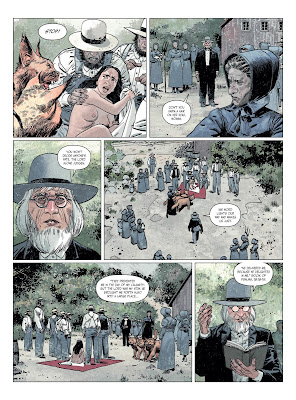


I’ll abbreviate a long segment of the story in which Cain and Abel must contend with a bandit army, whose colonel has been enchanted to think himself a beast, not unlike the Biblical Nebuchadnezzar. As the brothers leave the bandidos, though, Cain persuades the colonel’s whore Lilith to come with them, offering her the golden bounty in exchange for her charms. But escaping one bandit army just leads the travelers into another one, and this time the brothers can only escape after the cursed Cain receives a roundabout “blessing” from his dead father, and Abel imitates his brother’s murderous ways. The volume ABEL ends with the mission being left up in the air, for Cain departs in the company of Ninita, while Abel continues with his mother’s body to the Isle, where one assumes Lilith will find some way to get her hands on the gold, if only by seducing Abel.


While Jodorowsky does work some esoteric non-Christian imagery into SONS, just as he did in the TOPO film, the core of the story is stronger for its reliance on Judeo-Christian symbols. Foremost among these is the story of two brothers separated by their father’s erratic will, and the mention of that patriarch’s blessing even conjures with another pair of Biblical siblings, Esau and Jacob. Cain and Abel are almost a split of the original Topo’s two sides, killer and visionary, while the two women in their lives are literally “nun and whore.” Medieval lore includes various stories of saints whose mortal forms proved incorruptible even after death, and I appreciate that Jodorowsky developed one small element from the film—that of the saint’s grave being surrounded by bees—so that now the gravesite is surrounded by bees’ honey—which, in ancient times, was often used as a funerary preservative. The name of Lilith, Adam’s first wife in rabbinical stories, is nicely applied to a sort of “bad mother” to both Cain and Abel, as if to compensate for their being “good boys” by taking the “good mother” to her resting place. Jodorowsky never uses the phrase “seven pillars” as it occurs in Proverbs 9, or their connection with wisdom. But it’s surely no coincidence that Ladronn draws seven pillars of gold, though it’s hard to say if even the saint Topo seems especially “wise” in his dealings with his sons. The story does end up feeling somewhat unfinished—the last image is of the beast-colonel still barking like a dog—but I tend to feel that Jodorowsky wanted to frustrate any readers who wanted an ending with all loose ends tied up. For myself I can easily live with the unfinished feel of the story, because the bizarre inventiveness of the journey more than compensated for the lack of destination. Like the film EL TOPO I judge this work to belong to the mythos of irony, although SONS is a fully combative work, as violent as any of the more gruesome spaghetti westerns.

Sunday, May 9, 2021

COMBATIVELY YOURS


In the three-part LOVE OVER WILL (FOR NOW) series, starting here, I listed five of the mythcomics I’d reviewed here because I deemed that they all rated as “accommodation narratives” rather than “confrontation narratives.” In my many observations on the combative mode in confrontation narratives, I’ve continually sought to make clear that although many narratives resolve conflict through violence, said narratives are only combative if the violence has a particular level of organization. I further observed that many other narratives of the accommodation type resolve conflict through romance and/or sexual activity, and that they would follow the same dichotomy. The stories would only be “combative,” so to speak, if two or more characters with *megadynamic * wills are brought into conflict, with that conflict resolved by their romantic interaction. 


That essay-series didn’t look at any of the accommodation narratives through the lens of the four mythoi, as I did with four confrontation narratives in STATURE REQUIREMENTS. I’ve now improved my interpretation of the mythoi through the metaphors of “the four ages of man” in the DYNAMIS essays, starting here, and so I’ll use that approach in comparing and contrasting four accommodation stories, one for each of the four mythoi.


Again, for an accommodation narrative to register as combative, the contending wills must have a high level of dynamicity, expressed in terms of sexual rather than martial conflict. If the tropes of combative energies in battle are embodied by famous myth-stories like Odysseus slaying the suitors (“extroversive”), the tropes of energetic sexual cooperation are embodied by a model like the one in Yeats’ “Solomon and the Witch,” wherein Solomon and Sheba have such great sex together that it seems as if the whole word has been temporarily annihilated (“introversive”). This would be the kind of interaction that Hollywood advertising calls “tempestuous,” so that’s what I sought in the four examples I’ll examine. Three of the examples are taken from the LOVE OVER WILL series, while the fourth is new to these considerations.


In the DYNAMIS essays, I’ve allotted the mythos of comedy to the first age of man, in which the main character, regardless of how old he may be, is placed in the situation of a child seeking to negotiate his way through the arbitrary, often ludicrous rules of society and/or nature. In “She Tried Her Own On,” a self-contained story from the series DOMINA NO DO, the humor proceeds out of nature. Lead female Hikari has been keeping her supposed boyfriend Takeshi in her mansion for some time, subjecting him to her confused sadomasochistic attentions. Then, like the Melancholy Dane, she begins to have “bad dreams.” She imagines that Takeshi menaces her with a titanic phallus, despite the fact that she’s seen his actual joystick and wasn’t consciously impressed. But Hikari begins to feel guilty about having abused Takeshi, so she decides to “walk a mile in his wang” by having her sorcerous grandma give Hikari a temporary penis. The experience doesn’t fill the young woman with anything akin to “penis envy,” but the ordeal does solve Hikari’s nightmare-problem, because now she can imagine “dueling” Takeshi in her dreams.       


Next of the four ages is that of adolescence, when the thoughts of young men and women turn to goals of heroic accomplishment. In the NEW MUTANTS story “To Build a Fire,” one of the titular heroes, Magma, finds herself stranded in the Amazonian rainforest with Empath, a member of the Hellions. Though the New Mutants and the Hellions belong to rival mutant schools, the ongoing continuity had Magma leave her team to sojourn with the “bad” mutants. The reasoning for the “school transfer” always remained murky, but the author’s main purpose was probably just to get Magma and Empath together. As her name suggests, Magma can call streams of lava from the vasty depths of the Earth. In contrast, Empath’s mutant power is entirely mental: he can persuade almost any woman to fall in love with him. When the two teens are stranded in the forest, they quarrel about whether Magma should use her power to call attention to their plight. The young woman gives evidence that she’s attracted to the rather skeevy Hellion even when he’s not using his power on her, and the mere fact that he might try to master her—albeit only mentally—may have a lot to do with her refusal to “give it up.” The story concludes with an accommodation between the two, in that Magma does use her power the way Empath wants, but only after both belting him and kissing him, leaving him confused about whether he influenced her at all.


Like “To Build a Fire,” “Rite of Spring” is a nonviolent story within a series that is dominantly violent (and within the combative mode as well). Like most stories centered upon a monster-protagonist, the SWAMP THING series falls into the dramatic mythos, particularly because Swamp Thing’s experiences as a monster don’t emphasize thrilling physical triumph (as with say, the Thing of the FANTASTIC FOUR), but the tragic dimensions of life, of the limitations that dog every mortal’s tracks when he transitions into the third age of man. The swampy protagonist, however, gets a bit of a new lease on life, when his female companion Abby, after having followed him around for years as a friend-in-need, suddenly confesses feelings of love for the plant-monster. He for his part reciprocates. Since the Swamp Thing is a mass of plant-growths in humanoid form, he doesn’t have the equipment to consummate a romantic relationship after the human fashion. So instead he encourages Abby to “eat of his flesh,” a specific tuber growing from his body. Not only is the tuber psychotropic, it apparently enhances Abby’s psychic senses so that she can behold the spirit-energies of living things that Swamp Thing can normally see. Swamp Thing and Abby then link minds and experience an ecstatic communion with all the surrounding life-forms of the swamp—which is portrayed as being both as intense and as intimate as any human coitus. Yet the advancement of their relationship into a sort of sexual congress signals that they've moved outside the sphere of triumphant adventure; that they've entered the sphere in which men and women have congress in order to create their replacements when they pass on-- even if the exigencies of comic book ensure that neither Abby nor Swamp Thing shall perish from their earth.


The hero of RAT GOD is actually more of a demihero, an upright New England man who finds himself entrapped in a Lovecraftian cosmos, including a degenerate town that I called “an Innsmouth for rats.” Clark Elwood, like many protagonists of such stories, finds himself forced to fend off a cult that worships the titular rat god. But whereas H.P. Lovecraft would have emphasized the brooding terror of the rat god and his followers, Richard Corben focuses on Elwood’s overly flattering view of his own racial heritage, as against, say, the local Indians. The only reason Elwood gets embroiled with the rat-worshippers is out of sexual passion, as he pursues his love-interest Kito. The real cosmic joke on Elwood is that he doesn’t realize that Kito is an Indian girl, meaning that cohabitation with her ought to be verboten for an upright Caucasian. This sort of a joke, in which the protagonist is caught in some ludicrous situation that he has no power to meliorate, is characteristic of the final age of man, as a person loses his health and faculties with increasing age. To Elwood’s credit, he does overcome his prejudices on a basic “but I really want her” level, and though Elwood’s not a real fighter he does show enough determination to outwit the rat-worshippers. Afterward, Elwood settles down to some sort of romantic accomodation with not only Kito, but also with a rather degenerate looking white woman named Gharlena. This is about as close to a happy ending as one ever gets from a predominantly ironic narrative. As seen in the conclusion of Voltaire’s Candide, the protagonist does not so much triumph as escape from the craziness of the madding world.


I mentioned in QUANTUMS OF SOLIPSISM PT. 2 that the master tropes governing the organization of the violent combative mode were either “univectoral” or “multivectoral.” The first three of these “combative love-attacks” emphasize the back-and-forth exchanges of Hikari and Takeshi, of Swamp Thing and Abby, and of Empath and Magma, so all three would be multivectoral in nature. Only RAT GOD would be univectoral, since the story’s main emphasis is upon Elwood, with Kito, despite her erotic charms, taking the position of a support character.  


Friday, December 11, 2020

FRYEAN BLIND

 One detail I didn’t mention in my quasi-review of THE POETICS OF MYTH is that when the author presents his rather rushed summary of Northrop Frye’s contributions to myth-criticism, Meletinsky conflates two different selections of Frye’s work, quoting from both ANATOMY OF CRITICISM and from an essay from six years earlier, “The Archetypes of Literature.” But Frye’s arrangement of his mythoi is not the same in these two works. Meletinsky ends up telling readers that Frye has equated comedy and romance with the seasons of summer and of spring, which is true in the essay. But in ANATOMY, Frye reversed the two comparisons. Given that the book represents the fullness of the critic’s thought, this was a rather clumsy mistake on Meletinsky’s part.


However, Meletinsky’s section on Frye did remind me of a topic I brought up in my essay THE FOUR AGES OFDYNAMIS. I said in that essay that I couldn’t find any evidence that Frye had based his four-season, four-mythos schema on anything in Ovid. A fresh scrutiny, though, reveals that a page or two before Frye begins his first section on this subject, entitled “The Mythos of Comedy: Spring,” he does make reference to other famous quaternities, including “the four periods of life (youth, maturity, age, death).” There’s not much chance that Frye was unaware of Ovid’s famous poem. It’s more likely that the “Four Ages of Man” as Ovid conceived them simply did not line up with Frye’s conception of his four mythoi, which took its principal influences from myth-ritual scholars like Gilbert Murray and Theodor Gaster.


Without question Ovid’s four ages are more persuasive than Frye’s foursome, not least because “death” is not really a period of life. In the ANATOMY Frye is acutely conscious that spring is associated with images of rebirth, not least in his own religion of Christianity, and also that historically Greek New Comedy tended to focus on the attempts of young men and women to be married despite the opposition of tyrannical authority figures. Thus, the critic leapfrogs over the period of actual childhood—Ovid’s “frail shoots and grasses”—so that he Frye can draw symbolic comparisons between mundane marriages of young people and the sacred union of God and humankind. In my early readings of the ANATOMY I was blown away by all of these mythopoeic allusions. Yet in later years I’ve come to decide that there are some problems with pages and pages of criticism on the subject of comedy that barely addressed the functions of humor.

Just as problematic is Frye’s attempt to disassociate the mythos of adventure-oriented romance with the “age” in which heroes venture forth to battle dragons and witches. Since Frye’s spring-protagonists must necessarily be adolescents, his summer-protagonists would have to be of a somewhat later age in order to represent “maturity.” In real life, however, adolescent males are more likely to seek combat-glory before they marry and settle down, even if New Comedies and their descendants tend not to depict that aspect of life. In my own writings, I tend to see that all of the strivings of adolescents, whether relating to Eros or Thanatos, belong on the same plane, since both activities are dominantly associated with persons in their “hardened” summer-phase. Raymond’s FLASH GORDON provides an example of focusing upon both romantic love and on romance in its connotation of a story of great conflict and adventure.


As I stated in FOUR AGES, comedy depends upon the frustrations of incongruity, and these frustrations aren’t exclusive to, say, the “heavy fathers” of Greek New Comedy. Slapstick humor, which may well have been prominent in Greek Old Comedy, may involve no romantic interest whatsoever. The incongruity can arise when the victim’s expectation of immunity from harm is thwarted by a banana peel under the shoe or a pie in the face. Yet Frye was right in thinking that comedy was essentially a mythos about “coming together:” it’s just not a union defined by romance. Rather, nearly every mortal ever born can laugh when a fictional character, good or bad, gets humiliated because every mortal ever born had experienced humiliation in some form, if only during the vicissitudes of childhood. Frye’s concept of comedy, centered upon the experience of adolescents, would seem to have nothing to say about a humor feature like SUGAR ‘N’ SPIKE, where the titular toddlers are constantly trying to make sense of the confusing adult world, but always fail because they see things “through a milk-bottle darkly.”


Frye’s period of “age” lines up loosely with what Ovid calls “the temperate season…midway between quick youth and growing age,” but Ovid’s conception remains superior here as well. The protagonists of serious drama need not be middle-aged, any more than the protagonists of comedy need be children (although it’s been remarked that Hamlet seems to have been a student at Wittenberg long enough to have left adolescence behind him). But in the mythos of drama the protagonists begin to feel the limitations of their personal power, just as living things begin to wane in autumn. Despite many of the adventure-trappings in the teleseries STAR TREK, the serial is at its heart a drama, given that it constantly deals with such limitations, even in such triumphant narratives as “Arena” and “Day of the Dove.”


Clearly what Frye means by “death” is a specific period of human decrepitude, the last phase for any given mortal before he or she dies, and Frye is entirely correct in lining up this state of existence with the season of winter and the mythos of the irony. Comedy levels human beings because everyone shares the humiliations of early life, but in a state of being in which life still holds endless hopes. Irony levels human beings in the opposite manner, separating rather than uniting, reminding us that we all die alone. The only redemption from the season of winter in actual life is the knowledge that one’s limited life may be perpetuated by either literal offspring or by “good works” that go down in history. In literature this slight satisfaction may give rise to a bittersweet black humor, so that even when an irony-tale ends with some sort of romantic alliance—as we see in both Voltaire’s CANDIDE and Elio Perti’s THE TENTH VICTIM —the romance only succeeds because the principals manage to isolate themselves from the madding world.


Wednesday, June 17, 2020

NOTES TOWARD A MORE EXTENSIVE BAT-ANALYSIS


So I ask myself the question: given that I’ve become keen on the idea of sussing out how many, if any, episodes of the 1966 BATMAN teleseries (hereafter BATMAN ’66) qualify for myth-status, I must ask myself if there’s any special approach I should use.

Whenever I’ve reviewed individual episodes or story-arcs within the open-ended DC BATMAN comic-series, it’s been possible to deal with each discretely. However, a closed series—one which, as I noted earlier, simply came to an arbitrary end upon cancellation—is somewhat different. When teleserials last no more than three years, they usually keep roughly the same roster of producers and creative talents. It’s not impossible for such a series to change its creative priorities in some radical way, as can be seen in the differences between the first and second seasons of BUCK ROGERS IN THE 2TH CENTURY. But on the whole, the episodes of a short-run show tend to cohere a little better than those of a long-running comics series.

Another complication is the distinction between a “one-tier” approach and a “two-tier” approach. Without altering my position about dominant mythoi—that every serial concept is dominated primarily by one mythos—it’s obvious that some serials are more overtly devoted to one mythos, while others may seek to “sample” from other mythoi to “switch things up.”

For the most part, every generation of BATMAN comics offers its readers the invigorating elements of adventure, with only minor references to modes of drama, comedy, or irony. This would be a one-tier approach.


BATMAN ’66, however, explicitly sought a “two-tier” approach according to the public statements of producer William Dozier, offering invigorating thrills to the kids in the audience, while giving the adults campy, ironic asides about the absurdity of the events depicted. I’ve repeated my reasons for viewing ’66 as dominated by the mythos of adventure various times, so I won’t repeat those reasons here.


Now, in my essay FANTASIES OFINNNOCENCE AND EXPERIENCE, I made a direct comparison to two “two-tiered” concepts: that of BATMAN ’66, an “adventure-irony,” and that of Wally Wood’s WIZARD KING duology, an “irony-adventure.” In the essay, which focuses primarily on my reasons for pronouncing WIZARD KING an irony, I attempted to show how the invigorating elements of normative fantasy-adventures—LORD OF THE RINGS, PRINCE VALIANT—proved secondary to Wood’s concentration upon motifs of doom and deception. Yet, it must be admitted that although Wood’s version of a fantasy-scape can’t be taken at face value, his mortificative ironies are not nearly as harsh and discordant as those found in the most severe "one-tier” irony, such as the Mills/O’Neill MARSHAL LAW. The story’s reluctant hero (and viewpoint character) is not especially appreciative of the strange beauties he encounters. But the reader sees what Odkin does not—the wonder in winged boats floating across the sky, or mammoth earth-ogres coming to life after eons. Thus there is a sense that the fantasies of innocence exist to comment on the fantasies of experience, even if the latter get the primary emphasis.

Any analytical approach to BATMAN ’66 would have to be note how the episodes play off the two mythoi constantly, even though the emphasis goes in the opposite direction. To illustrate, here’s a brief cross-comparison.


Very few actual Batman comics-stories were adapted to the teleseries, but a telling exception is 1952’s “The Joker’s Utility Belt.” In every way the original comic is a thoroughgoing adventure-story, with no elements of drama, irony or even comedy to distract from the tale’s focus: yet another duel between Batman and the Joker. As the title implies, the villain’s main ploy is that of biting the hero’s style, as the Crown Prince of Crime begins wearing a belt full of useful gizmos, albeit all patterned upon jokey conceits, like sneezing powder and a hand buzzer. Naturally, the Joker puts Batman and Robin through their paces—literally, on a conveyor belt leading to a furnace—until the heroes turn the tables and consign the villain to durance vile once again.


Dozier and his staff adapted this story to the fifth and sixth episodes of the teleseries’ first season, which were respectively entitled “The Joker is Wild/Batman is Riled.” Not many comics-stories were adapted at all, but “Joker is Wild” is amazingly close to the original model, particularly in comparison to the Riddler-story that was used for the season’s first and second episodes. The TV-script doesn’t use nearly as many campy asides as did the average first-season episode, but the most significant departure appears at the end of the sixth episode. Batman has defeated the Joker’s minions, including a beautiful gang-moll named Queenie (not present in the 1952 comic-tale). As the sober-sided crusader prepares to take the malefactors in, Queenie tries to see if she can negotiate some leniency via her tempting body. Batman’s response—calling the gang-moll a “poor, deluded creature”—is out of character for the comic-book hero, but totally appropriate for the campy series. Having Batman sound a bit like a priggish defender of moral virtue does not in any way diminish his heroic accomplishments, those of figuring out the Joker’s plot and defeating his forces. But it’s a transparent signal to the adult audience, that the Cowled Crusader is first and foremost a hero for children who don’t know anything about the temptations of sex.


Now, pointing out the particular usages of either adventurous or ironic elements does not in itself constitute the value of “mythicity.”Mythicity is, as I’ve written before, not equivalent with artifice. The literary devices of artifice are the primary vehicles through which mythicity is expressed, but the "driver" of each vehicle is only mythic in nature if he’s communicating not just the bare facts of his artificial existence, but also the manifold joys of epistemological reflection. How many such “drivers” I will find in BATMAN ’66 is at this point an open question even to me.


Saturday, June 6, 2020

THE BAT-BACHELOR THREAD


I concluded my GROTESQUES AND ARABESQUES post without formulating a “bachelor thread” for the Batman comics-series, because I wanted to rethink the matter somewhat more in relation to the influential 1966 teleseries. I’m never going to attempt to review all the Batman comic books, but I have considered doing an episode-by-episode myth-analysis of the teleseries. To do so, I would need to determine what aspects of the comic’s “bachelor-thread" the series-writers chose to follow, and what aspects they replaced with others.


My original thought for the Batman comic in toto was going to be something like, “the darkness of trauma, though usually breeding monsters, may also breed a slayer of monsters.” I even had this approximate notion in mind as I began GROTESQUES AND ARABESQUES, but in the midst of crafting the essay, I began to think a lot more about how Robin had altered the aesthetic of the series. Though he as much as Batman suffered a trauma that caused him to become a crusader against evil, Robin certainly does not become a “creature of the night.” If anything, his bright, colorful costume suggests the stubborn renewal of life and light after the temporary reign of darkness. The legendary Robin Hood was almost certainly the exemplar on which the teen hero was modeled, but arguably over time the more important connotation was that of the robin as “the first bird of spring.”


 Robin’s vernal presence certainly doesn’t dispel the monsters of fear and darkness, of course. He debuts after Batman’s encounters with a handful of early, somewhat crude grotesques—Professor Hugo Strange, the Monk, and the Duc D’Orterre—but the Boy Wonder is on the scene for all the major grotesques: the Joker, Clayface, Scarecrow, Two-Face. And because of the visual and narrative interplay of the grim Dark Knight and his playful “squire,” the writers began coming up with more villains who were more sprightly in nature, foremost being the Penguin. (As noted elsewhere, it took the writers a while to come up with a well defined version of Catwoman.)


So, having made Robin’s presence more essential to the overall developm ent of the Bat-mythos, the bachelor-thread for the overall series must balance the elements of darkness and brightness. Additionally, although the heroes are victims of trauma, many of the villains are less traumatized than simply maladjusted, usually by virtue of greed. Obsession rather than trauma as such seems to define the Bat-mythos. Batman himself starts the ball rolling by extending his chosen identity to such tools as the Batarang and the Batmobile; the Joker follows suit with a poison that causes his victims to laugh themselves to death, and so on. So perhaps a trial thread might read something like, “Though the Greeks wanted to find beauty only in bright things and ugliness in dark ones, virtue and vice have equal propensities to be either light or dark, depending on the nature of the obsession.” This thread-concept would even remain in operation during the era I call “Candyland Batman,” when Batman himself is very nearly the only character who projects any grotesque affects, and nearly every new villain is conceived along the lines of the Penguin’s arabesque obsessions, thus leading to crooks who base their crimes on the use of kites and freeze-rays and polka dots.


The idea of obsession, incidentally, glosses my earlier ruminations on the nature of artifice. Most if not all familiar literary tropes incite in their ardent readers a heightened feeling like that of obsession, but one channeled through the matrix of game-playing. The very attraction of a literary trope lies in the fact that it is artificial, like the rules of any game. Truly ardent lovers of mystery-fiction never tire of the consummatory pleasures they receive from the masterful resolution of a whodunit, while an outsider to such pleasures can only wonder, as did Edmund Wilson, “who cares who murdered Roger Ackroyd?” Obviously the love of the game runs deeper in some than in others. A Gary Groth may start out loving the aggressive fantasies of superheroes and barbarians, only to lose his taste for those pleasures, and to spend most of his career lecturing other readers on the childish nature of their fantasies.


When such fantasies are seen through a distancing lens, such as that of the campy irony present in the Batman teleseries, some audiences are pleased to think that they’ve escaped the hidebound rule of the old game, and entered a more challenging, more adult form of play. This would seem to the case with a 2014 essay by Noah Berlatsky, in which the author could not imagine why Bat-fans didn’t want to toss out old; childish Batman in favor with new, ironic Batman. I answered his question with my essay-series THE BATTLE FOR BAT-LEGITIMACY, but for the purpose of this essay, I want to look at how the teleseries attempted to rewrite the rules of the comic book’s scenario.


The essence of the word “irony” is that of saying one thing and meaning something else. William Dozier and his collaborators were certainly not the first pop-culture dabblers in this domain. Al Capp’s LI’L ABNER, though dominantly a broad comedy, is full of instances where characters revisit familiar story-tropes to indirectly make fun of them.The most famous of these appeared when simple-minded Abner would geek out on the gory misdeeds of his comic-strip hero Fearless Fosdick, a blatant send-up of DICK TRACY. There had been various superhero spoofs in comics and in cartoons before ’66 BATMAN. But Dozier and Co had the inspired notion to adapt the overall mythos of an established superhero-serial, playing it straight for kid-viewers but injecting any number of sly asides to please the adult audience.


This was, of course, a game no less restrictive than the rules of the Bat-comic, and nothing shows this more than the pastel-filled visual approach of the ’66 show. At the time of the show’s airing, DC’s two Bat-features had just made an attempt to reject the aesthetics of Candyland Batman, since the books weren’t selling as well as desired. This shift in editorial policy led to a very modest revival of grotesque/Gothic imagery, as seen in the May ’66 appearance of the Death-Man.


 However, though Dozier et al borrowed from a few stories that appeared during the post-Candyland phase, the show-runners were largely married to the aesthetics of Candyland Batman, where villains with weird obsessive traits popped up for no particular reason, almost existing purely to counter Batman’s own crime-fighting obsession. Mister Freeze was one of the few TV-villains to be given a particular reason for his criminal career. Usually, though, if there wasn’t something about a villain’s modus operandi that really begged for explanation, the writers dispensed with even simple melodramatic motivations.


In the universe of ’66 BATMAN—a admixture of both adventure-tropes and ironized versions of them— both the heroes and their villains still had their obsessions, but they barely tied in to any life-events (Batman mentions the cause of his crimefighting obsession once or twice, almost as an afterthought; Robin, like the majority of villains, gets no origin at all.) Thus the rules of the show were far more formalized than those of the comic book. For instance, during the first two seasons, the two-part episodes all have cliffhangers at the end of the first segment. Building on producers’ statements about their audience, presumably the idea was that kids would be worried about the heroes’ survival while adults would wonder what absurd trick the writers would use to save the good guys. Since all episodes in those seasons had to have a cliffhanger, every villain had to nurture the impossible dream of devising a deathtrap good enough to extinguish the Dynamic Duo. In such a ritualized world, neither darkness nor dark obsessions really exist. So my makeshift Bat-bachelor thread, when passed through the devouring gullet of the ’66 Bat-serial, becomes: “Virtue and vice alike take the form of pastel, often psychedelic arabesques, and virtuous arabesques only triumph over those of vice because the rules say that they must.”


That said, Dozier et al knew that they couldn’t quite undercut all the rules of the comics-feature, or they couldn’t be sure of winning over the kids. Thus, Batman and Robin’s fights are never burlesqued as one sees in most superhero spoofs. The gigantic sound-effects provide a distancing effect for adults, but do not efface the effects of two heroes who are just so good with their dukes that they can outfight three or four plug-uglies at once. Similarly, though Robin no longer serves the purpose of “brightening” Batman’s Gothic domain, he still fulfills the same role of the junior hero receiving tutelage from his elder. Though the duo’s goody-good personas are often subverted, the familial affection between the two is played straight.

To conclude, if I was ever to perform a critical analysis of ’66 BATMAN, I would have to look at each episode to see how well it balanced the use of adventure-tropes with irony-tropes, and whether or not the balance attained the higher levels of mythic discourse—just as a sustained analysis of all Batman stories might emphasize the balance between dark grotesques and colorful arabesques.