Featured Post

SIX KEYS TO A LITERARY GENETIC CODE

In essays on the subject of centricity, I've most often used the image of a geometrical circle, which, as I explained here,  owes someth...

Showing posts with label william moulton marston. Show all posts

Wednesday, October 29, 2025

NEAR-MYTHS: WONDER WOMAN EARTH ONE (2016-2021)


I have a dim recollection that when Grant Morrison first began publicizing his WONDER WOMAN EARTH ONE project-- and I was not able to locate the item I'm remembering, so this is at best a paraphrase-- that he considered it something of a challenge to devise a Wonder Woman concept modeled on the original Marston/Peter series of the Golden Age. Morrison stated that he intended at the very least to address the bondage element in some way, which element has been largely elided from many if not all post-Crisis WW renditions. Whatever I read sent up a bit of a red flag in my mind. I've liked a lot of Morrison's work, particularly many of his takes on DC characters like Superman (in ALL-STAR SUPERMAN) and Batman (various arcs from roughly 2008 to 2013). However, I wondered if he was simply undertaking the WW project because she was part of the "DC Trinity," not because he had a sincere interest in Marston's concepts.

Well, the three graphic albums of WW EARTH ONE-- part of a DC imprint that sounds like little more a refurbished ELSEWORLDS-- are at least more focused than Morrison's scattershot ACTION COMICS run. Still, I never felt like Morrison was allowing his EARTH ONE take on WW to soar into the heights of erratic creativity for which the writer is best known.


Several departures from the Marston canon are entirely justified. The Marston series was launched a few months prior to the Dec 1941 attack on Pearl Harbor, but there was no way that a contemporary WW series, even a limited one, would begin in a WWII setting. However, one of the base concepts of the Marston series was that the heroine undertook her mission to man's world not just to fight Nazis, but to reform warlike males and bring them under the loving authority of the Amazon goddesses Athena and Aphrodite. I don't imagine that Marston, as much as he may have believed in his gynocentric philosophy, had any notion of showing the rise of a dominion of pagan goddesses in 20th-century America. However, Morrison-- who honors Marston as a representative of "alternative lifestyles-- decides that his Amazing Amazon will not just attempt such a conversion but accomplish it within a span from the 21st century to a time three thousand years in the future.     

To emphasize this manifest Amazon destiny, Morrison dials back the eternally-frustrated hieros gamos Marston arranged for his heroine and her beloved American Steve Trevor. In order to tweak expectations, Morrison makes his Trevor a Black man. However, Morrison isn't interested enough in his Trevor to make him into even a two-dimensional character. Morrison gives the readers mixed signals regarding the Diana-Steve relationship. It's as if he and artist Yanick Paquette were leery of imparting too much importance to the Amazon Princess's first potential heterosexual encounter. It's clear all the Amazons of Paradise Island have had frequent lesbian relationships, including both Diana and her mother Hippolyta-- even though no erotic encounters as such are shown-- so it's arguable that he might as well have dispensed with Trevor altogether.


Surprisingly, Morrison gets far more mileage with his version of perpetual comedy-relief Etta Candy, here renamed "Beth" and given the persona of a randy, plus-sized cheerleader for Wonder Woman's feminist agenda. Even the famed "woo woo" schtick works, possibly thanks to Morrison emulating various plus-sized celebrities. As a counter to all of the countless stories in which Diana's mother, Amazon queen Hippolyta, was simply a timely aid to her heroic daughter, Morrison forges a more acrimonious relationship between the two. But given that Hippolyta is destined to be disposed of in the second book, the effort feels somewhat doomed. Morrison also dispenses with WW's "clay statue" origins, but to no great effect  

But just as Marston couldn't really elaborate villains who had a well-conceived reason to oppose the Amazon's "loving authority," Morrison also struggles to embody believable masculine villains. Though a prelude establishes that in ancient times Hippolyta did encounter the genuine son-of-Zeus Hercules, the status of the Greek gods in the EARTH ONE domain is dubious. Does Ares, usually the opponent of loving Aphrodite in the comics, really exist, or is he just metaphorically true in the head of main villain Maxwell Lord? Possibly Morrison wanted any converts to Diana's philosophy to embrace her POV without any assurance of deific confirmation.


 Morrison's version of Doctor Psycho is not any better. In Marston, Psycho is an ugly dwarf who seeks to control women with his mental weapons, rather than with male muscle. Morrison's Psycho is a handsome charmer who comes close to seducing Wonder Woman with skillful mind games, but he like Trevor lacks depth. 


Similarly, Morrison devotes no background to his only female villain, the only holdover from WWII-- the Nazi Paula Von Gunther. Hippolyta allows Paula to join the Amazons after mental conditioning, much as Marston did, but this time, mercy for Paula has dire consequences. All of the villains, like most of the support-cast, are a little too transparent in their status as plot-functions.

Paquette's art is nice-looking but far too poised to possess any dynamism, even in the fight-scenes. Rough and blocky though H.G. Peter's art was, there were times it got across the cruel basics of the sadist/masochist tangos between various characters. In the hands of Morrison and Paquette, all that transgressive stuff just seems a little on the vanilla side.st

I'm not sorry I read WONDER WOMAN EARTH ONE, but it's clearly not really Grant Morrison's jam. I'd be totally okay with Morrison steering clear of Matters Amazonian for the future.        

Monday, August 25, 2025

MYTHCOMICS: "THE (SECOND) ORIGIN OF THE CHEETAH" (1944)

 'density is the means by which the reader subconsciously rates one creator above another: because the reader believes that Creator A can better describe a set of relationships so "densely" that it takes on the quality of "lived experience."'  -- GOOD WILL QUANTUMS 

Thanks to my acquisition of IDW's collection of the complete run of the 1944-45 WONDER WOMAN newspaper strip, I found a good example of a prominent author-- i.e., William Moulton Marston  -- taking a second shot at an early story and infusing it with greater density. 

Though Marston put a lot of (shall we say) mature content into the Golden Age WONDER WOMAN comic book, often the creator of the Amazon heroine tended to write down to his audience in terms of plotting. This was true of most raconteurs of the era: they assumed kids who bought comics just wanted as many marvels to gawk at as possible. But Marston took a different tack with the newspaper strip. He knew there was at least a chance of reaching an adult audience-- a chance eliminated by the strip's cancellation-- so in many cases he dialed down the sheer quantity of wild inventions. And in the case of his rewrite of the 1943 comics-story "Wonder Woman and the Cheetah," he upgraded a story with only fair mythicity into an exemplar of good myth. Unfortunately, there are almost no free scans of the newspaper strip available online. Thus I'm flung back to my practices during this blog's early days: depending on textual description with minimal illustration, partly taken from the 1943 story.


In the original CB story, Marston starts out by having Wonder Woman show off her prowess at a stateside benefit. However, she doesn't show up on time, and the chairman of the relief fund tries to placate the anxious audience by introducing debutante Priscilla Rich. This only exacerbates the audience's fervor to see the Amazon, and there's just one panel devoted to Priscilla being slightly miffed that the audience ignores her. Then Diana Prince shows up on stage, demonstrates her inability to move a heavy piano, and then cedes the stage to her powerful alter ego.

But in the CS version, Marston takes a more layered approach to introducing Priscilla. In a sequence that took up two weeks of daily strips, Priscilla shows up at the office of General Darnell, barges past his secretary Diana, and asks the officer to put her in contact with Wonder Woman, to ask her to appear at the benefit. This establishes a slight animosity between Priscilla and the heroine, but Wonder Woman quickly shows up and agrees to appear. However, on the night of the benefit, Diana Prince goes out dancing with Steve Trevor and just happens to forget her commitment. Thus, not only is Priscilla personally embarrassed by the absence of the special guest, Marston subjects the upper-class woman to more humiliation. She tries to placate the audience by performing "The Death of the Swan" with her balletic skills, but she earns only catcalls. Then the heroine shows up, curiously in both her guises, and satisfies the audience's desires.


 In the CB story, Wonder Woman proposes a second stunt-- apparently one she arranged with the relief effort in advance-- which involves her being chained and submerged in a tank. CB Priscilla, for no reason, decides to bind WW with her own magic lasso, making the heroine's escape more difficult. But in the CS story, Priscilla does have a reason to resent WW for her superior popularity. 

In both versions, Wonder Woman escapes despite the added difficulty, and Priscilla pretends she didn't mean to endanger the Amazon's life. In the CB version, Priscilla is merely miffed because the heroine goes to dinner with the benefit chairman, though there's no real indication that Priscilla cares about him in a romantic sense. Out of nowhere, the rich girl simply looks into a mirror in her room at home and her "evil self" manifests in the mirror. There's no particular reason for Imaginary Evil Priscilla to wear a cheetah-costume, except that there happens to be a cheetah-rug in the room, and Evil Priscilla tells Normal Priscilla to make it into a costume.

The CS version is much more psychologically compelling. After WW breaks free, she lets Priscilla off the hook, but Steve Trevor and a half-dozen other people accuse the girl of attempted murder. This sort of attention Priscilla did not want, and she flees, thinking, "Everybody adores Wonder Woman and hates me... I feel so low, so inferior!" She hides in a theatrical prop room, and there she encounters the dummy of a woman in a cheetah-costume. In this arrangement, Marston juxtaposed Priscilla's desire to escape her inferior feelings with her discovery of the dummy, and thus a more believable symbol-association is made, whereon she again imagines herself talking to her evil self, convincing her to become a costumed criminal.

In the 1943 story, Cheetah steals the benefit money and tries to improbably frame both the chairman and Wonder Woman for the crime. Since Priscilla doesn't really care about the chairman, the next five pages of the cops arresting the accused are nothing but filler. However, the 1944 continuity has Cheetah set fire to the theater-- which arguably involves her taking vengeance upon the audience that rejected her. In the former tale, Cheetah lures the heroine into a death-trap, while in the latter, the villainess captures the Holiday Girls, friends of her nemesis, which amounts to a more personal attack. 

In the CB, Marston then devotes two separate sections to Cheetah finding new ways to assail Wonder Woman. One involves using a beauty salon and a mind-reader to learn military secrets, which leads WW into a tangential battle with Japanese troops in the Pacific. In the final section, WW gets involved with training female soldiers on Paradise Island, and Cheetah infiltrates the program. There are several moments in which the villainess continues to express the hatred of all Amazons for their athletic superiority, but this twist means that Cheetah is no longer specifically focused on her star-spangled nemesis. She steals the magic girdle of Aphrodite, which empowers her to battle WW on her super-strong level, but she's defeated and consigned to an Amazon reformatory. The first section of the 1943 tale garners at least fair mythicity, but I'd probably rate both of these sections as poor, being just a collection of random incidents.


As for the remainder of the CS story, Cheetah imprisons all the Holliday Girls at her mansion and subjects them to various humiliations (with copious bondage of course). Cheetah also lures WW to the mansion, and despite various upsets, finally binds WW with her own lasso and forces her to make an Amazon "shocking-machine." This device (admittedly the most ludicrous item in the story) brings out the "subconscious personalities" of the Holliday Girls in a manner supposedly analogous to the way Cheetah was born, though in the case of the Hollidays, they actually become anthropomorphic animals. (Etta Candy naturally becomes a pig-girl.) WW finally defeats Cheetah and restores the girls to normal. However, when Priscilla is arraigned at trial, WW's personal lie-detector, the lasso, can't prove that the rich woman's the Cheetah, because in the Priscilla ID she no longer remembers being a super-villain. And so ends the career of Comic-Strip Cheetah, as Priscilla is sent to an asylum for examination. Obviously, it was Comic Book Cheetah who became an enduring opponent for the Amazon Princess, but the "Second Origin" provides an interesting example of a revision being more symbolically complex than the original, which is generally not the norm.  


Wednesday, December 11, 2024

CURIOSITIES #41: WONDER WOMAN'S "NEW GOLDEN AGE"


In WONDER WOMAN #156 (1965), editor/writer Robert Kanigher endeavored to goose sales by announcing a "New Golden Age" for the heroine. This brief reboot of the low-rated WW series only lasted about eight more issues, in which the words "Golden Age" would often be used on covers or splash pages. Kanigher revived a smattering of villains introduced by William Moulton Marston in the 1940s, and he even had his regular artists, Ross Andru and Mike Esposito, emulate the drawing-style of the feature's original artist H.G. Peter. Once sales came in, probably indicating little if any improvement, Kanigher and the artists largely went back to what they'd been doing on the title in years previous.

One might think that Kanigher, who was himself a graduate of the Golden Age hard-knocks school, might have been able to capture something of the resonance of the Marston series. Indeed, for some years after Marston's passing, Kanigher even wrote scripts for Peter before DC gave the older artist his walking-papers. Since I haven't read every Kanigher WW script from his run of twenty-plus years, I can't make a decisive statement about why the feature began to lose readers over time, and I can't even say when the decline began. But my considered opinion is that Kanigher generally imitated the daffier aspects of Marston's scripts-- things like having Amazons riding kangaroos-- but he couldn't deliver on the heartfelt meaning that Moulton conveyed in his scripts. I'm not saying that any of Moulton's 1940s readers were necessarily converted to his unique feminist philosophy, or even that those readers understood what Moulton was talking about. But young readers are often attracted by the sense of an author's conviction in his principles, as long as he makes those principles into good stories. That's something Moulton was often able to do, in contrast to the modern generation of Progressive political comics-writers.

In summation, I think Kanigher looked around at the sales success of other DC revivals of Golden Age characters-- one of whom, THE FLASH, Kanigher had written at the dawn of the Silver Age, circa 1956. But the FLASH stories produced by dominant writer John Broome did possess a strong conviction in the types of science fiction and fantasy appropriate to juvenile audiences. In contrast, Kanigher writing a WW script in 1965 wasn't much different than a WW script in 1956: almost non-stop wackiness with a small moral sop tossed in. Kanigher looked at the success of some (though not all) of the Julius Schwartz line of DC magazines, and he thought all one had to do was mindlessly emulate the outward form of Golden Age stories-- which was exactly what the Schwartz line did NOT do. It's at least of passing interest that 1965 was the same year as the first full comic-book convention in New York, which is probably why Kanigher worked in a lot of references to the comic-collecting hobby in #156.

BTW, the fact that I have no comments on the featured "novel," "Brain Pirate of the Inner World," should be enough to signify my opinion of it.


Monday, March 25, 2024

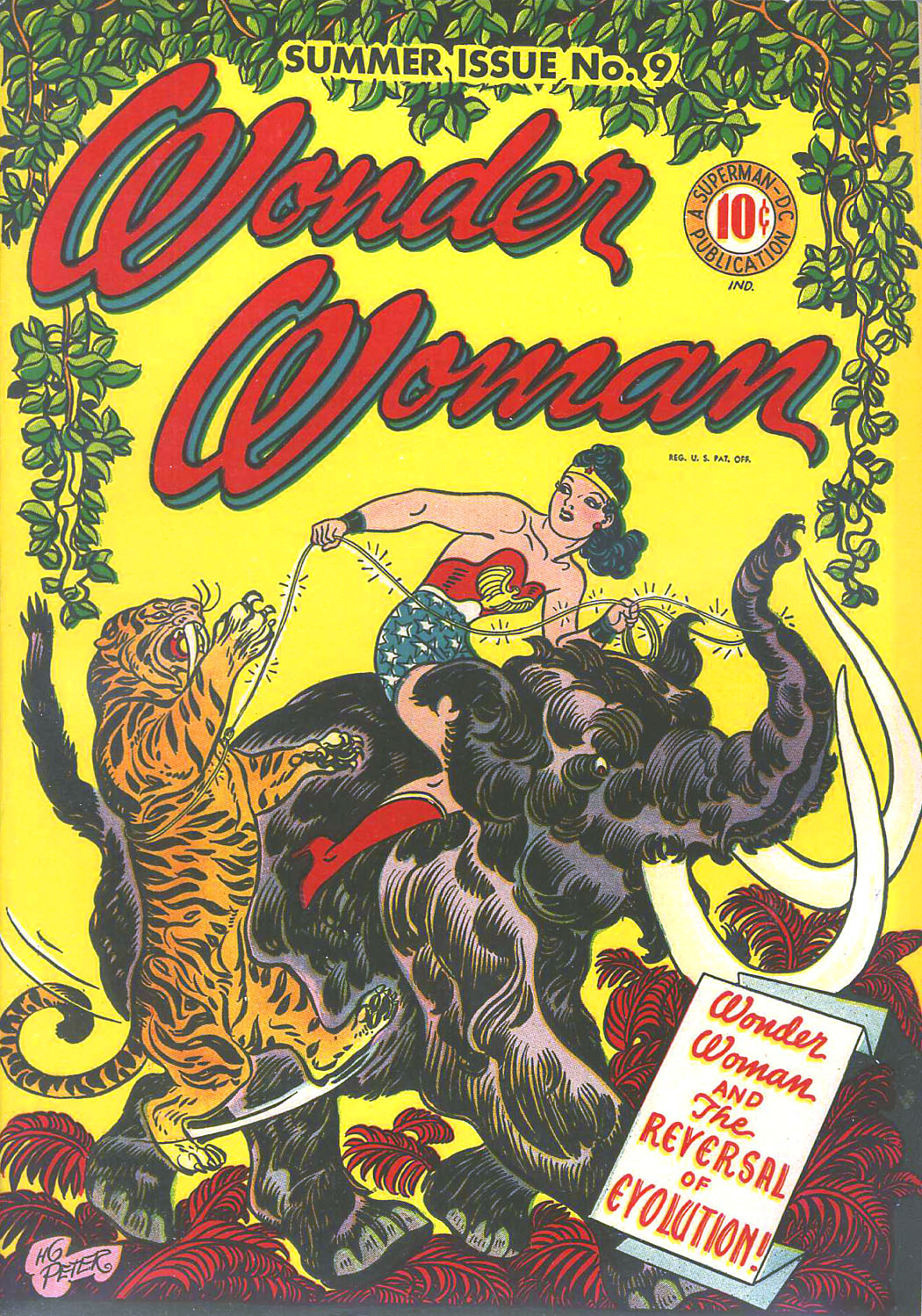
MYTHCOMICS: "EVOLUTION GOES HAYWIRE" (WONDER WOMAN #9, 1944)


For my second "March to Womanhood" post, I return to the well of Classic WONDER WOMAN. To be sure, this one is a good bit wackier than the last time I looked at a Marston WW story, the highly imaginative ICEBOUND MAIDENS. This time Marston, instead of producing a free flow of mythic and religious images, chose to riff on a "haywire" vision of evolution.


Kicking off the adventure is a mama gorilla who's lost her baby and decides not to go through the usual adoption process to obtain new offspring. Wonder Woman, in her Diana Prince ID, happens to witness the child-napping and pursues the angry anthropoid, who just happens to make tracks for nearby Holliday College.


The gorilla barges into the classroom of Professor Zool (short for zoology, apparently), who just happens to be giving the Holliday Girls a lecture on evolution, and about his new invention. The gorilla breaks in and tosses some students around, but the Amazon Princess outwrestles the beast with the help of the girls, who just happen to have lots of ropes lying around in the classroom. (Hey-- it could happen!) Steve Trevor, whose niece was abducted, wants to put down the damn dirty ape. Zool suggests an alternative: he can use his "electronic evolutionizer" to change the unruly critter into a human being. Presumably Zool has been waiting to come across just the right test case. Everyone's okay with it, including the zoo people, even though they stand to lose an expensive attraction.


And so we get the origin of long-lived WW foe Giganta. Though she attains a human physique, she pretty much forgets about having lost an ape-child but retains an unreasoning hatred of Princess Diana. They fight, and in the scuffle the evolutionizer is damaged, and we get William Marston's "magic wand" theory of evolution in detail.


I jest, for I'm sure Marston didn't think any evolutionary process could be turned backward, nor did he think he was infecting young minds with any such beliefs. Turning back time was just a fun way to illustrate said process, with crocodiles becoming dinosaurs and so on. Wonder Woman and her buddies, who look about the same but have supposedly devolved to cave-people, flee one of the dinos. They run into Giganta again, but the she-ape has no use for Women's Lib, and won't live with a "tribe led by a she." She seeks out a patriarchal tribe and immediately finds one in the "Tree People," so I guess the evolutionizer threw everyone back to a period when human ancestors were just starting to leave the trees for the ground, and these Tree People are the holdouts. Of course in no real-world model of ancient times were those tree-dwellers any sort of humanoids, not even "Missing Links" like the ones shown here. Apparently the Tree People, whom I presume to be modern citizens devolved by the machine, acquire a race-memory of antagonism toward "Cave People," even though the only cave-tribe they ever see is Wonder Woman's little band.


The Tree Men capture the 20th-century cave-dwellers and threaten to sacrifice them. Wondcr Woman once more demonstrates female agency by defeating a devouring dino, and that's pretty much it for the caveman fantasia.


After a few more challenging incidents, Zool gets his machine running again with a little help from Ben Franklin-style science. But with the next jaunt forward,  the time-travelers appear in a period of Greek history that most moderns consider purely mythical: "The Golden Age, when the world was perfect." Naturally, for Marston this is a time when there are no hierarchies between the sexes, and one that discourages the acquisition of wealth. 


Giganta, the savage who reflects the aspects of modernity Marston dislikes, allies herself to the "lower classes," who are individuals who like to accrue wealth. Giganta seduces them into wanting rulership as well, and though the Golden Age is not meant to be identical to the Garden of Eden, it's no coincidence that the rebels speak of gaining "the knowledge of good and evil." Wonder Woman eventually quells the rebellion but the queen sadly observes that, "The Golden Age is over-- people now know they can be wicked if they choose."


Moving into a new phase, but without another time-jaunt, Queen Darla's peaceful rule is challenged by male subjects who think that their superior strength entitles them to supremacy. Wonder Woman easily defeats the lead challenger, and for good measure the heroine scoffs at the man's wife for wanting to take pride in her man's might. However, the woman's perspective shows a chink in Marston's system. The author perhaps couldn't conceive that some women, not being aggressive or martially inclined, might want men to be dominant on the assumption that this made a tribe stronger-- which in a broad sense was true for most of human history.


In any case, this sort of negative "woman power" unseats Queen Darla. She and a small coterie join Wonder Woman and friends in seeking to found a new kingdom. Since they end up in a location geographically comparable to that of the Amazon kingdom, Marston probably meant Darla's voyage to be comparable to the later journey Queen Hippolyta takes to found Paradise Island. This would make Darla's group the ancestors of the Greek Amazons, despite the former's lack of martial tendencies. This is illustrated when Giganta once more activates the evolutionizer, flinging Wonder Woman's group into Greek Amazon times. In due time the heroine comes face to face with her own mother, thousands of years before Diana has been "born." Hippolyta explains that the city of Amazonia faces attack by the army of Achilles, at least partly because the Amazons sided with Troy against Greece. 


Most of the Amazons are off hunting husbands-- one of the few times Marston drew on the family-making customs of the warrior women-- so Diana suggests that Hippolyta send runners to bring the fighters back to Amazonia. In the meantime Wonder Woman challenges Achilles, another representative of patriarchal rule, to single combat. She wins, the other Amazons arrive to drive off the Greek army, and the adventure gets a quick wrap up, implying that the 20th century is freed from the evolutionary backstep and that everything goes back to normal. 

For some reason, though, the evolutionary erasure does not apply to Giganta, though her actual fate is left up in the air at story's end. The gorilla-girl only made one other Golden Age appearance. In that tale, it's disclosed that Giganta, like other WONDER WOMAN rogues, was sentenced to an Amazon reformatory-- until a group of lethal ladies break free to menace Princess Diana as "Villainy Inc." Given that she's a gorilla, in this story Giganta takes on an interesting "serpent in Eden" persona as Marston guided his readers through his narrative of the "rise and fall of sexual equality."

Thursday, December 7, 2023

MYTHCOMICS: '["THE AMAZON QUEEN OF FEMALIA"] (SMASH COMICS #76, 1948)


Most Golden Age comics stories achieve high mythicity in an erratic fashion. All raconteurs, well or poorly educated, were required to turn out a high volume of material in order to make a living. Thus, even though the writer of WONDER WOMAN had attended Harvard, and though he'd constructed one of the more elaborate superhero concepts of the period, he didn't necessarily turn out more myth-stories than did raconteurs who never got past high school. All comics-creators had to generate ideas very quickly, and only on rare occasions did any of them bring all the symbolic elements together to create something like a discourse, intentionally or not.

Golden Age mythcomics about the topic of sexuality are even rarer, given the audience associations-- though it should be said that most media of the period weren't much more complex on that subject. There were plenty of narratives about "the war of the sexes," and a fair number dealt with fictional versions of the Greek Amazons. But often such Amazonian societies were conjured up just to banish the demonic forces they suggested. Edgar Rice Burroughs' 1924 novel TARZAN AND THE ANT MEN doesn't deal per se with an Amazon society, but does introduce a savage tribe in which the women are physically larger than the men. Tarzan influences the males to take control and return women to a subordinate position.

Various comics-creators used societies of strong women for analogous reasons, as did Jack Cole in a couple of PLASTIC MAN stories. Cole also created the character under discussion here, though by 1948 his only contribution to the feature was that raconteurs like Alex Kotzky-- the creator to whom I assign this story-- sometimes sought to draw like Cole.


The character Midnight was essentially what Will Eisner's SPIRIT would have been, had Eisner concentrated only on adventure with lots of goofy comedic content. Midnight is a guy in street clothes who dons a domino mask and uses a few gimmicks to fight crime. However, his support-cast is designed to be dominantly humorous. First, Midnight gained a sidekick, name of Gabby, who was a literal "monkey-boy:" a simian endowed with the ability to talk (not, as some references have claimed, a little Black kid). Then an aptly named mad scientist, Doc Wackey, joined the entourage. Later additions included a baby polar bear (apparently just a pet) and a bumbling detective, Sniffer. All of them are on display in the splash page above, decked out in feminine harem garments and dancing before the titular "amazon queen."


The story unwinds quickly, with a lot of use of coincidence. (I tend to think no comics-people loved overheard conversations more than did the Quality Comics crew.) Midnight, in his regular ID as a radio host, lets "the illustrious Professor Zogar" lecture Middle America about the archaic custom of matriarchal rule. The three sidekicks and their pet go for a walk, during which Doc is particularly voluble, claiming that "the dame doesn't live who can push me around." Quick as a bunny, two Amazonian females in archaic bikinis seize him, clobber his friends, and drag Doc off to their land of Femalia, under the belief that Doc is their long absent king.


Heroic Midnight then interviews Zogar about the society of Amazons in Femalia, and drags the reluctant scientist along for the ride when he and his crew mount a rescue mission. However, if any juvenile readers were expecting these brave males to put the matriarchy back in its place, those expectations get dashed when a single woman floors Midnight with an uppercut.


The captives are dragged through a city full of huge women and shrimpy men, not a little reminiscent of one of Al Capp's "Sadie Hawkins" celebrations. Queen Menna (seen in the splash with a big stogie in her mouth) sits her throne besides her crowned king Doc Wackey. Menna is just as convinced as her servants that Doc is her long lost husband, and she takes no backtalk from uppity males.


Midnight does manage to escape the palace with Doc, and as the group rushes back to the plane the hero makes a half-hearted effort to inspire the local males to rebellion. Then comes the "big reveal" that probably didn't fool all that many kid-readers in the day. Menna calls out to the man she thinks is her consort Ragoz, and Zogar (spell it backwards) responds with a beaten-down "Yes, dear." This prompts Midnight to make the amazing correlation that the expert on matriarchal societies is actually the guy who escaped Femalia, and this in turn causes Menna to admit that yes, this other shrimpy guy is her real hubby. She lets the Americans leave-- and heroic Midnight is only too glad to leave Zogar in the lurch so that he and his friends can return to the land where women aren't quite so dominant.

It would be silly to think that Kotzky sought to say anything profound here by leaving a gynocracy in charge of their own domain, as was *sometimes* the case when Marston wrote analogous stories. Kotzky's main purpose was probably the same as in any other MIDNIGHT story: to come up with a wild tale diverting enough to get kids to part with their coins. Nor can one place any deeper complexion on the kinky sounding dialogue in the next to last panel:

MENNA: Go easy on him, indeed! Well, perhaps I will, AFTER I've given him a daily beating for about three months!

ZOGAR: You are very kind to let me off so lightly, your majesty!

Actually, it might be a light sentence, if Zogar was away from Femalia for the years it would require for him to become an "illustrious professor." And he would've gotten away from the modern Amazons, if he'd just kept his mouth shut about them! Not that I'm claiming this fictional character had anything like an actual psychology, but his creator might have appreciated the irony that Zogar's big mouth led him back to the subservient fate he'd escaped-- and it's by no means certain that he's not okay with it.

I also don't want to make too much of the final exchange between the heroes as they run back to the U.S., tails between their legs, but I'll note it to wrap up.

GABBY: Poor Zogar! What a life he must lead!

DOC: Are you TELLING me or ASKING me?

It's an interesting exchange only because Doc has been in the custody of the Femaliens for what one must assume is only a few hours. Certainly he doesn't have the chance to get initiated into Femalian society, whatever that might entail. So why was he wondering if Gabby was "asking" him about the "life" Zogar now leads, the "life" Doc would've been forced to lead had his buddies abandoned him like they abandoned Zogar? Doc only had time to learn the same lesson the others did: that when men lose the advantage of sexual dimorphism, they can be easily changed from "men" into "mice."

ADDENDUM: The only element that moves "Queen" into the domain of the marvelous is Gabby the Talking Monkey.

Tuesday, May 17, 2022

MYTHCOMICS: "LEGACY" (WONDER WOMAN #45, 1990)

Less than two weeks ago, celebrated comics-creator George Perez passed away due to a long struggle with cancer. I had liked Perez's work since I had encountered it in the 1970s, where he put as much work into delineating a toss-off character like Marvel's "Man-Wolf" as he would later devote to Fantastic Four, Avengers, Teen Titans, Crisis on Infinite Earths and the 1987 re-launch of Wonder Woman. FWIW, I even reviewed the first three issues of the Amazon's rebirth for THE COMICS JOURNAL. Without looking back at the old review, I remember stating that I admired the writer-artist's updating of the Marston origin for comics of the eighties and nineties, though I found that the next two issues slumped back into standard superhero fodder-- and I tend to think most of his Wonder Woman scripts, whether he drew them or not, fell into the same rut. Thus, though he worked with superheroes for over forty years, it's my reluctant evaluation that his immense creativity was focused largely on design of spiffy looking new characters, but that he didn't bring to those characters the sort of mythopoeic personality I can find in the creations of Jack Kirby and Gardner Fox.


Nevertheless, the WONDER WOMAN title pushed Perez to incorporate archaic myths into the type of stories he told, and "Legacy" from issue #45 seems to be one of his best ventures into the mythopoeic realm-- even though, oddly, the starring character is barely in it.


One relatively obscure archaic myth-figure whom Perez brought into the WONDER WOMAN mythos in the first issue was Harmonia, daughter of Ares. The Greek war-god, usually given the Roman name of "Mars" in the Marston continuity, was a frequent opponent of the peace-loving heroine, but Marston didn't devote much space to the offspring of either the war-god or any other Greek deity. I won't explore the full history of Harmonia in the Perez Wonder Woman stories. However, issue #45 makes clear that one reason Perez chose to build up this character was because in archaic Greece Harmonia was one of many incarnations of "the Fatal Woman," one who brings bad luck to men without even intending to do so-- not unlike another Greek myth-figure of greater modern renown, Pandora.


"Legacy" opens with Harmonia seeking the counsel of the famed dispensers of mortal fates, the Moirai. Harmonia has overheard various intimations from both her father Ares and from the forge-god Hephaestus about some mysterious identity between the archaic Pandora and the modern heroine Princess Diana. The goddess's desire to resolve the mystery gives Perez the excuse to expatiate upon the heritage of the archaic Pandora, with an eye, naturally, to explaining her significance to modern readers.


Perez then weaves two stories of Pandora. The first follows many familiar tropes of the story from the Greek poet Hesiod, the main source for the tale of the lady and her box, though Perez mixes in his fair share of tropes designed to heighten a feminist interpretation. His first break with tradition is that he depicts how, following the Greek gods' triumph over the Titans, a man named Prometheus-- mortal, and therefore not a Titan himself-- infiltrates Olympus and steals fire for the benefit of his fellow mortals. As in most renditions of the traditional tale, Zeus then has Hephaestus craft a woman of clay, calling her Pandora, which name was said by some to mean, "the gift of all" because a variety of gods bestowed assorted charms upon her. (It's of some interest that when Robert Kanigher rewrote the Wonder Woman in the 1950s, he had her getting her powers from various Greek deities as well.) As in the Hesiod story, Zeus sends Pandora as a peace offering to Prometheus. Prometheus smells a rat and won't receive the gift, but his not-so-bright brother Epimetheus marries Pandora. A second divergence appears, however, in that Pandora brings with her the Box of Evil Fate to which her name was ascribed. In the original tale Prometheus has custody of the container from the first, which is why Pandora's opening of the box rates as a great betrayal.


Perez's version also spreads the blame by borrowing from the Adam and Eve story, in that Pandora doesn't open the fatal box on her own, but incites Epimetheus to do so. However, after the world becomes overwhelmed by multitudinous evils, Epimetheus is not penalized the way Adam is, by getting blamed for his sins. Only Pandora gets cast forth, and presumably dies alone, though the end of the story seems to indicate that her clay may get "recycled" into the prima materia from which Princess Diana is conceived.


Then Harmonia's conversation with the Moirai provides a segue to the second Pandora story, which is far more in line with the way modern feminists would rewrite the story to contradict Hesiod's misogyny. The Moirai speak of a time before either Titans or gods ruled Earth, implicitly "caveman times." The only deity was Gaea, a goddess coterminous with the Earth, who looked upon struggling humans as her children. By some process of "virgin birth"-- yet another shout-out to Marston-- Gaea conceived Pandora, who was not the recipient of gifts but the bestower of only good things from the jar she carries. (Scholars have asserted that the "box" attributed to Pandora, "pyxis" in Greek, was in the original text a "pithos," a storage jar.) 


Yet, for reasons not made clear by Perez, the "Age of Titans" comes into being, followed by the Titan-god conflict which razes the Earth even though Later-Pandora has yet to unleash the evils of her box. Humankind at this point seems to lack any agency to be wicked, so Perez elides the traditional reason for the Greek deluge: that Zeus chose to wipe out most of humankind because of their sinful ways. Instead, most of humankind dies because kind-hearted Gaea weeps "ten thousand tears" at the carnage. Perez keeps the idea that two mortals survive the flood, a son of Prometheus and a daughter of Pandora--thus, like Hesiod, making modern humanity the descendants of a "marriage" that didn't happen between the sires of each progenitor. Perez then observes that the later Pandora story was  a repudiation of the true, earlier one, so that Woman became not "the Inspirer" but "the Tempter." Following the conclusion of the second story, the last few pages set up later WW storylines, and so aren't relevant to the mythopeic "meat" of the two conflicting narratives. 

"Legacy" has a fair number of weaknesses. The artwork-- contributed by three female artists and one male-- is only fair overall, though the artists can't be faulted for a sequence in which Perez shows fierce gryphons guarding Zeus's sanctuary, but never explains how mortal Prometheus gets past the monsters. Perez also notes that the two survivors of the flood fling stones behind them when they survey the wasted world, but he fails to explain that this is the magical method by which the two humans repopulate the world-- an omission so major than one suspects editorial meddling. But overall "Legacy" is still a creditable entry into the ranks of modern mythcomics, and a tribute to George Perez's own legacy.


Wednesday, September 22, 2021

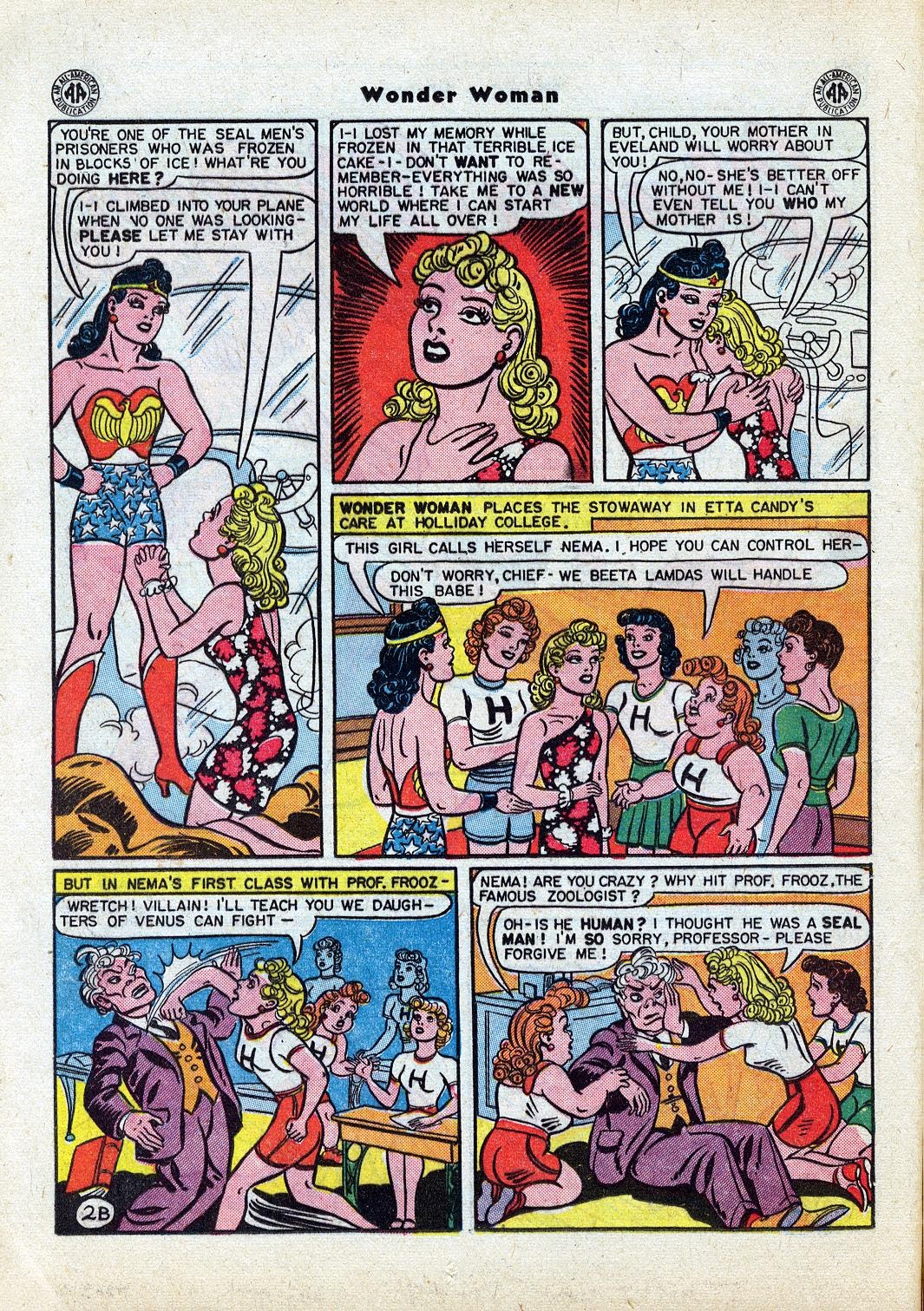
MYTHCOMICS: "THE ICEBOUND MAIDENS" (WONDER WOMAN #13, 1945)

 One of the most intriguing images in the entirety of William Marston's WONDER WOMAN canon appears on page eight of "The Icebound Maidens." The Amazon, having voyaged to Paradise Island to counsel young Amazons in facing their challenges with willpower, is assigned to do the same for "the daughters of Venus." Prior to this tale, Marston had built four stories around the planet Venus, inhabited by beautiful winged girls who, like the Earth-Amazons, worshipped love and beauty in the incarnation of the Greek goddess Aphrodite. "Maidens" is the final Marston story using the Venus-women, and this time the writer merges this myth-trope with that of an icon of Judeo-Christian belief, that of the Garden of Eden. In the Old Testament, God commands that Eden is off limits to mortals once Adam and Eve are expelled, appointing one or more cherubim to stand guard with a "flaming sword." In an audacious image, Marston's Aphrodite is seen commanding a hand with a flaming sword-- presumably a denizen of Heaven, not exactly on speaking terms with pagan goddesses-- to propel the entire Garden of Eden to a subterranean domain beneath the ice of Earth's South Pole.


To be sure, Marston has no interest in engaging in involved cross-comparisons between Greek and Jewish myth. He wanted a broad contrast between Eden, a land of life, and the frozen wastes of the Antarctic, a land of death. Aphrodite transforms one Venus girl into an Earth-female (which effectively means clipping her wings) and sends her to live in Eden, renamed "Eveland" to stress its new status as a "land of women." Providentially, the girl's name is Eve, so even if the First Man is gone from Eden, an avatar of the First Woman is still allowed to rule therein. And as the Hebrew God gave Eve to Adam for company, Aphrodite gives the second Eve a "spirit daughter" with the odd cognomen of "Eve Lectress" (a labored pun on the Greek name "Electra," more on which later). Somehow, possibly through parthenogenesis, dozens of other maidens join Queen Eve and Eve Lectress in the subterranean garden. 


But though the Eveland girls have left men out of their hortus conclusus, the ruthless male element asserts itself. Though one might expect that Eden has all the pleasures that the Venus-girls could want, Eve Lectress is lured into Bitterland, the "dark ice caves" where dwell the brutish Seal Men. Periodically the Seal Men, who cannot stand strong light, capture Eveland girls and make them work in their gardens. These gardens require blinding light to nurture the males' favorite delicacy, "pomoranges," and so the Seal Men want the maidens to toil on their behalf, even though eventually even the Eden-girls will lose their sight with these labors. The title "Icebound Maidens" refers to the fact that the cold-hearted villains literally keep a supply of replacement girls on ice for future use.


Wonder Woman ventures into the domain of the Seal Men and frees all of their prisoners, but somehow conveniently forgets about looking for Eve Lectress, nor does Queen Eve mention not having recovered her daughter. As the heroine journeys back to man's world, she finds she has a stowaway on her invisible jet: a young Eveland girl who claims her name is "Nema." The origin of this Marston-name is fairly obscure: it doesn't seem to scan well whether one compares it to "Nemea," the Greek valley from which the Nemean Lion hailed, or to the Hebrew word "amen," which is what "nema" spells backwards. Whatever the name's meaning, Nema is Eve Lectress, running away from home because she's guilty of her transgressions-- though Marston doesn't explicitly condemn her for seeking out Bitterland for unstated (maybe sexual?) reasons. 


Wonder Woman allows "Nema" to mingle with the Holliday Girls, so evidently she doesn't figure out the girl's true identity. But after a few days someone from Eveland rings up the Amazon on her mental radio, summoning Wonder Woman back to the garden. The heroine takes along all of the Holliday Girls and Nema, who still doesn't reveal her true nature to anyone. It seems that because Eve Lectress is missing, Queen Eve, acting the part of the Greek fertility-goddess Demeter, goes looking for her in the unfertile domain of Bitterland. The queen is almost executed by King Rigor (like "rigor mortis?"), the nasty lord of the Seal Men, but the Amazon rescues Eve and all other prisoners once again.


By Part Three of "Maidens" Princess Diana must have started  to feel like a bouncing ball, for a little later she'/s again forced to return to the South Pole. This time, however, it's her own ingenuity that provides the excuse. Diana has invented a "telepathograph" which has potential value to spy on the thoughts of foreign agents. (I don't know if Marston plotted the story before or after the surrender of Germany in May 1945, but it probably wasn't before the dropping of the atom bomb on Japan in July; in any event, this segment contains no explicit reference to the WWII conflict.) In any event, the new spy-device can only be tested at the South Pole, so the Amazing Amazon takes Steve Trevor to test the device.


The subject of the telepathograph gets abruptly dropped after it functions much like the mental radio, alerting WW to the fact that those Eveland girls are in cold water again. The heroine meets with Nema, who still hasn't come clean to her mother, and they go in quest for King Rigor's new captives. Steve follows, but he's caught and sentenced to work in the blinding light of the pomorange gardens. Around the same time, Wonder Woman and Nema are captured, and for some reason King Rigor is the only one who figures out that Nema is Eve Lectress with a dye-job. Rigor tries to blackmail Queen Eve into sending him a steady tribute of girls for servitude by threatening to flood the fertile garden with the destructive waters of male potency (or something like that). 


Wonder Woman escapes imprisonment and runs a scam on the otherwise clever king. When the monarch attempts to sacrifice several de-thawed maidens to the Seal Men's effigy, a fire-mouthed "walrus god," the Amazon substitutes statues for the sacrifices, and then fools Rigor into thinking she can revive the slain girls from death. This road-company Lord Hades capitulates and signs a treaty with Queen Eve, and the latter generously claims that the women of Eveland will still supply the Seal Men with their precious "pomoranges," though nothing is said about what the women will get in exchange.

Despite the references to the Eden trope in the early pages of the narrative, clearly the Demeter-Persephone myth was central in Marston's mind. While Eve Lectress has nothing in common with the most famous owner of the "Electra" name-- the daughter of Agamemnon who gave her name to the "Electra complex"-- but Marston may have known that an Oceanid named Electra was supposed to be one of Persephone's companions before she was abducted by Hades. Queen Eve never quite duplicates Demeter's feat of laying waste to the Earth while she searches for her lost daughter. Possibly this was because "Bitterland" stands in for the image of the Earth made infertile? To be sure Marston's handling of Eve Lectress's motivations is clumsy in the extreme, and I tend to believe that Marston was dancing around the possibility of Eve the Second having a fling with one of the Seal Men. Though Rigor is a standard homely monarch, he has a fairly handsome son, Prince Pagli, though Pagli and Eve II are never seen together. ("Pagli" seems derived from the name of the Italian opera Pagliacci, which means "clowns"-- and if there's any symbolism there, it went past me.) The "pomoranges" are visually modeled on ordinary oranges, which flourish in the very light that the Seal Men despise-- but symbolically, these made-up fruits are more strongly linked to the Greek fertility symbol of the pomegranate. In the Persephone myth, the daughter of Demeter makes the mistake of eating pomegranate seeds in the underworld, which means that she must return periodically to the world of Death-- during which time Demeter causes the mortal world of living things to undergo the "rigors" of winter. 

In closing I'll note that Marston's assistant Joye Murchison recapitulated many of these Persephone-elements in the 1946 story "In Pluto's Kingdom." This time, however, Pluto-Hades abducts women not to make them labor in harsh light until they go blind, but to serve as sources of light to Pluto's dark kingdom.