Featured Post

SIX KEYS TO A LITERARY GENETIC CODE

In essays on the subject of centricity, I've most often used the image of a geometrical circle, which, as I explained here,  owes someth...

Showing posts with label daredevil. Show all posts

Friday, April 18, 2025

CURIOSITIES #46: A TALE OF TWO MATTS

 I happened to read a scanned copy of TWO GUN KID online and noticed that about five times in the text, the Kid's secret identity of "Matt Hawk" is addressed as "Matt Murdock." DAREDEVIL #6 was out at the time, so I don't find it hard to believe that Stan Lee was quickly typing the script and forget which Matt he was writing about. Presumably all was corrected in reprints.                                                          


Wednesday, April 9, 2025

ICONS AND IDENTIFICATION

In MY SHORTEST POST YET I sated that what I term "icons" are the parts of narrative through which readers identify with various presences in fictional narrative, and without such identificatory figures, no one would ever invest any thought or feeling into the broad plot-scenarios called "tropes." This assertion brings me back to an elaboration of my "law of identification," which I gave its first full elaboration in the 2011 essay HERE COMES DAREDEVIL, THE MAN WITHOUT IDENTITY.                                                                                                                                                                                   Briefly, the essay addressed a speaker's failure to define fictional characters as vessels of identification, choosing to simply deem them "unreal" by a positivist philosophy. I responded by contrasting my law of identification with the "law of identity" attributed to philosophers like Plato and Aristotle, to wit:                                                           


"Daredevil is not a phenomenon with a real existence (at least not in materialistic/positivistic terms), but a fictional construct.


Ergo, neither Daredevil nor any other PURELY fictional character is subject to the "law of identity."

Rather, the Man Without Fear is, like all other purely fictional characters, is governed by "the law of identification."

Now, there is a "law of identification" out there in the Googleverse that has been coined in respect to religious matters. However, my current usage applies principally to literature. It can be *applied* to religion with some alteration, which may make for some future essay.

My law goes like this: Because Daredevil is a construct whose sole purpose is to be identified with, whenever anyone does so, that person brings into being the only reality (or "truth" if one prefers that term) that Daredevil can possibly have.

Therefore, neither a foolish child nor a discriminating adult is in any way wrong to say "I'm Daredevil," as long as either of them has actually identified with the character. Both would be wrong to apply that identificatory process to the world of real phenomena, as the poster points out in his tut-tutting manner. But if the act of identification is real, one can say with complete accuracy, "I am Daredevil-- or David Copperfield-- or Captain Ahab-- or Freewheelin' Franklin Freekowski."                                                                   
I have sometimes wondered if, before Plato wrote down a sentence or two that Socrates may (or may not) have spoken, these respective philosophers were aware of pre-Socratic traditions, or even religious concepts, that asserted that two unalike things could be the same in some quasi-mystical fashion, and that the later philosophers were reacting against that idea in forming the rudiments of the "law of identity." Be that as it may, art, particularly in the form of literature, was already devoted to forging identification between fictional characters who did not exist and non-fictional readers/audiences who enjoyed at least a temporally fixed existence. In any event, it should be further noted that no individual's identification with a fictional character is completely identical with another reader's identification. It's only the broad process of bringing a character "to life" that is identical in all "real readers." The reader takes his cue from the expectations that the author sets up as to the "reality" of the text. But that reality can fluctuate, as noted in this essay: '"phase shift" is my term for the process by which a function in literature-- which parallels my term "icon"-- shifts from one state of being (within the "horizontal" world of its purely fictional existence) to another state of being.' By extension, this means that although in the real world, Old Gene Phillips sustains "the law of identity" with Young Gene Phillips, there is no such law governing Superboy and Superman, or Dick Grayson Robin with Dick Grayson Nightwing. The latter pairings have different end-results for their identificatory processes, even if the overall process remains the same, and so Superman can be "phase shifted" into the different identity of Superboy-- even though anyone reading the stories of either character knows that they are the same character at different age-ranges.         

Saturday, August 3, 2024

COSMIC ALIGNMENT PT. 3

 In the first COSMIC ALIGNMENT essay I cited a few exceptions to my general rule that every time a given Sub-icon appears within the cosmos of a particular Prime icon, that Sub is aligned with that Prime. The most relevant exception was this one:

... in comic books Thanos first appeared in an IRON MAN story, but he was never established, via escalated appearances, as an Iron Man villain. Instead, his creator Starlin aligned Thanos first with the third Captain Marvel and then with Warlock, and given the demise of the former, I would tend to think that he aligns most strongly with Warlock.

Probably as a result of seeing DEADPOOL VS WOLVERINE, I gave some thought to the way various X-MEN characters had been mixed and matched with respect to alignment in their media-history, and I settled on illustrating my thoughts with the example of Lady Deathstrike. All of the stories I study herein also count as near-myths in my system.


Strangely, Lady Deathstrike starts as a side-character in a five-part DAREDEVIL story by Denny O'Neil. She isn't even in the first part of that story, but Wolverine is. I haven't troubled to check exactly what the status was re: the origin of Wolverine's adamantium skeleton, but O'Neil's story came out in 1983, eight years before Barry Smith produced the "Weapon X" continuity. In DAREDEVIL #196, both Wolverine and Daredevil learn of a plot by Japanese criminals to ship the bedridden hitman Bullseye-- reduced to a paraplegic toward the end of Frank Miller's run on DAREDEVIL-- in order to restore the villain to health by duplicating aspects of the bone-reinforcement operation used on Wolverine. Now, O'Neil had the unenviable task of keeping up the sales of the DAREDEVIL title after Miller's departure, and plainly one of his strategies was to bring back Bullseye. O'Neil had no involvement in the X-titles, so patently he must have got editorial approval to forge a link in the "Wolverine's origin" chain. But though one might think in 1983 Wolverine would be extremely curious about Bullseye's benefactors-- or anyone who had any information on the process of making an adamantium skeleton-- the X-Man quickly loses interest in the case so that the Man Without Fear is free to journey to Japan alone. Incidentally, though O'Neil isn't very good with Wolverine's dialogue, he does seek to play the X-Man's disregard for "playing for keeps" against Daredevil's compunctions against killing.


In Japan Daredevil rescues a young woman, Yuriko Oyama, from her father, the man responsible for seeking to remake Bullseye into his own private assassin. Said father runs his own private island full of mercenaries, and he has assumed the sobriquet "Dark Wind" to indicate his passion for taking Japan back to its warlike past. As an indicator of his monomania, he has inflicted facial scars on all of his adult children, including Yuriko, because he himself suffered scarring in his war years. Yuriko helps Daredevil infiltrate Dark Wind's island, but the two of them are too late to prevent both the operation on Bullseye and his subsequent escape back to America. (Daredevil concludes the sequence by following him back for a confrontation in issue #200.) All the Japanese issues, then, deal with Daredevil getting involved in Yuriko's quarrel with her father. There's a frustrated romantic arc involved as well, just as there was in O'Neil's previous father-daughter meditation, the alliance of Ra's Al Ghul and Talia in Bronze Age BATMAN. Yuriko has fallen in love with one of Dark Wind's retainers, and she wants to free her lover Kira from her father's influence. Her part in the story concludes when she saves Daredevil by stabbing her evil dad from behind.

In all likelihood O'Neil deemed Yuriko a minor support character, and since he concluded issue #199 (poetically entitled "Daughter of a Dark Wind") by giving her a romantic reunion with her lover Kira, he probably would never have revived her in another story. Since Dark Wind scarred Yuriko's late brothers the same way he scarred her, one can't argue a straightforward Oedipal complex-- though it's still mildly significant that Yuriko has to kill her dad to get access to her young lover. Had Yuriko been left alone, she would have remained a subordinate icon with very minor charisma.

But she wasn't left alone, as I'll address in Part 4.

Monday, January 15, 2024

NEAR-MYTHS: " PARTS OF THE HOLE," (DAREDEVIL V. 2, #9-15, 2011)


I only reread the introductory sequence for the Marvel character Echo because of the MCU teleseries, to re-familiarize myself with the template.

Back in the day I bought some odd issues of the original sequence, but wasn't exactly inspired to follow the whole story. Some of Joe Quesada's art was nice, but the concept-- principally executed by Quesada and KABUKI writer-artist David Mack, with some fill-in assists from two other raconteurs-- seemed too much like a superficial effort to introduce an "Elektra Lite." Echo, a deaf woman of Cheyenne ancestry, possesses what I guess is a mutant ability to instantly emulate any fighting-skill she sees, combining aspects of Marvel's villain Taskmaster and the autistic heroine "Zen" from the 2008 CHOCOLATE.


Mack and Quesada fill their seven-issue tale with lots of bizarre, Sienkiewicz-style imagery (probably inspired by the example of ELEKTRA ASSASSIN) and lots of decompression-style, pseudo-literary voyages into the heads of Matt "Daredevil" Murdock, Echo, and Kingpin, the nasty villain who sets a potential heroine against a real hero. It doesn't help Echo's reputation that Kingpin gulls the young woman-- to whom Kingpin's been something of a surrogate father-- by giving her doctored evidence that the Man of Fear killed her birth-parent. What, Echo just accepts one piece of evidence as to the hero's turpitude, and seems blithely unaware of Daredevil's numerous years of crimefighting? And, from what Mack and Quesada tell readers, she doesn't even need Kingpin to give her a compelling reason as to why a costumed hero would slay Echo's father-- though Kingpin himself was in partnership with said individual. For me, I downgrade this arc not just because Mack and Quesada indulge in this hoary "frame the hero" trope, but because they're so bad at it.


Echo's tragic past and her various musings are just as tedious and derivative as her motivation for fighting the hero, and her Native American heritage is tossed off in some jejune gibberish about learning "the devil's medicine." Given that Echo is a sexy femme fatale, she soon becomes another love-interest for the main character. However, unlike Elektra, Echo doesn't know Daredevil's civilian ID (though Kingpin does, and curiously neglects to tender that intelligence). So she ends up dating lawyer Matt, and they have some long "date-cute" interactions, though these too seem very dependent on a lot of "blind dating the deaf" tropes. Then, at first opportunity she dons a sexy outfit and gets into fights with the sightless crusader.


The fights are decent, though nothing that would ever make Frank Miller look over his shoulder. But in keeping with the fashionable decompression approach, any tension generated by the action is dispersed by loads and loads of banal wool-gathering in the heads of Murdock and Kingpin about their early years-- all of which had been done better by previous raconteurs on the title. "Hole" takes place shortly after Murdock's first great love Karen Page has died-- not sure if it was for the first time or not-- but the only good thing that comes of this touch is a weird but rather funny joke about how masturbation leads to blindness. And speaking of blindness, Echo does get the chance to take an ironic revenge upon her "bad father," so at least Mack and Quesada provided that much resolution before the character became absorbed into the Marvel continuum.

I also re-visited this introductory arc due to my interest in Native American figures in pop culture. I suspect, given the way the MCU distorts most of its adaptation-material, that reading the arc won't really yield much insight into the streaming show. But such are the sacrifices I make.


Tuesday, December 7, 2021

A CONVOCATION OF CROSSOVERS PT. 5

 Last and sort of least is the LOW CHARISMA crossover. 


I've already mentioned one example of this category in Part 3, that of Wolverine in his first interaction with the X-Men. Having been only a Sub, he had no stature, but he did have a degree of charisma simply from his having fought the Hulk in one story, With the exception of Cyclops, who possessed both stature and charisma by virtue of his long career with the hero-team, all of the other characters were new and only accrued charisma as the original story progressed. Some of the other established X-people appear in the tale as well, but their status is that of "guest stars" rather than functional members of the team-- a point underscored in the next installment, where all the old X's are given their walking papers for the time being. (To be sure, Jean "Marvel Girl"  Grey does get invited back rather quickly,)

NOTE: just after I wrote this, I remembered that Sunfire and Banshee, who were also in the New X-Men, had pretty much the same Sub-status as Wolverine, though the two of them had enjoyed perhaps three or four Sub-appearances apiece. Rather than rewrite the paragraph, take it as a given that what goes for new member Wolverine also goes for new members Sunfire and Banshee-- though Sunfire was quickly disposed of, ending his brush with Prime status almost as quickly as it began.

The same principle applies to the first crossover of the Joker and the Catwoman in BATMAN #2: neither had accrued much charisma at the time of that story, though obviously the writers meant to build up both characters as consequential to the Bat-mythos.


The subject of Subs being nurtured within a particular mythos is relevant to another species of crossover: the old-villain-meets-new-opponent crossover. As I also noted in Part 3, the tag-team villains Mister Hyde and the Cobra had been regular foes of Thor for a short period, and in DAREDEVIL #30, Stan Lee evidently felt that they would be a better fit for Daredevil. In the process of making the transfer, their villain-charisma had to start interacting with the very different charisma of Daredevil.

I should include a parallel to the discussion from Part 4 as to how former Primes might become Subs in another work, but could still enjoy high charisma, as with Dracula's appearance in a Billy the Kid movie. In cases of low charisma, one may have either new or established characters cross over with former Primes for the sake of brief bits of business rather than for major plot-functions. Examples include:

WHO FRAMED ROGER RABBIT? (in which the main characters are Roger and Eddie Valliant)


THE BOOKS OF MAGIC (in which the main character is Tim Hunter, and the vast panoply of the DC Universe exists as background to his decision)


A CONVOCATION OF CROSSOVERS PT. 3

The second crossover-category corresponds to the basic pattern of the first one, except that at least one of the stature-bearing characters has been compromised in some manner, making at least one of the characters of LOW STATURE. The most frequent manifestations of the low-stature crossover are usually termed "guest starring roles" or "cameos."

"Guest stars" are often considered to be the same as regular crossovers, but not infrequently guest stars appear in some ancillary role. I mentioned the example of the Golden Age Human Torch-Sub-Mariner crossovers. These took the shape of one of the two heroes appearing in an issue of the other hero's magazine, but the narrative emphasis is clearly on their interaction.


In contrast, the appearance that I'm calling the "guest star" is only moderately important to the plot. One of my favorites of this type appears in the Silver Age DAREDEVIL #30. For some reason, the titular hero decides that he wants to take on Thor's sometime foes Mister Hyde and the Cobra-- which is the main plotline of the narrative. But author Stan Lee, wanting to play the idea to its most absurd lengths, first has DD masquerade as the Thunder God to lure the villains out-- to which deception the real Thor takes exception. What follows is a sublimely silly encounter between the two heroes, which is not strictly necessary to the plot, though it's certainly a lot of fun.


Cameos are even more "throwaway" in nature, usually lasting only a few diegetic "moments." One of the dippiest I've recently encountered was in a 1944 issue of Quality's FEATURE COMICS, in which the almost forgotten comical character "Blimpy" became reduced in (physical) stature and so rang up another Quality character, Doll Man, in order to get some advice about getting small. 

Turning to another manifestation of the low-stature category, I didn't discuss in the previous post the concept of "rotating team" franchises, though I established in this 2019 post my estimation that the characters in each of these temporary teams shared equal stature (although, just to be totally confusing, at that time I was using the term "charisma" in place of what I now call "stature.") However, I made a few exceptions, saying of Batman's co-stars in THE BRAVE AND THE BOLD:

Most of the time, the co-stars either had their own franchises, or had enjoyed such regular berths at some point in DC's history. However, on a few occasions the Bat teamed up with one of his famed enemies, and I would consider all of these to be subordinate rather than coordinate figures, because the villains had not previously enjoyed their own franchises.


Even then, I had to further admit that although this was true of two such co-stars, the Riddler and Ra's Al Ghul, but that one other co-star, the Joker, actually had enjoyed a series of nine issues, wherein he usually contended with other Bat-villains. I made the comment that the Joker's series had not done anything to dispel his dominant image as a subordinate character, or Sub, but now I would rephrase that to say that nine issues were not enough to endow the Clown Prince of Crime with the stature one should perceive in a Prime. 


Similarly, a featured hero who only enjoyed a piddling few Prime stories, either as a solo protagonist or as part of an ensemble, would also possess only a very low level of stature. Prior to the Blue Diamond's appearance in MARVEL TWO-IN-ONE alongside the Thing, the Diamond could only boast a couple of Golden Age appearances and a couple in Roy Thomas's retcon team-title "The Liberty Legion"-- and so his Prime status is dubious. In fact, TWO-IN-ONE became something of a dumping-ground for short-lived Prime characters such as the Golem, the Living Mummy and Skull the Slayer, none of whom went on to rekindled fame after their TWO-IN-ONE outings. The same applies to the Sub character Jocasta, who got a brief shot at Prime status before returning to intermittent obscurity.


Some obscure characters, however, went on to respectable fame once they'd been inducted into regular teams. Magik had made a few minor Sub appearances before getting a four-issue mini-series. This series made the character a Prime, but had she never been inducted into a group-- be it the one she did join, the New Mutants, or some other team-- she probably would have returned to Sub status. An even more noteworthy example of a lowly Sub rising to superstar Prime status is Wolverine. At the time of the taloned terror's induction into the 1970s X-Men, he had only appeared in one adventure, as an opponent for the Hulk. Not only did Wolverine become a stellar member of the X-Men, he went on to enjoy a wide number of solo adventures. So Magik has only a little stature when she joins the New Mutants, and thus only her first alliance with that team can be called a Low-Stature Crossover at all. Wolverine's induction into the New X-Men does not qualify as a stature crossover, but would possibly qualify for a Low-Charisma type.


Tuesday, January 14, 2020

MYTHCOMICS: TYPHOID #1-4 (1995-96)

If Stanley Kubrick's film A CLOCKWORK ORANGE had married a 1990s Freudian treatise on the inter-relation of sex and violence, their baby would probably have looked like the four-issue miniseries TYPHOID by writer Ann Nocenti and artist John Van Fleet.


In an earlier review of another Nocenti story, I mentioned that my reading of the author's run on Marvel's DAREDEVIL comic title had been somewhat inconsistent. That said, even during my incomplete reading, I had some appreciation for Nocenti's original addition to the blind hero's mythos, a schizophrenic character who was essentially three personas in one body. Born Mary Walker, a shy and introverted artist, various circumstances cause her to manifest a second personality, the sexy and assertive Typhoid Mary, and then a third one, an ultraviolent man-hater named Bloody Mary. One character in the mini-series styles the trio as "virgin, whore and killer," thus separating off Mary's propensity for bloody violence from her enthusiasm for sex-play.

I didn't read enough of Nocenti's DAREDEVIL to know what the author last did with Typhoid in that feature, though according to Wiki the vixenish villain continued to make appearances in other Marvel features. In 1995, however, Nocenti had the deranged quasi-dominatrix escape an asylum, after which Mary Walker attempted to live an ordinary life despite her intrusive extra personalities. She even has a boyfriend named John (as in "John and Mary," maybe), but he only has a minor role in TYPHOID. The mini-series is far more concerned with what feminists now call "toxic masculinity," though Nocenti's skilled enough that the narrative isn't a pure paean to wonderful womanhood. Mary's first solo adventure is devoted to portraying her as a "schizophrenic private detective,"  though to my knowledge this was her only series.


Each of the four parts is given a subtitle derived from a famous fairy-tale female, respectively Snow White, Cinderella, Sleeping Beauty and Red Riding Hood. In addition, issue one also sports an additional title, "A Fairytale of Violence," though none of the other issues have such this add-on. Nocenti explicitly links all of these famed females together in terms of their suffering at the hands of males, and though the add-on title suggests that there's some disconnect between the linked ideas of "fairy-tales" and "violence," Nocenti almost certainly knows that both original folktales and their literary imitators utilized quite a bit of violence, not always directed purely at women. In any case, the TYPHOID narrative extends the split between innocent Mary and her demonic other selves to society in general, where innocence is continually victimized by violent acts, largely though not exclusively associated with masculinity.


Two plotlines dominate TYPHOID. The more overt plot deals with a serial killer preying on New York prostitutes. The local cops are unable to solve the case, whether they're corrupt male cops like Detective Richards, or dedicated rookies like sincere policewoman Clair Dodge, so Mary decides to track down the murderer. In the second plot, two loopy film-students, Quince and Trent, get the idea to capture the schizophrenic quasi-heroine and make a movie about her psychological aberrations. (This includes fixing her eyelids so that she has to look at a series of assaultive videos, a clear homage to a scene in Kubrick's movie.) Nocenti more or less brings the two plots together in the last issue, but no one should read TYPHOID looking for a well-wrought mystery. Nocenti has followed the pattern of hardboiled detectives, in which the sleuth solves the case not by ratiocination but by being enough of a nuisance to attract violent attraction from guilty parties.


I won't claim that Nocenti's basic idea is any more original than it is well-crafted. However, even if the overall intellectual heft of the story proves somewhat weak, Nocenti brings a rough-hewn poetry to her interactions of sex and violence. The murders are committed by a killer (or killers?) who force hookers to suck on the barrel of a gun before firing, and it's impossible to read this without thinking of Freud's concept of oral fixation. But the opening page gives readers a pun that goes beyond Freud's reductivism, as an unseen person asks Typhoid why she kills, and she responds (in part) that she does so "to lighten the load." The element of humor makes Nocenti's "fairy-tale of violence" a far more evocative realm than most of the Neopuritan screeds that followed in the next twenty years.

Thursday, January 10, 2019

MYTHCOMICS: "THE BULLY" (DAREDEVIL #257, 1988)


When Frank Miller left the DAREDEVIL feature for the first time in 1983, subsequent creators had a hard act to follow. I've read all the subsequent stories by such talented people as Klaus Janson and Denny O'Neil, and I remember barely anything from this post-Miller period. In contrast, while I was not a huge fan of writer Ann Nocenti, whose tenure lasted from 1986 to 1991, I have to admit that her DAREDEVIL stories offer a fresh take on Miller's transformation of the feature into hard-boiled crime.

"The Bully," graced by splendid art by John Romita Jr., is not precisely a stand-alone story, though it can be read independently. As the cover makes clear, once again the starring hero contends with the ultraviolent vigilante known as the Punisher. However, the main plot of "Bully" intersects with that of an issue of PUNISHER published in the same month as DAREDEVIL #257. In the first story, executed by Mike Baron and Whilce Portacio, the Punisher searches for a culprit who has inserted cyanide into aspirin tablets made by the company for which he formerly worked. The vigilante fails to corral the perpetrator, Alfred Coppersmith, but continues to pursue the poisoner. I have not read the PUNISHER story but apparently it loosely overlaps the events of the DAREDEVIL story.

Many of Nocenti's stories tend to come off as somewhat rambling. "The Bully" is a happy exception, dealing with the problematic nature of violence without simply issuing the standard ultraliberal/ Marxist denunciation. In fact, there is no single character in the story who fits the dictionary definition of a bully. Nocenti seems to be using the process of "bullying" as a metaphor for any unjust use of force against a less powerful individual. 

Nocenti also observes that "force" may be in the eye of the beholder. No less than three times does some character in the story muse on the facelessness of enemies in modern society. 


First, the Punisher, prior to gunning down a gang of drug-dealers, thinks to himself that "the enemy is everyone, anyone, and no one."

The second instance merges the idea of the faceless enemy with that of the bully. Daredevil seeks to garner information on Coppersmith by interviewing one of the man's former work-mates. The worker tells the hero how Coppersmith was laid off by the aspirin company, where Coppersmith had worked for many years, because he simply couldn't master the complex computers introduced by the bosses. The worker opines, "How do you fight it when a computer takes over? It's like when a big new bully moved in on your block. But who do you fight? The enemy is technology! How do you fight that? Where do you strike?"

Finally, the unemployed Coppersmith is seen alone in his apartment. He looks like the standard depiction of a bully: a muscular fellow seen doing reps with weights. Yet though he looks like a bully, he's the one who feels bullied by the company that fired him, and to himself he justifies his indiscriminate poison-murders by musing, "All men, any man. My enemy is faceless."


Given that slipping poison into medicine-pills should strike most readers as a contemptible form of violence, Nocenti is remarkably successful in making Coppersmith seem mildly sympathetic in his derangement. The criminal is duly overtaken by the Punisher, but Daredevil intervenes to keep Coppersmith from being executed. Inevitably the two fighters clash, seen through Coppersmith's eyes, who is too stupefied by the fight to escape. Indeed, he continues his "bully" theme by thinking to himself, "There's no difference between the two of them. Both bullies, and all bullies think they're the one that's right. Everybody can't be right." Coppersmith doesn't quite have enough self-awareness to apply this insight to his own campaign of violence, and in fact he finally does try to escape, only to be crowned into dreamland by Daredevil. 


The resolution of the conflict between the heroes is more fully explicated in the PUNISHER cross-over story. But before Coppersmith has his lights knocked out, he has a strange insight that belies all the rhetoric about bullies and faceless enemies, as he watches Daredevil and Punisher battle:

I feel like I'm witnessing something superhuman, something special and powerful-- like this is the best of the best-- and they're fighting over ME--

Daredevil wins the argument by taking Coppersmith into custody, and the story ends as lawyer Matt Murdock meets with the addled murderer. Murdock tells Coppersmith that though he will go to prison, he deserves mercy because "society must take care of the people it crushes."

While "Bully" covers some of the same territory seen in Miller's tenure, Nocenti has a refreshingly un-derivative take on the violence of the superhero genre; neither fully approving nor disapproving. 
I'll note in closing that though the story includes a subplot involving a long-running Daredevil-foe, Typhoid Mary, even the subplot works in unison with the main theme. During the subplot, Typhoid easily manipulates her boss the Kingpin with sex, thus showing that there are ways to "bully" even without violence. 

Friday, December 29, 2017

LOWBROW, BUT HIGHLY SERIOUS

He Chaucer lacks the high seriousness of the great classics, and therewith an important part of their virtue.-- Matthew Arnold.

I seem to be one of the few people in the country who didn't like THOR: RAGNAROK, and found its over-dependence on jokes to be an indicator of how little the show-runners "got" the character.  However, the more I think about it, the failings of RAGNAROK may indicate even more about the problems of the Marvel Cinematic Universe, as put forth by the fellow most associated with its success, studio chief Kevin Feige.

I say this with the full knowledge that Feige's version of "the Marvel Universe" is not likely to be surpassed within my lifetime. Feige clearly gets some of the key elements that made 1960s Marvel a success. Had there been no Marvel, it seems unlikely that (1) fans would have been motivated enough to create the direct market, and thus (2) mainstream comic books probably would not have survived their distributor problems of the 1970s.

Feige has reportedly called himself a "fanboy," and almost all of his cinematic credits support this assertion. Prior to 2008's IRON MAN, Feige worked in a production capacity on fourteen films, all based on superhero characters. In time he may be seen as being every bit as influential as Jim Shooter in promoting Marvel as a "superhero-first" company. And in some ways, Feige "got' Marvel better than Shooter. Feige understands three major aspects of Marvel's "Silver-Age" success;

(1) The Continuity Thing.

Stan Lee, as editor of the Marvel Line, probably had no aim beyond cross-promotion whenever he had Spider-Man try to join the Fantastic Four and the like. However, as time went on, he apparently found that continuity was not only popular with readers, it was a useful tool for a writer. For instance, in 1964's AVENGERS #4, he and Kirby whipped up a villain, Baron Zemo, who used a super-glue against two of the heroes, Giant-Man and Captain America.


How to get out of it? Well, you have the Avengers consult another expert on glue, the Human Torch's foe Paste-Pot Pete (whose face Kirby apparently forgot, making him look rather like his sometime partner the Wizard).


More importantly for the MCU, Lee also found a lot of material simply in having heroes from different milieus, and with different speech-patterns. Here's Daredevil trying to prove his "mad skills" to a certain thunder-god.


Whereas a lot of writers would have written the two characters indistinguishably, Lee understood that a thunder-god wasn't going to talk the same as a modern superhero. This discovery also led to another aspect of Lee's approach:


(2) Heroes with Problems.

For Stan Lee, this was clearly another device to draw readers into the fictional worlds of the Marvel characters, so that they would buy each and every issue of a given series, rather than just picking up random issues according to chance. But there's every indication that Lee himself became invested in the characters, as when he decided that he wanted to lay near-exclusive claim to chronicling the adventures of the Silver Surfer when the character graduated to his own series. I can't be positive that there might not have been some hard-boiled business decision behind Lee's claim, since he'd publicly admitted that Jack Kirby alone created the character. However, Lee definitely attempted some things he never attempted in other Marvel features, such as making his main character a Christ-figure.


(3) The Prevalence of Humor.

Of these three aspects of Marvel's success, this is clearly the one that Kevin Feige most emulates. Long before the rise of Marvel Comics, Lee's writing demonstrated an ability for "snappy patter" in humor comics like TESSIE THE TYPIST and MY FRIEND IRMA, and in many ways he simply translated that talent to the 1960s superhero books. However, he also made much of the humor flow from character, which had generally not been the rule for the superhero genre. Most of the Marvel features of the Silver Age were replete with a jazzy sense of humor, and even the more "serious" titles, like the aforementioned THOR, allowed for moments of whimsy, as seen with characters like "Volstagg the Magnificent."


Ironically, SILVER SURFER was possibly the only Lee-written title that boasted no humor of consequence, which may have contributed to the feature's early demise.


I believe that no fans familiar with Silver Age Marvel would dispute these three aspects as major factors in the Marvel success,but I think there's a fourth one that usually goes unacknowledged, and that is Lee's flirtations with what Arnold, in the quote above, called "high seriousness."

What Arnold meant by the phrase doesn't matter to me here, since the phrase has taken on a life of its own. In general it connotes a sense of gravitas, and is almost always applied to works of literary merit. At the time Lee made his first breakthroughs with Marvel, it's a given that the forty-something editor had no illusions about the status of comic books, no matter what he may have said later in his "bullpen bulletins." He knew that they were deemed lowbrow entertainment, and that any efforts he made to "elevate the form"-- like SILVER SURFER-- were aimed to impress fan-readers who wanted something a little different with their superhero action.

But even though Lee probably knew that he'd never be "taken seriously," he showed a talent for scenes of faux high seriousness, even within a lowbrow context. For instance, here's Thor facing the death-goddess Hela from the Mangog saga I analyzed here.

Granted, Jack Kirby staged the visuals that contribute at least fifty percent of the page's serious tone. Still, it's easy to imagine a modern writer-- say, Peter David-- trying to dialogue the same page, and missing the boat entirely. Lee's amateur experience in the theater, however limited, seems to have contributed to his sense of how to show characters both in their "light" and "heavy" moods.

My personal interpretation of Feige is that he's someone who may have read Marvel Comics like a demon, but who was into Marvel, like many readers, mainly for the jokes. The rapid-fire quips of Downey's Tony Stark read a lot more like the snappy patter of the Stan Lee persona than they do like the relatively sober-sided Stark of the comics. Feige even showed some facility with characters with a basically serious outlook, like the Evans version of Captain America, finding ways to exploit humor in other characters without hamming up the main hero.

In the first two THOR films, one can see Fighe and his collaborators trying to do something similar, keeping Thor basically serious while allowing support-characters-- in particular Kat Dennings' "Darcy"-- to provide the humor. That said, Fighe's Thor films don't really make any organized attempts at "high seriousness." The wars of the gods and the giants have no more mythic resonance than the opposing parties of a videogame, and thus it's not surprising that the figure of Hela the Death-Goddess becomes similarly over-simplified in RAGNAROK.

The only other time that Feige attempted another Marvel feature grounded in Lee's lowbrow version of high seriousness was the 2016 DOCTOR STRANGE. I've not yet been able to force myself to re-watch this artless adaptation for purposes of review. But the mere fact that it had to import some dumbed-down humor into the straight-laced STRANGE mythos in the form of the master magician's CAPE speaks volumes about the producers' inability to do anything without the support of jokes, no matter how inane. Thus I shouldn't have been surprised when THOR RAGNAROK stuck a bunch of pratfalls into the encounter of two of Stan Lee's more poker-faced characters, the thunder-god and the master of the mystic arts.


Before seeing RAGNAROK, I had numerous warnings as to how much comedy to expect, but I like to think that I kept an open mind, hoping for something no better or worse than the two GUARDIANS OF THE GALAXY films. But when the film started out with Thor, chained in Muspelheim and teasing info out of evil Surtur--


-- and I realized that it was just a steal from a similar scene in 2012's AVENGERS, with a bound Black Widow interrogating her captors--


-- it became clear to me that Feige's MCU is beginning to cannibalize itself, and with less interesting results that when Marvel Comics began repeating themselves so badly in the 1970s.


Friday, October 21, 2016

MYTHCOMICS: DAREDEVIL: LOVE AND WAR (1986)


A comment from fellow blogger A. Sherman Barros reminded me of this interesting Miller/Sienkiewicz collaboration, completed during the same year that they began their collaboration on the 1986-87 limited series ELEKTRA ASSASSIN. LOVE AND WAR is paced like a longish short story, while ASSASSIN is structured more like a novelette. I'll henceforth abbreviate the first title to LOVE, for the symbolic discourse of the story has much more to do with love than with war.

To be sure, the story is rooted in the ongoing conflict between Daredevil and his crime-lord nemesis the Kingpin. However, though the hero swashes a few buckles here and there, this is more of a dramatic tale than an adventure-story. Certainly it has little in common with the comic irony of ELEKTRA ASSASSIN, where the heroine's credo was that "no one is innocent." In LOVE, all of the action centers upon an innocent "damsel in distress," though there's a certain irony about the way her damsel-ness registers upon many of the males in the narrative.


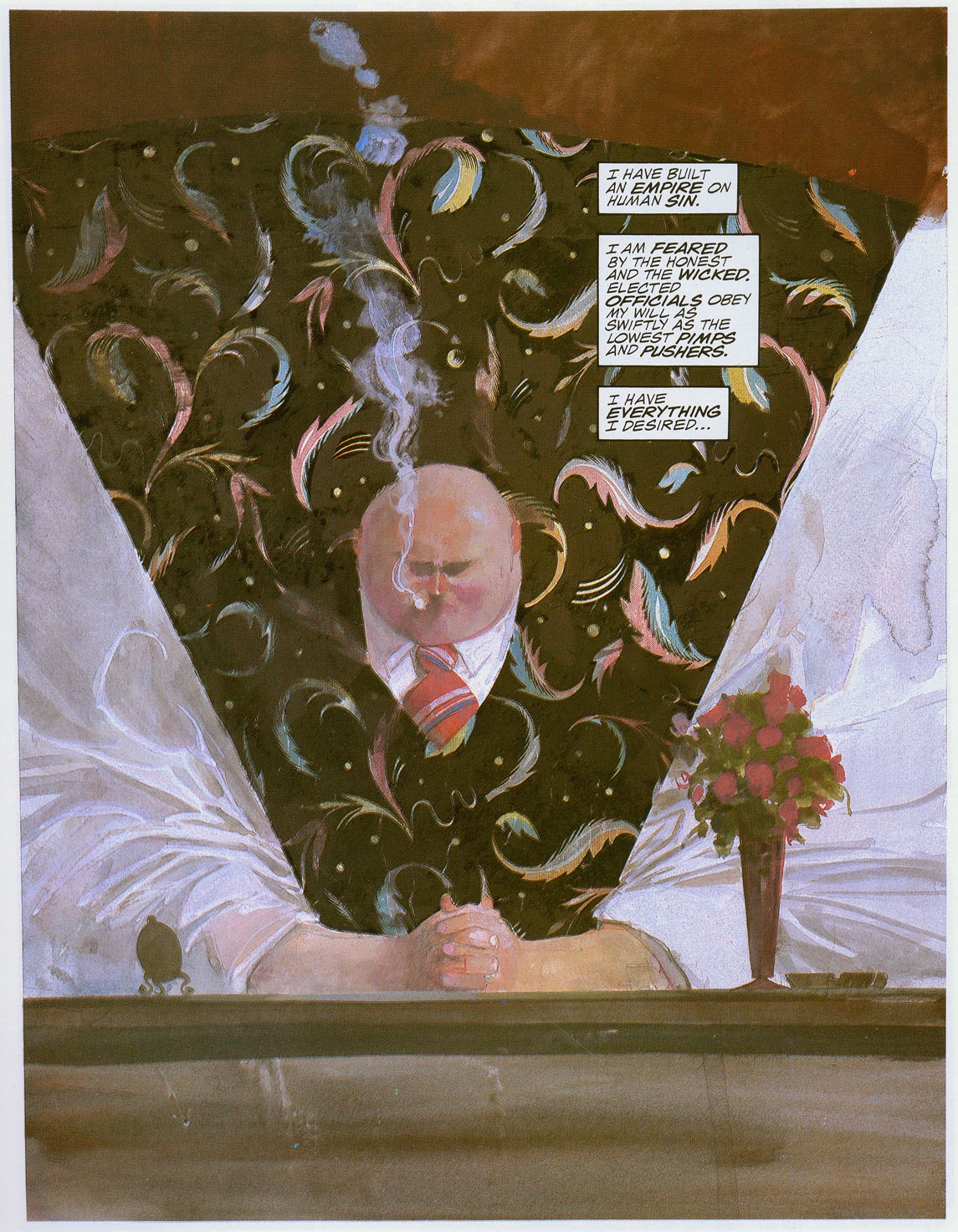
Love is the cause of the Kingpin's lastest crime. His wife Vanessa-- whom, according to Miller, he rescued from an obscure low-wage life-- was injured during the events of Miller's first run on the DAREDEVIL series. Vanessa had been up to a point successful in getting the Kingpin of Crime to retire from criminal activity, but her injury-- which came about indirectly because of her husband's involvement in criminal affairs-- also had psychological consequences. At the beginning of LOVE, she's entered a neurotic state of regression. The Kingpin decides to engage the services of Doctor Paul Mondat, a noted psychotherapist. But being a manipulative SOB, Kingpin wants to make sure the physician brings all of his resources to bear. Thus the crime-lord gives his thugs orders to abduct Cheryl Mondat, the significantly younger wife of Paul, who is also blind and has implicltly married the doctor after having been his patient at some point in time.

So far as getting Paul Mondat to co-operate, Kingpin's scheme is successful. However, the kidnapper selected to abduct Cheryl Mondat is a dangerously unhinged junkie named Victor. Whenever Victor appears, Miller treats the reader to the lunatic's never-ending mental ramblings-- among which is a line of thought in which he convinces himself that he and his kidnap-victim are in love. That Cheryl remains sedated during her abduction is no barrier to Victor. In fact the woman's utter helplessness spurs the kidnapper-- whom Siekiewicz renders as if the man were some weird human-mandrill hybrid, put through some Picasso-like fragmentation process-- to think of Cheryl as a princess, and he Victor as "her most loyal knight."


Daredevil learns about the snatch, and gets on the trail. He succeeds in finding Cheryl, though Victor escapes. The hero takes the unconscious blind woman back to Matt Murdock's brownstone, and assumes his civilian identity in order to talk to her when she wakes. As Murdock he convinces Cheryl to stay hidden, without telling her that he plans, as Daredevil, to liberate her husband from Kingpin's grip. He also manages not to tell her that he's almost as besotted with her helpless beauty as Victor is.

As it happens, though, Paul Mondat has found his own weapon to gain leverage against the crime-boss. As Vanessa begins to regain some of her normal responsiveness, she becomes dependent on Paul, and experiences only fear at the nearness of her husband. Paul, for his part, begins to feel a protective instinct toward Vanessa, and is perhaps a little tempted by her as well: "When [Vanessa] wakes and sees me-- I can only think of Cheryl-- She is much like Cheryl was-- before Cheryl became-- so capable."

During Paul's mental rehabilitation of Vanessa, he succeeds in making her become dependent on him. Then Paul challenges Kingpin to retaliate. As "beauty killed the beast" in KING KONG, Kingpin is utterly unable to deny his beloved wife anything. Thus, by the time Daredevil successfully breaks into the villain's stronghold, his mission is made irrelevant. Kingpin has given both Paul and Vanessa their freedom, and the wherewithal, to leave the country.

As for the damsel in distress, she does get some agency in the end. The demented Victor, using more luck than skill, tracks Cheryl to Murdock's brownstone and tries to kill her in the delusion that he's saving her. Instead, against all probability she manages to kill Victor. Daredevil's only function in the "happy ending" is that at some point he manages to return Cheryl to her husband. On the next-to-last page, Paul and Cheryl, along with the recuperating Vanessa in a wheelchair, prepare to board an airplane and return to Europe, where Vanessa will receive further treatment. The story's last image is that of the Kingpin, his bulk filling the panel, as he contemplates the temporal power he enjoys, even as he tries to forget the loss of the wife who now hates and fears him.


There can't be much doubt that Miller wanted to make a comment about the tendency of men to feel the "Sir Walter Reflex." However, Miller isn't explicitly condemning the reflex, as an ultraliberal feminist would prate about men not giving women agency. Miller seems to suggest that the protective instinct is hardwired into the male genome. (However, if there is a feminine "nurturance instinct" in women, it seems not to manifest in most of Miller's females.) It's significant that Cheryl, despite her being blind and inadvertently attracting almost every male character in the story, does prove, as her husband says, "capable." This trope was also seen in the character of Becky Blake of the DAREDEVIL series, and though Miller did not create her, arguably he gave her as much or more agency than did her writer-creator Roger McKenzie.

Friday, September 23, 2016

MYTHCOMICS: ELEKTRA: ASSASSIN (1986)


“Let mind and soul give way to bone and blood”—Jonin of the Hand

“You only want to fire that very large gun of yours”—Elektra

With the possible exception of Dave Sim, there’s no one that ideological critics, ranging from Gary Groth to Whatisname from Seekfart, have disparaged more than Frank Miller. Sim tended to get castigated for having renounced his comparatively liberal early tendencies in favor a conservative, religiously informed stance. However, critics may have most disliked Miller for his tendency to take ideological concerns lightly. In other words, Robert Crumb was always funny because he took his biggest shots at the Right. Miller took shots at both Left and Right. Clearly that made him a reactionary, and reactionaries can’t be funny.

But though Frank Miller is best known as a maker of hardboiled crime tales and wild superhero adventures, he's much funnier than almost all of the underground cartoonists put together (except maybe Gilbert Shelton). ELEKTRA ASSASSIN, appearing about three years after the culmination of the “Resurrection” arc in DAREDEVIL and in the same year as THE DARK KNIGHT RETURNS, proves this by taking a quirky ironic take on one of Miller’s signature characters.

Readers of this blog will know that I never use the term “irony” in a casual manner. Although all previous stories with Elektra resonnate with the dominantly serious mythos of adventure, this eight-issue “limited series” aligns with the ludicrous mythos of irony. It is not a comedy, in which silly things happen to people in a more or less normal world. In an irony, the whole world is fundamentally crazy, no matter how characters try to make sense of it, or how they may strive to be heroes.

That said, ELEKTRA ASSASSIN is not nearly as dark an irony as some. Miller’s sardonic tone is well complemented by his collaborator, penciller Bill Sienkiewicz. If I had to compare the Miller-Siekiewicz collaboration to that of the preceding Miller-Janson work on DAREDEVIL, it might be that while one is slightly expressionstic within a cosmos dominated by realistic representation.
ELEKTRA reverses the formula. Siekiewicz began his career emulating the extreme “photo-realism” of Neal Adams--


--but he quickly moved toward an expressionistic mode, with more affinities with Surrealist Art than with the “house style” of Eighties Marvel Comics.

Like the Sienkiewicz art, the story behind ELEKTRA ASSASSIN is just as subversive of “the Marvel style," though without any of the posturing self-importance of Crumb and his ilk.  In all eight issues the internal title page supplies the series with the subtitle  “The Lost Years.” Thus the series purports to tell the inside story of what happened to Elektra between the period of the character's college years, when her father’s death caused her to leave Matt Murdock, and the period in which she came back into the life of Murdock / Daredevil in the persona of a bounty hunter who eventually becomes a paid assassin.

But the subtitle is a clever hoax. In terms of tone alone, ELEKTRA ASSASSIN exists in a different world than DAREDEVIL. Yes, most of the boxes are duly checked off. Elektra as a child experiences an erotic fixation upon her father, which will later make her incapable of dealing with his death. She seeks out a substitute father in Stick, the same mentor who trained Daredevil, and he rejects her. She tries to infiltrate the criminal ranks of the Hand, and they turn the tables on her, enhancing in her the potential for evil action. But Miller has no interest in dotting the I’s and crossing the T’s of Elektra’s continuity. Even though Miller mixes in a few standard Marvel support-characters—notably Nick Fury and his SHIELD agents—the author also elevates a reprobate to the position of the President of Marvel’s United States of America.


The cult of the Hand is very different here than in their DAREDEVIL appearances, as well. They register as little more than garden-variety “bad ninjas,” who seem to operate with no particular end except to do bad things. Here, Miller and Siekkiewicz posit that they have always been servants of a demonic figure, “the Beast,” who plots the destruction of Earth. The Hand’s leader says, “No one is innocent,” and it’s no surprise to hear a villain make this sort of pronouncement. When Elektra herself echoes it, it’s plain that the traditional superhero ethic of protecting innocents doesn’t apply in this world.

Perhaps because of the Hand’s magical influence upon her, this Elektra is not just a skilled martial arts fighter, but a super-woman, capable of punching through metal or emitting sonic screams. In other words, this is an Elektra who could never have been slain by a mundane opponent like Bullseye—but more importantly, she is Frank Miller’s meditation on the unholy joy of super-humanity.


To be sure, Elektra is still an emotional basket case, and her meditations make her sound more than a little insane. Yet, because it’s an insane world, this proves to be an asset in battling the Beast and its adherents. By dumb luck Elektra forms a mental link with the aforementioned reprobate: a ruthless, hard-ass SHIELD agent named John Garrett.


Garrett starts out as a human being, and is turned into a Six Million Dollar Operative after Elektra almost kills him. Yet because Elektra now has vast mental powers, she can dominate Garrett, virtually enslaving him as the Hand tried to enslave her—and in time, he comes to take a quasi-masochistic pleasure in her dominion. Romance as such is impossible between two such amoral, messed-up characters. However, faced with the threat of worldly destruction, they do become one of the foremost examples of the “oddball partners” trope.


The series’ closest link to DAREDEVIL is that the combination of sex and guilt follows Elektra wherever she goes. Yet in ELEKTRA ASSASSIN, their confluence is not tragic, but ironically humorous. A psychologist examining Elektra concludes that she had a “stringent Christian upbringing,” which she rejected in favor of Eastern mysticism: all of which sounds like Miller dissecting his own character as a “lapsed quasi-Catholic.” For good measure, Miller also introduces a supporting adversary, SHIELD agent Chastity McBryde, whose very name denotes sexual ambivalence, and who appears at one point dressed as a sexy nun. 

In addition, one telling exchange strongly suggests that none of Elektra’s Asian disciplines have vanquished her Christian demons. Some time after escaping the Hand, but before launching her campaign against the Beast, the lady assassin meets with a client who wants her to kill a South American president. The client comments that the official has invited in so many outside interests that he’s made the country “as a popular as a two dollar whore.” He then asks Elektra what she wants to assassinate the President, and she answers, “Two dollars.”

I mentioned the storyline’s many satires of Left and Right, but I won’t cover them in detail. I must, though, allude to the visual absurdity of American Presidential candidate Ken Wind, who has the face of a Kennedy newspaper-cutout but who secretly serves the Beast. Political passions, as much as sexual ones, are a morass of delusion-- and even an individual's attempts to dispel delusions just lead to other delusions.


To be sure, Miller and Sienkiewicz mount a lot of violence-scenarios to please the fans who expect them from a Frank Miller work. But even these are often a little off-kilter compared to action-scenes done through a representational lens. The explosions and gun-battles here have the same cartoonish intensity as Elektra’s distorted memories.


 Early in the first issue, Elektra mentions that at some point she conceives of her mother—slain by terrorists long before her father’s death—as Clytemnestra, and her father as Agamemnon. Since the mother-figure dies first, Elektra’s backstory can have no direct points of comparison with the initiating action of the Greek Theban Cycle, as this starts off with wife Clytemnestra slaying husband Agamemnon, and so incurring the wrath of Elektra. But one other parallel suggests itself. In the Greek cycle, daughter Electra dominates her brother Orestes and guilts him into doing the dirty work of killing their murderess-mother. In essence, Garrett is as much a pawn to Elektra  as Orestes was to his sister. However, Orestes’ reward for following his filial duties was to be pursued by the Furies. Garrett may not get any romance from his harsh mistress, but he does reap a much more pleasant reward than Orestes. In the world of ELEKTRA ASSASSIN, even though no one is innocent, the people who get the best toys are the ones who are in on the whole cosmic joke.

Friday, September 16, 2016

MYTHCOMICS: "RESURRECTION" (DAREDEVIL #187-190, 1982-83)


"The road of the emotions leads me to True Philosophy."-- Rousseau (as quoted by Poe).

"Resurrection" is the title of the story in DAREDEVIL #190, the final collaboration between Frank Miller and Klaus Janson in their highly regarded rejuvenation of the blind superhero's franchise. In addition, this title was also assigned to five issues of the comic as they were collected in the fourth issue of the 1984 reprint THE ELEKTRA SAGA. The issues in that collection were #182 and #187-190, but as should be apparent from my title, I don't regard #182 as part of the second and last "Elektra arc." The story in #182, "She's Alive," is a brilliant coda to the previous issue, in which the villain Bullseye murders the lady assassin, and it's also a great "reverse-homage" to the 1981 noir-film BODY HEAT. However, if "Resurrection" can be used as the title of any arc, it should be the one beginning in #187, wherein the titular hero once more encounters his old mentor Stick, Stick's "good ninja" allies, and the "bad ninjas" of the Hand. The aforesaid villains initiate the action of the arc, first by declaring war on Stick's small ninja-clan, and then by deciding to resurrect the dead Elektra, so that she will become their obedient servant.

In this essay I stated that Miller's early Elektra-stories failed to make her character dramatically or mythically consistent. However, by late 1982 Miller's scripts showed major strides, perhaps in part because he had ceded penciling duties to Janson, who had supplied inks to Miller's art during their run. In the early stories Miller had only made intriguing but unsatisfying references to his character's psychology. Only after her death, it seemed, did Miller really grapple with the character's soul.

As noted before, the psychological concept of the "Electra complex" was intended to be the mirror-image of Freud's most famous formulation, though Freud rejected the term, insisting that "Oedipus complex" ought to apply to females as well as to males. Yet one should not assume that Miller was entirely guided by his knowledge of psychology, and the "Resurrection" arc shows that Elektra's nature is better glossed by the concepts of religion and myth. At the outset of issue #190-- a prologue that shows Elektra in the years immediately after her father's death and her parting from Matt (Daredevil) Murdock-- she hears the following psycho-profile of herself from her sensei:

Your dream, in college, was to save the world. But alas, that world was a fabrication-- ripped down by the senseless, pointless murder of your father. You see the world now as a chaotic place, huge and terrible. You hate it.

Many superheroes, including Daredevil, become crusaders in response to pain and humiliation, but the idealistic cast of their adventures, of their mission to save innocents, suggests that they are still able to love the world that hurt them. Elektra's morbid fixation upon her pain is more characteristic of the vengeful super-villain. At the point in time when her sensei drops this pearl of wisdom, Elektra has just been denied the chance to join the "good ninja" clan of Stick, because, as Stick says, "You ain't clean. Yer full of pain and hate."

The emphasis on mental cleanliness is one element that shows how Miller's account of good and evil diverges from the world of materialistic psychology. Elektra's problem is not something that can be solved by sublimation or "the talking cure," and her sensei's advice-- that she should seek to benefit the world despite Stick's rejection-- goes unheard. Having been unable to prevent the death of her father, she wants to prove herself to Stick. She chooses to infiltrate Stick's enemies, the Hand-cult. The evil ninjas are prepared for her, and they seduce her to the ways of evil, in part by causing her to slay her own sensei (this time, a father-death for which she is directly responsible). Though at a later date Elektra breaks away from the Hand's influence, and becomes a more-or-less-legal bounty hunter, Miller's script implies that she never entirely escapes this pollution. With this concept of spiritual pollution in mind, her previous actions become relatively consistent. In the early issues she keeps calling Daredevil her "enemy," long before he's done anything to merit it. The later issues make clear that her former lover represents the altruistic ascension she failed to complete, so that he becomes her "enemy" in a spiritual sense. This failure is given a tangible manifestation at the beginning of #190, when Elektra falls during her attempt to climb the great mountain where Stick's clan dwells.

By now the astute reader will have noticed that I'm not giving a blow-by-blow of the many twists and turns of the arc from issue #187 to #190, much less the various subplots.  Such plot-points are less important than Miller's overall thematic project. Within these issues, Miller elevated the base trope of a conflict between "good ninjas" and "bad ninjas"-- a trope which appeared in dozens of cheap 1980s flicks as the cinematic "ninja subgenre" became popular-- and used the vague Eastern mysticism associated with ninjas to meditate on the metaphysical interactions of good and evil.

In some Judeo-Christian traditions, the most prevalent role of the "resurrection concept" appears with respect to the sussing-out of individual good and evil. During the End Times, all the people who have ever lived will be physically restored, so that they can be judged as deserving either eternal bliss or eternal damnation. But there are no gods in the Miller DAREDEVIL, though the two ninja-clans eventually function as angels and devils, struggling over the fate of the late female assassin. That said, the parallel is not exact. The devils want to doom Elektra to further damnation, as she will presumably serve them as a zombie slave. Stone-- the only good ninja to survive the battle of issue #189-- wants only to destroy her body so that the Hand cannot use her.

Daredevil, despite his diabolical name, is the only one who believes in Elektra's essential goodness. In issue #190 he and his allies invade the Hand's hideout-- fittingly, in an abandoned Christian church-- as the evil ninjas attempt to revive Elektra's corpse. While Daredevil and Stone are in battle with the Hand-henchmen, the blind hero hears a single heartbeat from the body of his former beloved. Displaying the obsessional quality Miller lent him throughout the run, Daredevil gets the idea that he can use his own latent psychic talents to fully revive Elektra. In so doing, he fails to guard Stone's back, so that Daredevil's ally is wounded, possibly in a mortal sense. Both of them are only saved from the Hand only by the intervention of the Kingpin's thugs.

The thugs usher Daredevil out of the church, but Stone remains behind, preparing to chop Elektra's head to make sure her body is never misused. Then through his own talents Stone divines that "somehow, in [Murdock's] futile attempt to revive her, he has purged her. She is clean." Stone, wounded and weary of the life of a good ninja, sacrifices his life by discorporating, transferring his energy into Elektra's semi-resurrected body, so that she revives and steals away without anyone seeing her.


Again, no psychologist would credence this method of healing, in which the patient's soul-pollution is cleansed from outside her consciousness, by the good intentions of the patient's former lover. But Elektra's true way out of her dead-end complex-- the way that she should have taken in her normal life-course-- was to invest in those still living, particularly her lover. Significantly, the spiritual energy given her by Daredevil allows Elektra to return to the mountain where Stick's ninjas once made their home, and to successfully scale it at last. It's not clear what she will do from then on, aside from seeking to stay out of Matt Murdock's life (since it is implicitly too late for her to follow the 'plunge back into life" course), but her ascension signifies the advancement of her spirit.


That said, Miller's scenario does not entirely damn the unrighteous. Daredevil and his allies only find the abandoned church because the Kingpin's informants discover its location, and as said earlier, the Kingpin's gun-toting thugs destroy the Hand in the end, though one presumes that this is only because the more heroic types have served as distractions. The Kingpin, a devil-figure in his own right, confers this largesse only to eliminate the Hand as a competing force of evil, and to force his enemy Daredevil to do his bidding. "We need each other, Daredevil," says the criminal mastermind with Mephistophelean sophistry, "We are partners after a fashion. We are the power in this city."

Miller never recounted Elektra's further adventures, and he parted from Marvel Comics when they did so. His next (and final) work on Daredevil was devoted to declaring war between Daredevil and the Kingpin, which might be taken as his follow-up to Kingpin's speech, in which hero and villain have become mutually exclusive. Nevertheless, within the span of the "Resurrection Arc," good and evil are inextricably tied together, as all good abstractions-- angel and devil, hero and villain, life and death-- should naturally be.