Featured Post

SIX KEYS TO A LITERARY GENETIC CODE

In essays on the subject of centricity, I've most often used the image of a geometrical circle, which, as I explained here,  owes someth...

Wednesday, July 9, 2014

A QUICK ASIDE ON FUNCTIONALITY

On rereading this sentence from my previous essay, I felt I should elaborate the definitons of stereotype and archetype a little more:

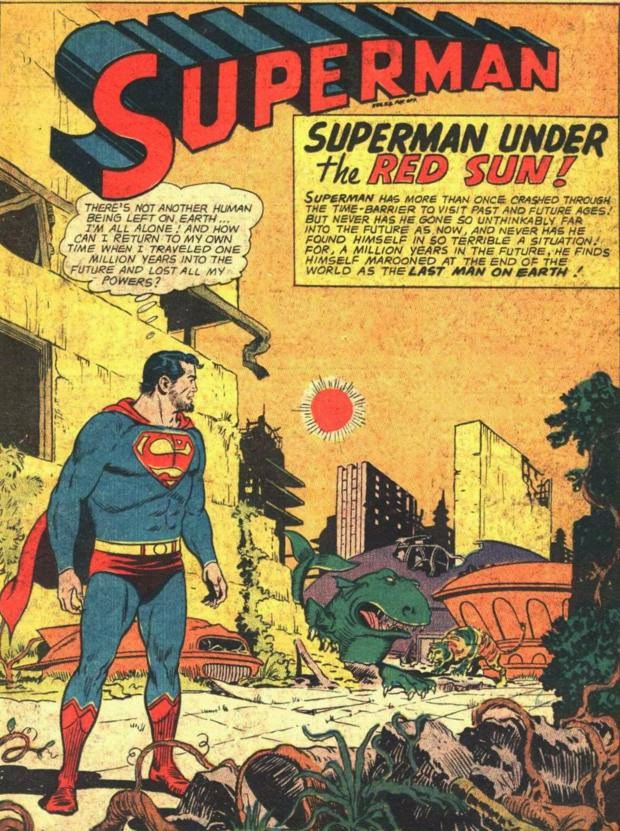
That [Superman] gets his science-defying powers from a yellow sun, or loses them in the presence of a red sun, are stereotypical devices to quickly explain why the hero does or does not have powers.

A stereotype, or stereotypical device, is identical to what I called a "simple variable" in this essay. For my purposes a simple variable is any item, event or entity within a narrative that is as close as one can conceive to a bare function; one that is static with respect to associative links to other items, events, or entities.

An archetype is equivalent to what I have called a complex variable, following Northrop Frye's logic on this subject. A complex variable is any item, event or entity within a narrative that proves itself dynamic with respect to associative links to other items, events, or entities.

Therefore in my schema:

A stereotype is defined by bare functionality.

An archetype is defined by some degree of "super-functionality."

I suppose I could call it "surfunctionality" if I wanted to distance it from the various "supermen" associations of Nietzsche, Shaw and Jerry Siegel. But that would be an elitist's consideration.

Tuesday, July 8, 2014

ONLY AN ARCHETYPE CAN BEAT ANOTHER ARCHETYPE PT. 2

In TRANSCENDENCE WHAT AIN'T SUBLIME, I printed a few excerpts from the 1951 Harvey Kurtzman story, "Man and Superman."  I did not, in that essay, address any questions of "stereotype vs. archetype," as my focus was on contrasting the two principal forms of transcendence as outlined by Aldous Huxley, "vertical" and "horizontal" transcendence.


However, "Man and Superman" works equally well to describe a battle between, not archetypes, but stereotypes about popular tropes.

Despite the use of the name "Superman" in Kurtzman's oh-so-Shavian title, the only trait of the DC hero being guyed here is the character's ability to defy scientific law by acquiring an unscientific level of physical density-- physical, that is, as opposed to the even greater mental denseness of the comic foil Charlemagne.  But though Kurtzman deserves credit for a clever satire, it is a satire that, as I pointed out earlier, depends purely upon a "reasonable and agreeable" conception of scientific law. There is no symbolic complexity to be found in Kurtzman's conception of scientific law: it's simply an amorphous taskmaster, set to punish those who try to step outside its unforgiving bounds-- which is indeed the fate of Charlemagne, who is stomped into nothingness by Imperial Entropy.


As noted before, Superman as Superman is not being spoofed here: Kurtzman mocks only one aspect of the character, his flagrant disregard for scientific law.  And though a myth-critic like myself can find symbolic complexity in many aspects of Superman's mythos, I have no problem admitting that the character is stereotypic in this respect. That he gets his science-defying powers from a yellow sun, or loses them in the presence of a red sun, are stereotypical devices to quickly explain why the hero does or does not have powers.


In neither case does one stereotype "defeat" the other, though. Readers of Superman often know that his powers make no sense in terms of real-world science, and so Kurtzman's satire cannot have any effect upon these readers' willingness to ignore verisimilitude for the sake of a pleasing fantasy.

It is possible for one stereotype to displace another, however. In Will Eisner's celebrated comic feature THE SPIRIT, the artist resorted in large part to "minstrel-show" stereotyping in producing the character of Ebony. None of the characteristics of Ebony-- his mush-mouthed speech, his blubber-lips or his deference to his white boss-- are acceptable stereotypes in modern culture.


However, was the Ebony stereotype displaced by anything comparable to an archetype? I would say that, while such a displacement was conceivable, what displaced the old stereotype was a new one.  Eisner, in this defense of Ebony, implies that the stereotype of the "Malcolm X-style radical" has usurped, or wishes to usurp, Ebony's place in the cultural scheme of things.


Eisner can be fairly criticized for distorting his past representations of Ebony. However, he seems to have been at least near the mark, as the stereotype of the "angry black man" is entirely acceptable to modern readers, however banal its representations may be.  I think this is the sort of usurpation my nephew was thinking about, where a "good stereotype" displaces a "bad stereotype"-- and archetypes as such are not really involved at all.


Next: Archetypes vs. Archetypes.

ONLY AN ARCHETYPE CAN BEAT ANOTHER ARCHETYPE

A few weeks ago, I was discussing storytelling with my gifted nephew, and somehow or other I broached the question of archetypes. While my nephew, currently in high school, is a beginner to storytelling, he reflected a common modern prejudice when he said something to the effect that he wanted to "get beyond the archetypes."

Assuming that I've quoted him correctly, I suspect that he doesn't see archetypes as I do, as templates of experience around which human beings organize all symbolic activity. It's possible that for him, archetypes are indistinguishable from stereotypes. And since stereotypes are usually bad, often being used to support racism or sexism, then archetypes must be bad as well.

The two can be simply distinguished, though, with recourse to Philip Wheelwright's conception of two basic forms of human language, on which he expounded in his book THE BURNING FOUNTAIN. In my post THE NARROWING GYRE I noted that he meant to propose this paradigm "not as a dichotomy" but "on the model of variables approaching a limit." Here is his description of "steno-language:"

 …meanings that can be shared in exactly the same way by a very large number of persons—in general, by all persons using the same language or the same group of inter-translatable languages. Examples are so obvious that they may be mentioned without explanation. Common words like child, parent, dog, tree, sky, etc., are steno-symbols, and their accepted meanings are steno-meanings, because what each of the words indicates is a set of definable experiences (whether actual or only possible) which are, in certain recognizable respects, the same for all who use the word correctly. (Metaphor and Reality, p. 33.)

In contrast to the use of words to describe objects or events in a static fashion, there is also a more dynamic "poeto-language," which depends on the dynamic manner in which the objects or events inspire "something at once familiar and strange:"

Certain particulars have more of an archetypal content than others; that is to say, they are 'eminent instances' which stand forth in a characteristic amplitude as representatives of many others; they enclose in themselves a certain totality, arranged in a certain way, stirring in the soul something at once familiar and strange, and thus outwardly as well as inwardly they lay claim to a certain unity and generality.-- FOUNTAIN, p. 54.

It's my contention, then, that stereotypes are static representations in tune with Wheelwright's "steno-language," while true archetypes are dynamic representations in tune with his concept of "poeto-language."

Examples will be forthcoming in future installments.

Monday, July 7, 2014

THE READING RHEUM #5: BORIS KARLOFF'S TALES OF MYSTERY

Horror comics from the 1960s can't compare with the mad, bad comics of the 1950s, but Gold Key's BORIS KARLOFF'S TALES OF MYSTERY was one of the better titles of the sixties. In general it managed to project a good sense of creepiness, even with the limitations of the Comics Code, and often boasted striking painted covers.


Take issue #10, from 1965. The cover story dealt with a couple of American entrepreneurs trying to unearth treasure from a volcano in Peru. They dismiss the idea that the area may be haunted by "the Hill Barbarians," a vicious gang of cutthroats who were vanquished centuries ago when the volcano went off and encased them all in lava.  Naturally, the undead warriors, horses and all, come back to life when one of the entrepreneurs tampers with their burial site. In keeping with the Code, no one is violently killed by the spectres, but there's a creepy moment when one of the locals observes that the barbarians are wasting away to skeletons even as they ride against their old enemies.

The most puzzling aspect of the tale is that the uniforms of the warriors are clearly modeled on the Spanish conquistadors. Yet at first the writer refers to them as "the Hill Barbarians of Peru," as if they are native to the realm. Then later, the characters referring to the warriors as "the Spanish barbarians," though there's no still no acknowledgement that they're literal conquistadors.  Maybe the unknown writer started out using conquistadors, but decided that he wanted them to be local bandits, who would be more likely to plunder Peruvian villages on a regular basis, rather than stealing from them legally, through taxation, as the conquistadors did.


A more satisfying refutation of European imperialism appears in BKTOM #24, from 1968. Suffice to say that the evil, red-bearded fellow on the cover ends up getting his from the magical "demon masks" of a tribe of Asian headhunters, and that his own head rests less than easy by story's end.

This issue, however, is more interesting for the story "The Guardians," which although it is narrated by Boris Karloff, contains references to "The Twilight Zone" in Boris' ruminations. Most probably this was an inventory story done for Gold Key's TWILIGHT ZONE title. Someone decided to adapt it to BKTOM by simply re-drawing Rod Serling to look like Karloff, but the editor didn't bother to correct the text. I expect horror-stories in comic books to be rather thinly plotted, but these two issues don't exact speak highly for the skills of the Gold Key editorial staff.

Thursday, July 3, 2014

BREASTS, BLOOD AND JUSTICE PT. 3

At the end of Part 1 of this series I wrote:

In Part 2 I will discuss some reasons as to why this is at most a lesser threat, one that pales in comparison to one that a modern Nietzschean might call "men and women with no chests."
This was a little misleading: the phrase "men without chests" originates not with Nietzsche or any Nietzschean, but in a quote by a critic who was in some ways opposed to everything Nietzsche stood for: the redoubtable C.S. Lewis, who wrote in his book THE ABOLITION OF MAN, "We make men without chests and expect from them virtue and enterprise. We laugh at honor and are shocked to find traitors in our midst."


Francis Fukuyama only quotes Lewis once in THE END OF HISTORY AND THE LAST MAN, but he utilizes this memorable phrase as the title of Chapter 28, which is principally his discussion of Nietzsche's objections to what we now call "liberal democracy."  Fukuyama does not dwell on the differences between Lewis and Nietzsche; he's interested only in comparing one similarity-- the pursuit of excellence, which Fukuyama associated with *megalothymia,* the human desire to prove oneself superior to others.

Liberal democracy, in contrast, is devoted to *isothymia,* the desire to prove oneself equal to others-- a desire to which both Lewis and Nietzsche were opposed, albeit for different reasons. 
It may be fairly claimed that often a given agent's desire to prove equality is spurred by another agent's attempt to prove superiority. Indeed, the key concept of what I define as ultraliberalism is the assumption that this defensive, reactive posture by a marginalized entity is the sine qua non of the liberal outlook. Thus in Berlatsky the majority of superhero narratives are defined as validations of the status quo,  and in Kelly Thompson the majority of sexy female costumes in superhero narratives are attempts to marginalize and/or dehumanize real women.


Real liberalism, in my view, allows its agents the freedom to campaign for greater real-world equality and, simultaneously, the freedom to compete for superior status upon a hypothetically level playing-field.  This level playing-field, however, does not mean that everyone strives after superior status in the same way, and when said field is occupied by both men and women, different strategies can fairly pertain.

In JUG BOND I printed this photo of a "girl about to go wild:"


Now, while both males and females have the ability to display their secondary sexual characteristics, and while hetero women do like to view the sec-sex characteristics of men, there's really no display males can mount that is quite this elemental. Yes, a given man can develop his pecs and abs to Schwarzeneggerian proportions, but this is a modification that takes a lot of work. Body-builders sculpt, they don't go 'wild," and many hetero women claim that they don't like this type of extraordinary musculature. In the end, there's no sec-sex characteristic that a male can display that reaps the same automatic, enthusiastic response. And while a woman's unveiling of her breasts can mean more than one thing, as I also noted in JUG BOND, in my opinion it most often connotes sexual readiness.

Camille Paglia famously argued that the ability of women to display themselves often had a profound, empowering aspect. One need not believe that it applies to all situations, as Paglia seemed to credence, but this view does supply a necessary corrective to the ultraliberal/WAPster notion that feminine sexual display can mean nothing but "coming across for The Man."

Further, sexual display is a strategy that works for some but not for all, even on a hypothetically level playing-field. Not all breasts are equal, and no matter how much WAPster feminists may campaign for a sisterhood in which all are equal, some women can flash tit to great approval, and some can't.  There have been any number of workplace suits alleging preferential treatment for women with "better" looks, and there's no excuse for that sort of unfair competition in the world of business.  But in fiction, it's entirely possible for "beauty" to correctly signify "goodness" and "ugliness" to signify "evil." The attempt to eliminate such hierarchies of "beauty vs. non-beauty" isn't politically possible in real life, and the attempt to curtail them in fiction is the sine qua non of absurdity.

As noted above, Lewis the proselytizing Christian and Nietzsche the advocate of "the death of God" were on very different pages. However, they were essentially agreed that human beings needed to strive toward excellence. Now it may be that neither scholar would have advocated that excellence in the form of being either a male or a female "hottie."  But I do, at least within the sphere of fiction, because physical beauty is often a conduit for the affect of the sublime-- a connection I may explore in more detail in a later essay.

Wednesday, July 2, 2014

BREASTS, BLOOD AND JUSTICE PT. 2

Now, if the object of the humor was actually MacFarlane and his penchant for ribald attack humor, a simple 15-second cutaway—much like those on Family Guy—would have gotten across the point…and the humor. But no, it goes on for nearly two minutes—the point is to name and shame, say the word boobs and turn actresses into dehumanized objects yet again. I have a dream that someday women will be judged by the content of their character and not the content of their Maidenforms, but that day has not come for MacFarlane.-- Heidi MacDonald, "Why Seth MacFarlane is Not a Great Satirist."

I won't repeat my arguments against MacDonald and others who advocate her type of feminism, which I covered at length here  and here.  I will call attention to one phrase MacDonald used that has some irony now, when she claims that all MacFarlane had to do was to say the word "boobs" and that this would turn "actresses into dehumanized objects."

This trite assertion becomes ironic in light of the evolutionary theories outlined in JUG BOND.  Purely from the standpoint of distinguishing homo sapiens from all other animals, the genetic arrangement of adipose fat tissue within the female's breasts and buttocks is extraordinarily "humanizing." One can contrast the organs of a male human being with those of other male animals, but no one will find any single organic feature that compares in distinctiveness with the female breast. Further, the role of the breast has been that of promoting the human pair-bond, whether one wishes to conceive of that bond as having its roots in sexual deception or oxytocin-produced ecstasy.

Some feminist thinkers, however, do not take into account the role of the female tit in its evolutionary character; its ability both to encourage and to discourage sexual congress. For them the exposure of a boob is simply a means to make the (usually living) female to whom it is attached to an "it" rather than a "thou," to reference the terminology of Buber, discussed here.

I began the first part of this essay-series by noting that it was understandable that female viewers of an exploitation film-- such as 1993's ANGELFIST-- should experience a cognitive dissonance when seeing a female action-hero simultaneously fighting off nasty thugs but also exposing her tits to the implied male viewer of the movie. I understand the attitude so expressed, which I deem to be produced, at least in part, by a tendency for women to advocate societal modesty. It's a tendency that might prove to be universal-- or nearly so-- in human cultures in every time and clime, at least in comparison with a male tendency toward raunchiness and rule-breaking. But though the attitude is important for the maintenance of society in the real world, I still find it to be grossly out of place when assessing fictional constructs.


Though there are some heroic characters in fiction who may escape the limitation of being either "male" or "female"-- "Rebis" of Grant Morrison's DOOM PATROL is literally a transgendered being-- the great majority of heroes can be fairly defined as either male or female. In Part 1 of BBAJ, I demonstrated the prevalence of the "mostly unclothed hero" in a wide number of narratives starring male heroes, and observed that a lack of clothing did not carry the same taboo for males that it did for comparable female characters.

Nevertheless, because both male and female characters are fictional, one cannot accurately speak of either one being reduced to "dehumanized objects" simply by the lack of apparel. Fictional characters are objects only in comparison with living human beings. The most one can say is that in society some characters create more of an impression of being "it-objects," while others create more of an impression of being "thou-objects"-- though such judgments will always be rooted in the vagaries of taste.

But in terms of pure logic, there is no reason to assume that a female character's lack of clothing is any more "dehumanizing" than a man's. Characters like Tarzan and Hercules are seen as figures of power precisely because they can defy the norms of society, very nearly walking around in their birthday suits.  So it is within the bounds of possibility that one may view disrobed female characters in the same way.  Rather than seeing them as commodities divested of clothing to please male viewers, it's possible to see them as beings whose bodies are so awe-inspiring that the open display of those bodies gives them a godlike formidability.


One cannot decisively prove, of course, that male viewers view Lara Croft more as a figure of awe than as a dehumanized object. But the converse cannot be proven either; it's merely an assumption that has deeper roots in political ideology than in literary analysis. To neutralize either heroes and heroines of their sexual assets puts a new spin on the notion of "men without chests."


Tuesday, July 1, 2014

JUG BOND

Before proceeding to the second part of BREASTS, BLOOD AND JUSTICE, I'll discuss some of the prevalent theories as to why the female of the homo sapiens species may have developed both enhanced breasts and buttocks.  I will briefly sum up some current scientific theories but will make no great attempt at attributing every theory to its putative originator.  Also, though I will quote evolutionary theories that presuppose materialistic explanations for all life functions, this does not mean that I subscribe to these presuppositions. It just means that I consider materialistic explanations to be part of the truth.

I draw in part on such references as Leonard Shlain's SEX, TIME AND POWER and the Lynn Margulis/ Dorion Sagan work MYSTERY DANCE. As I read things, the dominant narrative of human evolution with respect to feminine secondary sex-characteristics goes something like this.

(1) The ancestor of "homo sapiens" moves from a quadripedal orientation to a bipedal one, possibly as a reaction to a compromised evolutionary niche.

(2) When females hominids begin walking upright, it has consequences for the width of the birth canal.

(3) The compromise of the birth canal promotes the greater survival of neotenous offspring; i.e., offspring who are born in a lesser stage of development in comparison to other primates, principally because in this stage it's easier for the head to pass through the smaller birth canal. This stage of development becomes the standard for the new upright hominid.

(4) Because the human infant remains helpless for several years-- as opposed to many primate infants, who can often survive on their own after a year-- the mother is motivated to attract male protectors who will protect home and hearth.

(5) This cataclysmic situation eventuates in the end of primate-like "estrus cycles" as the female hominid develops the talent and inclination to signal sexual availability at any time of the year. By coincidence alone-- at least according to materialistic science-- the female hominid develops enhanced breasts and buttocks, so that the male cannot predict any particular time when the female will be available for sex. This, according to Shlain, enforced the female's ability to command a "veto power" that exists only sporadically, if at all, in other members of the overall animal kingdom.

(6) A corollary to this line of thinking is that the shift to bipedalism also shifted the dorsal sexual procedure of other primates to a ventral orientation. Desmond Morris famously suggested that female breasts developed as a sexual signal to the male to get with the new program. Sort of a sign reading, "This side up, stupid!"  But it may be fairly pointed out that while engorged-looking buttocks might indeed signal female estrus to males, engorged-looking breasts might have tended to suggest lactation, and therefore female unavailability.

I may have missed a step here or there, having no more than an amateur's cognizance of the basic arguments, but I believe this sums up the prevalent opinions. However, I have encountered one interesting recent contribution that might answer the lactation-taboo objection.

This essay from the online journal LIVESCIENCE addresses a possible reason for the human male's predominant preoccupation with female breasts:

Larry Young, a professor of psychiatry at Emory University who studies the neurological basis of complex social behaviors, thinks human evolution has harnessed an ancient neural circuit that originally evolved to strengthen the mother-infant bond during breast-feeding, and now uses this brain circuitry to strengthen the bond between couples as well. The result? Men, like babies, love breasts.

AND


Recent studies have found that nipple stimulation enhances sexual arousal in the great majority of women, and it activates the same brain areas as vaginal and clitoral stimulation. When a sexual partner touches, massages or nibbles a woman's breasts, Young said, this triggers the release of oxytocin in the woman's brain, just like what happens when a baby nurses. But in this context, the oxytocin focuses the woman's attention on her sexual partner, strengthening her desire to bond with this person.

What does this mean for the traditional narrative of breast/buttock evolution? The narrative assumes that the feminine hominids's alterations take place as a strategy of visual deception, comparable to the display of symptoms of "false estrus" in many other animals. But the release of oxytocin doesn't seem to be a tactic of deception. It certainly begins, as Young posits, as a biological mechanism to promote the "mother-infant bond during breast-feeding." But the traditional narrative doesn't emphasize pair bonding for the sake of mutual enjoyment, much less for the female's enjoyment. The narrative emphasizes "quid pro quo:" the male gets sex with greater frequency-- albeit modified by the female's "veto power"-- and the female gets protection for herself and her offspring.

It's noted in this 2009 online essay that whereas some biologists did not assign oxytocin to play a big role in the sexual stimulation of the human male, some new research suggests that the hormone is more important than was previously believed. If both sexes were initially stimulated by oxytocin through primary sexual contact, then the hormone's stimulation in the female through a secondary sexual characteristic-- that is, through nipple stimulation-- may only have come about as a latter-day elaboration of a separate biological reaction.

All of this signifies that the female breasts of homo sapiens-- and perhaps to a lesser extent, the rounded buttocks-- may have become a displacement for the idea of sexual activity as a whole.  Perhaps traditional cultures that show no great breast-obsession are able to distance themselves from "breast-as-sexual-signifier" because the mammaries principally connote the lactation-taboo under most circumstances. However, this would not mean that the males of those cultures could not still utilize nipple stimulation when real sexual availability was signaled.

And what does this mean for "breasts in fiction?" Obviously, whether one is dealing with a crappy Roger Corman flick or a tony art-film (such as Seth MacFarlane spoofed at the 2013 Oscar Awards), female breasts provide a synecdoche for sexual ecstacy even when no character is actually having sex.  To repeat my verdict from the second of my MacFarlane essays, I find it dishonest to pretend that there are not wholly natural, logical reasons for the use of breasts to sell films or comics or whatever-- reasons that are not intrinsically about marginalizing real-world females.

Not least because real-life females are far from universally agreed about the political consequences of a little jug-music: