Featured Post

SIX KEYS TO A LITERARY GENETIC CODE

In essays on the subject of centricity, I've most often used the image of a geometrical circle, which, as I explained here,  owes someth...

Monday, December 24, 2018

MYTHCOMICS" THE MAD COMPUTER" (2000 A.D. #144, 1979)


There’s a special kind of irony that the most mythic Xmas-comic I’ve found thus far doesn’t actually take place in the holiday season.

From the near-totalitarian philosophical stance of ultimate lawman Judge Dredd, holidays are just one more potential wrench in the gears of a smooth-running Mega-City: one more sybaritic excuse for citizens to misbehave and thus incur judicial wrath. This week’s mythcomic, spawned by John Wagner and Mike McMahon, shows that such “libelous displays” (to quote from Lerner and Loewe) are so infectious that they can even spread their cheery poison to days that are not holy, and to beings that are not human, like the titular “Mad Computer.”

“Everyone loved Barney, and Barney loved everyone—until the day that Barney went haywire, and Christmas came a little early to the Des O’Connor Block!” It would be interesting to know why Wagner chose the name of “Barney” for Mega-City’s master computer. The famed Purple Dinosaur, the “Barney” best known for cloying affection, did not come into being until 1992, and earlier Barneys from THE FLINTSTONES and ANDY GRIFFITH don’t seem like probable inspirations. Computer-Barney, a vital instrument in the running of the city, is given a human face by his creators—two tape-reels that look like eyes and a big red-lipped, toothy grin pasted on the machine’s front. The story, being only six pages long, doesn’t state outright that Barney has gone “haywire” because humans make the mistake of humanizing a mechanical intelligence, but the “everyone loved Barney” line implies that this is the proximate origin of the chaos.

One day, Barney decides that the Christmas spirit shouldn’t be confined to one day of Mega-City’s year. The inhabitants of “Des O’Connor Block” are the only residents who get expensive gifts from the computer, possibly because these are the people the computer most often sees day-to-day. Further, the local school is damaged by Barney so that all of the kids will be out of school, and the computer sends special announcements to some residents, which notes give unto them false “good news,” like a widow being told that her husband is still alive. Barney tells all of the residents, “I want you to be happy, folks—an’ I’ve got the power to do it! Before long, I’m gonna make it Christmas in every cityblock! Christmas every day of the year!”

The Bard memorably wrote, “If all the year were playing holidays, to sport would be as tedious as to work.” Judge Dredd isn’t worried so much about tedium as the insupportability of eternal good cheer. Since he can’t immediately attack the computer, which threatens to cripple all of Mega-City, Dredd tries to reason with the runamuck mechanism. When Barney proclaims his gospel-- “The law’s no good if it don’t make folks happy”-- Dredd responds with the Voice of Experience:

It’s false happiness, Barney! You don’t understand people! Pretty soon the bubble is going to burst—then the Judges will have to clean up the mess!

And Dredd’s gospel is borne out. Given a false god who promises that all one’s wishes can be fulfilled, the residents of Des O’Connor Block begin to fight amongst themselves, and even to commit murder, despite Barney’s confused, futile protests: “You should be happy!” Finally the Judges charge in to restore order, and by then, Barney’s circuits have become scrambled by seeing the results of his irresponsible largesse. Faced with a mother whose little girl was trampled by crazed residents, Barney commits suicide by switching himself off, making it possible for the Judges to control the city once more. The story’s final dialogue conveys the ironical gospel of Dredd, which counters that of the Pale Galilean by stating that essentially “man WAS made for the Sabbath:”

JUDGE TELFER: We can’t give people happiness. The best we can do is good old law and order.

JUDGE DREDD: As far as I’m concerned, Telfer, happiness IS law and order.

NEAR MYTHS: STOCKING STUFFER #2


This Xmas season’s second and last near-myth comes from the same series as the forthcoming mythcomic: the venerable series British series Judge Dredd.

In the first “stocking stuffer,” I opined that good sentimentality doesn’t always make good mythicity. However, sardonic irony doesn’t always provide the Keys to the Kingdom of Myth, either.

This cover, first appearing for a 1987 American reprint., seems to sum up one of the primary themes of JUDGE DREDD: no free rides for the pleasure-principle while Dredd, the incarnation of the displeasurable reality-principle, is on duty. 


However, most of the stories collected in this Quality Comics reprint, JUDGE DREDD v. 2, #6, make only niggling use of Xmas elements. The only tale that even deserves the status of a near-myth is 1985's “A Merry Tale of the Chiistmas Angel.”

That said, “merry mix-up” would be a better title, since scripter John Wagner and artist Steve Dillon simply tossed together four loosely-related plot-threads involving the terminally addled citizens of the futuristic Mega-City. One, the least memorable, involves a performance of the Nativity by a troupe of actors with bad Italian accents. In the second, Dredd’s perpetual sparring-partner, the manic Mean Angel, is lobotomized in order to make him into a model citizen, and in the third, a Christmas-hating terrorist named Flymo takes the Nativity-performers hostage. Lastly, there’s a frame story that starts out by suggesting that the Judges of Mega-City are extending the hand of charity to the grotty mutants outside the city’s borders.


Regarding the first and third plots, Wagner doesn’t even bother developing them past functional status, with Dredd commenting, after Flymo’s demise, that they (and the readers) will never know why the terrorist had a mad-on against the holiday season. Mean Angel is always fairly amusing with her berserker-rages against the incarnation of law and order. However, in symbolic terms the best part of this thread doesn’t involve the battle of hero and villain, but a comical bit where Mean receives a Christmas package containing a “Dredd-in-the-box”—which gift inadvertently helps break down the savage thug’s conditioning. As for the frame story, I’ll just say that it’s sort of plot that insures that JUDGE DREDD, despite its adventurous aspects, always keeps one foot planed in the realm of irony. Wagner’s Judges take no holidays from dispensing justice, and the Mutants—who are, very conveniently, all “known murderers”—find that the hand of charity is actually concealing the sword of Old Testament justice.

Sunday, December 23, 2018

NEAR MYTHS: STOCKING STUFFER #1

Not to be a Grinch about it, but though there's a lot of mythicity in the actual rituals and customs of Christmas, to say nothing of the intersection of pagan myth and Christian worship, not that much mythicity appears in pop-cultural Christmas entertainment. I like sentiment as much as the next fan, but with a few exceptions, like possibly Seuss's original Grinch-fable, holiday cheer doesn't seem to translate into what I've called (in my windy way) "hyperconcrescent symbolic discourse."

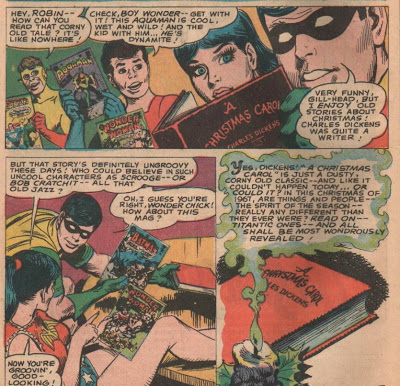
Case in point: TEEN TITANS #13, Bob Haney and Nick Cardy's winsomely corny reprise of Dickens' CHRISTMAS CAROL, blended with faux-hip teenaged superheroes. Haney probably guessed that most if not all of his readers had "grooved" on various adaptations of Dickens, and so what better grist for the story-mill than to have the Teen Titans experience almost the same story in "real life," with only minor changes of names and situations:

First the teen heroes sit around reading comic books, while Robin loftily recommends a more portentous author:


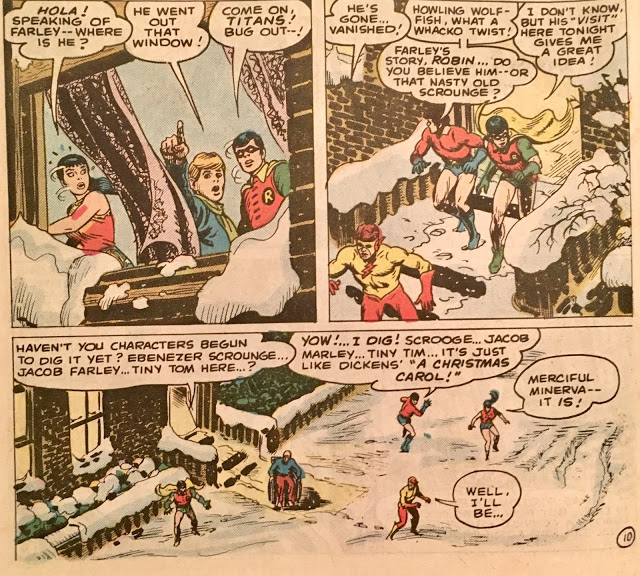
And then they start to experience almost the same events of the CAROL.


At no point, surprisingly, do any of the heroes start worrying, a la Will Farrell, that they may be helpless pawns of some capricious author. They just go about solving a crime that involves the skinflint "Mister Scrounge," his employee "Ratchet" and Ratcher's crippled son "Tiny Tom." I'd be lying if I said I hadn't enjoyed the pants off this cornball version of metatextuality back in the day, and that I still enjoyed Cardy's masterful mise-en-scene upon recently rereading same.

However, the closest the comic comes to mythicity is the weird, eye-catching cover:


The idea of having a bunch of good guys pinned to a Christmas tree like living ornaments is by itself nothing special. However, the idea of the faux-tree being  made out of a collection of junk is inspired, since Xmas presents usually connote the promise of The New, while Junk connotes the Old and the Unpromising. Further, seeing the heroes are bound by old tires and radiators and bedposts makes it seem as if the junk is alive, preying on the energies of youth. However, even Haney's lunatic imagination couldn't figure out how to justify "junk-that-eats-teens-as-food" (in contradistinction to the more familiar "teens-eat-junk-food"). So in the story proper it's not a tree of junk, just a big conical pile of trash that somehow has the power to magnetically attract the good guys, though not any of the bad guys they're fighting at the time. An added, almost Old-World touch is that the two figures in the foreground-- the "Scrooge" doppelganger and modern-day crook "Mister Big"-- are making deep, flourishing bows to one another as if emulating those turn-of-the-century personifications of politeness, Alphonse and Gaston.


Saturday, December 22, 2018

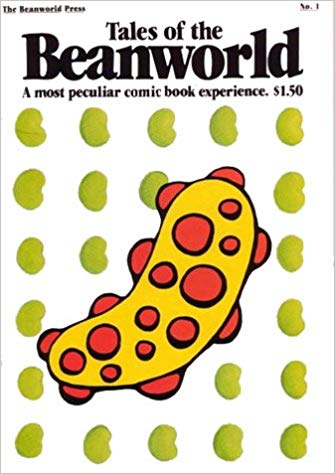
MYTHCOMICS: "THE LEGEND OF POP! POP! POP!" (BEANWORLD #1, 1985)


When I pulled out the first issue of TALES OF THE BEANWORLD, I wasn't consciously seeking a parallel to last week's mythcomic. Nevertheless, the parallel is there: both "Planet Story" and "The Legend of Pop! Pop! Pop!" spin fantasies about how a race of sentient beings exist in perfect harmony with their ecology, only to have that ecology disrupted. In "Planet Story," the mood is that of tragedy: the sentient beings choose to depart Paradise, needing no serpent to tempt them. In the BEANWORLD story, the mood is heroic, as well as more typical of ecology-oriented stories today, in which a figurative "serpent" doesn't just tempt the inhabitants of Paradise, but seeks to invade their world and destroy their equilibrium.

The first non-fanzine issue of the comic is accompanied by writer-artist Larry Marder's brief "history of the Beanworld." Marder asserts that he first began doing loose and inconsistent cartoon-sketches of his characters-- most of whom look like humanized beans, with arms,legs, hair and eyes (but no mouths)-- before finally deciding to publish them in a fanzine. To flesh out the cosmology of the Beams, Marder says that he "read myths, anthropology books and religious tracts," and so to some extent the Bean-universe is underscored by concepts about how human beings organize their own myths.


Like a 1930s animated cartoon, Beanworld sports minimal background designs. The cynosure of this bean-dimension is a gigantic tree known as "Grandma'pa," and the Beans are first seen congregating beneath the tree's bisexual (self-fertilizing?) branches. The Beans have no secondary sexual characteristics and most of them are defined by male pronouns, though their toolmaker, the whimsically named Professor Garbanzo, is designed as female late in the story. Most of the Beans are coded as male by their activity as "chow sol'jers," who are armed with big forks (sometimes called pluckin' wands), and their leader is implicitly male as well, the even more whimsically named "Mister Spook."


The Beans have gathered beneath Grandma'pa to witness an event important to their very lives: the spawning of a single seed, known as a "sprout-butt," which falls off the tree with a single "pop" sound. Though all of them are ready to catch the sprout-butt on their forks, only Mister Spook succeeds. Once this is done, the chow sol'jers are ready to depart on a raiding-mission to one of the other Four Realities.


Whereas Beanworld slightly resembles Earth in at least having a grassy sward of ground, the next reality, that of the Hoi Polloi, is more like one of the free-floating cosmoses one would see in "Doctor Strange" comics. As in Beanworld, there's just one species in this world: the Hoi Polloi, who look like disembodied heads (albeit with mouths!), except that each head has just one arm, complete with a gloved hand, growing out of it. The Hoi Polloi spend all of their time gambling with a "stony substance" called chow, though they never eat the stuff, nor are seen to eat anything at all. However, it's soon borne out that the Beans do need chow for their sustenance, hence their raiding-parties to the world of the Hoi Polloi.


As soon as the Beans enter the proximity of the one-armed heads, the Hoi Polloi become defensive. Each group of Hoi Polloi, perhaps twelve at a time, proceed to "circle the wagons," each head extending an arm to grab onto another head, and that one onto another, and so on. In the center of each circle, the heads guard the stony chow from the invaders. However, the Hoi Polloi can't defend themselves from direct attacks by the forks of the chow sol'jers. As the forks inflict superficial wounds, the rings break apart, and the chow sol'jers use their forks to scoop up bits of chow. Once they have a full load, these raiding Beans zoom back to Beanworld, where they will boil the stony chow into a soup that they can absorb with their bodies (perhaps necessary since they seem to have no oral cavities). However, before Mister Spook leaves, he tosses a compensatory gift to the particular ring his soldiers have robbed: the sprout-butt. Immediately that group of Hoi Polloi forms a ring around the seed, nurturing it with looks of quasi-maternal love, and in moments the seed is transformed into yet more stony chow.


If Marder had stopped with this depiction of cartoon-critter life, this part of the narrative would comprise a mythcomic on its own. Clearly the author was seeking to create a fantasy based in the idea of symbiotic life-forms, where two species benefit one another, even if one species' actions isn't committed with the other species' full permission. It may be that Marder was also familiar with a particular anthropological idea about the evolution of human trading. In ORIGINS OF THE SACRED, writer Dudley Young suggests that the earliest instances of trade may have started as counterfeit "raiding-parties," where there was the appearance of one group taking from another but the tacit understanding that the second group received something in compensation.

But Marder, as I noted earlier, did not stop there. Some time after the Beans of Beanworld have enjoyed soaking up their chow, Professor Garbanzo asks the heroic Mister Spook to rummage around the Four Realities for "spare parts." Having done so, the Bean-leader happens to visit the world of the Hoi Polloi. He's aghast to see that several of the Hoi Polloi have been both killed and reduced to skeletal masses, and one of the dying creatures tells Spook that the invaders only wanted him and his fellows dead, showing no interest in their chow-currency. When Spook hears a mysterious "pop pop pop" sound (hence the story's title), he hides, and thus gets a look at the invaders. Known only "whip-skinners," the invaders look much like beans but have four arms and carry whips. They skin the now dead witness to their attack and take the skin to their invasion-craft, which looks like a giant corn-cob. Still watching from hiding, Spook also sees their leader, "the Clone Commander," and learns from conversation that the invaders are out to ruthlessly plunder the environment without giving anything back.

Given how much time I've spent on recounting the involved layers of Marder's quixotic universe, I'll forego examining in detail the way in which Spook defeats this foul threat to the Beanworld's balanced ecology. I'll confine myself to mentioning that when Spook returns to his home, he consults with Garbanzo, and, in common with the archetypal practices of shamans, she summons otherworldly help by communing with the Beans' "god" Grandma'pa. The venerable tree delivers a weapon designed to play havoc with the ruthless hierarchical organization of the whip-skinners and their leader, forcing them to abort their mission and destroy themselves. Marder does hint about other enemies that may arise from the Dimension of Mass Exploitation (my term), but as far as the Beans and the Hoi Polloi are concerned, a terrible evil has been dispersed. The Hoi Polloi allow Spook and his soldiers to take all the chow they can carry back to their own domain, after which the one-armed heads began keening for their lost brethren. The narrative ends with the Beans feasting on chow-stew, though it goes without saying that other conflicts would await the intrepid Mister Spook in future issues.

In closing, though, I can't help but mention that "hoi polloi," according to Merriam-Webster, is one of those odd terms that has come to be used for two mutually contradictory designations:


1: the general populace : MASSES

2: people of distinction or wealth or elevated social status : ELITE

THE READING RHEUM: FANTOMAS (1911)


I've heard for many years that the character of Fantomas, originating in a series of French novels (forty-three in all), has been pegged as one of the important "proto-superheroes," for all that he was an unregenerate villain, unlike "gentleman-thieves" along the lines of 1905's "Arsene Lupin" and 1914's "Gray Seal." I've now read only the first of the novels, and there's some evidence that Fantomas is an important transitional figure. However, one of the primary visual tropes to which superhero fans respond-- that of costume-- does not apply in the case of the initial prose version of Fantomas. The cover of the first book edition, showing the villain wearing evening dress and domino mask as he looms over a city, is not borne out in the prose, nor does he wear the hooded garments seen in some if not all of the Feulliade silent serials.


Instead, Fantomas's costume, if he has one in the first book, is that of being "a man of many faces." Now, being a simple "disguise expert" is not enough to mark a protagonist as belonging to what I've termed "the superhero idiom." In past essays I've noted the existence of various characters who went around in masks, some of whom belonged to the idiom, like the Durango Kid, and some who did not, like Oldring's Masked Rider. By the same token, there are various "men of many faces" who do make my cut for belonging to the idiom, like the 1934 pulp-hero Secret Agent X--


--while others do not, like "Paris" from MISSION: IMPOSSIBLE.


The original FANTOMAS novel does, I believe, create the sense of strangeness needed for any character relevant to the superhero idiom. Indeed, when the novel begins, various ordinary French citizens are discussing the rumors of Fantomas, and the first thing they mention is his penchant for disguise:

In these days we have been distressed by a steady increase in crime, and among the causes we shall henceforth have to count a mysterious and most dangerous creature, to whom the baffled authorities and general rumor have for some time now given the name of Fantomas. It is impossible to say exactly what or to know precisely who Fantomas is. He often assumes the form and personality of some particular and often well-known individual; sometimes he assumes the forms of two human beings  at the same time. Sometimes he works alone, sometimes with accomplices; sometimes he can be identified as such and such a person, but no one has ever gotten to know Fantomas himself.

Later novels do unveil aspects of the master villain's history, but as far as the first novel is concerned, Fantomas is a shadow that constantly looms over law-abiding civilization, committing crimes with impunity, despite being pursued by a resourceful detective, Juve, who also dabbles in disguises himself. Imposture seems like a disease spread by the evildoer. One of Fantomas's early victims, a young man named Charles, is framed for a murder probably committed by the master villain, and to escape prosecution the youth must, with Juve's help, take on a fictitious new identity, that of Jerome Fandor, who often joins Juve in future novels to pursue Fantomas. Indeed, for reasons that are never entirely clear, the fictitious cognomen "Fandor" is explicitly taken from that of the master criminal.

In this novel Fantomas is even less "on stage" than other famous villains, like Dracula in Stoker's novel or Fu Manchu in the Rohmer series. Usually the criminal's misdeeds are discovered long after he is gone. Only in one sequence does a victim confront for some time a disguised criminal who may or may not be Fantomas, but the only reason that the villain maintains the confrontation is to suss out where the victim's valuables can be found. During this encounter, the maybe-Fantomas speaks of himself in lofty terms; when the victim says that he "must" leave, he replies, "Must? That is a word that is not often said to me."

A preface to my edition of the novel mentions that in later works, the malcontent attacks victims with such devices of plague-rats and sulfuric acid stored in perfume-spritzers. There are no gimmicks in the first outing, though. Even more important, though, for the determination of a character's relevance to the superhero idiom is that there is also an absence of spectacular violence.

In contrast to the Fu Manchu novels that began the very next year, all of the villain's violent acts are committed off-stage. There are sporadic incidents of violence, but no combat in the sense of the combative mode. This isn't surprising, since the narrative seems more allied with that of the detective tale, so that it's quite as if the authors had sought to create a series in which the Great Detective's lauded foe Moriarty received his own universe in which to play games upon the righteous.

FANTOMAS by itself is a good if not exceptional proto-pulp story. Upon reading further novels, I may be able to determine whether the character deserves to be associated with the combative idiom of superheroes and their supervillain adversaries, or whether he belongs to a side-category of "subcombative supervillains."


Thursday, December 20, 2018

UNCANNY GENESIS PT. 3

I foregrounded this essay in the first paragraph of BOUNDED WITHIN INFINITE SPACE:

My plans for the third and last part of UNCANNY GENESIS involve my using certain linguistic terms to expand further on my concepts of artifice, affective freedom and cognitive restraint.
The primary linguistic terms I'm invoking are the two most crucial to the concept of symbolism: the *simile* and the *metaphor.* Truth to tell, the particular significance of the simile became clearer to me when I looked again at my argument in the POWER AND POTENCY series, regarding G. Wilson Knight's assertion that Shakespeare's Hamlet was "a superman among men:"

G. Wilson Knight's essay on HAMLET implies this opposition between body and non-body when, as I showed in Part 1, Knight imputed to the moody Prince of Denmark a power that was not a literal power, saying that "the poison of [Hamlet's] mental essence spreads outward among things of flesh and blood, like acid eating into metal."  When he wrote this, Knight was not being at all literal, as his use of the acid simile demonstrates. Hamlet has no more physical power than any other human being, but because he has "held converse with death," he *SEEMS LIKE* he has become something more than human. But the "seeming" takes place purely upon the mental/spiritual/"non-body" plane of being.

The rest of Part II I devoted to showing how other manifestations of uncanny phenomenality seemed to possess some potency that exceeded the world of naturalistic causality. Since uncanny works by definition cannot exceed the coherence aspect of causality, they can only exceed naturalistic causality in the sense of *intelligibility,* which is why I argued that such fictional presences as Herman Melville's Moby Dick and Edgar Rice Burroughs' Tarzan are more allied with the world of the metaphenomenal than that of the isophenomenal.

So, what does it mean if the world of the uncanny is governed by the construct of the simile, and do the other two phenomenalities accord with other linguistic forms of speech?

Well, as noted earlier the simile and the metaphor are often paired as related but non-identical linguistic terms. The simile draws a comparison between two or more phenomena, one which may be expressively memorable but is not meant to change one's view of consensual reality. The metaphor, however, expresses the identity of two or more phenomena, in a manner that parallels the direct association of phenomena in Cassirer's view of mythical thinking:

Mythical "metamorphosis"... is always the record of an individual event-- a change from one individual and concrete material form to another. The cosmos is fished out of the depths of the sea or molded from a tortoise; the earth is shaped from the body of a great beast or from a lotus blossom floating on the water; the sun is made from a stone, men from rocks or trees."-- Cassirer, MYTHICAL THINKING, p. 46-47.


 In THE GREAT CODE, Northrop Frye spun forth a mammoth theory of language derived from the work of Renaissance scholar Giambattista Vico. In essence, Frye asserts that human language has three phases: the *hieroglyphic,* which is the language of the gods, the *hieratic,* which is the language of the aristocrats, who also give birth to what Cassirer calls "discursive reason," and the *demotic,* the language of ordinary-world description (what Wheelwright calls "stheno-language.")


Common words like child, parent, dog, tree, sky, etc., are steno-symbols, and their accepted meanings are steno-meanings, because what each of the words indicates is a set of definable experiences (whether actual or only possible) which are, in certain recognizable respects, the same for all who use the word correctly. (Metaphor and Reality, p. 33.)
I don't intend to draw direct comparisons between Frye's formulations and mine, for as I've mentioned elsewhere, Frye has no real interest in phenomenology. But I mention Frye's schema as a prelude to outlining my own, which concerns not the nature of language but the application of linguistic terms to the three phenomenalities, to wit:

The NATURALISTIC is governed by the concept of the "stheno-symbol," of the base sign that is supposed to represent exactly what it shows and nothing more.

The UNCANNY is governed by the concept of the "simile," in that there is a restricted level of symbolism. Thus Edgar Rice Burroughs can compare his hero Tarzan to a "forest god," which gives the hero the semblance of godliness to the character, yet without actually imputing the nature of a god, or that god's power, to Tarzan in any literal way.

The MARVELOUS, however, is governed by the concept of the "metaphor," in which the symbolism is meant to imply some base identity between two or more phenomena, as seen in Cassirer's last two examples, the sun being created from a stone and men being created from rocks or trees. Within fiction, this transcendence of experienced reality may be explained by magic, by some not-yet-discovered principle of real-world science, or by nothing whatever. But the action involved is always that of an identification of two disparate phenomena, becoming associated after the "magical" fashion of the metaphorical connection.

Wednesday, December 19, 2018

BOUNDED WITHIN INFINITE SPACE

...the first Greek philosophers were looking for the "origin" or "principle" (the Greek word "archê" has both meanings) of all things. Anaximander is said to have identified it with "the Boundless" or "the Unlimited" (Greek: "apeiron," that is, "that which has no boundaries")... some have pointed out that this use of "apeiron" is atypical for Greek thought, which was occupied with limit, symmetry and harmony. The Pythagoreans placed the boundless (the "apeiron") on the list of negative things, and for Aristotle, too, perfection became aligned with limit (Greek: "peras"), and thus "apeiron" with imperfection.-- INTERNET ENCYCLOPEDIA OF PHILOSOPHY.
O God, I could be bounded in a nutshell and count myself a king of infinite space, were it not that I have bad dreams.-- HAMLET, Act 2, Scene 2.

My plans for the third and last part of UNCANNY GENESIS involve my using certain linguistic terms to expand further on my concepts of artifice, affective freedom and cognitive restraint. So first I'm going to take a shot at clarifying how these concepts diverge from language and all the forms of symbolism underlying language.

I always meant to draw some comparisons between Anaximander's apparent categories of apeiron ("the boundless") and "perata" (the limited) with my categories of freedom and restraint. Admittedly, Anaximander was addressing the origins of the physical universe, which has no direct bearing on my explanation of the universe of art and literature. For my system "the boundless" is not the physical universe-- "infinite space" though it may be-- but the universe of the human mind, as it stands in comparison to humanity's physical environment.

However, the closest I came to systematizing these ideas of affective freedom and cognitive restraint is probably this passage from this essay:


One mythical idea to which Cassirer refers occasionally is myth’s view of the origins of the world. Some mythical tales hold the world comes into being only because some giant being—Ymir in Norse stories, Purusha in Hindu stories—is torn apart, so that the different parts of the giant’s body become the earth, the seas, the moon, etc. Within the scope of these narratives, there is no attempt to provide a rationale as to why the world had to made from the flesh and bones of a giant. It is true purely because it confers the aura of human associations upon the whole of creation, even those aspects of creation that may seem entirely alien to human experience. This is what I’ve called “affective freedom,” humankind’s ability to imagine almost anything, whether it accords with experience or not.
Rational conceptions of causal relations, of course, could not care less about the aura of subjective emotions and drives: the desire is to extrapolate a closed system of relations that depend entirely on physical force: CAUSE A exerts FORCE B upon OBJECT C, resulting in RESULT Z. This tendency to rely exclusively upon material experience is one that I’m now terming “cognitive restraint.” Just as in psychology “the affective” and “the cognitive” describe complementary aspects of human mentality, “cognitive restraint” exists in a complementary relationship with “affective freedom.” In other words, human beings are entirely defined by neither: we need both the ability to imagine what seems impossible and to discourse about what we believe to be immediately possible.

Persons of a positivist slant might point out that one cannot truly call the human "ability to imagine" to be truly boundless. Still, as Hamlet points out, the imagination certainly makes it possible for one to escape the bondage of a nutshell-- even a nutshell called Denmark-- with the vision of being "a king of infinite space." True, the Dane is too melancholy to enjoy such fantasies, because he's also hemmed in by "bad dreams," presumably brought on by his knowledge of the real-world corruptions of his mother and uncle. But Hamlet is a character in a tragedy, doomed to perish along with most of the Danish court, and so his verdict on the imagination may not be the final word.

The tension between these two states-- of being able to imagine anything, yet being hemmed in by the physical world in which one necessarily exists-- is one that Northrop Frye attempted to define:

Our survey of fictional modes has also shown us that the mimetic tendency itself, the tendency to verisimilitude and accuracy of description, is one of two poles of literature. At the other pole is something that seems to be connected both with Aristotle's word mythos and with the usual meaning of myth. That is, it is a tendency to tell a story which is in origin a story about characters who can do anything, and only gradually becomes attracted toward a tendency to tell a plausible or credible story. Myths of gods merge into legends of heroes; legends of heroes merge into plots of tragedies and comedies; plots of tragedies and comedies merge into plots of more or less realistic fiction. But these are change of social context rather than of literary form, and the constructive principles of story-telling remain constant through them...-- Northrop Frye, ANATOMY OF CRITICISM.
My ARCHETYPE VS. ARTIFICE series, beginning here, was devoted to explaining why Frye's use of the term "myth" was not viable, and why I coined the term "artifice" to replace it. "Affective freedom," then, is the principle underlying an author's use of tropes based in artifice, while "cognitive restraint" is the principle underlying an author's use of tropes based in verisimilitude.

Further, an author's usage of tropes, whether it is dominated by artifice or by verisimilitude, creates a "literary universe" for each narrative universe, be it a stand-alone novel or a series of interconnected stories. Since I've asserted that no author of fiction ever fails to use tropes both from the domain of artifice and of verisimilitude, this has led me to distinguish three modes of literary "universe-building," which I have termed "the naturalistic," "the uncanny," and "the marvelous." I went into considerable detail about the definitions of each universe when viewed through a lens provided by science-philosopher Roy Bhaskar, but happily these deeper definitions do not pertain to the current argument.

All of the concepts relating to the phenomenality of fictional universes are communicated through language, but they are not linguistic concepts as such. Thus, when I attempt in UNCANNY GENESIS PT 3 to explicate the three phenomenalities with reference to linguistics, this must be seen as a illustration and not as an attempt to conflate the very different domains of language and of phenomenology.