Featured Post

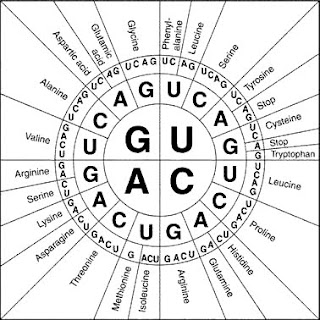
SIX KEYS TO A LITERARY GENETIC CODE

In essays on the subject of centricity, I've most often used the image of a geometrical circle, which, as I explained here,  owes someth...

Friday, January 11, 2019

EMANCIPATION VS. FREEDOM PT. 3

In Part 1, I quoted Fukuyama on a philosophical question posed by Nietzsche:


 Is recognition that can be universalized worth having in the first place? Is not the quality of recognition far more important than its universality? And does not the goal of universalizing recognition inevitably trivialize and devalue it?


Contemporary television serials are possibly one of the best mediums by which ideologies can produce widespread, albeit trivialized, forms of the ethic of emancipation. When television was dominated by conservative and occasionally ultraconservative creators of content, the emancipation ethic followed the "melting-pot" paradigm that I mentioned in Part 2.  Persons who did not conform to the WASP image of normality were not condemned for their differences, but there was the expectation that, say, a heroic Black American would be devote his energies to the benefit of the American status quo.  A character like Barney Collins of the 1966 MISSION IMPOSSIBLE provides an apposite example. In the Hegelian terms promoted by Fukuyama, Barney received "recognition" of his talents and his heroic nobility because he served the status quo by curbing the excesses of foreign dictators. MISSION IMPOSSIBLE, then, provides a fair example of the trivialization of recognition along conservative political lines.


 In the ultraliberal morass of current television, a series, or a group of related serials, are far more likely to pursue liberal ideals of "identity politics," whether the identity is defined in terms of a character's race, religious heritage, or sexual proclivities. My apposite example of this current trend is the so-called "Arrowverse," usually identified with show-runner Greg Berlanti and incarnated in four current TV-shows on the CW Network: ARROW, THE FLASH, LEGENDS OF TOMORROW, and SUPERGIRL (which originally debuted on CBS but moved to CW in the show's second season).

The Arrowverse's identity politics orientation does not touch on the matter of religious heritage very often, so this aspect does not come into play. In terms of the representation of racial identity, the four shows have not followed the tendency of race-bending established franchise-heroes. Green Arrow, the Flash and Supergirl, depicted as Caucasian in the comics, are all played by Caucasian actors, and most of the "Legends" follow the same pattern, with the exception of short-lived members like Hawkgirl and Kid Flash.

However, the Berlanti-verse has invested heavily in the idea of "gender-bending" various characters in terms not of sexual identity but in terms of sexual proclivities, to wit:

ARROW started the ball rolling with the character of Sara Lance/White Canary. Sara was an original creation for the teleseries, though she was loosely patterned upon the comics-character Black Canary, and was apparently conceived as a lesbian early on. Sara did not stay on ARROW but was later spun off on the LEGENDS OF TOMORROW show. However, a gay version of Mister Terrific-- who debuted in the comics as a straight character in 1997-- joined the ARROW show in 2015.


THE FLASH, though it rewrote the hero's origin so that he now had a Black American "father" and "sister," didn't "gender-bend" any previously existing characters, such as those based on DC-characters Vibe and Killer Frost. In the course of one of the Arrowverse-crossovers, however, regular FLASH villain Captain Cold was revealed to have a gay doppelganger in another universe.


SUPERGIRL, though it introduced "Black Jimmy Olsen" as the Arrowverse's most notable "race-bending" up to that point, did not signal its investment in LGTB concerns during the show's first season on CBS. When the second season commenced on the CW, the original-to-TV character of Alex Danvers, adoptive sister to Kara "Supergirl" Danvers, belatedly discovered that she was a lesbian without ever having realized it, thanks to an encounter with a cop named Maggie Sawyer. Sawyer, a character who debuted in the SUPERMAN comics-universe, was "ambiguously gay" in her first appearances, though eventually her lesbian status was fully embraced by DC. The TV-version of Sawyer did not remain as a regular on SUPERGIRL but Alex Danvers remained as the representative for this particular strand of identity politics. In the fourth season, the show introduced a new character who will be defined as "trans," and though created for the teleseries, Nia Nal is loosely patterned after "Dream Girl" of the LEGION OF SUPER-HEROES franchise.


LEGENDS OF TOMORROW, obviously, started out with a lesbian character as one of the regular members, and she was eventually joined by regular girlfriend Ava in Seasons 3 and 4, whose status is that of a support-character, rather than being a member of the Legends team. None of the Legends regulars were gender-bent, though in Season 4 the group recruited DC character John Constantine. In the comics Constantine has been loosely defined as bisexual, but according to online essays, the comics have not tended to focus on the character's homosexual encounters very often, while Season 4 made one such liaison a going concern for several episodes. There has also been a suggestion of possible romance between Constantine and "Citizen Cold," the gay doppelganger of FLASH's Captain Cold.


Now, what's my point in laboriously listing all the examples of gender-bending in the Arrowverse? Obviously nothing I could write would change Greg Berlanti's patent conviction to his liberal emancipation ethic. His interpretation of the liberal ethic seems based on the "monkey see, monkey do" principle, essentially taking the position that the only way TV can help achieve equity for LGTB people in reality is to bombard viewers with LGTB characters, and hope that said viewers, if not already liberal in their sentiments, will become more liberal in attitude by exposure to such characters.

Here, however, Berlanti's intent is far more consistent than his execution. Speaking only for myself, I consider most of the LGBT characters in the Arrowverse to be extremely mediocre,  both as characters and as representatives of identity politics. The only character who seems authentic both as a character and as a homosexual is Mister Terrific of the ARROW series, expertly portrayed by the actor Echo Kellum.


In some cases, the actor may be good but the character-arc is mediocre. Like many fans, I applaud the fact that the Arrowverse gave actor Matt Ryan the opportunity to portray John Constantine once more, following the demise of the 2014 NBC teleseries in which Ryan first essayed the character. However, his homosexual story-arc was jejune in the extreme, as are most of the arcs involving Sara and Ava,  which are also not well-served by the wooden line-readings of Cathy "White Canary" Lotz. Chyler Leigh provides decent thesping for the character of Alex Danvers on SUPERGIRL, but since her primary function on the series is to be an ally to the central heroine, being a lesbian doesn't really hurt or help her.

I assume that Berlanti's deluge of LGBT characters within a relatively short span of time is predicated on roughly similar liberalizing strategies seen in earlier eras. I stated in Part 2 of this series that the racial liberalization seen in television shows and even comic books of the 1960s broke down many of the old barriers of white privilege vis-a-vis creating all characters as WASPs. However, it's my conviction that people didn't respond so much to mediocre Black American characters like the aforementioned Barney Collins, but to those the audiences found more distinctive and memorable, like the contemporaneous 1960s character Alexander Scott of I SPY.


Berlanti follows the current trend of identity politics, assuming that as long as you keep showing "noble gays" to the public in great quantity, the public will embrace gay people in response to this fervent appeal to social equity. But I don't think that's the way it worked for the liberalization of 1960s attitudes toward Black Americans as fictional characters. White people may remember the presence of a Barney Collins or a Julia Baker (from the titular series JULIA), but mediocre characters don't change opinions. Whatever the real-life failings of Bill Cosby, his portrayal of Alexander Scott puts across a character who is enjoyable because he is rounded as well as being black. Similarly, even though Nichelle Nichols' Lieutenant Uhura appeared in far fewer scenes than did Diahann Carroll's Julia, the former made a more lasting impression because her character was better conceived, both as a character and as a black woman.


Both the melting-pot paradigm and the paradigm of identity politics substitute political status in place of vivid characterization. They fail because they conceive of the audience as imitative monkeys, and when their politics become known, they're more likely to conjure forth King Kong than Curious George.


Thursday, January 10, 2019

MYTHCOMICS: "THE BULLY" (DAREDEVIL #257, 1988)


When Frank Miller left the DAREDEVIL feature for the first time in 1983, subsequent creators had a hard act to follow. I've read all the subsequent stories by such talented people as Klaus Janson and Denny O'Neil, and I remember barely anything from this post-Miller period. In contrast, while I was not a huge fan of writer Ann Nocenti, whose tenure lasted from 1986 to 1991, I have to admit that her DAREDEVIL stories offer a fresh take on Miller's transformation of the feature into hard-boiled crime.

"The Bully," graced by splendid art by John Romita Jr., is not precisely a stand-alone story, though it can be read independently. As the cover makes clear, once again the starring hero contends with the ultraviolent vigilante known as the Punisher. However, the main plot of "Bully" intersects with that of an issue of PUNISHER published in the same month as DAREDEVIL #257. In the first story, executed by Mike Baron and Whilce Portacio, the Punisher searches for a culprit who has inserted cyanide into aspirin tablets made by the company for which he formerly worked. The vigilante fails to corral the perpetrator, Alfred Coppersmith, but continues to pursue the poisoner. I have not read the PUNISHER story but apparently it loosely overlaps the events of the DAREDEVIL story.

Many of Nocenti's stories tend to come off as somewhat rambling. "The Bully" is a happy exception, dealing with the problematic nature of violence without simply issuing the standard ultraliberal/ Marxist denunciation. In fact, there is no single character in the story who fits the dictionary definition of a bully. Nocenti seems to be using the process of "bullying" as a metaphor for any unjust use of force against a less powerful individual. 

Nocenti also observes that "force" may be in the eye of the beholder. No less than three times does some character in the story muse on the facelessness of enemies in modern society. 


First, the Punisher, prior to gunning down a gang of drug-dealers, thinks to himself that "the enemy is everyone, anyone, and no one."

The second instance merges the idea of the faceless enemy with that of the bully. Daredevil seeks to garner information on Coppersmith by interviewing one of the man's former work-mates. The worker tells the hero how Coppersmith was laid off by the aspirin company, where Coppersmith had worked for many years, because he simply couldn't master the complex computers introduced by the bosses. The worker opines, "How do you fight it when a computer takes over? It's like when a big new bully moved in on your block. But who do you fight? The enemy is technology! How do you fight that? Where do you strike?"

Finally, the unemployed Coppersmith is seen alone in his apartment. He looks like the standard depiction of a bully: a muscular fellow seen doing reps with weights. Yet though he looks like a bully, he's the one who feels bullied by the company that fired him, and to himself he justifies his indiscriminate poison-murders by musing, "All men, any man. My enemy is faceless."


Given that slipping poison into medicine-pills should strike most readers as a contemptible form of violence, Nocenti is remarkably successful in making Coppersmith seem mildly sympathetic in his derangement. The criminal is duly overtaken by the Punisher, but Daredevil intervenes to keep Coppersmith from being executed. Inevitably the two fighters clash, seen through Coppersmith's eyes, who is too stupefied by the fight to escape. Indeed, he continues his "bully" theme by thinking to himself, "There's no difference between the two of them. Both bullies, and all bullies think they're the one that's right. Everybody can't be right." Coppersmith doesn't quite have enough self-awareness to apply this insight to his own campaign of violence, and in fact he finally does try to escape, only to be crowned into dreamland by Daredevil. 


The resolution of the conflict between the heroes is more fully explicated in the PUNISHER cross-over story. But before Coppersmith has his lights knocked out, he has a strange insight that belies all the rhetoric about bullies and faceless enemies, as he watches Daredevil and Punisher battle:

I feel like I'm witnessing something superhuman, something special and powerful-- like this is the best of the best-- and they're fighting over ME--

Daredevil wins the argument by taking Coppersmith into custody, and the story ends as lawyer Matt Murdock meets with the addled murderer. Murdock tells Coppersmith that though he will go to prison, he deserves mercy because "society must take care of the people it crushes."

While "Bully" covers some of the same territory seen in Miller's tenure, Nocenti has a refreshingly un-derivative take on the violence of the superhero genre; neither fully approving nor disapproving. 
I'll note in closing that though the story includes a subplot involving a long-running Daredevil-foe, Typhoid Mary, even the subplot works in unison with the main theme. During the subplot, Typhoid easily manipulates her boss the Kingpin with sex, thus showing that there are ways to "bully" even without violence. 

Sunday, January 6, 2019

EMANCIPATION VS. FREEDOM PT. 2

At the end of Part 1 I said:

In Part 2 I'll address some of the ways current popular fiction devotes itself to universal recognition /equity without showing any insight as to the "quality" of said emancipatory representations.
I decided to put off the examples I had in mind at the time in favor of a quick look at an example of what I've called "negative equity" not in popular fiction, but in a non-fictional work about popular fiction.

I've just started reading Alec Nevala-Lee's 2018 book ASTOUNDING, which purports to chart the historical development of American science fiction through the medium of the magazine ASTOUNDING SCIENCE FICTION. The book's subtitle specifies that Nevala-Lee concentrates on the intersections of three major figures of science fiction-- writers Isaac Asimov and Robert Heinlein, and ASTOUNDING editor John W. Campbell Jr.-- and one figure of cultish notoriety, L. Ron Hubbard. Having finished only the prologue and first chapter, I have no doubt that he's put a huge amount of research into the lives of these four intersecting figures, and as of this reading, it seems like this is going to be a very good read into a very neglected topic.

In the prologue, however, Nevala-Lee feels the need to "virtue signal," by attacking early science fiction for being too WASPy:

Campbell's writers and their characters were almost exclusively white, and he bears part of the blame for limiting the genre's diversity. At best, this was a huge missed opportunity. ASTOUNDING, which questioned so many other orthodoxies and systems of power, rarely looked at racial inequality, and its lack of historically underrepresented voices severely constrained the stories that it could tell.

This is, in a word, garbage. I might qualify it as well-intentioned garbage, but it's still garbage.

That all or most of Campbell's writers were white is a half-truth. Some writers, like Isaac Asimov, were descendants of European Jews, so they did look "white," though by virtue of their descent they were not necessarily deemed "white" by the time's more conservative standards. One can certainly argue that even Jewish writers still created characters who were dominantly WASPs, which may be an overstatement, though not by much.

But Nevala-Lee's attempt to place blame bears no relation to any truth, save that of ideologues who mouth truisms like, "If you're not part of the solution, you're part of the problem." To such ideologues, it's always easy to tell someone else to sacrifice their livelihoods on the altar of social justice. If John W. Campbell bears "part of the blame," then it's a blame shared by not only popular culture of the thirties and forties but also the majority of so-called "high culture." During these two decades, and most of the next two as well, there was essentially no mass market for non-white characters. If one wants to indict as racist the whole of American culture for the first half of the 20th century, one can certainly do so. But John W. Campbell's share of blame for that cultural racism is so  infinitesimally small that it's hardly worth mentioning-- unless one wishes to show off one's own virtuousness.

In the 1950s and 1960s, there were marginal changes that went against the cultural grain, such as Sidney Poitier movies and the presence of non-white heroes in ensembles like those of I SPY, MISSION IMPOSSIBLE and Marvel Comics's THE AVENGERS. During this period, perhaps one might fairly fault a given editor or writer for keeping things too WASPy. But in the 1930s and 1940s, no one could have fought against the current of white privilege without drowning-- certainly not the editor of a science-fiction magazine, back in the days when the genre was deemed little more than "Buck Rogers stuff." It's really not a "missed opportunity" if the opportunity wasn't there at all.

Particularly egregious is the cant about "historically underrepresented voices." Nobody in the 1930s or 1940s would have even understood what that meant, for those were the days of the diametrically opposed cultural concept of "the melting pot." Campbell may have been racist in specific ways-- and this is something Nevala-Lee may well be able to demonstrate in future chapters-- but Campbell certainly was not racist because he didn't have some visionary apprehension of another generation's concept of equity.

Nevala-Lee's prologue also sings some sad songs about the marginalization of female voices. There may be a little more evidence for women being kept out of science-fiction's "boys' clubs," though even then, most of the evidence comes from women of Caucasian heritage who managed to write professionally under ambivalent cognomens like Leigh Brackett and C.L. Moore. I've seen no evidence to suggest that persons of color, of either gender, had that much interest in breaking into the science-fiction magazines. Often it takes a cultural revolution before any marginalized outgroup starts thinking seriously about crashing the gates of the favored ingroup.

I also object to the politicized thinking that asserts, even indirectly, that a given genre's worth can be measured in terms of how many "underrepresented voices" it champions. But I'd need a whole nother essay to do justice to that topic.

Saturday, January 5, 2019

EMANCIPATION VS. FREEDOM PT. 1

In this blogpost, responding to one of THE BEAT's superficial attacks on so-called female objectification, I wrote:

The whole "who's exposed more" question should never have been one of pure equity.  Equity is something to be observed in the workplace or the boardroom, but not in fiction.  Fiction is a place where fantasy reigns, and as I said in the essay, it's simply a lot harder to sell hyper-sexualized fantasies to women than to men.  I tend to think that this is because in general men are hornier bastards than women, but others' mileage may vary.
Equity should never have been the question because equity of this sort is not feasible.   There will probably always be more sexualized female characters in pop fiction than sexualized male characters-- but that doesn't mean that the latter don't occur at all, or that one can slough off all the chiseled chins and buff bodies as manifestations of "idealization."

I've not written much about "equity," but now I want to see it in a continuum that relates to a wider concept I will term "the ethic of emancipation." Equity, the theoretical fair treatment of everyone in a society, is a modern concept that has come about in democratic societies largely because these tend to subscribe, at least overtly, to the ideal of emancipating those who are enslaved, disenfranchised, and so on. The ethic extends back through human history, but in modern times the United States has become the country most intimately associated with emancipation, beginning with the country emancipating itself from England. Radical ultraliberals ceaselessly cavil about the false ideals purportedly put forth in the Declaration of Independence, in which "all men are created equal" is said to have connoted "white men only" (which argument Stephen Douglas made explicit in 1858). However, the nation's commitment to emancipation still exceeds that of many if not all other nations since the States' formation, and one of the many liberations that made far more progress here than elsewhere than in other countries is that of women's suffrage.

The problem, however, is that often those who rise do so by making someone else fall. Ultraliberals in recent years have gone beyond the sensible demands of early liberals, and have chosen to stigmatize what they are pleased to call "straight white males" (and occasionally "straight white females" as well) in order to carve out new terrain for the non-meek who shall usurp the earth. The less vitriolic ultraliberals take the position that dull straight white people will be much improved by this exposure to diversity, so it's all good.

However, in THE END OF HISTORY AND THE LAST MAN, Francis Fukuyama explored, among other things, some of the problems with the idea of "universal recognition"-- Fukuyama's Hegelian term for the idea of a emancipation from all hierarchies that bar the goal of total equity.

For Nietzsche, there was little difference between Hegel and Marx, because their goal was the same, a society embodying universal recognition. He, in effect, raised the question: Is recognition that can be universalized worth having in the first place? Is not the quality of recognition far more important than its universality? And does not the goal of universalizing recognition inevitably trivialize and devalue it?


In Part 2 I'll address some of the ways current popular fiction devotes itself to universal recognition/equity without showing any insight as to the "quality" of said emancipatory representations.


Thursday, January 3, 2019

MYTHCOMICS: DEMON STAR/ GOTHAM'S MOST WANTED (2011-2)


In structural terms Grant Morrison’s Batman stories of the 2010s bid fair comparison with Dave Sim’s mammoth CEREBUS epic. Both are less like novels, graphic or otherwise, than assemblages of inter-related novels on the same themes. Here I’ll concern myself only with the culminating storylines, the novels DEMON STAR and GOTHAM’S MOST WANTED, which are some though not all of the novels united under the rubric BATMAN INC.


One of the overriding themes of Morrison’s Bat-pedia is that of the relation of the hero to family. For these two novels, the core of this conflict is a rewriting of the Barr/Bingham graphic novel, BATMAN: SON OF THE DEMON. Barr’s script for SON, which I examined here, posits a situation in which Batman pretty much forgets about his whole extended Bat-family for the sake of joining the house of Al Ghul. In contrast, BATMAN, INC. brings many of the characters who comprise the Bat-family into open conflict with Talia Al Ghul. Further, the Bat-family goes beyond the protectors of Gotham, and extends to several Batman-emulators from other countries:  an Amerindian Batman, a British Batman, and so on.  In this Morrison referenced a 1955 Bat-tale, “The Batmen of All Nations,” but the Scottish author’s purpose goes beyond the simple gimmick of the original story. Batman himself states one aspect of that purpose early in DEMON STAR, where the hero meditates to himself, “The first truth of Batman. The saving grace. I was never alone.”


Part of Morrison’s kaleidoscopic plot involves Batman having had a vision of a terrible future, which may or may not come to fruition. But a far more crucial thread, introduced in the arc BATMAN AND SON, deals with the rewritten history of Batman’s interaction with Talia. In this version, Talia drugs Batman in order to have sex with him, but instead of bearing his child naturally, she has the fetus removed and raised through artificial means.  Talia names the child Damian, apparently in homage to THE OMEN, and when he reaches the age of ten she introduces Damian to the father who never knew his son existed.  Given that Damian’s mother gave her son the same ruthless League-of-Assassins training that she received from her father, the boy proves a handful, to say the least. However, by the time of DEMON STAR, Damian has become re-socialized enough that he can function as one of the crusader’s many “boy wonders.”


However, Talia has had many more irons in the fire beyond tormenting the hero with an unruly child. She’s taken over the League of Assassins from her father, and has used the League’s super-science to create clones of Damien,  as well as co-opting the “Man-Bat”  serum from its inventor to create a scourge of man-bat ninjas. Further, she creates a subversive organization, Leviathan, in order to spread chaos in Gotham. She does all this because in Morrison’s world, Batman does not choose her over the war on crime.


Leviathan, whatever the name portends in Biblical lore, is one of the many incarnations of evil feminine will within the BATMAN INC. storyline, and is joined by other such learned references as the Greek image of the Medusa and the Hindu visage of Kali Ma. Still, references to myth aren’t necessarily mythic in themselves; they have to take on their own resonance within every new story.


Many Bat-writers, including Denny O’Neil, tended to sentimentalize Talia Al Ghul, but Morrison does not. He presents snapshots of her early history being raised by Ra’s Al Ghul, and the reader sympathizes with her, especially when it’s strongly intimated that Talia’s mother Melisande was cast aside by Ra’s when she got old, and that ultimately he had her killed. Further, for the first time, a writer suggests that Ra’s may have had a darker motive for encouraging the union of his daughter and his foremost enemy: that Ra’s wanted a grandson into whom the soul of Ra’s could be transferred, thus insuring his continued immortality. But Talia is no better. She allows Damien to bond with his father, but only with the hope that her son will eventually choose mother over father. She also keeps in reserve one of the Damien-clones, artificially grown to manhood and wearing the cowl of his “father.” The clone, who is never even given the dignity of a name, ends up murdering his “brother” and being murdered in turn by his mother. ”Leviathan has many children,” Talia asserts, “Leviathan is mother to no one.”


I’ll have  to pass over a host of Morrisonian references, though I’ll mention that he excels in his usage of the Medusa-imagery, and proceed to the Big Climax. In part it’s a riff on “The Demon Lives Again,” since Talia beards Batman in his cave and challenges him to a swordfight. However, she does so wearing some imitation Bat-garments, which she quickly discards while mocking him: “I’ve beaten you at your childish game of clues and traps, masks and toys.” Yet earlier Batman perceives that her real animus is toward the father who ruthlessly used her, and Talia’s fate is decreed, not a passing scorpion, but by one of the many members of the extended Bat-family—one who was supposedly slain by the League of Assassins years ago. Thus the Mother of Monsters is slain not by her mate, but by one of his symbolic “daughters.”

NEAR-MYTHS: "THE DEMON LIVES AGAIN" (1971), SON OF THE DEMON (1987)


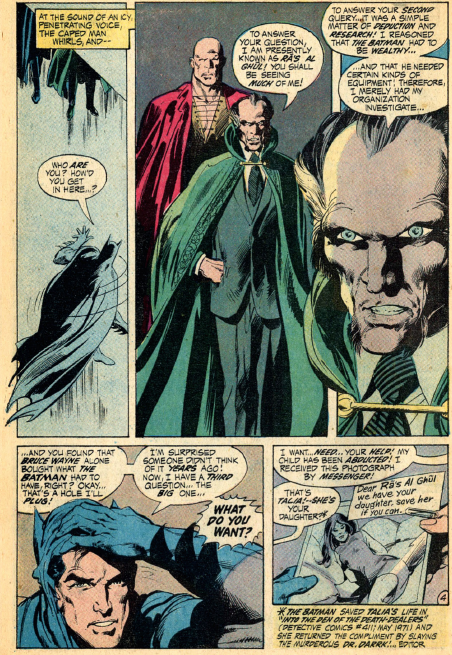
In the mythos of Golden Age Batman, as with those of many heroes in that era, criminality is a short-term menace. World-conquerors in this period are relatively few, and the various spies and agents of foreign powers represent a different type of villainy. Batman’s best-known rogues seem content to rip off company payrolls and visiting potentates. Sometimes they even commit crimes with no real end beyond dueling with Gotham’s premiere protector.


In 1971, however, writer Denny O’Neil and artist Neal Adams added two characters to the rogues’ gallery that became as well-known to Bat-fans as any of the classic Golden Age malcontents: Ra’s Al Ghul and his daughter Talia. In various interviews O’Neil averred that his primary inspiration for these characters were that father-and-daughter team created by Sax Rohmer: the world-conquering Fu Manchu and his daughter Fah Lo Suee. Like Fu Manchu, Ra’s Al Ghul—whose name is routinely translated as “the Demon’s Head”-- has used weird science to live far longer than his normal span of years. Further, like Fu, Ra’s commands a covert army of Oriental assassins, with whom Ra’s hopes to change the entire structure of Earth’s sociopolitical system. However, there are also important differences.


In his early adventures Fu Manchu has no daughter. That said, the first story-arc introduces a femme fatale, Karameneh, and when Doctor Petrie asks who she might be, Fu’s perpetual opponent Nayland Smith speculates that she might be the arch-fiend’s own spawn. Rohmer doesn’t introduce Fah Lo Suee until 1930, after which the character remains a permanent feature of the prose-series. Fah Lo Suee is often seen aiding her father’s schemes, though when convenient she lends aid to Nayland Smith and Petrie. When she does help the Englishmen, it’s because of her amour fou toward Nayland Smith, an amour of  which her father definitely does not approve.


O’Neil, however, introduces Talia Al Ghul slightly before her father’s debut, and when Ra’s shows up, he first puts Batman through a series of ordeals. Then the vaguely Arabic-seeming overlord announces to the hero that because Talia has fallen in love with him, Ra’s wants Batman to give up the life of a crime-fighter and inherit Ra’s mantle, the governance of the League of Assassins.  Batman of course opposes the criminal plots of his would-be father-in-law, even though the hero reciprocates Talia’s feelings.


Most of the Ra’s/Talia stories don’t reach a high level of mythicity. However,  in one respect Ra’s improves on his model. Whereas Fu Manchu simply uses an alchemical elixir to cheat death, Ra’s is first seen literally rising from the dead in a two-part 1971 arc, thanks to the help of a supernatural resource: a “Lazarus Pit.” The second part of the story,  “The Demon Lives Again”(BATMAN #244), develops this revelation by positing that when Ra’s first comes back from death, he becomes temporarily insane as well as having “the strength of ten,” equally temporarily. Thus he might seem to be the horror of bridegrooms everywhere: the father-in-law who’s never really out of his little girl’s life.


Yet perhaps the most mythic aspect of Ra’s culminating narrative is his battle with Batman beneath the desert sun of Old Araby. Fu Manchu is never seen fighting his enemies, but Ra’s, despite his great age, is every bit as battle-worthy as his prospective son-in-law. “Demon” concludes with Ra’s and Batman doffing their shirts and fighting with swords beneath the Arabian sun. Briefly, the desert seems to intercede on the behalf of its human representative, for a scorpion stings Batman, presaging his death. But Talia, in her first real betrayal of her father, slips an antidote to the hero. Batman then returns to face his foe again, giving “the Demon’s Head” his first opponent who seems to match Ra’s for deathlessness.


For fans of BATMAN, the comic book rarely exceeded the intensity of this Oriental romanticism. Over the years, this scenario, in scripts both by O’Neil and by other DC writers, the “eternal triangle” between Batman, Talia and her fanatical father proved a fruitful source of high melodrama, particularly as Ra’s becomes increasingly portrayed as an “eco-terrorist,” out to purge the world of humankind’s corrupting influence. But with the possible exception of Grant Morrison’s BATMAN INCORPORATED serial-- which I’ll address separately— no one succeeded in giving the Ra’s-myth deeper connotations.


In the 1987 graphic novel BATMAN:  SON OF THE DEMON, writer Mike W. Barr and artist Jerry Bingham create an “alternate-world” scenario for the threesome, about a year or so after Frank Miller did the same with his vision of THE DARKKNIGHT’S RETURN. Without speaking to the personal involvement of the authors, SON seems to be aimed firmly at the “Talia-shippers” among Batman-fandom, since the story alters the “triangle-scenario” to make the three characters one big happy family, complete with a little one on the way.


To achieve this familial bliss, Barr creates a mutual enemy for Batman and the Al Ghuls: a terrorist named Qayin (the Arabic version of the name given to the Bible’s first murderer). Batman encounters one of Qayin’s terrorist-cells in Gotham, and almost immediately Talia shows up on his doorstep, inviting him to join her and her father in rooting out this world-menace—who just happens to be an indirect part of the Al Ghul family, since Ra’s is Qayin’s godfather. Talia’s reasons for pursuing Qayin are more personal than Batman’s, for Qayin slew her mother Melisande. (Parenthetically, this seems to be the first extensive accounting for the absence of Talia’s female parent.) Batman is invited to join not only in hunting down the terrorists, but to join with Talia in holy matrimony. On rather short notice, Batman not only puts aside his commitment to Gotham City and becomes the de facto son of Ra’s Al Ghul, so that the hero can remold the League of Assassins into a paramilitary force trained in the crusader’s non-lethal techniques. Further, Batman puts a bun in Talia’s oven, hence giving Ra’s his first grandson. Although Talia is now depicted as a kung-fu mistress—for the first time, I believe-- Batman tries to protect her from harm.  However, she loses the child, and after Batman vanquishes Qayin and his nuclear threat, the hero returns to Gotham. The novel then ends on a peculiar note: suggesting that Talia faked losing the child and sent the baby away to be adopted, though Barr supplies no hints as to why she might do so.


The most mythic aspect of SON OF THE DEMON would be the story’s evocation of the trope of “the hero tries to walk away from his destiny.” Barr’s handling of the myths of both Batman and the Al Ghuls is pedestrian at best, while Qayin is a make-work villain. He becomes embittered toward Ra’s because Ra’s sent Qayin’s parents on a mission that resulted in their deaths, which by itself is banal. Further, the circumstances under which he kills Melisande don’t track either. She surprises her godson messing around near one of Ra’s Lazarus Pits, but it’s not clear if he has some idea of using the Pit to bring back his patents, or if he just wants to deprive Ra’s of the resource. To complicate things needlessly, Barr also reveals that at some point Qayin becomes terminally ill, which apparently accounts for his willingness to destroy the whole world—which is also extremely jejune in terms of any discourse, symbolic or otherwise.

However, simplistic as SON OF THE DEMON is, it did contribute some tropes to the Bat-mythos that proved vital to Morrison’s massive “encyclopedia of all things Batman.”

Tuesday, January 1, 2019

CONVERGING ON CONCRESCENCE PT. 2

In Part 1, I wrote:

Conscresence, more than its roughly equivalent term "coagulation," suggests the process by which seemingly unrelated phenomena "concretize" into a greater whole. Thus images, symbols and story-tropes which can only have a very limited meaning by themselves, take on greater depth when associated with others that have a reinforcing effect.

What causes this "reinforcing effect," though? Upon rereading August's FOUNTS OF KNOWLEDGE PT. 3, it occurred to me that most of the mythcomics essays I've printed here depend on the authors having organized their symbolic constructs around what I called "aspects of discursive symbolism." The full context is as follows:

Thus, it would seem that even when humans are seeking to plumb the depths of presentational symbolism in order to employ tropes that transmit deep emotional states of mind, the same humans cannot help but reproduce aspects of discursive symbolism characteristic of the theoretical mind-- which may later have some repercussions to my evolving theories regarding the interactions of human work and human play (to be discussed at some future time).

In other words, in order for a narrative to manifest the strongest form of symbolic concrescence-- a.k.a. "hyperconcrescence," as I currently like to call it-- the author(s) must first draw upon what they know of the real world, the world which can be represented by discursive symbolism (or "work"). Then, to make this knowledge function in a fictive world, the kernels of information must be transformed into the tropes of presentational (also called "expressive") symbolism (or "play"). Thus the mind's ability to "work hard" proves essential to the process of "playing hard," and therefore, "playing well."

I have to reiterate that it's always possible for an author to "dumb down" the expressive symbolism in a narrative in order to get across some limited didactic message. When an author does so, he has to some extent sacrificed "play" on the altar of pure "work" by making the narrative function as persuasive rhetoric. That said, creators who have deep reservoirs of imagination may still at times produce narratives that have the qualities of mythic play even though the authors are trying to convert an audience to some position.

Case in point: Dave Sim's CEREBUS. Most of the time, particularly in the later issues, Sim is seeking to persuade readers of his philosophical positions, and this is probably no less true in the narratives I've deemed mythcomics (the last part of LAST DAYS here, and the first part of GUYS here) as in a narrative I deemed a "null-myth" (the horror of CHASING YHWH). But irrespective of Sim's conscious intentions, his imagination is "working" full blast at the same time his conscious intellect is formulating the didactic schemes of the prior two works, while in YHWH, his imagination has sort of given up the game. So, although discursive symbolism is at work in all three, in CHASING YHWH there is no such transformation of Sim's rhetorical stance into the playful discourse of art. Thus, even though I personally disagree with Sim's position re: "fanboys" as he expresses them in GUYS, I had to give him some props for "promoting a satiric version of Spider-Man to make his points about creeping emotionalism." Thus there's an expressive underthought to complement the rhetorical overthought.

I will expand on the final paragraph from FOUNTS PT. 3:

I should add that I regard even scientifically incorrect theoretical conclusions, like the concept of the seven spheres of heaven, or early theories on spontaneous generation, to be well within the scope of the discursive.
In similar fashion, I regard Sim's sociological connections between comic book people and "creeping emotionalism" to be incorrect on two counts: one, because there's no way to prove such a connection, and two, because even if there was one, how would it be categorically different from the "creeping emotionalism" present in any other ingroup-- say, Canadian hockey fans?

Hyperconcrescence, then, most often takes place when the discursive mode of work, the overthought, reinforces the expressive underthought. The main exceptions are those narratives that seem to have no strong discursive overthought, like the origin of the Golden Age Hawkman. Yet even here, author Gardner Fox is conjuring with metaphysical tropes that were discursively organized by their pagan proponents. And thus familiar tropes, such as the one regarding the soul's fate after death, still exhibit the modern author's understanding of the original structuring principles, even within the venue of a superhero comic book.