Featured Post

SIX KEYS TO A LITERARY GENETIC CODE

In essays on the subject of centricity, I've most often used the image of a geometrical circle, which, as I explained here,  owes someth...

Wednesday, November 10, 2021

KNOWING THE IDEA FROM THE CONCEPT

I am as guilty as anyone of having used the two terms almost interchangeably-- and by "anyone," I mean a number of philosophers, ranging from Hume to Cassirer, who use either one or both terms inconsistently. Yet, the root associations for each word still continue in demotic usage. The archaic Greek etymology stresses that an "idea" is something one sees, and in demotic use this is reflected by the proverbial trope of a "light bulb" blinking on when one gets a new idea. Indeed, comics-creator Carl Barks played with this common visual trope by giving his genius-inventor character Gyro Gearloose a little robot "helper" who had a light-bulb for a head.


In contrast, though there's no standard sensory trope associated with "concept," said word does trace its lineage back to Latin, where the word connoted the physical conception of every human being within the womb. And for human beings, the birth of a new living thing is by no means as quick a thing as the act of seeing, so I tend to think of "ideas" as simple notions that may or may not prove useful, while "concepts" are ideas that have been worked out more thoroughly in terms of real-world applications. I would not be surprised to find that this or that philosopher has used these two terms in ways opposed to the way I choose to use them, but that's my choice nonetheless. At least part of my preference stems from my readings of Cassirer. particularly the frequently raised topic of how "theoretical thought" descends from the earlier and more expressive form of "mythical thought." The Stanford Encyclopedia of Philosophy provides this handy summation:

Characteristic of the philosophy of symbolic forms is a concern for the more “primitive” forms of world-presentation underlying the “higher” and more sophisticated cultural forms – a concern for the ordinary perceptual awareness of the world expressed primarily in natural language, and, above all, for the mythical view of the world lying at the most primitive level of all. For Cassirer, these more primitive manifestations of “symbolic meaning” now have an independent status and foundational role that is quite incompatible with both Marburg neo-Kantianism and Kant’s original philosophical conception. In particular, they lie at a deeper, autonomous level of spiritual life which then gives rise to the more sophisticated forms by a dialectical developmental process. From mythical thought, religion and art develop; from natural language, theoretical science develops. It is precisely here that Cassirer appeals to “romantic” philosophical tendencies lying outside the Kantian and neo-Kantian tradition, deploys an historical dialectic self-consciously derived from Hegel, and comes to terms with the contemporary Lebensphilosophie of Wilhelm Dilthey, Henri Bergson, Max Scheler, and Georg Simmel – as well as with the closely related philosophy of Martin Heidegger.

As an example of my own imperfect use of at least the term "idea," in one April 2021 essay I attempted to identify the different types of tropes underlying the two abstractive potentialities:

In literature as in other cultural forms, all potentialities express themselves through processes of discourse. The discourses of “lateral meanings” deal with concrete subject matter—that of what sensations the subject experiences, and of the subject’s emotional reactions to those sensations. In contrast, the discourses of “vertical meanings” concern themselves with abstractions, with the didactic making use of “ideas” while the mythopoeic makes use of “symbols.” For the sake of argument, I will treat both ideas and symbols as if they existed as discrete monads, which is not the way either are experienced. Both ideas and symbols are best expressed in the form of typical story-tropes. Levi-Strauss was pleased to term these tropes “mythemes,” conveniently ignoring how such monadic forms were dispersed throughout all forms of human communication, not just myth.

Whenever I thought about the matter, I wasn't entirely comfortable with my opposition between mythopoeic "symbols" and didactic "ideas," particularly when I'd specified that neither of them were experienced as any sort of monadic entities. I'm now specifying that any "idea," as I use the term, is primarily a symbolic construct, given that it functions to describe a base relation between one or more symbols. In contrast, a "concept" is primarily a didactic construct, since the one who conceives it is attempting to give it a more developed form, with one's own mind providing the analogue to fetal development within the womb. So in future, whenever I refer to the types of tropes favored by either the mythopoeic or the didactic potentiality, I will speak of the former as "idea-tropes" and the latter as "concept-tropes."

I can't over-stress the importance of "the idea" as a mental construct that is first and foremost expressive rather than rigorously logical. Some ideas, as noted above, form the basis of developed conceptual systems, a familiar example being the mutation of the Judeo-Christian "idea" of "the believing elect" into a more didactic form, such as the socialist "concept" of the rise of the proletariat, which is, at least in theory, more responsive to real-world considerations.

I will conclude with an example of the sort of impractical symbol-play one encounters with pure ideas taken from my recent review of SUPERMAN IV: THE QUEST FOR PEACE. I wrote:


As poor as the script is, I can see some potential in the basic imagery here, which is the only reason I gave QUEST a "fair" mythicity rating. Superman attempts to get rid of Earth's nuclear weapons by tossing them into the sun. In rude poetic terms, the weapons "get even" by spawning their own champion who journeys to Earth and almost kills the hero. 

I assumed that I should credit writers Konnor and Rosenthal for the final form of the script, and that Chris Reeve was only responsible for the base idea of tossing nuclear weapons into the sun. Reeve's initial notion would be a fragmentary idea-trope by itself, probably derived from the opinion that a hero from a destroyed world might be proactive about preventing the destruction of his adopted world. Konnor and Rosenthal may have been given the basic idea of providing a framework for an "imperfect duplicate" of Superman by someone else, but I speculate that they would have elaborated Reeve's one-note idea into a slightly more elaborate framework of idea-tropes. It's not a didactic concept, given that at no point do the writers claim that the weapons are "angry" at Superman for "killing" them, and since they cannot act, the villain Luthor must be responsible for spawning Nuclear Man. Another didactic development of the idea-framework might have also intimated that the sun was pissed off at the hero from dumping all of these weapons in its maw, and thus the solar body is also complicit in spawning Superman's nemesis-- though once again, Luthor has to provide all the heavy lifting for any inanimate objects. Even Luthor's mode of creating Nuclear Man, that of using a hair from the hero's head to make the duplicate, embodies a symbolic idea, though as I recall Konnor and Rosenthal don't even attempt to invoke the still-nascent science of cloning to make the genesis of Nuclear Man more "logical." Frankly, the original comics-method by which Luthor birthed Bizarro was more forthright. But I can't claim that the method itself displayed any mythic idea-tropes, even though Bizarro himself did, as discussed here.

I will probably explore the process of concept-formation, as opposed to idea-formation, in a future post.

ADDENDUM 1-28-2022: Roughly six years prior to this essay I addressed some similar developmental formulations in A PAUSE FOR POTENTIALITIES, where I said:

Now, I agree with Jung's comment that "ideas" are developed out of what might as well be called "images" (Kant called these lesser elements "notions.") 


Tuesday, November 9, 2021

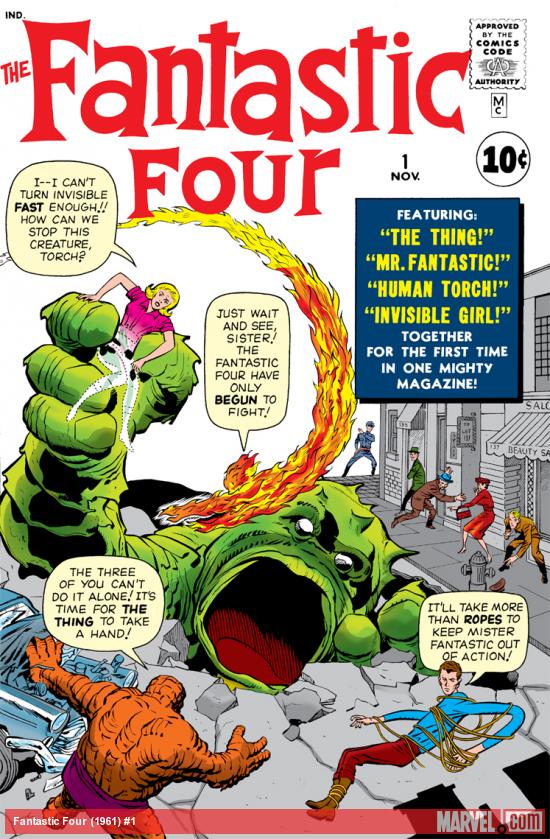
MYTHCOMICS: “ORIGIN OF THE FANTASTIC FOUR” (FANTASTIC FOUR #1, 1961)


The following analysis was originally part of a larger essay analyzing the first FANTASTIC FOUR story in terms of its symbolic discourse. I found that the main story—the narrative in which the four heroes contend for the first time with the Mole Man and his subterranean creatures—did not meet my standards for a mythcomic, unlike several other FF stories. However, in more recent years I’ve decided that certain vignettes within full-fledged stories may be more mythic than the story as a whole, examples being “The Origin of the Batman” and “The Heart of Gold.” I’ve decided that, for my 300th post mythcomics post, that the Origin of the Fantastic Four deserves the pride of place. Readers may observe that my writing-style for this overall project proves a little different here than my usual blogposts. _________________________________________________


At the conclusion of the main story’s 8-page “teaser,” in which nothing substantial is revealed about the foursome, there ensues a five-page explanatory flashback that establishes that the heroes are not aliens, but began as ordinary-- if quarrelsome-- human beings. Indeed, the first panel of the flashback begins with a quarrel between Ben and Reed. The substance of that quarrel is almost all we readers ever know of the characters in the introductory story.


The four characters speak to one another as if they have been acquainted over a long period, though readers don’t get any of the backstories circulated in later retellings of the origin. Readers are told that Reed is a scientist who has designed a moon-rocket and that he wants Ben, an experienced pilot, to fly the ship to the moon, with Reed along for the ride. Ben refuses. He asserts that the venture is too dangerous because humans don’t know enough about possible peril from “cosmic rays” in outer space.


About Sue and Johnny, we know even less. Sue is Reed’s fiancée, Johnny is her younger brother, and both of them enthusiastically support Reed’s moon-jaunt without hesitation. Ironically Ben, later seen to be the most caustic and reckless of the foursome, is the sole voice of caution. At this point Reed, Sue and Johnny are little more than living personifications of the “space race” that dominated American feelings in the early 1960s, for Sue emphasizes that they must reach the moon “unless we want the Commies to beat us to it.” The political rationale is merely a cover for the real motives behind the trip-- more on which later-- but what persuades Ben to join the team is not patriotism but a challenge to his manhood. Sue implies that Ben’s caution is rooted in cowardice. Ben’s reaction—in which he agrees to pilot the moon-rocket after all—is perhaps unusually intense, suggesting that he may have ulterior motives for overvaluing the opinion of another man’s fiancée. Later events bear out this supposition.


With the conversion of the “doubting Benjamin,” the foursome’s next act is to commit what looks like high treason. The rocket designed by Reed Richards is being kept launch-ready at a nearby “spaceport,” which is guarded by a man wearing an American army uniform. No military organization is ever mentioned by name, but since Richards does not want to wait for “official clearance” before mounting his lunar expedition, one can only assume that Richards constructed the ship for American authorities and then had a falling-out with them over the best time to launch. In later retellings the military is no longer involved: Reed uses his own resources to construct the rocket. In short order the four adventurers—whose qualifications for space travel remain anyone’s guess-- sneak aboard Reed’s ship and successfully launch the rocket, unaided by any ground crew.


During the flight, we finally get the real motive for Reed’s wish to undertake the forbidden flight. In the first panel of the story’s tenth page, a voice from within the rocket—not attributed, but probably Reed’s—asserts, “We had to do it! We had to be first!” This is the true motive for Reed’s desire to make the flight as soon as possible: the desire to win the race against all comers, to have the glory of being “first.” Such Promethean endeavors have been undertaken by hordes of “mad scientists” since the type came into being. In most “creature features,” the act of overreaching results in the scientist himself being cursed with some evil fate or fantastic transformation. But here it is not Reed, the overreacher, who is punished for his hubris. He, Sue and Johnny—the three who believe in their doomed cause-- are transformed, but not in a truly undesirable manner. It is Ben, the doubter, who reaps the bad fortune that would usually devolve to the hubristic scientist. Is it because he knew better than the others the potential peril of the journey, and went anyway, with a divided heart? Or is it because he coveted the fiancée of another man—the man who “got there first” in an affair of the heart?


The creators provide no details about the mysterious cosmic rays suffusing Earth’s atmosphere; rays which in the next issue they will portray as a “belt” surrounding the Earth, like the authentic “Van Allen radiation belt.” In 1912 cosmic rays were identified, as well as being misnamed, since these “rays” were actually super-charged particles, called “cosmic” because they were supposedly generated from the depths of space. Other Marvel Comics heroes would also become empowered as a result of encountering radiation—the Hulk, Spider-Man, Daredevil—but these other early heroes gained their powers from man-made ventures into the world of radiation. Only the Fantastic Four gain their powers from venturing into forbidding—though not literally forbidden—territory, and only in their case is the radiation that affects spawned by the universe itself. Given that their powers make it easier for the foursome to explore many aspects of that universe, one might view the failure of Reed’s original mission as a blessing in disguise—at least for three out of the four explorers.


Ben’s earlier fears are justified. Reed’s brainchild does not have shielding adequate to screen out the radiation of the “cosmic storm area” through which the ship must pass when it tries to leave the Earth’s atmosphere. The would-be astronauts lose control and the ship crashes back to Earth. All four survive the crash, but in a sense, they are “reborn” from their brush with the mysteries beyond the familiar realm of Earth. Sue’s mutation is the first to manifest. This seems fitting, given that she’s the reason that both Ben and Johnny undertake the flight, and the factor that makes it possible for Reed to have his pilot. The sole female, in one way or other the focus of attention by all three men, disappears from their sight just long enough for Johnny to worry that she may never come back. A Kleinian psychologist might read this scene in terms of the primal fear of infant life: that the mother, the primary female in an infant’s life, may leave and never return. Then Sue’s invisibility wears off. This cues a new outbreak of hostility between Reed and Ben. Moments after Reed embraces Sue, Ben criticizes Reed for having possibly cursed them all with even stranger powers.


In later issues, Reed will become the very epitome of the hand-wringing Marvel hero, tormented with the memory of how his actions turned his friend into a misshapen freak. But in this origin story, Reed never expresses a single regret, before or after Ben loses his humanity. The great scientist is on the whole arrogant and self-absorbed, at most irritated that Ben should challenge the purity of his motives. “I didn’t purposely cause our flight to fail,” he rationalizes, tacitly refusing any responsibility for the inadequacy of the ship’s shielding. Though Reed never shows any awareness of Ben’s unvoiced affection for Sue, obviously the creators knew all about it, and may have chosen to “punish” Ben as Reed might have wanted to punish a potential rival.


Ben threatens to attack Reed, at which point he transforms into the rock-bodied Thing. His true feelings also spring forth as he rants, “I’ll prove to you that you love the wrong man, Susan!” Reed transforms as well, becoming the rubber-limbed Mr. Fantastic, and he subdues the Thing, though not without an expression of horror at his own transformation. Immediately thereafter, the excited Johnny displays his newfound power of turning into a man of fire. As the flashback draws to a close, all four of them are so sobered by their sudden acquisition of super-powers that Ben’s coveting of Sue is dropped and never mentioned again in the story, though his unrequited feelings do crop up later in other stories. Even the emotional consequences of Ben’s grotesque transformation are put on hold, and the four adventurers swear to dedicate their powers to becoming the “Fantastic Four.” _________________________________________________


Few if any of the myth-tropes from the vignette are reflected in the main story about the Mole Man. However, I will note that even though creators Lee and Kirby never made any further direct references to Ben’s hidden passion for Sue Storm, they found a way to compensate for their monster-hero’s amour by giving him a consolation prize: Alicia Masters, a near-lookalike for Sue who showed up seven issues later in “Prisoner of the Puppet Master” and remained the Thing’s inamorata for the remainder of the Lee-Kirby years.

Monday, November 8, 2021

NEAR MYTHS: JSA THE GOLDEN AGE (1993-94)


SPOILERS SPOILERS SPOILERS

GOLDEN AGE, written by James Robinson and penciled by Paul Smith, is an Elseworlds take on some of the many latter-day interpretations of the Justice Society heroes, crossbred with an assortment of characters who had nothing to do with the Society or, sometimes, even with DC Comics (such as Captain Triumph from Quality Comics, whose company's heroes were belatedly acquired by the Superman people). 

I reread GOLDEN for the first time in many years, in part because I was so pleased with the second season of STARGIRL, on which teleseries Robinson serves as producer and occasional writer. STARGIRL is much like GOLDEN in being a virtual love letter to the Justice Society, directed to all other such fans. Yet STARGIRL has a crucial advantage in that it's all about legacy characters who inherit the mantles of the WWII crusaders. In contrast, GOLDEN is set in the America of the postwar 1940s, which in the real world would herald the cancellation of all but a smattering of DC's costumed heroes. Since the Golden Age characters were not revived, but were instead temporarily replaced by the legacy figures of the Silver Age, Robinson was obliged to follow the established game-plan followed by such earlier writers as Roy Thomas and Paul Levitz, who set up the notion that in the DC-cosmos the various luminaries simply retired for about ten years until they got back into action-- occasionally in the Silver Age, and then with greater frequency in the Bronze.

In addition, GOLDEN could not help but take considerable influence from the fan-culture of the eighties and nineties, when comics-makers began playing to the adult readers with "grim and gritty" versions of established heroes, as per the usual suspects of WATCHMEN and THE DARK KNIGHT RETURNS. Robinson's version of the Justice Society is not as boldly transgressive as either of these, as the peoject includes little in the way of sexuality and was only slightly more violent than the average issue of NEW TEEN TITANS. The most interesting thing about GOLDEN is that for all of the characters involved, they become divorced from the trauma-free lives they led as costumed crusaders, where the most emotional conflict came down to not being able to marry their lovers due to fighting crime. In the opening scenes of GOLDEN, Robinson is explicit about the way the conclusion of the war signals "the end of innocence."


I don't find Robinson's concept of innocence very persuasive: for the most part, it comes down to all the main characters having really bad days in one way or another.  Many of the plot-points were established by earlier writers: Hourman is now addicted to the drug that makes him super-strong, while Johnny Quick and Liberty Belle, two heroes who became romantic in an 1980s continuity, divorce. The death of innocence is also signaled on the social level: the atom bomb has changed the nature of national conflict, and competition from Russia makes average Americans eager to condemn anyone suspected of ties to Communism. (It's possibly a mark of Robinson's extreme liberalism that he brings up both of these topics but never remembers that Russia became a major competitor in part through the act of stealing the American plans for The Bomb.) It's not precisely that Robinson ever sings any sad songs for the USSR, but it is interesting that the main villain turns out to be the embodiment of allegedly-Right-leaning fascism: a recrudescent Nazi.


GOLDEN's basic plot-pattern probably owes something to WATCHMEN, insofar as various heroes pursue separate life-courses, all of which, in one way or another, end up dovetailing. The obscure DC character "Mister America" is the uniting factor: whereas many other heroes were unable to go to war for complicated reasons, this super-athlete was able to fight the Nazis behind enemy lines. Under his regular name "Tex Thompson," the former mystery-man returns to the U.S., rises to great political power, and begins a new project to create an invincible superhero as a bulwark against the threat of Russia. Since anti-Communism led to bad things like the Red Scare, no one will be surprised that Thompson turns out to be a traitor in patriot's clothing-- as well as a recrudescent super-villain.


The main plot is never much more than an excuse for the various scenes of regret and recriminations, which, to be sure, are kept to a minimum in comparison to the predominant Marvel soap-opera emotive style. The most persuasive plot-thread involves Liberty Belle's re-marriage to another hero, Tarantula, who just happens to resemble her former hubby Johnny Quick. Others are badly underdeveloped. The Golden Age Robotman becomes a stone killer for no explicit reason, and the aforementioned Captain Triumph only appears in his civilian identity, rejecting (with questionable judgment) his superhero nature and losing his life in combat with the evildoers. A subplot involves an amnesiac hero, Manhunter, who eventually fills in a lot of the blank spaces for the heroes (and the readers) about what really happened to Thompson overseas and the nature of his pet superman. Paul Smith, never one of the best delineators of superhero action, is out of his depth with the numerous battle-scenes, but he does a better than average job keeping the faces and their emotional reactions distinct from one another.


GOLDEN is at best diverting, but I certainly wouldn't rank it as one of the better homages to the Golden Age of American superheroes-. Indeed, some of Robinson's issues of STARMAN come much closer to that mark. To wrap up, I'll note that, despite the many characters in the four-issue tale, GOLDEN is yet another example, like CRISIS ON INFINITE EARTHS, where the dramatic personae divide into a "very significant" superordinate ensemble and a "not so important" subordinate ensemble. 

SUPERORDINATE-- Johnny Quick, Liberty Belle, Manhunter, Green Lantern, the Atom, Hourman, Starman

SUBORDINATE-- Tarantula, Bob Daley aka "Fatman," Hawkman, Johnny Thunder and his Thunderbolt, Captain Triumph, Miss America (another Quality character BTW), and the Tigress. Three characters with heroic pasts-- Tex Thompson, Dan the Dyna-Mite and Robotman-- are essentially retconned into villainous presences. There are also a huge number of cameos in the final section, including the 1950s stalwart Captain Comet and a large sampling of more Quality protagonists, such as Plastic Man, Doll Man, the Jester, Phantom Lady and the Red Bee.


Tuesday, October 19, 2021

PREHENSIONS AND PERSONAS PT. 2

I may be dovetailing two subjects with only a loose relationship, since my acceptance of the Whitehead term "prehension" (as explained here) came into being about the same time that I started meditating on the hypothetical evolution of what I've labeled as the four literary personas. Nevertheless, I'm going with the conceit.

A "prehension," as noted before, is a process by which an organism gains knowledge of and organizes its experience, whether that knowledge is organized through the concrescence of sensation (the kinetic potentiality), of feeling (the dramatic potentiality), of thinking (the didactic potentiality), of intuition (the mythopoeic potentiality), or any possible combinations of the four. All four potentialities would have been available to the human species ever since they split off from smaller-brained mammals, so none of the potentialities predate one another.

In contrast, though, I can imagine-- just as part of a large thought-experiment-- ways in which the four personas might develop diachronically. 

From 2015's COMBAT PLAY PT. 4, here's my last summary definition of how the four personas play off one another in terms of the abstractions they represent, the positive and negative forms of "glory" and "persistence":

The model I've established is one in which heroes and villains alike align themselves with *glory* by championing either the positive or the negative forms of the "idealizing will," while monsters and demiheroes align themselves with *persistence* by pursuing the negative or positive forms of the "existential will."

Prehension may be relevant here as the process by which the two forms of will distinguish themselves, in terms of how such forms of will manifest themselves, first as real human activity and secondarily as the "gestural" literary abstraction of human activity.

Assuming the usual schema for the development of early protohumans-- living in small hunter-gatherer tribes once they've come down from the trees-- then the persona of the *demihero* would have "pride of place." The demihero embodies "positive persistence" insofar as he/she is in essence the persona most concerned with immediate survival. The same need for persistence also determines that the demihero is the figure that is, or at least appears to be, the most thoroughly socialized, because in prehistoric times the tribe is the means by which the individual survives.

The next in line of development then would be "the monster," whatever figure becomes outcast from society. There's no knowing what form of rebellion would give rise to the monster, but it could be anything from an individual rebelling against codes of exogamic marriage to a victim selected as a sacrificial *pharmakon.* The monster is defined by his exclusion from society, and in most if not all his/her forms, he's always "out of place" or "out of step" in some manner.

It's not impossible that other tribes might also contribute to the idea of the monster-persona, but given that a particular tribe cannot really designate a separate tribe as being "outcasts," it's more likely that rival tribes would be the source of the "villain-persona." A given tribe may have to trade with other tribes, particularly in terms of gaining exogamous marital partners, but as long as other tribes can be perceived as a threat, they-- or more probably, their overlords-- would be the ancestors of the villain. 

When a given society faces entities too powerful to be simply cast out after the fashion of the rejected monster, the notion of the hero, the individual able to conquer the most powerful representative of the enemy tribe, is born. The hero may also take partial shape from human being's battles against non-human animals, but in a social sense, the hero is most reified by his rivalry with the villain, where both represent the tribe's greater self-expression to goals of "glory" rather than mere "persistence."


PREHENSIONS AND PERSONAS PT. 1

 In NOTES ON WHITEHEAD PT. 3, I expressed my regrets that the philosopher had not chosen to define many of his terms more precisely in his most famous book, PROCESS AND REALITY. I wasn't even able to get a concise sense of what a "prehension" was, even in the chapter "Theory of Prehensions."

However, by sheer chance I found a definition without even looking for it. I happened to pick up an old book I'd not read through despite owning it some twenty years: COLIN WILSON, a literary study by one John A. Weigel, devoted to examining Wilson's works up to the year 1975. I have only read two of Wilson's philosophy books, none of which include RELIGION AND THE REBEL. It's from this book that Weigel alternately quotes and paraphrases Wilson's take on Whitehead's concept of the prehension, which is far clearer than anything Whitehead wrote in PROCESS AND REALITY.

Of central importance is Whitehead's idea of "prehension," which is dramatically defined, following Whitehead's specifications, "as that act of the soul, reaching out like an octopus to digest its experience." Fixing on "prehension" as the basic act in existentialism, an act carefully to be distinguished from "apprehension," which is based on intellectual rather than soulful understanding, Wilson rests his own case.

Wilson's "octopus" metaphor brings to mind a more primitive form of organic life: that of the one-celled amoeba, which has no perceptual organs and so assesses its contact with the "outside universe" purely by touch. I feel like I've resorted to the amoeba once or twice to suggest the base process of perception somewhere, but even if I haven't, I.A. Richards did, as I noted in my summation of his book PHILOSOPHY OF RHETORIC here:

...the lowliest organism-- a polyp or an amoeba-- if it learns from its past, if it exclaims in its acts, 'Hallo! Thingembob again!' it thereby shows itself to be a conceptual thinker.

Richards doesn't specifically link his notion of conceptual "sorting" to Whitehead, though as I also noted, the author does mention Whitehead elsewhere in RHETORIC. Both Wilson's octopus metaphor and Richards' amoeba metaphor stress the faculty of perception through non-intellectual methods, which I would broadly compare to Jung's concept of the organism reacting to the world through the irrational functions of sensation and of intuition. Moreover, such metaphors cohere well with what I have labeled Whitehead's "theme statement" for the whole of PROCESS AND REALITY:

There is nothing in the real world which is merely an inert fact. Every reality is there for feeling: it promotes feeling; and it is felt. Also there is nothing which belongs merely to the privacy of feeling of one individual actuality. All origination is private. But what has been thus originated, publicly pervades the world.

Since I discontinued my reading of PROCESS, I cannot say whether or not Wilson's use of the term "soulful" is accurate with respect to Whitehead's heuristics. But for me, "soulful" embodies a "concrescence" of all four of the potentialities, acting in unison to sort experience in all its multi-faceted variety. And it's with this covalence in mind that I'll examine the idea of prehensions in line with my concept of the four literary personas in my next post.


Monday, October 18, 2021

THE READING RHEUM: XICCARPH (1972)


I started seriously reading prose science fiction in the late 1960s, and aside from horror tales, that was close to being the only form of metaphenomenal fiction around for most of the decade. There were a few exceptions to this tendency-- J.R.R. Tolkien and C.S. Lewis-- but I didn't happen to read them during that decade.

As I remember, though, I got my first substantial taste for reading prose fantasy in the early 1970s, and Tolkien's best-selling LORD OF THE RINGS was the cause, because it stimulated Ballantine Books to issue a substantial series of fantasy reprints from 1969 to 1974. To be sure, Lancer Paperbacks had already started the ball rolling by issuing new editions of the works of Robert E. Howard, but somehow I didn't encounter these in the early 1970s either. 

It didn't take me long to find out that devotees of early fantasy spoke in reverent tomes of the 1930s pulp magazine WEIRD TALES, and that of all horror-and-fantasy authors who appeared in its pages, Robert E, Howard, H.P. Lovecraft and Clark Ashton Smith were deemed the top of the heap. Lovecraft's horror-and-fantasy works had seen paperback reprint in the 1960s, but Smith-- who for most of his life was more of a verse poet than a prose-story writer-- had wait for the Ballantine imprint. Editor Lin Carter did a sterling job of selecting some of the choice stories, and though Smith never became as popular as the other two with later generations, these volumes still give one the easiest access to this writer's ouevre.

As I do these days with everything I read or re-read, I wanted to evaluate Smith's work through the lens of myth-criticism. The Carter selections are organized into four reprints, each of which is given the title of one of Smith's fantasy-lands. Not all stories in every volume take place in the titular locale, for Smith tended to toss off new landscapes at the drop of a hat rather than devoting himself to any particular one, as Howard did with Hyboria. My chosen volume, XICCARPH, boasts six subdivisions, all devoted to different locales.

Many of the tales in XICCARPH were just decent reads, but not worth discussing in detail (SPOILER warnings for those I do so discuss). Here are the exceptions:

The entries for "Xiccarph" focus upon what may be Smith's only continuing character, for just two stories. In "The Maze of Maal Dweb," a young man, native to the fantasy-planet Xiccarph, finds out that his beloved has been abducted by the evil wizard Maal Dweb, who rules the world with his magical skills. The youth successfully penetrates the wizard's sanctum, full of bizarre garden-growths and weird automatons, but Maal Dweb has the hero outpaced from the first, so it's an unhappy ending for him. The sorcerer's triumph is somewhat mitigated by the fact that he only steals young women for aesthetic purposes, turning them into beautiful stone statues for his contemplation. Smith must have liked the character, for he then wrote "The Flower-Women," in which Maal Dweb journeys to another world and decides to play hero, liberating a race of delicate flower-women from a cabal of wizards descended from lizards-- lizard-wizards, if one chooses. Smith's depiction of his worlds are highly colorful but not particularly mythic.

Three stories are set on a loose SF-locale, "Aihai," but all of these I found unexceptional. The only point of interest is that one story, "Vulthoom," is named after a Lovecraftian-styled alien god, and that comics-writer Gardner Fox recycled the name, slightly altered to "Volthoom," for a Silver Age JUSTICE LEAGUE continuity.

"The Doom of Antarion," though, presents a more mythically-dense concept. Modern-day Earthman Francis Melchior (note the Biblically inspired name) runs an antiques shop and spends all his free time star-gazing. He holds an enduring fascination with two seemingly contradictory spectacles: those that are "steeped in the mortuary shadows of dead ages," and those that suggest "the transcendent glories of other aeons." Smith incisively notes that these desires are both rooted in Melchior's distaste for "all that is present or near at hand," which might be seen as a comment on the tastes of horror-and-fantasy readers in general. While pursuing his astronomical observances, the protagonist, not unlike that other Melchior, fixates on one heavenly body in particular, "one minute star" that fills the antiquary with "intimations of loveliness and wonder." In due course, Melchior finds his earthbound spirit drawn to the planet Phandion that orbits the distant star, and that spirit merges with the living body of a poet named Antarion. But even though Phandion satisfies all of Melchior/Antarion's desire for exotic beauties-- including Antarion's beloved Thameera-- the world is doomed to perish when its sun dies. Thus "transcendent glories" fall victim to "mortuary shadows," and the antiquary Melchior then returns to his own body, haunted by the memories of the transcendence he so desired. I might observe that Edgar Allan Poe showed a similar passion for both "glories" and "shadows," and that here Smith produced a very Poe-esque take on the psychology of both passions.

Of the other four stories in the collection, only one other, "The Monster of the Prophecy," stands out, and it's interesting in that it reverses the verdict of "Antarion."  On contemporary Earth a poet named Theophilus feels estranged from his fellows by his poetic sensibilities (which may make this character a stand-in for Smith himself). Theophilus considers suicide, but a scientist invites the poet to join him in an experiment. Though the scientist looks like an Earthman, in reality he's a non-humanoid alien-- possessed of five arms, three legs, and three eyes-- from a world called Sabattor. The alien wishes to return home with a specimen of an Earthman, and asks Theophilus to accompany him voluntarily. The poet has no attachments to his Earth-life and he accepts. Though for some time the human finds it fascinating to learn the ways of an alien world, the attractions of being a scientific curiosity pale, and his existence brings him trouble from Sabattor's small-minded priesthood. Oddly, though, Smith gives Theophilus a somewhat happy, if macabre ending, as he ends up living out the rest of his life as the love-mate to one of the non-human alien females, who, like the protagonist, is a poet without an audience on her native world.  The happy ending is not without a certain irony, but here the irony is directed not at the main character but at the world in which he was born.

Sunday, October 17, 2021

MYTHCOMICS: “SECRET OF THE TRANSFORMATION” (WEEKLY SHONEN SUNDAY, 1997)

Long after I wrote my first analysis ofan INU-YASHA narrative, I formulated my CATEGORIES OF STRUCTURALLENGTH in 2018. With those formulations in mind, I’ll now label Rumiko Takahashi’s “feudal fantasy” as a “basic serial,” in that the finished narrative consists of interpolated “stand-alone” stories, short arcs, and long arcs. The arc considered here, identified as SECRET OF THE TRANSFORMATION after one of the chapter-titles, is an extra-long arc that encompasses five other long arcs.


In my earlier summary of the series, I related only the factors that bore directly upon the arc under consideration, THE BLACK PEARL. Some of the things I omitted become more important in the TRANSFORMATION sequence, such as the fact that the two-person ensemble of half-demon Inu-Yasha and modern mortal girl Kagome expands to five principals. Thus for the balance of the narrative, the ensemble also includes demon-hunters Miroku and Sango, both roughly the same ages as the first two heroes, and a juvenile fox-demon, Shippo, who provides substantial comedy relief.


The quintet’s members are united by the desire to gather all the scattered shards of the Shikon Jewel and to keep the powerful shards out of the hands of both meddlesome mortals and rapacious demons. Many of the demons who menace the heroes are just one-off marauders, but there are also continuing opponents, In addition to the two ambivalent figures I mentioned in BLACK PEARL—Kikyo, a revenant version of a mortal woman Inu-Yasha once loved, and Sesshomaru, the half-demon’s hostile half-brother—there is also the series’ “big bad,” Naraku. Long before Kagome travels back to Sengoku Japan to meet Inu-Yasha and the others, the medieval bandit Naraku suffered injuries which brought him under the ministrations of the shrine-maiden Kikyo, then pledged to Inu-Yasha. Naraku lusted after Kikyo, and when he could not have her, he gave his injured body up to being consumed by demons, who molded him into a mortal-demon hybrid. In this form Naraku caused the death of Kikyo and the imprisonment of Inu-Yasha, until Kagome travels in time and releases the demon-youth from his magical confinement. From then on, Naraku continually hectors the jewel-hunters with dozens of plots, so that for its entire run INU-YASHA strongly resembles the scenarios of a RPG fantasy, with the heroes sussing out each new threat to their lives and managing to counter it.


TRANSFORMATION actually concerns two major changes at this point in the series. I mentioned in the BLACK PEARL summary that Inu-Yasha inherited from his late demon-father a magical sword, Tetsusaiga, and that throughout the series the demon-hero must learn all the ways in which the sword can transform itself through its occult powers. I left out the fact that when he first appears, Inu-Yasha is alienated from his mortal side and that he yearns to become a full demon—but that when he undergoes this “transformation,” it finds it’s not all its cracked up to be.


Some lesser transformations have already taken place: as mentioned before, Kikyo has returned as a revenant, pursuing her own obscure purposes. Sesshomaru, though as passionless as ever, allows a little human girl, Rin, to accompany him in his travels, possibly showing the demon’s potential for human growth, though he may be on some level imitating his half-brother’s penchant for acquiring human beings as allies. As for Naraku, he has just begun to unveil his most formidable talent. The villain, created from a congeries of demons, displays the ability to “split off” new entities from himself. Prior to TRANSFORMATION, he’s already used this process to create two other demon-allies, Kagura and Kanna, and the story that launches the long arc under consideration is entitled “The Third Demon.”


The ogre Goshinki, the newest of Naraku’s self-spawned servants, attacks Inu-Yasha and his allies. But when the hero wields Tetsusaiga, the ogre catches the huge blade in his teeth and snaps the metal to pieces. This not only deprives Inu-Yasha of his weapon, it breaks a preventive spell laid upon him by his late father; a spell to reign in Inu-Yasha’s demon-half. Inu-Yasha goes berserk with demon-rage and slaughters Goshinki, but now he presents a danger to his friends, even after he temporarily reverts to normal.


The swordsmith Toto-sai intervenes with some much-needed advice. He can fix Tetsusaiga—a blade carved from a fang taken from Inu-Yasha’s dead father—but only by pulling out one of Inu-Yasha’s own fangs to use in the sword’s re-construction. The smith fixes the sword, but he relates that Tetsusaiga is no longer powered by the magic of the hero’s dead sire, but by Inu-Yasha’s own resources—and thus the hero finds it much harder to wield the huge weapon. Meanwhile, Sesshomaru comes up with his own deviltry. He finds the dismembered head of Goshinki and forces a rogue smith to make a new sword from one of the ogre’s fangs—thus producing a new weapon, Tokijin. Sesshomaru uses the weapon to duel Inu-Yasha, only to be shocked when he senses his half-brother’s new demonic potential.


The fraternal conflict is put on hold when Inu-Yasha’s company is forced to deal with a new threat from Naraku. This plot comprises another long arc of stories, starting with the winsomely titled “The Fourth One,” and none of these developments directly relate to TRANSFORMATION’s master-thread. Somewhat more germane is an arc beginning with “Kikyo’s Crisis,” in which Kagome is tormented by seeing Inu-Yasha’s feelings for his former lover, though this arc largely exists to set up more developments down the road. An arc starting with “The Castle’s Ghost” then follows up on a plotline involving Sango’s brother having been suborned by Naraku.


Then we at last get to the story entitled “Secret of the Transformation,” wherein Inu-Yasha crosses paths with a minor marauding demon. After getting separated from his sword, Inu-Yasha again transforms into his full-demon form and mangles the marauder—but once more, he poses a threat to his own people. Sesshomaru chooses this moment to intrude on his brother’s life once more—and this time, there’s no question that Sesshomaru is capable of slaying the bestial version of Inu-Yasha. Yet the full demon spares his sibling, with the excuse that “there’s no virtue in killing a beast that doesn’t know who or even what it is.” Once Sesshomaru has departed, Kagome puzzles over his motives: “It’s as if he came to stop Inu-Yasha’s rampage.”


The puzzle of Inu-Yasha’s brother must wait for a future story, but Toto-sai finally reves what the hero needs to gain mastery of Tetsusaiga’s powers and thus of his own demon-nature. Inu-Yasha’s new quest is to journey to the place where his late father imprisoned a huge dragon-demon, Ryukotsusei, and slay said dragon. While in combat with this demon, Inu-Yasha is belatedly informed that his sire perished of wounds he took in the process of jailing the dragon. Thus, even though Inu-Yasha professes no goal beyond mastering his own abilities—a thing possible only if he can “surpass my old man”—the narrative of TRANSFORMATION inverts the conclusion of BLACK PEARL. In PEARL, Inu-Yasha accepted the last bequest of Tetsusaiga from the father he never knew. Here, despite claiming that “I wouldn’t waste even a drop of sweat avenging [my sire],” the hero performs the ultimate act of filial piety by slaying his father’s killer. And he does so after facing a “last temptation,” for he briefly casts his sword aside and becomes a pure-demon again to fight the dragon-thing. But he regains his purpose, reclaims the sword, and instinctively taps a new power from the sword, with which he obliterates Ryukotsusei. From then on, the accounts between the hero and his late father are squared, and Takahashi makes few if any references to either of Inu-Yasha’s parents in the rest of the continuity. Future stories continue to show Inu-Yasha finding new methods to employ his father’s bequest against his many enemies. But only once he’s discharged his last duty to his demon-father can Inu-Yasha pursue his own human destiny.