Featured Post

SIX KEYS TO A LITERARY GENETIC CODE

In essays on the subject of centricity, I've most often used the image of a geometrical circle, which, as I explained here,  owes someth...

Monday, June 18, 2012

PHINDING THE PHANTOM

Ever since Sigmund Freud asserted the universality of the Oedipus complex, countless analysts and critics have attempted to demonstrate the truth of his thesis by finding the complex in all forms of myth and literature. 

Surely the largest single compilation of such readings appears in Otto Rank's mammoth The Incest Theme in Literature and Legend.  Throughout this tome Rank-- who would later split from the Freudian fold-- finds the complex in every literary manifestation of father-son hostility and sibling rivalry.  Many of his arguments are pertinent, though in the end one cannot avoid noting that Rank never finds even so much as an ambivalent example, much less reporting one that does not conform to the Freudian paradigm.


The basic story of THE PHANTOM OF THE OPERA is well known thanks to its many cinematic adaptations.  Within the confines of a Paris opera house (in the 1880s in the novel, though the movies vary the temporal setting), a mysterious madman pretends to be a lurking ghost.  He insinuates himself into the life of a young opera-singer named Christine, using his vast knowledge of music to tutor the girl while planning to make her his.  Christine is also courted by a more presentable suitor, youthful Viscount Raoul de Chagny.  Like the time-setting, Raoul he too seems fairly changeable in film-versions, and sometimes becomes little more than the standard "young man" in the Freudian family romance, where a young man can only possess a young woman by overcoming the threat of an older male competitor.  For Freud and Rank, such a male competitor is always a father-figure in disguise.

Most of the other characters in PHANTOM are inconsequential, but two others are significant though they don't loom large in adaptations.  Though Raoul's father and mother are dead, he has a brother, Phillippe, who is the reigning Count and who has been a paternal influence on Raoul's life.  The fact that Phillippe is a good twenty years older than Raoul suggests strongly that he is indeed a father-substitute, though in the novel that may not mean everything a Freudian might expect.

The other character is known only as "the Persian," who in the novel's last quarter is revealed to be the only friend and confidante of the freakish Opera-Phantom.  He is a sketchy, deus-ex-machina figure, brought in to help Raoul rescue Christine, and to provide needed information on the Phantom.  Like both Raoul and Chrstine, the Phantom-- given the name "Erik" by the Persian-- has no living parents.  However, the Persian-- who meets Erik when the latter peddles his expertise in torture-devices to certain Eastern rulers-- may be seen as being both father and brother to the Phantom, even as Phillippe is to Raoul.

Of course, whereas the Raoul-Phillippe relationship or the Phantom-Persian relationship can and have been dropped in adaptations, no one would be foolish enough to elide the Phantom/Christine/Raoul triangle, which is the essence of the story.  But does the triangle conform in all respects to the Freudian paradigm?

One interesting contrast between the novel and most PHANTOM movies is that in the early chapters, Erik the Phantom-- despite possessing a macabre, skull-like visage-- isn't nearly as retiring in the novel as in the films.  Once he's convinced the majority of the opera house's personnel that he's "the Opera Ghost," thus making it possible for him to lurk around through the structure's hidden passages and near the underground lake, Erik actually exhibits himself openly on various occasions.  Apparently, even though Leroux tells us that he has the skill to disguise himself and pass through Paris as a normal, Erik chooses to spite the opera's personnel by showing off his phenomenal ugliness.  Obviously, most films don't include such episodes, for they would spoil the "big reveal" that has been a standard ever since the original Lon Chaney film in 1925.

Why does Leroux the author have the Phantom show himself so much?  One likely possibility is that he wants readers to consider in early chapters that Erik may be a real ghost-- and not just any ghost, but the ghost of Christine's dead father.  Leroux explores Christine's background in great detail, even to telling us that she and Raoul meet and form their bond when both are still children.  But the most relevant detail is that before Christine's father passes, he tells her that her gift of musical talent will be nurtured by an "Angel of Music."  Presumably the father meant this as a metaphor, but somehow Erik finds about it and manages to use it to convince the naive girl that he is her "Angel of Music," so that she better accepts his ghostly comings and goings.  Raoul first finds out about Christine's strange trysts when he overhears the two of them talking, and hears the Angel of Music pleading with Christine to love him.  He is naturally jealous for most of the novel.

But does the novel's Christine give him reason to be jealous?  In the films it's often though not always suggested that the Phantom has an erotic "demon lover" appeal for Christine, at least before she finds out how ghastly he is.  But in the novel, Christine doesn't seem to consider that the Angel may be her father returned to life, which certainly would have put a damper on any conscious romantic appeal he might've had for her.  More, the novel doesn't show Christine evincing any erotic attraction to Erik even before he unmasks.  Presumably Leroux wanted his heroine to be a "good girl," for she shows no romantic interest in anyone but her childhood sweetheart Raoul.  Thus, if Otto Rank had chosen to scrutinize PHANTOM in his "big book of incest," he would've found scarce pickings.  If anything, Leroux's story evinces an "anti-Oedipus complex," since she has no attraction to this potential avatar of her father.

To be sure, Rank might have made something of a curious circumstance toward the end of the novel: due to the havoc Erik unleashes with his bizarre mechanical devices, both he and Phillippe perish about the same time.  I can imagine Rank declaring that, because both had aspects of "the Father" to them, their mutual deaths clear the way for Raoul's unchallenged access to Christine.  There's even a little support in that Leroux reports that Paris gossip circulates a story that Christine was "the victim of a rivalry between the two brothers," which certainly suggests a scenario in which Raoul killed his sibling in the standard fight over a woman.  Yet though these details aren't without interest, they are eclipsed by the facts that Phillippe shows no interest whatever in Christine, any more than Christine does in her supernal teacher.

What this suggests to me is that PHANTOM's psychological matrix is as responsive to the dynamics of the "family romance" as any of the works Freud and Rank considered to be heralds of the paradigm-- but that Leroux did not eroticize the dynamics as Freud and Rank would think he ought to, based on the universality of said complex.  I deem PHANTOM a work of "reproductive imagination" based on the way it recapitulates the 'empirical" relationships of family life, but it doesn't "reproduce" the Freudian paradigm, even though some subsequent movie-treatments have.  That's one reason that I've termed the Oedipus complex to be just one "archetype" among many, as opposed to being an all-encompassing determinative factor.

As I plan to review some of the film-adaptations on my film-blog, I'll foreground those reviews here by noting that Leroux's novel falls into the category of "the uncanny" with respect to four of my designated tropes: "outre outfits skills and devices," "freakish flesh," "bizarre crimes," and "phantasmal figurations."  The novel also includes a strange figure who may be a real "Opera Ghost," encountered late in the novel by Raoul and the Persian.  Leroux maintained till the end of his life that there had been a real ghost in the real opera-house, but in terms of the actual narrative, he doesn't allow an actual "marvelous" element to intrude upon his "uncanny" setting, and so I can't regard this particular spectre as having any reality in the sphere of the PHANTOM narrative.


QUICK SIGMUND SUMMARY

By "Sigmund summary" I'm referencing my FINDING SIGMUND essays, seen here, here, and here.  In this series I explored some possible modern applications of Kant's dichotomy of the "reproductive imagination" (whose "synthesis is entirely subject to empirical laws") and the "productive imagination," which follows "principles which reside higher up, namely, in reason (and which are just as natural to us as those which the understanding follows in apprehending empirical nature.)"  The essential point of the essay-series was to provide a theoretical structure which would enfold the relevant aspects of Freudian criticism without being absolutely determined by those aspects.

That said, Freud wasn't always the go-to guy even for those literary works dominated by the reproductive imagination. Steranko advanced a sketchy argument for an Adlerian reading of superheroes (quote here), and while I would still hold out for the superiority of Jung, certain superheroes and their kindred in other genres are sometimes better understood through theories framed via "empirical laws."

This quick summary is a prelude to a glance at one such "kindred" figure: the Phantom of the Opera, a "masked mystery man" of a villainous rather than heroic stripe (though Leroux also penned his share of unusual heroes).  I've just reread the novel for the first time in several years, and I'm impressed with the fact that while it contains all the makings for the Freudian "family romance"-- some of which have been exploited in film-adaptations-- Leroux plays down or elides those elements that might seem to suggest the family romance.

Were Freud made aware of such a counter-argument, he would almost certainly claim that the elision was merely a form of displacement: that the universality of the Oedipus complex made it inevitable that all men and women should have their romantic leanings determined by their parental units-- or, in a pinch, by sibling-figures who were merely dopplegangers for the parents.  With this logic Freud asserts that Hamlet's hatred for his uncle, the man who murdered the Prince's father, is actually hatred for the father.

In the FINDING SIGMUND essays I chose to focus upon two examples of the "productive" and "reproductive" forms of imagination, both of which were based on works that were written before Freud made his inroads into intellectual history.  For the "reproductive" type I chose Lawrence Olivier's very Freudian version of HAMLET, while for the "productive" type I chose Rouben Mamoulian's DR. JEKYLL AND MR. HYDE. 

However, in one respect PHANTOM OF THE OPERA might be an even better representative of the "reproductive imagination" than the Olivier HAMLET, since the former is, after all, an original work.  Perhaps in a future essay, for sake of symmetry, I'll address another original novel that captures the essence of the "productive imagination."

Sunday, June 17, 2012

OVERTHINKING THE UNDERTHOUGHT PT. 3

How wouldst thou use me now, blind, and thereby
Deceiveable, in most things as a child
Helpless, thence easily contemn'd, and scorn'd,
And last neglected?-- Milton, SAMSON AGONISTES.

All higher or moral tendencies lie under suspicion of being rackets.-- Saul Bellow, HERZOG.


In Part 1 I disagreed with Charles Reece's WONDER WOMAN essays. In order to indict William Moulton Marston's WONDER WOMAN for being propaganda for an "ideological state apparatus," albeit one based in the worship of "Aphrodite's law" rather than the state as such, he overemphasized some factors and underemphasized others.  I also compared his method with mine, asserting that in my own WONDER WOMAN analysis I'd stayed closer to the source material and attempted to represent the narrative "underthought" in concert with its literal "overthought."  The following essay touches on some related points in that respect, particularly with respect to the Mulveyan concept of "the male gaze."


Reece likens the Amazon's Transformation Island-- where criminals are obliged to wear "Venus girdles" designed to bring them to a consciousness of Aphrodite's law-- to both real-world correctional institutions and the philosophical concept of the "panopticon:"


Liberal do-gooder resistance to retributive justice can often slip into the most totalitarian of utopian ideas. By focusing on utilitarian notions of rehabilitation and deterrence, rather than a just punishment to fit the crime, the criminal’s agency can be diminished for the general good. What results is a society that begins to look like a penal colony. There are the science fiction dystopias such as A Clockwork Orange and The Minority Report, but also B. F. Skinner’s utopian model for the real world, Walden Two, where a centrally planned system of positive reinforcements has eliminated crime through the shaping of behavior (the behaviorist had no truck with talk of free will, Beyond Freedom and Dignity being one of his major popular works). And, to my mind, Marston’s Transformation Island is a more horrifying, feminine version of Jeremy Bentham’s panopticon.

The concept is ubiquitous nowadays (cf., the masthead above), but briefly: The panopticon is a circular prison with a watchtower in the center covered in two-way mirrors, where guards can observe any of the prisoners through the glass walls of their cells that face the tower. It’s a model of efficiency: few to no guards are needed at any given time, because the prisoners can’t determine when they’re being watched. Thus, they learn to act as if they’re always being watched. Besides the obvious visual analogy of the tower to the phallus, the concept can be read as masculine due to its use of Laura Mulvey’s “male gaze.” [3] Similar to what’s done with Rear Window, substitute the film audience for the guards, the screen for the glass walls and images of women for the prisoners, and you pretty much have her view of cinematic pleasure. The woman/prisoner exists as spectacle (connoting “to-be-looked-at-ness”), “freezing”/disrupting the progression of narrative/legal order, which is what the masculine camera/guard’s gaze is ultimately searching for: “This alien presence [erotic or criminal spectacle] then has to be integrated into cohesion with the narrative [patriarchal or legal order].” [4] [p. 203, Mulvey]

Laura Mulvey's (in)famous concept of the "male gaze," whatever one thinks of it, does compare reasonably well with the panopticon concept.  Both ideas are based in the fear and anxiety one may experience-- not unlike Milton's blind strongman-- of being looked at without being able to look back.  However, I'm moved to point out that Marston's concept of Transformation Island has exactly nothing to do with the idea of visual monitoring, and so a comparison to either Mulvey or Bentham seems egregious.

The only resemblance to Bentham's panopticon is that Transformation Island does have some guards.  However, the intrinsic idea of the Venus girdles involves a spirtual awakening, rather than a deadening. In WONDER WOMAN #28 one of the Transformation Island guards explains:

[The girdle] is magic metal from Venus—it removes all desire to do evil and compels complete authority to loving obedience.
Initially this sounds an awful lot like brainwashing of the Orwellian kind.  However, in the same issue, one of the long-time prisoners of the Island, after being liberated by newer escapees, has the following mental monologue:
 “Without the girdle I feel dominant—invincible! But I don’t feel cruel and wicked as I used to—the Amazons transformed me! I love Wonder Woman and Queen Hippolyte—I can’t bear to have them hurt—I must save them!”
 
It's possible, I suppose, to view the speaker as being just as brainwashed as Winston Smith.  However, to do so one must force onto Marston's narrative an "underthought" not supported by the "overthought" expressed in the story proper.

Reece's comparisons to Mulvey, Bentham and Orwell are not without purpose.  By alluding to various methods of thought-control, he can suggest that Transformation Island is simply a tool for such control, rather than what Marston believed it to be: a means of awakening "cruel and wicked" souls to a greater understanding of their own potential for love.  One may find this sort of psycho-religiosity sappy or repelling as a matter of taste, of course.  But it's impossible to overlook that in Marston's universe, the law of Aphrodite has a different phenomenological nature than any of the compulsions from 1984. 

Another problem specific to the comparison of Marston and Bentham is that in the former, readers know that the prisoners of Transfomation Island are all guilty of their crimes.  We know this with a narrative certainty that cannot extend to the philosophical prison of Bentham.  This diegetic fact weakens Reece's case for portraying the Amazon's adversaries as pawns of an "ideological state apparatus."  Therefore, to strengthen his case he brings in Mulvey's formula of the "woman-as-spectacle," the cinematic female who is also unable to prevent being under the scrutiny of a male-dominated order.  However, the comparison is not apt.  In one case we're talking about characters as they're being controlled by other characters within a narrative diegesis, and in the other, about characters being controlled by the extra-diegetic forces (a film's producers and audiences) who bring the diegesis into existence. 

In case it's not been made clear in earlier essays like PROOF OF EMBODIMENT, I reject absolutely Mulvey's cockeyed notion that only women are sources of spectacle, either in the cinematic medium or any other.  There are some differences in the ways men and women are "spectacularized," differences which have their roots in the biological and sociological identities of the genders.  And if there's any comic-book creator who did the most to shift the burden of spectacularization from female to male, Marston would be my nominee.

In my earlier WONDER WOMAN essay, I too made a comparison between the story I analyzed and the Mulveyan concept:


“Origin” could also serve as a satirical commentary on Laura Mulvey’s oversimple concept of “the male gaze.” Though Trevor is an intrusive presence, he sees nothing of the Amazon world for most of the story, and indeed his eyes seem to have been injured from his experience, since on page 12 he comments that “my eyes must be bad again” as he sees Diana in all her costumed finery, rather than as “the scientist who saved my life.” Rather than seeing, he is the one seen as Diana and her friend Mala rescue him from the waters. Yet only Diana, the one explicitly born on Paradise Island, falls in love with him and brings him back to life. Toward the tale’s end, when Hippolyte prepares to send Trevor back to his world in the company of Diana, the physician relates that she has removed Trevor’s “eye bandages.” Hippolyte orders that Trevor “must see nothing on Paradise Island,” and Diana retorts, “Nothing except me! I’ll bind him again--myself!” While Hippolyte protects Paradise Island from the rapacious gaze of men, Diana accepts Trevor’s gaze and his desire, though the binding of Trevor’s eyes may prefigure her intent to convert him, and every other man, to the bondage of Aphrodite’s law.


Obviously Marston's scenario makes Steve Trevor the "man-as-spectacle" within the diegesis of the narrative, and makes him a "blind Samson" for the length of his stay within this bower of femininity.  Of course the extra-diegetic readers see everything Trevor does not: Princess Diana, her hot Amazon sisters, and all the ritual appurtenances of Paradise Island.  Nevertheless, the Amazons aren't precisely on display as commodities for male gazers, after the fashion of Mulvey's most prominent example of male gazin': the multi-gal musicals of Busby Berkeley.  Given that WONDER WOMAN has long been a favorite of female comics-fans, it's arguable that this particular "Island of Beautiful Women" often serves the female audience's needs for the feeling of fictional superiority.  This dynamization parallels the sense of validation which Mulvey imputes to male viewers as they observe a "narrative/legal order" that always shows the guys on top.

I note also that my essay, written and printed long before Reece's, does deal with the fact that Wonder Woman's ultimate purpose is to "convert" man's world to the law of Aphrodite.  Yet, where Reece regards this sort of mental/moral conversion as just another "racket" to keep the ideological apparatus running, I regard it, first and foremost, as a fantasy.  I don't believe that Marston's vision would have worked in the real world, but not because it's fascist or invested in mind-control.

On a more minor note, I can't help noting that Reece indicts most if not all superheroes as sharing the same quasi-fascist agenda as WONDER WOMAN: "This is your basic superhero moral gobbledygook, only encoded as feminist."  Yet he also says, in the quote above:

"By focusing on utilitarian notions of rehabilitation and deterrence, rather than a just punishment to fit the crime, the criminal’s agency can be diminished for the general good. "

Most superhero comic books do not deal with "rehabilitation and deterrence" to the extent that Marston's WONDER WOMAN does-- which is, on balance, still a small though not insignificant corpus of "Transformation Island" tales against the entirety of Marston's body of work.  Usually "just punishment" is precisely what superhero comics are about.  Though some villains die (or appear to die) as a result of their crimes, many receive what is coded in the stories as "just punishment," enduring temporary imprisonment so that the writers can bring them back again and again with impunity.  The Penguin might occasionally pretend to be rehabilitated, or Mister Element may actually be reformed, but in neither case are they subjected to Orwellian mind control.  The Penguin returns to being "cruel and wicked" because it gives him a charge, while former Wonder Woman villain Paula Von Gunther becomes the Amazon's boon ally.  One is a static view of the subject of "crime and punishment," while the other involves dynamic personal transformation and is based in what Bellow calls "higher and moral principles."  One need not agree with every idea propounded by William Moulton Marston to appreciate the dynamism of his conceptual universe.


Tuesday, June 12, 2012

OVERTHINKING THE UNDERTHOUGHT PT. 2

All complicated machines and appliances are very probably the genitals -- as a rule the male genitals -- in the description of which the symbolism of dreams is as indefatigable as human wit. It is quite unmistakable that all weapons and tools are used as symbols for the male organ: e.g. ploughshare, hammer, gun, revolver, dagger, sword, etc.-- Sigmund Freud, THE INTERPRETATION OF DREAMS, Chapter 6.


Clover refuses to call identification with the Final Girl feminist, because of the many reductive psychoanalytic assumptions that have been a hallmark of feminist film theory: she is “a male surrogate in things oedipal, a homoerotic stand-in, the audience incorporate; to the extent she ‘means’ girl at all, it is only for purposes of signifying phallic lack, and even that meaning is nullified in the final scenes [where she picks up a ‘phallic tool’ and inserts it into the killer].” -- Charles Reece quoting Carol Clover here.


I’ve always thought that building feminist critical theories on the psychological theories of Sigmund Freud was akin to building a sandcastle right in the path of the incoming tide.  No matter how ingeniously a critic like Clover attempts to reconfigure Freudianism to accommodate feminine views of sexuality, Freud remains a “one sex” philosopher for whom male sexuality is paramount, as Luce Irigaray noted:

While Irigaray praises psychoanalysis for utilizing the method of analysis to reveal the plight of female subjectivity, she also thinks that it reinforces it. Freud attempts to explain female subjectivity and sexuality according to a male model. From this perspective, female subjectivity looks like a deformed or insufficiently developed form of male subjectivity.-- Irigaray entry in the Internet Encyclopedia of Philosophy.

        Freud remains significant in that he formulated his own set of psychological archetypes, archetypes that have become pervasive—though far from universal—throughout many manifestations of art from the 20th century on.  But Freud’s tendency to characterize maleness as “active” and femaleness as “passive” would seem extremely problematic for feminist theory.

Regard, the wording of Reece’s paraphrase of Clover.  The implication is that only by the act of imitating a man—by stabbing with a knife, as a man “stabs” with a penis—that a woman can become empowered.  I’ve argued myself that the fictive act of violence tends to possess a different resonance for female characters as against male characters.  In addition, the nature of sexual dimorphism makes it probable that most if not all genres will always be dominated by male heroes, villains, or monsters.  But that’s far from imputing all power to the male gender, as Clover does by recapitulating Freud's one-sex POV and imputing it to American culture as a general principle:


If the early experience of the oedipal drama can be—is perhaps ideally—enacted in female form, the achievement of full adulthood requires the assumption and, apparently, brutal employment of the phallus. The helpless child is gendered feminine; the autonomous adult or subject is gendered masculine; the passage from childhood to adulthood entails a shift from feminine to masculine.


Here’s one of the iconic scenes of 1980s slasher cinema, from 1981’s HAPPY BIRTHDAY TO ME (spoiler warning ahead):


The illustration does not depict that the (male) victim is bound and helpless to prevent being fed a deadly shish kebab, but it would seem implicit.  Given that this bizarre assault doesn’t depend on sheer muscular power, it’s plain that either a man or a woman could perpetrate it— and indeed, BIRTHDAY is one of the best-known slashers in which the maniac in question doesn’t posses the “Y” chromosome.  But is the deadly shish kebab a phallic substitute, as seen in Freud's summation above?  Or in this case, is it possible that the weapon is just a weapon?

In contrast to the classic “monster movie,” in which the gender of the monster is diegetically clear (however ambivalent in terms of depth analysis), the slasher-film’s roots are in the mystery genre, often making it feasible that the malefactor may be female as easily as male—and indeed, one of the founding examples of the subgenre, FRIDAY THE 13TH, rests on just such a turnabout.  This isn’t possible for slashers based on recurring characters, since such films align themselves with classic movie monsters in that the monster’s gendered nature is clearly defined.  But for the non-serial type, it seems egregious to view violent acts in themselves as possessing some mysterious “gender aura” that dispels the female’s Lacanian “penis lack” by giving her a substitute penis in the form of a knife or some other “longer-than-it-is-wide” weapon. 

 Clover is correct when she states that "gender is less a wall than a permeable membrane," but she does not take the implications of this permeability far enough, falling too easily into the trap of Freudian thinking: that a female character automatically takes on "male" qualities simply by the act of defending herself ably.


 In a similar vein is Noah Berlatsky's essay, "Men in Women-in-Prison," which overall is an accurate survey of the women-in-prison subgenre but also succumbs to the same Freudian one-sex essentialism at assorted key points.  Toward the essay's end he quotes Freud's verdict upon male masochism: "For Freud, then, the male masochist's fantasy of being beaten by the mother is meant to conceal the desire for the father"-- which in my view, is one of Freud's most egregious examples of one-sex blindness.  After then citing an alternate view by Gilles Deleuze-- which still doesn't get beyond Freud's patriarchal obsessions-- Berlatsky examines the martial nature of the female protagonists of Jack Hill's THE BIG DOLL HOUSE:


Many of the woman in the film have aggressive characteristics usually associated with men — Bodine knows her way around a machine-gun; Grear, the predatory butch, refers to herself as "old man" and acts towards Harrad and Collier as an abusive husband; Alcott is sexually frustrated, sexually aggressive, and sexually violent in a stereotypical male way; Dietrich explicitly takes the power and gender of a man. These characters are all physically attractive, variously nude, and fetishized. By lusting after these strong, masculinized women, then, you could argue that the male viewer is expressing his wish not to be emasculated, but to be enmasculated— possessed by the father.

        Berlatsky concludes by advocating Deleuze's POV: 'In comparison to Freud, Deleuze better captures the excessiveness of The Big Doll House— the theatricality of the abuse, torture, and violence. When Alcott rapes Fred, it's a joke both on him and on masculinity in general. As Tania Modleski says, "the humorous effect [is] achieved precisely by the incongruity of placing a woman in a position of authority, of substituting her presence for that of the law."'

       As with Clover's "Final Girl" theory, however, the very idea of feminine power is made to seem something other than itself: it can only be a satire of male power, or a substitute for "the law," which is automatically defined by Father Freud as male in nature.  And so Berlatsky, who in theory should be trying to carve out a niche for feminine independence, forces female power into just as much of a second-class status as did Freud. 


       At the end of Part 1 I said:


Part 2 will touch on other problematic aspects of the sort of criticism that is to literature as a prosecuting attorney is to the subject of an indictment.
I must admit that the above essay, having investigated Clover and Berlatsky for a different set of problems related to "Freud anxiety," does not really treat the problems of "prosecutorial misconduct" (although Berlatsky does take a similar attitude with regard to "masculinity")  Part 3, then, will touch on the ethical problems of said misconduct more thoroughly.


Friday, June 8, 2012

OVERTHINKING THE UNDERTHOUGHT


‘Meaning is derived from context, and there are two contexts for verbal meaning: the context of literature and the context of ordinary explicit or intentional discourse. When we first read a concentrated and difficult poem, we first try to grasp its explicit meaning, or the prose sense of what it says. We often call this the “literal” meaning, but actually it is a translation of the poem into a different verbal context, and is not what the poem really means at all. Gerard Manley Hopkins draws a distinction between the poet’s “overthought” or explicit meaning, and his “underthought,” or the meaning given by the progression of images and metaphors. But it is the “underthought” that is the real poetic meaning, and the explicit meaning must conform to it ...-- Northrop Frye (fuller context here).

On a deeper symbolic level, Marston as author certainly knows that Wonder Woman’s conversion of “man’s world” to the law of Aphrodite is his personal fantasy, but as long as his creation Wonder Woman keeps saving fictional victims, that law is continuously validated.'-- me, MYTHCOMICS #23:WONDER WOMAN #1.


At the end of BETTER THE DEVIL YOU KNOW PT. 2, I said that I'd explicate an example of the species of "adversarial criticism," which I define as criticism in which the critic assumes an adversarial relationship to the literary work he critiques, beyond merely judging its merit as literature.  For this essay, I select Charles Reece's essay ON SECOND THOUGHT, I REALLY DON'T LIKE WONDER WOMAN, which appears on the HOODED UTILITARIAN in part one (the bulk of which does concern Wonder Woman) and part two (which only tangentially concerns the DC heroine).

Reece's essay is a perfect example of the process of "overthinking the underthought" as per my title. The "underthought," Frye tells us in the above quote, is the "real poetic meaning" of any given literary work, and for centuries critics have attempted to validate their livelihoods by demonstrating that they possess the ability to discern the real meaning beneath the merely "explicit meaning," or "overthought," of said work.  As a quick example, anyone can sum up the "overthought" of HAMLET by simply reciting the "prose sense of what it says," but the "underthought," conveyed by "the progression of images and metaphors" within the work, is a more dicey proposition.


My examination of WONDER WOMAN #1 and Reece's examination of the WONDER WOMAN mythos generally (though he only cites the events of one story from WONDER WOMAN #28) have this one critical purpose in common: in Fryean terms, both of us are claiming to have ferreted out the "underthought" represented within the stories critiqued.  However, I assert that the thing that separates our methods is that I believe, as Frye says at the end of the above quote, that there must be some agreement between underthought and overthought, between "poetic meaning" and "explicit meaning."  Reece, in contrast, feels that he can represent the underthought as what it connotes to him, with scant reference to the overthought/explicit meaning of the work in question.

Early in Part 1, Reece lays bare his ideologically informed reaction to the WONDER WOMAN mythos as follows:


If there’s a danger to Marston’s feminism, it’s in his tranquil submission to a “loving” authority. Don’t ultra-nationalists love their country? He circumvents this problem by making his heroes as anodyne as possible. We should trust the Amazonians, because we know they are pure and virtuous. Granted, this hardly sets Wonder Woman apart from all the other classic DC heroes, but isn’t that a problem? Even a feminist heroine can be as indicative of the fascistic aesthetic as any of her male counterparts. Marston’s creation helped with equality in representation, but it did so by presenting some ideas that any libertarian-minded type should find fairly repellant (and by ‘libertarian’ I mean the philosophical belief in free will, not necessarily the political variety)...Any society that promotes a totalizing agenda should be feared and distrusted, as should art promoting such an agenda, whether it’s rooted in misogyny or feminism.


Throughout his essay Reece will keep Marston in the docks for the charge of having promoted a totalizing "propanganda," taking as gospel (perhaps naively) Marston's philosophical tub-thmping on behalf of his Amazon creation, as seen in this Marston quote offered by Reece early on:


[That w]omen are exciting for this one reason — it is the secret of women’s allure — women enjoy submission, being bound [was] the only truly great contribution of my Wonder Woman strip to the moral education of the young. The only hope for peace is to teach people who are full of pep and unbound force to enjoy being bound. … Only when the control of self by others is more pleasant than the unbound assertion of self in human relationships can we hope for a stable, peaceful human society.


Was Marston sincere in his belief that women might transform society through an ethic of submission?  Probably to some extent, though I prefer to give the author the benefit of the doubt.  In my summarizing quote above, I opined that Marston was surely aware that his fantasy of the "law of Aphrodite" was just that, a metaphorical fantasy, and therefore the "underthought" to the events of Wonder Woman saving widows and orphans and whatnot.  Precisely because WONDER WOMAN was fantasy and not some fanatic's account of his personal hegira, I don't believe that it's fair to regard the series as "art promoting a totalizing agenda." 

Speaking of "totalizing," I find that Reece uses totalizing logic in aligning all "pure and virtuous" heroes with "the fascistic aesthetic."  Comic books certainly did not invent the narrative strategy of asserting that a given hero was  foursquare virtuous (not to mention good-looking), which qualities made that hero worthy of the reader's emotional investment and conviction.  However, I doubt that any medium outside of comic books has been so frequently pilloried for using this narrative device to usurp the "free will" of their readers through this identificatory process.

In order to vilify the heroes, of course, such dodgy critiques must elide or downplay the act of the villains opposed by said heroes.  In the comments-thread of the second part of Reece's essay, I challenged him on this point with the comment I preserved under QUICK COMMENT PRESERVATION.  My opposition boils down to this statement:


I find it really hard to reconcile a “dominating will” who waits until the other guy strikes. That too would seem not to line up well with your “fascism” charge. I’ll agree that a reluctant hero is inevitably going to kick ass. But that doesn’t eliminate the connotative difference between the reluctant hero and the quasi-hero who’s ready to go Lobo on anyone with the least provocation.

I'm not going to rehash Reece's responses at length here, as anyone (at this time) can search out the thread and read it.  But as far as I can tell,  Reece feels that the actions of the villains are merely excuses for the hero to kick ass, rather than diegetic realities in themselves:


Similarly, WW’s dominating will can remain passive (on the surface) so long as everyone shares it. When someone violates the (Amazonian) dominant order, she uses force to contain the transgression. Is a dominant will operating under the ideologically determined image of waiting “until the other guy strikes” all that difficult to reconcile when we live in a country with fundamentalist Christians?

This old dodge was often practised by both Frederic Wertham and Gershon Legman; in order to prove superheroes fascist, you dismiss the diegetic reality of the villains whom they fight, who most often are seen robbing and killing and swindling, and choose to perceive them simply as amorphous violations of a "dominant order."  That way, you paint the hero/ine as a mindless defender of that order-- one that can then be compared, no matter in what far-fetched manner, to whatever dominant order one doesn't like ("fundamentalist Christians.")

I remarked earlier that there should exist a conformity between the story's "explict meaning/overthought" and its "poetic meaning;/underthought."  Whereas my analysis of WONDER WOMAN #1 cites every major event in the story, the only event on which Reece focuses in his critique of WONDER WOMAN #28 is the fact that Wonder Woman's opponents, the aggregate of WW foes known as "Villainy Inc.," seek freedom from their conditioning on Paradise Island.  He makes this most explicit in the comments-thread:


And get this straight: the only characters talking about freedom in WW#28 are the villains. That’s right, Marston only has villains caring about freedom. If he sees them as fascists (which I doubt that he does), then that would be a pretty clear cut case of Newspeak. The book is totalitarian and authoritarian. It views mind control as good and individuality as bad.
Of course the freedom of the villains here means, within the diegesis, the freedom to commit any crime they please, ranging from Queen Clea enslaving a whole society to Zara simply swindling people with her flame-powers.  Reece, busy overthinking his agenda against fascist agendas, gives no thought to the fact that all of the villains are much closer to practicing the vices of fascists than Wonder Woman or her Amazons.  The ladies of "Villainy Inc." are "individuals" only within the sense that they're colorful opponents for the hero within a fictional cosmos.  In real life, you wouldn't want to sample their individual "quirks." 


Part 2 will touch on other problematic aspects of the sort of criticism that is to literature as a prosecuting attorney is to the subject of an indictment.


Wednesday, June 6, 2012

BETTER THE DEVIL YOU KNOW PT. 2

At the end of Part 1 I used a couple of Image "bad girls" as counter-examples to an essay by Noah Berlatsky:


The objection may be raised that RIPTIDE et al are intended to function in roughly the same way as any DC serial superhero character: that they have serial continuities that suggest that the characters have a consistent life outside the boundaries of the panels. But this would be a fallacious defense, for in practice there's no more grounding of the internality of the "Image bad girls" than there is of the "Jack Cole hotties." So the logical extension of Berlatsky's position is that "Image bad girls" too should be exempt from any expectations of verisimilitude, because "visual stimulation" is their raison d'etre, not building up a coherent sense of their characters as heroic, principled adventurers.


To clarify, I don't downgrade either the "Image bad girls" or the "Jack Cole hotties" because they are, in Berlatsky's words, "simply about visual stimulation."  Given that I view all literary constructs as "gestures" in the sense defined by Susanne Langer, it's the nature of all such constructs to be more unreal than real.  Their relationship to reality, then, is always more a matter of common cultural consent than of any objective measure of realism.

As much as Berlatsky, I have my own likes and dislikes with respect to the way this or that character's verisimilitude is portrayed, and I have my own dislike for seeing characters I've liked or appreciated portrayed as (say) "space-tarts."  But I also recognize that individual taste, rather than critical logic, often (though not always) governs the degree to which readers accept or reject a given character's portrayal.

For instance, Berlatsky considers it "insulting"-- though it's not clear who or what's being insulted-- that a "smart, motivated, principled, adventurer" should be depicted as having "an uncontrollable compulsion to dress like a space-tart on crack."  So in this particular case, Berlatsky wishes to see an agreement between the internal characterization of the "adventurer" in question and her choices in personal attire.  In the previous essay I deemed this to be a concern for "verisimilitude" over any sensationalistic elements of a given story in the genre under discussion.

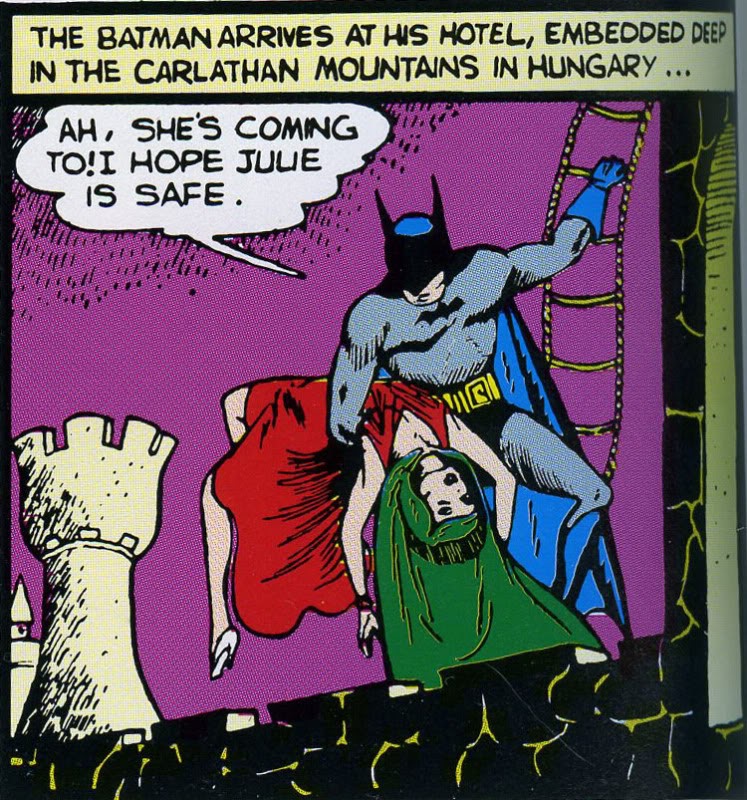
And yet, in 2009's COMICS IN THE CLOSET, Berlatsky shows this panel from an early BATMAN comic, described as "a picture of Batman acting in typical manly fashion."


Does Berlatsky regard Batman's act as that of a "heroic, principled adventurer?"  On the contrary, here it's not verisimilitude that concerns Berlatsky, but its polar opposite (at least as described in the first part of this essay), a particular spectrum of sensations encoded by Batman's actions in the comic-book diegesis.


"So masculinity in super-hero comics is almost laughably straightforward. And yet, at the same time, it isn’t straight at all. Instead, it’s bifurcated, incoherent and, in a lot of ways, really gay. To begin with, super-heroes generally have a secret life, a “secret identity”, that they can’t talk about even to their closest friends and relations. In other words, they are all closeted. And what’s in that closet?. A hypermasculine, muscle-bound body, swathed in day-glo tights; an uber-manly man whose physical tussles with the bad guys preclude any meaningful relationship with the leading lady. Out of costume, on the other hand, the hero is a feminized sissy-boy, whose painful secret prevents him from having any meaningful relationship with the leading lady. Either way, what looked like iconic maleness starts to look, from up close, rather queer. And that’s not even getting into the whole boy sidekick thing."


So when Star Sapphire dresses up like a space-tart, that's an offense against her qualities of heroic (or even villainous) internality. However, Batman's apparent claim to heroism is automatically nugatory, and his appearance, despite a lack of overt sexualization, is nevertheless indicative of hypermasculine defensiveness, whose main purpose is to deflect any appearance of gayness.   I'd like to cut Berlatsky a break by claiming that these contradictions arise purely from personal taste.  However, it's more likely that the discontinuity arises from the type of adversarial criticism Berlatsky practices-- which I'll address in a future essay, though not necessarily one directed at Berlatsky.

Saturday, June 2, 2012

BETTER THE DEVIL YOU KNOW

After taking a second look at the Noah Berlatsky remarks cited in DUCK SHOOT PT. 2--

If you make it simply about visual stimulation, it’s simply about visual stimulation, and doesn’t have to have anything to do (or at least, not much to do) with real women. Once you start pretending that you’re talking about a smart, motivated, principled adventurer, on the other hand, you end up implying that said smart, motivated, principled, adventurer has an uncontrollable compulsion to dress like a space-tart on crack. Which is, it seems to me, insulting.

-- I find that Berlatsky's intent here is to show a deep-rooted conflict between two aspects of current superhero comics.  One aspect is that of the sensationalism in which the earliest versions of the genre (as with most if not all genres) are rooted.  Sensationalism includes, but is not limited to, blatant appeals to the kinetic entertainment values of violence and sexiness (though not literal sex in the case of early superheroes).  The other aspect doesn't appear in superhero comics to any significant extent until Marvel Comics changes the paradigm for the genre, injecting the expectation of verisimilitude into stories about bat-cloaked avengers and giant green monsters.  Given that Berlatsky is chiding current comics for expecting him to believe that a motivated heroine (or villainess, a la Star Sapphire) would "dress like a space-tart on crack," he's privileging the aspect of verisimilitude within the context of superhero stories, though he doesn't oppose pure sensationalism in the cheesecake cartoons of Jack Cole, since these are only "about visual stimulation."

In my essay-series RULES OF ESTRANGEMENT (beginning here),I critiqued a statement from Grant Morrison on the supposed immunity of fantastic fiction from verisimilitude, and found that "Morrison.... may be too cavalier about the need for some types of verisimilitude in even the most fantastic fiction."  At the same time I disagreed with Tim O'Neil in his view that "fiction is a set of rules." For comparable but not identical reasons, I also reject Berlatsky's idea that verisimilitude takes priority, whether in the superhero genre or elsewhere.

The interactions of those narrative aspects that I've called "sensationalism" and "verisimilitude" in this essay (purely for convenience, not as terms for general use) are far from simple; therefore I won't explore them here. I will note that Berlatsky is far from alone in perceiving a conflict between the verisimilitudinous depiction of fantasy-figures and the use (or overuse) of sensational elements.

On a 4-23-12 post to a Comic Book Resources thread I started, entitled "Black Widow-- unzipped, sometimes heels?", a poster named Hrist (identified as female) made this comment:

There's a difference between elements of titillation and a sequence whose purpose is solely to titillate. It's heroic fantasy first, everything else second, really, with superheroes; the sexual elements are mostly leftovers from a power fantasy, not there to say anything much on their own.
I won't rehash my response to Hrist's assertion here. Yet I find it interesting in that it shows the poster's conviction-- similar in my opinion to Berlatsky's theme-- that there is a type of "heroic fantasy" that may possess "elements of titillation" but which is not defined by them.  Certainly one could find any number of other posts or essays by comics-readers that express diffidence toward the "power fantasies" of the superhero genre becoming infused with explicit sexual sensationalism, as against the various levels of violent sensationalism with which they're dominantly associated.

There's a particular irony in seeing Berlatsky emphasize the importance of verisimilitude within the superhero genre, while championing cheesecake art for being about nothing more than"visual stimulation."  Can't one find superhero characters who function on the same non-verisimilitudinal level of narrative as the cheesecake cartoons?  Here's one:


 And here's another:


Now, in DUCK SHOOT PART 2 I agreed with Berlatsky that the DC Star Sapphire is a contradiction, being a powerful villainess who dresses like a slag.  But the contradiction only exists in respect given that other versions of Star Sapphire have not been so focused on "visual stimulation."  Titles like RIPTIDE and WYNONNA EARP have no such history, so can one not fairly give them the same free pass that the girly-cartoons are given?

The objection may be raised that RIPTIDE et al are intended to function in roughly the same way as any DC serial superhero character: that they have serial continuities that suggest that the characters have a consistent life outside the boundaries of the panels.  But this would be a fallacious defense, for in practice there's no more grounding of the internality of the "Image bad girls" than there is of the "Jack Cole hotties." So the logical extension of Berlatsky's position is that "Image bad girls" too should be exempt from any expectations of verisimilitude, because "visual stimulation" is their raison d'etre, not building up a coherent sense of their characters as heroic, principled adventurers.

Such a defense I would find even more problematic than the admitted discontinuities between a given creator's treatment of a well-traveled character like that of Star Sapphire.  While I may agree with Berlatsky about the unattractiveness of a particular sexualized representation of a particular character, that's merely a statement of personal taste.  From a critical stance I find it illogical to disregard the role of "the sensational" in the superhero genre, or, for that matter, the role of "verisimilitude" in even so humble a form as the cheesecake cartoon.

I'll return to some of the more complex aspects of how these two aspects intersect when I return to the somewhat neglected topic of "adult pulp."