Featured Post

SIX KEYS TO A LITERARY GENETIC CODE

In essays on the subject of centricity, I've most often used the image of a geometrical circle, which, as I explained here,  owes someth...

Wednesday, March 15, 2017

THE APPROPRIATION HUSTLE

On this BEAT post, I corrected Heidi for referencing "whitewashing" on the Netflix IRON FIST series, which I have not yet seen. Then I added a slight amendment of my position:

I will note that I've seen the IRON FIST show accused of "whitewashing Asian themes" to get around the fact that the central character was always white, and maybe that's what Heidi referenced. Still, it's dubious as to how much the trope of the "lost Asian land where people learn great secrets" is an actual creation of Asians.  I assume the trope existed in Asian culture, whether it was rooted in fiction or in legend, but was James Hilton referencing any of these when he wrote LOST HORIZON in 1933? Or was he just making up his lost land out of whole cloth, and grafting it onto Tibet because Tibet was conveniently out of the way?

Since this thread may get closed any moment as did the one I referenced here, I don't expect to discuss cultural appropriation there, so I'll give it a stab here.

It's been some time since I attacked the inadequacies of Roland Barthes, but the linked essay ought to outline my general problems with his oversimplification, particularly the idea of appropriation, which he touted in paragraphs like this one:

Every object in the world can pass from a closed, silent existence to an oral state, open to appropriation by society, for there is no law, whether natural or not, which forbids talking about things. A tree is a tree. Yes, of course. But a tree as expressed by Minou Drouet is no longer quite a tree, it is a tree which is decorated, adapted to a certain type of consumption, laden with literary self- indulgence, revolt, images, in short with a type of social usage which is added to pure matter.
I critiqued Barthes' narrow notion of "consumption" as an attempt "to reflect a doctrinaire Marxist imperative," one depending upon a supposed pure experience and one that has been tainted by "consumption." Elsewhere in MYTHOLOGIES, though, Barthes contradicts his words above by treating the products of a given culture-- specifically, the architecture favored by the Basque people-- as if they were "pure" in their original state but were "tainted" by the evil of modern Parisian appropriation.

Of course, as I've mentioned elsewhere, one can't assume that the Basque architectural style was conceived by Basques and Basques alone: they may have borrowed some or all of their design-motifs from other contiguous peoples. But I don't for a moment believe that Barthes cared about real-world influence: only about castigating French bourgeoisie for the sin of appropriation. This is essentially the argument advanced by the proponents of the "White Privilege" theory: it doesn't matter if Asian creators borrow motifs from so-called "western culture," like the well-documented fact that Bruce Lee "appropriated" western boxing-styles for his martial art-- it's only a bad thing when White People do it, even if the general idea of "mysterious Asian lands" was probably primarily the creation of White Creators, at least as we have them in Euro-American culture.

In addition to my Hilton remark above, the pulp Shadow probably started the "heroes' Asian journeys" during the 1930s. Here's the 1939 Bill Everett character who inspired the Thomas-Kane "Iron Fist:" Amazing-Man.


Here's a much less celebrated Tibetan "white crusader," Thundohr:


And, just to show that the same hustle can be applied in other circumstances, here's a page from Jaime Hernandez's LOCAS, in which the artist has a character lecture the audience about the inappropriateness of modern white people affecting Native American hair-styles.


ADDENDUM from the BEAT thread:

Since no one's going to speak to the question of "Who If Anyone Owns the Tropes," I'll confine my remarks to saying, contra Seth, that I don't think I'm worried about whites being underrepresented.

I worry more about creators being told what they have to do by the Diversity Police.

SECOND ADDENDUM:

I'd heard of the K'un Lun legend, and I assume that Thomas and Kane knew it as well. But that doesn't get to the heart of the matter about whether these tropes belong to just one culture or not.

Same thing with the system of kung fu. If it's inauthentic for Caucasians to be martial arts masters, why isn't it inauthentic for every non-East Asian to be one? Is this a rule that applies only to Caucasians as payback for imperialism and related sins? Well, OK, if an artist feels that way, it's his right to reflect that in his work.

But if an artist doesn't feel that way-- what then?


Friday, March 10, 2017

NEAR MYTHS: ["THE WOLF GAL"], LI'L ABNER (1946)

Since I gave an example of a LI'L ABNER mythcomic this week, I decided to recycle a portion of an earlier FEMMES FORMIDABLES essay as a means of clarifying why Capp's "Wolf Gal" wasn't nearly as mythic as his Shmoos, despite possessing equal potential.


Here's the relevant excerpt from the original essay:


In 1946 Al Capp created a feral female with no such convenient inhibitions: the Wolf Gal, who lived in one of the forested areas neighboring Dogpatch with a pack of wolves.  She and her human-eating pack perpetually prey on any humans who venture too close to their territory, and though Wolf Gal could speak as well as any Dogpatch hillbilly-- which isn't saying much-- she thinks of herself as another wolf and considers all other humans her enemies.
Up to this point Capp had created many predatory females, but their mode of predation concerned attempting to seduce Li'l Abner Yokum before his true love Daisy Mae could link him to her in marriage.  Wolf Gal has some leanings in that direction, but the thing that gets her on Abner's trail was somewhat more involved.  When Wolf Gal turns eighteen, she and her pack manage to corner an old crone in her secluded cabin.  Bargaining for her life, the crone reveals that she knows Wolf Gal's nature: that at birth she was born with a "wolf's heart" despite the otherwise normal natures of her hillfolk parents.  A nearby wolf-pack senses that the child is a kindred spirit, so the pack attacks and devours her parents-- much to the delight of the infant child.  In addition to revealing Wolf Gal's origins to the lupine Amazon, the crone also makes a prediction: that Wolf Gal will only know the meaning of "love" under certain circumstances.  Wolf Gal, stung by curiosity, begins to study human mating rituals, as well as catching her first sight of Abner.  She interprets the prophecy to mean that she must kill Abner to learn what love is.
There follows one of the quickest transformations from "nature" to "culture" ever shown in fiction.  Wolf Gal decides that the only way she can get close to Abner in his Dogpatch milieu is to educate herself in the ways of women-- and not hillbilly women, but "sassiety ladies."  She journeys to some big city, locates a finishing-school, and by threatening the teacher's life forces the woman to give Wolf Gal the appearance of a well-bred woman. 

There are three strong myth-kernels here: (1) the continuing opposition of "nature" and "culture," (2) the association of hillfolk with all manner of deviant practices, including cannibalism, and (3) the association between love and death. Yet, there's something blandly functional about Capp's treatment of Wolf Gal's initial arc. It's as though he couldn't quite deal with the blatantly transgressive aspects of the wolf-child myth, and so he reduced it to just another of his many plotlines involving either the romantic seduction or attempted murder of Li'l Abner. I've found this to be an almost syndromic fault among classic American comic strips, in that they so often focus only upon "lateral meaning" as opposed to either "overthought" or "underthought:"

...  my verdict on the narrative story-strips of the classic era is that though they had greater potential for complication-- which I've elsewhere called "amplitude"-- because they could run at great lengths, they often did not use it  because they were so concerned with "straightforward linear narrative." -- STRONG CONTINUITY, WEAK CONTINUITY, PT. 2.
Thus, following the line of thought I've established in the LINE BETWEEN FAIR AND GOOD essays, the "Wolf Gal" sequence is only "fair" because it too is akin to "a disorganized essay with a strong theme statement."

Thursday, March 9, 2017

MYTHCOMICS: ["THE MUSIC OF THE SHMOOS"], LI'L ABNER (1948)

In STRONG CONTINUITY, WEAK CONTINUITY PT. 2, I wrote:

My re-reading of ABNER is by no means complete. However, in the upcoming "mythcomic of the week," the sequence I have chosen is not the sort of thing most comics-mavens would have chosen. Most would probably have selected one of Capp's overt satires, like those involving the Shmoos. The Shmoo storyline is a pretty good example of a strong "overthought," but I don't think it displays the mythic "underthought" that I've been searching for.


I have not yet tracked down what Shmoo-strip I'd read when I made this comment, but it's now clear to me that I had not read the original sequence from 1948. My source for the original story-- the 1998 Kitchen Sink reprint-- mentions in passing that creator Al Capp returned to his Shmoo-theme a few other times, so I assume I saw some later Shmoo-outing.

I also mentioned in the cited essay that a lot of Capp's storylines were too haphazard to generate "significant mythicity." The storyline I'm calling "Music of the Shmoos"-- a bad pun I consider worthy of Capp's own bad puns in the sequence-- is no less haphazard than the average Capp continuity. However, in giving birth to the Shmoos, Capp came up with a concept strong enough to unify all of his humorous schticks.

The reason I thought that the Shmoo-sequence might boast nothing more than an over-intellectualized overthought was because I'd seen much commentary about the political reactions to the concept. According to Dave Schreiner, whose essay on Shmoo-history appears in the Kitchen Sink volume, Capp got complaints from factions identified with both "the Right" and "the Left." The objections of the Right seem more immediately justified, for the Shmoo-- a creature who looks much like a walking penis with a cartoon-walrus face-- directly threatens the forces of capitalism. The Shmoos, who have existed "since the dawn of time," inhabit a lonely valley near Dogpatch. Li'l Abner Yokum seeks out the valley, guided by some strange music he alone hears. Once he gets into the valley, he meets a hairy old man, who tells him that the Shmoos are unique, self-sacrificing creatures who can provide for all the creature comforts human beings desire.


This means, of course, that anyone who makes money off providing such comforts is out of luck.


There are no explicit barbs at the Left in the sequence. Still, it's not hard to see why persons of any strong political persuasion would resent the idea of the Shmoos. In my analysis IDEOLOGY VS. MYTH, I extrapolated the position taken by Northrop Frye: that all ideologies are rooted in their ability to deliver the Good Things in Life:

Name any ideology out there and at base it's just another way for its adherents to maximize their chances of getting those things that make life pleasurable and fulfilling.
I suggest that this is the reason the Left didn't like the Shmoo any more than the Right did. If you've got magical creatures who can provide for your every need, why do you need socialism any more than you need capitalism?

Schreiner covers two of the great appeals of the Shmoo for postwar audiences: that the creature spoke to Americans who had been forced to do without many creature comforts during World War II, and the fact that the Shmoos look like living penises, making them intrinsic symbols of plenitude. (That said, we learn late in the sequence that there are both male and female Shmoos, though elsewhere Capp himself says they're asexual.) Schreiner also points out that Capp the consummate businessman almost certainly planned to make the Shmoos into a multi-level merchandising property even before the August 1948 sequence appeared. That said, the fact that Shmoo merchandise did become phenomenally popular for the next few years suggests that Capp knew the temper of his audience, knew that the American people would respond favorably to this image of living "Horns of Plenty." At the same time, Capp is enough of a satirist-- even though the sequence as a whole is more comedy than satire-- to paint human beings almost in the light of cannibals, despite the invariable willingness of the Shmoos to be eaten.


Capp clearly knew that he, as much as the businessmen in the strip, needed to put an end to the Shmoos so that his comic strip could return to what passed for "normal." Thus the artist has a squad of hitmen descend upon the hillbillies and use high-powered guns to wipe out all known Shmoos in Dogpatch. However, two Shmoos-- one male and one female-- remain.

At this point, most sane artists would have the couple speed back to their hidden valley to repopulate, never to be seen again. Instead, in one of his daffiest sequences, Capp decided to intermingle the successful Shmoo-myth with the other famous trope of the ABNER strip: the Sadie Hawkins Day Race.

As some readers of the blog may know, this annual competition featured a literal "manhunt. " Dogpatch bachelors are given a head start, after which they're chased down by the unmarried women of Dogpatch-- who range from the ghastly to the gorgeous-- and any man who gets caught has to marry his captor. From the genesis of the strip, this provided Capp with an excuse to have incorrigible bachelor Abner chased down by assorted women, particularly the smitten Daisy Mae, who alone truly loved the big hillbilly lout.

This time, Abner is chased not only by Daisy, but also by an unnamed woman  who looks almost exactly like Abner, though she's apparently not related to him.To complicate Abner's predicament, he has charge of the male Shmoo, while Daisy has custody of the female one-- and while Abner doesn't want (consciously) to be caught by Daisy, the male Shmoo certainly wants to be caught by his opposite number. Many slapstick antics ensue, and Capp almost seems to be competing with himself by wedging in pleasant but irrelevant appearances by two of his most buxom female creations: Moonbeam McSwine and The Wolf Gal, Finally the two surviving Shmoos are united and sent off to breed, while Abner escapes marriage by the usual hairsbreadth.

I've saved the best for last, even though it's actually the first part of "Music." When Abner hears the mysterious, never-explained music, he draws near a place called the "Valley of the Schmoon." Later in the story Capp uses the same plural for "Shmoo" that I've been using here, apparently he used "Schmoon" as a plural in the first few strips just so he could make a couple of goofy puns with the made-up word (like talking about"the light of the silvery schmoon.") I neglected to mention that before entering the Valley, Abner encounters a threshold guardian who tries to keep him from entering.

"She's a big one!! Fire is a-flashin' fum her eyes, an' she's a-flexin' her (gulp) MUSCLES."

The guardian-- whom Abner addresses as "Large Gal"-- forbids Abner to enter the Valley. When Abner insists on entering, the statuesque woman-- clad for the most part like the usual hillbilly-- attacks him. Abner won't fight a woman and so gets knocked out. Daisy Mae comes running up, trying to save her beloved, but the valkyrie tosses Abner into the valley, apparently assuming that the fall will kill him, Abner survives, and goes on to find his way to the Shmoos, and that's the last anyone sees of "Large Gal."

So why did Capp bother to introduce Large Gal at all? She only extends the sequence about three strips, and her sole plot-function is to make Abner's quest a little more suspenseful by offering brief opposition. It's not impossible that Capp simply wanted an excuse to introduce yet another buxom female into the strip: throughout the run of LI'L ABNER Capp rarely ever missed an excuse to perform his version of Raymond Chandler's famous advice, though in Capp's case the advice was more like, "When in doubt, have a hot girl come through the door."

And yet, there are three interesting psychosexual touches to Large Gal's appearance. The first, in line with the above quote, is that Abner is initially intimated by her "muscles"-- which would not be that unusual in the modern days of women's bodybuilding, but which was a pretty rare sight in 1948. The second is that even as Large Gal prepares to execute Abner by tossing him off a cliff, she praises his manhood, calling him "a fine young specimen," and the third is that Daisy Mae associates Large Gal's aggression with romance: "Ef yo' don't want him-- toss him mah way!" Further, given that Abner's near-murder results in him leading a swarm of ambulatory penises out of a vaginal valley, I think I'm justified in saying that Capp distilled some uniquely weird underthoughts into his most pervasive comic myth: that of animals who ceaselessly sacrifice themselves for the benefit of humankind, and who must be slaughtered to prevent their interference in human commerce.
Monday, March 6, 2017

QUICKIE BEAT-COMMENT #7799

I hope to write more fully about the asinine concept of "cultural appropriation" at some future time, but for now, here's a quickie BEAT-comment that may get deleted from this thread soon:

-----------------

Anyone want to "educate" me as to how Haron can claim that Asian martial arts originated in Africa? I mean, with a straight face?

But of course "appropriation" is perfectly OK when it's done by anyone but a Caucasoid.

If I were Asian, I'd be a lot more irate to think that the origins of a major part of my culture was being cavalierly ripped off, just for the sake of making common cause against non-POC. But I suppose a lot of people will buy into anything.

ADDENDUM: To her credit, Heidi did not delete my comment or that of anyone else who objected to P.C. thinking; she merely closed the thread. I love that one of the posters labeled any protests against the PC mentality  as "false outrage" and associated all such outrage with Donald Trump. Way to have an open conversation, all right-- and in the same spirit, Heidi said that all anti-PC posters ought to "check their privilege." Once again I'm reminded of more than one guest who appeared on the happily defunct Larry Wilmore show, claiming that they wanted to "have a conversation" about race. The tenor of their remarks, like those of Heidi, reveal that they didn't want to "have a conversation" any more than Heidi does: they wanted, and she wants, purely to "win the argument."

Still not as vapid and as prone to prevarication as Berlatsky, though...

Saturday, March 4, 2017

DEMIHERO RALLIES

I've been giving a little thought recently to the concepts of "monster rallies" and "villain rallies," and how often these have been featured in various media, as opposed to the more frequent "hero rallies," better known simply as "team-ups."

However, since I'm the only one that uses the neologism "demihero," denoting thereby a fourth essential literary persona there are of course no "demihero rallies" as such. They do exist, but audiences merely think of them as plain old "character crossovers."

From the 61 entries I completed on my possibly abortive 100 GREATEST CROSSOVERS OF ALL TIME, here are the ones featuring demiheroes. I'll add a comment only when the demihero persona is mixed with of the other three personae.

DYNASTY AND THE COLBYS

STEVEN UNIVERSE (hero) AND UNCLE GRANDPA (demihero)

THE MAN WHO HATED LAUGHTER (mostly demiheroes, though some of King Features' heroes, like Mandrake and the Phantom, make brief appearances)

WHO FRAMED ROGER RABBIT? (Non-toon Eddie Valliant is a hero, all the rest, from Roger to all the cartoon revivals, are demiheroes)

FONZIE AND MORK

SIMPSONS AND FUTURAMA

DREAM-QUEST OF UNKNOWN KADATH (mingles demiheroic protagonists and monstrous entities and settings)

ARCHIE BUNKER AND MAUDE

More on this subject later, possibly.


Thursday, March 2, 2017

MYTHCOMICS: "LOIS LANE'S SUPER-DAUGHTER" (LOIS LANE #20, 1960)


This story was actually the second in a series of two imaginary "what if Lois married Superman" stories, which ran back to back in issues 19 and 20 of the LOIS LANE magazine. I presume from this that editor Mort Weisinger accepted an initial pitch for both stories, instead of choosing-- as he sometimes did-- to wait awhile to gauge audience interest. There may have been a sequel or two that followed, but these two were produced so as to be read back-to-back.

The first story from #19, "Mr. and Mrs. Clark (Superman) Kent," however, is not as symbolically resonant as the second one from #20, though both stories were written by Jerry Siegel and drawn by Kurt Schaffenberger. "Mr. and Mrs" is not much more than a "beware what you wish for" homily. Superman marries Lois Lane, thus supposedly fulfilling the dream she's cherished since she first met him (at least in Weisinger's universe), finds out her dream isn't all it's cracked up to be, for in public she's simply the wife of the hero's alter ego Clark Kent. The fact that he's Superman is of course kept secret from the populace, so that no one-- especially Lois' longtime rival Lana Lang-- knows that the superhero is off the romantic market. It's a pleasant enough story, but "Lois Lane's Super-Daughter" strikes a deeper chord.

About three years after this story appeared on newstands, Betty Friedan's THE FEMININE MYSTIQUE was published. Building on material the author had gathered during the late 1950s, Friedan sought to make clear that modern American women had become desperately, symtomatically unahppy due to the imposition of a "mystique" upon their lives; one that kept them from fulfilling themselves as rounded human beings. MYSTIQUE was a major influence upon Second-Wave feninism from that time on. But Jerry Siegel's "Super-Daughter" presciently taps into some of the same discontents, though obviously it does so within a juvenile context, and within the context of a continuing superhero melodrama.

A few fans of Silver Age Superman have wondered why, after Superman's cousin Supergirl appeared on Earth in 1958, he didn't "man up" and adopt her in his identity of Clark Kent. I don't think the question was formally addressed in the actual continuity, and I'm sure that the proximate reason the character did not do so was that his editor and writers didn't want him playing Adoptive Daddy in every story. But there was still a kernel of logic in Clark's reticence, for during this time-period social services personnel generally took a dim view of single men or women adopting children of any age. Given this state of affairs, having the teenaged Kryptonian placed in an orphanage to seek adoption by a bonafide married couple-- which eventually does transpire-- doesn't strain my credulity.

What's interesting from the story's beginning is that the moment Clark and Lois are married, Clark springs it upon her that he'd like them to adopt this teenaged cousin that he's never mentioned before.


Lois looks a little bit poleaxed by this revelation, but she's married "for better or worse," and when the adoption agency complains that she might not be able to handle a new child and a job, Lois does what anyone in the period would deem The Right Thing.


Keep in mind that this Lois is not the fire-eater from the Golden Age. Though it would be absurd to assert that the Lois character was thoroughly consistent, since her moods could fluctuate according to the needs of a given story, it is at least part of Weisinger's conception of Lois that she has an irreducible domestic side to her personality. Mort Weisinger may well have been the sort of man whom Betty Friedan criticized for wanting women to become wholly domestic once they became wives. Nevertheless, for the time, the demands of the adoption agency seems not unusual, and the strength of Siegel's story is that one does see certain disadvantages to the world of domestic bliss.

True, there's almost no trace of mother-daughter bonding in the story, except for minor scenes like this one:


But it probably would have been a little beyond Siegel's skill-set to be THAT attuned to the ways of modern women, and besides, the main thrust of the story is all about Lois's discomfort with this perky intruder who's been thrust into her domestic world before the former lady reporter has even had a chance to get used to her new husband. The problem is only aggravated by the fact that both Lois' husband and her de facto daughter belong to a world of super-powered endeavors to which Lois cannot aspire. Here's one of the tandem "super-feats" to which Supergirl alludes on the cover of #20:


Worse by far, though, is that Supergirl's powers make Lois's function in the household irrelevant.


There's an exquisite irony in this setup that I wonder if Betty Friedan could have appreciated, even without the fantasy-content. Lois sacrifices the "exciting life" she enjoyed as a girl reporter, but her reward is to be marginalized within the household that is supposedly her domain. Yet through it all, Lois masks her pain, a veritable Stella Dallas of the comic books, an icon of maternal martrydom. Yet, where Olive Prouty's character accepts her marginalization, Siegel's Lois manages to manifest her hidden hostility in one of the most roundabout ways ever conceived, even in a Mort Weisinger comic book.


Yes, that's right: not only does Lois "just happen" to whale on the backside of a robot who looks just like Supergirl in her secret ID, a snoopy women from the adoption agency literally invades Lois's private home just in time to catch Lois in the act of unleashing her fury at the (first) unwanted intruder. I particularly enjoy how tearful Lois is in the story's final panel, perhaps revealing just a touch of the schadenfreude she may be experiencing from Supergirl's "unhappy ending." Will Lois ever make things up to Superman? Well, maybe or maybe not, but either way, she won't have a fifth wheel getting in the way.

I should note that though a fair number of stories from this time-period contain hints at some sexual stirrings between the two super-cousins-- particularly "Superman's Super-Courtship"-- "Super-Daughter" actually works just as well without any such elements of sexual transgression as it would with it. I could see the story entering new terrain if it were ALSO about a nubile young adoptive daughter nudging out an older wife from the affections of the adoptive father. But mythically speaking, the story works quite as well as a melodramatic-- as well as comical-- look at the marital disadvantages of a former working woman in the era of the Comic-Book Silver Age.

Wednesday, March 1, 2017

LOIS, MANSPLAINED

Since I remarked in the previous essay that I thought Lois Lane was a more intrinsically "mythic" figure than Jimmy Olsen, I'll provide a little justification of that statement here.

In the first official "mythcomics" post here, I only touched upon the significance of Lois Lane in passing, but I've noted elsewhere that she's highly significant as the "chosen bride" of Jerry Siegel's "Christ with Muscles," no matter how far in the future their unison might take place. This 2014 essay provides a refutation to Noah Berlatsky's rhetoric of victimization-- i.e., that Lois was always being maltreated by the main hero-- and shows that, even though she had her share of faults, she was on the whole an admirable character, and something of a "tough cookie" for her time.


In the next day or so, I'll devote a mythcomic essay to one particular Lois tale, and it comes from DC's long-running LOIS LANE comic book, which presented a somewhat different version of the character. Whereas the comic-book Jimmy Olsen was strongly modeled on the radio/television character-- even if comics-Olsen showed some significant departures-- Lois seems to have been remodeled less with reference to the "Adventures of Superman" TV show and more in line with what editor Mort Weisinger thought would sell to his readers. There's a fair amount of anecdotal evidence to the effect that SUPERMAN'S GIRL FRIEND LOIS LANE was more oriented toward female juvenile readers, and even though all of the raconteurs on the title were male, it seems a safe bet to say that they re-modeled Lois in line with their perceptions regarding feminine soap-opera, albeit adjusted for a juvenile audience. If Lois had held on to any of her streetwise toughness and courage during the period when Jerry Siegel was drummed out of the DC ranks, that last remnant of that previous characterization was well and truly gone by 1958, when the magazine was launched (following a tryout in the SHOWCASE magazine, by the bye). Lois wasn't seen to slug anyone, as in the panel above, until about 1966.

Perhaps because Lois, unlike Jimmy, was viewed as a full adult, there are more adult concerns in the stories, albeit filtered through a juvenile lens. Many of the stories are just as silly as the ones in the JIMMY OLSEN title, but there is a greater propensity to allude to Lois as a mythic concatenation of womanly traits. This often reflected negative characterizations typical of men's humor, like accusations of overweening feminine curiosity-- but even these retain a certain larger-than-life quality. In the remainder of this essay, I'll briefly touch on some of these myth-kernels, though with the caveat that nearly none of them qualify as mythcomics.

Though the character of the Weisinger Lois was a little too hard-nosed to go in for occult matters, I find it symbolically significant that the first issue of her series attributes to her a "witchy" power. Note Superman's apparent fear of having his powers surpassed.


Here's the first of many issues in which Lois is "body-shamed" in some way. Some find these sort of tropes to be representative of the whole series, which is certainly throwing out the baby with the bathwater.


Though Lois isn't really any sort of tough jungle-babe in this story, it's amusing to see her take a leaf from the book of Sheena. Some will recall that Sheena preceded Superman in being the first major comic-book character published, even though the jungle-queen's sales didn't take off until after the Man of Steel became a superstar.


One of the first stories really condemning Lois for the sin of curiosity. The big giveaway? Lois has the head of a cat, or rather, she thinks she does, having been given a post-hypnotic suggestion to punish her for an act of intrusive curiosity. It's interesting that the hypnotist in this case is female, though.


Weisinger recycles a trope used by Siegel in an earlier story, in which Lois was supposed to get powers from a super-blood transfusion.


Jimmy Olsen's relationship with Superman never lent itself to stories like this one.


Second of a two-part story in which Lois marries Luthor and spawns an evil son. However, he later marries into the family of Superman and Lana. Ah, if only Weisinger had edited Greek plays!


"The Snoopiest Girl in History" reveals that Lois traveled in time and gave rise to the legend of Pandora.


Lois again travels in time, gets stuck on Krypton, and decides it's a good idea to steal Superman's father from Superman's mother. Only at the end of the story does she realize that she might have ended up becoming the mother of the man she always wanted to marry. Writer Otto Binder must have been digging into his Freud the day he scripted this one.


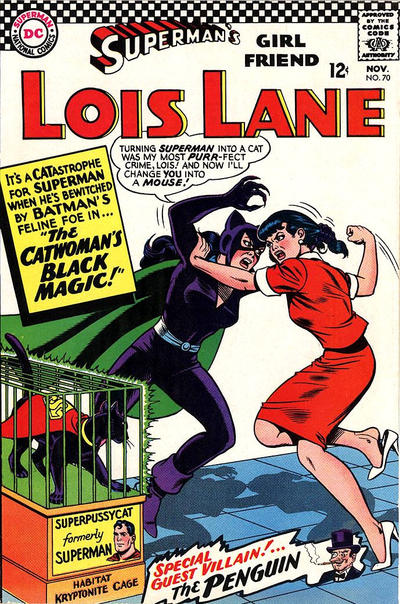
Lois has the distinction of re-introducing Catwoman to the DC universe after the villainess had been exiled for eight years, probably because of her being mentioned in SEDUCTION OF THE INNOCENT. Sadly, no actual catfight takes place between the two Golden Age icons, though Lois does get to take a walk on the wildcat side by assuming Catwoman's identity.


"Shock story of the year," indeed. It's hard to believe no one at DC knew that Joe Shuster had done not entirely dissimilar work for a 1954 skin magazine.


Aside from a reprint issue, here's the last issue edited by Weisinger. Appropriate, since she starts off as a witch and ends up as the bride of Satan.