Featured Post

SIX KEYS TO A LITERARY GENETIC CODE

In essays on the subject of centricity, I've most often used the image of a geometrical circle, which, as I explained here,  owes someth...

Friday, April 28, 2017

UNANSWERED POLITICAL QUERY

From a forum on political stuff--

_________

So tonight ABC will air a documentary about all the events that led up to the 1992 LA riots, with special emphasis on the heavy hand of Daryl Gates. The doc is given the somewhat inflammatory title of "Let It Fall."

I don't know how accurate or balanced the doc will be; it may indeed be a superb work of non-fictional filmmaking. As a liberal, I believe that everyone should have access to all aspects of our history, however uncomfortable.

What I find myself wondering, however, is whether or not the doc-- assuming it is, as said, indicting the Gates regime-- will have any beneficial effects as such.

I can imagine that when a filmmaker tackles this sort of topic, his basic moral message is akin to, "Never again." In other words. he wants to shame the Caucasian population so that future generations will never again think about enforcing a new Jim Crow.

But does a document that makes an "anniversary" of a riot 25 years ago have the desired effect? Does it make white people more penitent?

Or does it have the opposite effect, making many of them-- those who are NOT card-carrying members of white racist organizations-- sick and tired of hearing about grievances that date back that far?

I know the Santayana rationale that's always trotted out in these situations. But in terms of pure effectiveness-- will a doc like LET IT FALL appeal to anyone but the already converted?

ADDENDUM: I later commented-- 

Having watched the doc now, I still can't say if it will have any beneficial effects, but I'm impressed with Ridley's work here. I found it even-handed in structure, in that none of the L.A. populations-- white, black, or Korean-- came off looking sinless. 

If any documentary can prove persuasive across ingroups, I think the more even-handed ones have the better chance.

Not that the doc won't have its detractors, of course.

Thursday, April 27, 2017

MYTHCOMICS: FABLE OF VENICE (1977)


It's long been observed that American genre-comics tend to travel a more straightforward, plot-determined path to get to their destinations, while similar works in Europe tend to wander about in peripatetic fashion. I don't make this observation for the reasons of elitist critics-- to tout the innate superiority of the European approach-- but to apply the distinction to this week's mythcomic.

Milton Caniff's comic strip TERRY AND THE PIRATES cast a long shadow over the world of comics long after Caniff departed the strip in 1946. The Italian Hugo Pratt was one of many artists who to some extent emulated Caniff's bag of visual tricks. For a comics-critic confined to the English language, it's difficult to assess Pratt's overall work. Almost the only works translated are Pratt's stories of Corto Maltese, and these stories caught the attention of American fans largely thanks to Frank Miller talked up Pratt's work during the height of Miller's popularity.  

The titular hero bears a loose resemblance to the tough adventurer Pat Ryan of Caniff's TERRY, but Pratt's Corto Maltese is much more laid-back and eccentric, and where Ryan is confined mostly to China, Corto wanders many parts of the world during the early 20th century. His creator knew some of these locals from personal experience. According to a preface in NBM's 1990 translation of FABLE OF VENICE, Pratt based this 1977 album-novel on his own experiences growing up in Venice. 

Given the protagonist's name, I find it logical that a particular influence on FABLE must have been Dashiell's Hammett's 1929 novel THE MALTESE FALCON and/or its film-adaptations. The novel is named for a fabulously valuable statue of a falcon, over which the novel's hero and his antagonists contend. The novel, much like Caniff's strip, is usually concerned purely with worldly concerns of profit.

But Pratt, who claims to have experienced uncanny phenomena in his encounters with the variegated cultures of Venice, takes the same idea of a character seeking a fabulous treasure but uses the idea to illustrate the arcane traditions of the Mediterranean cultures. FABLE starts with Corto falling through the ceiling of a room in which a group of Venetian Masons are convening. But where this might lead to some wild brawl in a Caniff storyline, the Masons simply escort the unfortunate sailor out of their sanctum. But the scene gives Pratt a chance to establish Corto's philosophical status with the reader. He shows that he knows something about the esoteric tradition, and yet tells the Masonic leader that "I'm just a free sailor-- at least, I  hope I am!" 

From then on, Corto wanders the streets of Venice, encountering both old acquaintances from past visits and new people, most of whom are directly or indirectly associated with esoteric matters. He has a few dust-ups with the authorities, just like Caniff's hero:


But on the whole, the wandering plot is mostly about the mysteries of Venice, where Corto observes that anything can happen. The treasure he seeks is a supposedly magical emerald, but he quests after this prize not for personal gain, but because a late associate, Baron Corvo, challenged the sailor to find the emerald. The emerald has a storied history like that of the Maltese Falcon, but the gem goes much further back, supposedly passing through the hands of myth-figures like Cain and Lilith and into the slightly more historical-seeming figures of Simon Peter and Simon Magus.

While trying to track down the elusive jewel, Corto meets various people associated with occultism, particularly Hipazia, who believes herself to be the reincarnation of Hypatia, the renowned Neoplatonic scholar who lived in Egypt during the 4th century A.D.  Hypazia projects the sense of being almost other-worldly, though Corto tells a friend "that girl can only love what she can't have."


FABLE puts forth a cornucopia of arcane references from the Greco-Roman world, the Bible, Islam, and even Nordic mythology. I don't think any of them add up to much individually, but these references, like the characters I discussed in this essay, "take on mythic status through their association." No literal magic is seen, so the novel registers an uncanny phenomenality through the trope of "weird societies." In addition, Corto has a bizarre dream in which he has a long conversation with a genie who looks like one of his old adversaries. And though he awakens from this dream, after the treasure-hunt (and murder-mystery) is solved, it turns out that the novel itself is something of a dream. FABLE ends with Corto bringing all of the characters "on stage"-- even those who have died-- to take their bows, and then leaves to appear in his next story. In my experience, this is one of the few times that a "delirious dream" took place WITHIN the context of a "fallacious figment."

Wednesday, April 26, 2017

GOOD WILL QUANTUMS PT. 4

Though I don't repudiate anything I wrote in Part 3, it does occur to me that an attempt to describe the virtue of simplicity ought to embrace that virtue, at least for that particular essay. And since last week I was dealing with some of the complexities of the Lee-Ditko SPIDER-MAN, I may as well take an example of valuable simplicity from that source.

In my essay on THE ENFORCERS, I took pains to demonstrate a level of mythopoeic complexity in the relationship between Peter Parker and J. Jonah Jameson. I mentioned the character of Betty Brant only in a negative sense: that she did not fulfill the role of "daughter" to Jameson's "heavy father," and that she became connected to Spider-Man's war on crime because she had taken a loan from the Big Man, who, in the tradition of loan sharks everywhere, called in the note with heavy interest. I also noted in a previous analysis that she didn't line up with the usual Oedipal figure of the "mother-substitute:"

So a doctrinaire Freudian reading does not apply, particularly since Parker's sexual needs are still turned outward, toward women more or less his own age. One might make something of the fact that the character's first major girlfriend is a little older than he is: Betty Brant is a working woman, roughly of college-age, when she starts dating the high-schooler. Few stories treat the Betty character as significantly older than Parker, though. So despite the occasional reference to her age-- in one story, her rival Liz Allan makes Betty feel "a hundred years old" simply by addressing Betty as "Miss Brant"-- she doesn't work as a mother-substitute any better than does Aunt May.

So does Betty Brant possess any "density?" Not within the mythopoeic domain, certainly. Whatever storytelling virtue she has would seem to apply only to the dramatic potentiality, which deals with affects. Here's one of the better examples of Stan Lee's skillful dialogue melding with the energetic visuals of Steve Ditko:


Even so, one never knows as much about Betty Brant as one knows about an Ibsen character. Aside from the eventual revelation that her brother Bennett became involved in the criminal life,  she comes from nowhere and doesn't really have a meaningful arc of her own. She is simply-- note my use of the word-- Peter Parker's first love.

But in contrast to the "denser" concerns that make the Lee-Ditko SPIDER-MAN compelling, simple characters like Betty-- and Ned Leeds, Anna Watson, and others-- have a valuable function. They don't ask the reader to understand them in any depth. Their simplicity is like a breath of fresh air next to all the breast-beating and hairshirt-tearing.

And that is probably the simplest I can get about the aesthetic of simplicity.

Monday, April 24, 2017

GOOD WILL QUANTUMS PT. 3

In GOOD WILL QUANTUMS PT. 2 I said:

But although "density/complexity" is the primary criterion of fictional excellence in any potentiality, there is a role for Raymond Durgnat's "aesthetic of simplicity." Simplicity is the mode or modes through which an author seeks to communicate complexity in a pleasing manner, so that the reader absorbs the complexity without the sense of having it forced down his throat. More on this point later.

I invoked the base idea of simplicity-- though not as an "aesthetic"-- in a February 2008 essay, MOVING FURNITURE, TRADINGS SYMBOLIC SPACES.  

To repeat what I said in “Myths Without Fantasy,” any kind of story may attain to the complexity of myth, and any element of narrative storytelling—a plot-event, a setting, a piece of dialogue, or a turn of characterization—can have the potential to go from a simple variable to a complex one. At the simple level, such elements are manipulated by the author to serve the ends of the story, which (as per this article’s title) I consider to be akin to the simple act of moving one’s furniture from one place to another. However, where one encounters the author bringing in extra levels of associational complexity, often not necessary as such for the story’s smooth functioning, one is dealing with another level of symbolic discourse, where the simple is “traded” for the complex, rather than simply being moved from one spot to another.

 I didn't mention Frye in this essay, but he was credited for the "complex variable" insight in a related essay, DON'T FEAR THE FURNITURE, where I further built upon the simple/complex dichotomy.


Back in this essay I spoke of functions without any great associative complexity as "simple variables," akin to narrative "furniture" that an author had to move about. Somewhat later I used "null-myth" as a term of evaluating such simple variables in terms of their lack of mythicity. "Function" is meant to be more inclusive. Say that I consider Sherlock Holmes mythic while I deem August Derleth's imitation-Holmes "Solar Pons" to be null-mythic. That does not mean that I might not be amused in some way by a Solar Pons tale, depending on how well the author presents his material on the purely kinetic level. But I would not expect the level of associative complexity that makes the Sherlock stories generally more appealing.
Both Holmes and Pons stories share functions that their respective authors did not "invent." The Holmes stories, because of their added associative qualities, may be said to be "super-functional" in that author Doyle forges more felicitous associative connections within the literary elements of his tales than Derleth does. But Doyle doesn't escape the need for narrative functionality.
"Narrative functionality" means that whether a story is symbolically simple or complex, it has to satisfy certain some audience's narrative expectations, even if that audience might be limited to the author's idealized image of "the perfect audience." This is easy to descry with genre-stories: once Conan Doyle establishes (but does not invent) the trope that every detective-story concludes with the detective solving some mystery, then most other stories in that genre will follow the same pattern, in order to be "pleasing" to the reader. And though many literary elitists like to think that artistic fiction is immune to this sort of narrative expectations, I've noted the same distinction between complex and simple forms of art-fiction on assorted occasions, as per my unfavorable comparison of Daniel Clowes to Harvey Kurtzman here.

In the second part of DON'T FEAR THE FURNITURE, I also associated the simply functional elements of literature with the linguistic concept of the *denotative:* 

Even I, a pluralist, would rather read works that strike me as "super-functional" rather than only functional. But that which is purely functional informs every narrative ever conceived, if only insofar as all narratives need the denotative as a buttress for the connotative. So fearing and/or hating the functional is, in the final analysis, not much more profound than the activity of moving around one's old furniture.

Nowadays, I would not associate my idea of the "null-myth" with this base denotative functionality: over time it's come to mean a work that had "super-functional" potential coded into the narrative but which became denatured by authorial confusion or misjudgment. I note that in these older essays I only referenced the potentialities of "the kinetic" and "the mythopoeic." However, I've given other examples in recent essays as to how the other two potentialities are also embraced by the concepts of narrative complexity and simplicity.

To return to the last two examples cited above, the better work of Harvey Kurtzman has a desirable level of complexity, but it is presented in such a way that the author does not "force [the complexity] down the audience's throat." In contrast, though I do not consider Daniel Clowes' to be very complex in terms of any potentiality-- though I suppose it's strongest in the domain of "the didactic"-- it also sins in regard to the aesthetic of simplicity, by conveying his intellectual take on life in a poorly executed emulation of Alfred Hitchcock's storytelling practices.

Friday, April 21, 2017

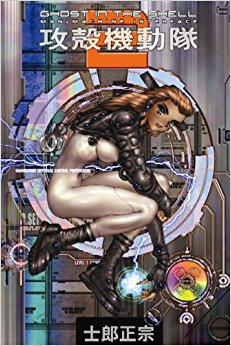
NEAR MYTHS: GITS: MAN-MACHINE INTERFACE (2001)


I remember liking the anime film adaptations of Masamune Shirow's GHOST IN THE SHELL franchise, though I've not re-screened them in years, and would prefer to see them again only if I should get the chance to read the original 1989 manga-stories on which they were based. Though I didn't have easy access to the 1989 work, I did check out this 2001 "graphic novel." The events of MAN-MACHINE INTERFACE take place about four months after the events of the first continuity but one source claimed that the works are not interdependent.

Unfortunately, I didn't get much out of interfacing with INTERFACE, for much the same reason I didn't enjoy Shirow's earlier success APPLESEED: Shirow just can't shut up about the wondrousness of his cyber-world long enough to tell a coherent story. Most of the story deals with the main hero, android Motoko Aramaki, showing off her ability to download herself into a variety of android bodies while investigating-- well, something. Frankly, I couldn't follow the rudiments of Motoko's mission, though it did involve submarine pirates and pigs being used to grow substitute organs. In fact, Shirow's margin-notes, in which he explains the various aspects of his sci-fi cosmos, are more interesting than the main story.

To his credit, Shirow knows how to give readers both action (one of Motoko's android bodies gets into a big firefight) and fanservice (Motoko often shows off a lot of leg and butt, even while resenting anyone who enjoys the view). Some elements of Japanese mythology are crammed into the helter-skelter narrative, and I'm sure that Shirow has the talent to produce a symbolic discourse by scenes such as this one.


However, the main content is much like that of a 1930s "space engineering" story, where the authors' main interest is always focused upon singing of the wonders of science. In terms of organization MAN-MACHINE INTERFACE also resembles the 1940 origin of Hawkman by Gardner Fox. The mythic content is indubitably present, but it's something of a potpourri.

I didn't have a lot of love for the GHOST IN THE SHELL teleseries, but at least its storytelling proved coherent. Some day in future I may try to reread Shirow's 1986 DOMINION as translated by Dark Horse, since that too offered more organized stories.


Wednesday, April 19, 2017

MYTHCOMICS: "THE ENFORCERS!" (AMAZING SPIDER-MAN #10, 1964)


In this long mythcomics analysis of the early Lee-Ditko SPIDER-MAN, I concluded that the relationship between Peter Parker, his alter ego and his employer Jonah Jameson was one of unending conflict:

From then on, this becomes the new status quo: to make money Parker must continue selling photos to an older man who hates Parker's alter ego, while Jameson, who hates Spider-Man, must continue feeding the fame of "the menace" or face losing the interest of the paper-buying public. (One later tale even asserts that the paper's newsstand sales go down whenever Jameson writes another of his many anti-Spider-Man editorials.) For the young hero, there's no final duel with the older authority. The alienated individual simply goes on jousting against the older man and the conservative society he represents -- on and on, world without end.
I should quickly note that when I speak of Parker being alienated, it has nothing to do with the banality that is Marxist alienation. Parker is not alienated against capitalistic society; he's simply for the most part frozen in time as a young man on the verge, which means that he'll always be opposed to the conservatism of the older generation. Jameson is in a sense more alienated than Parker, because as a good capitalist he must give his audience what they are willing to buy. Since he has wealth, he continually seeks to influence public opinion through the media-- inveighing against Spider-Man on television, or instructing his writers to attack the superhero in the Daily Bugle. Yet Jameson's ability to manipulate the masses is severely limited. In "The Enforcers," Jameson instructs his flunky Fred Foswell to write editorials that will associate the crime-fighter with the Big Man, a master criminal currently causing chaos throughout New York. Foswell objects that they have no proof for such an allegation, and that "if you [Jameson] turn out wrong again, people will lose confidence in our paper." Jameson overrides his sensible employee's objections, but subsequent issues bear Foswell out. On some occasions Jameson may be able to sway the more simple-minded readers, and he can take advantage of reversals in the hero's career to embarrass him. But on the whole Jameson's control of the public media cannot nullify the self-evident fact of Spider-Man's heroism.

In the above-cited essay I also said that although in many ways Jameson functions as a "heavy father," sort of a nasty version of Parker's angelic Uncle Ben, he has little in common with the symbolic kindred of Laius. In contrast to Freud's Oedipus schema, Jameson does not proscribe Parker from any female companionship; their rivalry is entirely based in the desire for public acclaim. Parker is Oedipus only in terms of constantly saving a city from various dooms, while Jameson is a Tiresias who is motivated not by a love of truth but by a bruised ego.

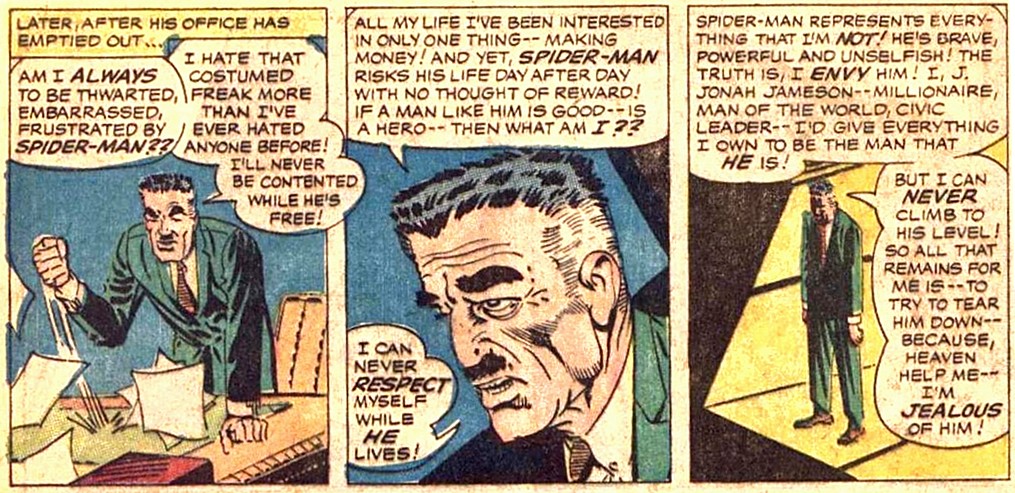
SPIDER-MAN #10 is certainly one of the first times a commercial comics-magazine ever referenced a soap-operatic revelation on its cover, to wit: "Learn why J. Jonah Jameson really hates Spider-Man!" Though Stan Lee had dropped hints about the publisher's motives prior to issue #10, this was the first time Lee foregrounded the basic philosophical difference between them: that Spider-Man appears in every way to be a selfless hero, who requires no reward for risking his life, while Jameson has defined success as "making money."


Though Peter Parker indubitably gets the short end of the stick in his contest with Jameson, "The Enforcers" is psychologically interesting in that this time Parker starts aping Jameson's modus operandi: imagining that the man who makes his life miserable may in fact be the master criminal the Big Man.


This leads to a humorous conclusion: like Jameson, Parker imagines his enemy as a dastardly crook, and he, far more than Jameson, is duly embarrassed when the truth comes out.


To be sure, though, Parker learns from his error and never again misjudges Jameson, while Jameson keeps on repeating his mistakes, in order to keep the comic routine going. That said, there's nothing illusory about the fact that Jonah, while not a criminal, is still an asshat; the kind of boss who makes the world of daily work a crapfest.


However, adults on the verge must learn to live with the minor crappiness of other law-abiding adults, while the corruptions of actual crime are of a different order,


The subplot about why Parker's girlfriend Betty engaged the services of a loan shark is never worked out very well in subsequent adventures, despite a very loose explanation involving Betty's brother, But the Betty subplot is significant in establishing the way crime impacts on the lives of average square citizens. Thus"The Enforcers" is the first Lee-Ditko story to deal with crime as a sociological myth.

That said, one must make allowances for the fact that the story presents a juvenile vision of crime that no adult could take seriously for a moment.


So the Big Man tells New York's major gangland figures, "I'm going to run this little enterprise like a big business," and then the reader must believe that all of these armed gangsters can be beaten into submission by the crime-boss's three oddball henchmen: a big strong goon (the Ox), a short fellow with judo skills (Fancy Dan), and a cowboy with a lasso (Montana). The three Enforcers may have their roots in a trope seen in a fair number of Golden Age BATMAN stories: the trope of the "specialty criminal." Still, from an adult perspective it's awfully hard to imagine a crime-boss rising to prominence with only these three non-powered schmoes serving as his muscle.

That said, throughout his career Ditko would continue to pit his heroes against crooks rooted in the traditions of urban crime, though super-villains like Electro and the Vulture were arguably more popular with readers.The Big Man and the Enforcers might not be impressive representatives of gangland activity, but they represent a trope about crime that was apparently very important to the artist's ethos. It remains a significant irony that none of the gangsters Lee and Ditko created for SPIDER-MAN-- the Big Man, the Crime-Master, Blackie Gaxton, Lucky Lobo-- proved as influential in the Marvel mythology as the crime-boss who debuted over a year after Steve Ditko left the SPIDER-MAN title.




Saturday, April 15, 2017

SHADOW BOXING WITH BATGIRL'S GREATEST ENEMY

Just to get the title-explanation out of the way, the "greatest enemy" of Batgirl-- and indeed, of most if not all fictional characters-- is the ideological critic, the sort who reads fiction in order to see only what he wants to see. I've already critiqued the misrepresentations of Ennbee's Guardian essay on the KILLING JOKE DVD, and I truly meant to leave it at that. But it occurred to me that are deeper issues involved in the ideological reading of KILLING JOKE than just whether or not a given critic renders a careless, ideologically over-determined reading.

A bigger issue is that ideological critics like Ennbee are unable to understand the inevitable contradictions inherent in their position. For instance, here's Ennbee arguing that even if the DVD adaptation had been better than the source material, it still would have been a bad idea:

Rebooting stories that are racist and sexist is one way that racist and sexist narratives and ideas get replicated and perpetuated. You can sometimes change the story and make it better – and then, sometimes, you can’t. The Killing Joke didn’t have to be as wretched in cartoon form as it turned out to be, but remaking it was always going to be a bad idea.

Now, here's Ennbee arguing for what DC Animation should have done, rather than perpetuating an evil sexist story:

Instead, maybe, DC could have done an animated Birds of Prey – a series in which numerous female superheroes, not least Barbara Gordon, fight crime together without having to ask Batman for permission. 

As I mentioned in the previous essay, Ennbee made no mention of the film's allusion to Barbara Gordon becoming Oracle at the end; of continuing her heroic activities in another manner. This by itself is mere sloppiness on his part. But Ennbee's real whopper is that he doesn't even get that without the Moore-Bolland KILLING JOKE, there is no BIRDS OF PREY, at least in the historical sense.

Sure, it's *theoretically* possible that, had DC never published any story in which Barbara Gordon or anyone else was shot and paralyzed, the company could have published its first all-female team-book without such a character: without "Barbara Gordon in her new identity as Oracle." Such a book would still have to employ any number of narrative contortions to satisfy Ennbee's political purity test, of course. But from what Ennbee wrote in the Guardian essay, one would never know that BIRDS OF PREY was in any way dependent on the events of the Moore-Bolland work. He makes it sound like BOP was totally untainted by the events of the very graphic novel that, quite unintentionally, determined a new direction for the then-moribund adventures of Barbara Gordon.

To sum up briefly: Moore asked DC for permission to have Batgirl be crippled by the Joker in KILLING JOKE. Later he stated that he never expected the character to remain a paraplegic, given the many miracle-cures abounding in the DC Universe, and indeed DC did toy with the idea of reviving Batgirl via one such cure, "the Lazarus Pit" of Ra's Al Ghul. This idea was dropped, and credit for a better direction is usually given to writers Kim Yale and John Ostrander, who spearheaded the idea of reconfiguring Gordon as a mysterious dispenser of information to the superhero community. Thus Oracle made her debut roughly a year after her fate in KILLING JOKE, in Ostrander's SUICIDE SQUAD #23.


Once the character was revealed to be the now-paraplegic Barbara Gordon, she became a more prominent player in the DC Universe, particularly in the Bat-corner of that cosmos. This new role-- which gave Gordon greater prominence than she had enjoyed as Batgirl in the late 1980s-- engendered a one-shot team-up with Black Canary in 1996, which in its turn led to the regular BOP title.


To be sure, the first fifty-plus issues of the regular series, largely scripted by Chuck Dixon, were basically no more than decent formulaic action-stories. Gail Simone, debuting on BOP #56 in 2003, distinguished herself on the title and made both the character of Oracle and the feature's "girl power" theme more appealing to fans. 


Now, though I consider Simone's contribution to the BOP concept to be vital in a creative sense, there's no question in my mind that from first to last, BIRDS OF PREY is intimately tied to the supposedly sexist injuries inflicted on Barbara Gordon by Moore and Bolland. I have no idea whether Ennbee thinks well of the comic book itself, though he certainly seems to be stumping for an adaptation, if only one produced by female creators. 

In earlier years Simone apparently agreed to some extent with Ennbee's characterization of KILLING JOKE as sexist, for she listed Batgirl's paralysis as one of the casualties of dastardly male creators on her WOMEN IN REFRIGERATORS site.  In this essay I expressed my disapproval of Simone for ham-handedly listing characters regardless of the context of their suffering in each given narrative, and over the years I've become (in contrast to Ennbee) even less sympathetic to the "WIR" complaint. But Simone's protest against female marginalization becomes even more ironic, when one realizes that BOP was her first major success in the comic-book field, and that her success stemmed in large part from the fact that DC readers were invested in the fate of Paraplegic Barbara Gordon. That Simone wrote some really good stories with PBG-- quite possibly better than anything Alleged Misogynist Alan Moore could have rendered, given the same subject-- does not obviate Simone's indebtedness to Moore's 1988 ambition desire to shock his complacent audience with an event of arresting violence. That indebtedness also does not "go away" even if Modern Moore recants his 1988 ambitions. BIRDS OF PREY, DC Comics' first all-female team-title, owes its existence to the Big Event of a heroine being sliced, diced, and stuck in a Frigidaire-- though it appears that even before Simone, Yale or Ostrander became involved, there was always the possibility of a Resurrection from the Refrigerator.

To explain the other part of the title now: this complaint comes down to mere "shadow boxing" with the ranks of ideological critics in general. From experience I know that, should I post my analysis of Ennbee's faulty logic on HU, Ennbee would not be capable of arguing any of my points. He has established a persona whereby everything he writes is for the betterment of marginalized people, so if you challenge him on logic or anything else, you must be a low-down defender of the status quo. I would be curious to know if Gail Simone perceived herself in any way indebted to Moore, but from what little I know of her during her Comic Book Resources, she has never really forsworn WOMEN IN REFRIGERATORS, so that may not be a likely scenario either.

At the end of NEGATIVE I.D. I said that "one must distinguish between the artistic potential of a controversial trope like girlfriend-killing, and any particular negative example of same." Even if I agreed with Ennbee that the gut-shooting of Barbara Gordon marked Moore, Bolland and DC Comics as unregenerate masculinists-- which I don't-- I would still contend that what didn't kill Barbara Gordon made her stronger, rather than reducing her to a victim. Simone herself pursued that theme in BIRDS OF PREY more than once, and any animated adaptation of the property that didn't allow Barbara Gordon to suffer for a good narrative reason would surely end up as far worse than the 2016 KILLING JOKE.