Featured Post

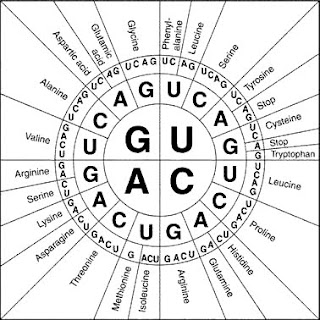
SIX KEYS TO A LITERARY GENETIC CODE

In essays on the subject of centricity, I've most often used the image of a geometrical circle, which, as I explained here,  owes someth...

Friday, March 8, 2019

MYTHCOMICS: "LIFE AND DEATH AND THE END OF TIME" (LEGION OF SUPER-HEROES #50, 1988)

ENTROPY:
a process of degradation or running down or a trend to disorder-- Merriam Webster online.

From the POV of a Silver Age DC enthusiast, John Byrne would be the incarnation of entropy. DC continuity was constructed slowly and erratically during the Silver Age, and was then codified into a regularized cosmos during what I term the Bronze Age. But by 1986, DC continuity was deemed unwieldy in comparison to competitor Marvel Comics. Byrne, who insisted on revising the Superman continuity to exclude Superboy, was one of the key players who degraded the established continuity, though to be sure if he hadn't done it, someone else would have.

Of course, the re-ordering of post-1986 continuity had a drastic effect on the profitable feature LEGION OF SUPER-HEROES, which was based on the idea that the 20th-century crusader Superboy periodically traveled to the 30th century to have adventures with a cadre of similarly teenaged heroes, the Legion. For the first few years, writer Paul Levitz compensated by inventing the idea of a "pocket universe" where the Legion's continuity was maintained. Yet, since the company didn't want, contra Byrne, any sort of Superboy flying around, that hero had to be killed-- killed by the same entity who created the pocket universe, the Time-Trapper.


This particular Legion villain had gone through some pre-1986 revisions himself. He was invented as a toss-off villain in the story "Menace of Dream Girl," wherein he prevented the heroes from traveling to the future (providing a contrast to the debuting heroine Dream Girl, who could at least intuit future occurrences). Hamilton's story implies that the Trapper is just another sci-fi mastermind, though a later Levitz story makes him into a member of a super-powerful race, the Controllers. By the time of this 1988 story, though, the Trapper becomes the embodiment of a cosmic principle:

They have called him by a thousand names. He is night. Death. Apocalypse. Eternity. Entropy. Time.

The opening pages of "End" show the solitary robed figure of the Time Trapper in a wasteland far removed from the Legion's era, while the captions inform the reader that "all things have ended here, even those that never began... If logic wars with faith over the nature of the beginning, so too it must over the ending. Logic decrees that all things begun, must end."

To say the least, this was not the typical language of a Levitz LEGION story. The elevated, philosophical tone comes closer to what Levitz sounds like in the 1978 tale "The Summoning." Clearly, whatever Levitz's personal opinion of DC's 1986 revisions, he determined that he could give his readers a good story extrapolated from the editorial mandate that "old guard" Superboy had to die. Levitz couldn't alter that policy, but he could create a situation in which the feature's incarnation of entropy was punished for his crime.

Having established the cosmic background of the villain, Levitz approaches the heroes of the Legion in more basic terms, That said, he interweaves two plotlines that are germane to the attempt of the Legionnaires-- spearheaded by their resident genius Brainiac 5-- to avenge Superboy, The first plotline involves a "friend of the Legion," Rond Vidar, who appears to have come back to life despite having been slain by his villainous father. The second thread relates to another character introduced in two earlier stories: Rugarth, a scientist accidentally transformed into another cosmic being known as "the Infinite Man." Rond's mystery is resolved later in the story, but the Infinite Man poses an interesting moral problem, since he's brain-dead and cannot agree or disagree with the role given him by Brainiac 5.


Both of these subplots, not coincidentally, involve persons who may be able to transcend death, thus setting up the suggestion that the degradation of entropy may not be the final answer to all things, as the prologue supposes.

To make the vengeance-drama more personalized, the entire Legion doesn't voyage into the entropic world to combat the Trapper. Only the four members who witnessed Superboy's death make the journey: Brainiac 5, Duo Damsel, Saturn Girl, and Mon-El (who, incidentally, was conceived as something of a Superboy knock-off). To say that the heroes are overmatched is an understatement. Duo Damsel, who lost one of her natural three bodies in an earlier adventure, loses her last extra body.


And Mon-El, the most powerful of the group, unleashes a lot of power but fails just as hard.


However, the Trapper is given some pause by Rond Vidar, whose mysterious return to life is explained by his mastery of a Green Lantern's power.


Yet in the end, Brainiac 5's plan depends on introducing the incarnation of entropy to his conceptual opposite, The green-skinned genius argues that the theory of entropy is countered by one arguing that "time itself is infinite, folding back on itself in endless cycles-- and each end may simply be a new beginning." The incarnation of this principle is, of course, the Infinity Man.


Naturally, the Legionnaires survive this cataclysm and go on to other adventures, just as the Trapper comes back in new incarnations. Levitz ends the story in circular fashion, repeating some, though not all, of the captions from the prologue, but suggesting that even the Trapper's kingdom of entropy has proven temporary.

This story, while consequential to LEGION fandom, didn't have a lot of impact on comics as a whole, certainly not as much as this week's "near-myth," "The End at Last."  Levitz and Giffen produced a better symbolic discourse in their "End of Time." But as I argued in this essay:

Though I define the quality of mythicity in narrative as that of symbolic complexity, not everyone uses the word "myth" this way. Often when the average person describes Superman or Batman as a "myth," they simply mean that they are extremely popular with many people, as some myths in the archaic world undoubtedly were. However, since not all archaic religious myths had widespread popularity-- some being confined to this or that isolated tribe of "fanboy" worshippers-- it follows that not all literary myths are going to be world-beaters either.


Tuesday, March 5, 2019

NEAR MYTHS: "THE END AT LAST" (STRANGE TALES #146, 1966)

Since this week's mythcomic falls into the domain of a metaphysical myth, this gives me an excuse to look at one of the most famous metaphysical myths in mainstream American comics.

Two issues prior to STRANGE TALES #146, Stan Lee and Steve Ditko had just finished the longest, most ambitious story-line in the "Doctor Strange" feature, during which the master of the mystic arts was forced to run from pillar to post, fleeing the minions of his earthly enemy Baron Mordo, who in turn had been granted superior magical power by the extra-dimensional dictator Dormammu. Strange attempts to cope by petitioning another entity, the mysterious Eternity, for help-- thus giving rise to one of Ditko's most visually arresting creations.


However, once Strange does find Eternity-- made to look like the cosmos in humanoid form-- the cosmic being simply tells Strange to pull himself by his own bootstraps. What seems like a brush-off turns out to be the simple truth: Strange does manage to defeat both Mordo and Dormammu without any special resources, ending both threats for the time being in #144.


The done-in-one story in #145 is so negligible that few fans back then could have anticipated that it would give way to "The End At Last"-- which was also the end of the Lee-Ditko collaboration on the good doctor or on anything else, for reasons that have been discussed on the web in great detail.

It starts out with Dormammu, smarting from his recent defeat, deciding to make another foray against the Earth-magician. In addition, the mystic madman decides to launch a pre-emptive strike against Eternity, just in case the ethereal incarnation of the cosmos might give him some trouble.


Thus Dormammu seals Eternity away in his own dimension and spirits Strange into yet another occult contest. However, Eternity doesn't stay sealed very long.


Ditko's artistry was at the top of his game here, and arguably he would never produce another magic-scape battle equal to this "clash of thaumaturgic titans." Dormammu is apparently destroyed, and Strange just barely escapes the dimensional chaos.


Yet despite the intensity and artistry of Ditko's panels, the story lacks the concrescence I've found necessary for a mythcomic. Dormammu, as always, is no more than a typical blustering tyrant despite his unique appearance, while Eternity, while pleasingly enigmatic, remains too abstract to take on any deeper resonance. Even though I would presume that Ditko's Randian outlook permitted no religious sentiments as such, I can't help feeling that he called upon Biblical myths in order to ring down the curtain on the "Doctor Strange" universe by bringing together a figurative "God" and a figurative "Satan"-- though the tone of the contest reminds me more of the pre-Adamic rebellion of Satan and his forces against God than the final conflict of Revelations.

But, even though metaphysical myths allow for more abstraction than the other three types, Ditko's opposition of "upstart evil" and "a force beyond good and evil" simply doesn't generate the symbolic discourse necessary for a full-fledged mythcomic.


Thursday, February 28, 2019

STATURE REQUIREMENTS PT. 5

First off, I'm currently not grabbed by my current term "narrative emphasis" as it applies to sorting out which character(s) in a narrative incarnate the centric will. For that matter, the earlier term "centricity" isn't all that illustrative, either. So I'm introducing yet another new term-- the first of three, in this essay alone!-- namely "charisma," which, as it happens, is sometimes defined as the means by which leaders are designated, and sometimes in terms of a mysterious attractive charm. Merriam Webster provides two definitions:

a personal magic of leadership arousing special popular loyalty or enthusiasm for a public figure (such as a political leader)

a special magnetic charm or appeal

It's easy enough to sort out charisma when a narrative, be it a stand-alone type (Philip Wylie's GLADIATOR) or a serial type (the Siegel-Shuster SUPERMAN), is indubitably focused on one character.


But as I began discussing in SUBS AND COES PT. 1, the fact that a serial narrative bears one name in the title, as with BATMAN, that doesn't mean that Batman has all the centric charisma in that narrative. Sometimes Robin is in there with him, sometimes he's not; the situation can vary from story to story or from long arc to long arc.

The term "stature" doesn't really speak to the process by which the author decides, consciously or subconsciously, what focal presences he will emphasize. Rather, the term applies best to the finished work, to deciding what characters have acquired greater stature as the result of their functions in the story. Further, charisma applies exclusively to the focal presence alone. Within a given narrative, other characters may have different levels of stature according to the narrative's needs. In one story, such as THE KILLING JOKE, the Joker has almost as much stature as Batman, while in another, such as the BATMAN TV-episode "Joker's Favor," an everyman like Charlie Collins may acquire more stature than Joker-- though without Collins exceeding Batman.


At the same time, there are, as I discussed more fully in STATURE REQUIREMENTS PT. 2,  there are a lot of "hero's sidekicks" out there who may perform many if not all of the same narrative functions as Robin-- Junior Tracy, Doctor Watson, et al-- and none of them come close to sharing centric charisma. In PART 3 I provided my analysis as to how the teleseries ANGEL started off as a "one-centric-character" narrative like that of its source-series BUFFY THE VAMPIRE SLAYER, but, perhaps for exigent reasons, it morphed into a narrative with an extended ensemble.

Now that I've put forth "charisma" as a term that better approximates the creator's organization of narrative elements, my other two terms apply to the process of whether the charisma is bestowed upon just one focal presence, or is distributed to more than one. The first would be "non-distributive," given that the charisma is not divided up, as with the Superman mythos, while the second, as seen in the Batman mythos, must be judged as "distributive" on the whole, since the Bat-mythos has a history of allotting narrative charisma to more than one presence in a sustained manner.

[After I formulated these two terms, I duly looked them up on the 'Net, and found that the pairing had been used for the (mostly unrelated) disciplines of algebra and the stock market. I think it unlikely that I'd ever heard of these usages, though.]

"Charisma" in many cases would apply more to "leadership" than to "charm." I've noted here that in many narratives, the focal presence may not be the most interesting presence in the room:

...I reject Springer's thesis that a work's "real hero" must be its most dramatically interesting person. A given author may merely wish to use the "centric will" of a given protagonist as an organizing factor, and nothing more, and there have certainly been other good stories that starred protagonists even duller than either Ivanhoe or the Spirit. 

I'll possibly discuss this dynamic further in a forthcoming follow-up to my earlier INVESTMENT VS FASCINATION essay.  However, in conclusion I should mention one situation in which a narrative can "star" more than one character and still not be distributive. Some narratives star what I call a "swarm" of interrelated characters who are not distinguishable in any important way. Each film in the ALIENS franchise concerns a different alien, or group of aliens, but despite superficial differences, they all share the same basic identity, and so each of them has but one focal presence. Occasionally this "swarm type" of focal presence includes entities with different appearances, as one can see in the Cartagrans of WAXWORK II. However, they all share the same identity, and so WAXWORK II is also a non-distributive type.


Wednesday, February 27, 2019

MYTHCOMICS: "A BAD CUT" (1987)


RANMA 1/2, Rumiko Takahashi's second long-running serial, marked a change in approach from her previous extended project, URUSEI YATSURA. The earlier serial focused on the adventures of two prickly paramours, Japanese boy-teen Ataru and alien girl Lum-- and although Takahashi often devoted considerable time to the series' support-cast, Lum and Ataru were front and center when the artist finally brought the series to a close.

However, a close reading of URUSEI's first stories suggests that Takahashi may not have originally intended Lum to be the co-star. (It's my recollection that the artist said as much at a San Diego Con many years ago, but I didn't write down her remarks.) My close reading suggests that Ataru and his normal girlfriend Shinobu might've have been Takahashi's original romantic team, with Lum registering as little more than an obnoxious intruder.

The first major arc of RANMA 1/2-- which I've chosen to title "A Bad Cut" after one of the story-titles-- seems designed to leave no room for any Lum-like character to oust the "normal girl."In URUSEI, Takahashi doesn't really devote much attention to Shinobu, but Akane Tendou, the female co-star of RANMA, gets her own personal psychology. She also has her own unique place within her family, consisting of her widowed father Soun and her two older sisters Kasumi and Nabiki. To be sure, Takahashi never, in the entire series, devotes much detail to the sisters' late mother. The mother's absence has no perceptible psychological effect on the older sisters, especially not Kasumi, who essentially takes on the role of the family's "mother" by handling all the cooking and cleaning of their home. Indeed, Kasumi never shows any sexual feelings for anyone, nor evinces any intention of leaving her faux-mother position in the family.


Akane, lacking a feminine role-model capable of helping her negotiate her interactions with boys of her own age, apparently emulates her father instead. In "Bad Cut," the reader knows little about Soun Tendou, except that he maintains the girls' home in some Japanese suburb by running a dojo (although no students are ever seen, and he's not even seen instructing Akane). Martial arts offer Akane a way to keep the male of the species at a distance, as is seen early in the arc, when she's seen literally fighting off boys at high school who think she'll date them if they defeat her.

So Akane becomes a Japanese Atlanta, using her athleticism to avoid contact with males. However, unlike the folkloric father of Atlanta, Soun does want Akane-- or at least one of his three daughters-- to marry in order to carry on the heritage of Soun's dojo. To accomplish this, Soun promises to marry one of his daughters to Ranma, the son of Soun's fellow martial artist Genma Saotome.

One day Genma and Ranma come to Japan to visit Soun-- but neither of the Saotomes is anything like what Soun remembers. It's eventually revealed that while the Saotomes traveled in China, brushing up on their martial arts disciplines, they foolishly trained in "the Ground of Accursed Springs." Over the years, many creatures, including human beings, have fallen into this or that spring and drowned-- and any spring that has drowned a living creature also has the magical power to "impress" the physical appearance of the drowned creature onto any living creature who falls into a given spring. The transformation is temporary, in that it can be reversed if the victim is doused in hot water. However, the reversal is also temporary, since cold water will return the victim to his or her cursed status. In the case of Ranma, he's cursed to transform into a girl (hence the title, which means something like "Ranma between two states"), while his father Genma does double-duty as a giant panda.


The shape-shifting antics of the Saotomes naturally provide lots of craziness for the relatively normal Akane to deal with. Neither she nor Ranma agree to their patents' idea of an arranged marriage, but Soun nevertheless invites the Saotomes to be his permanent house-guests. Thus the two teenagers are obliged to interact every day, as well as going to the same high school, and they frequently quarrel as a result, not least because they do have a tentative attraction to one another. Ranma is more often the source of the quarrels, for his upbringing as an itinerant martial artist have made him into a bantam rooster who views every confrontation as an excuse for a fight. Further, while Genma isn't particularly put out by his periodic transformations into a panda, Ranma's masculine ego is perpetually injured by his assumption of female physicality. His male mentality is never altered by his transformation, and one could hypothesize that his many years of training have atrophied his sexual instincts. Whereas URUSEI's male lead Ataru could think of nothing but chasing girls, Ranma is even less practiced than Akane at dealing with the opposite sex. Often he needles Akane about her looks, acting more like a twelve-year old than a boy of about seventeen, and yet he's immediately threatened if another male makes up to Akane. As for Akane, whenever any competition arises-- and Ranma, despite his lack of manners, attracts a lot of other girls-- she responds by violently beating up Ranma, who refuses to fight back out of a sense of chivalry.

I won't explore every incident in "A Bad Cut," which includes introducing two of Ranma's frequent foes and sexual competitors, Tatewaki Kuno and Ryoga Hibiki. It's during one of Ranma's wild fights with Ryoga that Akane's long hair gets sliced off by one of Ryoga's weapons.


Despite her masculine aggressiveness, this attack on one of her feminine attributes strikes Akane hard. Takahashi then uses flashbacks to show how as a child Akane formed a crush on a handsome local twenty-something physician, given the winsome name "Doctor Tofu." However, even as a kid Akane notices how besotted Tofu is with Kasumi, who, for her part, seems oblivious. The child-Akane lets her hair grow out in the vain hope of attracting Tofu when she's old enough, making him something of a father-imago for her.


In the intervening years, apparently Tofu never works up enough courage to disclose his feelings to Kasumi, and his character quickly disappears from the RANMA narrative, given that he served his purpose by providing Akane with an early crush-object. Clearly Takahashi found in Tofu a means to intimate the existence of Akane's normal feminine instincts, which then had to be directed toward a more appropriate boy her own age. The accidental cutting of her hair, brought about by the aggressive behavior of boys, allows Akane to "get over" her childhood crush, and although her relationship with Ranma remains fractious for the rest of the series, it's from this point on that the reader's been assured of the continuance of the "dueling lovebirds" theme for the rest of the series.


Significantly, about a year later Takahashi does get around to bringing a female character who strongly resembles Lum in being a powerful "alien" figure" the Chinese Amazon Shampoo. Though Ranma never makes love to any of the women who pursue him-- being, in his way, faithful to Akane despite her constant suspicions-- Shampoo, with her greater martial skills and her exotic sexiness, seems the greatest threat to the main romantic relationship. But Shampoo never has any of Lum's charming qualities, thus assuring that she's really no danger to the romance at all.


Tuesday, February 26, 2019

THE READING RHEUM: UPROOTED


Back in September of last year I experimented somewhat with "viewing the mode of the combative through the lens of sex rather than violence." My specific conclusions in that essay are only tangentially related to my reading of the 2015 Nebula-winning fantasy-novel UPROOTED.

There have been, as I've frequently mentioned on my FEMMES FORMIDABLES blog, hundreds if not thousands of fictional characters who conform to what I called, in LOVE OVER WAR "the fighting woman archetype." I've occasionally seen ultra-feminist ideologues complain that this archetype isn't true to the spirit of actual femininity, that it reduces the female characters to "men with boobs" or some such nonsense. Clearly, I for one don't think it's a problem to show fictional women assuming confrontational roles, like the superhero's function of fighting evil in all its forms, as opposed to some pie-in-the-sky conception of a femaleness that is ideologically opposed to confrontation.

That said, I think it's conceivable that one might be able to create a combative heroine who's oriented more on accomodation than on confrontation, going by the terms discussed in the LOVE OVER WAR series. However, such an "accomodation heroine" would have to be more than some warmed-over tripe with no theme smarter than "girls are sugar and spice and everything nice."

In UPROOTED, author Naomi Novik takes a trope seen in many archaic folktales-- that of the maiden forced to serve a strange or evil master-- and gives it several modern twists, not least being that of giving the maiden, one Agnieszka, her own individual, quirky personality. But Novik doesn't approach this challenge in the narrow, ideological manner seen in, say, Jemisin's BROKEN EARTH TRILOGY, which hardly lets a page pass without ranting against evil white males. In Novik's world, Agnieszka and her "master," the mysterious sorcerer Sarkan, evolve a fractious but ultimately emotionally rich relationship. But although it would be fair to deem Sarkan to be the "co-star" of the story, his male way of using magic-- that of constant confrontation with the book's "villain," an evil forest known as "the Wood"-- is shown to be inferior to Agnieszka's feminine sense of reaching an accomodation that heals and dispels evil rather than dominating it.

I won't go into the specifics of the plot, except to say that Novik's small fantasy-world-- loosely based on Polish folklore-- is under constant threat by the Wood, and that Novik brings that menace to a boil right at the time when the humble village-maiden Agnieszka is made aware that she, like Sarkan, was born with a wizard's power, making it incumbent on her to accept the Campbellian "call of heroic destiny." Again, unlike many feminist ideologues, Novik is actually extremely good with working out methods by which wizards might battle menaces like magical arrows and giant mantises. I'm not damning Novik with faint praise when I say that she's among the best female authors in terms of depicting invigorating combative scenarios, right alongside Rumiko Takahashi and C.L. Moore. And, as far as I'm concerned, she may even be their superior in terms of crafting battles that have a specifically feminine touch to them.

Friday, February 22, 2019

MYTHCOMICS: "BLACK GOLD" (THE SPIRIT, 1947)

Like most of the SPIRIT stories I've classified as mythcomics, "Black Gold" is not one of the better known stories in the canon. To make a loose generalization, I would say that most of the stories that other critics esteem-- whether for Will Eisner's mastery of storytelling tropes or for their appeals to comedy or sentimentality-- don't represent Eisner "digging deep" into his own power of symbol-making.

I've occasionally commented that Eisner showed a penchant for spoofing ethnicities and nationalities, and one can see an example of this in his comic Arab villain Ahmed-the-Trader in the late-1947 story "Money, Money." However, about six months prior to that tale, Eisner produced a somewhat elegaic look at the Arab world, playing off the West's discovery of oil-- a.k.a. "black gold"-- in various North African countries following the end of WWII.

Eisner begins the story with an improvised, but none the less serious, elegy for the waning fortunes of an Arab landholder, Abu Ben Adim. (Presumably the author chose the surname to signify "son of Adam," for reasons that become clearer later.) Though in antique times Abu's tribe was rich, in 1947 his land has become unfruitful and Abu is almost the last of his line. Like the original Adam, Abu has two quarreling sons, Abu's being named Hanash and Ali. Both are, to borrow from a much later Christian text, "prodigal sons" insofar as they both deserted their father's orchards to seek success in the Western world. The only reason Hanash and Ali return to their father's house is because he's on his death-bed, and both "jackals," as Abu calls them, want nothing but their unearned inheritance. Further, both of them are thoroughly rotten. Hanash in particular brings a prisoner in tow: none other than the crime-fighting Spirit. As for Ali, he has a Western woman in his company, though her face is cloaked by a veil, and as soon as he receives his bequest, he heartlessly leaves the woman behind, presumably having enjoyed some romantic tryst with her previously.


As for the bequest, Abu leaves to Ali all of his land, which Abu considers barren, and bequeaths the "family sword" to Hanash, though in dying he curses both sons for their faithlessness. Hanash believes that he's been given the stick's short end, since both brothers know that the Ben Adim land is rich in oil, and that Western petroleum companies will pay top dollar for access. Hanash retaliates by making a particularly odd attempt on his brother's life: bludgeoning him with the covered-up body of the Spirit.


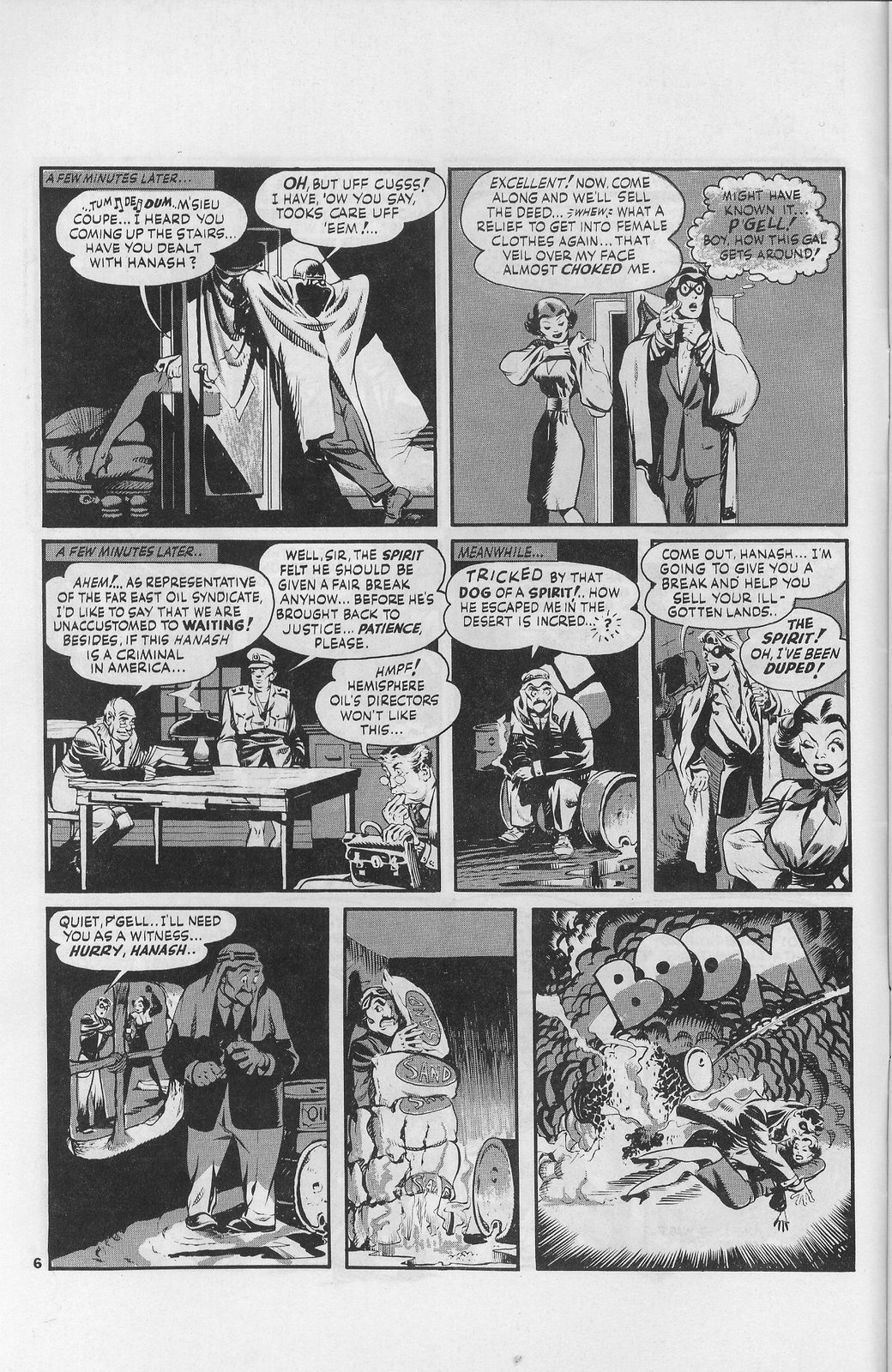
This doesn't serve to kill Ali, but while one of Hanash's henchmen takes the crimefighter away for an eventually fatal encounter, Hanash executes Ali, impaling Ali with the family sword, and in effect "exchanging" their bequests.. Ali's widow pretends to go along with Hanash, who then decides to kill off the Spirit by shooting the bound and covered figure. To no reader's surprise, it's soon revealed that the hero escaped and left the henchman bound and covered, so that the henchman dies and the Spirit can keep following Hanash. (Hanash seems a particularly dim villain, not to even check the face of the enemy he plans to execute.)


Within a few pages of this fast-paced tale, Hanash makes plans to sell off the deed he's stolen from his dead sibling, and the Spirit, trailing the villain, learns that the veiled woman is none other than his old sparring-partner P'Gell. This time the money-hungry adventuress is working hand-in-glove with the Western powers to make sure her employers get the deed, and the Spirit is fine with that, so long as he still gets to take Hanash into custody for his assorted crimes.


The story then rushes to the big twist ending: P'Gell's employers don't want just the land, they also want the family sword with which Hanash killed Ali, because there's a map on the sword that will guide the buyers to the only oil cache on the Ben Adim land. Crazed by this revelation, Hanash escapes and runs into the desert, intending to regain the sword from his murdered brother's body, but he simply perishes in the desert heat. Eisner then adds a double twist, revealing only to the reader that Ali survived his stabbing for a time. Ali crawled away from the scene of his murder, trying to slake his thirst with water, and all he found was-- oil.

In Kitchen Sink's 1986 reprint of "Black Gold," commentator Dave Schreiner elicited from Eisner the observation that "If I were doing the story today, I'd have done something about Israel becoming a state." Though this did not take place in real history until 1948, I would guess Eisner knew, even in 1947, that revolutionary Jews in Palestine were trying to oust British rule with the object of forming such a state, which become possible when the Brits left and the Israelis defeated the Arabs in the 1948 war. However, "Black Gold" is a much more mythic story by not referencing politics directly. Archaic Israel is mentioned only fleetingly, and the real bone of contention stems from the quasi-colonial efforts of the European powers to get access to the oil hidden with the earth controlled by the impoverished Arabian people. That said, Eisner certainly does not make the European powers any sort of villainous figures, and even P'Gell is relatively tame this time around. One may hazard that for Eisner the Europeans' interests would have been in line with those of America, while the interests of the Arabs would have been, to say the least, unfriendly to the interests of Jews everywhere. The idea of the cursed bequest brought to my mind the wrangling between two other Biblical siblings, Esau and Jacob, in that Jacob manages to steal Esau's birthright. In "Black Gold," though, both siblings attempt to supplant one another, and end up bringing about one another's deaths. Whether or not this is a comment on the dwindling fortunes of Arabs as Eisner saw them in 1947 is up to the individual reader.

Thursday, February 21, 2019

STATURE REQUIREMENTS PT. 4

Continuing my ruminations from Part 3 re: centricity in "serial narratives focused on ensembles"...

In contrast to live-action television shows, comic books experience no special expense when they bring in new characters, whether as new members to an ensemble, or as recurring guest-stars, or as allies who simply don't belong to the ensemble-mix. Case in point: the 1960s continuity of Marvel's AVENGERS title, following the period when Stan Lee passed the title into the hands of scripter Roy Thomas.


As most readers of Silver Age Marvel know, Lee decided, for whatever reasons, to make the AVENGERS feature look less like DC's JUSTICE LEAGUE, with the result that founding members Thor, Iron Man, Gi(ant) Man and the Wasp decided to leave the team. The latter two returned to the ensemble a little later under Thomas, but the immediate replacements, led by the new addition of Captain America, were two former X-Men adversaries, Quicksilver and Scarlet Witch, and one former Iron Man opponent, Hawkeye. All three of them were forgiven for their earlier missteps and soon became sterling examples of reputable super-heroes.


Absent from the mix, though, was Black Widow, who had been an Iron Man foe prior to Hawkeye's appearance in that venue. Despite the fact that she had been retooled in the IRON MAN feature to make her into yet another costumed hero-type, Thomas did not bring Black Widow into the Avengers. In fact, the writer raised a certain amount of "sturm and drang" by having Giant-Man (rechristened Goliath) oppose the Widow's admission to the group, largely on the basis of her Communist past. (Later fan-writers might've added that the size-changing superhero had had more than a few bad encounters with Commie villains, though Thomas never went into that much depth.) Though the Widow was eventually inducted to the super-group in the 1970s, that was some time after Thomas's tenure, during which she was something of a hanger-on at best. Thus, in the terminology I've introduced, the Black Widow was a subordinate figure to the regular ensemble of coordinated centric heroes.


However, I should clarify that membership alone was not the only factor capable of making a character a coordinated member of an ensemble. Here I return to my definition of centricity as stemming from narrative emphasis. Thomas's Black Widow hung out with the Avengers and helped them from time to time, but she wasn't coordinated not because she wasn't a member, but because Thomas didn't tell stories that relied on her presence.


As contrast, there's the example of Marvel's Hercules. This character was introduced as a "friendly adversary" to Thor in various issues of the Asgardian's title. Then in AVENGERS #38, the Olympian strongman was used by a pawn against the mortal superheroes by their old enemy the Enchantress. By the end of that story Hercules managed to throw off the villainess's control, but Herc's heavenly father Zeus conveniently exiled the demigod to Earth. For the next six issues, Hercules was no more than a guest at Avengers Mansion. He became a full member of the group in AVENGERS #45-- but during the issues in which he was just a guest, was he also just a "guest star?"

Not so. Even the stories in which the Greek hero was not an official member, Thomas wrote all of the stories to emphasize the ways in which Hercules mixed and mingled with the rest of the ensemble: challenging Captain America to a fight, darting lusty looks at the Scarlet Witch, and so on. Even a casual reader of the time could've probably guessed that the Olympian was being groomed for permanent membership, probably as a replacement for the verboten God of Thunder. Hercules didn't remain a regular member all that long in the scheme of things, but he was indubitably part of the ongoing ensemble. To be sure, some later appearances were more in the nature of guest-starring shots, but these appearances bore this nature because of a *lack* of narrative emphasis.

An even more pertinent example-- even though it takes the argument away from the Thomas tenure-- is that of the character Mantis. She came to the super-group as part of a package-deal when they agreed to bring a rogue member, her boyfriend the Swordsman, back into the fold. However, in one of her earliest appearances, she denies any desire to join the group.


However, she became, to all intents and purposes, a regular ongoing member, fighting at the sides of the other heroes, and only at the end of her association with the group do all of her superheroic friends make her a member by acclimation. But from her introduction to her last appearance, Mantis was always a part of their coordinated ensemble.