Featured Post

SIX KEYS TO A LITERARY GENETIC CODE

In essays on the subject of centricity, I've most often used the image of a geometrical circle, which, as I explained here,  owes someth...

Sunday, March 30, 2014

WHEN FUNNY ANIMALS ATTACK

Technically the words "funny animal" could be used for real-life critters who perform amusing stunts, like the contenders in Dave Letterman's "Stupid Pet Tricks." But it's generally used as it is in this Wiki-page: to signify creatures who are anthropomorphic in some way.

One variety is the fully humanized animal, who regularly walks on two legs, may wear clothes like a human, and who frequently interacts with cartoon versions of human beings.


Another type behaves in some ways like an amimal, and usually walks (or flies, or swims) as its real-world counterpart does. However, at any time such types can "take a break" and do identifiably human things.

They may do nothing more than think coherent thoughts, like the titular star of Disney's 1964 film THE THREE LIVES OF THOMASINA.


They may imitate only a few human actions, like standing on two legs. as Garfield often does. A
related but more outrageous type like Snoopy doesn't regularly wear clothes but can don them whenever he wants to take on another identity.


Some continue to go on all fours but can talk like-- and even to-- human beings, a la Scooby-Doo.


It's clear that in a purely technical sense, all of these types fall into the phenomenal category I call "the marvelous."  And yet it's clear from my studies of other compendia of metaphenomenal films that often this species of marvelous phenomenon is given a "pass." To my knowledge no such compendium has ever included 1972's SNOOPY, COME HOME, in spite of its walking, coherent-thinking "funny animal."  Similarly, in the essay ON FAIRY STORIES, Tolkien's great examination of the nature of fantasy, he excluded animal fables like those of Aesop from his realm of faerie.

I can well understand Tolkien's reticence. Features in which the characters look like humanized animals but essentially act like human beings generally fail to transmit what Tolkien called the "arresting strangeness" of fantasy. Mickey Mouse animated cartoons may at least have the mouse doing impossible things, but the Floyd Gottfredson comic strip was more like a rural comedy-adventure that just happened to star humanized mice, horses, etc. The erotic anthropomorphic comic book OMAHA CAT DANCER only rarely referenced the animal natures of the characters, whose adventures usually fell into the realm of soap-operatic melodrama.


It's as if funny animals have a certain "invisibility" in certain contexts: they're so obviously stand-ins for human beings that one doesn't think of them as "marvels" at all. I'm tempted to regard some of them, like the casts of OMAHA and  the MICKEY MOUSE comic strip as belonging to the naturalistic version of my narrative trope "delirious dreams and fallacious fantasies." However, to qualify as a "fallacious fantasy," the fantasy would have to be a phenomenon that was simply a departure from the work's diegetic "reality" that the audience was not expected to take seriously. An example of this would be the animated "Pink Panther" from the live-action PINK PANTHER films, who may comments upon, but is not involved in, the "reality" of those movie narratives.


In conclusion, I can only note that although many funny-animal works technically belong to the category of the marvelous, they often evoke so little of the affects of wonder and strangeness that they almost constitute an "attack" on their own domain.

Saturday, March 29, 2014

THE PHENOMENALITY OF PSYCHOS

In my last essay I emphasized the essential independence of dynamicity, mythicity, and their respective significant sublimity-values.  However, I also noted that their affects could become "intricately intertangled." Since I've been addressing the phenomenality of the "perilous psycho" intermittently this year, starting with the essay OF SHERLOCK AND PSYCHOS, I'll stick with this theme as a source of examples.

In the aforesaid essay I questioned in part whether or not Sherlock Holmes was always a naturalistic figure in all of his iterations.  In the third essay in this series, I observed an opposing tendency in the villain of the Holmes film A STUDY IN TERROR:

I have yet to encounter a fictionalized Jack the Ripper, however, whose spectre does not suggest either "the uncanny" or "the marvelous."  This is in contrast to many other perilous psychos. 
The character in STUDY is of the "uncanny" type, which means that he does not violate the regularity aspect of causality, but does transgress upon the expectations of intelligibility. Jack the Ripper in STUDY IN TERROR is uncanny because he is "anti-intelligible," because he cannot be reduced to naturalistic causes, even though his real-life model probably was no more than a crazy man.


A STUDY IN TERROR is also a combative film in that its hero and villain engage in a battle of spectacular violence near the film's climax.  Because this Ripper is no more than an ordinary man possessed of uncanny madness, he is also "megadynamic" in the sense I used the term here.

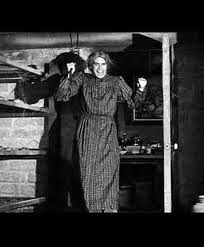
It may be harder, though, to see all such uncanny figures as megadynamic, since not all of them are as combative.  In the 1960 PSYCHO, Norman Bates is a megadynamic figure only while he pretends to be his crazed, axe-murdering mother, and only when he is assaulting women in a relatively helpless position. When this psycho is caught by an ordinary husky man, Norman's appearance of power is stripped from him like his phony white-haired wig.


I suppose that I could solve the dilemma the same way I solved the fluctuation of power-levels in the three dynamicities in DYNAMIC DUOS PT. 2: Norman is merely an "exemplary" psycho, while Jack the Ripper is an "exceptional" one.  But I find it worth noting that Norman, both in his initial prose and film incarnations, is superior in terms of his mythicity to the Ripper-character from STUDY IN TERROR.  This suggests that he is a better conduit for the "combinatory-sublime," even as the Ripper is a better conduit for "the dynamic-sublime."

At present I have not found a necessary connection between the two forms of the sublime.  It does suggest to me how some figures of comparatively low dynamicity can suggest that they are more powerful than they really are. I conclude that it is because of the effect of the combinatory-sublime, which seems to invest such figures with a larger-than-life "mana."


COMBINATORY-GLORY + DYNAMICITY-POWER= KINGDOM OF THE SUBLIME

...combinatory sublime... a sublime affect brought about by the potentially dazzling array of "changing forms"-- COMBINATORY CONSIDERATIONS.

In the case of religious myth-figures, some sort of extra-human power would seem to be implied in the very idea of religion.  Mircea Eliade once commented that the hierophany (manifestation of a god) was always also a kratophany (manifestation of power), be it the strength of Heracles, the ability of Aphrodite to make mortals fall in love, or even the power to become a holy sacrifice, as with Dionysus in his form of Zagreus.  Folklore proper, perhaps because it often stems from oral and/or rural roots, tends to deal more with clever if powerless trickster-heroes as well as types who possess superior power: types like the "Jack" of beanstalk-fame would seem to outnumber types like the German "Strong Hans."-- THE UBERMENSCH AND THE PRINTING PRESS.

In the second quote, I noted that "extra-human power" was a fundamental aspect of religious myth-figures. But I do not find it to be so fundamental in the form usually called the "folktale."

In this essay I commented on the distribution of the levels of dynamicity between three tales from the collection of the Brothers Grimm. The last-analyzed tale, "The Youth Who Went Forth to Learn What Fear Was," sports the protagonist with the greatest dynamicity, in that he overcomes threats almost as powerful as himself, so that the tale also sports the greatest potential for the "dynamic-sublime."  The tale "Hansel and Gretel" deals with protagonists who have no spectacular dynamicity themselves, but who do overcome a menace of such high dynamicity, an evil cannibal-witch.  And "The Bremen Town Musicians" deals with only a functional level of dynamicity, as a group of intelligent animals take over a house from a gang of easily routed thieves.

Having rated these stories in terms of their potential for the dynamic-sublime, do they show the same dispersion with regard to the combinatory-sublime, a response to the "dazzling array of changing forms?"

As I noted in the last essay, not all works in the marvelous phenomenality are equally able to inspire the affect of the combinatory-sublime.  Though the protagonist in the "Youth" story encounters more menaces than Hansel and Gretel do, it might be argued that none of the young hero's menaces inspire a sublime affect equal to the primary menace presented in "Hansel and Gretel," that of a cottage of candy which conceals a cannibal witch: a crone who makes an appeal to the hunger of lost children in order to satisfy her own hunger on their flesh.  Certainly "Hansel and Gretel" has a fair greater popularity than "Youth," though this in itself does not demonstrate greater mythicity.

However, "Musicians" is still on the bottom level with respect to mythicity as it is in terms of dynamicity, and this returns me to the point I made at the outset.  The only marvelous element of the story is that the animals are intelligent and can communicate with one another, though as I recall not with human beings.  This seems to be the only marvelous element one can finds in most such animal-fables, like those for which Aesop became famous, and in general, as Tolkien observed in a different context, this form doesn't usually engender much in the way of the "sense of wonder." Further, though today Aesop's oeuvre is strongly associated with animal-fables, that oeuvre also includes joke-tales of a wholly naturalistic nature:


The joke involves a woman who asks a surgeon (in this case) to cure her from approaching blindness on the understanding that he would not be paid until she was cured. The surgeon applied salves but stole from the house anything moveable during the course of his visits. Once the cure was completed, the woman refused him payment on the grounds that now her sight was worse than ever, since she could not see any of her household effects.-- "The Old Woman and the Doctor."

So the folktale, unlike the religious myth, is able to be as marvelous both with or without involving "extra-human power," or simply naturalistic, or arguably uncanny, as in the case of the most well-known version of the Bluebeard tale. 

All of these observations are pertinent as proofs of my argument that the "two sublimities" are essentially independent of one another's operations, though those operations can become intricately intertangled, as I'll note in my next essay.

OUT WITH THE OLD "PROBABILITY," IN WITH THE NEW "INTELLIGIBILITY"

In April 2013, I formulated the concept of the "combinatory-sublime," defined here as a sense of wonder born from the "endless combinations" one may find in fiction, a phrase I derived from a statement in Tolkien's ON FAIRY STORIES.  Unfortunately, though Professor Tolkien has remained a true guide in these matters, I was not as well guided by his colleague Professor Lewis.  All of the TWO SUBLIMITIES HAVE I essays, as well as the follow-up SUBLIMITY VS. MYTHICITY PT. 3, were written when I was attempting to explain the distinctions between the three phenomenalities in terms of comments made by Lewis-- and by Aristotle-- on the nature of "probability" and "possibility." I have rejected these terms now, for reasons I won't repeat, but I find it necessary to re-examine certain of those essays with the new concept of "intelligibility" in mind.

For instance, I observed in the last-cited essay that the "combinatory-sublime" was a "significant value" corresponding to the "narrative value" of a given work's mythicity.  The narrative value of mythicity denotes the density and complexity of the mythic symbols in the work; the significant value of the combinatory-sublime speaks to the reader's reaction to this density and complexity.

Parts of the SUBLIMITY essay are still unblemished by my later formulations, as when I examined the mythicity present in three franchises of each respective phenomenality:

DIRTY HARRY-- symbolizes the psychology of the (fictional) Old West, reborn in a modern urban environment
ENTER THE DRAGON-- symbolizes the psychology of the peerless martial artist, whose power lies not only in physical strength but also in his ability to "see" the weaknesses of his enemies
STAR WARS-- symbolizes the psychology of the archetypal orphan-hero, seeking to prove himself in a cruel world and finding his strength in opposition to a father (and a grandfather) archetype

But the next paragraph unfortunately tries to define the effects of the combinatory-sublime in terms of what the reader may think to be probable and/or possible:

 On the level of the narrative value, all of these myth-functions are equal.  HOWEVER-- the potential of myth-combination is inevitably limited in Dirty Harry's world, since a naturalistic world always values verisimilitude over myth's improbabilities.  Works in an uncanny world have more leeway to be improbable, and thus greater combinatory power-- while marvelous works, able to present various levels of "the impossible," can present more combinations of elements than either.  Thus it seems demonstrable that because mythic/symbolic aspects are so highly referential in nature, this principle skews more toward the significant value of the "combinatory sublime," toward calling attention to the difference between the dancers and the dance.
Now I would rephrase this to say that the combinatory-sublime arises rather from the transgression upon the reader's expectations in terms of intelligibility and regularity. DIRTY HARRY, a naturalistic work which conforms to general expectations regarding intelligibility and regularity, has its own proper level of mythicity but is not likely to inspire a high level of the combinatory-sublime because of said conformity. ENTER THE DRAGON conforms to expectations regarding regularity but not intelligibility; being "anti-intelligible," it has a higher potential to arouse the combinatory-sublime. And STAR WARS, which violates both intelligibility and regularity, has the greatest mythicity of the three in reality, as well as the greatest potential for symbolic combinations and thus for the combinatory-sublime.

Now, I add "potential" because one can only assert abstract matters such as mythicity in purely logical terms, not in terms of statistical analysis. Suppose that in place of three 1970s action-films by different authors, I substitute three plays with the same separate phenomenalities from the same author:

HAMLET (1599-1601)= "uncanny"
KING LEAR (1605-06)= "naturalistic"
MACBETH (1606)= "marvelous"

Just as no one can prove via statistics that any of these well-regarded is factually "better" than one another, no one can prove that the mythicity of one is "better" than the other. However, it can be argued logically that Shakespeare's mythicity is highly dependent on his frequent references to myth, religion and folklore, even within a naturalistic context like that of KING LEAR. Therefore even when a given work does not violate intelligibility and regularity, its principal if not exclusive means of gaining mythicity stems from making reference to mythico-religious beliefs, which are dominantly based upon the violation of intelligibility and regularity. It is for this reason that I state that works of the marvelous possess the greatest potential for the combinatory-sublime, not because I believe that every actual work of the marvelous possesses superior mythicity to the works of the other two phenomenalities.

Friday, March 28, 2014

HERO VS. ANTIHERO VS. DEMIHERO

The term "antihero," which dates back to 1714, is defined thusly on Wikipedia:

 a leading character in a film, book or play who lacks the traditional heroic qualities

My concept of the "demihero" will probably never supplant this better-known formulation, but in my essays I've tried to show that "heroic qualities" can appear in all four of my persona-types, as can "unheroic qualities"-- which in this case would probably parallel other paired concepts in my system, ranging from "life-affirming forces/life-denying forces," "glory/persistence," or "idealizing will/existential will." In THE COMPLICATIONS OF COMEDY PT. 2 I noted the intermixing of the "positive" and the "negative" in Marvel's "unheroic hero," The Punisher:

It's less typical for focal heroes to have negative manifestations.  Marvel Comics' Punisher would probably be one example, in that his obsession to eradicate crime, though certainly larger-than-life, is rooted in his personal animus rather than in concern for life.  The Punisher does end up supporting the forces of life, but he's not always admired for his persistence, so that he ends up becoming a quasi-villain in the features of other Marvel heroes like Daredevil and Captain America, or getting beat up by Batman in a throwaway scene of JLA/AVENGERS.


An even better example of this intermixed quality appears in a novel I recently reviewed on my book-and-comics review site OUROBOROS DREAMS: the character of Hell Tanner, the hero of Roger Zelazny's 1969 DAMNATION ALLEY. In part I wrote:

Zelazny isn't simply glorifying the type of antihero that became fashionable in the 1960s.  Although Hell is a son of a bitch, he begins to have a very unsentimental appreciation for the magnitude of his task...

This appreciation appears in this excerpt from Hell Tanner's thoughts about his mission:

 Nobody had ever asked him to do anything important before, and he hoped that nobody ever would again. Now, though, he was taken by the feeling that he could do it. He wanted to do it. Damnation Alley lay all about him, burning, fuming, shaking, and if he could not run it, then half the world would die, and the chances would be doubled that one day all the world would be part of the Alley.


Now, going by the Wikipedia definition-- and by the generally lax way that the term "antihero" is tossed around-- one could judge Hell Tanner to be an "antihero," simply because he "lacks the traditional heroic qualities." Indeed, I have seen two online reviews of the novel that use the term. However, I think that even though Tanner has any number of negative aspects, his heroic ones dominate the unheroic (or demiheroic) ones.  The passage cited above is not the sort of thought one would find in the heads of characters usually out only for themselves, indicating to me that author Zelazny wanted to delve into deeper waters. He seems to have wanted to put a vicious son-of-a-bitch in the position of acting heroically even though he has no sentimental regard for society or its members. Like the Punisher, Tanner is a hero who affirms life even though he may choose at any time to kill or maim anyone he doesn't like. 

The reverse is seen in the case of the cinematic Rick Deckard of Ridley Scott's 1982 BLADE RUNNER. In this essay I gave my reasons for regarding this Deckard as a combative demihero. Through a Google search I've seen many online sources regard Deckard as an "antihero," but in my opinion the use of this term blurs a crucial distinction between Deckard and Tanner: that the former is motivated only by the quality of "persistence"-- that is, of making sure that he and his immediate loved ones can survive-- while the latter is motivated by the quality of "glory," that of doing something great even though it defies the logic of survival.


Saturday, March 22, 2014

PERFECT STORMS OF SEX AND VIOLENCE

I mean, you’re willing to defend sex and violence from highbrow critics, but somehow slapstick is to be scorned? Come on now.-- Noah Berlatsky to me in this essay's response-thread.

There's no point in trying to reconstruct whatever tenuous line of logic Berlatsky used in making this remark, since it had almost nothing to do with the argument we were having on his essay-thread back in January.  Had I asked him at the time what "defense of sex and violence" of mine he was referencing, I don't imagine Berlatsky would have given me a straight answer.  But compared to some responses I've received from illiterate know-nothings, Berlatsky's summary, apart from its irrelevant aside about slapstick, is at least partly on the money.

It's partly misleading, as well, though. I don't defend *all* sex and violence; I defend the principle that it can be used well, like anything else in fiction.  In 2009 I gave an example of a piss-poor execution of the use of violence when I reviewed a hyper-violent comic book, BLACKEST NIGHT #1, and said:


my problem is not that [Geoff] Johns put these characters through the wringer. I like them all, but I don't mind seeing them travestied, if it's done with some imagination.
At the same time, I have defended the use of violence when it's been used just for kicks, if I think that some degree of imagination had been evoked, as with this once-infamous scene from SUPERGIRL #14:


I won't repeat the specific arguments I used to refute "highbrow critic" Dirk Deppey's interpretation.  But I will extend those arguments to observe that often when highbrow types object to this sort of hyper-violence, with or without erotic elements, they're taking issue with the very nature of popular art, which is generally characterized by its ability to deliver almost pure kinetic entertainment to any audience, or as one story weekly of the 1880s called it, "sensational fiction with no philosophy."
For highbrow/elitist critics the lack of philosophy in narrative is anathema, which may be why they so often pursue Sigmund Freud's strategy: claiming that one can read such entertainments in order to reveal latent meanings that show the philosophical underpinnings not of the work or its author but of the culture that formed both.  Usually this cultural substructure embodies some psychological or sociological opinions or practices that the critics do not like-- e.g., masculinism, fascism, and so on-- and so the identification of this alleged "latent content" takes the form of casting out the critics' personal demons.

While I've gone on record as saying that these and other deeper facets do exist, and that even the most barren seeming narrative does have some "philosophy," my approach is Campbellian rather than Freudian/Marxist.  SUPERGIRL #14 doesn't have many deeper facets, but those that are present relate to mythic tropes like "the Hero Gains a New Power," which is what's transpiring in the violent scene above when the titular heroine stabs her bat-attacker.

These distinctions apply to sex as much as violence, for though the two are separable kinetic phenomena both in the real world and the world of fictional narrative, they have an interconnectedness best expressed by George Bataille.

...of all forms of human might/activity, violence and sex are the perfect exemplars of competition and cooperation, and therefore of the thymotic tensions that pervade all human societies and cultures.  Further, violence and sex are also the primary sources of what Bataille calls "sensuous frenzy," which may be termed the perception that one's thymos has become so expanded as to escape the confines of one's body.-- A REALLY LONG DEFINITION OF VIOLENCE, PT. 3.

I've used the term "perfect storm" in the title, defined by Wikipedia as "a rare combination of circumstances will aggravate a situation drastically." The meaning is usually negative in the real world.  As I apply it to narrative fiction, it's a positive thing, referencing the ways in which the creative forces of an author, or set of authors, may combine elements of a narrative to create storms of sex and/or violence that sweep away the senses, and arguably promote the sense of the sublime.

Do people experience such storms in the real world?  It's obvious how the "swept away" metaphor applies to sex, but it can apply no less to certain experiences of violent conflict, or at least to people coveting glorious battle: one might recall my observation here that "an estimated 150,000 German soldiers went off to the trenches with [THUS SPAKE] ZARATHUSTRA in their knapsacks."  But such real-world tempests are limited to those who experience them, and they can be communicated to others-- usually for the purpose of engendering envy-- only through narrative, albeit not the narrative of fiction.

In contrast, the sensuous frenzies of fictional sex and violence potentially belong to everyone.  The vagaries of taste insure that even the kinetic scenes that are most celebrated at any given time will not please absolutely everyone, and in some other time they may fall out of favor. Further, there may be some danger in concentrating on the kinetic to the exclusion of other aspects, which makes certain aspects of Camille Paglia's criticism as problematic as the ratiocentric prejudices of the highbrows.  In criticism, too, one desires a "perfect storm," where all potential insights come together for a spectacular breakthrough.

Friday, March 21, 2014

ROBINSON CRUSADE

I should expand a little on my remarks here, with regard to my speculative citation of ROBINSON CRUSOE as a contender for the "first work of popular fiction" in Western culture.

CRUSOE was not intended as a work of popular fiction in the sense that we use the term today. Though I confess that I have not read Defoe's entire novel, its deeper themes mark it as an ancestor of the form Voltaire later called the "conte philosophique," which he Voltaire coined in opposition to simple "popular tales."  This online journal includes an essay by one Peter Leithart, who asserts that "Robinson Crusoe is a novel that continually threatens to collapse into allegory." 

CRUSOE was not the first work of "elite culture" ever to become popular with the masses. We know from Ben Jonson's remarks that the audience he shared with William Shakespeare embraced the "mouldy tale" of PERICLES PRINCE OF TYRE, though the folkloric feel of the play alienated many later generations. But I perceive that CRUSOE, writing to a post-literate populace-- that is, one that had become dominantly literate and accepted all the customs of literacy-- validated the nature of the visceral and the popular in CRUSOE in a way that could not have happened with PERICLES or any similar work.

In the opening chapter of the literary survey LOVE AND DEATH IN THE AMERICAN NOVEL, critic Leslie Fiedler suggests some of the reasons that this may have come about.  Fiedler deems the eighteenth century to be the period of a "continuing, complex event" he calls "the Break-Through," in which many if not all of the old societal beliefs began to undergo a systematic reversal.

Whatever has been suspect, outcast and denied is postulated as the source of good... in a matter of months, Don Juan, enemy of Heaven and the family, has been transformed from villain to hero, and before the process is finished, audiences have learned to weep for Shylock rather than laugh him from the stage. The legendary rebels and outcasts, Prometheus and Cain, Judas and the Wandering Jew, Faust and Lucifer himself are one by one redeemed.

The same principle holds for that ancestor of the horror-genre, the Gothic:

..."gothic" passes from a term of contempt to one of description and then of praise...

Fiedler, although he would champion popular fiction in many of his later works, does not treat popular fiction as a separate subject in LOVE AND DEATH, as this work is concerned largely with the novels that became canonical literary works.  But I assert that, in addition to the developments Fiedler cites for the Break-Through, another such turnabout is one in which fiction aimed at the masses began to be valued.  Admittedly, the next three centuries had no shortage of highbrow critics inveighing against the merely popular, one example of which can be read here. 

ROBINSON CRUSOE, perhaps as much or more than THE CASTLE OF OTRANTO, may have played a key role in fomenting the rise of "popular tales," even if neither Defoe nor Walpole intended to bring about such a revolution in literary taste.  Significantly,  CRUSOE is the first novel of the 18th century to become popular enough to generate two sequels, as well as engendering its own eponymous genre, the "robinsonade."  Predictably enough, many of the works listed as followers in this generic tradition-- particularly the best-known, the 1812 SWISS FAMILY ROBINSON-- have little of the "conte philosophique" about them.  But this was only fair, given that "elite culture" had a long tradition of borrowing from the pre-literate forms of "popular fiction"-- with the great Bard of Avon fairly well leading the pack in this respect.