Featured Post

SIX KEYS TO A LITERARY GENETIC CODE

In essays on the subject of centricity, I've most often used the image of a geometrical circle, which, as I explained here,  owes someth...

Thursday, February 2, 2017

MYTHCOMICS: FLEX MENTALLO (1996)

To repeat my criteria from POMO AND PLURALISM, I’m judging works as “modernist” or “post-modernist” based on the author’s attitude toward the nature of the universe on which the work is modeled. A modernist work starts with the proposition that the fictional world depicted is modeled on a single “realistic” world that can be largely explained by science and rationality. A post-modern work states or implies the possibility of a multiplicity of worlds in the story, which may imply a similar statement about the reader’s real world, if only in metaphorical terms. Alan Moore’s MIRACLEMAN stands as an example of the first type, reading various superhero tropes, mostly from franchises like “Superman” and the Golden Age “Captain Marvel,”as pointless escapes from a unitary, mundane realty.


Though the Internet is rife with various descriptions of a personal feud between Alan Moore and Grant Morrison, there’s no reason to assume that Morrison’s commentary on superhero tropes, either in FLEX MENTALLO or elsewhere, is necessarily a response to Moore’s treatment of them.  That said, MENTALLO also gives a great deal of emphasis to tropes associated with Superman and Captain Marvel, as well as those of The Question, Steve Ditko’s most philosophically representative creation, whom Alan Moore parodied in WATCHMEN as “Rorshach.”

The character Flex Mentallo first appeared as a fully formed concept in issue #42 of Morrison’s DOOM PATROL. This was also an endorsement of the relativity of reality, in that Flex was a character created in an amateur comic book by a kid named Wally Sage. Sage’s latent psychic powers brought Flex to life in the “real world”—or at least, as real as the Earth of DC Comics could get. 

Flex was also “unreal” in that he was modeled on the once prevalent ‘Charles Atlas” bodybuilding ads that appeared in commercial comics for many decades. Yet instead of depending on physical strength as did the character in the ads, Flex’s power was to project waves of energy from his unified “bodymind.” Nowhere in the DOOM PATROL or in this mini-series does Flex actually hit anyone in the old-fashioned way. Morrison didn't even stress any continuity between the miniseries and Flex’s previous appearances. Flex seems to exist in a world that barely has any superheroes left, which means that it can’t be DC-Earth. He does seem to share the same world as his now-adult creator Wally Sage. The two of them never meet, though they both encounter some of the same supporting characters.

The plot of FLEX MENTALLO isn’t intended to be especially coherent, so I won’t spend time summarizing it. The story more or less begins with the musclebound protagonist looking for one of his long-vanished crime-fighter colleagues, the Fact (who is in part Morrison’s take on The Question). Flex wanders through his unnamed city, having mystifying encounters with the remnants of the native superhero world, or with super-people who seem to be emigrants of some disintegrating cosmos.


Counterpointing Flex Mentallo’s peripatetic quest are the largely verbal divagations of Wally Sage. He spends most of the mini-series talking on the phone with an unseen volunteer for a crisis hotline—said crisis being that the reality-hating Wally has taken pills in an attempt to commit suicide. True, Wally is so addled that he’s not sure whether he took barbiturates or M&Ms. In many respects he seems to be the epitome of the escapist superhero fan with his head up his ass, for all he can talk about is his juvenile love of superheroes:

“…when you think about it, they’re like archetypal… they come right up from the depths, those things—how can they that stuff’s stupid?”

The imputation that superheroes are juvenile escapism is the place where most elitist critiques of the genre both start and stop. But even though Wally’s pretty messed up, Morrison implies that the character's desire for visionary experience allows him to tap into a deeper level of reality. Wally has suppressed memories that initially seem to be recollections of sexual abuse, but turn out to be a childhood encounter with “the Legion of Legions,” who are some of those emigrant superheroes mentioned earlier, trying to manifest in a nearly superhero-less world.


There’s also one more subplot: Flex has an ally on the police force, name of Harry, and for some reason Harry enlists the help of an imprisoned super-villain to investigate the threat of world destruction. The villain’s name, The Hoaxer, is a patent reference to The Riddler, making him the only major reference to DC’s Bat-mythology.

Although Morrison’s main project is to demonstrate the reality of the superhero world, if only in archetypal terms, he doesn’t neglect to picture the limitations of ordinary reality. He devotes several pages to an unnamed junkie/ male prostitute who desires transcendence so badly that he takes a drug designed to make him feel like a superhero, but he dies in the attempt. Flex tries to save him by resorting to a magic word written on a piece of paper, but finds that he’s lost the paper. 


This absurdist subversion of a standard “life-saving” trope is also another standard trope of elitist critiques. Nevertheless, Wally survives while the “last boy on Earth” (as the junkie calls himself) perishes, even though Wally clearly knows his way around a pharmacy as well. It's possibly meaningful that Wally's insights go beyond his own personal welfare, as when he conceives that the emigrant superheroes “live in a factory where ideas are made.” Further, Wally’s visions are oriented not only on himself but upon humanity as a whole, saying of superheroes, “We can be them.”

To be sure, Morrison’s vision of what superheroes mean doesn’t resemble that of most critics, even though at one point Wally declares, “Frederic Wertham was fucking right!” Clearly Morrison isn’t thinking about sexual superheroes in the same way Wertham did: as seductive power-fantasies devised to seduce innocent children. Sexual realization is part of Morrison’s program of visionary fulfillment.

Nowhere is this seen more clearly than in the author’s validation of the Silver Age of Comics, which is, as many fans know, the comics-age Morrison experienced as a young fan. Wally observes that the Golden Age of superheroes was “pretty simple,” boiling down to the “Charles Atlas hard body homoerotic wish-fulfillment.”  (I disagree, but this one interpretation doesn’t undermine the general strength of Morrison’s theme.) Wally then observes that the Silver Age changed the paradigm. “Strange transformations, multiple realities, dreams, hoaxes… it was like the hard body began to turn soft...” I could carp that this description mostly applies to the line of Superman comics supervised by Mort Weisinger, with a little Julie Schwartz on the side, but it’s still a stimulating reading.

The miniseries concludes on the implication that the emigrant superheroes will indeed break through to Wally’s fallen reality. I’m not quite prepared to term this a Jungian katabasis, given that I think Morrison is at best a dilettante Jungian. Nevertheless, when he has Wally speak of a “synchro-interaction with readers” of this “ultra-post-futurist comic,” I’d like to think that he, as much as Jung, is trying to show the favorable aspects of understanding more worlds than just the one in front of one’s nose every day.


Tuesday, January 31, 2017

THE SUBJECTIVITY WAS ROSY

I stumbled across Dirk Deppey's current blog, which I mentioned before in two posts, here and here. He had supplied a link to one of my old essays in which I argued with him, and I thought that my response-essays would probably be the last I'd write about him.

Then I see that he's got a quote from me in his current portal:

"Like most Journalistas, Dirk Deppey is spiritual kin to Fredric Wertham."

I don't have anything new to say about either the original context of my remark or about the wry, jokey context in which Deppey presents it. So instead I'll touch on something that interests me more: the subjectivity of taste.

I've occasionally discussed my belief that the decade of the 1970s, more or less equivalent to the so-called "Bronze Age of Comics," was a crucial creative time for mainstream American comics. Deppey, in a 2007 essay, found the decade more than a little wanting:

And then there were all the old Marvels of my childhood. At last, I could read all the good stuff that I'd heard people praise, but that I'd never had a chance to see!
Actually reading them disabused me of any notion that these were good comics. Jim Starlin's stuff approached "vaguely interesting," once or twice, but beyond that? Crap. Killraven? Crap. Marvel's horror line? Crap. The early Conan and Red Sonja comics had nice art, but were all written in that stilted voice that Stan Lee had used for Thor comics. ("Zounds!") Even those old X-Men comics quickly lost their luster once I could no longer read them with a nine-year-old's eyes. Hell, the first half of Frank Miller's run on Daredevil was nowhere near as cool as I remembered it.


Obviously, I don't care about his opinions any more than Deppey would care about mine. What I care about is the question as to what individual taste means in a social context.

I scraped at the iceberg of an "intersubjectivity solution" here and here, where in essence I was giving one of Tom Spurgeon's broadsides more attention than it really merited. Deppey's above comment also doesn't really amount to much in analytical terms, but as I said in the intersubjectivity essays, both my opinion that Marvel's KILLRAVEN was good and Deppey's ppinion that it was "crap" are right insofar as they capture whatever expectations either of us has for quality fiction. I summed up the essentially non-rational nature of taste in KIRBY'S CHOICE PT. 2:

Every expression of personal taste, I suggest, is informed by what I will now dub "proto-propositions."  In attempting to justify my liking of FANTASTIC FOUR over CHALLENGERS, my mind might initially formulate the proto-proposition, "I like The FANTASTIC FOUR better than CHALLENGERS for the emotions in FF."  With conscious thought I can expand this statement into a full-fledged proposition, one phrased so as to show how the FANTASTIC FOUR characters show many dimensions while those of the CHALLENGERS do not, complete with examples and counter-examples to support my propositional logic.  Equally valid is the proto-proposition of a fan who might not like superheroes of any kind: "I like CAPTAIN MARVEL better than HUMAN TORCH because the first one shows superheroes as silly"...  But no matter how good or bad the formal proposition, it remains rooted in a "proto-proposition" that expresses whatever validates the individual subject...

So, as I'm sure I've said a few other times, it's idiotic to debate tastes; all one can only debate the fully logical propositions one uses to defend one's tastes. Deppey chooses to defend his 2007 tastes by the usual elitist attempt to run down the tastes of others, in this case by claiming that anyone who liked the works must have read nothing but comic books.

I suspect that what protected me from 1970s Marvel worship despite having read a bunch of them as a kid was the fact that I read too much prose at the time to ever consider such comics as the be-all and end-all of storytelling. I wasn't exactly reading Proust as a child, but even 1970s YA novels like O.T. Nelson's The Girl Who Owned a City had a depth and grounding to it that was absent at Marvel — or DC, or Charlton, or anything else that published for the spinner racks during the years that Gerald Ford and Jimmy Carter were president.

Since I know the kinds of things I was reading around the time I was also reading 1970s comics, I think it far from likely that my liking for Bronze Age comics was a consequence of considering them "the be-all and end-all of storytelling." There may well be some extreme comics-fans who would never read anything but funnybooks. But then, where are the statistics to prove that they were typical of the fandom of the period? I noted in KIRBY'S CHOICE PT. 2 that 'even *intersubjective* agreements are significant only to the degree one finds their statistical dominance important.'

Without any such statistics, Deppey's assertion by itself is just another proto-proposition with nothing to back it up-- and one which validates the individual subject, Dirk Deppey, as a Person of Taste as against the Undiscriminating Rabble.

A final note: I wouldn't mind arguing on some more current Deppey topic if he cared to write something more current. However, an awful lot of space on the site is devoted to the films of Pedro Almodovar, and I can't very well argue about those-- given that they are such unremitting crap.

Monday, January 30, 2017

NULL-MYTHS: MARVEL'S ORIGINAL GHOST RIDER (1967-1971)

To repeat one of my observations on null-myths from this essay:

...when I originally started using the term "null-myth" here, I was primarily applying it to story-elements whose mythic content was negligible in their execution (albeit not potential).
And:

....because of my realization that on occasions a given work may have symbolic potential, and yet does not use it because of some flaw in the execution, I've started utilizing "null-myth" as a label for all examples of "frustrated mythicity"

I've devoted a handful of posts lately to the Gary Friederich/Mike Ploog Ghost Rider of the horror boom, so it occurred to me to go back and reread the first Marvel character of that name. Though I was a hardcore collector by 1966-67, it's my memory that I didn't buy the seven issues of the character's own magazine on newsstands, nor his second series as a feature in the 1970s anthology comic WESTERN GUNFIGHTERS 1-7. I wasn't aware till long after that period that there had been an almost identical "Ghost Rider" from the Golden Age, published by Vincent Sullivan's "Magazine Enterprises," and that one of the creators of that character-- though he credited Sullivan with dreaming up the basic idea-- was Dick Ayers, who penciled all the episodes of the Marvel character until his arc concluded in WG #7. Indeed, this blogpost and its responses include the assertion that Marvel may have cancelled the featured title because of a threatened lawsuit from Sullivan.


I remember getting a fair amount of enjoyment out of the first seven GHOST RIDER issues, because it was a very basic imitation of earlier Marvel features. The first issue introduces schoolteacher Carter Slade, journeying to a podunk Western town when he comes across an apparent Indian massacre. He tries to stop the Indians, who turn out to be white men in masquerade. Slade is shot and mortally wounded, but an orphan boy comes across his body and tries to take him to town. Instead the boy encounters a tribe of real Indians. The tribe's medicine man Flaming Star not only saves Slade from death, he gives the schoolteacher a sacred mission: to become a white-garbed crusader for western justice, using a special set of illusion-tools that Flaming Star has devised. Slade duly signs up for the task of becoming the Ghost Rider with very little protest, and gains the orphan boy Jamie as a confidante.

Slade meets the rest of his cast upon arriving at the podunk town: beautiful Natalie Brooks, her hothead brother Ben (who becomes the town sheriff in the first issue), and Natalie's fiancee Clay. Slade is immediately smitten with Natalie, which was surely Gary Friedrich's attempt to emulate the soap-opera melodrama prevalent in most Marvel titles of the decade. For the next seven issues, Slade tries to balance his duties as a teacher with fighting costumed varmints like the Tarantula and the Sting-Ray as the Ghost Rider, all the while mooning over a woman who vaguely suspects his affection but is still deeply in love with her fiancee.

I don't know if the GHOST RIDER magazine could have succeeded at the time had there been no prospect of a lawsuit. Both Marvel and DC continued to publish westerns throughout the 1970s, so clearly someone was buying them, even in reprint form. But the feature had a number of problems, for both Friedrich's writing and Ayers' art were never more than adequate. Around the same time John Buscema's art was becoming a dominant Marvel house style, despite the fact that the artist had little interest in superheroes, and Ayers' largely functional layouts probably wouldn't have grabbed the typical Marvel reader for many more issues, anyway. The lawsuit, if genuine, would have made the matter academic, as Marvel would soon divert the trademarked name into a property that no longer resembled any Vince Sullivan work: the Friedrich/Ploog "Ghost Rider."


Further, though Friedrich and Ayers had earned some fan-respect for their collaboration on the "Sergeant Fury" title, neither one succeeded in giving the Sagebrush Spook a memorable rogues' gallery. But even more germane to my topic of the "null-myth" was the aforesaid angle of the "romantic fantasy."

It was typical enough for Marvel titles to deal in romantic conflicts, sometimes between the main hero and some male member of his support-cast. Marvel's flagship title FANTASTIC FOUR started off by suggesting that Ben Grimm might nurture some affection for the fiancee of his friend Reed Richards. However, in the next few issues there were no more overt hints of Ben being interested in Sue Storm, and the idea that she was already Reed's fiancee was also dropped. The "sympathetic villain" Sub-Mariner showed up and started questing after Sue's affections, but he wasn't one of the main heroes in the title. Thus GHOST RIDER seems to be the first time a central Marvel hero become besotted with another man's fiancee. He nobly kept his feelings to himself, but the one time Natalie suspects his affection, she maintains a loyal attachment to her fiancee Clay-- which, for most readers, would have signaled that the whole romantic fantasy wasn't about to go anywhere.

I mentioned that Natalie had a brother, Sheriff Ben Brooks. He was clearly constructed by Friedrich and Ayers as a cowtown version of J. Jonah Jameson. He immediately took a dislike to the Ghost Rider despite the hero's good deeds, and so existed largely to complicate the main character's life. But where the Jameson character in SPIDER-MAN took on a fairly logical psychology over time, Ben Brooks was just a functional plot-device, nothing more.

As I re-read these old comics, though, I thought of a possible fix: what if the fiancee Clay had been the one who had an irrational hatred of Ghost Rider, and what if he, rather than the negligible brother, had been the sheriff? Clay was never shown to be aware of Slade's affection for his intended, but it would have made for a slightly better psychological myth if he'd been the one repeatedly gunning for the Ghost Rider, his animus stemming from some subconscious awareness that the Rider and his romantic enemy were one and the same.


To be sure, I know why Friedrich didn't go that way: Clay also had a double identity, functioning as one of Ghost Rider's villains. But even when this fact was revealed, Friedrich didn't seem to know how to get any dramatic heft out of it. Friedrich left the series before its final issues in WESTERN GUNFIGHTERS, and writer Len Wein stepped in with a story that terminated Carter Slade's career as a hero, and transferred the mantle to Slade's brother Lincoln-- though this transfer also became academic in the wake of a new and different Rider.


All that said, in a strange way Carter Slade's history as a man tempted to be a seducer ended up being transmitted to his brother. Re-dubbed "the Phantom Rider" in later Marvel comics, Lincoln did what Carter would not, succumbing to his passions and using drugs to seduce the superheroine Mockingbird-- who was, at that time, the wife of superhero Hawkeye. So in a strange way, the "frustrated mythicity" of the original Marvel Ghost Rider bore fruit in another incarnation.


ADDENDUM: Incidentally, as a result of further research, I found out that the 1967 character wasn't the first time the ME "Ghost Rider' got copied. Atlas, the ancestor of Marvel, published another "Ghost Rider" in the 1950s, though at least he didn't swipe the look and devices of the ME character.


Saturday, January 28, 2017

MYTHCOMICS: "A DREAM OF FLYING" (MIRACLEMAN, 1982)

(Note: "A Dream of Flying" is the title of the first MIRACLEMAN story, and is used for a Marvel Comics reprint of material with the character. In my review-usage the title denotes what I deem the first main arc of the MIRACLEMAN story, from the beginning to the death of the hero's principal villain.)

Though WATCHMEN will probably continue as the main touchstone for many readers regarding the talents of Alan Moore, MARVELMAN-- renamed MIRACLEMAN in its first and subsequent American reprints-- may carry more cultural weight in the long run. When the character first appeared in the first issue of Great Britain's WARRIOR magazine (1982), Moore's idea of examining the superhero in more realistic terms was far from new, as evinced by the 1970s works of creators like Steve Gerber (for DEFENDERS) and Ross Andru (for THE FLASH)-- to say nothing of the Lee-Ditko SPIDER-MAN of the 1960s.


What Moore did was to up the game. Lee, Gerber and Andru all remained firmly within the ethos of melodramatic entertainment, but Moore created a sociological and psychological myth of the superhero that embraced the dominant critical attitude he'd apparently grown up with: that of literary modernism.

In this essay I touched on the salient differences of modernism and post-modernism as regards popular culture, so when I define Moore as a modernist, I'm thinking primarily in terms of my distinction that "modernism was essentially tied to a realistic paradigm not appreciably different from that of representational realism, and that post-modernism was in essence a reaction against that realistic paradigm."


In short, though Moore did not invent the idea of "the realistic superhero," he brought the idea in line with one particular philosophical outlook: that of rejecting the fantasy-appeal of violence and regarding it as a violation of "real" human values. Though not all literary modernist authors favored this view-- Jack London being a major exception-- it's a common trope throughout the early 20th century. A cogent example would be Simone Weil's 1939 essay THE ILIAD, OR THE POEM OF FORCE, whose radical interpretation of Homer's classic epic was grounded in a rejection of the credo of "force" that had plunged the world into a Second World War.

The true hero, the true subject, the centre of the Iliad, is force. Force employed by man, force that enslaves man, force before which man's flesh shrinks away. In this work at all times, the human spirit is shown as modified by its relation to force, as swept away, blinded, by the very force it imagined it could handle, as deformed by the weight of the force it submits to.

In old interviews Moore stated that in his MIRACLEMAN work he was seeking to exorcise the part of him that loved the "fascist power-fantasies" of the 1950s "Marvelman," of which MIRACLEMAN was a more "adult" reboot. Throughout the first large arc of the story crafted by Moore and various artists, the inhuman "force" which Miracleman incarnates-- as well as his fellow "monster" Kid Miracleman-- is treated as a source of horror rather than as an occasion for juvenile excitement. Moore's "overthought," as I've employed the term here, is clearly to interrogate the genre of superheroes for its love of "force before which man's flesh shrinks away," as Weil puts it. In many respects, Moore's tone sounds not unlike that of Frederic Wertham, decrying outrageous fantasies in favor of humble normalcy.

And yet, despite the mediocrity of this "overthought," Moore was-- and possibly still is-- too much of an artist not to allow for a deeper "underthought," in which he can still see superheroes and supervillains as transcendent presences. Thus we get this authorial observation during the city-smashing battle between Miracleman and his opposite number, Kid Miracleman.

They are titans, and we will never understand the alien inferno that blazes in the furnace of their souls. We are only human. We will never grasp their hopes, their despair, never comprehend the blistering rage that informs each devastating blow… We will never know the destiny that howls in their hearts, never know their pain, their love, their almost sexual hatred… …And perhaps we will be the less for that.

This poetic aside does not nullify the thrust of Moore's modernist critique, of course. In the "real world," superheroes are not made by stalwart young chaps being given powers by saintly old wizards. Such expenditures can only come from the government, and the government only makes such expenditures in the name of war-technology. That said, Moore can't quite resist the allure of  a key trope of superhero fiction: the "supervillain-as-master-manipulator." The man responsible for turning an ordinary English bloke into an Aryan god is not a faceless bureaucrat, but the closest reality can come to a "super-villain:" an obsessed schemer whose whole project is to use the "superman technology" as a way of gaining personal immortality. The villain can only do all this through one of the most popular tropes in modernism: that of "everything you know is wrong"-- in this case, causing ordinary bloke Mike Moran to become consubstantial with Miracleman.


By now it should be obviously that I'm passing over the specific permutations of Moore's plot, with his confused double-identity hero and his no-less-confused wife, for the key to A DREAM OF FLYING lies in Moore's "Readers' Digest" version of Friedrich Nietzsche. Put bluntly, I don't think Moore read the German philosopher with any great insight. Nevertheless, as a teller of fictional stories, he's allowed to bowdlerize, as long as what he produces is a *good story.* Nietzsche serves the same purpose for Moore that he did for Wertham: he's a name everyone knows as a proponent of a "superman philosophy."


Happily, Moore only selects one or two actual quotes from the philosopher: like Wertham, Moore's real target is capital-F fascism. Both of the main villains of the arc-- "opposite number" Kid Miracleman and master manipulator Doctor Gargunza-- are strongly associated with Nazis. In the case of the former, he rants that "the real era of the Overman is here." Gargunza, though he is of Mexican nationality, ends up working under the Fuhrer himself, not to mention enjoying kaffeeklatches with famed "Nazi philosopher" Martin Heidegger, whose only purpose in the story seems to be as a stand-in for Nietzsche. Gargunza defects to England-- possibly a comment from Moore on the alacrity with which Allied nations accepted ex-Nazis into their midst. In Old Blighty the unscrupulous scientist comes in contact with the alien technology that will make the Miracleman project possible. Thus, as Moore points out at least twice, Gargunza is in a philosophical sense the "father" of Miracleman, but he hopes to become a "son" by impressing his brain-engrams upon the persona of the infant offspring of Miracleman and Mike Moran's wife.


The "Flying" arc ends with Mike Moran escaping a trap by Gargunza-- a trap which, like those of most super-villains, is entirely unnecessary, compared to the ease of shooting the vulnerable alter ego in the head. Moran manages to re-assert his Miracleman persona. First he kills various thugs working for Gargunza, all of whom seem to be practicing modern Nazis ("Forty years we have waited for you, for the first of the blonde gods that would replace us"), and then the hero executes Gargunza while Moore's captions invoke the "Star Light Star Bright" verse.


I don't take seriously Moore's political take on superhero psychology; while it's deeper than that of Steve Gerber, it's still fairly shallow. I do, however, regard him as a leading creator in the modernist tradition-- and my next mythcomic will show how one can examine some of the same content through a more "postmodern" lens.


Thursday, January 26, 2017

UNTIMELY RUMINATIONS #1

The end of 2016 also brought the end of the oldest comics-oriented fan-apa in the U.S., CAPA-ALPHA, of which I was a member. The apa will continue in an electronic format but I chose to terminate my participation with the conclusion of the paper format.

I'm also in the process of sussing through a lot of the old apa-zines I accumulated. I only want to keep stuff that I think I may use for reference later, including my own works. However, I'm egotistical enough to want to preserve a few observations I made back in the olden days, possibly to build on said insights later

Here's something I wrote (with a little language clean-up) back when the 1996 SUPERMAN cartoon premiered.

_______________


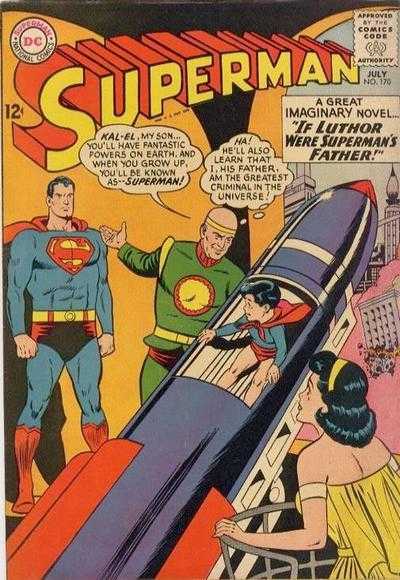
I agree that SUPERMAN has not proven to have a "vision at work." Maybe it's because it's harder for creators to agree on what Superman means than Batman. As a very loose comparison I can see more agreement on Batman's meaning within the works of Englehart, Miller, and O'Neil-- different as each writer may be from each other-- than I see regarding Superman's meaning in works by Maggin, Moore and Byrne. I did get one mythic buzz from the first episode, though. In the concluding scene between Superman and Luthor-- largely copied from a similar scene in the LOIS AND CLARK premiere-- there's a line where Luthor says something about "owning" Metropolis. The line itself is not special, but it made me realize that Luthor stands in the same position as the somewhat corrupt master of Fritz Lang's film METROPOLIS. This character, name of Fredersen, controls the city in a ruthless manner, but he's brought back to a sense of common humanity by his son Freder. In the cartoon Superman becomes a more combative version of this "son" figure. I don't know that anyone ever explored the Luthor-Superman relationship as being between "evil father and righteous son" in a sustained manner. However, there is a weird Jerry Siegel tale in which Luthor journeys through time and space to Jor-El's Krypton. There the villain seeks to inveigle Superman's mom into marrying him instead of Jor-El, with the idea that when he Luthor returns to his own time and space, Superman won't be able to interfere with anything his "father" does. It's a pretty weird story, even for 1960s Weisinger-Superman, but it may contain a dollop of psychological truth.


Wednesday, January 25, 2017

MYTHCOMICS: "EXECUTIONER'S HILL" (WEEKLY MANGA ACTION ?, 197?)


(Note: my translation of this LONE WOLF AND CUB story is the one provided in issue #12 of the First Comics reprint-effort.)

I won't attempt in this post to cover every aspect of the complicated manga-saga LONE WOLF AND CUB, a series taking place during the era of Japan's Shogunate rule. Main character Itto Ogami, a master of the samurai sword and executioner to the Shogun, is cast out from his lofty position due to the political maneuvers of his enemies. With the fall of his aristocratic house, he wanders Japan as a masterless ronin, hiring out his sword as a master assassin. At the same time he's constantly pursued by enemies for the price on his head. His only companion is his very young son Daigoro, whom Itto usually pushes in a baby cart.

This image alone, a melding of the worlds of innocence and violence, is quintessentially Japanese in character. That said, not every LONE WOLF story is equally mythic. Some stories are simply tales in which Itto takes on some powerful foe and wins out. Other stories succeed in communicating the rigor of the samurai ethos but characters may remain flat.

"Executioner's Hill" displays more mythic resonance than the average tale. It starts with six roving bounty hunters, impoverished due to a lack of victims. One of them complains, "The world's gotten peaceful too damn fast." The group's leader, known only as Shiwasu ("boss"), tells them that they'll have to go looking for fresh hunting-grounds. However, on their way out of town, they spot Itto with his baby-cart. Siwashu gets the idea that Itto must be saving up the gold he earns for his assassin-jobs in order to vanquish his foes and rebuild his family line, so that Daigoro can inherit this status. The hunters manage to capture Daigoro, hoping to use the child to blackmail Itto into surrendering his money.


The LONE WOLF world is one in which the desire for money and creature comforts is distinctly inferior to the pitiless road of the samurai-- particularly one who, like Itto, views that road as the road to hell itself. Itto will not yield anything for the life of his son, since he regards both of them as fated to die on their path of violence. Thus creators Kazuo Koike and Goseki Kojima craft a sociological myth opposing the path of self-interest and comfort to that of selfless, though not especially beneficial, violent action. I wrote in this essay that Lady Snowblood, another of Koike's creations, was one of "a long line of Japanese heroes whose raison d’etre concerns committing brutal actions with a near-mystical detachment." Itto Ogami is perhaps even more effective in transmitting that ethos than Snowblood.

There are some other poetic tropes in the story: both Itto and his main adversary Shiwasu are compared to wolves, with Shiwasu clearly being portrayed as the wolf who has become relatively "tamed" by civilization. In addition, the story displays a high level of craft with respect to action sequences like this one, allegedly a major influence on Frank Miller (cover artist for this First reprint).


Tuesday, January 24, 2017

THE PESKINESS OF POSSIBLE RESOURCES

One of the consequences of my brand of literary pluralism is that I can't dismiss any particular genre or genre-work without sussing it out for myself (in contrast, naturally, to the elitists who depend on good reputation to make their determinations). However, it can be a lot of work to make such judgments.

Take today's review on my film-blog. In the history of popular films, or even of SF-films or buddy-comedies, REAL MEN is pretty negligible. But it did serve a purpose in terms of stimulating an aspect of my "superhero idiom" theory, which I continue to refine "behind the scenes" even when not posting about it here.

In most of my ruminations on works within the superhero idiom, I've paid a great deal of attention to the resources of both heroes and villains-- by which I mean (for the most part) weapons or non-sentient helpers. This can create a problem, though, with respect to a lot of works in which both heroes and villains struggle over some item that they both want, but which isn't something the combatants can employ against one another in a fight, as Wonder Woman uses her lasso and the Joker uses his acid-squirting flower.

REAL MEN is problematic to my system. It qualifies as a "combative comedy," given that if focuses on its heroes-- two good guys in this case-- mounting a struggle against assorted enemy agents. But neither the good nor the bad guys use anything but standard firearms and mundane fighting-techniques. There is one silly moment where some of the villains dress up in clown-outfits for no good reason, and this element by itself does push the film into the realm of the uncanny-metaphenomemal, as per my formulation of the trope "outre outfits, etc." However, I found myself wondering: if REAL MEN had dropped that one visual joke, then the only remaining source of the metaphenomenal was that of the aliens, who offer humanity one of two gifts: a "big gun" or a good package." Toward the end of the film good guy Bob Wilson reaches the aliens and gets the "good package," which is meant to benefit humanity, thus foiling the attempt of the bad guys to get the super-weapon.

The viewer of REAL MEN never sees the "big gun" that the villains desire to possess. However,  the gun's function in the story is allomorphic with many of the scientific objects or processes that villains ceaselessly seek to acquire in assorted serials, such as BLAKE OF SCOTLAND YARD, LOST CITY OF THE JUNGLE, and THE MASTER KEY.

All three of these serials bear a slight structural similarity to REAL MEN in one respect. Just as the villains in REAL MEN have one metaphenomenal aspect-- their "clown posse"-- the villains of these serials usually have one or two gimmicks that lift them out of the isophenomenal domain. However, it would be easy to imagine their scripts leaving out those piddling gimmicks, just as one could imagine sending out the clowns.

In my review of THE MASTER KEY, I was at one point particularly exercised by the fact that for most of the serial the viewer sees both heroes and villains in mostly mundane circumstances, except that from the first they're struggling over a scientific breakthrough that allows one to harvest gold from the ocean. I wrote:

The Nazis, working under a mysterious figure called "the Master Key," are trying to obtain the scientific breakthrough of Professor Henderson, whose "Oroton Tubes" can harvest raw gold from the ocean, presumably without spending more than one uses for the harvesting-techniques. Despite the efforts of G-Man Tom Brant (GUNSMOKE's Milburn Stone in his salad days) and his aides, the spies do capture Henderson, but the scientist fears being killed if he simply gives up his secret. He cooperates only to the extent of buying time with requests for the materials to build the Tubes. Thus, as in many serials, both good and bad guys are sent chasing after any number of McGuffins. The idea of a gold-making device is sufficiently advanced that it registers as a marvelous phenomenon, although one doesn't see it in action more than once or twice. 

And later:

 So why is my phenomenality-category still bifurcated? In essence, though the masked mastermind and the zap-trap seem like last-minute additions to the story, they are still *centric* to the story, whereas the gold-machine is truly *peripheral."

Though I'm not going to alter what I wrote in the review, I'm reversing myself on this verdict. The gold-machine might be function the same as a more mundane McGuffin, but it is meant to change the scope of the adventure in the same way that a death ray or some similar gimmick will. The gold-making device has been originated by a scientist aligned with the Allies, but the narrative danger was that it would fall into the hands of the Axis and thus endanger the outcome of the War.

In a handful of other essays I've used this distinction between "in posse" and "in esse:"

  1. A child living is in esse, but before birth is only in posse.-- from Your Dictionary's definition of *in esse.*
My original context for using these paired terms was to state that a particular work-- namely Wilkie Collins' THE MOONSTONE-- possessed clansgressive aspects *in posse* even if neither Collins nor his audience recognized them (more on which here). I've thus belatedly realized that I was only considering the resources of both heroes and villains *in esse,* while overlooking the fact that sough-after McGuffins can function as resources *in posse.* Even if the villains never actually get the powerful dingus, narrative suspense is generated by the possibility that they might-- and so the dingus-- in this case, the gold-making process-- is allied to the sphere of the villains' resources.

More on these matters as they occur to me.