Featured Post

SIX KEYS TO A LITERARY GENETIC CODE

In essays on the subject of centricity, I've most often used the image of a geometrical circle, which, as I explained here,  owes someth...

Sunday, April 7, 2024

DEPARTMENT OF COMICS CURIOSITIES #32: "THE AMAZONS OF NESBO" (FEATURE COMICS #37, 1940)


So this standard "jungle hero meets city ruled by women" sports not one but three suspicious names:


The culture itself is named NESBO...


The queen is named SOPHO (like "Sappho")...


And there's a minor character named LEBA.


Whoever was writing under the Quality Comics "house name" John Charles apparently had a bee up his bonnet-- and it wasn't a drone...


Saturday, April 6, 2024

TIMELY MEDITATIONS

 So far my most extensive ruminations about how icon-crossover is affected by temporal considerations appeared in last June's TIME OUT OF ALIGNMENT. And now, as if so often the case, I find myself repenting at leisure some of the proposals I put forth-- though in my case I've never explicitly been "married" to any of them.

So in ALIGNMENT, I said:

 A major aspect of my crossover-theory is that of alignment; the principle that every literary cosmos, particularly with regard to serial concepts, is dominated by one or more superordinate icons whose are the "center" of the narrative, while all subordinate icons orbit around the central icon or icons. In CROSSING GODS I gave several examples of innominate figures from mythology being "crossed over" with one another, and sometimes with newly created serial characters, the example of the latter being Atticus of "the Iron Druid Chronicles." In COSMIC ALIGNMENT PART 3 I spoke of a different form of innominate character, that of a fictionalized version of a historical personage. I asserted that no crossover took place when a narrative associated legendary characters already associated in history-- Jesse James and Cole Younger-- but that it was one if the author depicted an association between characters not known to have encountered one another, like Jesse James and Belle Starr.

Characters involved in time-travel, though, break down normative categories of alignment, and for that reason even figures I've rated as properly "legendary" don't rate as crossovers when they interact with characters who (more or less like authors) are no longer bound by restrictions of the time-space continuum. Thus, a goodie-good Billy the Kid meeting a version of Dracula? Crossover. A vampire-version of Billy the Kid, who has no real connection with the historical figure, meeting Bloodrayne? Crossover. But Billy the Kid, as portrayed by Robert Walker Jr. in the scene above, meeting one of the Time Tunnel guys? Not a crossover. And the same principle applies to works in which the time-travelers bring together assorted characters from different eras, as Billy the Kid, Napoleon and Socrates are brought together by those excellent time-dudes Bill and Ted.

So, in re-assessing this theory, I ask myself: why was it important to me that all subordinate icons in a serial narrative should be aligned in terms of time? Arguably, there are many serial narratives wherein the superordinate icons are not aligned with the subordinates in terms of space. All of the adventures in the 1960s STAR TREK take place within a certain time-frame, roughly aligned with the life-spans of the main characters. But the TREK superordinates never visit the same precise location once, aside from appearing on Earth, but in different time-frames. A couple of times, Enterprise heroes meet figures that appear to be such innominate legends of history as Genghis Khan and the Clanton Gang, but these are merely lookalike constructs.


I suppose my basic feeling was that protagonists who traduce the boundaries of time aren't "playing fair." Such TREK antagonists as the Metrons and the Excalibans are so separated by the gulfs of space that they're unlikely to meet-- but as long as they're in the same time-frame, they COULD. But there would normally be no way that a 20th-century "Time Tunnel guy" could meet the legends of other eras, like Ulysses, Merlin, or Billy the Kid, without crossing the gulfs of time. Conquering space with the use of a star-drive may be sheer fantasy in reality. Yet it seems a believable extrapolation from the way Planet Earth has grown "smaller" thanks to technological advances that allow, say, James Bond to jet over to Italy or Japan. 

Nevertheless, I have to admit that in my ALIGNMENT statement I accidentally alloted crossover-status to a different form of "time-travel." I said that Bloodrayne's meeting with Billy the Kid counted as a crossover. But the heroine is only able to meet her universe's version of the  Kid in the late 1800s because she's an immortal dhampire. Bloodrayne becomes a mature female in the early 1800s, but she looks the same age in the late 1800s, and the same is true in her final cinematic adventure, where she's still unaltered age-wise, in WWII, kicking Nazi ass. So, if I'm going to allow for Bloodrayne meeting The Kid thanks to a fantasy-factor, I suppose I ought to make the same allowance with regard to time tunnels, TARDIS-machines, and the like. 

However, not all fantasy-factors are equal. I would maintain that non-legendary historical figures still carry no innominate crossover-mojo when they appear in modern times, whether it's Ben Franklin whammied up by Samantha Stevens or Bill and Ted using their time-traveling phonebooth to summon Napoleon and Socrates. But Billy the Kid remains a legendary historical figure, so I guess his meeting with the excellent dudes-- who, to be sure, are both superordinate icons-- does count as a crossover. And the same would be the case for their interactions with innominate figures of myth and legend, like Satan and the Easter Bunny-- particularly when Bill and Ted meet both in the same narrative, giving rise to a "Super-Legend Crossover."


I also raised issues with the Quality Comics character Kid Eternity, whose super-power allowed him to call upon various figures of myth and fiction to fight on his behalf. I even cited a page from one adventure in which the hero calls up Sherlock Holmes. A side-character rightly remarks that Holmes was created in fictional stories, and Holmes answers that "Doyle's stories made me seem real to so many readers that I became a real person." Because of this sort of jiggery-pokery, I'd speculate that the hero's power didn't summon actual humans or deities from the past, but merely images of them, who were able to flawlessly emulate the skills or powers of their models. 


If these figures were all just spectres of the original models, then Kid Eternity isn't actually summoning anyone from any time-frame, not even contemporary heroes like Blackhawk and Plastic Man, and thus that they aren't any more diegetically "real" than the illusions of Genghis Khan and the Clanton Gang in STAR TREK. So it might be the case that none of the characters the hero summons are crossover-figures-- and the same would be true of legendary evildoers called forth by the Kid's polar opposite, Master Man from KID ETERNITY #15 (1946).


However, if the time-travel summoning is veracious, then innominate  manifestations can be crossovers. This would include such interesting if quirky examples as AVENGERS #10, in which newly-minted super-villain Immortus invokes innominate figures of fiction and history such as Attila the Hun, Paul Bunyan, Merlin, Goliath, and a version of Hercules presumably unrelated to the Marvel-Earth incarnation that would debut a year or so later.


And just to give an example of a "team" of innominate legends drawn purely from recorded history, here's a 1947 BLUE BEETLE story from ALL TOP COMICS #8. The titular hero encounters, thanks to a time-travel device, a "super-menace team-up" whose members are culled from different eras: the pirate Blackbeard, the serial killer Jack the Ripper, and the wife-murderer Doctor Crippen. In fact, the writer of this tale made an overt attempt to "mythify" the historical Crippen-- who only killed one woman according to the law-- into some sort of odd "Bluebeard" type who killed multiple wives.

Friday, April 5, 2024

LEGENDS OF YESTERYEAR PT 2

 In the first LEGENDS OF YESTERYEAR, I said:

I won't pause at this time for a rigorous definition of what I mean by "legends," but I think it important to stress that though there are hundreds of famous historical figures who have been committed to fiction, very few of them have taken on the quasi-unreal status of legends. Billy the Kid is such a legend. A later author can imagine him doing all sorts of unhistorical things-- becoming a vampire who fights Bloodrayne, or being taught gunmanship by the Two-Gun Kid, but each fictionalized Billy has that legendary quality. Thus even in a story in which the Kid is a superordinate character, Billy sustains only "crossover-charisma" when he appears alongside a stature-bearing character like Bloodrayne or Two-Gun. In contrast, the vast majority of historical figures, even when they're shown doing unhistorical things, are still no greater than what the reader/audience knows of the originals. Winston Churchill is just Winston Churchill even if he's seen consulting with The Invaders. Adolf Hitler is just Hitler, even if he's depicted as the secret creator of The Red Skull.

When I wrote the above passage almost a full year ago, I was concentrating on creating a coherent lexicon for all possible manifestations of crossovers, so I back-burnered any possible definitions of what I tentatively called "legendary quality." But it came to me recently that legendary or historical fictionalized figures with this "quality," are subsumed by the literary mode I have termed "artifice," while fictionalized figures without such a quality are subsumed by the literary mode I have termed "verisimilitude." 

My most direct comparison of these two modes appeared in ARCHETYPE AND ARTIFICE PT. 4, where I paralleled the modes with their literary effects of "affective freedom" (for artifice) and "cognitive restraint" (for verisimilitude):

 "Affective freedom," rather, stems from the author's intention to privilege the tropes from the domain of literary artifice over tropes that signify adherence to worldly verisimilitude...

Also, in the same essay, I specified that "artifice-tropes" were the source of everything I might have previously styled as "larger than life" in its literary effects. "Verisimilitude-tropes," by contrast, always signal that phenomena within their purview can only be "life-size," reflecting that "adherence" to ordinary, limited experience. (I'll forbear to pursue my additional parallels to the categories of "the limitless" and "the limited" at this time.)

Now, in other essays I've judged as *innominate* both fictionalized figures of history-- which are all I discussed in the except above-- and fictionalized figures of legend. The distinction, which I may not have made clear, is that historical figures are generally well documented as to when they lived and what deeds they performed, while legendary figures are not as well documented. Some of the latter may never have existed at all, which seems to have been the case for the 19th century outlaw Joaquin Murrieta. Some, like King Arthur, Robin Hood and Gilgamesh, may have been based, VERY tenuously, upon historical figures. But whether the legend-figures were totally imaginary or were based on real, once-living people, legends are manifestly dominated by "artifice-tropes."


Historical figures, when subjected to fictionalization, can go either the way of artifice or the way of verisimilitude. To repeat one of my earlier counter-examples to Billy the Kid, Adolf Hitler's historical record can never be diminished by fictionalization. Hundreds of years in the future, he might become a legend of evil, but at present his presence in literature is always dwarfed by his presence in history. A fiction-story can depict Hitler in dozens of completely artificial situations-- he creates the Red Skull, he gets burned to death by The Human Torch, his body (or, more frequently, just his brain) gets preserved so that he can be revived in some new, world-conquering form. But these artifice-tropes never supersede the historical record.


In the case of Billy the Kid, the record of his real-life exploits as a hired killer ARE superseded by all the artifice-tropes built around the name, "Billy the Kid." In fact, only a relative handful of fictional depictions even make the Kid a nasty customer. His conversion into a righteous hero may have started in 19th century dime novels, but I would venture that none of these remained available to pop-fiction audiences by the beginning of the 20th century. Somehow, just the name "kid" seemed to connote not only youth, but righteousness. In the 1940s, Buster Crabbe made ten B-westerns about a heroic Billy, while Charlton's baby-faced crusader earned a comics-title in 1957 and endured until 1983. But good Billy or bad Billy, the name of the character has become divorced from almost every aspect of the historical figure. And the legend that grew out of the long dead Henry McCarty even engendered countless "western kids" in cinema and comics, who borrowed the artifice-trope inherent in the name and nothing else.

Sunday, March 31, 2024

NEAR-MYTHS: THE DARK KNIGHT RETURNS,THE LAST CRUSADE (2016)


LAST CRUSADE was a one-shot comic from some of the same collaborators that produced the previous year's DARK KNIGHT RETURNS: MASTER RACE. This time out, co-creators Frank Miller and Brian Azzarello partner with John Romita Jr to produce a much shorter take on one aspect of the Dark Knight universe: the events leading up to the Joker's capture and murder of The Jason Todd Robin.

To be sure, the creators aren't bothering to synch up their story with the well-known "Death in the Family" events, but instead produced a new narrative spun off from a brief reference to Jason's death in the 1986 DARK KNIGHT RETURNS. The Joker's act of slaying Todd-Robin was not mentioned in DKR, but not surprisingly in CRUSADE the Clown Prince is still the culprit, albeit under different circumstances.

The Joker and Batman actually don't square off at all here, for the villain spends most of his time in Arkham Asylum, telling quixotic stories and eventually breaking free. Batman and Todd-Robin spend most of their time investigating a plot set up by Poison Ivy and abetted by Killer Croc. Oh, and a de-costumed Catwoman has a few scenes. (Guess one could take that two ways.)

CRUSADE's only notable element is how Miller and Azzarello address that frequent that bete noir of realistically-minded comics-fans, the moral queasiness over under-age kids becoming the sidekicks of adult heroes. Of course when the kid-sidekick trope began in comics' Golden Age, it was nothing more than a transparent attempt to appeal to kids who wanted to fantasize about being heroes close to their own ages, rather than identifying only with adult crusaders. It's therefore ridiculous to treat a simple wish-fulfillment fantasy as if it were subject to moralistic evaluations.

To be sure, Miller et al don't pursue the "black beast" all that much. Rather, because Batman is getting old, he begins to worry about Jason Todd taking chances-- and, in addition, whether or not he's become increasingly ruthless. The problem with these two intertwined elements is that they work against one another, and against the expressed idea that kids in general shouldn't be exposed to dangerous activities. I suppose the authors might have formulated the argument that Jason's faults, as seen through Batman's eyes, were tied to his youth, but they didn't precisely do so. 

In fact, I speculate that the main reason Miller et al build up Jason Todd's penchant for violence is not because of anything in Todd-Robin's original career. IMO it's more likely that the authors were responding to the developments of "Reborn Robin" in 2005, in which Jason re-appeared as a bloodthirsty vigilante, The Red Hood. Later narratives redeemed the Hood so that he became a virtuous hero again. But CRUSADE suggests that even in his "innocent youth" Todd-Robin had somewhat sadistic tendencies-- which is ironic, since this was a mental quirk Miller imputed to his version of Batman in the classic DARK KNIGHT RETURNS.


Friday, March 29, 2024

SUPERNORMAL POETICS REVISITED

Now, Campbell did make a somewhat similar argument, that on some occasions certain creatures seemed to prefer the more "unnatural" stimulus. Hoffman, perhaps in line with his 2010 source, goes so far as to claim that ALL creatures do, including humans. "A male Homo sapiens doesn't just like a female with breast implants as much as a female au natural: he likes it far more." His footnote for this and similar assertions also cite the 2010 book, but whatever that work's data, I find the conclusion fatuous.-- READING AGAINST REALITY: NOTES, LAST PART.


The fatuity of Hoffman's claim doesn't need much elaboration. Without even looking at his footnoted source, I surmise that its "proof" of male preference is derived from purely visual tests, where male subjects look at photos, possibly subliminal, of the different types of feminine breasts. This of course would be a thoroughly incomplete study without invoking tactile sensations as well. But try to persuade some research center to give the go-ahead on a study in which a set number of male subjects grope a set number of both real and fake boobies.

But I will elaborate upon Campbell. In this blog's infancy I examined in detail Campbell's supernormal poetics (my term), in this 2009 blogpost. Whereas Hoffman rejects the "existence claims" of myth and religion, Campbell embraces them in the following terms:

[Campbell]  suggests that though mythology cannot be rationally understood, it may be "viewed in the light of biological psychology as a function of the human nervous system, precisely homologous to the innate and learned sign stimuli that release and direct the energies of nature." Campbell, building largely on the ethological researches of Lorenz and Tinbergen, calls this psychobiological system "the supernormal sign stimulus," and implies that it is through such stimuli that both myth and art work their wiles on audiences.

There was a time when I was very invested in Campbell's theory. When I was writing my as-yet-unpublished book on the superhero phenomenon, I initially devoted a chapter to the supernormal sign theory. However, I soon realized, through close analysis of that chapter of PRIMITIVE MYTHOLOGY, that an awful lot of Campbell's heuristic conjectures proved shaky. For instance, later in my 2009 essay, I extrapolated from Campbell the idea of "normal sign stimuli," but Campbell never actually renders such a conception. It's possible that the author was exposed to the semiotics of his time, but if so, he's too caught up in explicating supernormal signs to worry about their opposite. Further, though in the essay I agreed with Campbell's quoted poet A.E. Houseman that "intellect is not the fount of poetry," I caviled that Houseman had not given intellect its due in the process of making art.

Much later I expanded upon the intertwining of intellect and imagination, under the more general terms "cognitive restraint" and "affective freedom," in this appropriately titled essay. And though I favor the poetics of Campbell and Houseman far more than those of Hoffman and Richard Dawkins, I tried in this and other essays to strike a balance with respect to how these two aspects of human existence affect creativity:

Even in fiction, where the boundaries of affective freedom *may * sometimes exceed those of religious mythology, cognitive restraint is necessary to make the essentially mythic ideas relevant to living human beings.

Wednesday, March 27, 2024

READING AGAINST REALITY: NOTES, LAST PART

 In the last couple of days I was able to finish the remaining portion of Donald Hoffman's CASE AGAINST REALITY. One reason is that it's both an easy read and just a little over 200 pages. But the other reason is that I could skip over a lot of Hoffman's fine points about tests of perception. This sort of slow case-building is necessary in science. But it wasn't strictly necessary for me to grasp his main thesis: the idea that all human perception is seen through the matrix he calls an "interface," as opposed to the common notion that "what we see is what there is." Hoffman's main concern is to demonstrate the superiority of his interface model, and for most of the book it appears he has no interest in inquiring into whatever aspects of reality that we, as products of evolution, are not privy to.

In the next to last chapter, "Scrutiny," Hoffman repeats examples from earlier chapters regarding creatures whose evolutionary instincts, which should promote fitness, may lead them down blind alleys. One prominent example is that of the Australian jewel beetle, which came near extinction because the males kept trying to mate with beer-bottles which resembled the markings of female jewel beetles. However, in an earlier chapter this was presented as no more than a comedy of mating errors. In "Scrutiny" the author goes a little further, claiming that fitness-conditioned entities as a whole cannot help but prefer "extreme" versions of normative stimuli, termed "supernormal stimuli."

Astute readers of this blog (or, more likely, of the works of Joseph Campbell) should recognize these two words. I believe Campbell first used the term in his 1959 book PRIMITIVE MYTHOLOGY, and he derived the phrase from ethological writings of his time. I printed a representative excerpt from said tome in my 2012 essay VERTICALLY CHALLENING. I'm not surprised that Hoffman doesn't mention Campbell, but his only footnote on the stimuli-subject is for a 2010 book that uses that very phrase for its title, SUPERNORMAL STIMULI. Maybe that book properly credits the ethologists of the 1950s. 

Now, Campbell did make a somewhat similar argument, that on some occasions certain creatures seemed to prefer the more "unnatural" stimulus. Hoffman, perhaps in line with his 2010 source, goes so far as to claim that ALL creatures do, including humans. "A male Homo sapiens doesn't just like a female with breast implants as much as a female au natural: he likes it far more." His footnote for this and similar assertions also cite the 2010 book, but whatever that work's data, I find the conclusion fatuous. I have no doubt that Hoffman embraces the notion because it supports his general theory regarding the limitations of fitness-based perception.

Only in the last chapter does Hoffman venture some thoughts about the excluded perceptions. I was sure that, even though he makes a brief reference to Kant, that Hoffman had no interest in either Kant's philosophical project or any of the religious systems to which Kant was somewhat indebted. What I did not expect was that his version of excluded perceptions would sound not unlike the philosophy of Alfred North Whitehead.

The claim of conscious realism is better understood by looking in a mirror. There you see the familiar-- your eyes, hair, skin and teeth. What you don't see is infinitely richer, and equally familiar-- the world of your conscious experiences. It includes your dreams, fears, aspirations... the vibrant world of your conscious experiences that transcends three dimensions.-- p. 186.

And here's Whitehead writing about his version of "conscious experiences," almost a hundred years ago:

There is nothing in the real world which is merely an inert fact. Every reality is there for feeling: it promotes feeling; and it is felt. Also there is nothing which belongs merely to the privacy of feeling of one individual actuality. All origination is private. But what has been thus originated, publicly pervades the world.-- PROCESS AND REALITY.

However, philosophy is not Hoffman's metier, and he proves it later in the same chapter, when he cites this statement by Richard Dawkins:

Religions make existence claims, and this means scientific claims.

Immediately after, Hoffman says:

I agree with Dawkins. If a system of thought, religious or otherwise, offers a claim that it wants taken seriously, then we should examine it with our best method of inquiry, the scientific method.

A little later, Hoffman claims that his "conscious realism" system might effect a "rapprochement" between the worlds of science and spirituality. But how could any detente be forged if science alone, even one based in Hoffman's "case against reality," is in the driver's seat? 

I understand that for scientists, religion's history of infringement upon "existence claims" like those of Galileo cast a long shadow. But if Hoffman really valued what he terms "conscious experiences," the hallmarks of a consciousness not yet explained by current science, then he might have seen that a religious "existence claim" is substantially different in nature from one of science. A story about humanity's origins in the Garden of Eden does not compete as an "existence claim" with the story of evolution. The latter is about viewing the universe as what Whitehead called "inert facts," allegedly objective evidence. The former is about the full range of subjective human feelings, extrapolated into a system of mythopoeic correlations.

And so Hoffman's case fails in the light of superior testimony by Alfred North Whitehead. But Hoffman's argument is at least less polarizing than that of science-worshipper Dawkins, and so the court of public opinion may see a better thinker come forth to forge the desired rapprochement.

Monday, March 25, 2024

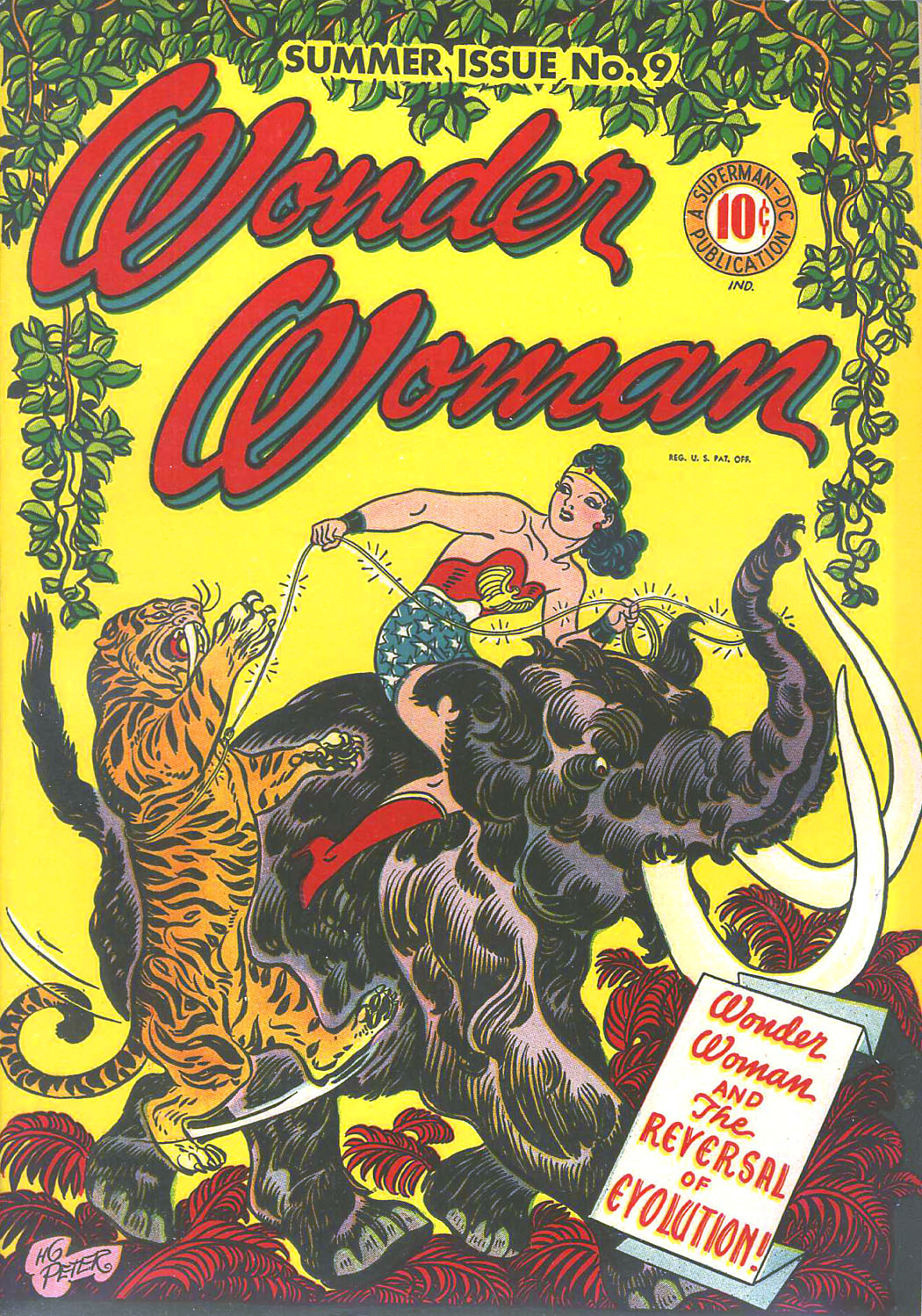
MYTHCOMICS: "EVOLUTION GOES HAYWIRE" (WONDER WOMAN #9, 1944)


For my second "March to Womanhood" post, I return to the well of Classic WONDER WOMAN. To be sure, this one is a good bit wackier than the last time I looked at a Marston WW story, the highly imaginative ICEBOUND MAIDENS. This time Marston, instead of producing a free flow of mythic and religious images, chose to riff on a "haywire" vision of evolution.


Kicking off the adventure is a mama gorilla who's lost her baby and decides not to go through the usual adoption process to obtain new offspring. Wonder Woman, in her Diana Prince ID, happens to witness the child-napping and pursues the angry anthropoid, who just happens to make tracks for nearby Holliday College.


The gorilla barges into the classroom of Professor Zool (short for zoology, apparently), who just happens to be giving the Holliday Girls a lecture on evolution, and about his new invention. The gorilla breaks in and tosses some students around, but the Amazon Princess outwrestles the beast with the help of the girls, who just happen to have lots of ropes lying around in the classroom. (Hey-- it could happen!) Steve Trevor, whose niece was abducted, wants to put down the damn dirty ape. Zool suggests an alternative: he can use his "electronic evolutionizer" to change the unruly critter into a human being. Presumably Zool has been waiting to come across just the right test case. Everyone's okay with it, including the zoo people, even though they stand to lose an expensive attraction.


And so we get the origin of long-lived WW foe Giganta. Though she attains a human physique, she pretty much forgets about having lost an ape-child but retains an unreasoning hatred of Princess Diana. They fight, and in the scuffle the evolutionizer is damaged, and we get William Marston's "magic wand" theory of evolution in detail.


I jest, for I'm sure Marston didn't think any evolutionary process could be turned backward, nor did he think he was infecting young minds with any such beliefs. Turning back time was just a fun way to illustrate said process, with crocodiles becoming dinosaurs and so on. Wonder Woman and her buddies, who look about the same but have supposedly devolved to cave-people, flee one of the dinos. They run into Giganta again, but the she-ape has no use for Women's Lib, and won't live with a "tribe led by a she." She seeks out a patriarchal tribe and immediately finds one in the "Tree People," so I guess the evolutionizer threw everyone back to a period when human ancestors were just starting to leave the trees for the ground, and these Tree People are the holdouts. Of course in no real-world model of ancient times were those tree-dwellers any sort of humanoids, not even "Missing Links" like the ones shown here. Apparently the Tree People, whom I presume to be modern citizens devolved by the machine, acquire a race-memory of antagonism toward "Cave People," even though the only cave-tribe they ever see is Wonder Woman's little band.


The Tree Men capture the 20th-century cave-dwellers and threaten to sacrifice them. Wondcr Woman once more demonstrates female agency by defeating a devouring dino, and that's pretty much it for the caveman fantasia.


After a few more challenging incidents, Zool gets his machine running again with a little help from Ben Franklin-style science. But with the next jaunt forward,  the time-travelers appear in a period of Greek history that most moderns consider purely mythical: "The Golden Age, when the world was perfect." Naturally, for Marston this is a time when there are no hierarchies between the sexes, and one that discourages the acquisition of wealth. 


Giganta, the savage who reflects the aspects of modernity Marston dislikes, allies herself to the "lower classes," who are individuals who like to accrue wealth. Giganta seduces them into wanting rulership as well, and though the Golden Age is not meant to be identical to the Garden of Eden, it's no coincidence that the rebels speak of gaining "the knowledge of good and evil." Wonder Woman eventually quells the rebellion but the queen sadly observes that, "The Golden Age is over-- people now know they can be wicked if they choose."


Moving into a new phase, but without another time-jaunt, Queen Darla's peaceful rule is challenged by male subjects who think that their superior strength entitles them to supremacy. Wonder Woman easily defeats the lead challenger, and for good measure the heroine scoffs at the man's wife for wanting to take pride in her man's might. However, the woman's perspective shows a chink in Marston's system. The author perhaps couldn't conceive that some women, not being aggressive or martially inclined, might want men to be dominant on the assumption that this made a tribe stronger-- which in a broad sense was true for most of human history.


In any case, this sort of negative "woman power" unseats Queen Darla. She and a small coterie join Wonder Woman and friends in seeking to found a new kingdom. Since they end up in a location geographically comparable to that of the Amazon kingdom, Marston probably meant Darla's voyage to be comparable to the later journey Queen Hippolyta takes to found Paradise Island. This would make Darla's group the ancestors of the Greek Amazons, despite the former's lack of martial tendencies. This is illustrated when Giganta once more activates the evolutionizer, flinging Wonder Woman's group into Greek Amazon times. In due time the heroine comes face to face with her own mother, thousands of years before Diana has been "born." Hippolyta explains that the city of Amazonia faces attack by the army of Achilles, at least partly because the Amazons sided with Troy against Greece. 


Most of the Amazons are off hunting husbands-- one of the few times Marston drew on the family-making customs of the warrior women-- so Diana suggests that Hippolyta send runners to bring the fighters back to Amazonia. In the meantime Wonder Woman challenges Achilles, another representative of patriarchal rule, to single combat. She wins, the other Amazons arrive to drive off the Greek army, and the adventure gets a quick wrap up, implying that the 20th century is freed from the evolutionary backstep and that everything goes back to normal. 

For some reason, though, the evolutionary erasure does not apply to Giganta, though her actual fate is left up in the air at story's end. The gorilla-girl only made one other Golden Age appearance. In that tale, it's disclosed that Giganta, like other WONDER WOMAN rogues, was sentenced to an Amazon reformatory-- until a group of lethal ladies break free to menace Princess Diana as "Villainy Inc." Given that she's a gorilla, in this story Giganta takes on an interesting "serpent in Eden" persona as Marston guided his readers through his narrative of the "rise and fall of sexual equality."