Featured Post

SIX KEYS TO A LITERARY GENETIC CODE

In essays on the subject of centricity, I've most often used the image of a geometrical circle, which, as I explained here,  owes someth...

Thursday, January 17, 2013

QUICK LIST OF EXEMPLARY OPPONENTS

Since I've recently advanced the notions that (a) a combative work must contain no less than two opposed characters possessed of megadynamic "might," and (b) that level of "might" extends from a low level ("the exemplary") to a high level ("the exceptional"), it behooves me to provide a short list of examples of the more newly-defined of the two categories, the "exemplary."

As of this writing I've reviewed over 200 films on my movie-blog, though there are fewer than 200 entries given my tendency to "double up" or "triple up" the films to which I've given short critiques.    In each case where a film had a combative mode, I noted that status in the label section, along with each given film's status in terms of its Freyean mythos.  So the easiest thing is to go down the list and determine which if any films are qualified by either protagonist or antagonist (or both) being of the lower level in the combative mode.

Since the separate "demihero concept" also requires some elucidation, I'll also mention whether or not it appears in this grouping of films, though this will not be a list of all demiheroes in the corpus of films reviewed.

______________________

Under the label "combative ironies"--

Only one of the films, John Carpenter's THEY LIVE!, has a protagonist of the exemplary level, the hero John Nada.

________________________

Under the label "combative comedies"--


In 1989's EASY WHEELS, the villain She-Wolf and her gang of bad bikers are exceptional; the heroes are only exemplary.

Both 1994's BLANKMAN and 1989's CHOMPS pit exceptional heroes against exemplary gangster-villains.

Both of the DOCTOR GOLDFOOT films pit an exceptional mad scientist against merely exemplary secret agent heroes.

 ___________________________

Under the label "combative dramas"--

Both 1958's HORROR OF DRACULA and 1960's BRIDES OF DRACULA present a "Doctor Van Helsing" who, while not exceptional in his level of power, is a much more athletic and resourceful hero than the character from the novel DRACULA.  In past essays I've mentioned that the assembled "vampire killers" of the novel, though they are demiheroes, also qualify for greater-than-ordinary status, though I was not using the term '"exemplary" at that time.

The 2011 RED RIDING HOOD potrarys the titular heroine as an exemplary demihero.

In 1999's VIRUS Jamie Lee Curtis' character Foster is an exemplary demihero.

In 1954's MISS ROBIN CRUSOE, both the demiheroes and villains are exemplary types.

The character of the vampire-slaying monsignor in 1968's DRACULA HAS RISEN FROM THE GRAVE has the same exemplary status as Hammer Films' Van Helsing.

______________________________

Under the label "combative adventures"--

The villains of 1941's JUNGLE GIRL are exemplary types.

Exemplary villains menace the heroes of 1945's ONE THOUSAND AND ONE NIGHTS and 1953's THE SIREN OF BAGDAD.

Both THE WHISPERING SHADOW (1933) and SHADOW OF CHINATOWN (1936)  pits exceptional villains against exemplary demiheroes.

Exemplary villains constitute the threats in 1986's ADVENTURES OF THE AMERICAN RABBIT, 1937's DOCTOR SYN, 1963's DR. SYN ALIAS THE SCARECROW, 1953's BANDITS OF CORSICA, 1943's THE PHANTOM, 1953's VALLEY OF HEADHUNTERS, 1951's MASK OF THE AVENGER, 1953's THE KID FROM BROKEN GUN, 1937's THE SHADOW STRIKES, 1958s LONE RANGER AND THE LOST CITY OF GOLD, 1984's SHEENA, two of the "uncanny" HERCULES films, many of the TARZAN films and all of the BOMBA films.


NOTE: I have used the term-set "exemplary and exceptional" before, to denote differing types of literary merit.  However, I don't envision using them in that manner very often in future, and so have chosen to re-use the terms in this very different context.

ADDENDUM 4-29-17: Since writing this I have disallowed CHOMPS, the GOLDFOOT films, and DRACULA HAS RISEN FROM THE GRAVE from combative status.
 

Wednesday, January 16, 2013

DYNAMICITY DUOS PART 1

I'm tempted to subtitle this essay "the trouble with gangsters," since some of the considerations here stem from evaluating the presence of the combative mode in stories where the exceptional hero faces unexceptional crooks.  Are there ways in which some gangland-spawned foes prove more "combative" in the significant sense than others, just as I've said that some heroes, who have (discounting weapons) only ordinary mortal abilities, can possess more dynamicity than other heroes of the same basic abilities?

Anyone who's read this blog (aside from the automatic Google search-engines) should know that when I phrase a proposition in this manner, the answer will be affirmative.  But is there a way to rephrase the concept of dynamicity to take in this application of the combative mode?


In DYNAMIS VS. DYNAMICITY I outlined three "power-ratings" of dynamicity, patterned loosely after related categories in Aristotle.  To sum up:

The "X-type," who possessed megadynamicity, was said to be entirely "exceptional."

The next rating down, the "Y-type," possessed of mesodynamicity, was said to cover a range of "good-to-fair."  I justified the need for such a range thus:

'This category requires a "range" approach because characters who are simply "good" in terms of their personal dynamicity function almost exactly the same as those who are simply "fair."'

Finally, for roughly the same reasons, I assigned the final rating, the microdynamic "Z-type," as "fair-to-poor."

However, I've now amended that breakdown.  Keeping in mind my assessment of the way a "mesodynamic" hero, such as Jack Burton, could be "boosted" to the higher status, I decided that the the same principle should apply to some-- though not all-- of the mundane opponents pitted against an exceptional hero.

As a negative example, one where such boosting does not take place, here's a brief scene from the first adventure of "the Bat-Man."


These two catchpenny thugs, while hypothetically capable enough within the "good-to-fair" range, are so easily disposed of by the exceptional hero that they certainly cannot be "X-types."

However, the corpus of Batman's adventures contains many mundane crooks with no more actual powers than those in the previous example.  Such opponents could and did give the hero a harder time.


I suggest that although these ne'er-do-wells are not in the same league with Batman's truly exceptional foes, as per my example of the Penguin here, they still fall into the range of the megadynamic by virtue of their narrative operations. For one thing, though in both examples Batman defeats the mundane malefactors, he has to work somewhat harder in the second case, suggesting that the lawbreakers here are smarter and/or more formidable.

The same "boosting" distinction applies even in cases where the criiminals are even more outclassed, as when they combat heroes with literal super-powers.

In "The Mysterious Mister X" (ALL-STAR COMICS #5, 1941), a group of gang-leaders get sick of having their operations continually broken up by the members of the Justice Society, many of whom are powerhouses like the Flash and Doctor Fate.


With one exception (the section of the story devoted to Green Lantern), none of the gangsters have any special resources.  Even the guy in a Hindu outfit, who goes after Doctor Fate, is merely a trickster.

All of them meet ignomious defeats, such as this one:


And this one:


Nevertheless, as outclassed as the hoods are in the powers department, one has to admire, if only slightly, the guts of mundane men determined to tilt with gods.  Perhaps their courage is born of foolhardiness-- certainly the author was not holding them up for admiration.  Still, it takes some moxie for such thugs to take on the mighty Justice Society.  I'd argue that even this futile attempt confers on them a level of "might" not seen in less ambitious crooks.

While such thugs' moxie cannot make them exceptional, I suggest that it does boost them to what I now term the lower level of megadynamicity, which makes such encounters qualify for both the narrative and significant values of sublime dominance.

Thus I've re-interpreted the schema put forth in DYNAMIS VS. DYNAMICITY, to show that all three categories encompass a range of dynamicities.  The reigning schema now reads thusly:

THE Z-TYPE covers the narrative functions of all dynamicities ranging from the "poor" to the "average."

THE Y-TYPE covers the narrative functions of all dynamicities ranging from the "fair" to the "good."

THE X-TYPE covers the narrative functions of all dynamicities ranging from the "exemplary" to the "exceptional."

This elucidation of an "exemplary" range of power in the megadynamic level doesn't just serve to account for the narrative functions of mundane villains like the "Academy of Gangsters."  It also takes in certain "weak heroes" like Jack Burton and Jonathan Harker, who begin as no more than "mesodynamic" presences but who "step up" to become full-fledged monster slayers, either through the possession of limited talents or dogged persistence.

In Part Two I'll offer detailed examples of each of these six power-ratings, to illustrate how the extent of a character's dynamicity affects his (or in the case of the forthcoming examples, her) narrative function. 

Tuesday, January 15, 2013

MYTHOS AND MODE PART 3

In MYTHOS AND MODE 2 I said:

In a similar manner, narrative values can trump significant values in terms of determining whether or not a work is “combative” or not.  Based on that assertion, I would say that MACBETH remains a “combative drama” even though it lacks the significant value of sublime dominance between two contending forces.  In contrast, I would not consider CORIOLANUS combative in that I feel the subcombative narrative values predominate.  As I continue to consider other cases I will probably come across examples where the reverse verdict proves true for each example.

I'm revising this nugget of theory to say that the "combative mode" should always denote those works that contain both a narrative combative value and a significant combative value.  This means that MACBETH and possibly one or two other works I previously labeled as "combative" are necessarily subcombative instead.

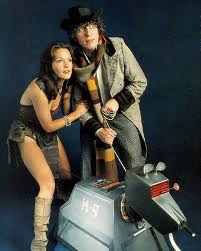
I recently came to this conclusion as I considered the statement I'd made re: the character of "Doctor Who" in WHAT'S ON FIRST, WHO'S ON SECOND:

...in essence the Doctor... belongs in the adventure-mythos, but only in the subcombative compartment of that mythos.

I realized that the reason I'd made that assignment was precisely because the Doctor's tendency to use "froda" rather than "froda" to triumph over his multifarous enemies. This approach deprives the viewer of beholding "the significant value of sublime dominance between two contending forces."

To be sure, certain Who episodes may contain brief contentions of this sort, as when the Doctor employs a powerful ally like K-9.


But because the narrative is not centered around the battle, such clashes have at best a transitory effect, such as one sees in the sole battle of Coriolanus and Aufidius examined in MYTHOS AND MODE 2, or with the clash of the two werewolves in WEREWOLF OF LONDON.

The same applies to the example of MIGHTY MAX, which I analyzed in terms of its central persona but not in terms of its conflictive mode in this essay.  I remarked that Max sometimes had his ally Norman handle much of the heavy lifting.


But Norman is neither a member of a "ensemble" as I define the term, nor a "genie" who becomes the real center of the story because he dependably comes to the hero's aid, a la GIGANTOR.  Thus his exhibition of "might," like that of K-9, are no more central to the narrative than the examples from the Shakespeare play or the Universal werewolf film.

It's possible that I may come across exceptions to this rule as currently stated.  But at present, I will consider that a work should generally be combative only if it combines the narrative and significant values associated with the mode.

Monday, January 14, 2013

RACIAL NON-POLITICS IN DJANGO UNCHAINED


Whenever learned articles employ such phrases as “racial politics” or “sexual politics” to describe fictional narrative, the metaphor is clear. No matter how escapist the narrative may seem, it’s assumed that a political opposition is always at work, possibly stemming from Frederic Jameson’s “political unconscious.” 


Further, it is a not a “politics” like that of the real world, where politicians shift allegiances or make secret deals for purely personal advantage.  It is an absolute politics, in which the representatives of oppression are always for oppression, and the representatives of liberation are always for liberation. 


I speak, however, of “non-politics” as a counter-metaphor to escape this rigid oppositionalism.  “Non-politics” takes in any and all purely personal elements that have been elided from oppositional accounts, elements that don’t fit the “either/or” dichotomy.


After viewing Quentin Tarantion’s DJANGO UNCHAINED with a friend, that friend made a remark that I feel sure many other white viewers made: observing that Tarantino’s movie portrays an American West almost bereft of “good white guys.”  With the obvious exception of central character Dr. King Schulz (Christoph Waltz), every other white character is either a villain or an ineffectual bystander. 


At the time I replied that such strong racial opposition was wholly characteristic of one of the major influences on DJANGO specifically and on Tarantino generally: the “blaxploitation” movies of the 1970s.  Not all of these films are without “good white guys,” but it’s far more typical to draw battle-lines in terms of race in such films as DOLEMITE, HUMAN TORNADO, SUPERFLY, BLACK SAMSON, FOXY BROWN, and COFFY, just to name the first six that come to mind.  However, race doesn’t always tell, for one can find examples of black characters who “sell out to the Man.” A noteworthy example appears at the climax of COFFY, where the heroine’s boyfriend sells her out both politically and sexually (i.e., sleeping with a white woman).


Most of these films are escapist in tone, making no attempt to address abstract matters of morality or justice.  In the minds of oppositional critics I presume they would fall upon the side of “liberation” since they depict, however crudely, the triumph of oppressed people—just as Griffith’s BIRTH OF A NATION would fall on the side of oppression in validating an oppressive regime.  However, oppositional critics generally fail to see that when blaxploitation films do draw battle-lines exclusively in terms of race, they subscribe to the same logic as the Griffith film does, saying, in effect, “protect only those who share your own ethnic characteristics.”


At first glance, it might appear that Tarantino’s DJANGO UNCHAINED subscribes to this same logic.  Bounty hunter King Schulz liberates the slave Django (Jamie Foxx) from his masters so that Django can help him identify a trio of wanted men; former overseers on Django’s plantation.  For this service Schulz promises to give Django his freedom, though Django goes beyond the letter of the agreement when he tastes the forbidden fruit of blasting down white oppressors, specifically those who have injured him and his wife Broomhilda.  Following this successful adventure, Schulz and Django bond so strongly that Schulz agrees to help the ex-slave find his wife, who had been sold separately to an unknown buyer.  The duo locate Broomhilda on the plantation of wealthy Calvin J. Candie, so they initiate a scam designed to liberate Broomhilda legally, though it requires some deception as to their real motives.  However, Candie’s house is managed by a slave named Stephen (Samuel L. Jackson).  He sees through the deception and exposes the scheme to protect his master’s interests.  In the end Schulz and Candie both die and Django takes bloody vengeance on the entire Candie family, leaving the race-traitor Stephen for last.  He and Broomhilda ride off into the sunset to make a new life, having also acquired papers that will give Broomhilda freedom.


It’s true, as my friend said, that aside from Schulz all the white characters are villains or ineffectual bystanders.  What he didn’t notice, though, is that the same situation obtains for black characters.  Nearly all black characters in DJANGO are ineffectual bystanders except for Broomhilda—but even though she's not a simple bystander, she's also unable to participate in Django's heroics.  She does try to play along with her husband’s scam, but when it fails, she’s reduced to nothing more than a damsel in distress.  There’s one moment when some liberated slaves manage to execute the man who enslaved them, but the event only comes about because Schulz liberates them. 


And then there’s the one black villain.  At first glance Stephen might appear to be just another “sell out to the Man,” as with the character in COFFY.  However, I suggest that something more complex and non-political is going on.


For one thing, the relationship of Stephen to Calvin Candie is almost a mirror-image of the one between Schulz and Django.  There are differences, of course. Schulz, coming from Germany, has had the benefit of a classical education, while Stephen—made up to look a malevolent version of the “Uncle Ben’s Rice” icon— mangles words to show his lack of formal education.  Nevertheless, Stephen, despite having internalized the white man’s system of values, so that he feels extreme hatred toward Django upon seeing a “nigger” on a horse—is easily as subtle as Schulz.  Where Candie is easily flattered and manipulated, Stephen remains suspicious and perceives the connection between Django and Broomhilda.  After Candie has been killed, Stephen’s authority is sufficient to keep Candie’s relatives from killing Django too easily, as he persuades them to sell the former slave to a cruel mining camp.  Of course this reprieve allows Django to save himself and his wife, and to bring an end to Stephen, after Django tasks him with having ignored the tortures of thousands of slaves of his own race.  Yet the irony of this “moral” is that if one were to assume that race-loyalty is the standard, then Schulz would be as big a “race-traitor” in that he doesn't confine his loyalty only to Caucasians.


There are also obvious differences between the men being mentored.  Django has apparently been born and raised in slavery, so his moments of ignorance—such as not knowing some of the words Schulz uses—don’t reflect badly on him.  This feeling also extends to the one moment at his expense, when Schulz allows him to choose his own “valet uniform” and Django picks out an outfit that looks ridiculous even in the eyes of his own people.  In contrast, Candie has had the benefits of good education like Schulz, but is plainly a mediocre intellect at best.  Schulz chooses to mentor Django because he likes him and dislikes slavery.  Stephen, having lived in the plantation-house since the days of Calvin’s grandfather, has become the mentor to Calvin via inheritance, much as the character of Mammy becomes a maternal influence on Scarlet O’Hara in GONE WITH THE WIND.


Nevertheless, despite the fact that Stephen continually sasses his master in order to manage the house the way Stephen thinks right, the bond between the two is as real as the one between Schulz and Django.  Oppositional critics probably will not understand the scene in which Stephen weeps over his dead master, since it might seem to sympathize with standard “slave-weeps-over-dead-master” scenes out of UNCLE TOM’S CABIN.  This is the only way the scene can be understand in a “racial politics” sense, as a sneaky way of saying, “see, slavery isn’t so bad if the slaves feel affection for their owners.”


Of course this is not the point of the scene or of Tarantino’s film: only a fool would think that Tarantino has presented slavery as anything but evil in DJANGO UNCHAINED.  However, because Tarantino is also capable of thinking outside the political box, he can reflect on the varied ways in which human beings allow themselves to be seduced into evil—sometimes in very ordinary ways, like Stephen coming to regard the young Master of the House as something akin to his own offspring.  Candie clearly reciprocates the feeling, at least within the boundaries of the master-slave relationship. Thus we seen the differences between the two mentor-student dyads are largely superficial.  Battle-lines are no longer drawn in terms of race in DJANGO UNCHAINED, so that evil and good can be determined in terms of a more abstract justice, rather than in terms of belonging to either a majority or minority ethnicity. 

Thursday, January 10, 2013

TWICE THE MIGHT PT. 2

</


In keeping with my observations in Part 1, I'll detail two more examples of films that share the quality of being combative in terms of one value (the significant), though they divide in terms of the other (the narrative).

The first film to consider is 1959's THE ANGRY RED PLANET, which I reviewed here.

The above film-ad shows a combat between the futuristic astronaut-protagonists of the film-- armed, naturally, with the requisite ray-guns-- as they contend with the most famous beastie they encounter, the so-called "Rat-Bat-Spider."  Clearly both the ray-wielding astronauts and the monster qualify as megadynamic sources of might, which satisfies the significant value.

However, ANGRY RED PLANET cannot be combative in a narrative sense, as the film does not center around any of the combats between the astronauts and the Martian monsters.  The various menaces are something of a gauntlet the heroes run until they are sent back to Earth, more or less with their tails between their legs.  Therefore the overall spirit of this space-drama is subcombative.

In contrast, 1956's FORBIDDEN PLANET-- which possesses a wealth of virtues that the later film does not-- also possesses the narrative combative value as well as the significant combative value.

The significant value is obvious in the assorted scenes in which the astronaut-protagonists come to grips with the "Id Monster," prior to finding out that it's been generated by Krell machines which are in turn responding to the anxieties of scientist Dr. Morbius. 

However, whereas the sense of escalation to a final confrontation is absent from ANGRY RED PLANET, FORBIDDEN PLANET builds this sense by virtue of the baffled astronauts as they attempt to learn the nature of their invincible enemy. 

To be sure, when the Id Monster is defeated, it isn't because of the clash between the weapons of Earth-science and the power of the Krell machines.  The Monster is defeated by undermining the source of its power in Morbius, who is in essence the Monster's Achilles heel.

Nevertheless, without the clash of energies that establishes how potent the Id Monster is, there would be no narrative perception of the need to seek such a vulnerable point.

I'll note in passing that I rate the central heroes of both films as "demiheroes" in that they are concerned more with the Hobbesian value of "safety" than of "glory."


Saturday, January 5, 2013

TWICE THE MIGHT BUT LESS FILLING

Returning once more to the formulation of Kant from CRITIQUE OF JUDGMENT:

 Might is called dominance if it is superior even to the resistance of something that itself possesses might.

I've touched slightly on a few manifestations of might and dominance in canonical literature and in folktales, but where dominance is concerned, it occurs most frequently in certain types of genre literature. I noted in STRENGTH, IN NUMBERS:

... as a rule modern genre-narratives explore these concepts on a more sustained basis than do most modern would-be literary efforts.
Genre literature can excel in this regard because it allows, as Northrop Frye said, an "unobstructed view of the archetypes"-- including, in this case, the archetype of the narrative pattern Joseph Fontenrose terms "the combat myth."

However, not every narrative that contains two opposed sources of "might" necessarily evokes the combative mode.  It's for that reason that I've distinguished the presence of both narrative and significant values within the combative mode.  The lack of one value or the other can cancel the narrative's potential for combative sublimity.

As my first examples, regard these two classic Universal horror-films:


WEREWOLF OF LONDON (1935)


FRANKENSTEIN MEETS THE WOLF MAN (1943)

Both of the films, like the majority of horror films, conform to the kenotic mythos of the drama.  Both contain two characters who possess supernormal might: two werewolves in LONDON (seen above, played by Warner Oland and Henry Hull), the Frankenstein Monster (Bela Lugosi) and the Wolf Man (Lon Chaney Jr.) in the 1943 film. Both films end with rather short battles between the supernormal figures, so both satisfy the significant value of the combative, which engenders a particular sublime effect through contending might.

However, WEREWOLF OF LONDON is primarily about the tormented sufferings of the Henry Hull werewolf.  His conflict with the Oland character is distinctly secondary to his agonies over the loss of his wife to another man. The mere contention of two powerful figures in a narrative cannot engender the narrative value of the combative, as I showed here with respect to Shakespeare's CORIOLANUS.  

In contrast, though some have argued that FRANKENSTEIN MEETS THE WOLF MAN places more emphasis on the Wolf Man than on Frankenstein's creation, the essential thrust of the plot focuses on arranging the "meeting" of the two monsters-- cultivating an alliance between the principal characters, bringing them together with the late Doctor Frankenstein's research as a means of ending their respective maladies, and then culminating in a "heroic" Wolf Man taking on a "villainous" Frankenstein Monster.  Here, the narrative value is satisfied in that the entire narrative is built around a culminative combat, while the formidability of the characters satisfies the significant value.

It should go without saying that a narrative lacking either combative value-- one which has several "mighty" figures within the narrative who are engaged only in preying on "basic strength" victims rather than fighting against each other or against another "mighty" threat-- such a narrative displays only "might" and never dominance, as exemplified by 1944's HOUSE OF FRANKENSTEIN.


Friday, January 4, 2013

SHORT POST ON SIEGEL AND SHUSTER

Another BEAT-response.  I just can't seem to stop wasting my time there. Heavy sigh.

________________________________


Well, I agree that Siegel and Shuster made their own bed for the most part.  Going largely by the Gerard Jones account, they weren't exactly starving when they made the Superman deal.  The Larry Tye book says they consulted a lawyer before they signed, but it musta been some punk kind of shyster!  Surely by then any lawyer worth his salt would have known how much merchandising proceeding from cartoon characters like Popeye and Betty Boop.

Now one might fairly  loathe DC for later crimes, like swiping the Superboy concept and eventually muscling Siegel and Shuster out of the operation.  But I don't think you can blame the DC editors for trying to make the best deal they could for their company.

I can't agree  that the "hostage situation" hurts original independent creators, though.  If anything the loss of Superman warns artists not to sign away anything they believe in.  If the company wants to own everything you create, don't give them "John Byrne's Next Men," give them "John Byrne's 'Spinnerette!'"

What I've seen companies doing for the last 20 years is not confining all work "in-house," but attempting to spin off properties created during the Bad Old Days.  The failures (thus far) of attempts to claim characters created during those days, like Howard, Blade and Ghost Rider, makes them a good bet for development.  And of course the Big Two have published work that is strictly owned by the artist, but they haven't succeeded in creating a lasting imprint dedicated to such work, so the policy remains marginal in effect.


Small point in the Gerber piece: Jerry Siegel claimed he created hits for Ziff-Davis.  What were these "hits?"  LARS FROM MARS, maybe?  Or LITTLE AL OF THE FBI??