Featured Post

SIX KEYS TO A LITERARY GENETIC CODE

In essays on the subject of centricity, I've most often used the image of a geometrical circle, which, as I explained here,  owes someth...

Thursday, June 9, 2022

THE WHOLENESS OF HALF-TRUTHS PT. 1

It's been nine years since I dove into the deep waters of a Stuart A. Kauffman book, which I examined somewhat in the NATURAL LAWBREAKING posts, all of which appeared in 2013, beginning here. That book, REINVENTING THE SACRED, came out in 2006, and the one I'm now slowly working through, INVESTIGATIONS, was written six years earlier. Both books are concerned with defining the processes by which life evolved on Earth, with Kauffman taking a less reductive (and thus more holistic) view of how a myriad of factors combine to bring about organisms capable of sexual generation. 

Not having ventured back into SACRED since that first reading, I don't remember if Kauffman had anything to say about the work of philosopher Ludwig Wittgenstein. However, Kauffman has much to say in INVESTIGATIONS, noting that he derived the title of this 2000 book from the thinker's 1953 book PHILOSOPHICAL INVESTIGATIONS. 

Now, my only direct contact with Wittgenstein was an unfavorable one, as I remarked in the 2014 essay WITLESS IN VIENNA-- in which, by an odd coincidence, I critiqued Edward Skidelsky's preference for Wittgenstein over Ernst Cassirer by comparing Cassirer's perspective to that of... Stuart A, Kauffman! The following quotes from the WITLESS essay accurately represents all I knew then about Wittgenstein as well as everything up until beginning Kauffman's 2000 tome--


It's been at least ten years since I plowed my way through Wittgenstein's TRACTATUS LOGICO-PHILOSOPHICUS.  I found it thoroughly uninteresting and couldn't understand why this logic-chopper had become such a major voice in modern philosophy.

And--

I cannot speak to the veracity of Skidelsky's findings on Wittgenstein's motives.  I will note that my principal response to the TRACTATUS was that I too assumed that the author shared the purpose of the positivists: to devalue "sentences of metaphysics or pseudoscience." 

And finally--

I cannot deny that Wittgenstein, even today, is viewed with more approval than Cassirer.  Yet I must ask: how many persons interested in philosophy are even aware of Wittgenstein's "mystical vision," or his critique of scientism, and how many have made the same assumptions that the Vienna Circle did, translating pure logic into empiricist epistemology?  Cassirer may not be understood by the average readers of philosophy today; he may well be regarded as "old hat." But do these readers understand that Wittgenstein opposed empiricist scientism?

I tend to doubt it, and I'm tempted to make a survey of philosophy blogs to determine how many people today write of "Wittgenstein, anti-empiricist."  Wittgenstein's focus upon a logic denuded of and distanced from all sensuous content is at base allied to the language used by science

Now, without double checking I assume that everything Skidelsky wrote was based upon his admiration for the 1921 TRACTATUS, which bored the hell out of me. I don't think Skidelsky has much if anything to say about the closing works of Wittengenstein's life, which are the very works that Kauffman champions over the early ones.

In Chapter 3, Kauffman wrote:

In his early TRACTATUS, Wittgenstein had brought to conclusion the mandate of logical atomism from Russell. Logical atomism sought a firm epistemological foundation for all knowledge in terms of privileged "atomic statements" about "sense data"... One might be mistaken in saying that a chair is in the room, but one could hardly be mistaken in reporting bits and pieces of one's own awareness... Logical atomism sought to reconstruct statements about the external world from logical combinations of atomic statements about sense data.

So this is the only Wittgenstein I knew, the one I remarked as having favored "a logic denuded of and distanced from all sensuous content"-- by which I did NOT mean "sense data," but the content of the perceiver's personal reaction to the data. Kauffman, having outlined the position of 1921 Wittgenstein, then says:

It was Wittgenstein himself who, twenty years later, junked the entire enterprise. PHILOSOPHICAL INVESTIGATIONS was his later-life revolution. His revolution has done much to destroy the concept of a privilege level of description and paved the way to an understanding that concepts at any level typically are formed in codefinitional circles.

What's "codefinitional?"

Wittgenstein's point is that one cannot, in general, reduce statements at a higher level to a finitely specified set of necessary and sufficient statements at a lower level, Instead, the concepts at the higher level are codefined.


These concepts are meant to serve Kauffman's long-range purpose of envisioning a biology not defined simply by mindless reproduction of templates, but holistic interaction of systems-- and that's all that I can say about Kauffman's biological agenda, having not finished the book yet. 

But the idea of codefinition has some interesting permutations for my notions of literature as a place where truth and non-truth, perata and apeiron, continually co-exist and play off one another.


Thursday, June 2, 2022

MYTHCOMICS: "ATONEMENT" (HEAVEN'S LOST PROPERTY, 2013-14)

Manga-serials strongly based on fantasy-premises vary widely with respect to how assiduously their creators elaborate the rationales for those concepts. Some serials toss out a very basic premise and never develop beyond what is strictly necessary, as with Masakazu Katsura's SHADOW LADY. Another group of serials will explore their premises in a thorough and linear fashion until reaching a logical conclusion, as with Lynn Okamoto's ELFEN LIED. Still others articulate and follow a strong premise in one arc and then go on to develop the underpinnings of the fantasy-world in even greater detail, as fans saw when Nozomu Tamaki followed the first "super-arc" of DANCE IN THE VAMPIRE BUND  with the shorter arc of SCARLET ORDER.

Suu Minazuki takes a more roundabout path to his premise in his most famous work, HEAVEN'S LOST PROPERTY. His narrative approach somewhat resembles that of the American teleseries LOST, which teased its watchers to the very end with expectations of a great "here's-the-explanation-for-it-all" revelation. Readers of PROPERTY do get a better explanation of that manga's fantasy-world than did the audience of LOST. Still, detailed explication was not one of Minazuki's priorities, though the manga's final arc-- which I've titled "Atonement" after one of the installment-titles-- succeeds in achieving a high level of myth-concrescence anyway.

PROPERTY's setup resembles that of many Japanese fantasy-based harem comedies: a relatively ordinary young man, ranging in age from middle school to college, has a bevy of supernatural beauties converge on his place of residence, sometimes with one or two regular Earth-girls around for variety. All the babes are in love with the main guy but their competition for his favor brings about an enforced chastity, since none of them get anything more than basic canoodling. 


In PROPERTY, middle schooler Tomoki Sakurai finds himself playing host to three young women who look like a cross between Judeo-Christian angels and Victoria's Secret models (even if one of them is closer to the measurements of Twiggy than of Heidi Klum). All three are beings called "Angeloids" and they come from a mysterious island in the sky called "Synapse," possibly derived from Swift's Laputa, but they can't talk about their place of origin-- which works out fine for Minazuki, since he wants to keep the nature of Synapse under wraps for most of his epic. The name "Angeloids" implies that the girls are androids, which is confirmed by the fact that all three have weapons-systems built into their bodies. However, they might also be cyborgs, since if you bonk them on their heads they get the usual mushroom-sized lumps. A few other Angeloids intrude on Tomoki's sanctum for shorter lengths of time, but the main three throughout the story are Ikaros (beautiful but bereft of expressive affect), Astraea (beautiful but stupid), and Nymph (beautiful, but was last in line when they were handing out funbags).


Prior to the Angeloids' advent, Tomoki lives by himself in the small Japanese town Sorami, his parents away on extended travels. His solitude may stem in part from his motto, "Peace above everything," meaning that he doesn't like to be stirred by anything. He has one friend, next-door neighbor-girl Sohara, who as I observed in my review of the TV show, often seems more like a discipline-minded mother than a potential girlfriend, often punishing Tomoki for offenses real or imagined. Sohara's plainly in love with Tomoki, but he just wants to go to school, laze around his house and read porn. He does have an odd recurring dream where a mysterious woman pleads with him to help her daughter, but this doesn't have any definite meaning for Tomoki.

Two of Tomoki's fellow students, Sugata and Misako, more or less con him into intercepting a predicted celestial event. Thus Tomoki is out in the wilds when an armor-garbed winged woman crashes to Earth. Tomoki's tempted to leave her to the authorities, but his basic decency asserts itself, and he takes the Angeloid Ikaros to his home.

Two traditional myth-narratives are conflated here. One, obviously, is the Christian myth in which former angel Lucifer/Satan is exiled from Heaven and flung down to Hell. The other is the Greek story of the great craftsman Daedalus and his son Icarus, who manage to escape the prison of King Minos by flying into the sky with artificial wings. Icarus, unlike his father, crashes when he flies too near the sun, so that his wings break apart and he falls to his death. Neither fate is meant to seem beneficial, but in the case of Ikaros, it turns out to be a "fortunate fall," since by staying with Tomoki she begins to learn about her own potential humanity. (Incidentally, the woman from Tomoki's dream, loosely responsible for sending Ikaros to Earth, sports the name "Daedalus.")


For most of the PROPERTY narrative-- both before and after the next two Angeloids are added to the cast-- most episodes seem like what I DREAM OF JEANNIE would have been if Major Nelson had been a sleazehound. Tomoki soon learns that Ikaros and her friends have vast super-scientific powers-- which gives the youth the chance to carry out the pursuits dearest to his heart: ogling pretty young girls and fondling pretty young girls. (For the most part, he seems uninterested in any girls but those in his own class, including Sohara.) In one episode, Tomoki has his body transformed into the water in a swimming pool, retaining just enough solidity to fondle the girls' nubile forms. All of these pursuits end with Tomoki reverting to his normal form at the wrong time and getting mercilessly pummeled by Sohara and the other girls, though none of the beatings dissuade him from trying the same thing again in some other form. Late in the series it's suggested he gets his extreme sleaziness from his mother's genes, but Minazuki is careful to show that when he's not overwhelmed by horniness, he's actually a decent enough fellow-- and the combination makes Ikaros, Nymph and Astraea all fall hard for him.


While all these hijinks are going on, Minasuki teases out little bits and pieces about the world that birthed the Angeloids. Hardly any non-android inhabitants of Synapse are seen, except for the winged (but implicitly organic) ruler of the floating city, whose name is finally revealed to be (naturally enough) Minos. Minos is the epitome of the bored autocrat, torturing his own flunkies-- particularly the naive Nymph-- just for entertainment, and he regards earthbound mortals as "bugs." He sends both Nymph and Astraea to recover Ikaros, but Tomoki's kindness converts them. Minos continues to send other Angeloids to kill his mortal foe, and most are killed or otherwise compromised by Tomoki's trinity of protectors. Only one Angeloid becomes a recurring menace: a child-like cyborg named Chaos, curiously dressed in the traditional outfit of a nun (though this doesn't seem to signify anything more than a little casual nunsploitation). Chaos is fascinated by the "love" that has changed the loyalties of the other Angeloids, but she thinks it has something to do with physical pain, which makes for lots of sadomasochistic schtick.


After a minor Angeloid character is slain by Chaos, "Tomoki's Angels" finally decide to make a frontal assault on Synapse, which is where "Atonement" begins, and where Minazuki finally decides to unveil the nature of the floating city. Chaos, temporarily allied with Sugata, takes him to Synapse and shows him "The Rule," an arcane column with many writings on the surface. Chaos explains that these were wishes inscribed by citizens of Synapse, but unlike the idle fantasies of Tomoki, these wishes had deep costs, both for the mortal world-- which gets remade by these wishes-- and for the Synapseans. It's revealed that the reason most Synapseans aren't around is because they've all entered cryosleep, deeply disillusioned with having too much control of the world, so that everything comes too easily. And now the world is about to be reset once again, eliminating everything in Tomoki's existence.


Tomoki and his Angeloids assault the floating city, but the cost is high. Astraea perishes fighting Chaos, Nymph expires while destroying Synapse's defenses, and Ikaros is erased by the act of venturing back to the place of her "exile."


In the end, though, they still participate in the defeat of Minos, for when Tomoki faces the corrupt ruler, he wields the core taken from Ikaros's dissolved form, which contains the spiritual force of their evolved humanity. After defeating Minos, Tomoki receives the guidance of Daedalus and is able to inscribe one last wish upon the Rule column. His lesser self tempts him to alter the world to reflect his own needs, but in the end he does the right thing and remolds the world to what is was before the attack. Despite all his desire for a "peaceful life," he's once more got a houseful of unruly Angeloids and a quasi-girlfriend who karate chops him all the time. A coda suggests that the bond between Tomoki and his first angel Ikaros is really the "true love" of the tale, but like most harem stories, the movement into adulthood will never take place.

Because this post is long, I'm glossing over two major subplots, one involving the backstory of Sugata, and the other an unexpected connection between disciplinarian Sohara and "mother of angels" Daedalus-- who in some ways seems like a "good mother" substitute for the "bad mother" who actually birthed Tomoki. Both of these subplots share the same concrescence as the Synapse revelation, and are brought to fruition in the "Atonement" arc. 


Saturday, May 28, 2022

NULL VS. NASCENT STATURE/CHARISMA

(NOTE: I posted this yesterday but belatedly realized I needed to correct a few things, so the continuity may be a bit rocky.) 


In ESCALATION PROCLAMATION PT. 2 I sought to establish some ground rules for my conception of stature as it operates either through what I termed either Qualitative or Quantitative Escalation. The theory's best summation would be that at times a given literary character can ascend to a certain height of popularity purely through quality irrespective of the number of times the character appears, but that it's more common for characters attain popularity through repeated appearances.

I began by giving two examples: one of a famous literary character who only appeared once, and another who appeared several times. 

This is the most important aspect of escalation with relevance to cultural significance. It does not matter that Ivanhoe had just one literary outing while Fu Manchu had twelve novels and four short stories; what matters most is that they became cultural touchstones. Once this happens, these iconic characters, no matter how much they may be changed in later adaptations, have had their stature escalated to the highest level possible for a purely literary character; the level of Qualitative Escalation.

For the present I believe that the contrasting example of Quantitative Escalation is clear enough for my purposes at present. Yet as I've studied my previous statements on crossovers, I've decided that there are occasional exceptions to the Qualitative Rule that evoke the matter of "quality" without involving what I called above "cultural significance"-- and this "quality" stems from the author's success in giving his characters a relatively high level of stature over time, in comparison to those authors who are not so successful. In this essay most of what I'll be writing about both stature and charisma will concentrate on how they operate within the context of crossovers. Wherever I speak of stature and charisma in this context, I will use the terms "c-stature" and "c-charisma," since I've already stated that Primes and Subs both possess certain amounts of stature and/or charisma even when they are not in a crossover context.

In the above-cited essay, I also wrote:

...I noted that I deemed the now obscure Golden Age heroine Miss Victory to have accrued a moderately high level of stature-- one related purely to how often she appeared-- so that when she was revived in the 1980s series FEMFORCE, her original stature "crossed over" with the new heroes created for the series, even if this "crossover" existed only in the initiating episode of the FEMFORCE series, since the character, re-dubbed "Ms. Victory," became thereafter absorbed into the Femforce mythos.
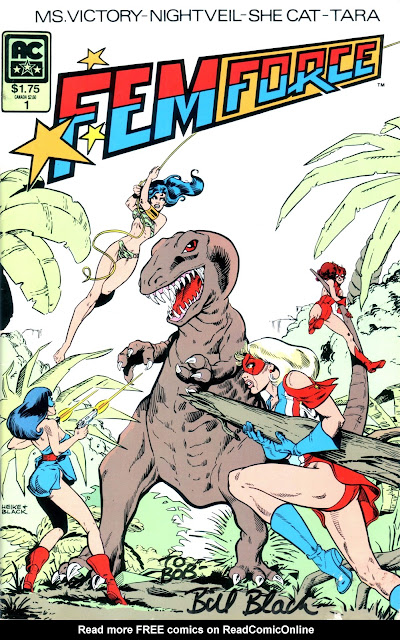
 

But the question comes to me: can I truly regard FEMFORCE #1 as a "crossover" if the renamed "Ms. Victory" is the only one with stature accruing from Quantitative Escalation? The other three heroines seen on the above cover-- The Blue Bulleteer, Tara the Jungle Girl, and the She-Cat-- are all familiar riffs of earlier superheroine types, but to my knowledge none had previously appeared in commercially published comic books or in any other professional medium. So at the time of this issue's publication, doesn't that mean that these three heroines actually had no more stature than any other character who appeared just one time-- say, no more than a hero who just got one story and never appeared again? And if they did not possess stature within the first issue, then one might reason that none of the "regular" issues of the magazine would possess "c-stature." (I say "regular" because some issues were devoted to reviving other public domain Golden Ages like Miss /Ms. Victory.)

My answer is that such a combination of a "established character" with "newbie characters" can possess "c-stature." However, the presence or absence of "c-stature" can only be determined once the feature or franchise has accrued some history as a recurring venue in which the established character and the newbie characters continue to interact and in which the newbies are free to "spin off," if only temporarily, from the parent concept. In such a feature, the author's intent to launch a "new universe" has been realized, and so I conclude that all three "newbies" in the FEMFORCE comic book start out with what I call "nascent c-stature."
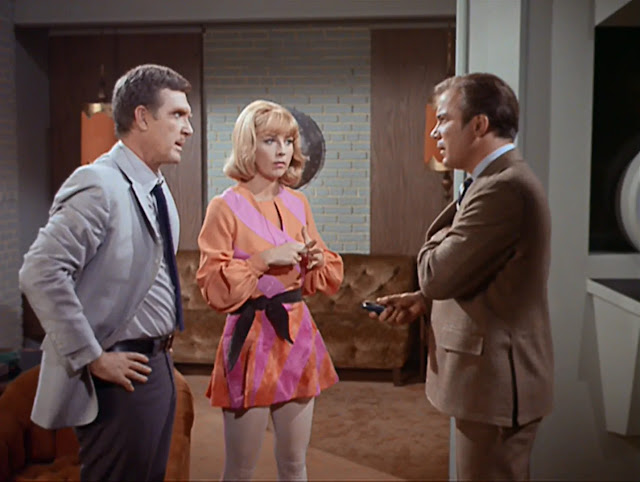


The opposite type of "c-stature," one in which the stature-potential is not realized, is what I call "null c-stature." This type would appear whenever there's an unsuccessful attempt to launch a new starring character (or characters) with help from an established one. The best example can be found in the television concept of the "back-door pilot," in which a producer would seek to foment a new series by having the proposed series' principal(s) interact with the characters of an established series. In 1968 Gene Roddenberry attempted to launch a concept for a new SF-series by having its characters, Gary Seven and Roberta Lincoln, encounter the characters of STAR TREK in the episode "Assignment Earth." If a series had eventuated from this encounter, I would have deemed the characters of Seven and Lincoln to share Prime stature with the TREK characters, and so both newbies would have "nascent c-stature" until their series actually manifested. In earlier essays I suggested that Norman Lear's character Maude had stature even prior to getting an actual series, having only appeared on two episodes of ALL IN THE FAMILY, but I did not have a distinct term for this particular type of stature, which is, again, "nascent c-stature." In those two episodes of FAMILY, Maude shares Prime c-stature with Archie Bunker and the other regulars, but only in a nascent sense. But no series for Seven and Lincoln eventuated from "Assignment Earth," and so the characters only possess "null c-stature," but only from the standpoint of a crossover analysis. For those who watch the episode without knowing that it was a back-door pilot, Seven and Lincoln are perceived to be just like any other Sub supporting characters on the show, possessed of charisma but no starring stature of any kind.


The same principle applies to null and nascent c-charisma. A character who appears just once and never again-- such as this 1947 Bat-villain The Glass Man-- has a base level of ordinary charisma, but he has no claim to any sort of c-charisma.


Now a character who appears only once may debut under circumstances that make it more POSSIBLE that he could be revived. Also in ESCALATION PT 2, I focused upon the 1996 multi-villain crossover BATMAN: THE LONG HALLOWEEN, writing:


The same [principle of charismatic crossovers] applies to a multi-villain crossover like THE LONG HALLOWEEN-- but only to those villains-- Joker, Mad Hatter, Scarecrow et al-- who have "made their bones." This same story introduces a new villain, Holiday, but since he never appeared prior to that story, he has negligible charisma and so is not part of the charisma-crossover per se. 

Given that close to twenty years have passed, and that Holiday, like the Glass Man, was slain in his debut, it seems at this point that Holiday also possesses ordinary charisma in that he achieved neither Quantitative nor Qualitative Escalation. Still, if someone did revive Holiday, I *might* judge that he retroactively possessed "nascent c-charisma" within the LONG HALLOWEEN narrative in a manner analogous to the newbie heroines of FEMFORCE possessing "nascent c-stature." But I'm not holding my breath for that to take place.
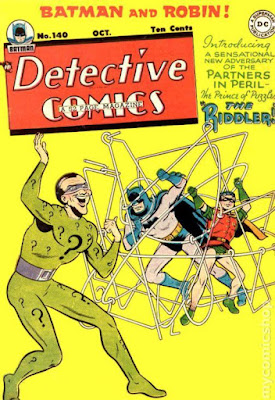


Of course a number of low-charisma characters were reinvented over time to have either high charisma or even high stature, both of which improved their chances to accrue either "c-charisma" or "c-stature." During the Golden Age of Comics, the Batman villain Deadshot only appeared once while the Riddler appeared only twice. But the Riddler's first appearance in the Silver Age led to his adaptation to the 1966 TV show, and he was almost instantaneously promoted to being a first-rank villain. One might say that this promotion also stemmed from quality rather than quantity, since Frank Gorshin's performance gave the character greater appeal to audiences than he had ever garnered from comic-book readers as the result of his three appearances in comics.  Eventually he would become notable in respect to both Quantitative and Qualitative Escalation, and even branches out to "cross over" with other DC heroes like the Elongated Man-- probably his first "c-charisma" crossover.

As for Deadshot, he certainly became Quantitatively more significant. The 1970s Englehart-Rogers redesign of his costume and modus operandi made him more popular with fans, and further articulations, particularly by John Ostrander in SUICIDE SQUAD, gave Deadshot a more well-defined character. I would not say that Deadshot became as Qualitatively exceptional a figure as did the Riddler. However, unlike the Riddler, Deadshot accrued high Prime stature through his membership in the eighties SUICIDE SQUAD (and, I  assume, later incarnations of the franchise as well). By definition,  of course, SUICIDE SQUAD was a crossover of many characters, almost all of whom had started as Subs, and this change resulted in all of them obtaining both regular stature and c-stature. 
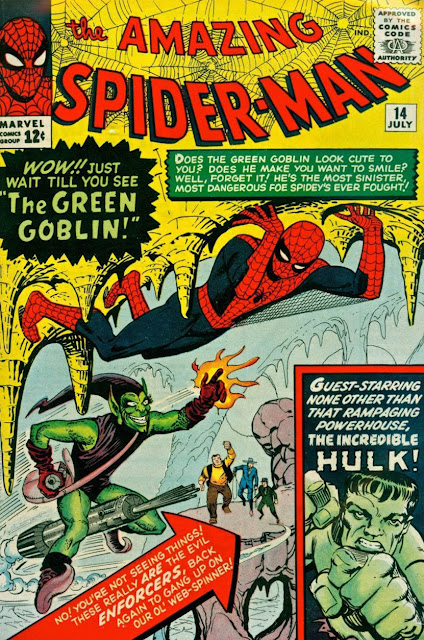


The relevance of the "null and nascent" categories with respect to "charisma crossovers" also means that only from a historical perspective can I consider a story a crossover if it contains the association of a "first time villain" with a "repeat offender." In SPIDER-MAN #14, the "repeat offenders" are The Enforcers, though they had made but one previous appearance. The Green Goblin was the "first timer," and though his creators patently intended for him to be a repeat villain, his first appearance can only be seen as having "nascent c-charisma" from the perspective of knowing that the Goblin made further appearances. But from the current historical perspective, most comics-fans know that the character became far more iconic as a Spider-villain than the Enforcers ever could have been, and so SPIDER-MAN #14 also can be deemed a charisma-crossover. 

As I begin to wrap up yet another convoluted concoction of categories, I may as well circle back to a series that runs counter to that of the opening example. In A CROSSOVER MISCELLANY PT 5, I outlined three types of ensembles, concluding with what I called "the semi-inclusive ensemble." The earliest example of this known to me was the Golden Age series "The Girl Commandos," in which the feature's creators picked up an established solo character, Pat Parker, and "included" her in a team made up of "newbies." Now, the pattern here superficially resembles that of "Femforce," where only one established character with a bunch of newbies. However, "Girl Commandos" was not a crossover in my judgment as "Femforce" was, because the female allies of Pat Parker were not designed to operate independently of the "Girl Commandos" feature. The heroines of "Femforce," however, were over time frequently spun off into individual features, however short-lived, so that they began to resemble a purely inclusive ensemble, but one where team stature came first and individual stature came later. 

Semi-inclusive groups became far more prevalent in the 1970s. The  1960s X-Men team was entirely exclusive in its members were meant to remain in their own feature aside from very rare individual guest-shots in other features. However, the 1970s X-Men combined a group of newbies with one legacy character from the first series (Cyclops) and a smattering of mutant characters who had only appeared in supporting roles. The newbies for the most part became the most popular characters, along with one-shot Hulk-antagonist Wolverine, and the characters' association with the X-Men largely effaced any piddling associations that Wolverine or anyone else-- except Cyclops and, slightly later, Marvel Girl-- had accrued, so I would not tend to judge the X-Men to be an ongoing "static crossover" series as I would FEMFORCE and SUICIDE SQUAD.


NOTE: Some of the terminology in this essay has been discarded since its writing.
Saturday, May 21, 2022

DEPARTMENT OF COMICS CURIOSITIES #10

 Here's a rare example of a comic-book Black guy (African? Aborigine?) who's not made the goat for his dialect, from a 1943 issue of SPEED COMICS, in the feature "Padlock Holmes" by Ed Whelan.


And from a slightly later issue, here's The Black Cat encountering an African medicine-man whose intellectual attainments (and his resentment of Euro-culture) would fit him to appear in the next BLACK PANTHER movie.


Friday, May 20, 2022

A CROSSOVER MISCELLANY PT. 5

 I might well have placed this post under a title like ENSEMBLES ASSEMBLED, but I chose the above series-title instead because the premise is rooted in some of the crossover-notions I've introduced here.

For instance, in A CONVOCATION OF CROSSOVERS PT. 2, I mentioned that a solo Golden Age character, Miss Victory, had been inducted much later in the Bronze Age super-team Femforce, and that I did consider this to be at least a static crossover, because Miss Victory had accrued a certain stature in her original appearances.

This led me to the realization that team-features as a rule fell into three ensemble-configurations.

The one most popular during the Golden Age was The Inclusive Ensemble, in which a team was composed entirely of protagonists who had their own features. A few of these teams were one-shots, as with this Black Cat story, but the most memorable such teams were the long-lived ones like THE MARVEL FAMILY and THE JUSTICE SOCIETY OF AMERICA.

Less prevalent in the 1940s was The Exclusive Ensemble, whose members all debut in the same team-feature and for the most part remain confined to that feature. The best known example would be THE BLACKHAWKS, none of whom appeared in other features, though one member, Chop-Chop, appeared for several years as a humor feature-- but this was always in magazines wherein the BLACKHAWKS were the stars. 

The last type was barely ever seen in the Golden Age, and I term this the Semi-Inclusive Ensemble, in which either one featured character gains a group of new characters to share the spotlight. I only know of one in the period, THE GIRL COMMANDOS. A solo character, "Pat Parker War Nurse," had appeared on her own for about eight stories, and then the editors put her in a girl-group for the remainder of her career. Much later, though, comics from the Bronze Age onward began cobbling together new teams out of characters who had appeared elsewhere, often in failed solo features.


ADDENDUM: On reflection, there are probably a lot more Exclusive Ensembles than Inclusive ones in the Golden Age, but many of the former were short-lived, and even those that enjoyed longish runs have been forgotten. A few old comics fans may recall Jack Cole's "Death Patrol." But "Red, White and Blue?" Or "The 3 Xs?" Not so much.

NEAR MYTHS: "HOLLYWOOD ATTACKED" (SPEED COMICS #23, 1942)


I might have listed this hero-crossover under "curiosities," but there's a little mythic appeal to the idea of having all the Harvey heroes in SPEED COMICS come together in one story, even though Lev Gleason had executed the same idea the year before  with DAREDEVIL BATTLES HITLER. 

Just as the Lev Gleason story was technically a Daredevil tale in which all the other featured characters were guest stars, this story stars the Black Cat, whose spy-busting adventures mostly took place in and around Hollywood. The idea of both the Japanese army and navy invading Hollywood, and only Hollywood, is amusing by itself, as is the idea that the Cat and her fellow stars-- Captain Freedom, Shock Gibson, disguise-artist Ted Parish and the Girl Commandos-- thwart the invasion without any help from U.S. armed forces.


That said, the unbilled writer did put a little thought into his premise, as seen on this page, where one hero suggests that they play the Japanese army and navy off one another-- an idea I can't remember having seen in WWII comics before. There's also a little "girl power" involved as the Black Cat and the Girl Commandos team up.

One other tidbit: at one point, a Japanese soldier uses the term "shimatta," which has more than one meaning but seems in context to mean "shit!"


Wednesday, May 18, 2022

A CROSSOVER MISCELLANY PT. 4

 I first laid out my criteria for the terms "distributive" and "non-distributive" in STATURE REQUIREMENTS PT. 5:

Now that I've put forth "charisma" as a term that better approximates the creator's organization of narrative elements, my other two terms apply to the process of whether the charisma is bestowed upon just one focal presence, or is distributed to more than one. The first would be "non-distributive," given that the charisma is not divided up, as with the Superman mythos, while the second, as seen in the Batman mythos, must be judged as "distributive" on the whole, since the Bat-mythos has a history of allotting narrative charisma to more than one presence in a sustained manner.

I later reversed my use of the terms "stature" and "charisma" in EQUAL AND UNEQUAL VECTORS OF AUTHORIAL WILL PT. 2, but the terms "distributive" and "non-distributive" are unaltered.

Since my arguments about the functions of stature and charisma in crossovers depends on the past history of the characters crossed over, I'll note that the distributive/non-distributive dichotomy may also apply to teamups of heroes and villains.

For instance, I said that BATMAN changed from non-distributive to  distributive as soon as the Crusader acquired Robin as a regular partner. Some characters who did not have their own features, such as the Barbara Gordon Batgirl, functioned only as guest-stars until such time as they acquired their own berths. Once Batgirl II had enjoyed her own backup strip for several years, I would tend to judge every appearance of Batgirl II in the BATMAN feature to be a "static crossover," because the character had acquired sufficient stature from being a centric character. 

Oddly, though, before getting that stature, one might argue that Batgirl-- a non-distributive character in her comic book berth-- debuted as a distributive type in the 1967-68 season of BATMAN. Every episode of that TV show's third season presented Batman, Robin and Batgirl as regular co-combatants, and thus they were as much a team in that season as Batman and Robin were in the previous two seasons.

More on these recondite matters later, perhaps.