Featured Post

SIX KEYS TO A LITERARY GENETIC CODE

In essays on the subject of centricity, I've most often used the image of a geometrical circle, which, as I explained here,  owes someth...

Wednesday, May 30, 2012

DUCK SHOOT AT THE ANTI-EMBODIMENT CORRAL, PART 2

At the end of FEMALE OF THE SPECIES PART 3 I said:
...though I have just two more Thompson-related essays to get out of the way, I may have come across another resource that supplies me with more debate-worthy fodder.
The "resource" to which I alluded was this 2-26-12 essay on Hooded Utilitarian, where Noah Berlatsky takes issue with several current offerings of comic-book superhero cheesecake, comparing all of them unfavorably with the cheesecake offerings from such bygone artists as Jack Cole and Dan DeCarlo, as well as current artist Larry Elmore.  Though Berlatsky does give a nod of approval to Frank Miller's sexed-up version of Catwoman, most of his superhero-comics examples he regards as "moronic."

I don't agree that current superhero comics are quite as bereft of what he calls "feministploitation," where:

the fetish clothing and the putative power of the character are coherently working together, both in that the power makes the character more sexy and in that that the clothing adds (not necessarily logically, but still) to the sense of the character’s potency.

However, I will agree that the particular examples Berlatsky chose are indeed incompetent exemplars of current hyper-sexualization.  To take just one example, he notes that "Star Sapphire’s costume, for example, goes right past sexy and on into ludicrous," and I can hardly demur:


I mentioned in Part 1 that in real life women often had to dress in social situations to show themselves off to good effect without showing too much and looking like sluts.  Apparently this version of Star Sapphire took her social cues down at the Boom-Boom Room.

That said, I find some problems with Berlatsky's justifications:

I think there are a couple of reasons. In the first place, super-heroines are, you know, heroes. They’re supposed to have stuff to do, crime to fight, justice to uphold, and so forth. For Dan DeCarlo and Jack Cole, the woman are just there to stare at; they’re hot, hot hot. That’s the whole raison d’etre; there’s no effort to pretend that you care what these women think, or how they act, or whether they defeat the villain without falling out of their tops and being exposed to the vastness of space.


And shortly afterward:

If you make it simply about visual stimulation, it’s simply about visual stimulation, and doesn’t have to have anything to do (or at least, not much to do) with real women. Once you start pretending that you’re talking about a smart, motivated, principled adventurer, on the other hand, you end up implying that said smart, motivated, principled, adventurer has an uncontrollable compulsion to dress like a space-tart on crack. Which is, it seems to me, insulting.

Though I would agree that all of Berlatsky's chosen examples are indeed bad, I don't quite agree with the idea that a given heroine cannot be a "motivated, principled adventurer" and still wear something a little on the sassy side, as per the "belly shirt Supergirl" that I've defended earlier:


The above drawing is certainly a little on the cheesecakey side-- what I've termed the "TITILLATION" category elsewhere-- but is there anything about it that makes the character look unprincipled or stupid because she's chosen to show a little flesh?  I would say no, though I have the impression that a lot of fans protested "sexy Supergirl" to the extent that the new incarnation sports a safe generic costume with zero titillation elements.

To many fans there seems a major disconnect, similar to Kelly Thompson's false "idealization/sexualization" dichotomy, between portraying heroes as characters with high ideals and principles and as characters who look good and obviously have the power to attract many sex-partners.

Thus I'm surprised that anyone, such as the blogger for this BEAT post, would intimate that the existence of "superhero sexuality" might not even matter. Maybe I'm biased in that I didn't start collecting the genre until I was eleven (having only dallied with kid-and-teen comics prior to that), but to the best of my recollection I always thought that even the "all ages" superhero books of the Silver Age had a strong sexual vibe, even if the sexiness appeared in very simple form, as with Lois Lane or Vicky Vale trying to "unmask" Superman or Batman, and thus play Delilah to their Samson.


More later.


DUCK SHOOT AT THE ANTI-EMBODIMENT CORRAL, PART 1

In FEMALE OF THE SPECIES PART 2 I said:

As discussed in EMBODIMENT, it's stunningly inaccurate to assume that male characters are less sexualized simply because they are dominantly "covered from head to toe."  What I believe Thompson truly objects to is the *feeling* of greater exposure for the heroines; the sense that they are always being subjected to the "male gaze" as promulgated by Laura Mulvey.
And in QUICK SEX-COVER-UP REMARK I noted this offhand comment by one Charles Reece:

"I don’t have any stats on any of this, but just based on the gals and guys I know and see, for the most part, the former prefer wearing more revealing clothing than the latter. Superheroes just kind of replicate that tendency in a more exaggerated manner. The men who walk around in cutoffs or with their shirt open to the navel or in half shirts tend to be gay or aging rockers."

While Reece and I are miles apart in most if not all ideological stances, I would agree, purely on an observational basis, that men tend to cover up and women tend to reveal, however strategically, as per the example I mentioned before:


If Kelly Thompson surveyed Hollywood musicals the same way she surveyed superhero comic books, would she come to the conclusion that they too are guilty of objectification and hyper-sexualization purely in terms of that one element:  how covered men are and how uncovered women are? 

That would be an unfair question were I asking it in more than a broadly comparative sense.  Clearly Thompson's essay indicts current American superhero comics for more than just the covered/uncovered dichotomy.  Nevertheless, because Thompson is busy assailing the forces of objectification in the superhero comic, I find it a fault that she does not consider that there might be other factors at work in the way comic book professionals portray male and female characters.  I suggest that in American culture it's typical to identify "maleness" with a process of concealment, in which one dons a Brooks Brothers suit as a knight dons his suit of armor, and "femaleness" with a process of partial revealment, wherein the female, when making a display of herself not only for men but also for other women in her immediate society, must strike a balance between showing her appearance off to best effect without showing off too much and thus being "slutty."

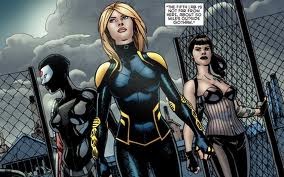
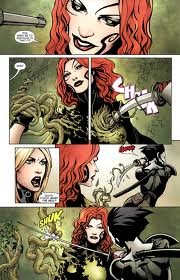
Sometimes comic books actually get the balance of sexual representation correct, as per this fan-favorite scene from BIRDS OF PREY #104:


The above scene, in my opinion, would not be an unfair depiction of male and female tendencies of dress, as it's based on current cultural imperatives as to how males and females dress at social affairs.  By extension, I don't necessarily regard it as a vile male conspiracy simply because none of the male members of the X-Men dress as revealingly as Storm, much less the White Queen. I make no bones about the fact that most superhero comics are written to a male audience, which means that they are likely to remain more heavily invested in cheesecake than in beefcake.  That said, some of the disparity may not be attributable PURELY to the likelihood that heterosexual male readers don't want to look at beefcake.  It may also be attributable to the cultural fact that men think that other men in revealing duds look unmanly, if not outright gay.  I mentioned in FEMALE OF THE SPECIES PART 1 that there had been male heroes that showed a lot of skin without seeming unmanned, as with Hawkman and Sub-Mariner.

But should a counterexample be needed, here's Cosmic Boy from some 1970s LEGION tale:


More to come in Part 2.

Saturday, May 26, 2012

THE RETURN OF THE REPRESSED COMMENTS

Suddenly my comments are back on the Thompson thread mentioned in the previous post.  Sigh, that means it's possible that their disappearance *may* have been only an Internet hiccup.

That, or someone who reads this blog is fuckin' with me.

I'm no longer sure which seems more likely these days.

Anyway, conditional apologies to Kelly Thompson, who isn't likely to read them in any case.  Here's the comments, which I may build on later:

__________________


KT said:

“How can anyone look around at some of the recent successes we’ve been seeing in film – Avengers, Hunger Games, Bridesmaids, etc. and deny that women and girls have media power? They are 50% of the goddamn population.”

Absolutely.
But– even if it’s true that 40% of AVENGERS watchers are female, is that necessarily true of the other Hollywood femme-action films in KT’s visual montage?

Was 40% of KILL BILL’s viewership female?

The UNDERWORLD films?

The RESIDENT EVIL franchise?

Given a very long period in which American female viewers tended to avoid the Big Loud Action Movies, whether they starred heroes or heroines– I’d say it’s going to take a long time to convince Hollywood to invest in the theory of a massive sea-change (my term) in gender preferences.

Friday, May 25, 2012

QUICK COMMENT PRESERVATION

Sometimes I wonder if I'm a little paranoid when I preserve comments here that I've put elsewhere.  Surely, as long as a comment is essentially polite even if dissenting, no one would delete one just out of personal malice.

Well, said deletion took place in the last couple days on Kelly Thompson's SHE HAS NO HEAD.  Since I didn't preserve the comment, I can't prove it was essentially polite if dissenting.  Since Thompson did ring in once on one of the Sequart threads, the conclusion is fairly obvious.

I have no idea if Noah Berlatsky might do the same, but just to be sure I better hurry and copy this dissent against a Charles Reece piece on HU:

Charles, I believe I’ve caught you in a contradiction.

In paragraph 6 you say:

“Wonder Woman is the dominating will. When she’s bound, it’s always wrong. The reader is to identify with her regaining control, making others submit. Similarly, Wonder Woman does a lot of hitting, but is rarely hit herself. (I count only once: Giganta nails her with a club. [p. 44])”

Maybe I missed something about volume(s) you read but I recall the Marston WW getting hit quite a lot, though of course she dishes out more than she takes. There may be periods where she’s sandbagged less than others, but one could say that of Batman or any long-lived hero.

The contradiction appears in paragraph 5:

“Although Wonder Woman regularly uses dominating tactics (the lasso, fisticuffs) they’re always reactive (the villain strikes first). Like Billy Jack, she wants to love, not fight, but she’ll kick your ass if you force her.”

I find it really hard to reconcile a “dominating will” who waits until the other guy strikes. That too would seem not to line up well with your “fascism” charge. I’ll agree that a reluctant hero is inevitably going to kick ass. But that doesn’t eliminate the connotative difference between the reluctant hero and the quasi-hero who’s ready to go Lobo on anyone with the least provocation.


____________________


Actually, Charles R. does touch on a topic that I've mentioned somewhere hereabouts before, as to whether Wonder Woman truly presents an ethic of masochism.  Don't know when I'll get around to giving my very different take on the matter, though.

QUICK SEX-COVER-UP REMARK

Posted this on a 2-26-12 post of THE HOODED UTILITARIAN:

Charles Reece said:

"I don’t have any stats on any of this, but just based on the gals and guys I know and see, for the most part, the former prefer wearing more revealing clothing than the latter. Superheroes just kind of replicate that tendency in a more exaggerated manner. The men who walk around in cutoffs or with their shirt open to the navel or in half shirts tend to be gay or aging rockers."

Here's a rare place where Charles and I agree.  Kelly Thompson (was she mentioned here or somewhere else? already forgotten) regarded the greater proportion of covered-up men as some vile conspiracy to subject only female characters to the evil "male gaze" or something of that sort.

But what if the superhero artists are simply reflecting their social mores?

Try to imagine what the dance-scene from THE GAY DIVORCEE would look like if Ginger was all covered-up and Fred was the one in the low-cut gown.

You may need something strong to drink after you've done so, but that won't be my fault.

Thursday, May 24, 2012

TAKE THE COMIC BOOK "SEXUAL EMBODIMENT" TEST, PART 2

In FEMALE OF THE SPECIES PART 2 I observed with incredulity the way a certain contingent of comics-fandom gave Kelly Thompson a free pass re: the evidence she presented with regard to the “hyper-sexualization” of female comics-characters. Despite the fact that Thompson constructed her case on the assertion that this or that character was “regularly unzipped” and so on, she gave no indication as to what time-frame these representations regularly took place, be it in the last ten months or the last ten years. It was entirely OK for Thompson to present what one respondent to my essays called “anecdotal evidence.” However, when I presented a point-of-view that mitigated Thompson’s one-sided perspective on gender representation, more than one respondent wanted chapter-and-verse, scientifically redundant, DNA-tested evidence coming out the wazoo. If I didn’t present same, that lack proved me a no-good ultraconservative defender of sexual oppression.


All this supposed demand for rigor, of course, was merely a cover to reject any observation that might mitigate the narrative of female victimization via so-called “objectification.” From a rhetorical standpoint, there’s nothing a preacher loves better than the devil against which he preaches. Without that object of scorn and detestation, the preacher’s got no audience. For most ultraliberals, the objectification of fictional female characters is one of their personal devils, and perdition help the critic who dares suggest that sexual representation, whether in comics or any other medium, might be a two-way street.


One of those respondents challenged me to show evidence of my claim that male characters in comics were also sexually embodied—apparently with the sense that even if I could show such, it would be meaningless unless I could show total parity with female sexual embodiment. I imagine he thought that the only possible rebuttal to Thompson’s imputations of inequality in “No, It’s Not Equal” would be to prove such parity. At no time did I claim that fiction aimed at a male audience would not contain a disproportionate quantity of sexualized depictions of females. What I did claim was that there was an ongoing process of embodiment that applied to both male and female character-construction, and that male characters were constructed to be appealing to female characters within the comic-book diegesis.


I mentioned on that comments-thread that I was meditating on a possible way to take a fair sampling of a batch of contemporary comic books and examine them for both male and female sexual embodiment, in contradistinction to Thompson’s skewed analysis. Given that I had in another essay touted some titles in DC’s “New 52” as representing a new development in the formulation of adult pulp, it occurred to me, “What if I performed such a survey on every New 52 title within a given month?” Limited though such a sampling would be, it would be better than Thompson’s “anecdotal” overview.


But, given the righteous attitudes displayed by most of my respondents, I thought twice. “Why bother with a full month survey, given that most fans are so in love with being blinkered and judgmental that they’ll never alter their opinions no matter what evidence is produced?” So I saved my money and, when a sale came round at a local comics-shop, I simply bought the back issues I wanted anyway and decided to use that as my sampling.

As explained in Part 1, I’m breaking down the sexual representations in each comic surveyed in terms of my deductive categories, GLAMOR, TITILLATION, and PORNIFICATION. I imagine that another easy way to dismiss my formulations would be to simply disagree with these divisions. A thoughtful critique is certainly possible.  However it's more likely most fans would just fall back to the victimization position, implying that a costume showing bare legs (an example of GLAMOR, usually) is exactly as bad as a costume that looks like Victoria’s Secret lingerie (PORNIFICATION, of course). Should anyone make this assertion, assume that I've already deemed it unilaterally stupid and move on.


I’m not counting every sexually embodied image in every one of these titles. Rather, I’m going by page-count. A book with “5 counts of GLAMOR” means five pages on which some GLAMOR-ous image is presented for the reader’s possible delectation. Covers count as only one page, though ads are not counted.
It's impossible to state that a given drawing carries the concept of sexual embodiment for everyone.  However, I focused on those drawings that at least showed enough of at least one face, one figure or the two together to connote sexual attractiveness.


Here goes.


BATGIRL #7— No counts of male sexual embodiment. 8 counts of female sexual embodiment of the GLAMOR type.


BATGIRL #8—No counts of male embodiment. 6 counts of female GLAMOR.


BIRDS OF PREY #1 – 13 counts of female TITILLATION. 7 counts of male GLAMOR.


BIRDS OF PREY #2 – 17 counts of female TITILLATION. 1 count of male GLAMOR.


BIRDS OF PREY #3 – 14 counts of female TITILLATION. No counts of male embodiment.


BLACKHAWK #1 – 6 pages male GLAMOR. 7 pages female GLAMOR.


CATWOMAN #5 – 7 counts of female PORNIFICATION. 2 counts of male GLAMOR.


CATWOMAN #6—11 counts of female PORNIFICATION. 4 counts of male PORNIFICATION. (And yes, they’re all Batman.)


CATWOMAN #7 – 7 counts of female PORNIFICATION. 2 counts of male PORNIFICATION.


RED HOOD AND OUTLAWS #2 – 1 count of male TITILLATION. 2 counts of female TITILLATION. 3 counts of female PORNIFICATION.


SAVAGE HAWKMAN #1—11 counts of male GLAMOR. No counts of female embodiment.


SUPERGIRL #1—11 counts of female GLAMOR. 1 count of male GLAMOR.


SUPERGIRL #2 – 16 counts of female GLAMOR. 16 counts of male GLAMOR.


If I wished to invest in a scanner to reproduce all the relevant pages, I could make arguments for all my categorizations—but again, that would involve spending money to prove my conclusions to an audience in love with defending victims—or what they like to imagine as victims.

Will that be my final word on the mélange known as “No, It’s Not Equal?”


Magic eightball says, “Maybe for now.”

Wednesday, May 23, 2012

SEX SURVEY SEGUE

Before proceeding to Part 2 of the "sexual embodiment" test, I feel the need to draw parallels between the three categories posited in PART 1 and three categories posited in the earlier essay LET'S GET SEMI-DIRTY.

In the latter essay, I started out with two terms introduced in a yet earlier piece, which sought to analyze two aspects of what I now call "embodiment"-- that is, "sex" and "violence" in literature-- and ally them with "clean" and "dirty" versions in terms of the intensity of what the viewer/reader was shown. 

In earlier essays on this theme I tended to discuss violence, but SEMI-DIRTY is intended to focus on demonstrating an interstitial category-- "semi-dirty"-- and for that I emphasized the aspect of fictional sex:

I didn’t give [in the earlier essay referenced] parallel examples of sex, but the same standard of explicitness applies. I should note that whether a work is clean or dirty has no bearing on how exciting its kinetic elements may be for a given audience-member. Some may well find the clean but vivid courtship-rituals of NORTH BY NORTHWEST more stimulating than the explicit dirtiness of LAST TANGO IN PARIS.


The same generalization applies to the "semi-dirty" category; some may prefer it to either manifestation.  Going purely on anecdotal experience, I have one (never to be named) acquaintance who dislikes sexual explicitness of any kind.  I would presume that if he gets turned on by any sort of fiction, it would have to be something comparable to the "vivid courtship-rituals of NORTH BY NORTHWEST."

At the other extreme, I have another acquaintance whose main comment to a screening of FASTER, PUSSYCAT! KILL! KILL! was to complain about the lack of (visible) tits.  So presumably nothing but "explicit dirtiness" would have worked for this individual.

The three categories I'll be using for the "sexual embodiment test" thus line up rather well if I say so myself:

GLAMOR-- "clean" sexuality
TITILLATION-- "semi-dirty" sexuality
PORNIFICATION-- "dirty" sexuality

The only major difference between these parallel essays is that in the "clean & dirty" ones, I didn't address narrative function at all.  In BATTLE OF THE MONSTER TERMINOLOGIES, I used separate terms to describe narrative function pertaining to spectacle, designating a dichotomy between "functional violence" and "spectacular violence"-- with the usual caveat that the same dichotomy applies to fictional sexual representation.  However, an interstititial category can be created for this aspect as well:

GLAMOR-- "functional" sexuality
TITILLATION-- "semi-spectacular" sexuality
PORNIFICATION-- "full monte spectacular" sexuality

Next up:  (part of) THE NEW 52 takes the TEST.