Featured Post

SIX KEYS TO A LITERARY GENETIC CODE

In essays on the subject of centricity, I've most often used the image of a geometrical circle, which, as I explained here,  owes someth...

Monday, October 15, 2012

SIM SIM SALLAH BLAM

Shows how much attention I pay to either Fantagraphics or Aardvark-Vanaheim these days, as I just found out last week from this BEAT post that there had been some lengthy discussions as to whether Dave Sim might allow Gary Groth, Inc. to republish CEREBUS in a bookstore-friendly version.

The "blam" in the title refers to the fact that the discussions seem to have blown up in everyone's faces, but I'm not interested in discussing the viability of seeing these two dialectically opposed comics-figures become "strange bedfellows."

One of the many comments Sim made (through a representative) was to vent his resentment of a cartoon that the JOURNAL published in which he was compared to Hitler.

... I was certainly surprised when one of the individuals responsible for labelling me as being co-equivalent with a Nazi concentration camp commandant was suddenly — quite publicly — talking about publishing my work and breathing new life into it... And if I did respond then I would be reinforcing the legitimacy of me being depicted as a concentration camp commandant, 18 years later. Otherwise why was I negotiating with them/him?"-- from "Dave Sim Responds" here.


Sim's aggrievement also doesn't concern me here just now.  Still I found my eyebrows substantially raised by Gary Groth's refutation of Sim's objection, helpfully excerpted on THE BEAT.


Consider this: TCJ, as has been pointed out, sold half of what Cerebus did. (That sounds about right: Cerebus probably sold around 20,000, the Journal around 9,000). Surely, a greater proportion of Cerebus readers cared about Dave Sim and Cerebus than that of Journal readers. It was Sim who first published a Dave-Sim-Is-Hitler analogy comment in a forum that would have far greater impact on Dave Sim’s livelihood than the Journal — his own comic, read exclusively his his own fans. Logically, then, Sim did far more to cultivate what he perceives as the Sim-Is-Hitler public persona that he believes currently exists (which, keep in mind, only exists in Sim’s head). So, we have several layers of lunacy at work here: the first is that there’s wide perception of Sim-as-Hitler (which there isn’t) and the second is that the Journal was solely responsible for this when it was in fact Sim’s own Cerebus that was, logically, far more responsible…..


What amazes me about Groth's comment here is that while I was a constant and (I think) thorough reader of CEREBUS back in the day, I had no idea what 'Dave-Sim-is-Hitler-analogy-comment" Groth referenced.  Groth states that it appeared in response to the incendiary issue #186, but the comment wasn't originated by Sim, though he did respond to it.

I'm having a lot of trouble figuring out how Sim responding to a comment "did far more to cultivate... the Sim-Is-Hitler public persona."  Did anyone remember this lettercol exchange before Groth mentioned it as a proximate cause that inspired the offending cartoon?

I don't think that Sim is "responsible" in any way for fomenting the intellectually lax "Sim-Is-Hitler" meme, even with the consideration that he could have chosen not to print the originating comment in the CEREBUS lettercol.  I can imagine that many people who didn't like Sim's views would have made comparisons between Sim and Hitler had Sim never printed that comment, or any similar comment, and also if THE JOURNAL had never printed the offending cartoon.  Comparing one's enemies to Hitler has spawned its own "law," if one can fairly call it that.

But if you ask me what did the most to spread the Godwinian comparison-- some little comment in the CEREBUS lettercol, or the fullblown cartoon in the JOURNAL-- well, obviously, the JOURNAL cartoon had the greater effect.  Such is the power of the image: *seeing* a comics-celebrity like Sim in Nazi attire will always sear its way into the cerebral synapses in the way that a verbal debate cannot.  I don't imagine that the JOURNAL's low sales prevented the dissemination and discussion of the cartoon in many quarters that paid no attention whatever to the lettercol referenced.

By saying this, I do not side with Sim on the question of whether it was right or tasteful for Groth to have published such a cartoon.

But Groth's attempt to shift the burden to Sim's shoulders is more than a bit egregious.


Wednesday, October 10, 2012

DEMIHERO DELIBERATIONS

The demihero can be resourceful, can be powerful, can be central to the narrative.  But he must embody “instinctive will” in its life-affirming guise, even as the monster does in its (generally) life-denying guise.-- DIAL D FOR DEMIHERO, PT. 3.
In this essay I gave examples of demiheroes who were *microdynamic* (TV's Carl Kolchak) and *mesodynamic* (Stoker's Jonathan Harker), but I didn't cite one who was in the high *megadynamic* range of power, nor show that it was possible for a demihero to have power and still be ruled more by "instictive will" than by "intellectual will."

In the interests of symmetry, here is one such:


I reviewed the film in which Doctor Erasmus Craven on my movie-blog here, along with another AIP horror-film starring Vincent Price.  I'll confine myself to one quote from the review in order to establish the character's demiheroic nature.

Just from this bare description it’s plain that like the protagonist of PIT AND THE PENDULUM, Craven is “craven” regarding the overshadowing history of his father’s exploits.  Though he’s willing to help the bad-tempered Bedlo, who seems to have earned his transformation by quarreling with Scarabeus, Craven wants no trouble with his father’s old enemy—

However, Craven is lured out of his self-confinement when the "raven" of the title tells him that he might find his "lost lenore" at the domicile of his father's old foe.  After assorted twists and turns, the film finishes up with Craven and Scarabeus duelling one another with magical spells.  Though the spells invariably have a comic tone, they nevertheless represent a level of power I've termed megadynamic, not least simply because they are marvelous in nature, as explicated at the conclusion of the essay MEGA, MESO, MICRO PT. 2.

I don't think that, despite Craven's possession of "super-powers," that anyone would ever view him as a distant cousin to the more mystical heroes, whether they are costumed types like Doctor Strange and Doctor Fate, or more worldly-looking types like Siegel and Schuster's Doctor Occult.

I anticipate one objection to the comparison might be that Craven follows a different narrative pattern than the occult heroes-- not in terms of my Fryean-derived mythoi, but simply in that he is a "one-shot" character whose narrative arc is resolved in his sole appearance, while the others are meant to be serial opponents of crime/evil.

However, in no way is the superhero idiom dependent on seriality.  Here's another film that has, at present, dealt with a one-shot mystic protagonist's struggle to define his place in the world.


Admittedly, SORCERER'S APPRENTICE could be turned into a serial property with little or no effort.  Nevertheless, my point remains undiminished: the 2010 film revolves around a main character who also must come to terms with his powers and oppose evil-- a theme certainly not derived from any of the original contexts for the "Sorcerer's Apprentice," whether from Goethe or Disney. Both of these stories are comic in tone, and the Nicholas Cage film transforms the image of the apprentice-as-bumbler into one befitting the stature of an occult hero.

At the same time, in keeping with my earlier remarks on *stature* as a quality that defines *dynamis* of a given character, it's not Craven's participation in a comedy that makes him a demihero.  In the above essay I used Ranma Saotome as a character who was a definite hero even though he inhabited a comic universe and so possessed a stature different in kind from that of, say, Buffy Summers.  But for symmetry's sake, I may as well also cite a comic hero who happens to have mystical powers.


I'm not going to detail the case for Lina Inverse of SLAYERS as a comic hero rather than an adventure-hero; anyone interested in how I parse such arguments should probably reread my series ADVENTURE-COMEDY VS. COMEDY-ADVENTURE, beginning here.

By these comparisons I have, at least to my own satisfaction, defined the narrative functions of hero and demihero (aka them "life-affirming forces") as functions that transcend any particular mythos.  I anticipate returning to the subject at some point, however.

Tuesday, October 9, 2012

MYTH MATTERS


“They’re very important, these comic book movies, because they’re our modern myths.”—Bryan Singer, SUPERMAN RETURNS: THE COMPLETE SHOOTING SCRIPT.


On this Comic Book Resources thread I found myself arguing against an overly rigid definition of myth.  Though the argument was short-lived, it reminded me somewhat of the more epic-in-scope tsunamis in which I took part on The Board of the Terminally Dense,  before said board descended into complete intellectual worthlessness.  I wasn’t able to make headway against the reign of rigidity there or on CBR, but the experience moved me to write a little on the question, “What is myth?”


As I’ve emphasized in earlier essays, those who claim flatly “superheroes aren’t myths” aren’t concerned with the applicability of myths to literature generally, as I am.  They simply wish to deprive the superhero genre of any such defense in order to knock the props out from its supporters, who range from the “insider” fans who support the comic books themselves to the “outsider” professionals like Singer, seeking to ratify the translation of comic-book fantasies into those of the cinema.


One of the hoariest anti-myth arguments depends upon defining myth in a functionalist manner.  In this definition a myth can only be a particular type of story, designed to provide stories of the gods or of archaic rituals, all of which have one purpose: to lend coherence to human tribes and societies.  A common corollary to this argument is that myths must be absolutely believed by those societies.  This imputation of complete and unwavering belief on the part of ancient societies sets myth apart from any form of literature, in which it's assumed that no one invests "belief."  This argument denies mythicity even those forms of literature that transmitted, in literary form, archaic myth-narratives otherwise lost to moderns, such as one finds in the works of Homer and Firdausi.


I myself have distinguished between religious myths and literary myths in this essay, defining the former as “closed rituals” and the latter as “open rituals.”  In the latter form, the author is often allowed the freedom to invent new stories from canonical myths, as when Euripides rewrote the sequence of events in the "labors of Hercules" to fit his play HERACLES.  Religious myths are thought of as “closed” by their more stern-minded proponents, who deny that they possess truth if they are changed.  But the senselessness of this attitude is shown in that many religious myths do change both their form and substance over time without losing their social function and effectiveness.


The question of “belief” isn’t one that deserves much refutation, in that no one can prove how deeply or intensely archaic societies believed in their societal myths.  Joseph Campbell devoted the chapter “The Lesson of the Mask” in PRIMITIVE MYTHOLOGY to the fallacy of absolute belief, demonstrating that even for ancient societies belief is a “game” first and foremost, and that religious literalism is mere “vulgarization” that goes against the essence of what myth is and what myth can do.


Once it is evident that the dividing-line between religious myths and literary myths is real only insofar as individuals “believe” in the distinction, one may be open to an interdisciplinary approach like that of Ernst Cassirer, who devoted his book MYTHICAL THOUGHT to the proposition that “mythical thinking” was a fundamental proclivity of humankind that was not confined those narratives which nominalists choose to call “myths.”  In essence “mythical thinking” is the counterpoint to what Cassirer calls variously “empirical” or “theoretical” thought.


In his opening chapter “Mythical Consciousness” Cassirer advances this oppositional argument.  After advancing the notion that both empirical thought and mythical thought have their own definitions of “causality” and of the nature of the perceived “object,” Cassirer says:


“According to Kant the principle of causality is a synthetic principle which enables us to spell out phenomena and so read them as experience.  But this causal synthesis… involves a very specific analysis…. It is a fundamental flaw in Hume’s psychology and his psychological critique of the concept of causality that he does not sufficiently recognize this analytical function… Mere local or temporal contiguity is transformed into causality by a simple mechanism of ‘association.’  But in truth, scientific knowledge gains its causal concepts and judgments through an exactly opposite process.”


That process, which depends on singling out “a specific factor in a total complex as a ‘condition,’ is alien to mythical thinking.”  Myth actually does depend on laws of association rather than analytical proof: “Animals which appear in a certain season are, for example, commonly looked upon as the bringers, the cause of this season; for the mythical view, it is the swallow that makes the summer.” Thus, Cassirer concludes: “Hume, in attempting to analyze the causal judgment of science, rather reveald a source of all mythical explanations of the world.”


To be sure, Cassirer does not address in this book the provenance of the mythical imagination in literature.  He does address in general terms the transition from “the mythicial image world and the world of religious meaning to the sphere of art and artistic expression.”  But it seems plain to me that literature functions far more through “association” than through “analysis,” and that it depends just as much as myth on creating “networks of fantastically arbitrary relations,” a phrase borrowed by Cassirer from one Hermann Oldenberg.

If one disproves the idea that myth can only be defined through its association with ratifying social structures, as I believe that I have, one is free to understand its essence as being true to what I called earlier “the free flow of associations,” a.k.a. “symbolic complexity,” and to see how it manifests in literature as readily as in religious myths or in pedagogical folklore.
 

Cassirer does not focus great attention to the imaginative process that spawns the “networks of arbitrary relations,” as does Campbell, and neither of them explicitly makes my point that such complexity arises as a “super-functional” quality from narrative tropes that, by themselves, are merely “functional.”  In this I take added influences from Northrop Frye and from Vladimir Propp, and I aver that their theories participate in an interrelated “network” of theories whose joint effect is to diminish the dogmatic stance of sociologically-oriented functionalism.


Monday, October 8, 2012

ANOTHER CHICKEN FOR THE POT

At the conclusion of TRUISM LIES PT 3 I appended this note:

I can't tell if others can see my comment appended at the end of Part 2 of the Chicken's essay; on my computer it says the comment's still awaiting moderation.
 
Today I checked the Chicken's essay, and saw that the answer is in the negative.  This suggests that editor Julian Darius no longer wishes to tolerate my broadsides at Chicken Colin on his site, even though my only comment, aside from the link to the "TRUISM LIES" essays, was to say that the Chicken's political nonsense was easy to refute.

So much for the spirit of open debate at Sequart.


DIAL D FOR DEMIHERO PT. 3


Returning now to the hitherto-sketchy idea of “intellectual will” vs. “instinctive will” expressed in this essay.

 
I’ll reiterate that of the four persona-types outlined in HERO VS. VILLAIN, MONSTER VS. VICTIM PART 1, any of them can be “protagonist” or “antagonist” as delineated in AGAIN SUPERHEROIC IDIOMS PART 4. 
 
As a general rule two of the four, the “hero” and the newly christened “demihero,” are the life-affirming forces, while the “villain” and the “monster” exist to thwart the forces of life.  However, experienced readers will be familiar with other permutations. 
 
 
A comics-series like MAN-THING portrays its monstrous protagonist doing good not as a conscious act but in response to instinctive tendencies. 


In the short-lived JOKER series of the 1970s, the titular villain still performed many of the same evil deeds he performed as a Batman antagonist, but in the majority of Joker-stories his efforts had the effect of putting other felons back in the pokey.


For simplicity’s sake I choose to define the story’s protagonist not as the person or presence most emphasized in the story—“the focal presence,” the “imaginative center”—but as the character with whom the audience principally identifies, while the antagonist represents whatever forces the protagonist struggles against.  Yet identification and imaginative focus are not the same.  I’ve frequently cited Lewis Carroll here.  One identifies with Alice, but Wonderland provides the audience’s imaginative focal point.


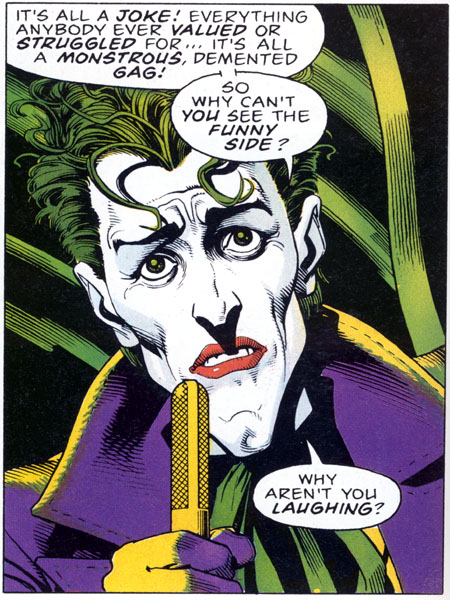
Admittedly, the focus is not always so easy to sort out.  In most Batman-Joker stories, it’s a given that Batman is both the identificatory character and the imaginative center.  The Moore-Bolland KILLING JOKE provides a rare exception in that the narrative shifts the imaginative focus to the Joker as it relates a possible origin for the Clown Prince of Crime.  Batman is still predominantly the identificatory character through whom the reader is lessoned in lunacy.  Arguably the hero loses some of his heroic status as he becomes the “Alice” lost in the demented “Wonderland” of the Joker’s madness.


I’m aware of a slight tendency on my part to categorize characters as “victims/demiheroes” if they are lacking in dynamicity (Carl Kolchak, Doctor Who) or centricity (Jonathan Harker of the DRACULA novel).
 

Yet that’s not what I meant to communicate when I formulated this schema.  The demihero can be resourceful, can be powerful, can be central to the narrative.  But he must embody “instinctive will” in its life-affirming guise, even as the monster does in its (generally) life-denying guise.


In my current analysis, both Doctor Who and Kolchak are heroes of the subcombative type.  Though they lack the *dynamicity* that would make them combative heroes, they do exercise “intellectual will” in order to stymie the forces of disorder.  Bram Stoker’s Jonathan Harker, on the other hand, is a *mesodynamic* type of protagonist who nevertheless ups his game enough to become a key player in the fight against the monstrous focal presence/antagonist Dracula.  Yet I judge that his type of heroism is governed less by a heroic ideal than by the instinct to protect himself, his home and his ingroup against all aggressors.  Thus, he provides a mirror to Dracula, the monster whose main focus is also self-preservation.


The instinct of self-preservation, though, does not rule either Batman or the Joker.  Their respective devotions to “order” and to “chaos” are often—though not invariably—framed as intellectual propositions.  The Moore-Bolland KILLING JOKE devotes its narrative to the Gospel According to the Joker, depicting the Joker’s madness as an insight into the true nature of the world.  Frank Miller’s DARK KNIGHT RETURNS, in contrast, depicts the Batman’s vigilante quest as one in which the protagonist breaks man’s law in order to protect a higher law—admittedly one perceived through Batman’s particular blend of ruthlessness and compassion.


By chance I stumbled across a quote that may illuminate some of the differences between these different yet complementary forms of human will.  Following the spinal trauma Christopher Reeve suffered in 1995, the actor wrote in his autobiography STILL ME:


“What is a hero?  I remember how easily I’d talk about it, the glib response I repeated so many times.  My answer was that a hero is someone who commits a courageous act without considering the consequences… Now my definition is completely different.  I think a hero is an ordinary individual who finds the strength to perservere and endure in spite of overwhelming obstacles.”


Reeve, though he was an actor whose job was to play fictional characters, speaks here of normative, real-world definitions of heroism, making no comment upon the depictions of heroes in fiction.  But his remarks do have application to the archetypes of heroes as we find them expressed in fiction.  Endurance, more than courage, is the hallmark of demiheroes like Alice and Jonathan Harker.  It also underlies the “raison d’etre” for the majority of monsters, though one cannot generally call their acts “heroic.”  Dracula seeks to survive by finding new feeding-grounds. The Man-Thing is psychically sensitive to the emotion of fear, and attacks anyone who broadcasts that emotion in his presence, which may include innocents as readily as malefactors.


Heroes and villains are more focused on “grand gestures,” made in defiance of consequences.  Not all villains are larger-than-life like the Joker: Batman often fights criminals who are no more than *mesodynamic,* though on occasion a sufficient number of ordinary crooks present an extraordinary threat. 


 Even the mundane crooks as portrayed in these stories want more than simple survivial.  Typically they desire wealth, which may be seen as establishing a form of willed control over their environment.  This will to control often manifests in the crooks forming their own society counter to that of honest citizens.  Unlike monsters, who are most often seen as forces gone out of control, villains seek to exercise total control, be it of city-neighborhoods or the entire world.  The hero responds in turn with his own counter-efforts to control the pernicious counter-society of crime.  Those efforts—whether they stem from a vigilante like Batman or a constituted legal authority like Judge Dredd—also go beyond the criteria of simple survival, emphasizing the power of the law to curtail the will of the lawbreakers.       


Wednesday, October 3, 2012

DIAL D FOR DEMIHERO PT. 2

I want to draw a connecting line of sorts between the concept of the demihero as thus far outlined here, and some of my earlier examples of how the viewpoint characters of a given story might not always be the *focal presences* of the story.  I might latterly define the *focal presence* as the "imaginative center" of that story, without which one cannot imagine the story taking the same basic shape.

Here are some demiheroes in the "occult crusader" category.  First, from the teleseries FRIDAY THE 13TH: THE SERIES, we have viewpoint characters Micki, Ryan and Jack:


Then from the telemovie and the series it spawned, we have Carl Kolchak of THE NIGHT STALKER:


Now, none of these characters possessed great *dynamicity.*  They perservered against the forces of the occult largely by using either dogged persistence, trickery, or a limited amount of knowledge about how to find occult countercharms.  All of them skew toward the "fair" end of the mesophenomenal category.  They are subcombative figures in that none are capable of manifesting any great degree of *might.*

I also assign both teleseries to the realm of the drama in its melodramatic form.  While there are occult crusaders who fall more properly into the mythos of adventure, the general tone of both teleseries emphasizes the *pathos* of how various types of monsters or occult forces are unleashed upon innocent humanity, only to be banished at the last moment by a demihero, or team of demiheroes, who can just barely manage the task.

Both Kolchak and the FRIDAY THE 13TH team are the characters with whom the audience identifies.  However, Kolchak is the imaginative center, the focal presence of all the NIGHT STALKER stories; the audience tunes in to see how the intrepid reporter gets the better of whatever fiend happens to be preying on the innocent.

In contrast, the FRIDAY team is not the focal presence of the series.  Rather, the imaginative center of the series is the antiques shop "Curious Goods" from which the late relative of Ryan and Micki, one "Uncle Louis," dispensed an infinite number of cursed objects designed to cause havoc amid mankind.  Uncle Louis only rarely appears in the series (as a shade living in hell), but his shop is the imaginative center of the show, not only because it is the source of the antagonistic forces opposed by the protagonists, but also because the antagonistic forces are the ones whose nature the audience must primarily understand.  The three demiheroes take a decided back seat to the cursed objects they are morally obliged to corral.


Monday, October 1, 2012

DIAL D FOR DEMIHERO PT. 1

In the first part of HERO AND VILLAIN, MONSTER AND VICTIM I said:

While both of [the processes of plerosis and kenosis] are particularly abstract as described above, plerosis is best conceived as the life-force engendered by the contest of hero-and-villain, taken seriously for the adventure and humorously for the comedy, while life is purged or otherwise compromised in the black-comic irony and in the drama.
I didn't write anything about the "monster-victim" trope there, but I did so in Part 2:


The hero's [by which I meant the protagonist's] power of action is often compromised, so that it's credible when and if he meets a dire fate-- which fate is summed up by the triumph of "monster over victim," aka the reality principle.  
I discarded the formulas featured in Part 2, but this segment should make clear that my initial idea was to imply that the "victim" was a character whose *dynamis* implied failure more than that of the other life-force figure, the "hero"-- even though, to complicate things all to hell, in literary studies the word "hero" can mean pretty much any protagonist-figure in any sort of story.  It even applies to a loathsome viewpoint character who deserves to be destroyed, like the nasty protagonist of this Steve Ditko horror-tale "The Gentle Old Man:"


In Part 3 I re-arranged my formulation so as to emphasize the stature of the "victim" as a life-affirming force that is more compromised in some way; he's bound to lose in the irony-mythos, and even when he wins in the comedy-mythos, it's principally due to the forces of luck.  In contrast, the hero, the conceptual opposite to the "victim," possesses a superlative chance of triumphing in the adventure-mythos and a fair chance of doing so in the drama. 

Yet "victim" really doesn't suggest a character who can win under certain circumstances, but rather, someone who's already lost the game.  Therefore I've invented the term "demihero" for a protagonist whose power is compromised in a given manner.

I also stated in Part 3:


The victim's true characteristic is to be allied to the ludicrous just as the hero is allied to the serious, as per my various remarks on these Schopenhaurean categories. With this in mind, "victim" should not connote a disempowered state within the sphere of narrative analysis, for when he is a primary actor he can be quite powerful. But he creates the expectation of losing even as the hero does of winning. And further, most victims encounter conflict in what I term an "intuitive" manner-- that is, not actively seeking trouble as heroes often do, but simply seeking to live life on a basic level-- just as many if not all monsters seek to do.

I explained this distinction with reference to Schopenhauer's dichotomy between intuitive and abstract representations.  What Schopenhauer called "abstract," I translated as "intellectual," and as of this essay I've decided that I think "intuitive" is also misleading for my purposes, so I'm now changing my dichotomy as being between "the intellectual" and "the instinctive."


The nasty protagonist of "The Gentle Old Man" is not really fit to be called a "hero" or a "villain," but in some ways he does mirror the nature of the "monster:" he wants what he wants when he wants it, with no intellectual mediation.  He is a "non-innocent victim," a character who deserves to be destroyed, so that the anomalous force represented by the "gentle old man"-- what would be "life-denying" in the case of an innocent victim-- ends up doing good by removing him from society.  As a shorthand to describe his tendency toward failure, I term this character a "demihero."

But just as I stated with regard to victims, demiheroes need not be utterly helpless.  Consider the character Jonathan Harker, pictured below as played by David Manners in the 1931 DRACULA.


In the original novel Harker is a victim who has a limited ability to fight back against the focal character of Dracula.  He's much less competent in the stageplay that gave rise to the 1931 film, while he's disposed of rather ignobly in 1958's HORROR OF DRACULA, reviewed here.  Regardless of his degree of efficacy in each rendition, he's still essentially a demihero, in that he never inspires the notion of triumph on his own, though in the novel he does at least manage to form part of a joint task-force that takes down the superior dynamicity of the vampire-lord.

Now, I'm not contradicting myself by citing two examples from dramas.  When I write that the drama is defined principally by the conflict between a comparatively empowered hero and a monstrous opponent, this is a generalization that doesn't preclude the idea that in some dramas the less empowered demihero is the sympathetic viewpoint character.  Similarly, even though the irony is the least favorable to the happy ending, the irony's version of the hero does sometimes appear, as with my frequent example of Marshal Law.


More on these matters later.